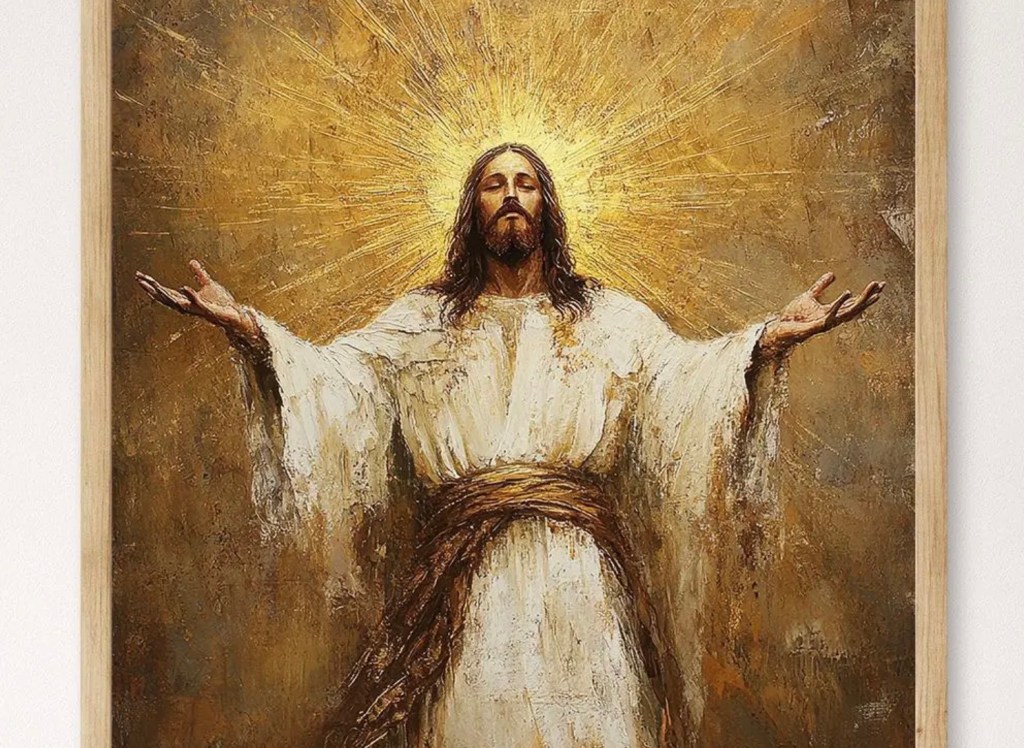
Jesus continued to teach Nicodemus and with these words, “No one has gone up to heaven except the one who has come down from heaven, the Son of Man” (Jn 3:13). Jesus expressed the truth about who he is, the Christ, the Son of the Living God. He called himself the Son of Man back in the first chapter when he described how angels will be ascending and descending on him, how in his very person, he opens up heaven for humanity (John 1:51). Jesus is the Son of God and the Son of man. From all eternity and for all eternity the Son is begotten not made. The Son has always existed with the Father and at the appropriate time, the Father sent his Son to be one with us in our humanity so that we can become one with him in his divinity.
We have been loved into existence, along with all of creation, by the outpouring of the love shared between God the Father and God the Son, who is God the Holy Spirit. The Son came to invite us back to restore our relationship with his Father, to show us where we have strayed, so that we may correct the course of our journey and return back to who we have been created to be. We have been created to be in communion, in an intimate relationship with God and one another.
Jesus, the Son of God became incarnate, took on flesh, and entered into our human condition that we would be deified, transformed into the very likeness of God by our participation in the life of Christ. This is why Jesus tells Nicodemus that we are to be born from above because through our baptism we are born again as daughters and sons of God the Father. The one who has come down from heaven has, as St Irenaeus wrote, “opened up heaven for us in the humanity he assumed.”
It is important to make time each day to savor the truth that we have been loved into existence. As we do so, we will realize that our lives are gifts from God and we have been created to receive God’s love and love others in return. During these present, uncertain times, we are given an opportunity to be more aware of what is important to us as well as Who and where our true stability lies. It is in times like these that we are given a chance to appreciate and grow closer to God, our family and friends, as well as begin to be more aware of those who are in dire need around us.
The gift of all life is precious. May we resist taking this precious gift for granted, and love others today in our own special and unique way. Jesus has loved us from the beginning, more than we can ever imagine and more than we can ever mess up! Just as the sun shines on the good and bad alike, so God loves each one of us with a love that is beyond all our understanding. The flow of our lives as disciples is to receive and share the love of God.
Painting: “Jesus Christ with Open Arms Art Print, Radiant Light” from Etsy






 Spiritual Stepping Stones