We have been created to love and to serve as Jesus loves and serves.

“When you have done all you have been commanded, say, ‘We are unprofitable servants; we have done what we were obliged to do'” (Lk 17:10).

This closing line from our Gospel reading today can be a hard verse to digest at first glance, especially with our track record of slavery in the U.S. We need to remember and recognize that this was a teaching that Jesus shared in a different time period, in a different culture, and in a place far removed from any clear modern context. The master/slave relationship is also a theme that Luke returns to often.

Another important point to touch upon when reading the Gospels is that when Jesus made the statement that, “we are unprofitable servants; we have done what we are obliged to do”, we are not to read this verse in isolation from the full context of Scripture. Jesus also shared a parable about a master and servants in which when the master returns, he waits on them (Luke 12:35-40). Jesus himself modeled this same service at the last supper when he washed his disciples’ feet (cf. Jn 13:1-17). This was the lowest of menial tasks. St Paul wrote to the Galatians informing them that in the Body of Christ there is no Jew or Gentile, slave or free, male nor female (cf. Galatians 3:28). The ultimate point is that God is God and we are not. We all have a part to play in participating in and promoting the kingdom of God by following his lead.

As a disciple of Jesus, we are not to seek adulation and glory. We are to serve God and one another without hesitation. We serve God because he is the director and we are the directed. He is the master and we are the servant. In aligning ourselves in this way, we also experience the intrinsic joy of following his will. As we follow Jesus’ lead and guidance, we grow in our relationship with him, his Father, and experience more of the love of the Holy Spirit. As the apostles followed Jesus, there came a point where he said to them that he no longer called them servants but his friends (see John 15:15). That is to be our hope as well.

No task is too menial or beneath us, nor do we need to be concerned about doing big and grandiose things. We just need to be obedient and act as God leads. Instead of reacting, losing our temper, fuming in anger, or twisting ourselves in anxious knots, we each can choose to smile, to hold a door, to respect and appreciate one another, to be patient and present to one another. When conflicts arise, breathe and ask the Holy Spirit to guide us before we react. We serve best when we listen with understanding, give others the benefit of the doubt, forgive, and allow ourselves to love and serve as God directs us.

Pope Leo shared during a recent gathering of bishops on September 11, 2025 that: “Service is neither an external characteristic, nor a way of exercising a role. On the contrary, those whom Jesus calls as disciples and proclaimers of the Gospel, in particular the Twelve, are required to have inner freedom, poverty of spirit and readiness to serve, which are born of love, to embody the same choice made by Jesus, who made himself poor in order to enrich us (cf. 2 Corinthians 8:9). He manifested the style of God, who does not reveal himself to us in power, but in the love of a Father who calls us to communion with him.” We may not be bishops, but we are disciples. We begin in simple ways and with each act of kindness, our hearts expand, we are moved to serve, to love and to grow in communion with God and one another. As St. Mother Teresa said, we are to be a pencil in God’s hand. In our willingness to be moved by God to serve, we as well as those in our realm of influence that we serve, will be better for the effort.

———————————————————

Photo credit: In giving ourselves prayerful pauses we can experience God’s love and so are recharged to love and serve some more.

Link of Pope Leo’s address to the bishops
Link for the Mass readings for Tuesday, November 12, 2025

Baptism, foot washing, and crucifixion show the depth of Jesus’ love for us.

Today’s Gospel from John begins as Jesus had just finished washing the feet of his disciples. Jesus then said, “Amen, amen, I say to you, no slave is greater than his master nor any messenger greater than the one who sent him” (Jn 13:16). Jesus not only taught the truth that God the Father sent his Son to serve and not be served, he modeled this practice consistently.

From his conception, gestation, and birth, the Son of God developed as a human being in the very simplest of conditions and endured the hardships of those on the margins. Joseph, Mary, and Jesus were political refugees very soon after his birth. The young family was forced to flee from Bethlehem to Egypt. When Herod the Great died they returned to Nazareth, and other than the incident when he remained in the Temple while Jospeh and Mary left him, we hear nothing about the life of Jesus until he begins his public ministry. The most likely reason for this was that there was nothing to tell. Jesus most likely apprenticed with Joseph, in the trade of a simple tektōn, a woodworker, which was pretty low on the rung of the social ladder.

Through the short time of his ministry, Jesus modeled for his disciples what a follower of his entailed and what it meant to be one of his successors. To follow in his footsteps they would need to participate in servant leadership. He not only taught them but lived and modeled that there is no task too menial that we can’t roll up our sleeves and dive in to help. There is no person too other that we can’t assist when they are in a need.

In this act of washing the feet, Jesus is also revealing something deeper. The depth of his love for the apostles and each of us. The Son was willing to come close, to become one with us in our humanity, to be in solidarity with us even in our sin, so that he could take the sin of the world upon himself first at his baptism and then upon the cross. In the washing of the feet, he is also showing the depth of his love in caring for them in such a menial way, that is another foreshadowing of the depths of his love in his willingness to give his life in a humiliating and horrific way for all of humanity.

Jesus, as fully divine, did not grasp at his divinity or lord it over anyone. He was willing to be baptized even though he is free of sin, to wash the feet of his apostles in the most menial of tasks even as master and teacher, and was willing to experience crucifixion and death as the Messiah. In each of these acts, Jesus reveals the full giving of himself and holding nothing back of himself from us. Jesus is encouraging his apostles and us with every breath, thought, word, and action to love each other as he has loved us.

A good prayer and meditation for us today is to ask Jesus to reveal for us how we have resisted his urgings in the past regarding serving and loving others as well as when we have refused to interact or treat someone with anything less than the basic human dignity which they deserved which is to love each other, to will each other’s good. Have we ever thought that what he was asking of us was beneath us? Have there been people we have kept at arm’s length or refused to reach out to? For those ways in which we have withdrawn within ourselves and refused to be of help may we ask for his forgiveness.

Being willing to allow Jesus to shed some light on our lack of embracing opportunities to be loved and to love in return is a good place to begin. Then renewed with his forgiveness, mercy, healing touch, and having been loved, may we be more willing to be bearers of the love, mercy, and understanding that we have received. May we be more open to each of the people and/or tasks that God will place before us, the discernment to know his will, and the clarity and courage to act as his servant with humility, with love, and without hesitation.
—————————————————————————-
Photo: Are we willing to reveal our needs to Jesus, to allow him wash our feet, to allow him to address our needs, and then be willing to serve the needs of others?

Link for the Mass readings for Thursday, May 15, 2025

We become whole by serving the One who came to serve us.

Power and honor are attractive temptations. Power is alluring because we want to be in control. Many of us believe that control provides security and safety. Many of us believe that power provides access and control over our environment and situations as they arise. Honor has an attraction also because we want to belong, we want to be a part of. With honor and fame, we believe we will be accepted, liked, have access, without the risk of rejection.

Power and honor become a problem when they are grounded in our self and when we feel we attain them on our own initiative. They become an asset if we recognize them as gifts from God that help us to promote his kingdom. In and of themselves, power and honor are finite expressions. If they are only fueled by our insatiable desire to put our self first, front and center, we will not only constantly fall short, but we will constantly be seeking more because nothing finite can fulfill the transcendental hunger that we have to belong to someone so much greater than ourselves.

The disciples of Jesus fell for the temptations of power and honor in today’s Gospel from Mark. Jesus had just shared with them for the second time that he was to be handed over and killed and that he will rise again. The disciples do not understand what Jesus was saying to them and instead grasped at their idea of what the Messiah meant to them based on their experience and culture. In their minds, the messiah would be a powerful ruler that would overthrow the occupying army of Rome, and so they began to jockey among themselves for seats of honor in his kingdom.

Jesus was aware that the disciples were squabbling about who among them would be the greatest, even though they were not willing to admit to that fact. Jesus had been using this time as they drew closer to Jerusalem to instruct them more deeply about his role in his Father’s plan, but also guiding them in knowing theirs. Jesus sat down among them and said: “If anyone wishes to be first, he shall be the last of all and the servant of all” (Mk 9:35). Power and honor do not come by being served. True power and honor come from the source of all existence, God the Creator. Nor is the infinite power of God some impersonal force that we tap into.

True power is trusting not in the material and finite things of the world because they are unstable. True power comes from God, the one who is omnipotent, all-powerful, and worthy of all glory, honor, and praise. We receive the power of God by experiencing, developing, and sustaining our relationship with him, through participation in the life of his Son and the Love of the Holy Spirit. The path of discipleship is traveled not by those who are worthy but by those willing to follow the lead of Jesus, submitting to his will, embracing the gifts that the Holy Spirit grants us, and sharing what we have received.

Lent begins in just about a week. One thing we might want to consider is to relinquish our perceived access of control in a fallen world that is ever unstable and changing and instead place our hope and trust in the one who is our destiny, who is our hope, our refuge, and our strength: Jesus the Christ, the Son of the living God. Let us let go of the desire to be liked and affirmed by others which can lead to unhealthy attachments and instead strive to be true to who Jesus calls us to be. May we not seek our security in control and self-sufficiency but in trusting in God and serving him and his will.

——————————————————————————————-

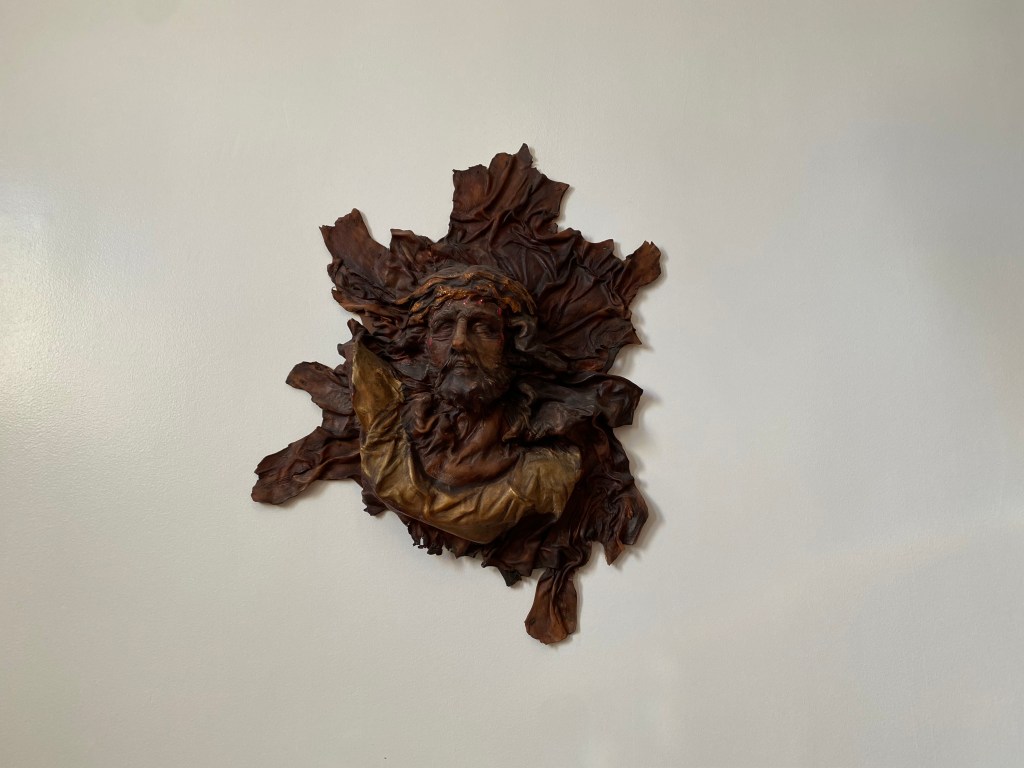
Photo: Sculpture of Jesus at the St. Clement Church, Santa Monica, CA.

Link for the Mass readings for Tuesday, February 25, 2025