Everything is possible when we believe, trust in Jesus and pray.

In the opening of today’s Gospel, we witness Jesus, Peter, James, and John returning from the experience of the transfiguration. While they were away, a man had brought his son to the other disciples to expel a demon from him but they were not able to do so. As they drew closer, the father appeals to Jesus: “But if you can do anything, have compassion on us and help us.” Jesus said to him, “‘If you can!’ Everything is possible to one who has faith.” Then the boy’s father cried out, “I do believe, help my unbelief” (Mk 9:22-24).

Jesus’ response to the man is clear and consistent with his teaching with authority, miracles, exorcisms, and healings. We see that the key ingredient over and over again throughout the Gospels is faith. Jesus receives this man’s request and seeks to empower him instead. What may be unclear is the man’s response, “I do believe, help my unbelief!” This statement may be a key to why Jesus’ disciples, who had exorcised and cast out evil spirits before could not this time. They were putting more faith in themselves instead of God. 

The man did have faith in Jesus to a point, for he brought his son to him believing that he could possibly heal him. His words now after his encounter with Jesus reveal the maturing of his faith, “But if you can do anything…” This request shows some doubt. This is much different than the woman with the hemorrhage who believed if she but just touched the tassel on his cloak she would be healed or the Canaanite woman who sought to have her daughter exorcised even though Jesus initially dismissed her for being a Gentile.

The father’s statement, “I do believe, help my unbelief!”, is beneficial to us all. The father believes in Jesus to a point, but recognizes he needs help from Jesus to go further. Jesus confirms that what is important in maturing in our faith life is being people of prayer. 

When his disciples talked to him in private, they asked him why they were not able to heal the boy and Jesus replied, “This kind can only come out through prayer.” Prayer is not some magic formula. Prayer is about becoming aware of God’s invitation to develop and mature in our relationship with him. When we make time for God and recognize his presence in every aspect of our lives, we come to know him and know his will, we come to know God’s voice. When we place him first before anyone and anything else, and trust in him, God’s grace builds on our nature and miracles happen. 

The exorcism of the young boy happened because his father appealed to Jesus hoping he could do something to help. The disciples could not heal him because they sought to do so through their will power alone instead of drawing on their relationship with God. The good news is that even though time and again the disciples fell short, they persisted in their faith and in their belief in Jesus. They learned, grew in their belief and trust in him such that they matured and recognized that apart from Jesus they could do nothing but with him, all things were possible. 

So much so, that we see Peter, who had denied Jesus, and reconciled with him after his resurrection, would come to encounter a man crippled from birth who was begging for alms. Peter said to the man: “I have neither silver nor gold, but what I do have I give to you: in the Name of Jesus Christ the Nazorean, [rise and] walk” (Acts 3:6).

Peter and the apostles’ faith grew over time, even through failure, sin, and unbelief, but they, like the father in today’s Gospel, did not give up, they continued to trust in and follow Jesus. We can mature in our faith as well. Let us begin our day with this prayer and return to it often: “Everything is possible to one who has faith.”

—————————————————

Photo: Jesus will guide us through any darkness and/or clouds. Rosary walk back in December.

Link for Mass readings for Monday, February 24, 2025

“Put out into the deep!”

In the first reading, Isaiah speaks, “Woe is me, I am doomed! For I am a man of unclean lips, living among a people of unclean lips, yet my eyes have seen the King, the LORD of hosts” (Isaiah 6:5)! And then in the Gospel after the miraculous catch of fish, Simon says to Jesus, “Depart from me, Lord, for I am a sinful man” (Luke 5:8). Isaiah in his vision and Simon through the super abundant catch of fish both recognize that they are in the presence of God and in that presence they also wisely recognize and confess their sinfulness.

Both men clearly fall short of the glory of God and God meets them both, not with condemnation, but with an invitation. Isaiah is met by the seraphim who places an ember on his lips to purify his mouth and Jesus says to Simon, “Do not be afraid; from now on you will be catching men” (Luke 5:10). God did not ask either of them nor does he ask us if we are worthy. He asked Isaiah and Peter, are you willing to follow me? And both were willing to do so and be sent.

When we enter the sanctuary where Jesus is present in the consecrated hosts in the tabernacle, do we allow ourselves to experience the awe that we are entering a sacred space, a place set apart that is holy for God? We bless ourselves with holy water when we first enter the church, to remind ourselves that in Baptism we have died with Christ and have risen with him to become part of the new creation. We also remember our baptismal vows to reject the things of Satan and to say, “yes” to the will of God. We then genuflect, kneel on our right knee, again making the sign of the cross, invoking the Trinity of God as we acknowledge the presence of the Body of Christ in the tabernacle. For where the Son is present, so is the Father and the Holy Spirit.

As we come to our seats, allowing ourselves to be still and silent in the presence of God, we call to mind our sins as did Isaiah and Simon and seek God’s forgiveness that will be offered for our venial sins during the penitential rite during the beginning of the Mass. As Isaiah received the ember from the heavenly altar in his vision to purify his lips, so we receive the Eucharist, the Body and Blood of Christ, that has been represented on the altar during the Eucharistic rite. We are purified and transformed. Our hearts and minds are made new through the love of Christ and the power of the Holy Spirit that has transformed bread and wine into the Body and Blood of Christ.

Simon, like Isaiah, was willing to experience the light of God coming through Jesus’ miracle. He did not roll and jump overboard, instead he remained in Jesus’ presence, and confessed his sinfulness. Simon, after fishing all night, was asked to do probably the last thing he wanted to do. Have some itinerant preacher enter his boat and command him “to put out a short distance from shore” so he could teach for a while. If that wasn’t enough, then Jesus, this carpenter, said to Simon, a seasoned fisherman, to “put out into the deep water and lower your nets”. In both cases, Simon, though reluctant, and not seeing any sense in the command, was willing to obey.

Because Isaiah and Simon were willing to trust, God happened. Their lives were transformed, and they were sent on mission. Most of us will not experience such a vision as Isaiah experienced but Jesus will come to us in the same way that he came to Simon. He meets us in the midst of our everyday lives.

So often we think or feel that it is our initiative that draws us closer to God, when in fact, the initiative is God’s. Our very desire to pray, to seek out God is already an awareness, a recognition of his invitation to draw close. God speaks to us in the silence of our hearts, through quiet invitations, and experiences. Each time we are aware, and each time, as did Simon, even when we hesitate, we still say “yes” to his invitation, we grow in our relationship with God.

Jesus comes to us as we are and loves as we are, even in our sin, but he doesn’t want us to stay there. When we are willing to become aware of our sin and faults and allow more of the light of Jesus to shine into the darkness of our lives, as we put out into the deep, as we go where the Holy Spirit leads us, beyond the horizon of our comfort zones and understanding, we will be forgiven, and blessed by the grace and wonder of God’s glory present in our lives. Apart from Jesus we can do nothing, but with him and following his guidance all things are possible. This is what Simon experienced in the miracle of the abundance of the fish filling his nets. What he could not accomplish on his own experience, skill, and strength, he did by following the invitation of Jesus and he became more acutely aware of the divinity of Jesus in his midst.

The deeper and more intimate our relationship grows with Jesus, the more our own sin is revealed to us. This is a gift to welcome, because in our awareness and confession of our sins we are freed from that which keeps us at a distance and prevents the growth of our relationship with the God who loves us more than we can ever imagine. When we face and confess our sin and weakness, and resist settling for mediocrity, we will grow in holiness, humility, and receive more of the light, love, and grace of Jesus such that we can grow beyond our fears, grow deeper in our relationship with him, so to better allow ourselves to be agents of his grace and mercy in the lives of those he brings into our realm of influence.

——————————————————–

Painting: Some quiet time with Jesus, listening to his invitation to, “Go into the deep.”

Link for the Mass readings for Sunday, February 9, 2025

Will we allow the Word of God, Jesus, to transform our hearts and minds?

The king was deeply distressed, but because of his oaths and the guests he did not wish to break his word to her (Mk 6:26).

The king referenced in today’s Gospel is the tetrarch, Herod Antipas, one of the sons of Herod the Great. He reveals the weakness of his character when he calls for the beheading of John the Baptist, much as a foreshadowing of Pilate before the crowd asking for Jesus’ death. Both condemned innocent men to die. They  each decided to take John and Jesus’ life. Herod chose to protect his foolish oath to Salome, instead of standing up and defending the dignity of the life of John the Baptist. Pilate caved into the pressure of the crowds who claimed he was no spokesman for Caesar. In both cases, innocent men were brutally murdered without any regard for their lives.

For the first part of his gospel, Mark has shown the opposite. He has shown what true leadership is as he has presented Jesus who instead of disregarding and degrading human beings has empowered them through his teaching a better way to be whole and in union with the God who has created his listeners. He has freed the possessed, healed those who had been on the outside bound by illness and/or sin. Instead of the evil disposition of Herodias, we recently saw the courage of the woman with the hemorrhage.

And while Mark provides us with this interlude and flashback of the death of John the Baptist, the apostles are on the march proclaiming the gospel, healing, and exorcising demons in Jesus’ name. They are putting into practice what they had learned. They are allowing their hearts and minds to be changed by the Word of God. Herod did not allow the same seeds of God’s word to find any root in his heart. Instead of hearing the words of John, repenting from his sin, and allowing his heart and mind to be transformed, the little inspiration that he received withered and died in the heat of his ego and passions.

Time and again, Jesus showed the moral courage to stand up for and empower those who were considered other, lesser, unclean, and social outcasts. He, like John, showed true courage by speaking the truth that God gave him to reveal. As John was willing to lose his head for being God’s spokesman and preparing the way for his Son, Jesus was willing to suffer, to be nailed to the Cross, to die and conquer death, that each one of us might have life, and have it to the full.

We have a choice to make each day and each moment. We can choose to follow the enemy or to follow Jesus. Herod and Pilate made their choices and the apostles made theirs. May we choose to follow Jesus and allow his words to find rich soil, that we may allow our hearts and mind to be transformed as apostles, and so also grow in virtue so that we too will have the moral courage to stand against the pressures of a culture of death and stand up for the dignity of each person at every stage of development from the womb to the tomb, and implore that our leaders do the same.


Photo: Nothing helps us to allow our hearts and minds to be transformed by God’s love than by making the time to be still, pray, and meditate on his word and listen.

Link for the Mass readings for Friday, February 7, 2025

“Do not be afraid, just have faith.”

“Jesus, aware at once that power had gone out from him, turned around in the crowd and asked, ‘Who has touched my clothes'” (Mk 5:30)? The woman could have slipped away, she could have stood still and said nothing, no one knew. His disciples were bewildered that Jesus asked such a question with so many pressing about him. But the woman approached with “fear and trembling” and told him the truth. Jesus did not admonish her for breaking a social taboo but publicly acknowledged her faith and so empowered her with a deeper healing than the merely physical that she sought.

All the while as this scene transpired, Jairus must have been in agony. He knew how close his daughter was to death, and every second counted. Jesus took that limited, precious time and engaged with this woman. Just as they were about to resume their journey, and he began to breathe again, the terrible news came that his daughter had passed away.

What might have flashed through his mind at that moment? The time Jesus took to talk with the woman, could that have made the difference? He was a synagogue official and would have known the taboos she crossed to reach out and touch Jesus in public, he knew that in doing so she would make Jesus unclean, she was a woman considered the lowest of low. She was frail and pallid from her condition, at death’s door herself, yet she had mustered such courage and faith to touch him. She took such a risk. While these or any other thoughts were passing through his mind, Jesus assured him, “Do not be afraid, just have faith” (Mk 5:36).

Jairus had just witnessed such faith with the woman healed from the hemorrhage, probably someone until this very moment for whom he might have shown disdain for. Maybe just maybe, if he could muster the same faith as her. Jesus could bring his daughter back to life just as Jesus had brought this woman, who was death’s door back to life and wholeness. A light shone in the darkness of his despair and the darkness did not overcome it. He would not be let down. Jesus indeed healed his daughter. He took her hand as he had done with Peter’s mother-in-law, and commanding her to rise and walk, she came back to life.

How many of us have ourselves or have ever known someone who has experienced such great needs as did Jairus, whose twelve-year old daughter died, or the woman who had been suffering for twelve years with hemorrhages, with no healing from doctors all this time? In both of these cases Jesus brought about miraculous healings. How many of us have experienced the opposite? No healing that we prayed for. We wondered where Jesus was or why he didn’t bother to help? The truth is Jesus is present, though he may or may not have brought about the outcome we may have sought.

February 2 marked five years and five months since JoAnn died. She was not healed from the pancreatic cancer that ate away at her body, as was the woman with the hemorrhage. Nor did Jesus come to raise JoAnn from the dead, as he did for Jaurus’ daughter, while I laid by her side and held her hand awaiting the funeral home to pick up her body. Does that mean Jesus does not heal anymore or that there is no relevance in the readings of the Gospel of Mark for us today?

No. Quite the opposite. Entering into the daily rhythm of reading, praying with, and meditating upon these accounts helps us to know him not as a historical figure but to encounter him as our Lord and Savior, brother and friend, who is present with us in this and each moment. As we enter into each passage, slowly and prayerfully, we are invited to enter into his memory, receive his direction and guidance. Over these five and a half years, I have healed, become aware of further areas in need of healing, attachments to let go of, and Jesus has helped me each step of the way. No step has been easy, but Jesus has given me the guidance and strength to make each one possible.

Read again prayerfully today’s account. May we pray for the courage and faith to approach Jesus and place all our trust in him for each situation as this woman did. When we struggle, when the ground feels a bit shaky underneath, let us take to heart and believe in the words that Jesus spoke to Jairus, “Do not be afraid, just have faith (Mk 5:36). When we place our trust and faith in Jesus, who is truly with us through it all, the good, the bad, and the ugly, we will experience his love, direction, and strength with each step we take along the way.


Photo: JoAnn received an even greater healing and I believe now that Jesus did come that day. He took JoAnn by the hand, and she like Jairus’ daughter arose to be with him for all eternity. 

Link for the Mass readings for Tuesday, February 4, 2025

“Quiet! Be still.”

On display in Mark’s recounting of the calming of the storm at sea is the humanity of Jesus. He had finally succumbed to the exhaustion from being pulled and touched, challenged and accused, the constant interaction through his service of teaching, healing, forgiving, and exorcising, such that he not only fell asleep on the boat but was in such a deep state that he was as if dead, even during the height of the storm.

What is also on display is his deep and abiding faith in his Father. For those aboard with Jesus were seasoned fishermen and had experienced sudden storms arise before. This must have been some storm to raise such panic. And yet, Jesus is sound asleep. He only arises because of his disciples insistence: “Teacher, do you not care that we are perishing” (Mark 4:38)? They unconsciously echo their ancestors in the desert with Moses when they moaned that it would have been better if the Lord had killed them in Egypt instead of their perceived starvation in the wilderness (see Exodus 16:1-3). Even though God had freed them from their slavery, they did not trust he would provide for them in the desert.

Despite the grumbling of the disciples and the fatigue of Jesus, he also reveals a glimpse of his divinity. Jesus arises. He does not invoke God’s aid but commands: “Quiet! Be Still” (Mk 4:39)! Just as Mark recorded that Jesus exorcised demons earlier in his Gospel, Jesus hear rebukes the wind and the waves and all is calm and peaceful.  This does not escape the disciples who are filled with awe.

The disciples have grasped his uniqueness, have accepted him as their rabbi, their teacher, but they are still grappling with the reality that Jesus is at the same time the Son of God. They will continue to experience his miracles, exorcisms, and teachings, but their faith is still small like a mustard seed. Though germinating, the stalks will not break through to maturity until after his resurrection and ascension. It is then that their faith will begin to bear fruit as they participate in the fullness of the ministry that Jesus is about to begin to train them for.

Similar to the disciples, storms arise in our lives, sometimes just as unannounced and as quickly as the squall from today’s Gospel. A health issue, an injury, an economic shift, a conflict, the effects of a mistake in judgment, or a sinful choice, all can arise at a moment’s notice. The most recent and devastating plane crash in DC shows how fragile our lives are and how quick life can change.

We, like the disciples, can sometimes only hold on so as not to be tossed into the sea, or bail out water so we don’t sink. Sooner or later, we need to turn to Jesus to seek his aid. A helpful point to keep in mind that I have learned from one of our past retreat directors, Fr. RB, was: “Sometimes the Lord calms the storm, and sometimes the Lord lets the storm rage on and calms his child.”

No matter the severity of the storm, let us place our trust in Jesus. Let us hold firm to the truth that Jesus remains present, accompanies, and cares for us and what we are going through. In every challenge he remains our anchor. We are never alone. Whether we brought the storms upon ourselves or they arose from another source, Jesus does not leave us to fend for ourselves.

When we remember to call on his name, he will either calm the storm or bring us a sense of peace as he guides us through, and empowers us to ride it out to the other side. With each storm that has arisen over the years, I have felt less fear and insecurity and more peace as I trust in Jesus. My faith has grown because time and again when I have turned to Jesus he has been there. The outcome has not always been the one I sought, but that he has been with me through each storm, I have no doubt.

As we experience Jesus and his love, we come to understand Jesus’ teachings as well as our lives better. The maturity of our faith begins to bear fruit when we are willing to allow Jesus to work through us so to be there for others in their storms. We can be a conduit of calm assurance for those who need Jesus even and especially when they do not know him or are focusing on the anxiety and fear of the storm instead of him. May God grant us the presence of heart and mind to be his peace and stillness for those who invite us into their boats as we ride out their storms with them.


Photo: Thankful all is calm and peaceful this night.

Fr RB Williams home page and link to his homily – http://www.rbwords.com/wttw/date/2018-01-27

Link for the Mass readings for Saturday, February 1, 2025

Let us repent and believe.

“This is the time of fulfillment. The Kingdom of God is at hand. Repent, and believe in the Gospel” (Mk 1:15).

With these words as recorded by Mark, Jesus begins his public ministry in time and space and we in 2025 begin the first week of Ordinary Time together. Whether we are in the season of Christmas, Easter, or Ordinary Time, each day is an opportunity to be thankful and celebrate our life for this continues to be “the time of fulfillment”. The Kingdom of God is still at hand because Jesus is still present with us.

We are not alone on our journey. The Son of God became human, as we just celebrated this Christmas season, and as we will celebrate in Easter, he died and rose again. This was no mere resuscitation like with Lazarus who rose and died again. Jesus conquered death and became the firstborn of the new creation. Ordinary Time is the season in which we not only study the life and teachings of Jesus but hopefully continue to be willing to be more conformed to his Body and the will of his Father through the love of the Holy Spirit.

One of the things that may hold us back from embracing the gift of the Kingdom of God in our midst is that we have often chosen to place our focus on other distractions or diversions or placed ourselves first before God and others. Jesus calls us to reorient our lives in urging us to repent, to turn away from the false reality that we are the center and author of our own lives, such that we come to realize the truth that God is our true author and director. To repent also means to open ourselves to his love, to place our trust in him, and to be assured that God accepts us as we are, right now at this very moment.

We do not repent so that God will love us. We do not have to do anything or act perfectly or say the right prayer for God to love us. We just need to “move the Lord out of the category of ‘polite company’ and into that of intimate friend to whom one can tell everything” (Barry 1987, 55). To repent means to turn back to the God whose arms are wide open ready to embrace us. We are given the opportunity to see where we have turned away from God. Let us run into his waiting embrace and receive the forgiveness, mercy, and love that he offers us.

The call to repent that Jesus accentuates is a continuation of the preaching of the prophets and John. What he adds to repentance is to believe. To believe is to “trustingly accept and yield to what God is doing in him. The kingdom is near enough that anyone who so chooses can reach out and lay hold of it through faith (Healy 2008, 42). As we turn back to God, reorient our minds to his guidance and direction, reflect on how much he has blessed us, we will better make an ascent to believe.

To “repent and believe” is a good way to begin our journey into Ordinary Time together. May we resist the temptation to hold anything back and share more with our Father and grow closer to God each day. Let us trust in Jesus who encourages us to resist limiting God and the possibilities he places before us. Instead of attempting to bend his will toward ours, may we allow the love of the Holy Spirit to expand our hearts and minds such that we will believe in and trust God more so to be like a pencil in his hand.


Photo: A good way to reorient our minds and hearts to the will of God and to believe is to slow down and make time to pray. Doing so at the side chapel in the Cathedral of Charleston this past June.

Barry, S.J, William A. God and You: Prayer as a Personal Relationship. NY: Paulist Press, 1987.

Healy, Mary. The Gospel of Mark. Grand Rapids, MI: Baker Academic, 2008.

Link for the Mass readings for Monday, January 13, 2025

Some guidance from Jesus, St. John, and St. André Bessette, for the new year.

The beloved disciple John shares with us today a wonderful compass to guide us into the new year. From his first letter he writes that God’s “commandment is this: we should believe in the name of his Son, Jesus Christ, and love one another just as he commanded us” (I John 3:23).

Before we can believe in God’s Son, we need to trust him. For many if not all of us at some point in our lives who have experienced being hurt, betrayed, or wounded in any way, trust can be hard. 

That is why the Son of God was willing to be sent by his Father. He wanted to become one with us so that he could not only experience all the pain and suffering of our humanity but that he could take that upon himself, even death, so he could conquer them and heal, restore, and show us the way back to the Father, through our suffering and pain and into healing.

We can trust Jesus. Jesus not only has our best interest in mind, but he knows the plan of his Father for our lives and he can lead us to experience his love and our vocation as we trust him by taking one step at a time. He gives us enough light to see two steps ahead and when we take those steps, he will give us enough light to see the next two.

We can trust Jesus, but each thought or invitation we hear in our mind is not necessarily from Jesus. Some may appear good and true, but are only apparently so. For as John continues: “Beloved, do not trust every spirit but test the spirits to see whether they belong to God” (I John 4:1).

The devil and his demons tempt, entice, divert, and distract us, with the ultimate goal to lead us away from the love of God, the source of our true fulfillment. They seek to plant seeds of so doubt, so we believe that God does not have our best interest in mind. And once those seeds of doubt begin to sprout he seeks to isolate us from our Father by fertilizing those doubts with distrust in our minds and hearts. And when we sin, the devil condemns and shames us, and leads us to believe that we cannot be forgiven and that no one will accept us for what we have done or for who we are.

God never tempts us, he invites us and challenges us to move beyond our sins and our fears. He gently coaxes us to come out of the darkness of our self-centered, protective cocoon, and into the gentle light of his love. He does so patiently, sometimes with a firmness of a good parent, but gently. We hear his voice mostly in the quiet and stillness of our heart. When we do make a mistake, he does not condemn us, he convicts us to learn, to renounce our mistake. When we sin and turn back to him, he forgives and embraces us. We then begin again strengthened by his grace and greater clarity. 

God loves us more than we can ever imagine no matter what we have or have not done, he loves us more than we can ever mess up, and he loves us even in the act of our sin. He has shown this love most profoundly in sending his Son so we can see his face and experience his love, forgiveness, and mercy. We can experience that he loves us as we are right now, right where we are in our weakness and imperfection. 

The key to walk free from the “fowler’s snare” (see Psalm 91:3-4) is to heed the words that Jesus began his public ministry with: “Repent, for the Kingdom of heaven is at hand” (Matthew 4:17). God does not seek to punish us. Neither does he want us to stay in our sin and separation from him. God’s love calls us to more. Feeling guilty and shame is a false humility that keeps us separated from God because our focus remains on ourselves.

God imparts within us a sense of guilt, so that we experience our separation from him. Being in touch with this experience, helps us to choose true humility which leads us to trust in the love of God and believe in his mercy. When we sincerely and contritely confess our sins, do penance, and with his help seek to sin no more, Jesus will forgive, free, save, and restore us to our right relationship with God. 

When we are willing to allow the gentle light of Jesus to shine in our darkness, Jesus helps us to see what our life is like without God and with God. He helps us to be able to see the difference between the apparent goods and the true good so that we can make a clearer decision. Will we choose darkness, separation, and death or light, reconciliation, and life?

St. André Bessette, whose feast day it is today, could have fallen for the devil’s tactics. He who was sickly since he was an infant, lived in poverty as a child, and who then lost his parents when he was only twelve, and struggled with illness for all of his ninety-one years, could have been bitter towards God. André chose instead to trust in God and how he could make this statement: “Do not seek to have your trials removed. Ask rather for the grace to bear them well.”

Living a devout life of faith as a youth, his pastor encouraged him to apply to religious life and he sought at twenty-five to enter the Congregation of the Holy Cross. His poor health continued to plague him and at the end of his novitiate year, he was not asked to continue. André continued to trust in his Lord and his long standing ally St. Joseph. His novice master and bishop saw the light of Christ in this young man and petitioned that he be given an extension and he was eventually admitted into the order and served as a brother. His birth name was Alfred. Upon his profession he took the name of André who was the pastor who had mentored and recommended the pursuit of his vocation.

André was assigned the position of porter, the door keeper, because of his lack of education and frail health. A role that many would not look on with any esteem, André welcomed with open arms. Seeing in this position the opportunity to greet Jesus at the door with each knock and person he met. Looking back at his life he would say, “When I entered the Congregation, they showed me the door. And I stayed there for forty years.”

During his time of service, through the intercession of St. Joseph and his unwavering trust in Jesus despite much opposition and his continued frail health, thousands experienced being heard, loved, and healed. Through St. André, they experienced a foretaste of heaven.

St. André is a model for us on how we can in this new year “believe in the name of his Son, Jesus Christ, and love one another just as he commanded us…”, trust only in the Spirit of God without hesitation, and when we do fall, “Repent, for the Kingdom of heaven is at hand.”

God loves us so much and wants to share his life with us so that we can share in his relationship. Are we willing to resist the lies of the enemy, trust in the love of God, seek his guidance in all circumstances, discern and let go of anything that is not of God? When we do so, we will heal, be forgiven, and be set free to love and love in return. This journey begins and continues by trusting in God the Father’s Son whom he sent.  


Photo: St. André Bessette, pray for us!

Link for the Mass readings for Monday, January 6, 2024

Spending time with Mary and sharing in her memory will help us in healing ourselves and our relationships.

Our gospel today is relatable to anyone hearing or reading it because each of us have experienced family life in all of the different ways family life can be expressed today. At one point or another we have experienced conflict, misunderstanding, and anxiety.

The Bible is good about not covering over the complexities and challenges of life. If the Holy Family can have difficulty, then that can give us comfort if we have gone, or are going through some challenges right now. 

One point that jumps out from the start is that Joseph and Mary are not helicopter parents. After celebrating the Passover, they have left the temple and Jerusalem and are heading back home to Nazareth. Because such a journey was not a safe one, they were traveling in a caravan of extended family, friends, and neighbors. After a day into their trek, they realized that they had not seen Jesus and began a more intense search.

Jesus was nowhere to be found and so they returned to Jerusalem. With each step their concern rose. The ancient near East was not a safe place to travel in nor was it safe to dwell. Children were often kidnapped and sold into slavery. When we don’t understand or are faced with the unknown, we typically conjure up the worst case scenarios and Joseph and Mary were no different. By the time that they found him after their three days of searching, they were filled  “with great anxiety.” 

Jesus, in typical pre-teen fashion did not seem to appreciate their need for anxiety. He was safe all along among the teachers in the temple. Where else would he be? Neither Joseph nor Mary understood what Jesus was talking about. What happened next is a good response to a lack of understanding. 

There was no argument. Jesus was found safe and sound. It was time to go. Jesus was obedient and followed. Joseph was quiet. Mary pondered and “kept all these things in her heart.” We are not given to know the conversation between them on their way back home, but what Luke does share was that, “Jesus advanced in wisdom and age and favor before God and man.”

Jesus did so because he was obedient to “God and man.” And that made a big difference.

Joseph and Mary reacted in the natural way that parents missing their child would react, with concern and anxiety. What they did not allow to happen was to allow their emotions override their reason. Jesus didn’t see anything wrong with what he did because he was following the direction of his Father. He didn’t seem to pick up on the point that he failed to share that little detail with Mary and instead assumed they would know where he was.

This is a powerful affirmation regarding Joseph and Mary’s faith. They were not only faithful to the annual Passover pilgrimage, but they showed their faithfulness to following God’s lead from the beginning of Jesus’ conception. They more than likely passed on their stalwart faith onto Jesus such that he believed that they would know where he was. Yet when he realized this was not true, he obediently followed his parents back to Nazareth.

The three days searching for Jesus would also be a preparation for turning to God and trusting him during another three days in which Jesus remained on a stone slab lying in a tomb. Mary trusted again during her time of anguish of not knowing. Not knowing if or how Jesus would come back from the dead after his brutal death on the cross. 

What spending any time in the school of the Holy Family will teach us, is that we are to place our trust in God first. We are to ponder more and react less. This does not mean we will understand God’s will each time, it does not mean that we will be free of suffering or anxiety, nor will we be free of conflict with those we love. Yet, when we resist placing ourselves front and center and instead remain faithful to and seek God’s will in every situation, when we resist reacting and seek to understand, when we are willing to forgive, there will be a better chance of healing and reconciliation sooner. 

In times of conflict and misunderstanding, when our intent is to will each other’s good, even when we see things differently and disagree, we will be better off turning to God and trusting in him. We will do better when we are willing to breathe and listen to the one speaking as well as the Holy Spirit that will give us the words to speak or the pause to be silent. Pondering and seeking to understand the will of God as Mary did is a course of action that will bring about better benefits. 

One powerful tool of prayer that helps us to be more patient, understanding, and forgiving one another is to spend time quietly meditating and contemplating the mysteries of the Rosary, like this fifth joyful mystery of Mary and Joseph finding Jesus in the temple. For each of us, Mary “continues to relate her personal account of the Gospel. Mary constantly sets before the faithful the ‘mysteries’ of her Son, with the desire that the contemplation of those mysteries will release all their saving power. In the recitation of the Rosary, the Christian community enters into contact with the memories and the contemplative gaze of Mary” (St. John Paul II, The Rosary of the Virgin Mary).


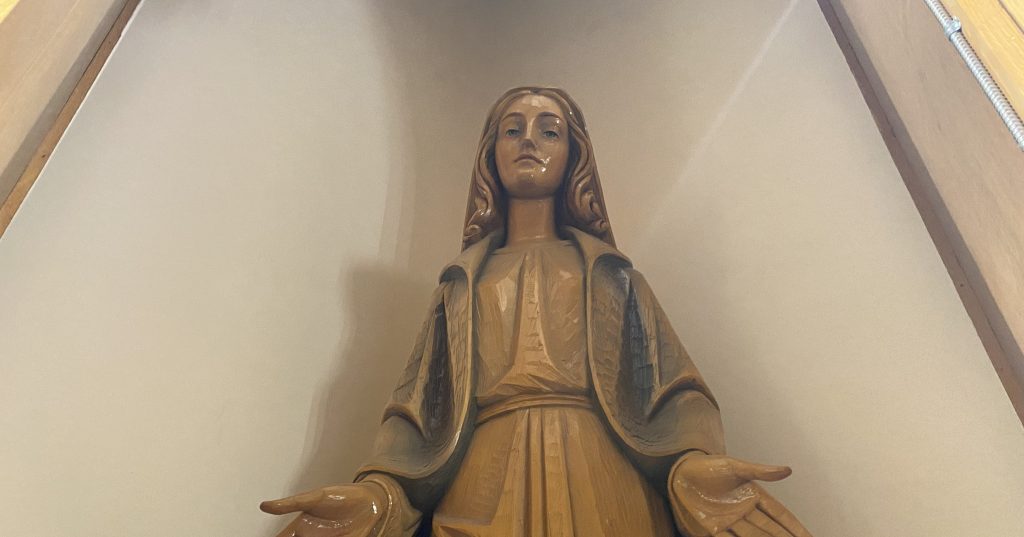
Photo: Our Lady of Grace on the grounds of Joseph and Mary Retreat House, Mundelein, Il, where I was blessed to spend a 30 day silent retreat. Learned much from Mary’s memory!!!

Link for the Mass readings for Sunday, December 29, 2024

May we play our part as did St. Joseph.

When the magi had departed, behold, the angel of the Lord appeared to Joseph in a dream and said, “Rise, take the child and his mother, flee to Egypt, and stay there until I tell you” (Mt 2:13).

The scene the magi left from was not a glamorous one. Mary gave birth to Jesus in a stable or a cave. This setting was not the most hygienic of situations as this is where animals were kept. After the shepherds and kings come to pay the baby homage the situation does not get much better. For as we read in today’s Gospel from Matthew, Joseph is urged by an angel to flee because Herod had ordered the death of all male children under two years of age.

Sounds a bit extreme of a measure, and one might think this could just be a trumped up story. Until looking back to see how Herod killed anyone he felt threatened without thinking twice. This included his own wife, Mariamne, and three of his sons. The news Herod received by the magi that they wanted to see “he who was born the king of the Jews” (Matthew 2:2) and the messianic fervor that was growing because the prophecy of Daniel (cf. Dn 9:24-27) predicted the messiah during this time period, could have easily fed Herod’s paranoia. When the magi did not return to reveal the location of this baby king, he wasn’t going to take any chances for this wee one to grow up.

Joseph would have known about Herod’s temperament as he was the rightful heir to the thrown of David as well as the caretaker of Jesus, the baby who, it was becoming clearer to Joseph, was the Messiah. With the words of the angel, Gabriel, Joseph trusted again and packed up all they had. The three of them were on the road again, not back home to Nazareth, but to Egypt.

The Son of God could have easily been born in a palace, among a family with power and stability, yet his Father chose to send him to be born among the poor and displaced. His earliest days were ones marked by instability and danger. The only stability and safety that Jesus had was in Mary and Joseph. They trusted in God, followed his guidance, and were willing to sacrifice their lives to protect and keep him safe.

Over these past days of readings we have encountered simple and yet significant figures of faith: Zechariah, Elizabeth, Mary, Stephen, Mary Magdalene, Peter, John, and today, Joseph. In the face of not understanding the reality of the conception of Jesus, he chose to trust Gabriel’s invitation to take Mary as his wife, to provide and protect her and Jesus. He risked his life by going into the territory of the crazed king Herod and then onward to Egypt until presumably Gabriel would call them back to Nazareth.

Joseph did what each of us are called to do, to follow the will of God – to be saints. We are called to listen to, trust in, and do whatever he tells us. In this way, we play our part, as Joseph and the others did. We are to allow the love of God to flow through us to those in our realm of influence, make a difference in our corner of the world, and make it a place where the dignity of each person in our reach is respected and cared for. When we do that, miracles happen!


Photo: St. Joseph Catholic Church, Poquonock, CT. Christmas Day, last year.

Link for the Mass readings for Saturday, December 28, 2024

May we, with John, contemplate the true gift we have received.

Jesus Christ is born for us. Jesus Christ dies for us. Jesus Christ conquers death and rises again for us. Because of our place in time, December 27, 2024 AD – Anno Domini, In the year of our Lord, we are capable of experiencing his life, suffering, death, Resurrection, and Ascension into Heaven. The important question we need to answer is, “Does this new fact, this new reality in human history, make a real difference in our lives?”

Christmas did not end two days ago. We are still in the Octave of Christmas. The Church celebrates two octaves in the Church liturgical calendars, Christmas and Easter. These eight days are celebrated as such to impress on us the solemnity of the event of remembrance. From the vigil celebration of Christmas Eve on December 24 to January 1, the Solemnity of Mary the Mother of God, we celebrate the significant event of the Incarnation, the Son of God, the second Person of the Trinity becoming one with us in human history. The Masses celebrated within the Octave of Christmas, as well as the readings of Evening Prayer in the Liturgy of the Hours, reflect the celebration of Christmas Day each day for the eight days. It is like having a week-long birthday party.

If we are solely focused on gifts, the returning of gifts, and celebrations apart from the celebration of Jesus’ birth, if we are removed from the liturgical cycle and rhythm of the Church, it is easy to fall into the post-Christmas blues because it does feel like everything is done but the returning of gifts and getting a good after Christmas deal. Christmas music has been alive and well on many radio channels for weeks, but at some point on Christmas Day and often the following day, they stop. They stop at the time when they ought to begin!

The material and finite, no matter how wonderful, even our closest relationships, will never satisfy our deepest hunger and thirst. If you are experiencing any post-Christmas blues, today is great opportunity to let go of the material for a bit and enter into the gift of silence, and to spend some meditating and contemplating on what will satisfy. The greatest gift that we have been given, we began to celebrate again two days ago. The Son of God changed human history by his conception and birth and we are invited to participate in God’s great theodrama of human transformation. Today’s Gospel reading is a fast forward from this birth we are celebrating and the gift that keeps on giving, the reality of the purpose of the incarnation.

Jesus was born to die, to show the fullest extent of his obedience to his Father. In trusting his Father, Jesus died, experienced our greatest fear of death, and through the power of the Holy Spirt, conquered death and rose again. Mary Magdalene was the first to experience the empty tomb and shared this good news with the apostles. Peter and John ran to see. John arrived first. John remained outside, possibly out of respect, to allow Peter to go in first. Peter saw the empty tomb except for the burial clothes. When John entered, “he saw and believed” (Jn 20:8).

Are we willing to take the time to ponder as John did? To see beyond the merely finite and physical? To be willing to be still. Silent. To allow God to speak to us in the silence of our hearts? John, Mary, and Peter’s lives were changed and transformed because they encountered Jesus and chose not to ignore him or run away, but to give their lives to him. We are invited to do the same. Our hearts were created for this relationship with Jesus and our hearts will be restless until we allow ourselves to slow down, embrace the gift of silence, and allow ourselves to hear him speak in the silence of our hearts that we too may believe.

————————————————————–

Painting: Close up of St. John the Evangelist by Vladimir Borovikovsky

Link for the Mass readings for Friday, December 27, 2024