trust


This Advent, let us trust more in Jesus and step free from the gloom and darkness and into his light and love.
St. Augustine taught that the New Testament is hidden in the Old Testament and the Old is revealed in the New. We see this presented in our readings for today. Isaiah presents how “the deaf shall hear” and “out of the gloom and darkness, the eyes of the blind will see” (Isaiah 29:18).
Jesus heals the blind men who call out to him believing that he is indeed the Son of David, the messiah, the anointed one. Jesus recognizes their faith that has healed them but he also points out that they are still in need of healing. They see, but they, like the apostles and others who are seeking the coming of the messiah, a messiah that is like David, a political and military leader that will lead a revolution to overthrow the occupying power of Rome.
Jesus told them clearly not to tell anyone what had happened, because he was not about to promote a cult of personality and nor have them portray him in a false way. Yet, share they did, their encounter with Jesus with great joy.
Though we may have eyes to see and ears to hear, are we too are also spiritually blind to who Jesus truly is. Jesus came into the world just over two thousand years ago as the visible reality of the embodiment of God who is love. Jesus calls us to be conformed to this same love. No easy task, for we are called to humility, repentance, and transformation.
The apostles and saints were those who followed Jesus and were willing to be transformed by the fire of his love. They encountered Jesus, had faith in him and believed. They then went out to share with all they met about their encounter. Will we follow the same path? Do we believe that Jesus is truly who he said he is, the Son of God, the second Person of the Trinity, who became one with us so that we can become one with him and his Father to experience the love of the Holy Spirit?
Let us pray together:
Jesus, this Advent, help me to choose to walk out from the gloom and darkness of anxiety, fear, and insecurity, and place my trust in your revealing light that I may walk with confidence on your path of love. Free me from any distractions and diversions such that I may experience the closeness you know with your Father. Please help me to place my trust in you, and heal my blindness so that I can see more clearly and reject the lies that lead me astray.
——————————–
Photo: Rosary walk back home in Palm Beach Gardens, Florida.
Link for the Mass readings for Friday, December 6, 2024

When we confess our sin, trust in Jesus, and are willing to serve each other, we take a closer step to peace.
“Amen, I say to you, in no one in Israel have I found such faith” (Mt 8:10).
The one to whom Jesus was referring to was the Roman centurion who approached Jesus seeking healing for his servant. I imagine that Jesus was not only amazed by the man’s humility, in recognizing his sinfulness and that he believed that Jesus could heal from a distance with simply his word, but also that he was aware of the need and suffering of his servant and willingness to do something about it. This Roman centurion, part of the occupying power in Israel, clearly embodied the teachings of Jesus! It is from the centurion’s words that we get the words that we speak before receiving Jesus in the Eucharist during each Mass: “Lord, I am not worthy that you should enter under my roof, but only say the word and I shall be healed.”
God chose the people of Israel not for themselves alone, but that they would be a light to all peoples. As Isaiah said, all nations shall stream toward mount Zion and “from Zion shall go forth instruction, and the word of the LORD from Jerusalem” (see Isaiah 2:1-5). Jesus echoes Isaiah’s prophetic words as is recorded in today’s Gospel: “Amen, I say to you, in no one in Israel have I found such faith. I say to you, many will come from the east and the west, and will recline with Abraham, Isaac, and Jacob at the banquet in the Kingdom of heaven” (Mt 8:11). The centurion’s act of faith is one of this beginning movements of faith in Jesus that, like a few drops of water, become the beginning of a majestic waterfall.
The first point we can learn from the centurion is that he was aware that his servant was in need. A slave held no dignity, and yet, he was not invisible to the centurion. Nor was the centurion indifferent to his suffering and pain. We also need to be aware of those in our midst who are in need. We need to resist the temptation to walk around, over, or by others and be willing to embrace them in their need.
Second, like the centurion, we need to embrace humility and acknowledge our own sinfulness, and when we do so, we are better able to see the needs of others. None of us are perfect. No one person is above any other. We all have gifts as well as shortcomings. We need each other because we complement one another and we are stronger together than apart.
Third, we cannot stand on our own. The centurion knew his strengths, the authority he possessed, while at the same time he recognized his limitations. He acknowledged that he needed help. He needed Jesus. As do we. We cannot accomplish our salvation on our own merit or will power. We need a savior, for apart from Jesus, who we prepare to encounter this Advent season, we can do nothing, but with Jesus all things are possible.
Jesus is the Truth that we seek. He has sent out a universal invitation of communion for all, to Israel first and then to those from east and west, north and south. The Roman centurion modeled our response to Jesus’ presence when he recognized his own sinfulness and acknowledged it before Jesus. He was also aware of and sought healing for his servant. The centurion had faith and hope that Jesus could and would provide healing with just his word.
May we follow his example this Advent as we take time to examine our conscience, have the humility to confess our sins, to acknowledge that we need help from Jesus and others. May we be willing to seek forgiveness and be willing to forgive. May we resist the temptation to embrace fear and close ourselves off from and be indifferent to the plight and needs of others.
We have so much to offer one another when we are willing to work together instead of stand apart from or against one another. May we who have received the forgiveness and grace of Jesus and felt the embrace of his love, work to beat our “swords into plowshares
and [our] spears into pruning hooks”. We can use our words to destroy or to empower and give hope. Choosing to return hate with love, and to say the good things people need to hear, we can promote a ripple of peace that can contribute to making Isaiah’s words a bit more real: “One nation shall not raise the sword against another, nor shall they train for war again” (Isaiah 2:4). Wouldn’t it be nice if we could take a few steps closer to this reality this Advent?
——————————————————————-
Painting: Sebastiano Ricci – Christ Heals the Centurion’s Servant, 1726-1729
Link for the Mass readings for Monday, December 2, 2019
144,000 + 2 = faith + trust
Our readings today hold up those who are faithful to God and his the covenant he has made with them. They have resisted the temptations of the world and given all to follow Christ, the Lamb who was slain. The Lamb, who though slain, rose again and as we celebrated yesterday is the King of kings and the Lord of lords.
The 144,000 from our first reading from Revelation represent those who were “undefiled” from worshipping idols. The worship of any other gods, or the the beast as shared in the Book of Revelation, was considered to be adultery. Those numbered were faithful to the covenant they had made with Jesus. Throughout Revelation, John equated a covenant between God and his people. The imagery he uses is the Church as the bride of the Lamb.
In the Gospel of Luke, we return to the widow we read about recently. She came to the Temple in Jerusalem as others came to share their offerings. These offerings were placed in the Shofar-chests in the Temple. Scholars recognize that there were thirteen chests in the Temple and each one for a specific offering that ranged from annual dues, sacrificial offerings, and freewill offerings.
As Jesus pointed out, most of those who were giving, gave out of their excess, but this widow, who most likely had no support as her husband had died, gave all that she had in giving her last two coins. What she gave an offering too we do not know, but she showed a radical trust in God. She did not even hold back one of the coins. She instead gave all.
The widow, like the 144,000, represent those who have trusted in and been faithful to God throughout the ages. They followed the commandment of Jesus to love God with their whole heart, mind, soul, and strength and their neighbor as themselves. They resisted the temptations that could have lead them astray and instead placed all their trust and faith in God.
There are many distractions and diversions that can lead us astray, temptations from without and within. Jesus remains faithful to us and the covenant that he made with us. We, as his bride, are invited to remain faithful to and trust in him. May those who have gone before us, the triumphant saints who now reign with Jesus the Lamb, who is seated at the right hand of the Father, intercede for, guide, and empower us in our lives to trust and be faithful as they were. May we be willing to be led by the tender chords of the love of the Holy Spirit into a deeper communion with God and one another.
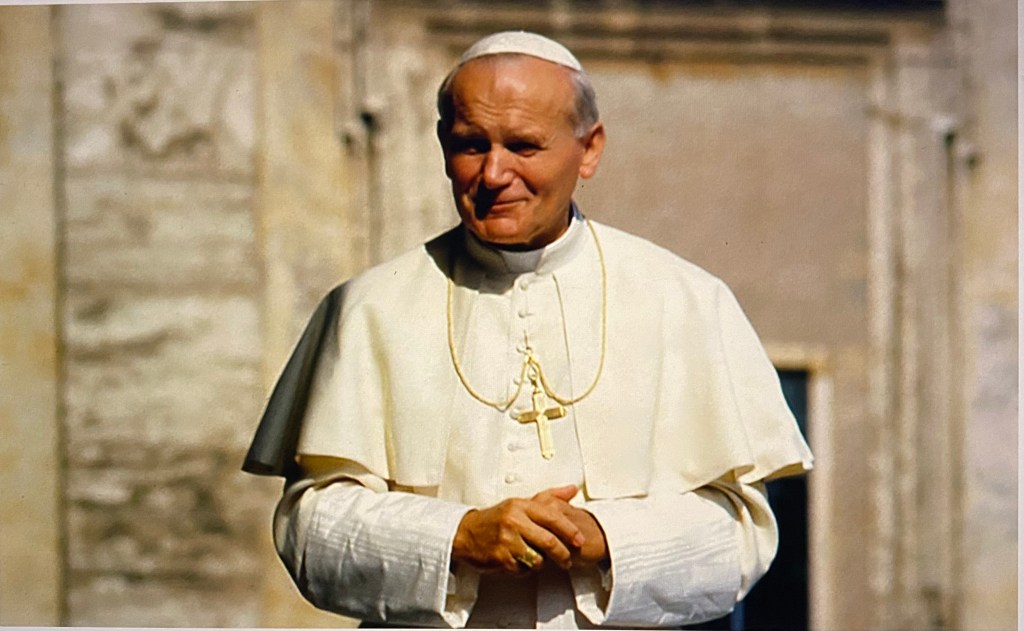
Photo: “God, our supreme good, is the source of all good things. I hope that you will all be ‘good’, that is, faithful witnesses to the love of our heavenly Father who fills us with so many gifts” – St. John Paul II, Audience, February 5, 1997.
Link for the Mass readings for Monday, November 25, 2024
We will fear less when we pray more.
In today’s Gospel, we have available to us the parallel to The Parable of the Talents from Matthew 25:14-30, which is The Parable of the Ten Gold Coins from Luke 19:11-28. There are a few differences. A key opening point is that in Matthew’s account, we do not know why or where the master goes after he entrusted three of his servants with talents; five, two, and one respectively. In Luke’s account the man is a noble and he “went off to a distant country to obtain the kingship for himself and then to return” (Lk 19:12). He called ten servants to invest a gold coin he gave to each of them. The theme that is similar in both accounts is that when the man returns, two of the servants invested well and brought about a greater return on their investment, and one hid what he was given out of fear of his lord.
Another added feature in Luke’s account was the fellow citizens of the nobleman that did not want him to be king and openly opposed him. The nobleman after attaining his kingship and returning successfully, dealt harshly, to say the least, with those who opposed him, having them slain. Those listening to Jesus tell the parable would understand this predicted outcome, as it was not uncommon in the ancient Near East for a ruler to slay those who opposed his rise to power.
The readings over this week continue in this vein of eschatological talk, references to the second coming of Jesus, and final judgment because we are in the final two weeks of the liturgical year. The readings present us with the reality that there will be a judgment by God, and what Jesus makes clear is that we are not the judge and jury, though many appropriate this role for themselves. We are only accountable for the talent or gold coin we have been entrusted with.
God has called us each uniquely by name and given us a gift that he wants us to put into action to help build up his kingdom. We need to resist burying this gift or hiding it away. Doubts, fears, and anxieties will arise in our hearts and minds. We may say to ourselves, “I don’t even know where to begin.” We can begin with prayer, we can pray with the one who calls us to participate in his work.
We are invited each day to begin with prayer. In the beginning, the length of time is not as important as consistently spending time with God intentionally. We show up, breathe, allow ourselves to be still, allow the restlessness of our mind to quiet, and we listen. This may take some time or days, but when we continue to return and trust that God has a purpose for us, we will hear his guidance, and then we are to follow his lead.
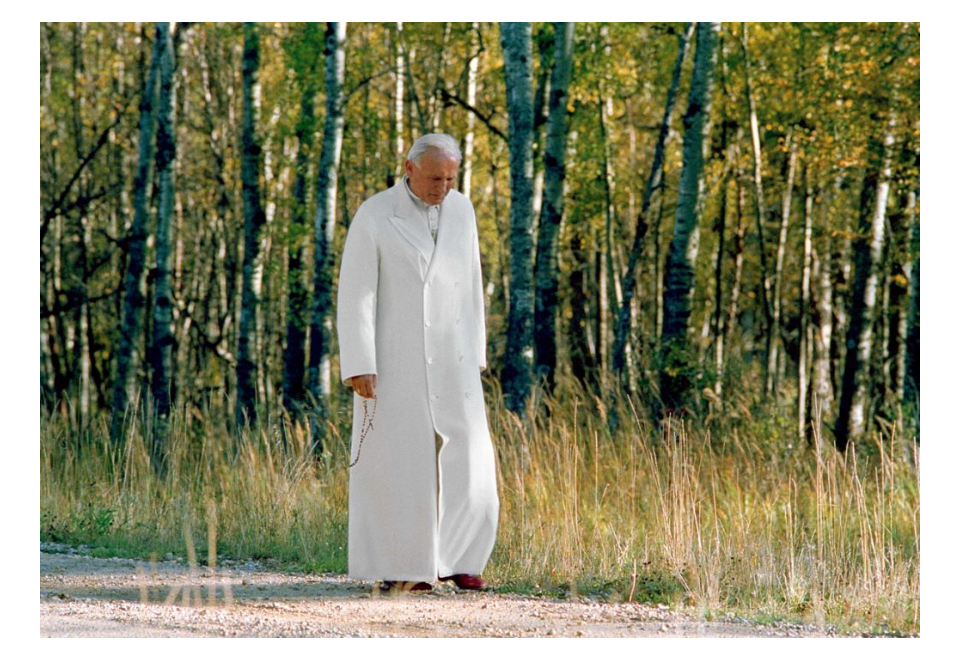
“Remember that you are never alone. Christ is with you on your journey every day of your lives!” – St. John Paul II
We are called by Jesus to be contemplatives in action. Mediocrity and fear are no longer to be our guides. With humility and patience, let us trust in the guidance of the Holy Spirit who will light our path to maturing and actualizing our unique call to serve God and one another.
Photo: Pope St. John Paul II Rosary walk – L’Osservatore Romano
Link for the Mass readings for Wednesday, November 20, 2024
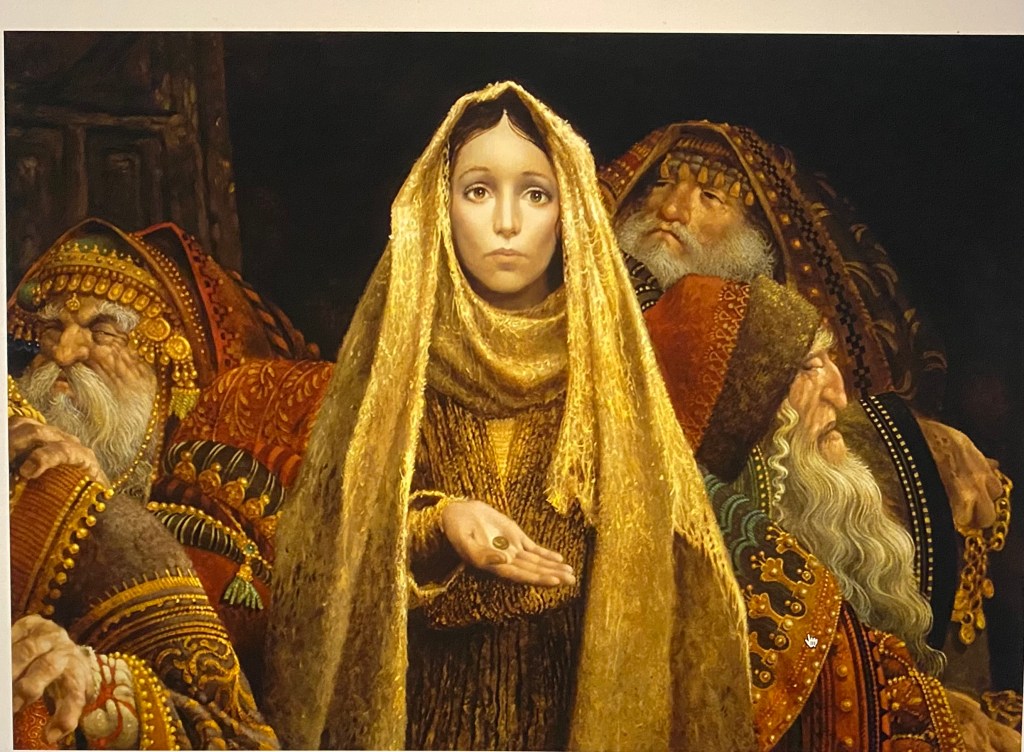
Can we trust God so as to also give as extravagantly, as generously, as radically?
Last week Jesus challenged us with the great commandment which is to love God with all our heart, soul, mind, and strength and to love our neighbors as ourselves. Our readings this week give us two radical examples of how to do just that. We begin by trusting in God.
We are to trust as did the widow of Zarephath from our first reading and the poor widow giving her last two coins to the temple treasury in the Gospel,“…she, from her poverty, has contributed all she had, her whole livelihood” (Mk 12:44). Each of these women were practicing a spiritual physics and being generous that defied what appeared to be the reality before them. Each had barely anything, one her last meal and the other her last two coins, yet they gave all they had, trusting that God would provide for them. They trusted in God’s providential care.
Each of us, the baptized, are the Church, and as we gather together each week to worship, we receive encouragement, seek to learn and grow deeper our faith, become transformed by the Body and Blood of Jesus made present again in the Eucharist, and pray for the needs of our world. This is a good way to build a foundation of loving God, self, and neighbor.
As people of faith we are to aspire to care for one another and creation, to resist the temptation to divide, demean, and define people as other and instead see each other as God sees us, as brothers and sisters. Elijah and the widow of Zarephath saw each other as human beings not people of different ethnicity or faith traditions. Each were in need, trusted in God, and supported one another.
St. Mother Teresa often recounted a story in which she brought a cup of rice to a Hindu woman because she knew how hungry her and her children were. As soon as the woman received the rice, she poured half into another container and left. When she came back Mother asked her where she went. The woman said, “They are hungry too.” “They”, were her Muslim neighbors.
Are we willing to have the kind of trust as these three women did? Do we have the courage to give not out of our excess but out of our need? On our own, most likely not. That is why God invites us to pray and spend time with him in our communal worship so we experience Jesus’ radical gift of himself in his word proclaimed and Body and Blood shared for us. He was willing to give himself, all of himself, holding nothing back.
Jesus gave his life for each one of us, what are we willing to give in return? Often we hedge our answer to this question because we are placing our trust not in God but in something else. For where our treasure is, there our heart lies. We would do well to meditate upon the accounts of the widow of Zarephath, the woman with two coins, and the Hindu woman this week. Meditating upon how each were willing to give the little they had, each expressing extravagant generosity, each trusting in God may help us to open our hearts and minds to the extravagance and generosity of God’s love for us so that we can trust him more and give as he invites us to give.
Painting credit: The Widow’s Mite by James Christensen
Link for the Mass readings for Sunday, November 10, 2024

To heal, it is important to reveal our sin and come out of the darkness.
The Lord said to him, “Although you cleanse the outside of the cup and the dish, inside you are filled with plunder and evil. You fools” (Lk 11:39).
Jesus’ harshest critiques were for acts of hypocrisy. He did so to show, in no uncertain terms, how dangerous this was, especially for religious leaders. These men were entrusted with the care of God’s people. They may have observed the proper rituals, spoke, and dressed to match the part but this all meant nothing if their hearts were hardened, and they were closed to the love and will of God. This situation was more perilous when they themselves became obstacles, stumbling blocks to those who sought God. Jesus indicting them as fools meant that they were bereft of the wisdom of God they projected to have.
A recent Pew study tracing religious affiliation from 2007 to 2014 found that approximately 56 million Americans identify themselves as following no religious affiliation. Some have labeled this group as the “Nones”. The context and nuance of why this trend has been on the rise has many components. One ingredient is the unacceptable levels of hypocrisy which has turned many off to organizations and the societal structures including the Church. Reports of abuse of children, women, and at risk adults over the past few decades further adds fuel to this fire. Although, church leadership has done much to correct those abuses and to put policies and practices in place to protect the flock, the damage has been done, the image has been tainted, and there is still much more work to do.
In the depths of our very being, we seek and yearn for the transcendent, the infinite. We are spiritual seekers. We seek God while at the same time we experience suffering, injustice, and hypocrisy at the hands of the very ones who are our leaders in both the religious and political sphere. This is why Jesus convicted those who abused their positions because he knew the significant damage that they could inflict. The good news is that the most recent study has shown for the first time that the rise of the “Nones” has plateaued. This is an affirmation that when we experience life without God, we will recognize that something, some One is missing.
No one is perfect, our leaders nor ourselves. We all fall short of the perfection of Christ, even those of us who seek and aspire to live by the Gospel. If we put anyone up on a pedestal, they, sooner or later, are going to fall, and the higher up they go, the greater the fall. God is to hold priority of place. We are to seek God first. God is to be our foundation, the light shining on the hill, our guide, and source. One way we can sidestep the trap of hubris is by resisting the urge to project all is well and good, that we are fine when we are not. None of us are super men or women. If we think we can go it alone, on our own power and persistence, we will fall sooner or later.
When we turn to Jesus to reveal our weakness and our sin, we can experience his transformative and healing power in our lives. To be vulnerable, to allow Jesus to shine his light into our inner darkness takes courage, but when we open all of our lives to him, we will identify and be able to release our own “plunder and evil”. The Holy Spirit can also help us to trust one another with our weaknesses, faults, and shortcomings.
We are healthier and stronger when we assume a posture of humility and openness and reach out for help. We are better when we entrust ourselves to Jesus and a core group of people we can trust, firmly ground ourselves in the love of God and one another. We grow stronger when we support the unique gifts of each other while at the same time hold each other accountable. Isolated and in the darkness, our sin festers and grows. When brought into the light, sin starves and withers away.
Jesus challenges us to resist projecting an image of perfection when all is not well on the inside. When willing to reveal our weaknesses, sins, suffering, and pain, we can receive help, heal, and let go of carrying the weight of seeking an internal perfectionism. Healed and transformed from being the center of the universe, which we never were or never can be, we don’t have to project any image. We can be free to be ourselves as God calls us to be and radiate his love as we receive his love. Instead of driving people to the nearest exit, we can begin to welcome people back home to be loved, healed, and transformed.
Photo: Rosary walk, Riomar Beach, Vero Beach.

The indissoluble union of the sacrament of Matrimony is to mirror the loving union of the Trinity.
The Pharisees approached Jesus and asked, “Is it lawful for a husband to divorce his wife?” They were testing him (Mark 10:2).
Among the Pharisees, there were different schools that arose from following the teachings of their rabbis. They sought how best to interpret the Torah, the Law or Teachings of Moses. Allowance for divorce was one of those debates. A stricter interpretation was found by the school of Shammai, in which he taught that the only grounds for divorce was infidelity. On the other end of the spectrum fell the school of Hillel which found that a man could divorce his wife if he felt she cooked a bad meal or with the school of Akiva, a divorce was permissible if the man found another woman more attractive.
The Pharisees that were approaching Jesus were not really looking for him to wade into the debate and get his insight. As Mark wrote, “They were testing him.” They were seeking to divide his support just as they would do in a few chapters when they asked whether it was permissible to pay the Roman tax. In both cases, they thought they had a good plan to trap Jesus and gain support against him. If he assented to paying taxes to Rome, the Jews would surely turn against him and if he said not to pay the tax, the Pharisees could turn him in to the centurions for going against Caesar. Jesus turned their question on its head when he said to pay to Caesar what belonged to Caesar and to God what belonged to God (Mark 12:14-17).
Jesus refused to take the bait with divorce as well. Instead of picking one of the Pharisaical school’s interpretations, Jesus did what he did when tempted by the devil in the desert. Jesus referred to the source, the Torah, and went back to the beginning in Genesis. God instituted marriage to be indissoluble for “what God has joined together, no human being must separate” (Mark 10:9).
Jesus also clarified that Moses allowed for the provision of divorce because of the hardness of the people’s hearts. Moses made such provisions to help to prevent a worse tragedy, such as a husband killing his wife so he could remarry.
When pressed further by his disciples afterward, Jesus did not water down his point, he instead remained on target and put both husbands and wives on the same standing. Husbands who divorce their wives and remarry as well as wives who divorce their husbands and remarry both committed adultery. Then as if on cue people bring their children to be blessed. The disciples attempt to turn them away, and Jesus said, “Let the children come to me, do not prevent them, for the kingdom of God belongs to such as these.”
Jesus seeks to restore the sacredness of marriage that God set in place so that we might be free to fulfill God’s plan for us to be in relationship with him and one another. Marriage as a monogamous and indissoluble union mirrors in the physical realm what the Trinity and divine communion of Father, Son, and the Holy Spirit reveal in the heavenly realm.
God the Father gives all that he is to the Son holding nothing back. The Son returns all that he has received from the Father, holding nothing back. This infinite exchange between the Father and the Son is the Holy Spirit, the love shared between them. In marriage, “a man shall leave his father and mother and be joined to his wife, and the two shall become one flesh.” In this union, there is the possibility of a third. The child that is conceived between the love and sacrifice shared between the husband and the wife.
This side of heaven, life and relationships are messy, they are not perfect, and unfortunately, relationships rupture. There are many reasons for this, there is much pain and suffering in those relationships that end in divorce or an annulment. Even so, Jesus will remain faithful to the Church, his bride. Just as Eve was “built” out of the rib of Adam, the Church was built out of the water and blood that flowed from the side of Jesus.
Jesus gave his life for his bride, and he will always remain faithful, and he will not lower the bar for his expectations of Marriage. Nor ought we settle for anything less. We remain faithful ourselves when we seek his help. Let us not give up on marriage, the gift of children, or each other.
Jesus’ teachings on marriage as well as the others that we have been receiving this summer are challenging. Many of us may feel that we cannot measure up, that they are too hard. When we feel this way, we are not to give up or to seek concessions. We are to trust in and seek help from Jesus.
Apart from him, we cannot fulfill what Jesus calls us to do, but with him, all things are possible. His teachings are hard, only because we are far from him. As we trust and rely on him and not ourselves alone, we come closer to his outstretched arms awaiting to embrace us. Jesus helps us to understand the truth of God’s divine laws, he gives us the grace to fulfill them, forgives us when we fall short, and encourages us to begin again.
This is why Jesus taught that we are to be like children. We must place all our trust and depend on God the Father, just as Jesus does. When we are willing to follow God’s guidance as his children and are willing to place our trust and total dependence on him, when we let go of what he reveals to us to be untrue, when we renounce the distortions of the father of lies who seeks only to divide, disrupt, and destroy us, we will inherit the kingdom of God. This is our birth rite and who we have been created to be, let us not lose it. We have been created to be in an intimate communion with God and one another. Let us not settle for anything less.
Photo: Jesus brought us together, and helped us to grow closer to him and to each other.

God cares more than we might think.
Job through all his sufferings, trials, and tribulations was faithful to God and coming to the end of the story, he gets an actual hearing from God himself. God speaks to him “out of the storm” (Job 38:1), though does not answer Job’s questions. God, in two speeches, asks Job questions that deal with the reality that Job is a finite human with the limitations that entails and yet gives Job a vision of the ordering of the whole of the cosmos and our created world.
From this amazing encounter, Job speaks in but a whisper: “I have dealt with great things that I do not understand; things too wonderful for me, which I cannot know” (Job 42:2-3). Job repents, he is willing to accept the gift that God gave him, of seeing how small he really is in the greater scheme of the vast cosmos and even in the ordering of this planet and the created beings upon it. God’s questions cut to the heart of Job’s limited point of view regarding the grand scheme of God’s plan and Job was willing to accept God’s guidance.
In the Gospel, Jesus receives the seventy-two he had commissioned to heal and exorcize demons in his name. They returned rejoicing at the wonders that they experienced in their service and Jesus invited them to see that what was more amazing was not so much that “the spirits are subject to you, but rejoice because your names are written in heaven” (Luke 10:20).
What is the most amazing of both accounts from Job and the Gospel of Luke today, is that God, even cares about us. God cares about us personally and intimately. God knows each of us by name and knows us better than we know ourselves. Even though God does not need us, God yearns for relationship with us and has planted that very desire to be in relationship with him in the very depths of our minds, hearts, and souls. God also wants us to participate in his plan of salvation history and has a particular part for us to play.
When we give ourselves some time to take this in, to rest and stop, to breathe, really take some deep and slow breaths, and ponder not only how much God loves us, but actually give ourselves time to rest in and receive his love. Wow! You’ll never breathe or see the world in the same way again.
You might hesitate or question whether God cares because he allowed something to happen or not to happen. You may not care about having your name written in heaven, for what’s the point of having an eternal relationship with someone who doesn’t care enough to listen. Even if you may not want to make the time to read about Job’s angst and encounter with God, maybe start with taking a few steps toward trusting God, who really does know what he is doing and knows what is best, even if you don’t believe that yet.
Just taking a moment to be still, and to bring our questions to God is a good first step. For God is the best one to answer them. We just need to be prepared that he may answer our question with more questions. As long as we are willing to enter into the conversation, we are moving in the right direction.
Photo: Rosary walk, Holy Cross Catholic Church, Vero Beach, FL.
Link for the Mass readings for Saturday, October 5, 2024

Humility, contrition, and confession are the pillars for forgiveness, love, and peace.
Logistically, to our modern minds, the setting of this verse may appear confusing. How could this “sinful” woman be standing behind Jesus such that her tears would fall on his feet? When we think of someone sitting and eating, we imagine them doing so by sitting in a chair. Thus, the feet would be toward the front of the person.
During the time period Jesus lived, the customary practice when eating was not to sit at all but to recline. Thus, the woman was standing behind the feet of Jesus as he reclined, and her tears fell on his feet. She then knelt down, dried his feet with her hair, and then anointed Jesus’ feet with the ointment she brought for him.
She did not rationalize, deny, ignore, or come grudgingly nor wait for Jesus to call her out, she came not asking for healing but with true contrition for her sins. Being in the presence of Jesus, when we are open to his love and experience his compassion, we are pierced to the heart with our own sorrow for the hurt we have caused others through our sinful actions.
Those quick to point the finger at other’s sins, like Simon who judged this woman, are less apt to be aware of the depth of their own sin and thus “the one to whom little is forgiven, loves little” (Lk 7:47). We are not forgiven less because God is not willing to forgive but because God will not go against our free will. If we are unaware or unwilling to bring our sins forward in a contrite manner, we are cutting ourselves off from the healing forgiveness God wants so much to share with us. But if we, like the woman in today’s Gospel account, are willing to bear our soul with humility and sorrow we will not only be forgiven but experience a deeper outpouring of God’s love. The one who confesses truthfully, fully, and contritely is forgiven more and thus will love more.
We are offered the same gift of grace and forgiveness as she received. What if instead of hiding from, being in denial of, rationalizing, or justifying our sins, we acknowledged them and sought the healing forgiveness of Jesus as she did? In opening our hearts and minds to the forgiving and purifying love of the Holy Spirit there is pain, as there is in any healing, but there is also freedom. When we trust Jesus as she did with our deepest and darkest sins, we too can be forgiven, healed, and freed of the shackles that bind us and experience his love.
Don’t believe the lies of the enemy. God loves us more than our worst mistakes and sins. When we trust him, are contrite, confess, and willing to atone for our sins, the truth will set us free, and we will experience God’s love more fully and his peace more deeply.
Photo: Good to be still, quiet, breathe, and examine our lives from time to time.
Link for the Mass readings for Thursday, September 19, 2024
 Spiritual Stepping Stones