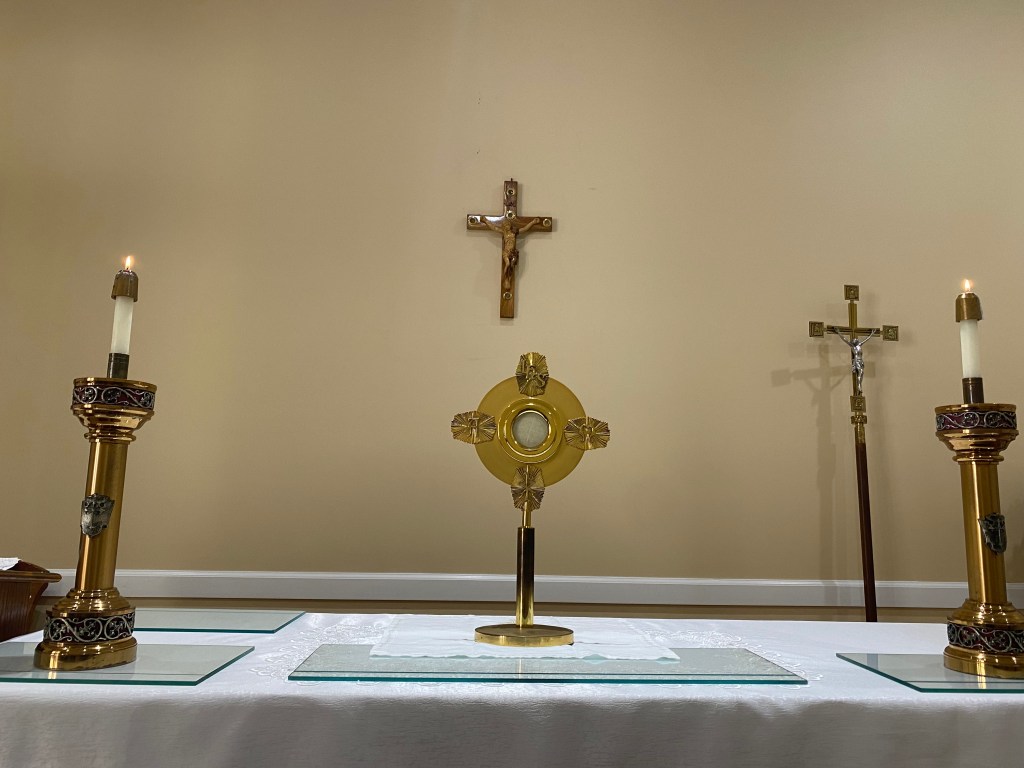
We are invited to be agents of calm and peace.

Some of the context for today’s reading of the Gospel is found in John’s account of the multiplication of the loaves which closes with this verse: “Since Jesus knew that they were going to come and carry him off to make him king, he withdrew again to the mountain alone” (Jn 6:15). Both Jesus and the people knew the Torah. In Deuteronomy 18:15-18, Moses shared that he was not the seal or end of prophetic tradition, he, like John the Baptist, pointed to one that would be greater than he.

As the five-thousand ate they talked among themselves, many may have then recalled how God fed the Hebrews in the desert, manna, bread from heaven. The miraculous multiplication mingled with the manna remembrance, comingled with the already growing messianic hope, could make a good case for why the people began to believe that Jesus was the “Prophet, the one who is to come into the world” (Jn 6:14), and then they rose to make him their king.

Recognizing their motivation and lack of understanding of the fullness of the kingship he would indeed assume, Jesus withdrew back higher up the mountain upon which he saw the people coming to him in the first place. The people presumably camped where they had eaten since evening drew near. Separation occurred between Jesus and the people because they moved to make him into something he was not. He refused, as he did during his fast in the desert, to give in to the temptation of power, pride, and honor.

The disciples were also separated from Jesus. They set out on the sea and headed toward Capernaum and would be reunited as they experienced a storm that arose on the sea of Galilee. Already full of anxiety as they were being tossed about by the waves, their fear grew as Jesus came closer to their boat, walking on the water. He calmed them as he said, “It is I. Do not be afraid” (Jn 6: 20).

Those present at the multiplication of the loaves and fish, the disciples, nor us today totally comprehend all of who Jesus is, for he embodies the fullness of humanity and divinity. Nor is he ours to tame. Jesus comes to us, is present to us, loves, and is willing to walk with us through all our trials and tribulations, as well as our joys and exhilarations. Though, what he will not do is be untrue to himself or to who he calls us to be. If we want to be fulfilled in this life, we need to let go of making Jesus in our image and likeness. Instead, with humility, we are invited to be conformed to his will, which, deep down is what we want too. We need to decrease, so that he may increase. We need to die in him, so that he may live in us.

In our willingness to surrender to the will of Jesus, we are able to keep our eyes focused on him. This does not mean our life will be perfect. There will continue to be challenges and conflict. The closer we come to Jesus the clearer we will see the truth and the absence of it within us and without. Conflicts with others will still arise. The difference is that when we experience the closeness of Jesus, while storms may rage on the outside, we will be calm on the inside. We will no longer feel the need react when our buttons are pressed, but can see another person with a wider lens, more  understanding, and love, and discern better how to engage or remain still.

We will grow stronger in our faith and trust in Jesus, and be more able to help others along the way to do the same, when we are willing to follow the guidance of Jesus and collaborate with him. In this free act of our will, we are aligning ourselves with the infinite power and ground of our being. In our participation with Jesus, we have access to his power working in and through us, we become agents of stillness and calm for ourselves and others, even while experiencing the storms of our everyday lives: “Be not afraid!” Trust in Jesus! When we do so, we will experience his peace.

——————————————————————

Photo: Spending some time winding down each day helps too! St. Vincent De Paul Regional Seminary, Boynton Beach, FL.

Link for the Mass readings for Saturday, April 12, 2024

Trust in Jesus’ love and mercy.

The disciples locked themselves in a room fearing further persecution from the Jewish leadership. Jesus was crucified and as their followers, they believed that they would be next. They were also ashamed of having turned away from Jesus during his time of dire need. Amidst this heavy weight of fear, despair, and shame, Jesus “came and stood in their midst”. Their reaction of amazement and fear of Jesus’ judgment could only just begin to form in their minds because as Jesus came and stood in their midst he said to them, “Peace be with you.”

Jesus forgave them for their betrayal. He did not rub their nose in their shame or say that he had told them so. Jesus came among them and immediately bestowed upon them his mercy. He then commissioned them to be his Apostles as he said: “Receive the Holy Spirit. Whose sins you forgive are forgiven them, and whose sins you retain are retained.” As Jesus is the Son of God, he has the power to forgive, and he is now sending his Apostles to be bearers of his forgiveness and mercy as he works through them.

Thomas, though not present on this first encounter, is present the following week and seeing the marks on Jesus’ hands and his side, he too believed, saying, “My Lord and my God!” Thomas too, even though initially doubting the resurrection of Jesus, became an agent of mercy and reconciliation.

Today, we still have access to the gift of God’s mercy and forgiveness instituted by Jesus as is recorded in today’s Gospel of John. This is a gift of healing made available to each of us, like the Eucharist, so that we may continue to experience Jesus, our Lord, and our God, working in and through our lives. When we come to the priest to participate in the sacrament of Reconciliation, we are coming to those, who in an unbroken apostolic succession, have continued to be bearers of Jesus’ forgiveness and mercy. It is to Jesus, through our priests, that we confess, and that we hear the words of forgiveness and receive absolution.

On this Divine Mercy Sunday, may we spend some quiet time with today’s Gospel and imagine ourselves in the locked room with the disciples. Experience Jesus appearing in our midst as he says, “Peace be with you!” Allow the radiating light of his mercy and forgiveness to wash over and through our whole being. Let us call to mind those sins that have kept us bound, visualize them as words floating up and out of us and dissipating into the radiance of the white and red rays emanating from the merciful heart of Jesus. May we allow ourselves to be transformed by the love and forgiveness of Jesus.

Having been reconciled and healed, Jesus sends us out to practice mercy and forgiveness with others. May we react less and breathe deeply more. Instead of adding fuel to the fire of negativity, let us seek to be advocates for healing and reconciliation. May we also take some time today to think of someone who could benefit from the presence of Jesus through our presence, someone who may need “to hear God’s good news of forgiveness and love” (Francis, 25). We may not be able to absolve someone of their sin, but we can forgive, make an effort to reach out to others in prayer and in person, and allow the love and mercy of Jesus to flow through us to those in our midst. Alleluia!

—————————————————————————————–

Photo of my copy of the painting by Eugeniusz Kazimarwoski. “Have mercy on us and on the whole world.”

McCann, Deborah. 30 Days of Reflections and Prayers: What Pope Francis Says About Mercy. New London, CT: Twenty-Third Publications, 2015.

Link for the Mass readings for Sunday, April 7, 2024

Jesus, blasphemer or human and divine?

Two groups of Jews emerged in today’s Gospel account. There were those about to stone Jesus for blasphemy and those who began to believe. The first group did not recognize the good works that Jesus did as coming from God, nor his reasoning that “even if you do not believe me, believe the works, so that you may realize and understand that the Father is in me and I am in the Father” (Jn 10:38). They listened to the claim that Jesus was making but they refused to accept the fulfillment of the assertion: Jesus did the works of his Father because he was then and still is today the Son of God.

The more that Jesus sought to help them to understand that he was who he says he is, the more they dug in their heels. They left the stones on the ground but then moved to have him arrested. Jesus evaded their grasp and moved on to the region across the Jordan where John first baptized. John did not preach in the Temple precincts either, even though he was the son of a priest. John followed the lead of God to prepare the way for Jesus and his eternal priesthood. The Temple had not been the seat of God for some time. Jesus would become the new and living Temple.

Jesus returned to the place of his baptism, where he joined in solidarity with sinful humanity. This visible image of consecration revealed what happened silently in his conception and birth: the Son of God took on flesh and paraphrasing St. Irenaeus, became man to open up heaven for us in the humanity he assumed. As people came to John in the Jordanian wilderness, so too, people came to Jesus. Not all rejected his message. Many came to him and said, “John performed no sign, but everything John said about this man was true.” And many there began to believe in him (Jn 10:41-42).

The question that arises for us as our steps take us closer to Palm Sunday and Holy Week is, will we label Jesus as a blasphemer or accept that Jesus is the Son of God? Today’s scriptural account does not reveal indifference as an option. There is no room for Jesus being only human; a good teacher, a wise man, or a revolutionary radical.

We either accept Jesus is fully human and fully divine or we don’t. If he isn’t who he claimed to be: God, then Christianity is just another philosophical, theological pursuit and in the words of St. Paul, our faith is in vain. Yet, when we accept that Jesus is the Christ, the Son of the Living God, then our lives are to be aligned with his. Our thoughts, words, actions, and even our faces need to reflect that truth. This does not mean we, or our lives are going to be perfect. We and our lives aren’t, but as we surrender our lives to Jesus, repent when we fall, seek his guidance, and invite him to be at the core and center of our lives, we will be perfected, slowly and surely by his love.

A good way to begin each day is affirming this fact by stating with an attitude of prayer, “Jesus I believe in you, you are my God and my all, and I need you.” Ask him what works of the Father he would have us offer in his name this day. In what ways can we be of help and support to another? May we have the openness of mind and heart to hear his words and the courage to act upon his guidance, so to be the precious, living stones we are, reflecting the light from our source, Jesus the Christ, the Son of the Living God.

————————————————————————-

Photo: As the moon reflects the light from the sun, so are we to reflect the light of Jesus.

Link for the Mass readings for Thursday, March 22, 2024

Jesus is the Son of God? Yeap.

Jesus’ listeners “picked up stones to throw at him” (Jn 8:59). Though less violent, this interaction has some similarities found in Jesus’ Bread of Life discourse (cf. John chapter 6), where Jesus made the statement, that, “I am the bread of life” (Jn 6:48). In both cases, the people do not understand what Jesus is sharing and yet Jesus resists softening his approach and instead doubles down.

In John 6, Jesus holds firm to the truth that his followers will consume him and in today’s Gospel Jesus does not equate himself as being just a representative of God, a prophet or a rabbi, but that he is, in fact, God when he states: “Amen, amen, I say to you, before Abraham came to be, I AM” (Jn 8:58). With these words, Jesus has just done the unthinkable, the unimaginable for the people of his time. He not only has spoken God’s sacred name, which is not to be uttered because it is considered to holy to do so, he equates this sacred name, “I AM”, with himself. Jesus is making his point very clear. Jesus is God. During the Bread of Life discourse, people walked away from him because they were repulsed and most likely considered him mad, here they may also think he is mad, but the issue is that to them he is speaking blasphemy. The reactions would be appropriate in both cases, unless of course, Jesus is who he said he is.

As his listeners then, we too have a choice to disbelieve or believe in the words of Jesus. One option that is off the table, if we give the Gospel accounts any rational reading, is that Jesus presented himself as just another teacher, philosopher, or prophet. Jesus, during his public ministry, is consistently embroiled in conflict, which is evident in all four Gospels because Jesus presents himself as God incarnate. Jesus heals on the Sabbath because he is the Lord of the Sabbath, Jesus is the Bread of Life, Jesus is: “I AM.”

The Apostles struggled time and again to make sense of the words and actions of Jesus and we may also struggle as well. We may have doubts, concerns, and unanswered prayers and/or questions. To walk the path of discipleship is not to walk with constant assurance, for we walk by faith and not by sight (cf. 2 Corinthians 5:7). Walking by faith though does not mean that we just throw up our hands, toss out all reason, and believe blindly. Dr. Holly Ordway defined faith as, “trust based on a reasoned knowledge of the evidence.” We trust that Jesus is who he claimed himself to be based on the scriptural evidence, our own experiences with the truth based on these claims, and our encounters with him in our everyday interactions and times of prayer.

We are to follow the apostles in that, even though we don’t fully understand, when Jesus calls, we also trust him and follow where he leads. He does not give us the full picture all at once, but as we step out with each faithful step, he will reveal a little more light and truth. He will be present with and work through us as we continue to turn our life over to him and one another more and more each day.

When doubts arise, we can lean on Peter’s claim, “Master, to whom shall we go? You have the words of eternal life.” (Jn 6:68). Peter made this claim based on his experience and trust in his relationship with Jesus. Our relationship and belief in Jesus will also grow more deeply and intimately, moment by moment, with each yes to the invitation of Jesus, the Holy One of God.

———————————————————————————-

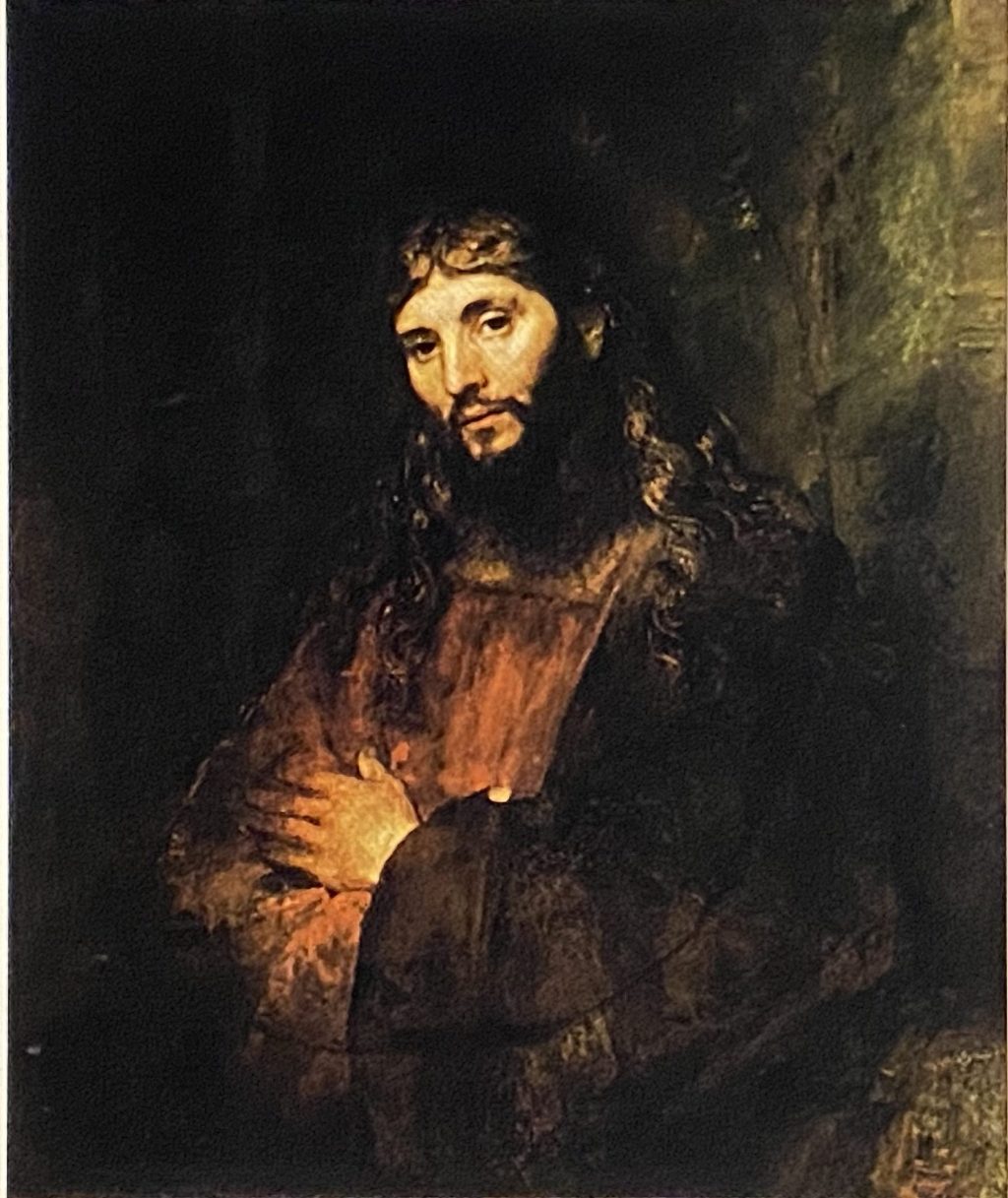
Photo: Rembrandt’s Christ With Arm’s Folded

Holly Ordway’s quote comes from Lesson 2: Bridging the Meaning Gap in her course: Imaginative Apologetics which can be accessed by registering for the Word on Fire Institute, the home page of which can be accessed: https://wordonfire.institute/

Link for the Mass readings for Thursday, March 21, 2024

Sign or trust?

“Give me a sign!”

Often, when we ask for a sign, we have a preconceived notion of what we are seeking, and we want God’s stamp of approval on it. The impetus is coming from us, seeking to bend the will of God to our will. More often than not this approach will end in frustration. The Pharisees in today’s account are asking for a sign. Jesus has already been preaching with authority, healing, casting out unclean spirits and demons, encountering the unclean and restoring them to the community and right worship, and this is not enough?

We can understand how: He sighed from the depth of his spirit and said, “Why does this generation seek a sign? Amen, I say to you, no sign will be given to this generation”(Mk 8:12). The majority of the Pharisee’s minds were set. Jesus knew there was nothing he could say or do to prove to them he was who he said he was; the kingdom of God at hand. If they had not the eyes to see and the ears to hear there was no argument, point, or sign that would have changed their minds. Jesus sighed from the depths of his spirit because their hearts were hardened such that they closed themselves off from the gift of the grace he sought to share. He then got into the boat to go to the other shore, to share his message with others: “This is the time of fulfillment. The kingdom of heaven is at hand. Repent and believe in the gospel” (Mk 1:15).

The question for us today is, do we believe, do we really believe, that Jesus is who he says he is; do we believe that Jesus is “the way, the truth, and the life” (Jn 14:6)? Do we seek to bend God’s will to our own will or seek to align our will with his? The woman with the hemorrhage for twelve years, the woman whose daughter was possessed, the friends with the man with the withered hand, and the leper, did not ask for a sign, they asked for a healing. They trusted, believed, and risked getting closer to Jesus so as to encounter him despite the barriers in place to prevent them. In each of these cases, Jesus recognized their faith, and each received the healing they sought.

In our discernment, we need to be aware of our intent. There is a subtle distinction, but it is important. Are we seeking proof, a sign, or are we willing to surrender, believe, and seek to understand God’s will, as Mary did when she asked, “How can this be” (Lk 1:34)? Are we demanding proof, a three-point plan from God before we follow his lead, or do we trust his invitation, and seek to understand how he wants us to act, knowing that he will reveal what we need to do each step of the way? Often, if we knew the end result and full ramifications of his original request, our doubt would crush our spirit before we even started.

Let us embrace a posture of faith seeking understanding today, trust in Jesus, and seek to align our will with our loving God and Father. May we make time to be still and enter a place of prayer and to open our hearts and minds to the leading of the Holy Spirit. May we with confidence, say in the words of Mary, “May it be done to me according to your word” (Lk 1:38), then arise, grasp the hand of her Son, Jesus, and face head-on that which is before us, to accomplish what he calls us to do, knowing that with Jesus, we can overcome any obstacle that is placed before us.

————————————————————————————–

Photo: God sharing a sign is different than us demanding one! Evening Rosary walk back in September, St. Vincent de Paul Regional Seminary, Boynton Beach, FL.

Link for the Mass readings for Monday, February 12, 2024