“Whoever humbles himself like this child is the greatest in the Kingdom of heaven. And whoever receives one child such as this in my name receives me” (Mt 18:4-5).
Children during the time of Jesus were seen, if they were acknowledged at all, to have little worth. They were vulnerable, had little if any status in society. They were often nothings, nobodies, and completely dependent on their parents for survival. Jesus invites a child to come to him, identifying himself with the child, as a response to the disciples’ question as to who would be considered the greatest in the Kingdom of heaven.
Jesus taught his disciples, and through his teaching that we get to hear or read today, he teaches us also that we need to be completely dependent on our loving God and Father, just as a small child is totally dependent on his or her parents. What leads us to greatness in the Kingdom of heaven is our turning away from the temptation to curve in upon ourselves, resisting the urge to feed our ego, place ourselves first, rely on a radical self-sufficiency that says we have to take care of ourselves because no one else will.
St Thomas Aquinas taught that we are to resist the cultural lures and substitutes for God: power, pleasure, honor, and wealth. In and of themselves, each of these four are neutral. Yet, when we seek our security in any, some or all, above and before God, we will be disillusioned and let down, because there is not enough power, pleasure, honor or wealth to fill the infinite need in our soul. Only God can fill that deed need to be seen, loved, and heard, especially in our deepest places of hurt, vulnerability, and those places we ourselves don’t feel all that lovable.
We are also to reject the image of the Übermensch, the super man, popularized by Friedrich Nietzsche, the 19th century German philosopher. Nietzsche wrote that God was dead and promoted the idea that humanity needed to create a world that would create new values based on the power of human will alone. Supermen and women striving for complete autonomy and self-sufficiency. Jesus teaches the exact opposite. We need to place our complete dependency and trust in and on God and rely on him for everything.
Participating in the reign of God is not one of lordship over another. Jesus teaches us to assume the humility to accompany, walk along with, and serve each other along our journey in this life. Jesus embodied this reality. He, as the Son of God, entered into our human condition. He did not grasp at his divinity but instead surrendered it to his humanity. While remaining fully divine, he became fully human when through the power of the Holy Spirit was conceived in the womb of Mary. In such vulnerability and weakness, he developed through his period of gestation, and was born into our fallen world. As an infant and child, he was completely dependent on Mary, Joseph, and God his Father.
As Jesus continued to grow as a young child, he experienced the fullness of the human condition. He laughed, he cried, he got sick, he was tempted, he felt pain, he experienced heartache and joy. Throughout his life, and especially during his public ministry, he experienced human suffering up close and personal. More so than we ever will, because there was never a filter or compensation or disordered affection that Jesus would utilize to cover up the pain. He received any pain full on with no filter. He understood the suffering of his neighbor and experienced his own human and finite limitations. He loved and wept as we saw in his encounters with Lazarus, Martha, and Mary. All that Jesus experienced he brought to his Father in prayer and received his love, strength, guidance, and consolation.
Jesus invites us to do the same as he did, to relate to our loving God and Father often in the best sense of that intimacy of dependence. St Thérèse of Lisieux, whose memorial we celebrated yesterday got this. “Jesus has chosen to show me the only way which leads to the Divine Furnace of love; it is the way of childlike self-surrender, the way of a child who sleeps, afraid of nothing, in its father’s arms.”
Accepting Thérèse’s image is an acknowledgment that we are just as dependent on God and others, that we are not self-sufficient, that we are not capable of living radically independent lives, nor are we supposed to. God created us to be loved and to love, to be in community, to care for, respect, and support one another.
Our guardian angels, whose memorial we celebrate today, are at the ready, awaiting our call. When we have the humility to ask for their help, we will realize that we are not alone. When we experience some supernatural support, from God, his angels and the saints, we might just be willing to seek help from and support each other. We can offer a shoulder to lean on, a smile, a hug, a voice that speaks for the voiceless, a text, email, or phone call if at a distance, a soul open to pray with and for others, an ear to hear, and we can embody the courage to serve and stand up for the dignity of each other.
St Mother Teresa who took her name from the Little Flower, Thérèse, was willing to come close and pick up that first dying man in the street. She did not ask his religion, was not concerned if he was of a different race or nationality, was not afraid to risk illness or injury by attending to him. She knelt down and was present in his time of dire need. We are at our best when we follow Jesus, St. Thérèse, St Mother Teresa, the saints, and our guardian angels, and surrender to, and place our dependency and complete trust in our loving God and Father and support each other by doing little things with great love.
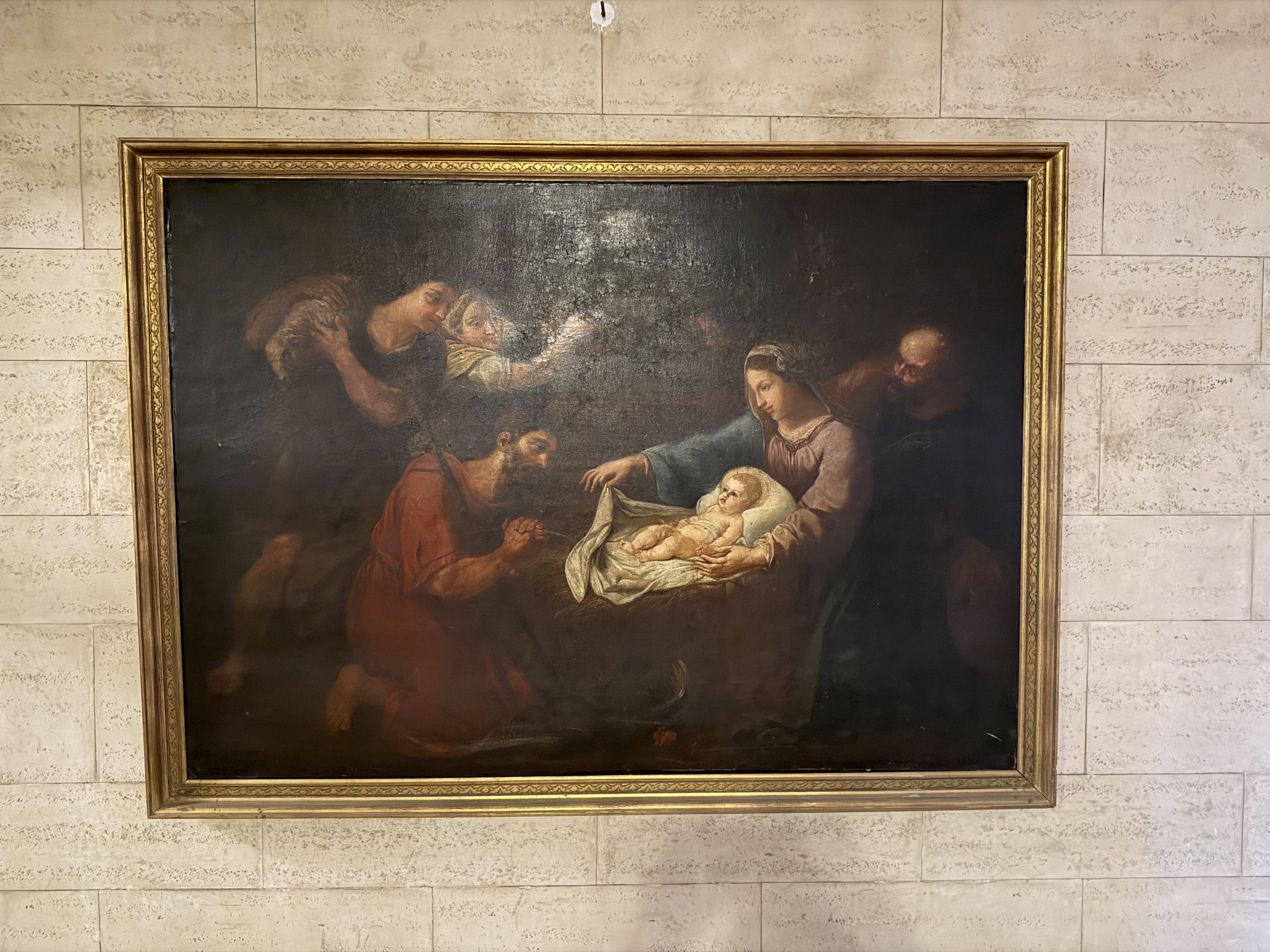
Painting: Jesus found rest, peace, and love in trusting in Mary, Joseph, his Father and the Holy Spirit. We along with our guardian angels as well can too!

