“Be merciful, just as your Father is merciful.”

My wife, JoAnn, asked me on a couple of occasions what were the favorite clothes of mine that she wore that I would like her to pack for our trip. I said the ones that you feel most comfortable in. She also shared with me what clothes she liked on me, including a pair of black, skinny jeans.

The reason we were having this conversation was because we were moving to Los Angeles. JoAnn had been diagnosed with Stage IV Pancreatic Cancer and we were moving to LA, for her final months this side of heaven.

With all packed, JoAnn flew ahead to Los Angeles with Jack. I would follow two weeks later after I finished out the school year. When I arrived and we were unpacking, JoAnn said, “You didn’t pack your black, skinny jeans.” The look on her face pierced my heart. We didn’t talk about it again.

About four months later and a few days after JoAnn died. The image of the look on her face came back to me again, and with some time to think, I realized that JoAnn was focusing on the clothes because these would be our last weeks together and why not dress in clothes that we both liked on each other. I was devastated that I missed it. The feeling also brought up times throughout our marriage where I did not make the time to listen to JoAnn, where I was impatient, and even treated her with contempt.

In that moment I experienced a deep sense of contrition at how I must have hurt JoAnn in those times. I cried as I walked to the cathedral in downtown LA which was about a half mile away. I got myself together and then fell apart again as I confessed to the priest. When I finished, he said that JoAnn forgave me, and that God forgave me.

Mercy, in Hebrew – Chesed – tender compassion.

God’s mercy, his tender compassion, is what I felt in that moment.

This is what Jesus is calling us to receive and be in our Gospel today. We are to be merciful, just as our Father is merciful with us.

Lent is a time to experience the mercy, forgiveness, and love of God. We do so when we are willing to be humble enough to allow Jesus to show us our sin, where we have fallen short of loving him, ourselves, and one another as he has created us to be. When we see our sin, Jesus does not condemn, berate, or demean us. If we experience any of that, know it is the devil seeking to isolate and separate us from the mercy, forgiveness, and love God wants to embrace us with.

All God asks of us is to be ourselves, to be who he has created us to be and that is his beloved daughter or son. All the other things we think we need to be, we can let go of. We can let go of all the anxiety, stress, and confusion about who we think we ought to be and just breathe deeply, receive, rest, and abide in the love our Father wants to share with us. When we live from this experience of God’s love, we will be in a better place. And when we mess up, we just need to be contrite, confess, be forgiven, do penance, and begin again.

As I shared my experience above, I encourage you to think of a time when you have experienced God’s mercy, chesed – his tender compassion. Rest in that moment and return to it again and again today and this week. When we return to and experience these anchor moments of God’s mercy for us, we will remember who and whose we are, and we will better be able to share God’s mercy, forgiveness, and love with others.


Photo: Treasure each moment you have with those you hold close to your heart. Even in the best of circumstances, time goes too quickly and the unexpected can happen. Let those you love, know you love them, with your thoughts, words, faces, and actions.


Link for the Mass readings for Monday, February 26, 2024

Jesus invites us to share in his divinity.

“Here I am” (Genesis 22:1)!

Abraham said this twice in today’s account from the book of Genesis. The first time was when God called Abraham to offer his son, Isaac, up as a sacrifice and the second time was when God’s angel called out to Abraham asking him to not offer his son as a sacrifice.

Hopefully, we have not become dulled by hearing this story before. This is a horrific act that God is requesting of Abraham. This would not be a natural response from our place of time and experience. Yet, for Abraham, he would have known of those who would have killed their children by offering them to the gods of the people of the land of Canaan. God meets Abraham in his own history of time and place.

God reached out to Abraham in a way that he would understand, but that still did not lessen the sacrifice that Abraham was willing to make. He and his wife Sarah were childless for decades, and God promised to give them a son way beyond child bearing years. God followed through on his promise and now God was asking Abraham to give Isaac back as a “holocaust”, a full burnt offering. Despite the anxiety and trepidation that Abraham must have experienced, he heard God’s call clearly and followed without hesitation. He left the next morning.

Isaac also had a part to play. We do not know his age, most likely a young teenager, but we know he is old and strong enough to carry the wood for the burnt offering on his back. Isaac was carrying the wood upon which he would be offered up. Isaac allowed himself to be bound with no account of his resistance to his binding and placed on the wood where he would give his life. He was clearly strong enough to stop his elder father and get away but accepted that he would be the sacrifice. God, through his angel, stopped Abraham from doing what God himself would do with his own Son.

God sent, his only begotten Son to become human and live the fullness of a human life. Jesus, like Isaac, would carry the wood of his sacrifice, most likely the cross beam of his cross. He also passively submitted to those nailing him to the cross. As St. Paul wrote, “He who did not spare his own Son but handed him over for us all” (Romans 8:32) was no generic or abstract sacrifice. God our Father sent his Son to die as a sacrifice by taking upon himself the full weight of each of our individual sins. Jesus was willing to follow the will of God all the way to his death.

How often have we taken the time to ponder this reality, that God was willing to give his only begotten Son for us and that Jesus was willing to give his life for us? Not in some abstract way, but personally. Jesus died for you and for me. Jesus seeks an intimate relationship with us, just as he did with Peter, James, and John.

In today’s gospel account, Jesus took these three up the mountain and revealed his divine personhood to them. This, as his miracles, was to reveal a foretaste of the fullness of the coming kingdom. The transfiguration was also an opportunity to empower and strengthen Peter, James, and John for the trial to come in which Jesus would willingly, like Isaac, go to be sacrificed. The only difference is that Jesus would not be spared, he would give his life on the Cross for us all. Jesus has given us everything of himself, holding nothing back.

The willingness of Jesus to give his life, expresses the fullness of our theological virtues: faith, hope, and love. He had faith in his Father, he trusted his Father. Even though he did not fully understand in his humanity the fullness of what his death meant, he had faith and so said, not my will but yours. From that faith in his Father, he had hope and could continue with allowing himself to be arrested, beaten, tortured, and crucified. Even on the Cross when he felt the separation between himself and his Father, he still had hope that God would bring about a greater good.

That greater good would become our salvation and the salvation of the world. Jesus gained for us access to the trinitarian communion of Love. God was willing to sacrifice his only Son, his Son was willing to be sacrificed, so that we human beings made in our Father’s image and likeness could be restored to our original glory by the love shared between them, God the Holy Spirit. The glory of the Lord, that Jesus revealed to Peter, James, and John is now available to us because Jesus became one with us in our humanity, to suffer and die for us so that we can experience his divinity.

We participate in the transfiguration of Jesus and enter into the trinitarian communion of love that each of the three persons of the Trinity share when we are willing die to our fallen and selfish nature and choose to love one another as God loves us.

The three pillars of Lent, prayer, fasting, and alms giving, all help us with this process. As we choose to make time to pray, we are putting God first by answering his invitation to do so and spend time with him. When we fast from food and activities, we come to see that there is more to us than just the physical. The physical is good, but without temperance and restraint we can slip into attachment and addiction. Fasting can free us from both. As we give alms, we choose to see other’s needs above our own, and are willing to provide for them. We are also better able to discern between our needs and wants. In doing so, our sacrifice becomes tangible, and we are putting our love into action.

We participate in these three acts of penance so we can better see the temptations and diversions of this world that are leading us away from God and who he calls us to be. As we are able to repent from and remove those obstacles, we can, like Abraham, Moses, Elijah, and Jesus, better hear the word of our Father and act upon it. Hopefully then, each Lent we grow more in the gifts that God has given us at our Baptism: faith, hope, and love for God, ourselves, and each other. In this way, throughout the year, we will better be able to hear God call us, and we can say without hesitation, “Hear I am!” And then do his will.


Photo: Taste of the transfiguration during evening prayer Saturday evening, St. Vincent de Paul Chapel, St. Vincent de Paul Regional Seminary, Boynton Beach, FL.

Link for the Mass readings for Sunday, February, 25, 2024

Love our enemies? Yeap.

“You have heard that it was said, You shall love your neighbor and hate your enemy. But I say to you, love your enemies, and pray for those who persecute you, that you may be children of your heavenly Father” (Mt 5:43-45). With these words, Jesus continues to raise the bar of discipleship and outlines what the pursuit of love truly is.

For many people, as Bob Dylan wrote and Joan Baez has sung, “love is just a four-letter word.” But the love that Jesus calls us to is not merely romantic, emotional, or mere sentimentality. There is nothing wrong with feelings of infatuation because in experiencing falling in love, we are drawn out from ourselves to another. This experience of love has no depth though and when it is channeled and disciplined, it can mature to the wonderful gift of friendship.

The bond of friendship and family goes beyond mere attraction and is built through shared interests and experiences. Through sharing our lives with others, working through conflicts, trust is built, and relationships will hopefully grow and deepen. Jesus, though, is calling us to mature in our growth of loving even beyond friendship or familial ties. If we love those who willingly love us in return, greet only our brothers and sisters, only those in our clique, group, tribe, or political party, what is the recompense or satisfaction in that? Agape, in Greek, loving without conditions, with little or no chance of mutual exchange, is what Jesus is calling us to strive for.

How can Jesus ask us to love an enemy or pray for someone who persecutes us? St. Thomas Aquinas can be of help. He defines the love that Jesus describes as willing the good of the other as other. We make an act of the will, a free choice to accept the person as they are, to see them, not from our limited, finite perspective but as God sees them, as a person with dignity. Jesus does not teach that we condone violence or abuse or dehumanization. We just don’t act in kind and meet hate with hate. Jesus is calling us higher so we can help to end cycles of violence and not continue to fuel the fire of hatred and division with retaliation.

On our own, we may not even conceive of the possibility, but we can be assured that if Jesus has asked us to strive for this height and depth of love, he will provide the means and support. We love others unconditionally by allowing Jesus to love others through us. We love one person at a time and strive to reach the summit of loving our enemy. Even when we fall short, how much better would our country and the world be if we sought this as our goal? To counter divisiveness, fear, and hatred, we need to choose to engage in an act of the will to love one another as Jesus loves us.

As St. Polycarp, Bishop of Smyrna in the second century who was martyred at 86 years old, was a disciple of John the Apostle who was a disciple of Jesus, taught, “True love desires not only one’s own salvation, but the salvation of all our brothers.” He put his words into practice. As Roman soldiers came to arrest him, he welcomed them and offered them food and drink before they led him to his death.

—————————————

Photo: Rosary walk and praying with Jesus, Mary, John, and Polycarp. St. Vincent de Paul Regional Seminary, Boynton Beach, FL.

Link for the Mass readings for Saturday, February 24, 2024

Let us reflect the love of Christ with our thoughts and our words.

Jesus calls us to be holy, each and every one of us. Our life is to be lived with the end goal being our ascent to heaven, to be in union with our Loving God and Father for all eternity, and to assist others to do the same. Jesus provides for us a concrete example of the heights to which we are called to reach: “You have heard that it was said to your ancestors, You shall not kill; and whoever kills will be liable to judgment. But I say to you, whoever is angry with his brother will be liable to judgment, and whoever says to his brother, Raqa, will be answerable to the Sanhedrin, and whoever says, ‘You fool,’ will be liable to fiery Gehenna” (5:21-22). Jesus is building on the Torah, the Law or the Teachings, by helping us to realize that we can not only kill with weapons but also inflict dehumanizing damage with our words.

To resist this temptation of inflicting mortal wounds, we need to start participating in a deeper examination of conscience which gets to the roots of our own thoughts, words, and actions. If we are not able to discipline our thoughts, what will follow is undisciplined words, and then undisciplined actions, which can lead to entertaining and embracing the deadly sin of wrath. Wrath is unbridled anger that leads someone away from the capacity to think or behave in a rational manner, such that this individual would no longer acknowledge the dignity of the person they would inflict their wrath upon.

Jesus is helping us to see that we can be free of the temptation of wrath if we recognize the danger and destruction of unleashing words as weapons. He offers us the examples of calling someone, Raqa, meaning something along the lines of an air-head or an idiot, and calling someone a fool. These words directed at another have no other cause than to demean, degrade, and belittle. This language, and worse, has no business coming out of the mouths of a disciple of Christ if we are serious about being one of his followers.

I remember a moment in sixth or seventh grade unleashing a derogatory word or two directed at a classmate. Even though they were loosed in jest, I felt a sinking feeling in my gut after hearing myself say them. God gave me a graced moment to feel, contrition, actual sorrow for the negativity and poison I had unleashed with my words. I remember making a commitment to myself not to speak that way toward another person going forward.

We need to be aware that words have the power to wound or to heal. If we are serious about following Jesus, then a wonderful practice this Lent can be to commit to fasting from gossip and from words that belittle, divide, diminish, or dehumanize and replace them with words that empower, unite, uplift and acknowledge the dignity of others. Even when we disagree with another’s point of view, we can do so by still respecting the person and fostering a posture of dialogue.

May we also commit to resisting and not feeing negative or dehumanizing thoughts when they arise. Even when we have defensive musings, resulting from another’s disparaging tone, words, or actions, we need to resist entertaining them. Instead, we can ask for the strength from the Holy Spirit to develop a more mindful disposition that seeks to understand instead of react and to hold each other accountable with respect. We can also give ourselves time regularly to be still and enjoy time outside to let go and unwind. It is important to get enough rest as well. Ultimately we need to consciously choose to love: to will the good of each other as our first step in encountering one another as human beings, as beloved daughters and sons of God.

—————————————————————

Photo: The simple act of looking up can make a difference in our attitude and emotional state. Give it a try and see! Rosary walk, St. Vincent de Paul Regional Seminary, Boynton Beach, FL.

Link for the Mass readings for Friday, February 23, 2024

“Who do you say that I am?”

Jesus asked, “Who do people say that the Son of Man is” (Mt. 16:13)?

Peter answers Jesus by saying that Jesus is: “The Messiah, the Son of the Living God” (Mt: 16:16).

What does Peter’s response have to do with our lives? Does he really care about our everyday challenges, struggles, and tensions? Yes, he does because Jesus is the Christ the Son of the living God. Jesus is Emmanuel, God with us. Jesus is one with us. The infinite reality of God is present within each human being that exists because Jesus became one with us in our humanity so that we can be one with him in his divinity.

We have been created in God’s image and likeness and this is true from the moment of our conception through each stage of life until natural death. The unfortunate effects of Orignal sin are that our image has been distorted and our likeness to God has been lost. We have not been totally corrupted but we have been wounded and we need to be healed and restored.

Jesus experiences our suffering personally. Whatever we may be going through, whether it be a temporary or chronic illness, loss of job, conflict and tensions with family, friends, colleagues, and/or classmates, as well as experiencing feelings anxiety, confusion, and/or lack of direction, mourning and grieving over the death of those we hold close to our hearts: Jesus feels our pain and suffering.

The suffering of humanity is not something abstract for Jesus because Jesus knows each and every one of us intimately and uniquely. He knows us better than we know ourselves and is the one who cares about us and what we are experiencing. Also, he is no stranger to suffering.

Jesus not only cares, he loves us and will walk with us no matter what we may be facing right now. Jesus is inviting us this morning and this Lent to trust in him, to allow his light to shine in those places of darkness, those places where anxiety and fear have a hold, and those places where we need to let go because we give them more priority in our lives than we do God.

A good question to ponder and meditate on this morning is: Who is Jesus for us and are we willing to invite him into our situations and allow God to happen in our lives?

—————————————————————————–

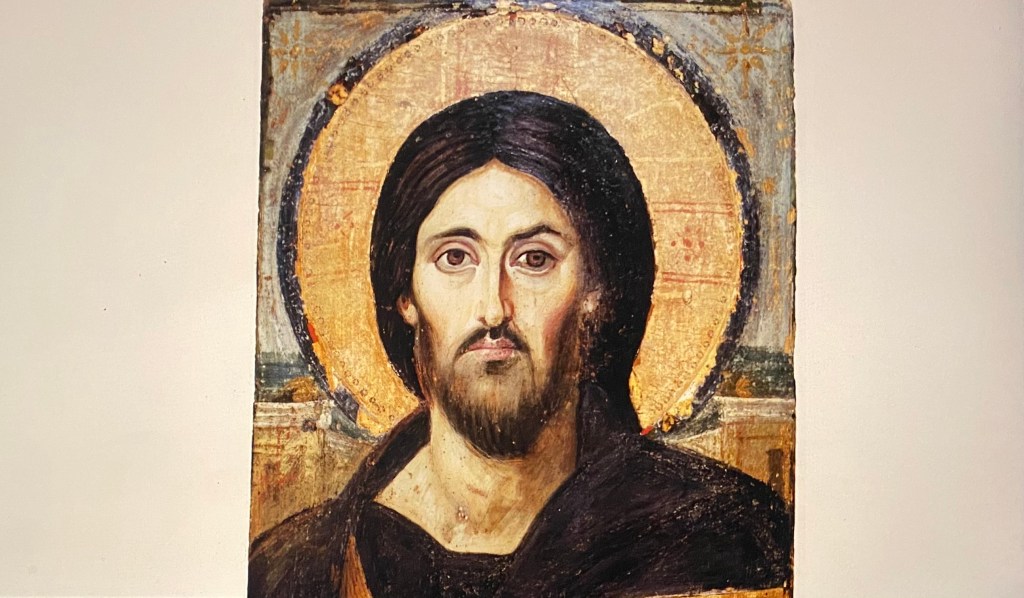
Photo: Closeup of a 6th century icon of Jesus from St Catherine’s Monastery.

Link for Mass readings for Monday, February 22, 2024

In stillness, there can be the beginning of healing.

There is something greater here. Something greater than the wisdom of Solomon and something greater than the preaching of Jonah. Following the way of Jesus is a faith we are called to live daily. Following Jesus is not a part-time vocation. We all have a unique gift in the dignity we have been conceived and born with. We have a unique way to express and live out our dignity as well. Unfortunately, what happens with most of us is that we are tempted, misdirected, distracted, and diverted as to what God would have us do and as a result we are often unplugged from the very source of our existence.

As Jesus taught, often in his parables, the kingdom of Heaven on earth starts small, like a mustard seed, like yeast, and develops slowly when nurtured. Lent is a good time to slow down, step back, take a retreat even while in the midst of our everyday activities. We just need to insert some dedicated time to God each day so as to better be able to acknowledge his presence in our activities.

If you are feeling a bit restless, on edge, or out of sync, I invite you to make some time to be still and breathe, this can be while in the shower, during breakfast, a morning walk, taking a sip of coffee or tea, during the car ride to and from work, or school. During this time ask God for some guidance. We can ask him to help us see those areas that we need to repent from and let go of, those thoughts, words, and actions that keep us distracted, redirected, and unsettled because we aren’t being truly who we are and who God is calling us to be. We can then confess to him and receive his forgiveness and reconciliation.

God invites us to come to the silence to also be able to sit in and experience the tensions, wounds, and traumas waiting for us there. Many of us would say a quick, “No, thank you,” to that invitation because who wants to experience those unresolved issues, hurts, and/or pain. We may even believe in the lie that if we open up those areas that we will be completely undone. Yet, it is only through experiencing the pain that we will experience the healing. Also, we will come to realize that the initial hurt is not as bad as the effects of it being left unresolved and the energy expended to keep it at bay is exhausting.

Jesus is present and waiting, to receive us and lead us through. He is inviting us to experience his acceptance and love as we are, to feel safe, to let go and be honest. With humility in seeking the help of and trusting in Jesus, we begin with simple steps that will lead us on the path to our freedom.

Jesus said in today’s Gospel that, “There is something greater here.” Christianity is not a secret sect. We are called to share the joy, the forgiveness, healing, and reconciliation we experience from God with others, even with, as Jonah found out, our enemies. We are to look for opportunities to offer a smile, an encouraging word, to reach out to someone we have been meaning to connect with for a while, in person or far away, and/or someone that we may sense just needs a listening ear. We can also react less by asking for God’s patience to be more understanding with those who may get under our skin or stretch us out of our comfort zones.

Lent can be a joyful time when we enter into the season with the intent to deepen our walk with the One who is wiser than Solomon and preached repentance and reconciliation. With our hearts and minds turned back and open to God, Lent will not so much be a drudgery to endure, but a joyful embrace of the opportunity for experiencing healing from those areas we have kept buried for far too long. Lent is a season that we are invited to change our minds such that we are more open to dialogue, forgiveness, healing, sharing the joy, reconciliation, and contributing to building up the kingdom of God one healing at a time!

———————————————————-

Photo: Some quiet time with Mary – St. Vincent De Paul Regional Seminary, Boynton Beach, FL.

Link for the Mass readings for Wednesday, February, 21, 2024

Allow the words of the Our Father to enkindle the fire of his love into your heart.

There is a creative power to God’s word. “In the beginning was the Word, and the Word was with God, and the Word was God” (John 1:1). God’s word is alive and present to all of us. And as Isaiah conveys in today’s first reading, God’s word “shall not return to me void, but shall do my will, achieving the end for which I sent it” (Isaiah 55:11).

This happened most profoundly in time when “the Word became flesh and dwelt among us” (John 1:14). God the Father through the overshadowing of the Holy Spirit and the ascent of Mary’s will, sent his Son to be human while remaining fully divine. Jesus lived, suffered, died, conquered death, rose again, and ascended into heaven bringing our humanity through his humanity back to the Father. God’s Word achieved the end for which he was sent, that salvation of the world!

God’s word, the Holy Spirit, and Jesus are still alive and active today. The gift of the Bible is that the story of salvation is there for us to experience. The Bible is not just a compilation of dead letters on a series of pages to be gathering dust. These words are most alive when they are proclaimed at Mass and read, prayed and meditated upon within our own time of prayer, and put into action in our daily lives.

God still speaks to us today through his living word when we make the time to listen and hear him speak in the silence of our hearts. In today’s Gospel, Jesus teaches us how to pray by sharing the words of the Our Father or the Lord’s Prayer. This is the same prayer that he taught his Apostles and has been prayed ever since then each and every day over the past two thousand years.

If you have been wanting to learn to pray and meditate with the Bible and haven’t been sure where to begin, the Our Father is a great place to start. Settle into a quiet place, take some deep breathes, and let the words come off the page and land on your lips. This can be silently or aloud. Read or recite slowly God’s word given to us by the Word, the Son of God, Jesus.

If you know these words well, resist the temptation to fly through them without a second thought. Say each word slowly, allow the mystery of God’s love to enfold you, allow Our Father to embrace you. The same Father who is in heaven, whose name is hallowed, holy. The God and creator of all that exists who is so far beyond our comprehension, while at the same time closer to us than we are to ourselves.

Contemplate on the wonderful truth that he wants us to be a part of his kingdom now and forever. God wants his will and our will to align as one so that we can be collaborators with him in creation so that we can put into practice what God guides us to on earth as it is in heaven. For heaven is the intimate communion with our loving God and Father that he seeks, and we have been created for.

We can then ask him for our daily bread, that which we need each day, most of all his Word among us made present again on Catholic altars throughout the world. Jesus, the Bread of Life, who we can consume and become transformed.

One of the most powerful transformations comes when we are forgiven by God who never tires of forgiving us. May we not only never tire of asking for forgiveness but also be willing to forgive as we have been forgiven. Sin, which causes separation and death from God and each other, is healed and we are redeemed by God’s forgiveness. As we are forgiven, we then are to forgive others and so God’s love is made manifest on earth as it is in heaven.

And as we prepare for each day, may we seek God’s guidance so that we may know his will and resist the temptations, distractions, and diversions of the enemy. God does not tempt us and he can help us to resist temptation when we follow his light. We will then not only avoid evil, but in the name of Jesus cast it out.

I invite you to pray with the Our Father in a similar way allowing Jesus to speak to you through your mind and heart as you meditate on each word. You may find that you want to stay with one particular word or phrase that calls to you and not even finish the prayer. Allow the Holy Spirit to guide you where he wills. May you feel his peace, love, and joy arise from within you as you do so, and enjoy!


Photo: The tree tops reflecting the rays of the setting sun. May we do the same as we receive and reflect the light of the Son from our experience of Jesus in prayer!

Link for the Mass readings for Tuesday, February 19, 2024

“You did it to me.”

How we treat each other matters. How we speak to each other or about each other matters. Even how we think about each other matters because most of our actions come from our thoughts and/or our reactions. When we are in the present then we can better see our options and better choose our actions. We really do not have or need to immediately react. We can think before we act. We can discern how what we are about to think, say, or do will affect the person before us.

One way to put this into practice is to follow the psychologist, Dr. John Gottman’s 5:1 principle. When a negative thought arises about someone and before texting or emailing, think and write down five affirming thoughts about that person. If we are engaging with another person, before reacting and speaking, think five affirming thoughts. Many times, we will find that by the time that we get to the fifth compliment we will have forgotten the original negative response we were ready to unleash.

Jesus is very clear in today’s Gospel from Matthew, “Amen, I say to you, whatever you did for one of these least brothers of mine, you did for me” (Mt 25:45). All of us are interconnected. What we do to one another affects everyone. When we throw a stone into the middle of a pond, the ripples of the water circle out to touch the bank and go even beyond the bank. This same ripple effect happens with our thoughts, words, and actions. Our inaction also matters.

When we are moved by the Holy Spirit to reach out to help someone in need, to be more understanding, kind, and to be willing to move beyond our prejudices and biases, we build up the Body of Christ. When we don’t, we are cutting ourselves off from Jesus and wound his Body. When we listen to our conscience and the urging of the Holy Spirit, when we are willing to risk, and move out toward another in love, we put Jesus’ teaching into practice, we begin the healing of our relationship with God, ourselves, and each other.

St. Mother Teresa called this verse her five finger gospel. She taught each person in her order and each person she had the opportunity to pass it on to that each finger on her hand represented the words: you – did – it – to – me.

When we entertain a thought today, are about to form a word, and are about to follow through on an action, may we first look at the five fingers of our hand before following through. Would we continue to think the thought, say the word, or follow through on the action if Jesus was in front of us? Because he is. For what we do to each other we do to Jesus.

Give somebody a Gospel five today!

———–

Photo: From Mother Teresa exhibit, Ave Maria University, July 10, 2022.

Link for St Mother Teresa sharing her five finger gospel starts about 30 seconds in:
https://www.youtube.com/watch?v=oL2aQWeWAmE

Link for the Mass readings for Monday, February 19, 2024


May we bear the light and love of Jesus to dispel any darkness or evil in our midst.

“The Spirit drove Jesus out into the desert, and he remained in the desert for forty days, tempted by Satan” (Mark 1:12-13).

Jesus experienced the temptations of Satan, the one who tempted Adam and Eve, the father of lies, the accuser, the slanderer. Satan is one who seeks division, and we dismiss the reality of his presence at great risk. On the other hand, we give him more credit than he deserves. Jesus is tempted, but unlike Adam and Eve, he does not give in. Jesus remains grounded in the will of his Father and so Satan has no power over him.

We need to remember that the weakest Christian is more powerful than Satan himself because we can call on the name of Jesus. This is not some magic incantation, but when we call on the name of Jesus, we acknowledge his presence with us, the fullness of his humanity and his divinity. God has given Jesus the name above every other name so that when his name is spoken, every knee shall bow in heaven and on earth (cf. Philippians 2:9-10). Just as a floodlight shines in the darkness, the darkness gives way to the light. This is even truer with Jesus. Where he is, no evil can remain.

I had a dream some eight to ten years ago now, I am not sure of the exact time, but it is still just as vivid. I was sitting on a couch on the first floor of a house. The scene shifted so that I was seeing myself sitting on the couch from above and then my view was redirected to the attic. I witnessed a misshapen, dark figure rummaging through old boxes and newspapers. He embodied pure evil. I was then back in my body and knew this creature was moving out of the attic and coming down the stairs to the room I was sitting in. My heart was pounding, and I felt petrified as I heard his steps drawing closer. I was frozen in fear. In a few more moments, he came into view. What I saw was not the figure in the attic, but just a man, but I knew it was him. As he continued closer my fear increased then a hymn came to mind. He stopped the moment I began to sing, my fear began to dissipate, and I woke up.

Evil tends to present itself at first as an apparent good, as attractive, as normal. Otherwise, we would reject it outright. Satan and his demons are active through whispers and nudges, they look for our weaknesses and through the same tactics as peer pressure, seek to inject their poison and manipulate our actions. I am not talking about possession here, I am just talking about their divisive and destructive influence. The most dangerous evil is the one masked in faith. Someone who can speak the verses of a Bible and quote chapter and verse does not a Christian make. The devil can do the same thing (See the parallel accounts today’s Gospel of Mark – Mt. 4:1-11 and Lk 4:1-13).

Each day we need to examine our conscience and assess honestly who we are serving. As with the Parable of the Talents, we cannot sit on our hands and do nothing like the wicked servant. That is the most effective tool Satan has, that he can influence us to do nothing in the face of the dehumanization of the person in all of its forms. We rationalize different reasons why we might support what we know is unacceptable in ourselves as well as others, we can easily slide into gossip, prejudicial, and/or divisive talk. If left unchecked, our thoughts and words can lead to actions or the withholding of actions.

Even in the smallest of ways, when we give into the temptations to belittle, demean and/or degrade others in our thoughts, words, and/or actions, we do so to Jesus (cf. Mt 25:35-45). Let us seek God’s forgiveness for the part we have played in spreading the darkness of the father of lies.

The devil wants us divided, undermining, and talking at or over each other, because as long as we are divided, we will not solve the smallest challenge, let alone the big issues facing us. There are no quick fixes, and it will take a unified effort to be able to listen to each other and work together to find solutions to the many problems in our communities, countries, and world. Jesus calls us to recognize the dignity of each person. He encourages the unity of all through the magnificent diversity of all. From the moment of conception until natural death and at each stage in between, we are called to empower each person we encounter, and seek to bring about reconciliation and unity in our realm of influence.

Do we fall short? Yes, all of us do every day. We need to resist beating ourselves up though because that is another trap, another lie. Also, temptations are not sins. Yes, falling for them weakens us, but with Jesus’ help, resisting them strengthens us. We need to examine and review our thoughts, actions, and words with humility. Thank God where we have said yes to his will, resisted temptations, and followed through on acting where he has led us, and where we have loved. Where we have fallen simply and contritely, ask for forgiveness.

May we make time to be still, breathe, rest, and abide in God’s love. The more we remember to do so, the less room we leave available for the temptations of the enemy. When tempted, call on the name of Jesus and he will empower us. When we fall, repent, and return to Jesus and be forgiven. God never tires of forgiving us. May we never tire of seeking his forgiveness, forgiving one another, receiving, and spreading the light and love Jesus gives us to dispel any darkness or evil in our midst.


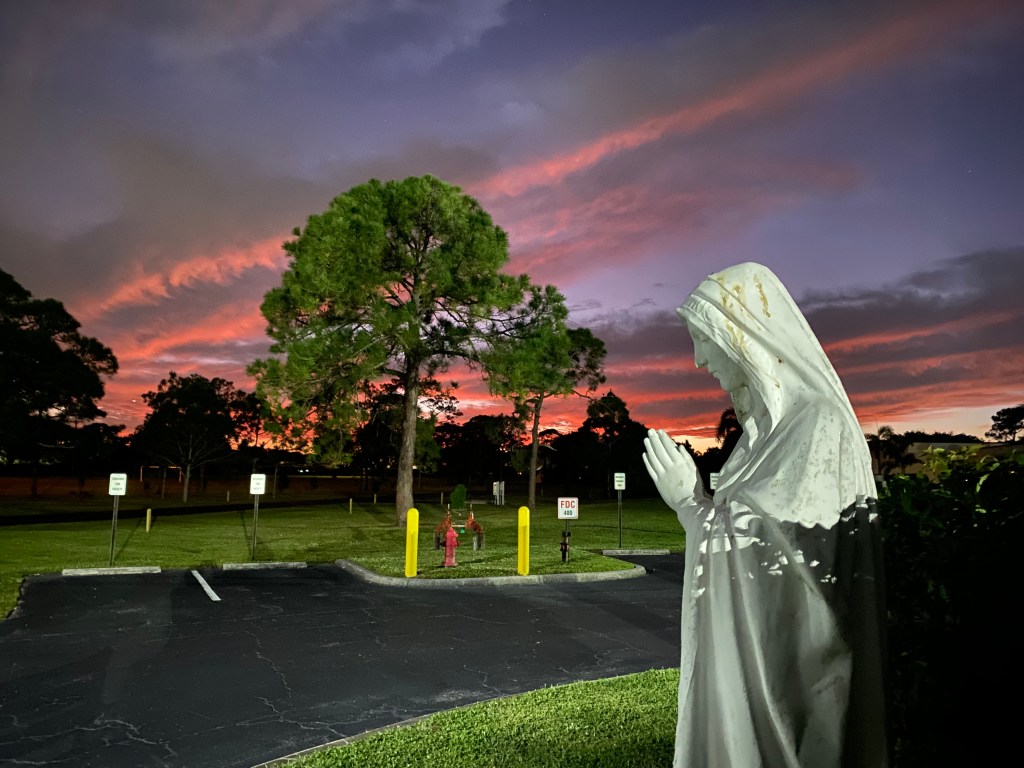
Photo: The last line of the plaque below the statue of Mary reads: “You are also bearers of my Son.” Like the moon reflecting the light of the sun, Mary reflects the light of her Son. May we do the same.

Link for the Mass readings for Sunday, February 18, 2024.

The Divine Physician is inviting us to experience forgiveness, healing, and his love.

Think about how good we feel after coming to be on the other side of healing from a bad cold or the flu, recovering from a twisted ankle, a broken collar bone, or other health conditions. We experience a feeling of wholeness that was missing during the midst of our suffering where we may have pondered a time or two whether we would ever get better.

The same can be said for estranged relationships. The distance of separation can be agonizing, an inner gut-wrenching experience that gnaws away at us. We wonder if there can ever be a coming back together. Then when reconciliation, forgiveness, and amending of the brokenness of relationships does happen, we can experience such a relief, lightness and joy, that we never imagined possible while in the midst of the gut wrenching angst, conflict, and separation.

Sin separates us from one another, and unchecked sin can build and multiply like cancerous cells. The Pharisees and the scribes questioned why Jesus was eating with tax collectors and sinners, and Jesus replied: “Those who are healthy do not need a physician, but the sick do. I have not come to call the righteous to repentance but sinners” (Lk 5:32).

Jesus is truly a light in the darkness. For Levi and his friends, who just settled for the path they were on, thinking and feeling, this is the best it was going to get, were given a choice, an invitation, a new way. A great celebration of fellowship ensued in Levi’s home because these men and women, who had been outcasts, who were separated from the greater community were forgiven, welcomed, and embraced. They were loved by Jesus as they were. They did not have to change first for Jesus to call Levi and gather with them.

They were welcomed into the kingdom and reign of God. Their ticket to reconciliation and healing was accepting the invitation of Jesus, to receive and experience his love and welcome. Levi and the other sinners did not run from the light of Jesus, but were willing to recognize their need for healing, were willing to repent, to turn away from their prior ways of life and so were reborn!

They were divinized because of their willingness to participate in the life of Jesus. Levi would continue to follow Jesus such that it was no longer he who lived, but Christ who lived in him (cf. Galatians 2:20)!

Jesus invites us each day, as he invited Levi in today’s Gospel, to follow him. We are given the same invitation and opportunity for healing and for discipleship. Will we resist rationalizing and justifying our sinful thoughts, actions, and habits, welcome the light of Jesus that reveals our venial and mortal sins, and admit that we are in need of healing, and repent so as to be forgiven and released from all the energy we have expended in protecting and hiding from ourselves and our God who loves us more than we can ever mess up?

Quietly spending time daily, especially in the evening and recalling our day, by asking Jesus to reveal to us those ways in which we have not lived according to his will is a wonderful practice. Those sins we call to mind we can confess on the spot and Jesus will forgive us. As we recognize recurring actions or more serious sins, we will need a more direct human encounter by embracing the Sacrament of Reconciliation. Reconciliation is a gift of mercy and healing where we can experience firsthand the healing grace of Jesus.

Jesus loves us as we are. Yet holding on to our sin, keeps us at a distance from experiencing the greater breadth and depth of his love. We only need to be willing to be contrite, to embrace sorrow for the harm we have inflicted with our personal sins and go to the Divine Physician in our time of prayer and/or Reconciliation. Once absolved, the heavy weight is lifted, and we are healed. We are then better able to engage in penance to atone for our sins committed, better able to forgive others as we have been forgiven, and to love as we have been loved!

——————————————————————–

Photo: Rosary walk over Thanksgiving break, St. Peter Catholic Church, Jupiter, FL.

Link for the Mass readings for Saturday, February 17, 2024