Are we weeds or wheat?

“’Master, did you not sow good seed in your field? Where have the weeds come from?’ He answered, ‘An enemy has done this.’ His slaves said to him, ‘Do you want us to go and pull them up?’ He replied, ‘No, if you pull up the weeds you might uproot the wheat along with them. Let them grow together until harvest” (Mt 13:27-30).

The master warned his servants to let the wheat and weeds grow together until they were more mature at the time of the harvest, so as not to pull up the wheat with the weeds. Weeds in this verse is translated from the original “Greek [as] zizanion [which] refers to a noxious weed that in its early stages closely resembles wheat and cannot be readily distinguished from it” (Harrington 2007, 204). Both, in their immature state, were indistinguishable.

Jesus is helping his disciples and to resist the temptation of condemning one another. Even when there are those who commit heinous acts of evil, and we may feel justified, Jesus says no. We are to convict another of their actions, and we are certainly to hold each other accountable, but condemn, no. The Father is the ultimate arbiter and judge. The Father sent his Son, not to condemn, but to save. There is always hope for repentance and a change of heart.

All of humanity has been created in the image and likeness of God, each of us are a unique gift to this world. We have been created good, yet all of us fall short of the glory and grace of God and because of our fallen nature our image and likeness to God has dimmed. God the Father will judge at the end of time between the wheat and the weeds and only he knows the time or the hour. Let us leave the judgment to God. Our invitation is to repent and align ourselves to the will of God, to encourage each other in the maturation process which can include, convicting others when needed, yes, but above all with love, willing each other’s good.

We are to resist the temptation the poisonous practices of gossip, prejudice, and self righteousness that create division and separation. Instead let us welcome, nurture and care for one another, promote unity while respecting the diversity of each person and their thought. We can disagree and have a good argument when we keep it at the level of an exchange of ideas while refraining from dehumanizing one another, and in the end accompany and be there for one another through thick and thin.

Not an easy path. What will help us, is to recognize that we are all in need of healing and transformation. Let us pray for patience, understanding, seek forgiveness, as well as be willing to forgive each other. Life, even when going well, is hard. We need the encouragement and support of each other if we are to mature and actualize the fullness of who God calls us to be as we strive through God’s grace to restore our image and likeness to God. “Encourage each other while it is still today” (Hebrews 3:13)!
—————————————

Photo: No wheat on Rosary walk but did find some sea oats. Riomar Beach, Vero Beach, FL.

Link for the Mass readings for Saturday, July 27, 2024.

Harrington SJ, Daniel J. “The Gospel of Matthew”. In vol. 1, Sacra Pagina Series, edited by Daniel J. Harrington. Minnesota, Liturgical Press, 2007.

Let us reflect the light of the mercy of Jesus as the moon reflects the light of the sun.

I say to you, something greater than the temple is here. If you knew what this meant, I desire mercy, not sacrifice, you would not have condemned these innocent men. For the Son of Man is Lord of the sabbath.” (Mt 12:6-8).

Jesus continues to rock established regulations and practices. Here he is challenging the understanding of the Sabbath itself when justifying the accusations leveled toward his disciples who were picking and eating grain on the Sabbath, and he does so in a profound way by saying that,“something greater than the temple is here.” Present in the heart of the temple, the area called the Holy of Holies, was the ark of the covenant. Atop the ark was the lid called the mercy seat of God. Jews believed that this was where God sat and when the blood of atonement was offered from sacrifices, God’s mercy was offered to the people. In the temple then, was the mercy seat, the very presence of God.

Jesus’ claim that he is greater than the temple is putting him on the same level as God. A blasphemous statement to say the least, unless of course, he is God. Jesus even doubles down by claiming that he is the Lord of the sabbath; Jesus used this latest challenge by those Pharisees seeking to trap him to help to reveal to them, his disciples, and us today that Jesus is God!

In quoting Hosea 6:6: “I desire mercy, not sacrifice”, Jesus is not only saying that he is the something greater, but that his Way is something greater. One of the foundational points of the Way of Jesus is mercy. Through the incarnation, the Son of God dwelt among us, became one with us in our humanity. He restored our dignity in the midst of our brokenness and sin. What Jesus said, in defending his disciples eating from the grains of wheat on the Sabbath, he is saying to us today: “What is owed to every human being on the basis of his or her human dignity is personal respect, personal acceptance, and personal care” (Kasper 2014, 202).

We grow closer to God and one another when we put Jesus’ teachings into practice. This is especially true when we bestow acts of mercy on our neighbor. “The works of mercy are charitable actions by which we come to the aid of our neighbor in his [or her] spiritual and bodily necessities. Instructing, advising, consoling, comforting are spiritual works of mercy, as are forgiving and bearing wrongs patiently. The corporal works of mercy consist especially in feeding the hungry, sheltering the homeless, clothing the naked, visiting the sick and imprisoned, and burying the dead. Among all these, giving alms to the poor is one of the chief witnesses to fraternal charity: it is also a work of justice pleasing to God” (Catechism of the Catholic Church).

Jesus came among us not to condemn us, but to forgive, instruct, and advise, to comfort, console, and provide care and accompany us in our needs. He extends mercy as his starting point, as his invitation. Jesus was and continues to be willing to join us in the midst our chaos. He does not wait for us to be perfect or worthy. He only asks if we are willing to allow him to love and heal us and then are we willing to enter the chaos of others and allow him to work through us to provide the same. Reviewing and examining our consciences with the spiritual and corporal works of is a good place to start. Praying about and deciding which one(s) to put into practice is a good next step. 

—————————————

Photo: Rosary walk, view from the midpoint of the Merrill P Barber Bridge, Vero Beach, FL.

Link for the Mass readings for Friday, July 19, 2024

Kasper, Walter. Mercy: The Essence of the Gospel and the Key to Christian Life. NY: Paulist Press, 2004.

Catholic Church. Catechism of the Catholic Church: Revised in Accordance with the Official Latin Text Promulgated by Pope John Paul II. Vatican City: Libreria Editrice Vaticana, 1997.

Focus on God who alone matters now.

“But the seed sown on rich soil is the one who hears the word and understands it, who indeed bears and yields a hundred or sixty or thirtyfold” (Mt 13:23).

God loves us. All of creation and each one of us have been created out of an outpouring of his love. God wants to be in relationship with us and like a good Father wants the best for us. He has sent his Son to be one with us in our humanity so that we can become one with him in his divinity. Time and again, generation after generation, since Adam and Eve, there are those who have rejected the Father’s love, rejected his Son, and the stirrings of the Holy Spirit.

In Jesus explaining the Parable of the Sower to his disciples, he is expressing why people may turn away from the generosity of God’s love. In a modern context we can experience hearing a word that touches our heart in Mass during one of the readings, prayers, homily, or verse from one of the hymns, or while in our own personal time of prayer. We are moved or even challenged. The devil can then threaten to take it away, we can meditate upon it for a time and then move onto other things forgetting this graced moment, we may even bring it back to mind for a time, but not apply it or put what we have learned into practice. Instead of taking firm root, maturing, sprouting and bearing fruit we remain spiritually immature.

Those who have “rich soil” to receive Jesus are those who hear his word, ponder it, return to it often, and put it into practice. The discipline of putting into practice what we have received from Jesus is the key for it taking firm root and transforming our lives. We are so focused too many times on completing and moving on to the next thing that, even when moved, touched, or challenged by his word, we can set the wondrous experience aside to move onto the next task.

I have been inspired and challenged recently by the words of Romano Guardini: “This restless being wants to pray. Can he do it? Only if he steps out of the stream of restlessness and composes himself. This means discarding roaming desires and concentrating on that thing alone which, for the time being, is the only one that matters… to become still; to free oneself of everything which is irrelevant, and to hold oneself at the disposal of God, who alone matters now” (Guardini, 12).

The message imparted by these words is not new, and this is a practice that I have been engaged in for years. Yet, these words engaged me, especially, “hold oneself at the disposal of God, who alone matters now.” They have been like rich compost that has been nourishing my prayer life and daily experiences for the past week. When my mind starts to wander, I bring it back, “God alone matters now.” and then a calming breath follows and I continue.

This is a good practice to begin to prepare rich soil, to return to, and go deeper with! All the invitations, temptations, apparent goods and glitter, pale in comparison to the hunger and desire that we all experience which is for a deeper intimacy with God. No one or nothing else fulfills. When we put all else aside and focus on God alone, he satisfies. Grounded in his infinite love, our relationships improve because we no longer cling out of a fear of losing them. We enjoy the material more because we no longer project onto them what they could never provide. Anxieties and fears lessen because we feel more safe and secure.


Photo: Enjoying a Rosary walk and the oaks of the neighborhood of Vero Beach, FL.

Link for the Mass readings for Friday, July 26, 2024

Guardini, Romano. The Art of Praying: The Principles and Methods of Christian Prayer.Manchester, NH: Sophia Institute Press, 1985.

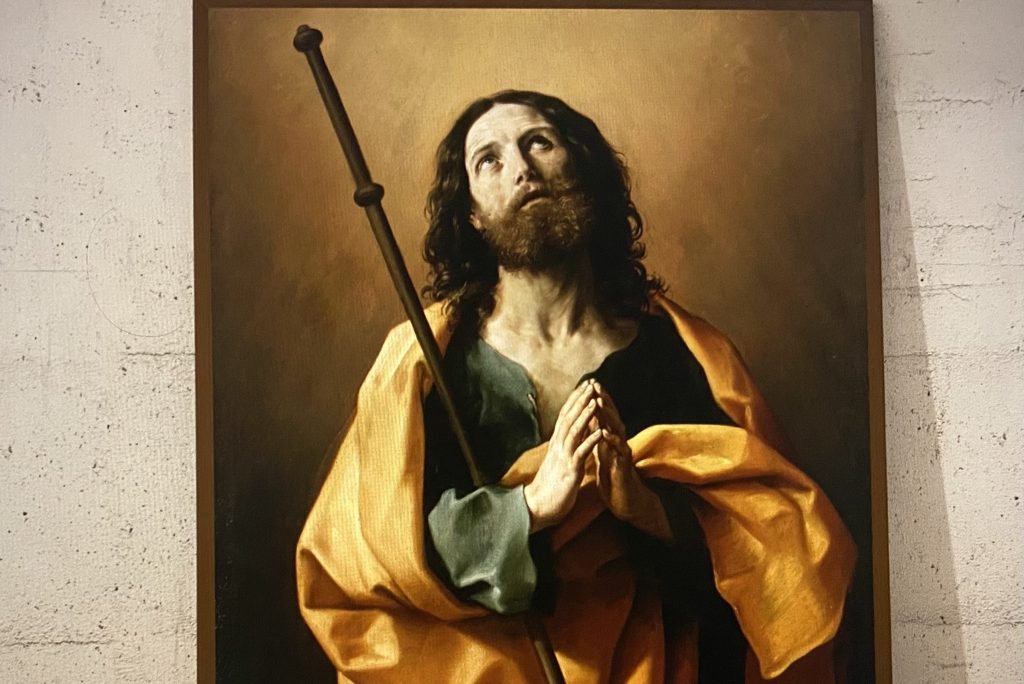
Following Jesus and St. James, we can learn to listen, love, and serve.

“The mother of the sons of Zebedee approached Jesus with her sons and did him homage, wishing to ask him for something. He said to her, ‘What do you wish?’ She answered him, ‘Command that these two sons of mine sit, one at your right and the other at your left, in your Kingdom’” (Mt 20:21-22).

The context of this request from the mother of the sons of Zebedee, James and John, comes from reading a few verses before the quote above. Start reading at Matthew 20:17 and you will see that Jesus and his twelve apostles are heading toward Jerusalem. Jesus stops to share with them, for the third time, that he will be condemned and crucified.

Jesus’ statement of his imminent suffering and death appears to be ignored by the mother of James and John. The other ten are indignant, not because of the apparent lack of acknowledging Jesus’ statement, but about who is the greatest among them! It is easy to imagine how a chaotic scene could then insue! As Saint John Chrysostom wrote: “See how imperfect they all are: the two who tried to get ahead of the other ten, and the ten who were jealous of the two” (Chrysostom 1975, 1552)!

This event is recorded in Matthew, Mark, and Luke. Mark has James and John speaking for themselves, not their mother, as in Matthew. Luke does not even record the initial request of James and John at all but comes in at the point of the apostle’s dispute. What all record, including the Gospel of John, is Jesus’ interjection where he made it clear to his apostles that he came to serve, not to be served. To follow Jesus meant, not that James and John would be given positions of honor and power in the worldly sense, the sitting at his right or his left, but that they were to serve as he served, to love as he loved.

As disciples of Jesus, one of the most powerful ways we can serve, the most powerful ways we can love, is to be truly present, done most effectively when we actively listen. This is done when we look at each other, resist the temptation of thinking about our own needs, and/or thinking about what we are to say. We put the book down, set the work aside, turn off the tv, put away the cell phone, disengage our thoughts, and instead look at and listen to what the person before us has to say.

This discipline becomes easier when we are willing to do the same with God who we can’t see. We do so when we are willing to be still, to stop, breathe and set everything aside, even our thoughts, to be present with and listen to Jesus. One does not have to come before the other. In the course of the day, it is good to have quiet times with Jesus and also intentional time with family members, friends, colleagues, as well as those to whom, in the past, we may not have given the time of day.

Jesus came to love, to listen, and to serve. May we too give of ourselves with our time and undivided attention toward those he directs us to love, listen, and serve. When we are present with one another the other gift of grace is that we experience the love of the Holy Spirit between us. St. James surrendered his pride and learned this practice well, and he has helped me on multiple occasions. St. James, pray for us!

—————————————

Painting: St. James by Guido Renin (1636-38)

Chrysostom, St John. Homily. The Liturgy of the Hours: According to the Roman Rite. Vol. 3. NY: Catholic Book Publishing, 1975.

Parallel Gospel passages to review:
Mark 10:35-45; Matthew 20:20-28; Luke 22:24-27 and John 13:12-17

Link for the Mass readings for Thursday, July 25, 2024

Stillness counters the threat of thorns.

“Some seed fell among thorns, and the thorns grew up and choked it” (Mt 13:7).

God wants all of us to be in relationship with him. His love for us in unconditional. He is willing to risk that we will say, “No” to his invitation of relationship rather than force us to love him, which is not love at all. God also wants the best for us, he knows the deepest desires of our heart beyond our even knowing for he sees the fullness of time, while we only see and experience a small part.

Jesus came to share the seed of his Father’s word through the teachings, healings, and exorcisms that he offered. We are recipients of each through the deposit of faith passed on generation after generation. One area that prevents us from allowing his seeds to germinate and bear fruit in our lives is when we allow the diversions, distractions, anxieties and worries to fill our mind such that they choke out the good that Jesus seeks to have develop within us.

On a physiological level, what we pay attention to fires neurons in our brains that form neural pathways. Each time we are attentive a new pathway is formed. After time, this is how our habits form and why after we do something consistently and are disciplined, the act is easier to do. It is also why a habit is hard to change in the beginning because we need to rewire those pathways.

To prevent the growth of our spiritual life from being choked out we need to practice each day stillness and focusing on God’s word. As we consistently sit in the same place each day, spend some time breathing and then focusing on reading a passage of scripture, praying, and/or pondering what God may be sharing with us, for that time we do so, we are to focus on Jesus alone. As thoughts and diversions to the contrary arise, we just bring ourselves back to Jesus and God’s word.

In time, with consistent, daily practice, we will begin to feel safe, we will experience God’s love and presence, his insights and guidance, we will heal, we will rewire our neural pathways such that it becomes easier to pray than not to pray. The thorns lose their sting, the distractions, temptations, and diversions lose their power as we begin to recognize God’s voice and follow his guidance.

Turning around unhealthy or sinful habits is not easy. When we decide to make time to spend time with God each day, while together we are attentive to only to him for that time we set aside and return to him as soon as we notice we are distracted, his seed with grow within us. Even when we feel like nothing is happening, God is happening, and we are growing and maturing.


Photo: Rooted and abiding in God’s love, we can grow free of that which seeks to choke us. Rosary walk Vero Beach, FL.

Link for the Mass readings for Wednesday, July 24, 2024

Following the will of God helps us to grow closer to Jesus and each other.

What Jesus proposes is not an either/or statement, but is meant to be a both/and statement. The end goal of our life is to be in communion with God. To attain that goal, we need to not only acknowledge that God exists but also come to know and follow God’s will. As Jesus said, “For whoever does the will of my heavenly Father is my brother, and sister, and mother.” (Mt 12:50). The challenge is that there is so much that pulls at us for our attention, so much that reaches out to divert us. People, activities, material pursuits are all vying for first place for our minds, hearts, and souls.

Then there are the challenges, demands, joy and wonders of family life. We often read, hear, and experience ourselves, how much the family is being challenged in our modern age from without and within. Many of us strive to put family first in our lives. That ought to and needs to be a priority as healthy relationships require commitment, love, sacrifice, and persistence. What Jesus offers then seems to be counter-intuitive to that reality.

Jesus is interrupted while he is teaching, and told that his mother and brothers were there wanting to see him. We would think he would say, “Great! Bring them right in, I have a place reserved for them here, front and center!” Yet, I am sure that his comment, “Who is my mother? Who are my brothers” (Mt 12:49), raised a few eyebrows and hackles.

Jesus was not choosing his disciples over his family, he was clarifying that the primacy of place of God his Father is to be first and foremost. “For whoever does the will of my heavenly Father is my brother, and sister, and mother” (Mt 12:50). Families come in many different shapes and sizes, one size indeed does not fit all. Building our relationship with our heavenly Father is the foundation toward striving toward healthier relationships.

As our ego and self-centeredness become less of a focus, we slowly come to realized we are not the center of the universe. This is no overnight or easy process, but as we surrender a little more each day to the truth that God is our Father and Jesus is our Lord, we will begin to experience the love of the Holy Spirit a little more. As the relationship of God becomes foremost in our life, we will begin to change. We will become more patient, understanding, less reactive, and more present to one another.

As we continue to mature in our spiritual life, we will also begin to experience the fruit of the Holy Spirit: love, joy, peace, patience, kindness, goodness, gentleness, and self-control (cf. Galatians 5:22-23). In sharing what we have received, we will be more available to others and better able to foster deeper relationships with our own family members, while at the same time experience a larger extended family, with those beyond blood. Let us surrender ourselves and all of our relationships to and entrust them into Jesus’ care.

Who was the closest relationship Jesus had? Mary. Not because she gave birth to him, but because who better than Mary followed the will of his Father? If life with some family members is a little bumpy right now or you just want to deepen your familial bonds, begin your day with Mary and say often, “May it be done to me according to your word” (Lk 1:38) and let God happen.


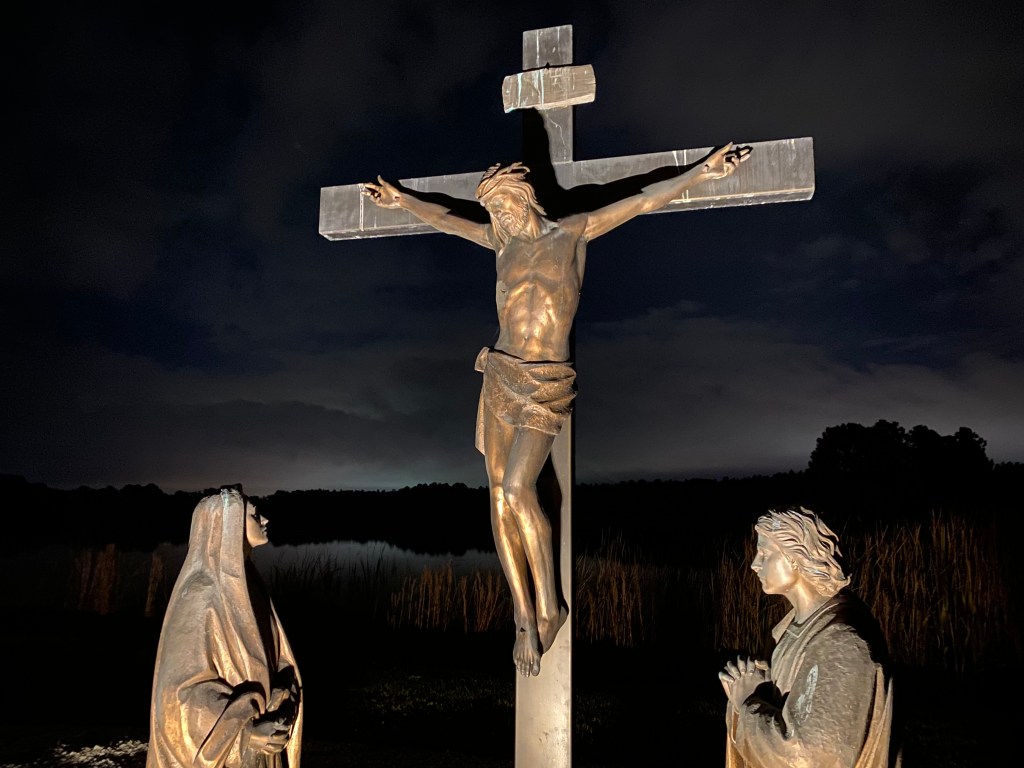
Photo: Mary and John followed Jesus all the way to the Cross. While on canonical retreat last December at Bethany Center, Lutz, FL.

Link for the Mass readings for Tuesday, July 23, 2024

Mary Magdelene remained, did not run, and encountered Jesus.

Mary Magdalene went and announced to the disciples, “I have seen the Lord,” and then reported what he told her (John 20:18).

Mary is the Apostle to the Apostles! Though before she announces this proclamation, the foundation of our faith that Jesus has risen, we find Mary weeping outside the tomb. She is crushed by the death of her teacher and his body appeared to have been taken away. Peter and John, following Mary’s initial lead, ran to the tomb, saw it empty, and “then the disciples returned home” (Jn 20:10).

Mary stayed, she remained still, experiencing her doubt and growing despair.

How many times have our hopes been obliterated, what pain have we or do we endure, what horrors do we continue to witness in our lives, throughout our communities, country, and the world? When Jesus first speaks to Mary, she does not recognize his voice, thinking him to be the gardener. Are we like Mary, that we are so weighed down by our sorrow that we are unable to recognize Jesus in our midst?

Mary’s courage gives us a gift. She was willing to weep, to experience and not run from her sorrow, and deep down held on to hope. Even after seeing the tomb empty, even after Peter and John had left, she still looked in the tomb again. Despite a growing doubt and despair, even after encountering two angels, she did not leave the empty tomb. She remained and Jesus came to her. Mary then recognized the risen Jesus when he called her by name!

May we also not lose the ability to weep and to also hold on to hope. Both are part of our humanity. To lose our capacity to weep is to risk the slide into the temptation of indifference to our own pain and the agony of others. Hope is one of the foundational stones of our faith. Jesus is present in the midst of our pain, suffering, and sin. When we are willing to be still and experience our emotions, resist the temptation to run away from them, or cover them up with many other diversions, while at the same time embracing hope, we too will encounter Jesus.

Jesus is willing to come as close to us as he did with Mary in our trials and/or sorrows, even in the agony we experience at the loss of our loved ones. While at the same time, Jesus is also present in our joys and successes, as he is with the full range of our emotions. After we encounter Jesus, like Mary, may we go boldly forth with joy, to proclaim what he tells us! May we share the stories of our encounters with Jesus so to be a living Bible to others. Our stories shared may be the only Bible someone else ever reads.

Mary of Magdalene, Apostle to the Apostles, pray for us!!!


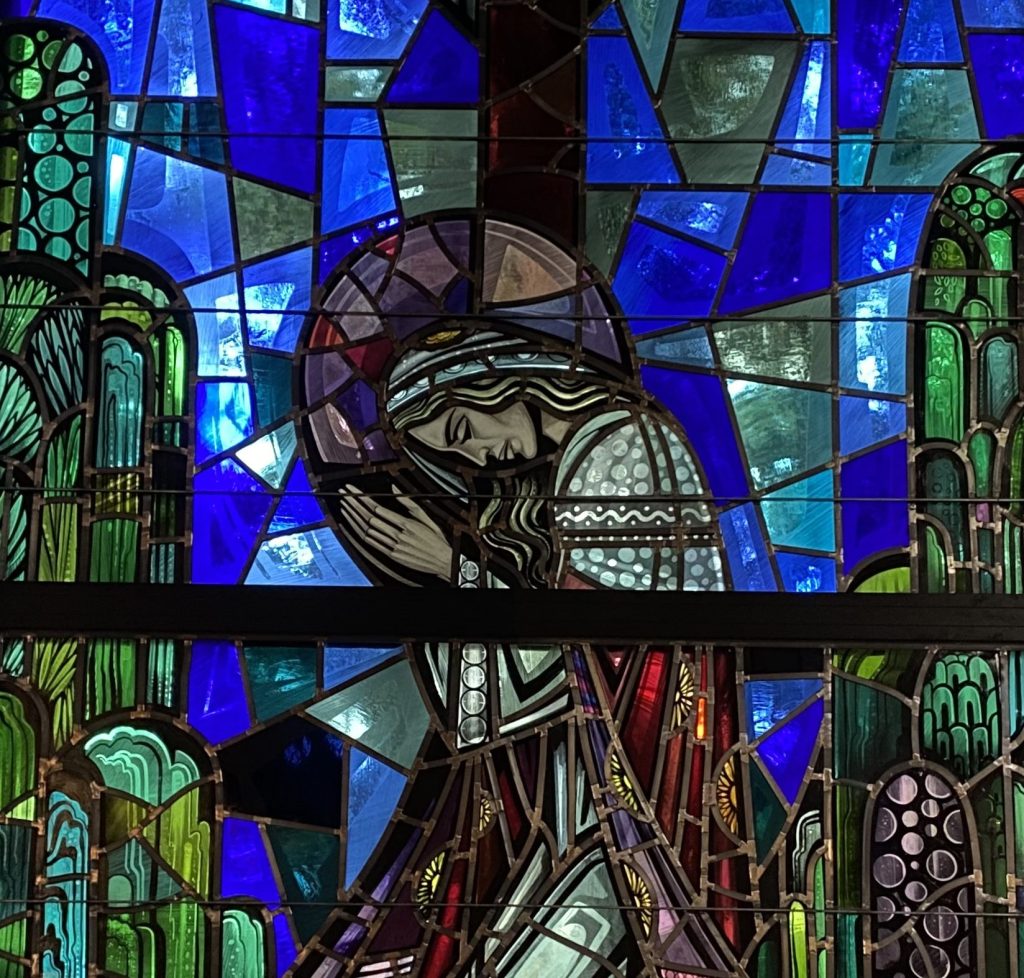
Photo: Praying with Mary, behind the altar at Holy Cross, Vero Beach.

Link for the Mass readings for Monday, July 22, 2024

Let all thoughts be still, and focus on Jesus alone.

Jeremiah, Psalm 23, and the Gospel of Mark all draw on the image of a shepherd. God as shepherd is referred to about twenty-four times in the Bible. The most famous is from Psalm 23. “The Lord is my shepherd; there is nothing I shall want…” The imagery in this psalm is one in which God is the shepherd who cares, protects, gives refreshment, and provides.

Jeremiah though, as the mouthpiece of God, is calling out those “who mislead and scatter the flock of” (Jer. 23:1) God’s pasture. They are not good shepherds, and the ultimate Shepherd will punish “their evil deeds” and he will go out to his flock and bring them back home. Not only will God provide new shepherds, but he will raise up “the righteous shoot of David.”

Jeremiah did not know, but we read his book and recognize that this righteous shoot is Jesus. God sent his Son to go out and save his sheep and provide security for them. God chose a people for himself, Israel. As the chosen people, they were chosen not for their sake alone but in God’s timing to be a light to all the nations.

In the incarnation, the birth of the Son, fully human and fully divine, the kingdom of heaven is at hand. As he continued his ministry he saw the needs of the people, their need for a shepherd. As in today’s account from Mark, Jesus sees the hunger of those who wait for him at the shore. He does not turn the boat away, even though he and his disciples need rest. “His heart is moved with pity for them, for they were like a sheep without a shepherd”(Mk 6:34). Jesus comes to them and us, to teach, care for, and love us.

Saul was a faithful Jew and also a shepherd of his people, seeking to protect his flock from those he thought to be wolves in sheep’s clothing. Until, on that fateful day, he encountered the Good Shepherd and experienced his correction, teaching, compassion and love, and his whole world was turned upside down. Saul became Paul and became a key piece in proclaiming the Gospel not only to the Jews but to the Gentiles. In the letter to the Ephesians, we see a shepherd seeking both those who were near, Jewish Christians, and those who were far off, Gentile Christians.

Paul sought to lead the people away from their limited points of view. They were stuck on the merely horizontal view. He was leading them to look up to the things of God, the purpose of God, which was the salvation of all. To get there, each one he taught and each one of us, needs to know the voice and needs to know the Good Shepherd.

Each of us have a point on the horizontal plane. Our goal is to move toward the zenith point, who is God. It does not matter how far away we are at the beginning, as long as we keep our eyes on Jesus, listen for his voice, and take each step following his lead.

To know the voice of the Shepherd, to know and experience his love, his love beyond all understanding so that we can be filled with the fulness of God, we must be people of prayer. Our minds are so diverted, so distracted, so restless such that when the Shepherd speaks, we do not hear him.

The Shepherd “speaks in the silence of our hearts” (St. Mother Teresa). We need not only to step away from the external noise and busyness of our daily lives, but we also need to learn to quiet our thoughts and focus our mind on him alone. During Mass or in our time of prayer, whether that quiet time be five, ten, or twenty minutes, we must let everything else go. When thoughts come roaring back, we just return to Jesus.

We often balk at this invitation because we feel we just don’t have enough time and no sooner do we stop praying “than there is plenty of time, and [we] fritter it away with useless activities. To recollect oneself means to overcome this deception which springs from unrest and become still; to free oneself of everything which is irrelevant, and to hold oneself at the disposal of God, who alone matters now” (Guardini, 12).

Just for this time in Mass, just for your time in prayer, even if only in the moment before, during and after receiving the Eucharist, let Jesus be first, let all else fall away. When we discipline ourselves to give ourselves this time with the Shepherd, we will begin to know his voice, we will begin to experience his love for us. The compassion that Jesus showed those on the shore, he feels for each one of us. We too will experience his compassion, his love, and his peace when we are willing to be still, breathe, listen, and free our minds from everything else and allow him to come close.


Photo: Putting Servant of God, Romano Guardini’s words into practice last night – Riomar Beach, Vero Beach, FL.

Link for the Mass readings for Sunday, July 21, 2024

Guardini, Romano. The Art of Praying: The Principles and Methods of Christian Prayer.Manchester, NH: Sophia Institute Press, 1985.

Jesus will help us to discern when to walk away and when to stand firm.

In today’s Gospel from Matthew, Jesus realized that: “The Pharisees went out and took counsel against Jesus to put him to death” (Mt 12:14). Jesus did not then start to plan how he would defend himself against their plot, he did not arm his supporters, nor is there any indication that Jesus let the fact that he was a marked man bother him. What did Jesus do with this bit of news?

“He withdrew from that place” (Mt. 12:15) and cured those who followed him. Was Jesus being a coward by withdrawing? No. Jesus refused to engage or give any of his time or energy to their negativity or threat. He focused on what he was about and that was continuing the mission that God had sent him to achieve, which was to help bring about the salvation of humanity and the world and to call those who would work with him to continue his mission.

Many of us will hopefully not receive death threats, but many of us have and may witness and/or receive critical, negative, belittling, or dehumanizing looks, words, and outright actions to cause physical, mental, emotional or spiritual harm. For those of us who choose to practice publicly the teachings of Jesus, we may receive even more!

Our common response to the many forms of perceived or actual animosity directed toward us is to react. Our reactions generally are based on learned defense mechanisms we have adopted. Often when we react, we slip into survival mode, experience increased anxiety, defensiveness, anger as well as a myriad of other emotions. Hopefully, as we mature in our faith we will resist reacting, remember to breath, and call upon God’s guidance to direct us such that we can be less reactive and more attentive to how to act as advocates of God’s grace.

Life is short, let us not take a day or moment for granted, nor give away our precious time by engaging in unneeded drama or negativity. There are times that we do need to stand and speak up. Other times, as Jesus did today, we need to walk away and direct our energies elsewhere. With each challenge, may we call on Jesus for his discernment on how best to act in each situation.

The words of Teresa of Avila, Spanish saint and doctor of the Church, (1514-1582) are good ones to repeat and meditate upon: “Let nothing disturb you, Let nothing frighten you, All things are passing away: God never changes. Patience obtains all things. Whoever has God lacks nothing; God alone suffices.”


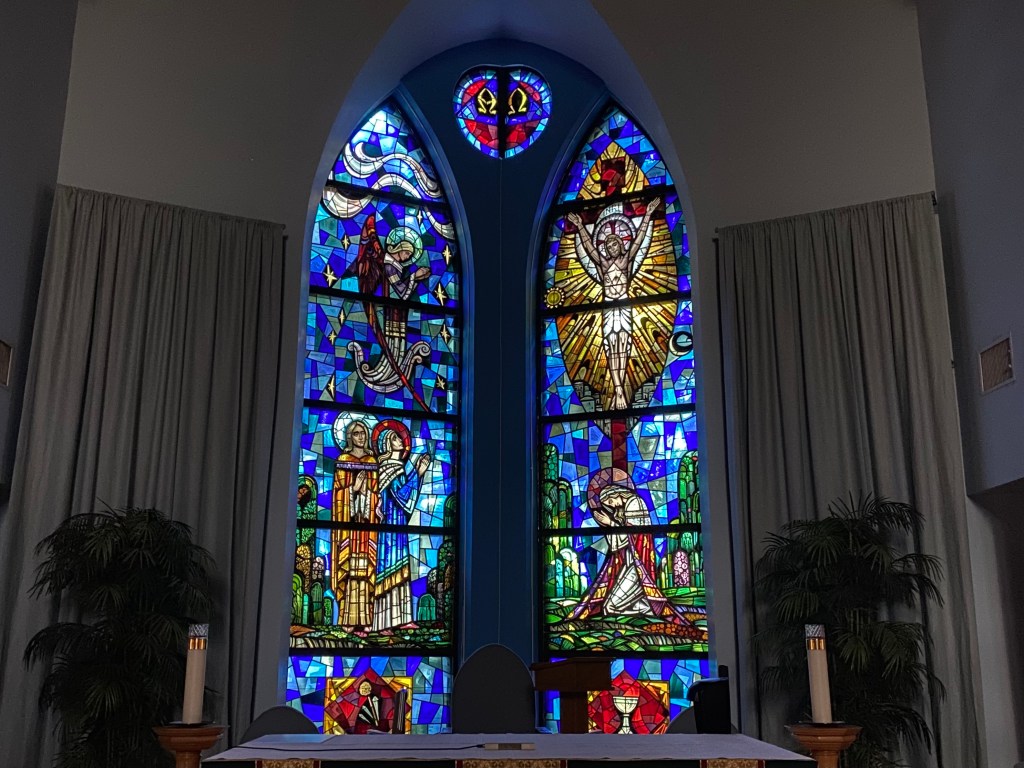
Photo: Jesus walked away from today’s threat but was willing to endure the greatest suffering of all when his appointed time had come to save and restore us to the Father. Praying in the sanctuary of Holy Cross, Vero Beach.

Link for the Mass readings for Saturday, July, 20, 2024

Our burdens will be easier when we allow Jesus to help us carry our load.

Jesus said: “Come to me, all you who labor and are burdened, and I will give you rest” (Mt 11:28).

Scripture scholar, Fr. Daniel J. Harrington, SJ, stated that in this passage Jesus’ invitation was given to those who are not yet his disciples, those Jews who do not yet believe in him and the way that he is proposing. Jesus is calling them from the heavy burdens laid upon them by the scribes and Pharisees and inviting them to accept his burden that is lighter (cf. Harrington, 167). We can read this in Matthew 4:3: “They tie up heavy burdens [hard to carry] and lay them on people’s shoulders, but they will not lift a finger to move them.”

Jesus’ charge leveled against the Pharisees comes from those who have experienced the laws without the assistance and support to follow them. The demands of Jesus are even more challenging than those of the Pharisees, Sadducees, or the scribes! I shared yesterday one of the six antitheses, here is another: “You have heard that it was said… whoever kills will be liable to judgment. But I say to you, whoever is angry with his brother will be liable to the judgment, and whoever says to his brother, ‘Raqa,’ will be answerable to the Sanhedrin, and whoever says, ‘You fool,’ will be liable to fiery Gehenna” (Mt5:21-22). Jesus is equating calling someone Raqa – an airhead or calling someone a fool akin to murder. Our words can destroy or empower! We need to choose our words wisely.

The difference between Jesus and many of the religious leaders of his time is that Jesus, the Son of God in the fullness of his divinity, was willing to enter into the chaos of our humanity. He experiences and suffers along with us. He invites us to yoke ourselves to himself. This will lighten the load that we carry. Many impose burdens on us, and we can impose burdens on others. We also impose them on ourselves and turn away from the invitation of Jesus’ help.

A handful of injuries I have suffered through the years were because I attempted to lift or carry something beyond my strength, instead of seeking assistance from another. I would think, “I can do it, I don’t want to bother anyone.” That is just the physical; there are also the mental and emotional burdens of anxiety, doubt, pride, fear, and worry that we burden ourselves with. This is not Jesus’ way.

Jesus offers us a path to follow that leads us to experience joy, peace, and tranquility in this life and fulfillment and union with God in the next. No matter what pain, suffering, trial, and/or challenge we are facing right now, we do not have to go through it alone. We just need to remember to reach out our hand to Jesus and when we do, what we will find is his hand already extended ready to grasp ours. Many times, the offering comes from those who are close to us, who are more than willing to help.

In aligning ourselves with God’s will, life isn’t necessarily going to be easier, but he will give us the strength and peace of mind not only to endure but to experience a peace that surpasses all understanding while doing so. Let us take our first step together today, hand in hand with Jesus, and so find rest in knowing that we are not alone!

Also, may we be kind to those in our midst with our words, actions, and faces. Among those who may be abrupt or rude, resist the temptation of reacting and instead be present and understanding; for we are not aware of the burdens others are carrying. Offer instead a simple smile as a start, instead of an instant reaction returned in kind, a posture of patience and understanding, which can make a heavy load just a little lighter.
—————————————

Photo: Restful end of the day with Rosary walk.

Harrington, S.J. Daniel J. The Gospel of Matthew. Vol. 1 of Sacra Pagina, edited by Daniel J. Harrington, S.J. Collegeville, MN: Liturgical Press, 2007.

Link for the Mass readings for Thursday, July 18, 2024