
Jesus leads us to slow down so we can experience the love and presence of his Father.

“Holy Father, keep them in your name that you have given me, so that they may be one just as we are one” (Jn 17:11).

Jesus is well aware of the temptations of the world, recognizes that the disciples will need the protection of his intercession, that they will remain faithful only if they remain in his love and in relationship with him. The unity that the Father and Son share is an eternal and infinite communion. Jesus, as the Son of God, continued to be one with his Father, while fully experiencing his humanity. As a human being, Jesus faced the same temptations present in this world that we face. The difference is that with each choice that he made, as a human being with a free human will, he chose to be faithful to his Father. The unity of his humanity and divinity remained intact and deepened.

Jesus sought the same unity that he shares with his Father for his disciples, and he seeks the same for us today. His hope is that we may be one as he and the Father are one. Yet, he is not going to pull us out of the world for that to happen. “I do not ask that you take them out of the world but that you keep them from the Evil One” (Jn 17:15). The disciples then and us today, are to do as Jesus did. We are to welcome the invitation to be in a relationship with God, grow in relationship with him so that we come to know his voice and will, and share it with those we encounter in our realm of influence. We are not to be transformed by the world, but to be transformed by the renewal of our minds and hearts by the love of the Holy Spirit. Through our transformation, we can then bring Jesus’ light into the darkness as God works through us one person at a time.

Following the will of God is simple but not easy and hard work to undo dysfunctional neural pathways, habits, that we have built over years and decades. We are bombarded by distractions, diversions, and temptations that attempt to wear us down and draw us away from being faithful and true to God, ourselves, and who God calls us to be. Many times, these distractions not only appear to be, but are good. The challenge is not whether we are good or evil, even are we being good or doing good, but are we doing God’s will, what God is calling us to do?

Being able to stop, be still, quiet our mind, and just breathe for a sustained period can help us to learn to recollect. Often when we attempt to spend time in prayer, we finish at the moment we are just getting ready to begin, and, then wonder why nothing is happening! Making time to recollect grants us the opportunity to transition from the busy to making friends with silence.

We can deepen our relationship with Jesus and his Father and experience the love of the Holy Spirit when we slow down our pace and become still. We are also in a better place to receive the gifts that the Holy Spirit seeks to impart, his guidance to discern his direction, as well as the courage to follow his will. Resting in silence, we may also experience emotions, some that have been buried. And that is good, because we are now feeling safe enough to experience them and with God release them and begin to heal. 

St. Mother Teresa taught that, “in the silence of the heart, God speaks.” We are better able to recognize God’s voice, experience his healing, and guidance when we embrace daily moments of stillness. We are better able to identify the temptations and pitfalls, dysfunctional patterns, and sins that prevent us from healing when we go slower. We grow in discipline, persistence, and dedication when we allow ourselves to be nourished by God’s love and affirmation. 

A new way of life is available for us when we are willing to change, to be transformed, and grow beyond the comfort zone of the dysfunction we know. We can trust Jesus, such that even through the growing pains, we will experience the love and oneness Jesus shares with his Father. We are not alone.

————————————————————————–

Photo: “Peace, be still” (Mark 4:39). When we are willing to slow down, Jesus offers us his peace.
Link for the Mass readings for Wednesday, May 20, 2026

Jesus’ ascension opens up heaven for us.

For many of us, when we hear about the Ascension of Jesus, we are just as beguiled as the disciples who, as recorded in the Book of Acts, were standing around, looking at the sky. Also, depending on where you live, will depend on when you celebrate this solemnity and for those of us in diocese’s that celebrate it on Sunday may be beguiled on why we don’t celebrate it on Ascension Thursday. 

If you live in the ecclesiastical Provinces of Boston, Hartford, New York, Newark, Omaha, and Philadelphia you already celebrated Ascension Thursday on its traditional day, this past Thursday. For the rest of the country, it is celebrated today, on Sunday. The reason for Ascension Thursday is that the Ascension of Jesus took place 40 days after the resurrection and 10 days before Pentecost. The point of concern for moving to Sunday observance may be lack of attendance on Thursdays. Solemnities are obligatory because we are celebrating the foundational anchor points of our faith. 

The event to remember and the readings offered enhance what and why we believe what we believe on an annual basis over the liturgical year and actively participating in these celebrations helps us to grow closer to God and each other as well as have a better understanding about the core tenets of our faith. Just as we celebrate birthdays, anniversaries and special occasions in the lives of our families, we do so in the life of the Church. I agree with Pope Francis that it is important for us to celebrate our baptismal days as well. Which I still do not do and forget even which day it was. Wait a minute… 

I just went and checked my files. I was baptized July 18, 1965, at the Church of the Sacred Heart in Bloomfield, CT. You may want to check to see your date of Baptism. That I was baptized in the Church of the Sacred Heart I don’t think I ever knew, but it aligns with a teaching I received last evening at a talk with Fr. John Horn. Jesus is present deep in the heart of all of us, in the very depths of our souls. The reality of that truth is activated by our Baptism! Something beautiful to celebrate!

Our baptisms are made possible because of Jesus, who as the Son of God, was willing to be sent by his Father to become one with us in our humanity without sacrificing his divinity. Jesus, lived among us, experienced the joys and sufferings of life like us in all things but sin, yet chose to enter into solidarity with our sinful human condition when he submitted to the baptism of repentance offered by John and then would take upon himself the full weight of our sins on the cross.

Jesus then died, entered into the utter godforsakeness of death, and conquered death. He rose again through the Love of the Holy Spirit, not as a ghost or a spirit, but still fully divine and fully man. His body was transfigured in the resurrection becoming the firstborn of the new creation, embodying the fullness of the humanity that God the Father always intended. 

Jesus returned to the Apostles and the close inner circle of disciples and for forty days would teach and prepare them further until the time of his ascension, which we celebrate today. Though those closest to him couldn’t bear losing him a second time, Jesus had to go. 

Not so much up, up, and away in my beautiful balloon, or zipping away like Superman to destroy an asteroid hurtling toward the earth. Nor was it that Jesus had had enough of his followers and left them to fend for themselves. After the forty days that he spent gathering his disciples, eating with, teaching, and empowering them to continue his work of making the will of his Father known, Jesus ascended back to the Father still fully human, and with our humanity as well. 

This is a type of physical and spiritual physics. God did not create us as autonomous and completely independent. God created to be interconnected and this is why St. Paul can write to the Corinthians, “For just as in Adam all die, so too in Christ shall all be brought to life” (1 Cor. 15:23)!

Bishop Robert Barron has explained it this way: “The Ascension is the translation of this earthly reality into a heavenly reality.” Jesus is no longer limited by the time and space of our present temporal reality. He transcends our recognized three-dimensional reality and now exists at a higher pitch of existence. Just as Jesus was able to pass through a locked door, he is able to be present to us at Mass on Thursday or Sunday or any time that the Mass is celebrated anywhere in the world in his glorified Body made present again on the altar. The priest up the Eucharist, Jesus present in his glorified Body for all gathered to see: “Behold the Lamb of God, behold him who takes away the sins of the world.” 

He who did not sin, took sin upon himself on the cross to conquer the power of sin and death so that in each Mass, we can say in the words of and trust like the centurion: “Lord, I am not worthy that you should enter unto my roof, but only say the word, and I shall be healed.” Jesus is present to all of us everywhere because we are united by our humanity and the humanity and loving embrace of Jesus!

Through the event of the Ascension, Jesus brings something of our humanity to heaven, and at Pentecost, which we will celebrate next week, he will send something of heaven to us in the descent of the Holy Spirit. And who is the Holy Spirit, but the Love that is breathed, that is shared between the Father and the Son.

What the Ascension means for us is that we are separated no longer from the reality of heaven. St Irenaeus wrote that “Jesus opened up heaven for us in the humanity he assumed.” We can see this displayed in biblical accounts such as the sky was torn open at the baptism of Jesus, as the veil was torn in two outside the Holy of Holies in the temple at the moment of his crucifixion, and as Jesus ascended with our humanity, to return to the right hand of the Father. Heaven and earth have been wedded in the birth, life, death, resurrection and ascension of Jesus.

We become part of the Church, the bride of Christ through encountering Jesus in the Sacraments, especially in our Baptism when we become part of the Body of Christ, when we are nourished by the Eucharist, and empowered through love of the Holy Spirit at Confirmation. Jesus did not leave us alone when he ascended, he did not close the door to us. Because of Jesus, there is an invitation to experience intimacy with him and God the Father. By our Baptism, we become an organic part of the Mystical Body of Christ and now as long as we remain in communion and relationship with him, we experience healing, life, and trinitarian love through our participation in the life of Jesus.

We are transformed, divinized, restored to our image and likeness to God through our participation in the life of Jesus. We are made holy, and our commission, the same as the Apostles, is to continue the work of being a bridge for the communion of the human and the divine. We are to follow the will of God, on earth as it is in heaven, to “Go, therefore, and make disciples of all nations” (Mt 28:19).

Having heard this Good News of the Ascension, let us not, as the two angels said about the disciples, just “stand around looking at the sky” (cf. Acts 1:1-11), but go forth and share the love that we receive in the Eucharist, when we consume him, or even through a spiritual communion if we are unable to receive the Eucharist at this time. Jesus is no longer limited by space and time, and he invites all to participate on earth what is celebrated in heaven, the love of the communion between the Father, and the Son, and the Holy Spirit. Amen! Alleluia!!!

————————————————————–

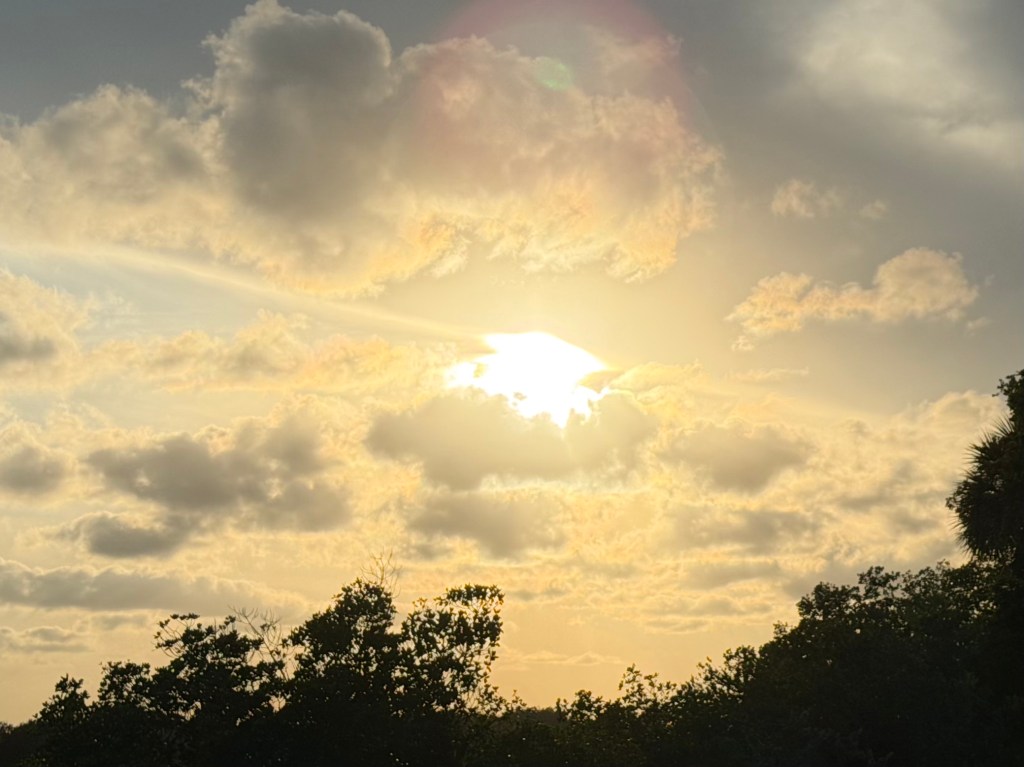
Photo: Beautiful moments God gives us in the Bible as we had from Acts today about the Ascension, and the book of his creation as the sun was setting.

Link for the Mass readings for Sunday, May 17, 2026

Jesus ascended up but not away! He is now closer to us than we are to ourselves.

For many of us, when we hear about the Ascension of Jesus we can be just as confused as the disciples who as recorded in the Book of Acts were standing around, looking at the sky. Also, depending on where we live, will depend on when we celebrate this solemnity. If you live in the ecclesiastical Provinces of Boston, Hartford, New York, Newark, Omaha, and Philadelphia you already celebrated Ascension Thursday on its traditional day, this past Thursday. For the rest of the country, as we do here in Florida, it is a holy day of obligation celebrated today, on Sunday. The reason for Ascension Thursday is that the Ascension of Jesus took place 40 days since the Resurrection and 10 days before Pentecost.

The Ascension is just as significant as is Jesus’ suffering and death that we remember during Lent and his Resurrection that we have been recalling during this Easter Season. Regarding what the Ascension of Jesus is, sometimes, we can understand a term better by saying what it is not. The Ascension was not an event where Jesus went up, up, and away in a beautiful balloon, or Superman zipping away to destroy an asteroid hurtling toward the earth.

The Ascension is the culminating event of the Paschal Mystery of Jesus Christ. Jesus who as the Son of God became a human being like us in the Incarnation, lived among us, experienced the joys and sufferings of life like all of us in all things but sin. Yet, Jesus took our sins upon himself on the cross. Jesus died, entered into the utter godforsakeness of death and conquered death. He rose again through the power of the Love of the Holy Spirit, not as a ghost or a spirit, but still fully God and fully man, yet his body was transfigured. In his glorified body, Jesus became the first born of the new creation.

For forty days after his Resurrection, Jesus spent time with his disciples. “Forty days (or the number forty in general) always symbolizes a time of transition, a time of purification and a time of preparation for a new stage” (Pitre). This is evident in the Noah flood account. God cleansed the world from sin and established a new covenant with Noah and his family setting the stage for a new beginning. Moses spent 40 forty days meditating with the Lord to give the people new commandments and a new covenant charting a new course for those that God had freed them from slavery in Egypt. Jesus himself spent 40 days in the desert, a transition time after his baptism and before beginning his public ministry, preparation to face the devil, and resist his temptations.

Jesus also spent forty days with his disciples after his Resurrection, to prepare them, to help them to understand the truth of the kind of Messiah he was. Not a political and military leader, but the suffering servant of Isaiah. The Son of God was sent by his Father to defeat Satan, undo his strongholds, and free us from our slavery to sin by giving his life and conquering death. He commissioned his apostles to go out to do as he had done, to cast out demons, to heal, to preach with authority, to preach repentance, and to forgive sins. They were to be martyrs, witnesses by their life, teaching to the Jews first but as well to all nations, and even giving their lives as Jesus had done to promote the faith Jesus passed on to them.

Then at the appointed time, just as Jesus descended from his Father in heaven, he would return. This time though he would ascend fully divine as well as fully human. Jesus led his followers “out as far as Bethany, raised his hands, and blessed them. As he blessed them he parted from them and was taken up to heaven” (Luke 24:50-51).

This was no simple goodbye gesture. Jesus revealed in this action his role as high priest. He blessed his followers as the high priest, Aaron, blessed the people after he had made the sacrificial offerings for their sins (cf. Leviticus 9:22). With this blessing offered, Jesus “parted from them and was taken up to heaven” (Luke 24:51). As Bishop Robert Barron explains: “The Ascension is the translation of this earthly reality into a heavenly reality.”

Jesus is no longer limited by the time and space of our present three dimensional realm. He transcends our recognized dimension and now exists at a higher pitch of existence. Just as Jesus passed through the locked door to bestow peace on his disciples, Jesus ascended to offer himself to his Father in the heavenly Temple. As we heard in the letter to the Hebrews: “Christ did not enter into a sanctuary made by hands, a copy of the true one, but heaven itself, that he might now appear before God on our behalf” (Hebrews 9:24).

Jesus gave himself as an offering for our sins and did so once for all and for all time. This is why Jesus is present to us at every Mass on Thursday or Sunday or any time that the Mass is celebrated anywhere in the world. Jesus is present to us where two or more are gathered in his name and he is present when we proclaim, read and pray with the words of the Bible. Jesus is present to all of us everywhere because we are united as one in his abiding love!

Through the event of the Ascension, Jesus brings something of our humanity to heaven and at Pentecost, which we will celebrate next week, he sent something of heaven to us in the descent of the Holy Spirit. And who is the Holy Spirit, but the Love that is breathed, that is shared between the Father and the Son.

What the Ascension means for us is that we are no longer separated from the reality of heaven. St Irenaeus wrote that, “Jesus opened up heaven for us in the humanity he assumed.” Our relationship with God our Father is made possible again because of the Ascension of Jesus. The biblical images foretell this great event, as the sky was torn open at the baptism of Jesus (Mark 1:10), as the veil was torn in two outside the Holy of Holies (Matthew 27:51) in the temple at the moment of his crucifixion, and as Jesus ascended in the fullness of his glorified body, with our humanity, to return to the right hand of the Father.

Heaven and earth have been wedded. We become part of the Church, the bride of Christ through our Baptism, we are nourished in receiving the Eucharist, and empowered in Confirmation. Through our baptism we are grafted, conformed to, and become an organic part of the Mystical Body of Christ. We are transformed, divinized, participate in the life of God through our participation in the life of Jesus. We are made holy, our image to God is restored. Jesus blesses through the priest at the end of every Mass and sends us as he did his apostles and the saints of each successive generation “to go into the whole world and proclaim the gospel to every creature” (Mark 16:15).

Having heard this Good News of the Ascension, let us not, as the two angels said about the disciples, just “stand around looking at the sky” (Acts 1:11) but go forth and share the love of his very being that we receive in the Eucharist and invite all to participate on earth what is celebrated in heaven, the love of the communion between the Father, and the Son, and the Holy Spirit. Amen! Alleluia!!!


Photo: View as I walked out of the sanctuary of St. Mark the Evangelist after celebrating my first public Mass in Spanish for the vigil of the Ascension.

Brant Pitre’s commentary on the Ascension

The Mass readings for the Sunday readings of the Ascension, June 1, 2025