Jesus’ ascension opens up heaven for us.

For many of us, when we hear about the Ascension of Jesus, we are just as beguiled as the disciples who, as recorded in the Book of Acts, were standing around, looking at the sky. Also, depending on where you live, will depend on when you celebrate this solemnity and for those of us in diocese’s that celebrate it on Sunday may be beguiled on why we don’t celebrate it on Ascension Thursday. 

If you live in the ecclesiastical Provinces of Boston, Hartford, New York, Newark, Omaha, and Philadelphia you already celebrated Ascension Thursday on its traditional day, this past Thursday. For the rest of the country, it is celebrated today, on Sunday. The reason for Ascension Thursday is that the Ascension of Jesus took place 40 days after the resurrection and 10 days before Pentecost. The point of concern for moving to Sunday observance may be lack of attendance on Thursdays. Solemnities are obligatory because we are celebrating the foundational anchor points of our faith. 

The event to remember and the readings offered enhance what and why we believe what we believe on an annual basis over the liturgical year and actively participating in these celebrations helps us to grow closer to God and each other as well as have a better understanding about the core tenets of our faith. Just as we celebrate birthdays, anniversaries and special occasions in the lives of our families, we do so in the life of the Church. I agree with Pope Francis that it is important for us to celebrate our baptismal days as well. Which I still do not do and forget even which day it was. Wait a minute… 

I just went and checked my files. I was baptized July 18, 1965, at the Church of the Sacred Heart in Bloomfield, CT. You may want to check to see your date of Baptism. That I was baptized in the Church of the Sacred Heart I don’t think I ever knew, but it aligns with a teaching I received last evening at a talk with Fr. John Horn. Jesus is present deep in the heart of all of us, in the very depths of our souls. The reality of that truth is activated by our Baptism! Something beautiful to celebrate!

Our baptisms are made possible because of Jesus, who as the Son of God, was willing to be sent by his Father to become one with us in our humanity without sacrificing his divinity. Jesus, lived among us, experienced the joys and sufferings of life like us in all things but sin, yet chose to enter into solidarity with our sinful human condition when he submitted to the baptism of repentance offered by John and then would take upon himself the full weight of our sins on the cross.

Jesus then died, entered into the utter godforsakeness of death, and conquered death. He rose again through the Love of the Holy Spirit, not as a ghost or a spirit, but still fully divine and fully man. His body was transfigured in the resurrection becoming the firstborn of the new creation, embodying the fullness of the humanity that God the Father always intended. 

Jesus returned to the Apostles and the close inner circle of disciples and for forty days would teach and prepare them further until the time of his ascension, which we celebrate today. Though those closest to him couldn’t bear losing him a second time, Jesus had to go. 

Not so much up, up, and away in my beautiful balloon, or zipping away like Superman to destroy an asteroid hurtling toward the earth. Nor was it that Jesus had had enough of his followers and left them to fend for themselves. After the forty days that he spent gathering his disciples, eating with, teaching, and empowering them to continue his work of making the will of his Father known, Jesus ascended back to the Father still fully human, and with our humanity as well. 

This is a type of physical and spiritual physics. God did not create us as autonomous and completely independent. God created to be interconnected and this is why St. Paul can write to the Corinthians, “For just as in Adam all die, so too in Christ shall all be brought to life” (1 Cor. 15:23)!

Bishop Robert Barron has explained it this way: “The Ascension is the translation of this earthly reality into a heavenly reality.” Jesus is no longer limited by the time and space of our present temporal reality. He transcends our recognized three-dimensional reality and now exists at a higher pitch of existence. Just as Jesus was able to pass through a locked door, he is able to be present to us at Mass on Thursday or Sunday or any time that the Mass is celebrated anywhere in the world in his glorified Body made present again on the altar. The priest up the Eucharist, Jesus present in his glorified Body for all gathered to see: “Behold the Lamb of God, behold him who takes away the sins of the world.” 

He who did not sin, took sin upon himself on the cross to conquer the power of sin and death so that in each Mass, we can say in the words of and trust like the centurion: “Lord, I am not worthy that you should enter unto my roof, but only say the word, and I shall be healed.” Jesus is present to all of us everywhere because we are united by our humanity and the humanity and loving embrace of Jesus!

Through the event of the Ascension, Jesus brings something of our humanity to heaven, and at Pentecost, which we will celebrate next week, he will send something of heaven to us in the descent of the Holy Spirit. And who is the Holy Spirit, but the Love that is breathed, that is shared between the Father and the Son.

What the Ascension means for us is that we are separated no longer from the reality of heaven. St Irenaeus wrote that “Jesus opened up heaven for us in the humanity he assumed.” We can see this displayed in biblical accounts such as the sky was torn open at the baptism of Jesus, as the veil was torn in two outside the Holy of Holies in the temple at the moment of his crucifixion, and as Jesus ascended with our humanity, to return to the right hand of the Father. Heaven and earth have been wedded in the birth, life, death, resurrection and ascension of Jesus.

We become part of the Church, the bride of Christ through encountering Jesus in the Sacraments, especially in our Baptism when we become part of the Body of Christ, when we are nourished by the Eucharist, and empowered through love of the Holy Spirit at Confirmation. Jesus did not leave us alone when he ascended, he did not close the door to us. Because of Jesus, there is an invitation to experience intimacy with him and God the Father. By our Baptism, we become an organic part of the Mystical Body of Christ and now as long as we remain in communion and relationship with him, we experience healing, life, and trinitarian love through our participation in the life of Jesus.

We are transformed, divinized, restored to our image and likeness to God through our participation in the life of Jesus. We are made holy, and our commission, the same as the Apostles, is to continue the work of being a bridge for the communion of the human and the divine. We are to follow the will of God, on earth as it is in heaven, to “Go, therefore, and make disciples of all nations” (Mt 28:19).

Having heard this Good News of the Ascension, let us not, as the two angels said about the disciples, just “stand around looking at the sky” (cf. Acts 1:1-11), but go forth and share the love that we receive in the Eucharist, when we consume him, or even through a spiritual communion if we are unable to receive the Eucharist at this time. Jesus is no longer limited by space and time, and he invites all to participate on earth what is celebrated in heaven, the love of the communion between the Father, and the Son, and the Holy Spirit. Amen! Alleluia!!!

————————————————————–

Photo: Beautiful moments God gives us in the Bible as we had from Acts today about the Ascension, and the book of his creation as the sun was setting.

Link for the Mass readings for Sunday, May 17, 2026

A fast from the busy can help us to decompress and reset.

In the Gospel of Matthew, we read today about the account of Jesus comparing himself to a bridegroom: “The days will come when the bridegroom is taken away from them, and then they will fast” (Mt 9:15). In a sense, the bridegroom has been taken from us, in another sense, he is closer to us now than he was when he was with his disciples and walked the earth. The fullness of his reign though will not be consummated until Jesus comes again, but while we wait, when we are willing to set aside other distractions and be still, we can hear and experience of the beating of his Sacred Heart.

We need food for our survival, but we don’t need as much as we think we do! Fasting from food is not the only focus of our Lenten fast. The discipline of fasting provides an opportunity to keep our passions in check. By resisting the impulse of instant gratification, we are able to better discern between apparent goods and the actual Good in our lives. When we are able to navigate through the maze of distractions, diversions, temptations, and allurements on a physical level, we can begin to go deeper into the spiritual reality to begin to expose some of the demons that we feed, such as “distrust, apathy, and resignation”.

Pope Francis mentioned that these three demons “deaden and paralyze the soul of a believing people.” He continued by stating that: “Lent is the ideal time to unmask these and other temptations, to allow our hearts to beat once more in tune with the vibrant heart of Jesus.”

When we are willing to discipline our impulsiveness, to slow down, to take time to recollect even with a few deep breaths, we can begin to see more clearly God’s will for our lives. We can then be more open to God’s invitation to grow in relationship with him and each other. We can better assume the posture of John the Apostle by resting our head on the chest of Jesus (cf John 13:25), such that our hearts will beat in the same rhythm as his Sacred Heart.

This is the gift of contemplation drives us to service. This is the same rhythm that beat in the prophet Isaiah who reminds us in today’s first reading what true fasting is all about:  “releasing those bound unjustly, untying the thongs of the yoke; Setting free the oppressed, breaking every yoke; Sharing your bread with the hungry, sheltering the oppressed and the homeless; Clothing the naked when you see them, and not turning your back on your own” (Isaiah 58:6-7).

————————————————————————

Photo: Stillness, quiet moments, while experiencing the wonder of God’s creation helps us to experience, can help us to slow down and allow our heart to beat with he rhythm of Jesus’ sacred heart.

Link for Pope Francis homily:

Pope Francis offers a “worksheet” for Lent: Check it out!

Link for the Mass readings for Friday, February 20, 2026

Jesus is offering to us his heart, are we willing to receive it?

We can observe two movements of Jesus going out to serve others in today’s Gospel. The first is evident in the beginning verse: “When Jesus saw the vast crowd, his heart was moved with pity for them, for they were like sheep without a shepherd; and he began to teach them many things” (Mk 6:34). Jesus was moved with pity or compassion and he also witnessed, beyond their immediate physical hunger their deeper, spiritual ache. hey were not even aware of the depth of their hunger.

They just had spent time with Jesus, experienced and had heard of the many other accounts of him preaching with authority, his healings, and exorcisms. They wondered if he could be the Messiah, the one who had been promised, present now in their midst. Yet, for the vast number of them, if not all gathered, they sought the kind of leader, that Jesus was not. He was not to be a mighty military leader, he would not train his followers in guerilla warfare, and Jesus would not conquer the Roman occupation with might.

After his teaching, the time grew late and he and his disciples were aware of the hunger of the crowd. The disciples only saw the five loaves and two fish that were present, barely if enough to feed the Twelve, let alone the vast multitude. Their first instinct was to send them on their way such that they could fend for themselves. Jesus, who knew the Father, knew there were no limitations to his providential care. Jesus: Then, taking the five loaves and the two fish and looking up to heaven, he said the blessing, broke the loaves and gave them to [his] disciples to set before the people; he also divided the two fish among them all (Mk 6:41).

Jesus shepherded and provided nourishment for five thousand men, so if that number was not including women and children, the number could have been easily doubled, and all ate and were satisfied (Mk 6:42). Jesus was aware of their deepest needs and provided for them. Jesus knew their spiritual hunger as well as their physical hunger, better than those who came to listen to him. This deeper desire, in time, he would provide as well.

Are we so different today? We think we know what we need, but how many times are they really apparent or disordered goods or substitutes for what we truly hunger for deep down? We continually strive to be autonomous, self-sufficient, able to control and govern our own affairs. We witness this when the disciples wanted to send off the people to get their own food, and they would deal with the meager amount they had. Yet, this is counter to who we have been created to be.

Jesus showed his disciples time and again the way of God was not self-sufficiency, but self-surrender. They were and we are to place our complete reliance on God. The deepest hunger we all have is to be loved by God. Can we allow ourselves to be loved? Will we remain still long enough to experience his love? Do we believe in some form of lie that says we are unlovable? If so, renounce it and replace it with the words of John: “In this is love: not that we have loved God, but that he loved us and sent his Son as expiation for our sins” (1 John 4:10).

To experience this love, we are invited to spend time with Jesus regularly just as we would to help nourish any human relationship. With only a small amount of bread and fish, Jesus was able to give enough to the multitude so that all were satisfied. So too, the amount of time we spend is not as important as that we spend time with him each day. The little bit of intentional time we give to Jesus, he will receive and share his love with us. Jesus requires nothing from us. When we are willing to offer him our poverty, recognize our need for, and acknowledge that we depend on him, we allow our heart to beat with the rhythm of his sacred heart.


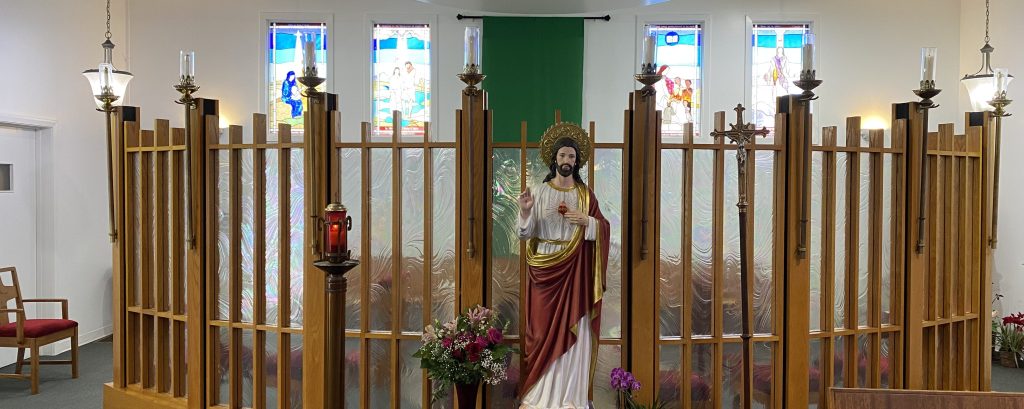
Photo: Statue of the Sacred Heart of Jesus, grounds of USML, Mundelein, IL.

Link for the Mass readings for Tuesday, January 6, 2025

May we slow down our pace so that our hearts beat in tune with “the vibrant heart of Jesus.”

In the Gospel of Matthew, we read today about the account of Jesus comparing himself to a bridegroom: “The days will come when the bridegroom is taken away from them, and then they will fast” (Mt 9:15). In a sense, the bridegroom has been taken from us, in another sense, he is closer to us now than he was when he was with his disciples and walked the earth. The fullness of his reign though will not be consummated until Jesus comes again, but while we wait, when we are willing to set aside other distractions and be still, we can hear and feel the beating of his Sacred Heart.

We need food for our survival, but we don’t need as much as we think we do! Fasting from food is not the only focus of our Lenten fast. The discipline of fasting provides an opportunity to keep our passions in check. By resisting the impulse of instant gratification, we are able to better discern between apparent goods and the actual Good in our lives. When we are able to navigate through the maze of distractions, diversions, temptations, and allurements on a physical level, we can begin to go deeper into the spiritual reality to begin to expose some of the demons that we feed, such as “distrust, apathy, and resignation”.

Pope Francis mentioned that these three demons “deaden and paralyze the soul of a believing people.” He continued by stating that: “Lent is the ideal time to unmask these and other temptations, to allow our hearts to beat once more in tune with the vibrant heart of Jesus.”

When we are willing to discipline our impulsiveness, to slow down, to take time to recollect even with a few deep breaths, we can begin to see more clearly God’s will for our lives. We can then be more open to God’s invitation to grow relationship with him and each other. We can then better assume the posture of John the Apostle by resting our head on the chest of Jesus (cf John 13:25), such that our hearts will beat in the same rhythm as his Sacred Heart.

This is the gift of contemplation that drives us to service. This is the same rhythm that beat in the prophet Isaiah who reminds us in today’s first reading what true fasting is all about:  “releasing those bound unjustly, untying the thongs of the yoke; Setting free the oppressed, breaking every yoke; Sharing your bread with the hungry, sheltering the oppressed and the homeless; Clothing the naked when you see them, and not turning your back on your own” (Isaiah 58:6-7).

————————————————————————

Photo: Some quiet time in prayer last week after Mass while still at St Clement Catholic Church in Santa Monica, CA.

Link for Pope Francis homily:

Pope Francis offers a “worksheet” for Lent: Check it out!

Link for the Mass readings for Friday, March 7, 2025