baptism

The least of us are greater even than that John because of our baptism in Christ.
Amen, I say to you, among those born of women there has been none greater than John the Baptist; yet the least in the Kingdom of heaven is greater than he” (Mt 11:11).
Jesus shared that there has been no greater than John the Baptist. John is a bridge from the Old Covenant to the New. To say that John and Jesus played significant roles in ushering in the Kingdom of heaven is an understatement. For they both preached the same message of repentance, of the need for all to recognize how and where they had turned away from and needed to turn back to God. This is a key invitation for us as well during the preparatory seasons of Advent and Lent. May we have the ears to hear!
John lived a life of asceticism giving all to God, rejecting the material comforts of his time, choosing to live in the wilderness, and relying solely on the divine providence of God. He followed in the line of the prophets and he did so with full-throated confidence and fearlessness. Many were moved by his words and came to repent. John though ministered not to put himself on a pedestal, his role was to prepare the way for the coming of the Messiah. He was to assist in ushering in the Kingdom of heaven, as he himself was not the Kingdom. John knew well, Jesus was to increase and he was to decrease (cf. Jn 3:30). John’s words of speaking truth to power also led to his martyrdom. The death of John signaled the time for Jesus’ public ministry to begin.
Jesus recognized the contribution and place of John in his Father’s plan, yet he also shared how “the least in the Kingdom of heaven is greater than he.” The reason Jesus made this claim was that John’s baptism was one of repentance. The Baptism Jesus instituted was one of a new life of communion. Through our being baptized in the name of the Father, and of the Son, and of the Holy Spirit, we have been given a new life and are incorporated into his Mystical Body.
Through our Baptism, we, in participation with Jesus, become priests, prophets, and kings. Through the gift of the common priesthood, we are to sacrifice our time, giving of ourselves in prayer, worship, and service; our talent, embracing the unique gifts God has given us to share; and our treasure, being good stewards of the blessings God has given.
As prophets, we are to speak the word of God, speak truth to power as John and Jesus did, we are to be the voice of the voiceless and stand for up for the human dignity of all those who are vulnerable or mistreated from the moment of conception, through each stage of life, until natural death.
We are to be servant kings, resisting the temptation to seek our own power, glory, fame, and riches, and instead surrender ourselves to the will of our Father, and like his Son wash the feet of those in need. There is no service of our brothers or sisters that we ought to feel is beneath us in reaching out in love, which is to will the good of each other.
Advent is our time to repent, to recommit, to rediscover the wonderful relationship we are invited to embrace and are called to share: The infinite, divine love of God the Father, God the Son, and God the Holy Spirit, whose name we have been baptized in.
Advent is also an opportunity to slow down and remember why we do what we do. Each time we pass the baptismal font we bless ourselves with the Sign of the Cross. We are invited to resist the temptation of dipping in our fingers and continuing to move ahead on the fly. Instead, may we stop, dip our fingers and intentionally make the Sign of the Cross calling to mind each person of the Trinity.
This practice also provides us the opportunity to recommit ourselves to our baptismal vows, to renounce Satan and all evil, to affirm our commitment to the Trinity, Jesus Christ our Lord, and one Holy Catholic and Apostolic Church. Just as we do this when we enter, we may repeat the gesture and brief meditation when we depart. We leave as bearers of the Christ who we have received at Mass to go forth into our realm of influence to love one another as Jesus loves us, with an all-embracing, unconditional love!
Photo: Last minute touch ups the eve before opening Holy Cross again for public Mass after completion of our renovation.

“He will baptize you with the Holy Spirit and fire.”
I am baptizing you with water, for repentance, but the one who is coming after me is mightier than I. I am not worthy to carry his sandals. He will baptize you with the Holy Spirit and fire (Mt 3:11).
John is offering a baptism of repentance. The people are coming to him, some traveling up to twenty miles through the desert. They were not coming to the Temple, the formal place of worship, but to the wilderness. John, the son of a priest, and so a priest, represents an answer to the hunger of the people that is no longer being fulfilled by much of the religious leadership of his time. He is the embodiment of the prophet who has returned – Elijah, who himself also dressed in “a hairy garment tied with a leather belt” (2 Kings 1:8). He speaks for God and the people are willing to listen and follow him because of his authenticity. And in his time he was most likely more popular than Jesus was in his. Jesus himself said that there was no one born on the earth greater than John (Matthew 11:11).
Yet, John the Baptist is clear that he is not the long-awaited Messiah. He is just the precursor as was promised. “John’s appearing in the desert dressed like Elijah would have signaled to the Jews that he was playing the part of the long-awaited Elijah, preparing for the Lord’s coming” (Mitch and Sri, 63). John as with the prophets like Elijah who had gone before him was preaching the need for repentance. He is preparing the hearts and minds of the people, inviting them to repent, to turn away from their sins and self-centered ways so that they will be prepared to recognize the Lord when he comes.
The baptism of Jesus was and is different than John’s. It is a baptism not just of repentance, but also of “the Holy Spirit and fire.” The baptism of Jesus will be wholly transformative. Fire consumes and transforms that which it touches and the Holy Spirit is often symbolized by fire. Within the Jewish tradition and found in the Old Testament, fire is associated with purification. The purifying and transformative fire of the Holy Spirit is love.
Love is an expanding, unitive force. It is a direct counter to the self-focused, curving in upon oneself and divisiveness of the fallen nature of our humanity. Love is an act of the will and draws us out to be engaged with the betterment of others. When we experience the love of God we are changed and transformed. This is not a one time be all encounter, but one that is to be experienced and shared consistently. The more we share the love of God the more we receive, and the more love we receive, the more we are transformed.
John the Baptist reminds those coming to him and us who read the Gospel of Matthew today that none of us are worthy of God’s love. That does not mean that we are bad. We just fall, short on our own, of the glory of God. We do not deserve nor can we grasp God for ourselves. No matter our will power and diligence, we must be willing to receive the Holy Spirit on his terms, not ours. We simply accept the invitation to receive the love of God, allow him to heal and expand us beyond our limitations, and share what we have received with others.
Photo: A quiet moment with the setting sun between the 4:00 and 5:30 Vigil Mass.

“The Kingdom of heaven belongs to such as these.”
“Let the children come to me, and do not prevent them; for the Kingdom of heaven belongs to such as these” (Mt 19:14).
Again we see the disciples refusing access to Jesus. The scriptures are not clear why they consistently act this way. We see them doing so with the blind man Bartimaeus, the tax collector Zacchaeus, and the Canaanite woman. In today’s reading, they are refusing access to children. The characteristic of each of those being refused is that they are considered to be on the periphery of Jewish society.
Children, paidia in Greek, especially so. Paidia could represent a child from infancy to twelve years of age. In ancient Palestine, children were particularly vulnerable, had no status and were completely dependent on their families for survival. Luke goes even further than Mark and Matthew by using, brephē, meaning infant, to describe the children. It is to these children and infants that Jesus states the Kingdom of heaven belongs.
Just as consistent as the disciples are in turning away those in need, Jesus is just as consistent in his ministry of paying particular interest to the individual person in their particular need. He welcomes the children and blesses each one of them. Jesus continually acknowledges and affirms the dignity of each person he meets, especially those neglected and ignored. Those who have been on the other side of the glass looking in, Jesus grants admittance. Jesus bridges the divide of separation through his presence and healing touch.
To enter the Kingdom of heaven, we must be willing to trust and place, as children, even more so, as infants, our total dependence on God alone, instead of relying on our own initiative or effort. There is nothing we can do to earn our way into heaven. The entrance into the Kingdom of heaven is a free gift of God’s grace. This gift is not about our worthiness, for all of us fall short. It is about our willingness to acknowledge our utter dependence on our loving God and Father and accept the invitation he offers all of us to be in relationship with him. As we do so, we are to resist the temptation to prevent others from having access to this wonderful gift, but instead we are to share the same invitation we have received with others.
Photo: A stained glass image of Jesus with children at Our Lady of the Angels Cathedral, Los Angeles, CA.
Link for the readings for the Mass for Saturday, August 16, 2025

Why was Jesus baptized and does it matter in our lives?
Today we celebrate the feast of the Baptism of the Lord and the ending of the Christmas Season. From the timeline of each of the Gospels, even though they emphasize different points, Jesus’ baptism is a significant step in the life of Jesus.
It is good to occasionally reflect on our own baptism and the vows made on our behalf if we were baptized during our infancy or we actually remember if we were baptized older. Each time Catholics enter church, we dip our fingers into the Holy Water. We then bless ourselves with the signing of the Cross. We participate in this act to affirm that we choose again to live by the baptismal vows we or others made on our behalf.
Reflecting in this way, we may see this feast as important to us as well. But we might ask, why is Jesus being baptized? Wasn’t he the Son of God and haven’t we been taught that Jesus is like us in all things but sin? Yes and yes. And this is the wonderful gift of the Bible that the words of Scripture invites us to enter into the tension of humanity and spirit.
Jesus was not participating in baptism as an act of repentance, he was joining in solidarity with us in our fallen and sinful nature, while at the same time affirming that we are not destroyed by sin but only wounded by it. Jesus came to redeem us, to save us, to help to reconcile our fractured relationship with his Father. In the words of St. Irenaeus, “Jesus opened up heaven for us in the humanity he assumed.”
We recall and celebrate this reality that the Son of God, non-being, Infinite Act of Existence, became a finite, human being and then even assumed our sinfulness, while remaining sinless himself. The pure, unblemished, Lamb of God would be the sacrificial offering on the cross. Just as in his birth there were images of his death; the cave foreshadowed his tomb, the swaddling cloths his shroud, and being laid in a trough that was to feed animals, by his death he would become the bread of life to feed us. His baptism also reveals signs of his death.
Jesus was willing to participate in John’s baptism, which was a foreshadowing of his crucifixion, because he loved his Father and was willing to follow his Father’s will all the way. He was willing to show unconditional love for us, by his willingness to walk among sinners coming to John for a baptism of repentance, he his solidarity with fallen humanity. He was showing that not only in his baptism but also in willing to die for us, he would take upon the sins of the world on the Cross. He came among us as human being so that what he assumed, he would redeem. The muddy waters of the Jordan he would be baptized in would also be made pure such that in our baptism we would be made clean, we would be cleansed of all stain of sin.
We have choices each and every day, each and every moment to make. We can turn our back on our God and Father and his love for us, and instead listen to false promises, seek after apparent goods, and give in to temptations and diversions that may satisfy for the moment but leave us empty in the end. Even if they do satisfy for the moment, we will not only be hungry and thirst again, we will never be satisfied and only want more. We can live a life for our selves alone working toward an eternity of eternal separation from the one who loves us more than we can ever know.
We can also choose another path, to allow God to love us, to receive his love and his guidance, to accept his invitation to be in relationship with him, to participate in the plan that God has for us, and to follow his beloved Son. By our baptism into the life of Jesus, we become adopted children of the Father so that we can hear each day, “You are my beloved daughter, you are my beloved son, with whom I am well pleased.” We can actualize our potential and experience the joy and meaning of a life of fulfillment as we collaborate with God and strive to live out the grace he has given us toward a life of eternity with God while at the same time helping others to do the same.
How come Jesus never sinned? Because he never said no to his Father. Jesus always said, “yes.” Jesus’ baptism also revealed the Trinity into whom we are baptized in. When Jesus prayed after his baptism, he did so as the Son of God, fully human and fully divine. As he was praying the Holy Spirit came down upon him like a dove and the Father spoke of him saying, “You are my beloved Son with whom I am well pleased.”
During our Baptism we were indelibly marked, eternally conformed to Jesus and became adopted daughters and sons of the Father, with whom he is well pleased! Such that our Baptism, our being born again, born from above, is just the beginning. God the Father has a part for us to play in bringing about his kingdom. It does not matter how small. We are called to be holy, we are called to be saints. Each and every one of us, each and every day, are invited to say, “yes” to God’s will, to live out our baptismal vows to commit to playing our part in salvation history.
We are not alone in this endeavor. The saints represented in stained glassed windows, with the light shining through, are not just there for adornment. They are examples and reminders of those, who though sinners, and imperfect like us, made a decision one day that their baptism mattered, that they were going to say, “yes” to God. That day, and each day that followed, they allowed the light of Christ to shine through them to others. We can do the same, as the saints cheer us on. The Father and the Son have also sent the Comforter, the Holy Spirit, to empower us through his love, to give us the guidance, the ears to hear, and the courage to act. All that needs to happen for us to begin and continue to live out our baptismal call is to say, “yes,” as Mary did today, tomorrow, and the next day, and in each moment to the will of our Loving God and Father.
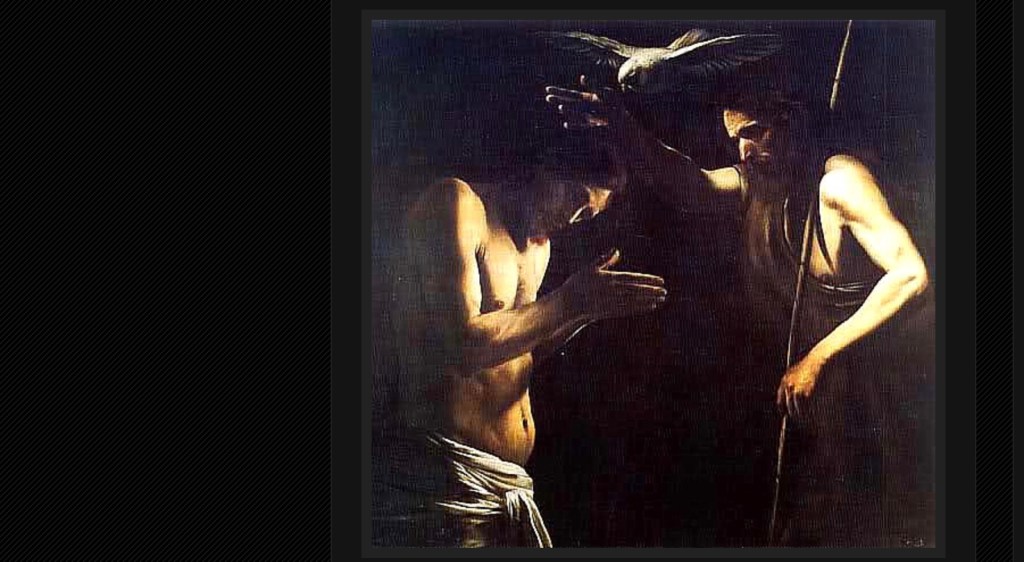
Painting: Baptism of Christ by Battistello Caracciollo
Link for the Mass readings for Sunday, January 12, 2025

In conversation and dialogue, may God be our guide.
The question raised by “the chief priests and the elders of the people” regarding what authority Jesus was teaching was not an uncommon question. Rabbis and teachers often began their presentations by sharing with their listeners who was their teacher. It would be comparable today to say what university we received our degree from.
Jesus did not do so for his authority came directly from God. Those questioning Jesus knew this and wanted Jesus to say it publicly so as to charge him with blasphemy by putting himself on the same level as God. Jesus did not give them the satisfaction. Instead of answering their question, Jesus asked one of his own. “Where was John’s baptism from? Was it of heavenly or of human origin” (Mt: 21:24)?
The answer given by the chief priests and elders to the question posed by Jesus showed further their unwillingness to accept who Jesus is. They were the shepherds of the people of Israel, yet they would not speak the truth. Instead, they offered an answer that was calculated and weighed out by taking a quick opinion poll among themselves. Their answer was lukewarm, “We do not know.”
In answering this way, their authority as leaders was diminished. For if they were the religious guardians and guides, why could they not answer the simple question regarding the origin of John’s baptism?
How about us? Do we weigh our answers solely on a perceived response or do we speak the truth? We want to be liked, respected, to belong and to fit in, to be affirmed and accepted, which is healthy and natural, but at what cost? Sometimes we feel uncomfortable speaking what we believe because we fear another’s reactions. This is even more challenging these days because a simple response can affect a harsh reaction.
Yet, to be people of integrity, to live out our baptismal call as prophets, there will be times that we need to resist the perceived and real pressures we feel, lean into the conflicts that arise, and speak what God would have us say in the moment.
As we do so, we need to remember to speak from a place of understanding and love. It is better to engage in a dialogue, not just mutually imposed monologues. A good reminder is to follow the lead of Jesus and ask more questions rather than offer ultimatums and pronouncements. Our goal in any encounter is not to impress or prove we are right and so the other is wrong, but to express what we believe and allow others to do the same. We can grow from one another when we are willing to listen.
Sometimes, God may be inviting us to be silent. We can actually move from talking past or shouting over one another, or going to the other extreme of avoiding talking altogether, when we are willing to listen first and respect another person even when we disagree.
Jesus, please forgive us for the times when we have not spoken as you have led us or when we have refused to listen and hear the perspective of another. In each moment help us to remember to breathe, to have ears to hear your guidance, to be understanding and respectful in every exchange. Give us the courage and words to speak with charity and help us to know when to be silent and to listen. Above all, with each encounter help us to love.
———————————-
Photo: Quiet times with God help us to listen more and speak less when in conversation.
Link for the Mass readings for Monday, December 16, 2024

Born from above as an outpouring of God’s love to love in return.
Nicodemus, “a teacher of Israel”, is struggling to understand what Jesus meant when he said, “You must be born from above.” Jesus attempted to clarify for Nicodemus with an analogy of the wind, yet this still did not help. Jesus went on to explain how much of a problem it was if Nicodemus and the leaders of Israel did not understand things that are concrete and plainly in view: “If I tell you about earthly things and you do not believe, how will you believe if I tell you about heavenly things?”
Thinking at that point that Jesus would soften his message he instead deepened his discussion, talking about how no one has gone up to heaven except the one who has come down from heaven, that the same Son of Man would be lifted up as Moses lifted up a snake in the desert, and God sent his only Son so that all might have eternal life. If Nicodemus’ head wasn’t already spinning with Jesus’ born from above statement, the follow-up statements would have really done it.
What Jesus conveyed to Nicodemus, his Apostles, and disciples, as well as anyone in earshot, and ongoing for generations up to us today is that Christianity is not Gnosticism, some secret sect of knowledge that is passed on for a select, elite few. Neither is Christianity a form of dualism or Manicheism such that our body and all that is material are bad and we need to shed the physical as soon as possible to attain the fullness of our potential through the absolute embrace of the spiritual only. Nor is Christianity Pelagianism, where we just need the proper discipline, will power, and persistence to follow the teachings of Jesus.
Jesus offers us a universal invitation for all to “be born from above”, which means to be baptized in his name, to follow him into his death, to die to our false sense of self, our sin, our pride, that attitude and disposition that strives to set apart, diminish, devalue, dehumanize, divide, and polarize, and then to rise with him.
In being born from above, we receive the offer of divinity and so, instead of rejecting our humanity, we are invited to embrace the truth and fullness of our humanity. The grace of God builds on our nature, the goodness of the creation he has made and formed into existence with his love. We accomplish this the same way Mary, the Apostles, Mary Magdalene, the disciples, and Nicodemus did. We answer the call to holiness and sanctity. We say yes to Jesus and give him all we are and recognize all that we have is a gift from God the Father and that we can’t do anything apart from him.
We will get through each day better when we are willing to be led by the hand of Jesus, the firstborn of the new creation, and participate with him by offering our hand to others. May we resist the temptation to put up barriers, to keep others at arm’s length. We are all, every one of us, invited to become saints through our participation in the life of Jesus.
I agree with Pope Francis who in his exhortation, Gaudete et Exsultate (“Rejoice and Be Glad”), that we cannot “claim to say where God is not, because God is mysteriously present in the life of every person, in a way that he himself chooses, and we cannot exclude this by our presumed certainties. Even when someone’s life appears completely wrecked, even when we see it devastated by vices or addictions, God is present there. If we let ourselves be guided by the Spirit rather than our own preconceptions, we can and must try to find the Lord in every human life.”
God is present to and invites us to grow in our relationship with him. May we embrace the gift of our baptism, by meditating upon what Jesus taught Nicodemus, in our being born from above. Through our dying and rising in Christ from the pouring of water and words of institution received at our entrance sacrament of baptism, which we renew ever Easter and whenever we bless ourselves with holy water, we have access to Jesus through the other sacraments and receive the breath and life, so to be transformed and made new by the Holy Spirit, the very Love of God. This love that we receive as a gift we are to then see in others, and share in our own unique ways as we are guided by Jesus.
————————————————————————–
Photo: July 18, 1965, at my baptism. Pope Francis said that baptism, “illuminates our entire life, guiding our steps until the heavenly Jerusalem.”
Link for the Pope Francis article on “Rejoice and Be Glad”
Link for the Mass readings for Monday, April 9, 2024

Acknowledge and ponder that you are a beloved daughter or son of God.
On coming up out of the water he saw the heavens being torn open and the Spirit, like a dove, descending upon him. And a voice came from the heavens, “You are my beloved Son; with you I am well pleased” (Mark 1:10-11).
Jesus was not baptized because he needed to repent. He did so as a foreshadowing of his taking upon himself our sins on the Cross. Just as the heavens were torn open and the Holy Spirit comes down and God the Father speaks, we are on sacred ground ourselves in experiencing the presence of the Holy Trinity.
Jesus in coming to earth “opened up heaven for us in the humanity he assumed” (St. Irenaeus). This imagery of the heavens being torn open is similar to the veil separating the deepest part of the temple, the Holy of Holies, where God was believed to dwell, being torn open when Jesus was crucified.
Because of and through Jesus there is no longer any separation between us and the Father other than what we allow to stand between us and separate ourselves from him. Jesus, being called the Father’s beloved Son, is a reminder to us that we are his beloved children. This is a truth we need to stop and ponder regularly so that we remember who and whose we are.
And when we are dealing with the challenges that arise, John’s words from today’s first reading are for you, “Beloved: Who indeed is the victor over the world but the one who believes that Jesus is the Son of God” (John 5:5).
When we truly believe in Jesus, we can experience the truth that we are the Father’s beloved daughter and son, and we are victorious. Victorious! We need to continue to remember that. The challenge is when we let the whisperings of the enemy rest anywhere near us. As we notice them, we are not to argue or dialogue with the enemy, get down on ourselves, but instead just renounce him and his lies, and open our hearts and minds again and again to Jesus our savior, our healer, defender, and friend.
As we breathe deeply regularly and invite the love of Jesus to fill us, not only does our lung capacity increase, but our faith will also increase. We will also experience and know that we are loved and redeemed! When we rest, receive, and abide in God’s love, acknowledge and accept that we are his beloved children with whom he is well pleased, we will live lives experiencing freedom, peace, and joy.
Photo: Jesus wants to share his love and joy with us, and we will experience these gifts when we are willing to slow down enough to receive them! One of Egret Landing’s residents sharing the light and joy of the Christmas Season, seen while on my Rosary walk a few nights ago.
 Spiritual Stepping Stones