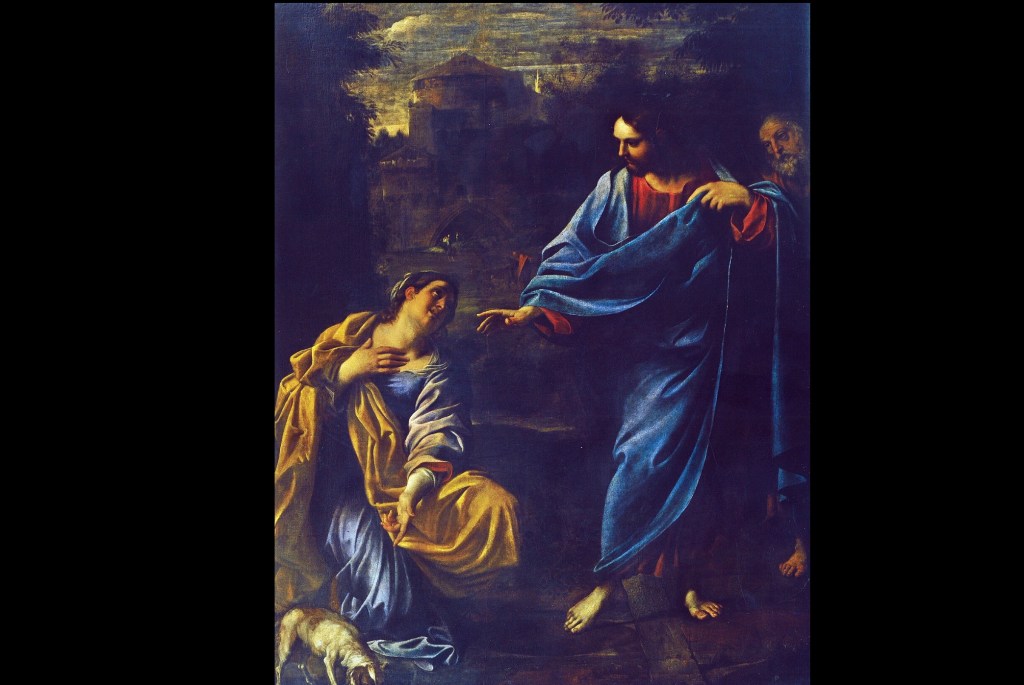
[A] Canaanite woman of that district came and called out, “Have pity on me, Lord, Son of David! My daughter is tormented by a demon” (Mt 15:22).
In Jesus’ encounter with the Canaanite woman, Jesus revealed through three responses, some of the darker sides of our fallen, human nature. In his fourth response, he also identified the way to resist these three sinful tendencies.
When the Canaanite woman called out to the Son of David to have pity on her, Jesus first responded with silence. His silence can represent the indifference we feel toward those not like us. We ignore their very presence as if they don’t exist. In the early nineties, while I was in the novitiate with the Franciscans of Holy Name Province, we toured an impoverished inner-city area in Philadelphia. One of the local friars pointed up to the elevated tracks as the commuter train headed past us toward the heart of the city. He shared how the majority of those commuting had no idea of the need, pain, and struggles of those down here below, like the homeless mother and her three young children that I had met that day. Are we aware of those in need around us, or do we ride our own Elevated Train of Indifference?
We can look upon or past people with indifference, but we can also look upon them with disdain or fear. This woman was in dire need and seeking healing for her daughter. She was also a Canaanite. To the ancient Jews she was not only one of the people they considered an enemy in war, but in cultural practices. Canaanites were believed to be immersed in idolatry, immorality, and even committing egregious acts of sacrificing their children.
The disciples approached Jesus and asked that he send the woman away. Was it because they considered her a pest, unclean, a pagan, not one of them… Yet, Jesus did not dismiss her. He replied: “I was sent only to the lost sheep of the house of Israel” (Mt 15:24). Jesus’ response can represent the dangers of tribalism and nationalism, and how it can taint our perception regarding how we perceive those that are outside of our group. Those we consider as not one of us. The danger is that this perspective can grow such that we see others as less than human.
A Lakota elder, Fire Hawk, who became family to me in my early twenties shared how in his youth, he thought about being a priest. He voiced his interest and was told that it was not possible because he was Indian, and after receiving one too many baths in which he was scrubbed down in bleach and water, to wash the red out, he gave up on the idea. Do we dismiss those in need around us, do we not help, or worse crush their dreams because someone has a different national, religious, political, racial, ethnic, or gender identity?
The woman was not deterred, increased her boldness, and walked directly up to Jesus and did him homage. She may have at that point knelt or prostrated herself before and asked him directly for help. Jesus still not only appeared unmoved, but appeared to ratchet up his own uncharacteristic response: “It is not right to take the food of the children and throw it to the dogs” (Mt 15:26). This derogatory statement has been hurled at people who have been different for eons. Jesus’ third response can reveal the power of our words and symbols that we use to belittle, demean, and dehumanize. When we place labels on others and begin to believe them, when we think we are superior, we begin to see others as caricatures, as less than human.
Not only do we refuse to help but we also make people, fellow human beings, into an enemy that must be put in their place. On April 18, 2015, I was living in Palm Beach Gardens, Florida. In the next town north of us in Jupiter, three white teens were out “Guat-hunting”, their phrase, looking for Guatemalans to rob. That night they found a Guatemalan young man, 18-year-old Onesimo Marcelino Lopez-Ramos, a son and brother. After their encounter, Onesimo was bludgeoned to death with a rock. Onesimo was heading home from working extra hours. When we allow our thoughts to be poisoned, our words will then be laced with venom, and then our actions can become deadly. Are we aware that our attitudes, our words, and our actions matter?
The Canaanite woman retorted, “Please, Lord, for even the dogs eat the scraps that fall from the table of their masters.” Jesus’ responded: “O Woman, great is your faith” (Mt 15:28)! This final statement can reveal to us that there is an antidote to indifference, fear, disdain, tribalism, and dehumanization and that is the love expressed by the Canaanite woman for her daughter. She crossed social boundaries, side-stepped indifference, refused to be sent away, risked ridicule, and possible abuse and death because she would not be denied until her daughter was healed. She did not get defensive, did not fight back, because she did not think of herself. She thought only of the welfare of her daughter.
Jesus in his interaction with the Canaanite woman was teaching his disciples and us today a profound lesson by allowing himself to be a mirror. His first response was silence. Those around him were given the opportunity to experience their thoughts about who this woman was to them. When the disciples asked Jesus to send her away, they were revealing something of what they were thinking.
His second response that he was sent “to the lost sheep of Israel” was true. Jesus truly was sent to unite the lost tribes of Israel and unite his people, which was one of the roles of the Messiah. He also knew about the first reading for today about how foreigners who became faithful to God and were willing to follow him would be received in love and welcomed to stay in God’s “house of prayer for all peoples” (Isaiah 56:7). Jesus provides the foretaste of that universal fulfillment in this and other encounters with those outside the house of Israel.
His third and most derogatory statement toward this woman who was now honoring him as her Lord, even when Jesus called her a dog, revealed the worst of our fallen natures. Could the disciples, who he had hand picked, who he had been modeling ways of love and compassion, the same ones who were asking to send her away, now be turning into a hurtful mob at these words? If so, they would receive an incredible whip lash. She was not deterred by the degrading, she remained resolute, and replied not in kind, but with one of the greatest one liners of the Bible. “Please, Lord, for even the dogs eat the scraps that fall from the table of their masters.”
Were the disciples ready to pick up rocks or were their hearts finally moved to compassion? Jesus responded: “O Woman, great is your faith” (Mt 15:28). This Canaanite woman full of courage from the love of her daughter stood toe to toe with Jesus and represented the height of the faith that Isaiah was prophesying. Jesus mirrored the fallen and dark side of our human nature. Who modeled love in the face of silence, determent, and degradation? The Canaanite woman.
What does this encounter between this woman and Jesus say to us today? We are to see each other as interconnected, as human beings. What befalls one of us befalls us all. We are sacred beings created in God’s image and likeness, we are all created by the same loving God and Father. Jesus demands that we meet darkness with light, hate with love, and that in everyone we encounter, we engage them with that same love and mercy he bestows upon us. We are to will the good of the other as other, no matter who they are. We are to choose faith, hope, and the greatest of these, love, as the light that guides how we experience one another, especially those who are hurting in our midst.
It is not enough to believe in and receive Jesus, truly present in the Eucharist. If we truly believe we receive him then we need to allow him into the darkest, most wounded areas of our souls where our biases and prejudices dwell. We also must have eyes that are willing to see him present in others. May we allow our thoughts, words, and actions go through the filter of the love of the Holy Spirit. Before we think, speak, or act, let us breathe, receive, rest, and abide in God’s love and then choose to dismiss or continue that thought, word, or action. From this posture, our places of worship, gathering, and homes, in the words of Isaiah, will “be called a house of prayer for all peoples.”
Painting: “Christ and the Canaanite Woman” by Jean-Germaine Drouais