“Love your enemies and pray for those who persecute you.”

The sixth antithesis may be the most challenging of them all. “You have heard that it was said, You shall love your neighbor and hate your enemy. But I say to you, love your enemies and pray for those who persecute you, that you may be children of your heavenly Father” (Mt 5:43-45). The parable of the Good Samaritan provides a nice parallel to this verse. It can be found in Luke 10:25-37. For in that parable, Jesus shows our enemy and our neighbor to be one and the same.

A good examination of conscience would be to read the above verse, ponder who would come up for us as an enemy, and then read the Parable of the Good Samaritan. Whenever the word Samaritan comes up, we drop the word Samaritan and insert the person or persons who came up for us. When we have finished this exercise, then, may we pray for the person or persons defined by us as our enemy, for if we only love those who love us, what makes us any different than anyone else? If we are to be disciples of Jesus, if we are to be children of our heavenly Father, we are not only to love those who love us, but we are to also love our enemies. We are to love those for whom there is little chance of being loved in return.

Jesus offers us the way to be able to accomplish this seemingly impossible feat: “So be perfect, just as your heavenly Father is perfect” (Mt 5:48). We are able to love our enemy as ourselves by being perfect. This is not much help unless we understand that the English word used here is translated from the Greek word telios, which means complete, whole, to reach one’s goal or purpose in life. As a Christian, our end goal, our purpose, our fundamental option, is to be in full communion with God our Father, who is Love. God the Father is not just loving, not just a lover, but Love. “God is love” (1 John 4:8).

God is love and so, “makes his sun rise on the bad and the good, and causes rain to fall on the just and the unjust” (Mt 5:45). We strive in our life to attain the end goal of being perfected by Jesus the Christ, when we, through an act of our will, allow ourselves to become transformed into becoming agents of his love. The most challenging of enemies is facing the enemy within. To love as God loves, we are to follow the words and actions of Jesus and the prophets.

Each day we are given a choice. We can choose to feed our fears, seek revenge, dig in our heels, embrace our egos, react in kind to negativity, and/or remain indifferent to the suffering around us and in our world. We can refuse to love our enemies, withdraw our love, and so reap what we sow and contribute to the condition of separation, polarization, violence, and dehumanization that plagues our communities, nation, and world.

Or, we can choose instead to resist giving in to all of the above and instead allow ourselves to be perfected by Jesus, brought into alignment with his Father’s will, and collaborate with the love of the Holy Spirit so to be agents and models of love, mercy, forgiveness, and justice in our realm of influence. By loving our enemies, we will help to diffuse the power of hate.

We can only be perfected and transformed by the love of Jesus when we spend time with him in meditation and prayer. We are called to receive his teachings, to resist hearing and letting them go in one ear and out the other, and instead read them again a second, third, and fourth time to allow the light of the Holy Spirit to convict us. Where do we fall short or resist putting into practice the teachings of the Sermon on the Mount? Answering honestly will help us to receive more of the love of God and the strength to put these seemingly impossible commands into practice in our lives with those real people we engage with every day.

—————————————————————-

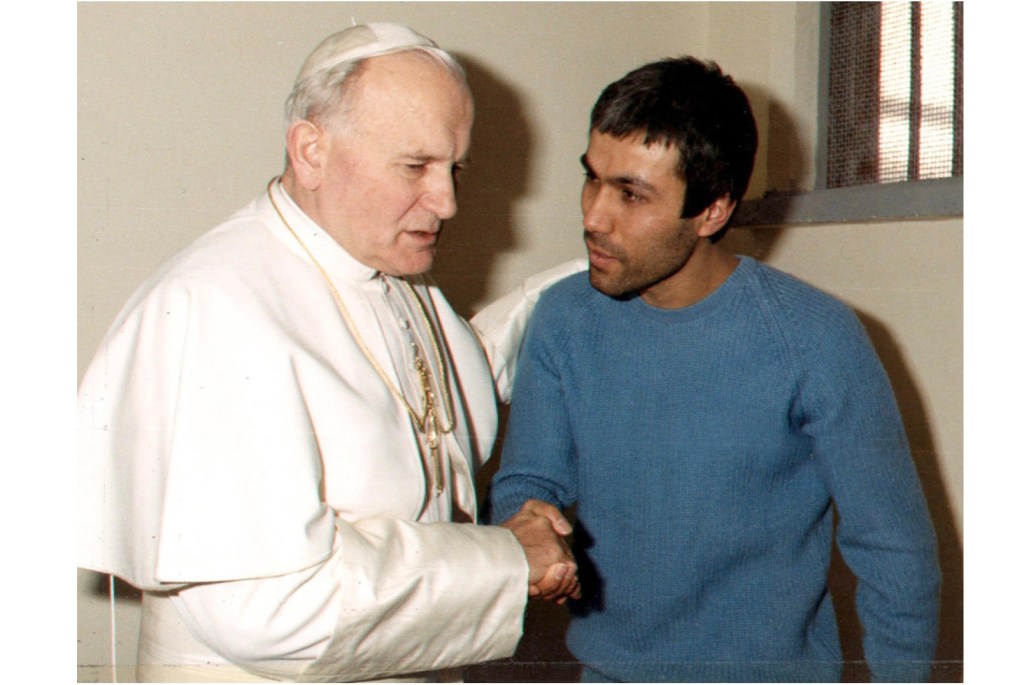
Photo: Pope St. John Paul II modeled for us this antithesis when he met, prayed with, and forgave Mehmet Ali Agca at Rebibbia prison on December 27, 1983, for shooting and attempting to kill him on May 13, 1981. (CNS photo/L’Osservatore Romano accessed from catholic sun.org)
Link for the Mass readings for Tuesday, June 17, 2025

“Tell the truth and you don’t have to remember anything.”

In today’s Gospel, we read about the fourth antithesis where, Jesus said to his disciples: “You have heard that it was said to your ancestors, Do not take a false oath, but make good to the Lord all that you vow. But I say to you, do not swear at all (Mt 5:33-34). The taking of an oath in Jesus’ time became an acceptable practice to confirm that someone was telling the truth. Taking an oath by invoking God made the testimony or presentation of one’s statement more believable because he was willing to receive God’s judgment upon himself if he was lying.

People expanded this oath taking as Jesus pointed out by replacing God’s name with taking an oath by heaven, earth, Jerusalem, or one’s head. The thought being that one would escape God’s judgement if they were not being fully honest. Jesus points out that this would not be the case. For heaven is God’s throne, the earth is his footstool, Jerusalem is the city of the great King, and it was even God who made the color of one’s hair.

As with his other antitheses, Jesus called his disciples to go deeper, to be better. The word of the disciple ought to stand on its own weight such that they need not take an oath at all. Jesus spoke the truth always and his disciples are called to do the same. If his disciple tells the truth, there is no need to take an oath. The “Yes” or “No” of a disciple is sufficient. “Anything more is from the evil one” (Matthew5:37).

We can see remnants of this practice today, when we hear someone say, “I swear on my mother’s grave that I did not…, I swear on our friendship that I did not…, or I swear to God as my witness that I did not…”

Jesus is teaching us as well that we are to resist the temptation to swear an oath at all. We are to just tell the truth in all circumstances. We are to be people of integrity and stand on what we say as the truth. We are definitely living in a time period in our country where the ability to tell the truth is certainly being called into question, where lies and the bending of the truth are becoming common place. This is one of the reasons why so many people have such a low opinion of secular as well as religious leadership. But it is also present in our day to day interactions with one another.

In a 2014 episode of his television show, Dr. Phil, gave a list of reasons researchers gave for why people lie: People lie to take what is not rightfully theirs, to escape accountability, to create a fantasy/false self-esteem to escape their mundane life, to avoid punishment, to inflict pain, to feel better in the moment, steal admiration, and to gain advantage to exploit others.

This is by no means an exhaustive list, but it is a very good place to start. Lying destroys the very foundation of relationships which is trust. Once trust has been broken, it is very hard to come back from and rebuild. Lying also supports our false self of the ego, so even if we do not get caught in a lie, we know, and our conscience convicts us of that fact. There is an ache in our soul because we are not being true to who we really are.

Covering up lies expends a lot of energy because we have to remember what we said. Left unchecked, one lie leads to another, and we string together a web of lies. We also begin to feel sick inside, because we have not been created to be deceitful and dishonest. We have been created good, to be people of honesty and integrity. We will experience less stress if we, as Mark Twain is believed to have said, “Tell the truth and we don’t have to remember anything.”

Examining our conscience is a good daily practice, and being humble enough to admit where we have lied is the next best step. In the beginning, when we begin to work to undo a habit of lying, we can visualize ourselves apologizing to the person we have lied to and ask God to help us to imagine how we could have handled the original situation in a more honest way. Then we can actually reach out to the person and apologize, move toward reconciliation, and living a life of honesty.

If we recognize a deep seeded pattern in which we habitually lie, then the Sacrament of Reconciliation is an opportunity to express our contrition and seek not only forgiveness, but the grace of Jesus to help and strengthen us to tell the truth. Jesus will help us to catch ourselves at the instant we begin to form a lie in our mind, and when we call on his name, we can harness the courage to tell the truth instead. In time, with the help of the Holy Spirit, our vices of deceit will be transformed into new virtues of honesty. Let us live by Jesus’ command to make our, “‘Yes’ mean ‘Yes,’ and [our] ‘No’ mean ‘No.’ Anything more is from the evil one” (Mt 5:37).

——————————————————————–

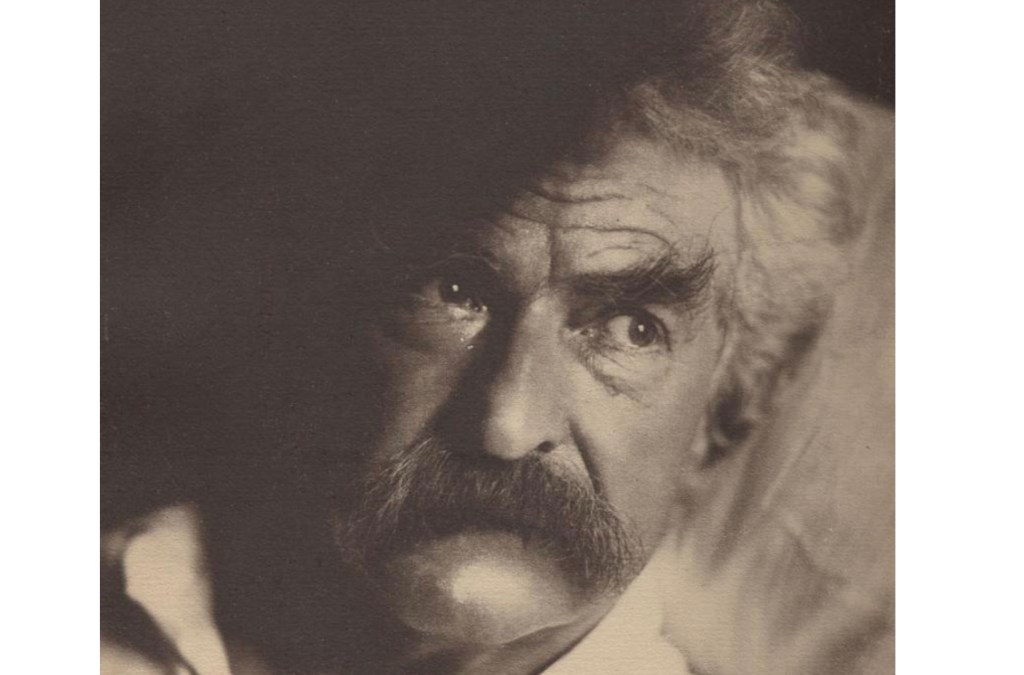
Photo of Mark Twain in 1906 accessed online from National Endowment for the Humanities.

Link for the clip of the Dr. Phil list for why we lie:

Link for the Mass reading for Saturday, June 14, 2025

We will experience joy and fulfillment with friendships grounded in the love of Jesus.

Jesus continued with his next antithesis in today’s account to his disciples: “You have heard that it was said, You shall not commit adultery. But I say to you, everyone who looks at a woman with lust has already committed adultery with her in his heart (Matthew 5:27-28).

Too many people today believe that our sexual urge is too powerful to channel and direct in chaste ways. In fact, to even attempt to do so, some would say is damaging. The Church has confused the matter a bit more because of those within her number who have not only abused children sexually but also those who have turned a blind eye to warning signs and/or covered up the abuse.

Yet, even these horrific acts by a few do not change the fact that Jesus calls us to practice chastity. Our sexuality is a powerful gift that when properly ordered in the marital embrace enhances intimacy and unity as well as offers the potential to bring life into the world. This is a wonderful gift. But the enemy seeks to distort and destroy all that God has created good. Twisting and manipulating the gift of our sexuality such that it can be used for mere physical gratification and objectification of another.

The normalization of lust, pornography, objectification of another must be countered with healthier and chaste ways of living. We figuratively tear out an eye or cut off a hand that leads us to sin by recognizing, identifying, and renouncing any disordered practices or variations. We also need to resist the opposite pull to the puritanical, opposite extreme, and identify our sexuality and all things human as bad. Suppressing our sexuality is not what Jesus is guiding us to engage in. God created humanity good, and our sexuality is good when we integrate it into the wholeness of the physical and spiritual aspects of our humanity.

This is a hard lesson to grasp if the majority of what we read, listen to, watch, think and fantasize about, are erotic and evocative. Living in a culture that is hyper-sexualized, condones enticing advertisements on TV, the computer, and billboards; normalizes pornography, acting out sexually at a younger and younger age, and the like, will make being and living a chaste life seem impossible. Jesus offers us a better way that will lead us to more authentic love and joy. We just need to be willing to allow him to transform our hearts and minds.

Self discipline and the dignity of human beings are true and authentic goods. Unbridled passions do not lead to happiness but instead to slavery and addiction. Seeing each other as objects for our own personal gratification demeans and reduces us to the bestial. Human beings are not merely objects and there is much more depth to our beingness beyond mere sensuality. As St. Pope John Paul II stated, “There is no dignity when the human dimension is eliminated from the person. In short, the problem with pornography is not that it shows too much of the person, but that it shows far too little.”

There is a greater intimacy that can be experienced when we engage in a wider range of personal engagement. Chaste friendships are a wonderful gift that is becoming a lost art. We all seek to belong, to be a part of, and to be loved. Making the time to have in depth conversations where we can speak and listen, share common interests, experience activities; work through challenges, conflicts, and accomplish goals together; as well as being able to take the risk to be ourselves, take off our masks, share our fears, insecurities, hopes, and dreams, and be heard, accepted, and loved, are ways we grow in intimacy and deep friendship.

Lust is too often linked with love. The sole pursuit of lust is to objectify another for our own self-gratification. The sole pursuit of the unconditional love that Jesus calls us to, is to will the good of the other as other, to seek their best. Jesus lived a chaste life full of love, joy, and meaning. He invites us to settle for nothing less. Jesus invites us experience the love of God, who fills our deepest longing. As we experience God’s love, we realize we don’t have to settle for counterfeit relationships. Our friendships can be properly formed such that we don’t see each other as objects for our pleasure, but instead friends to experience and grow in relationship with.

———————————————————————

Photo: Blessed by Jesus to be friends for decades!

Link for the Mass readings for Friday, June 13, 2025

“…whoever says to his brother, Raqa, will be answerable to the Sanhedrin…”

As was presented yesterday, Jesus made it clear that he did not come to abolish the law or the prophets but he came to fulfill them. In his Sermon on the Mount as recorded by Matthew, Jesus offered practical ways in which we can find fulfillment and happiness. In today’s account, he introduces the first of six antitheses. With these apparent contrasting statements, beginning with, “You have heard that it was said” followed by, “But I say to you”, Jesus provided for his disciples the way to avoid the trap that some of the religious leaders of his time fell into: “I tell you, unless your righteousness surpasses that of the scribes and Pharisees, you will not enter into the Kingdom of heaven” (Mt 5:20).

The scribes and Pharisees that Jesus pointed out were those who believed that they were following the letter of the law, but their hearts were not changed. They may have been adhering to the external provisions of the law, but there was no transformation, their hearts were hardened, they were focused more on their own access to honor and power. They were also imposing strict adherence to the law without providing the support or means for others to achieve what the law imposed. The law became more important than the dignity or value of the person. Jesus recognized the law, but also realized that it was in place to help to provide guidance and discipline so one could better resist the temptations of our fallen nature. The law was to be a foundation to be built upon, not the end goal in and of itself.

Just as children need clear boundaries and structures in place to provide a clear path toward healthy development, this is also true for those of us growing and maturing spiritually. We need to learn to crawl, to build strength and balance before we can take those first wobbly steps. With continued support, we are then able to walk and soon run. Jesus is not only providing the means to go through each of these stages in our faith life, figuratively teaching each of his disciples and us today to not only crawl, walk, and run but to also be able to fly as we seek to reach the heights that Jesus is willing to raise us to!

The Beatitudes and six antitheses are challenging because each one of them goes counter to much of the way the structure of our fallen world has been governed for centuries. If we are to catch the fire that Jesus has come to set, we need not only to read, pray, meditate, and contemplate upon on the teachings of the Sermon on the Mount, we need to also see their relevance and practicality to our time and place today, and begin to put them into practice. As Christians, our faith ought not to be shaped and informed by our culture, but we are to be shaped and conformed by the Gospel of Jesus the Christ, so to shape and inform our culture.

Today we start with the first antithesis: “You have heard that it was said to your ancestors, You shall not kill; and whoever kills will be liable to judgment. But I say to you, whoever is angry with his brother will be liable to judgment, and whoever says to his brother, Raqa, will be answerable to the Sanhedrin, and whoever says, ‘You fool,’ will be liable to fiery Gehenna (Mt 5:21-22). The seeds of anger begin to sprout in our mind from our knee jerk reactions to a perceived or actual threat, from our hearts hardened by prejudgments, prejudices, and/or a reflection of our level of spiritual immaturity.

Jesus addresses the known provision against murder. He then builds a hedge around the Torah. If one does not want to break the law, another is imposed so as to protect one from even getting close to breaking the first. If we can resist the temptation to react and instead step back for a moment, take some deep breaths, pray, and seek the guidance of the Holy Spirit, we will be less likely to criticize, judge, demean or dehumanize another, and then there is much less chance for our anger to grow into wrath, that left unbridled could lead to murdering someone.

Jesus is also saying that our words matter, that they have the power to destroy or to create. Calling someone Raqa, Aramaic for a block-head or idiot, and then calling someone a fool, would “be liable to fiery Gehenna” (Mt 5:22). How much more egregious are we today? How polarized we have become inside and outside of the Church because of the level of demeaning words, tone, and language that is spoken, condoned, and justified? This has a ripple effect that poisons our family, relationships, and spreads to the wider culture, politics, and the Church with growing hateful rhetoric, overt expressions of prejudice, and violence.

Instead of settling for two dimensional caricatures of one another, we can go deeper when we are willing to spend time with and get to know each other. Jesus challenges us to slow down and see the person before us with dignity and respect. When we resist reacting, giving in to our biases, and prejudgments, and instead recognize the value and dignity of each person, we will have a better chance of building relationships. We will also be more apt to reform policies and structures that respect the dignity of each person in the womb, after birth, and at each stage and condition of life until natural death.

May we all take some time today to reflect on Jesus’ teaching about how we think, speak to and about, and act toward one another. May we examine our conscience and seek forgiveness for those times we have thought, condoned, or justified thoughts, words, and/or actions that have been belittling, dehumanizing, and demeaning directly or while with others, we approved by our manner or our silence.

Jesus, please impart within us your infusing power of justice, love, and mercy so that we will be more inspired to live out your teachings in our daily lives. Help us to strive to encounter each other grounded in mutual respect and understanding as our brothers and sisters, no matter our race, ethnicity, creed, and/or gender, and to commit to building a culture of life and dignity for all, not in some abstract utopian way, but in the concrete moments of our everyday experiences, one person and one encounter at a time.

——————————————————————–

Photo: Let us listen to Jesus and do whatever he tells us.

Link for the Mass readings for Thursday, June 12, 2025

Jesus offers us a better Way.

When we spend time reading the Gospels, we will encounter in them that the God of Jesus Christ is a God of justice, yes, but a justice that is tempered with mercy and love, a restorative justice, not a punitive justice. God invites us to be in communion with him and one another, and to answer that call requires a transformation, a change of heart and mind. Jesus meets people where they are, accepts them as they are, while at the same time holding a mirror up to them to show how what they are doing is keeping them from the very reality of communion with his Father that they seek.

One example can be seen when Jesus encountered the Samaritan woman at the well and he asked her for a drink. What followed from that simple, while at the same time profound request, led to her humble confession that she did not have a husband to which Jesus responded: “You are right in saying, ‘I do not have a husband.’ For you have had five husbands, and the one now is not your husband. What you have said is true.” Jesus spoke to a woman and a Samaritan in public, two things that were not done in his time as it was against societal norms.

Jesus recognized the distinction, but saw instead and foremost, a human being, a woman isolated, possibly being ostracized from her community, for who else would come by themselves to fetch water in the full heat of the day? What he shared with her was respect, as he spoke to her as a person. Because of her honesty, humility, and courage, what transpired over the course of the conversation was not only her transformation but the redemption of her and her whole community. This transpired because, with joy and courage, she proclaimed the Good News even to those that had kept her at arm’s leg, and on the margins (cf. Jn 4:1-12).

Another encounter happened with Saul who was present and oversaw the stoning of St Stephen and continued his zealous persecution of the followers of Jesus. On the road to Damascus, Saul encountered the risen Jesus, who met him with the words: “Saul, Saul, why are you persecuting me” (Acts 9:4)? Again, as with the woman at the well, Jesus greeted Saul with a simple but profound question which had a tremendous effect on him. Saul was transformed from a persecutor of the Way to a follower of the Word. He would not only change his name to Paul and proclaim the Gospel to a community but to the Mediterranean world.

In today’s Gospel, Peter, who had betrayed Jesus three times, encountered Jesus who also posed a question, but this time asking it three times: “Simon, son of John, do you love me?” (cf. Jn 21:15-19). With these simple questions and Peter’s affirmative responses of yes, Jesus forgave Peter for betraying him. Peter went forward to proclaim boldly the life of Jesus at the feast of Pentecost, and three thousand were moved by his words and sought to become part of the Way of Jesus.

Jesus encountered the Samaritan woman, Paul, and Peter, and met each of them, not with condemnation, but with love and mercy. He met them on their level and then offered them a look in the mirror by asking a simple question. Jesus sought to draw them out of their own false senses of self and sin, and into the love of God. Jesus provided another way. Each person answered with truth and humility, and willingly looked at their life, turned away from what Jesus revealed and accepted his invitation to change their hearts and minds.

The justice of God is not about the punitive measure, about rubbing our noses in our own mistakes and misjudgments. Yet, if we choose our own sin over the love of God’s healing transformation, it may feel punitive, because God will allow us to feel the effects of our decisions. God gives us another choice. He has sent his Son to show us the path of love, forgiveness, and reconciliation. Jesus echoes Hosea 6:6 when he is recorded as saying, “‘I desire mercy, not sacrifice’. I did not come to call the righteous but sinners” (Mt 9:13). Jesus comes to us, as he came to the Samaritan woman, Paul, and Peter.

As we make some time for prayer, enter into any of these biblical accounts, and spend some time in silence today, let us allow ourselves to see Jesus approaching us or sitting with us. What simple, yet transformative question does he ask that reveals in what way or areas we are keeping God distant? In what way(s) do we need to change our hearts and minds? When we choose to leave behind our false self, our pride, and our ego, and instead respond with humility and contrition, true sorrow for our sins, as did the Samaritan woman, Paul, and Peter, we will be healed, transformed, and empowered to go forth to share the Good News of the love and mercy we have experienced with God.

—————————————————————————-

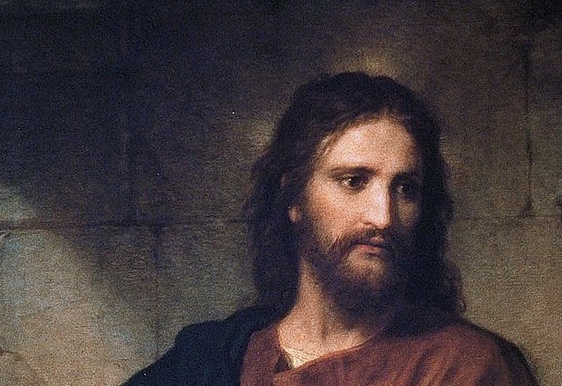
Photo: Close up of Heinrich Hoffman’s Christ and the Rich Young Ruler, 1889

Link for the Mass readings for Friday, June 6, 2025

Slowing down will help us to be one as Jesus and his Father are one.

“Holy Father, keep them in your name that you have given me, so that they may be one just as we are one” (Jn 17:11).

Jesus is well aware of the temptations of the world, recognizes that the disciples will need the protection of his intercession, that they will remain faithful only if they remain in his love and in relationship with him. The unity that the Father and Son share is an eternal and infinite communion. Jesus, as the Son of God, continued to be one with his Father, while fully experiencing his humanity. As a human being, Jesus faced the same temptations present in this world that we face. The difference is that with each choice that he made, as a human being with a free human will, he chose to be faithful to his Father at each and every opportunity, and so his unity of his humanity remained intact and deepened.

Jesus sought the same unity that he shares with his Father for his disciples and he seeks the same for us today. His hope is that we may be one as he and the Father are one. Yet, he is not going to pull us out of the world for that to happen. “I do not ask that you take them out of the world but that you keep them from the Evil One” (Jn 17:15). The disciples then and us today, are to do as Jesus did. We are to welcome the invitation to be in a relationship  with God, come to know his will, and share it with those we encounter in our realm of influence. We are not to be transformed by the world, but we are to allow God to transform us by the renewal of our minds and hearts. As we do so, we can also bring Jesus’ light into the darkness as God works through us one person at a time.

Following the will of God is not easy. Many distractions, diversions, and temptations pull at us and attempt to draw us away from being faithful and true to God, ourselves, and who God calls us to be. Many times these distractions not only appear to be, but are good. The challenge is not whether we are good or evil, we are being good or doing good, but are we doing God’s will, are we doing what God is calling us to do?

Being able to stop, be still, quiet our mind, and just breathe for a sustained period of time can help us to learn to recollect. Often when we attempt to spend time in prayer, we finish at the moment we are really just getting ready to begin and wonder why nothing is happening! Making time to recollect grants us the opportunity to transition from the busy to making friends with silence.

We can deepen our relationship with Jesus and his Father when we slow down our pace, become still within, because we are better able to hear his voice. We are also in a better place to receive the gifts that the Holy Spirit seeks to impart, his guidance to discern his direction, as well as the courage to follow his will. If any fear or anxiety arises, we just need to remind ourselves to trust that God will provide the means and support we need, for we are not meant to do what he calls us to do on our own.

St. Mother Teresa taught that, “in the silence of the heart, God speaks.” We are better able to recognize God’s voice and the people he places in our lives to help us when we embrace consistent moments of stillness. We are better able to identify the temptations and pitfalls along path when we go slower. We grow in discipline, persistence, and dedication when we allow ourselves to be nourished by God’s love and encouragement. When we are willing to change, to be transformed, to grow, and take the risk to trust in Jesus, we, like the disciples, will experience the love and oneness Jesus and his Father seek to share with us.

————————————————————————–

Photo: Meditating on the Glorious Mysteries (back in April before the newest renovations).

Link for the Mass for Wednesday, June 4, 2025

“Love one another as I love you.”

Jesus said to his disciples: “This is my commandment: love one another as I love you” (Jn 15:12). This verse is foundational to our faith as we seek to live as disciples of Jesus. Love is what Jesus lived, modeled, taught, and commanded, but even more so, love is who, as the second person of the Trinity Jesus is. Jesus is love because: “God is love” (I John 4:8). By becoming human, as one of us, and embracing the Paschal Mystery: his suffering, crucifixion, death, Resurrection, and Ascension into Heaven, the Son of God opened up the reality for us that we can also participate in the very same love he shares with his Father.

We are capable of loving others because Jesus has loved us first. How did he love us? Jesus gave his life for you and me, each and every person, for those who believe in him and those who don’t, he gave his life for the good and the bad alike. Jesus was willing to suffer the scourging, agony of his carrying the cross, crucifixion, and death. He was not just going through the motions, his divine Person was not somehow hovering over his body. Jesus felt the rejection, the betrayal, the physical torment of the nails, because, “No one has greater love than this, to lay down one’s life for one’s friends” (Jn 15:13).

Some of us may have heard this verse so many times that we do not fully appreciate the impact of it. The gift of the liturgical seasons is that the readings of Scripture are offered again and again so we can experience their telling again and again. We just need to slow down and ponder the significance of this reading, breathe in the reality of this passage, so that it becomes the living Word of God, not just a dead letter. As we do so, we will be less apt to take our lives for granted, the life we have been given at such great cost. In coming to realize the gift that Jesus gave for us, and meditating on that reality, hopefully, we can see others in our lives who we may have taken for granted. Those who have loved us, have been there for us, have been there when maybe when no one else has been.

What is our response to the love of Jesus that we have been blessed with? Jesus answers: “This I command you: love one another” (Jn 15:17). Jesus ends today’s Gospel as recorded by John where he began at the beginning, he invites us to love. Jesus loves us more than our worst mistakes or our most grievous of sins; he loves us more than we can ever hope or imagine. This is important to not only hear but to allow the reality of this grace to fill us to overflowing, such that we seek to love others as well in the same fashion.

In embracing the love of Jesus, his invitation of friendship, and with a heart full of gratitude, maybe just maybe, we too will love others a little more today than we did yesterday, and a little more tomorrow than today. Love is not a willingness to love each other only when everything is going well. Love is being willing to do so one conflict at a time, one interruption at a time, one inconvenience at a time, one heartbreak, and even one betrayal at a time. We are able to truly love when we are willing to see each other as Jesus sees us, as friends: as human beings endowed with dignity. When we are willing to do so, we are ready to love, one encounter, one moment, one person at a time.


Photo: A quiet moment to breathe, receive, rest, and abide in God’s love.

Link for the Mass readings for Friday, May 23, 2025

“Whoever remains in me and I in him will bear much fruit”.

In today’s Gospel reading, we experience the imagery of the vine and the branches. As the branch of the vine matures, it begins to look more like the vine itself. As it remains connected, is sustained by the nourishment provided, and protected by the vine grower, the branches become more and more conformed to the vine. This is also true in the event that a branch not originally attached to the vine is grafted to it. Over time, the branches are almost indistinguishable from the vine itself. The blessing of the vine does not stop there. A healthy and mature branch will also bear fruit.

Our hope, as disciples of Jesus, no matter what our background, culture, gender, ethnicity, or race will be the same. We are to be one as the Son and the Father are one. As St Paul has written to the Churches in Galatia and Collosse: “In Christ there is neither Jew or Greek, circumcision or uncircumcision, male or female, barbarian, Scythian, slave or free because we are all one in Christ” (cf. Galatians 3:28, Colossians 3:11).

Being a disciple of Jesus is not being a mindless follower, quite the opposite. The more we are conformed to Jesus, the more we come to know him and also experience the unique gift of ourselves. We begin to let go of the pressures to conform to the pressures of the world, that which stunts our growth, and begin to embrace the freedom and truth of who we are. That freedom that just wants to burst out is allowed to be free when we die to our false selves and live in the love of Christ.

We will experience the freedom of being fully alive when we accept the invitation of Jesus to enter the divine communion of love between himself and his Father. We remain connected to him as the vine when we also “obey Jesus and love one another with God’s radical, self-giving love” (Martin and Wright, 254). Focusing solely and turning in upon ourselves disconnects us from the vine, from the very source of our lives. Just as the body will suffer without water and food, so our soul will suffer if we are separated from the living spring of our sustenance. Remaining attached to Jesus, the vine, means that we will mature and live our life to the full, with joy that expands out beyond ourselves to engage in supporting the needs of others.

We will mature and bear fruit as we remain in Jesus and allow Jesus to remain in us. A good measure of our ripe harvest is when we: “Put on then, as God’s chosen ones, holy and beloved, heartfelt compassion, kindness, humility, gentleness, and patience, bearing with one another and forgiving one another, if one has a grievance against another; as the Lord has forgiven you, so must you also do. And over all these put on love, that is, the bond of perfection. And let the peace of Christ control your hearts, the peace into which you were also called in one body. And be thankful” (Colossians 3:12-15).

————————————————————-

Photo: Accessed from Coravin Wine

Martin, Francis and Wright, IV, William M. The Gospel of John. Grand Rapids, MI: Baker Academic, 2015.

Link for the Mass readings for Wednesday, May 21, 2025

“I will not reject anyone who comes to me.”

“Everything that the Father gives me will come to me, and I will not reject anyone who comes to me, because I came down from heaven not to do my own will but the will of the one who sent me” (Jn 6:37-38).

Jesus does not reject us when we seek him out and when we come to him. He accepts us because he knows that we come because we have on some level listened to his Father and allowed our hearts and minds to be moved by his love. Jesus has come to do his Father’s will which is to lead us all to salvation, to be redeemed and restored to the proper order of freedom from our enslavement to sin. Even when we turn away, are diverted by distractions, misled by our sin, or misunderstandings, Jesus will seek us out. In the depths of our souls, we all seek the love of God that we have been created for.

This is why Jesus met Cleopas and the other disciple on the road to Emmaus. Even though they were walking the wrong way, Jesus did not tell them that. He came upon them, walked among them, and opened up the Scriptures to them. In doing so, the fire that had been dimmed by the despair of Jesus’ death, was rekindled in Jesus’ breaking open the word for them, in sharing salvation history for them, such that when Jesus moved to continue on, they invited him to stay with them. Then, in the breaking of the bread, they recognized Jesus who they thought they lost. They experienced in their presence and were nourished by “the bread of life” (John 6:35).

It was through sharing a meal with them that they recognized him. How many meals had they shared together before his death? A close reading of Sacred Scripture shows how important table fellowship is for Jesus and his followers before his death and after his Resurrection. True, Jesus eating with his disciples after his Resurrection shows that he is no ghost, he is human, but also he is reestablishing the cornerstone of his ministry, table fellowship.

Not only are the basic needs of sustenance met, but also in sharing his time and conversation with anyone willing to eat with him, no matter their level of ritual purity, they were touched at the deepest hunger within their hearts, which is to belong, to be accepted for who we are. The majority of the crowd that Jesus spoke to has continued to come to him because he fed them with only a few loaves and some fish. In the miraculous multiplication, Jesus provided for their bodily nourishment, but also was also inviting them to experience the deeper spiritual nourishment of the soul which can only be nourished by his Body and Blood.

Jesus loves us, he wills the best for us. Many resist this truth for different reasons. It could be the callouses, scars, and growing cynicism as a result of wounds inflicted by others, those who did not fulfill expectations, betrayal. Each of us could have experience the same and have also been let down by those we have looked up to and trusted. If we are involved in a relationship long enough, we will experience disappointment or worse. This is because sooner or later, when we draw close the masks will come down and who we truly are, the fullness of our wounds and our gifts will come to the fore. Conflicts will arise because we are finite and imperfect, human beings. We are still a work in progress.

None of us are perfect. We are all on a journey. On our own, we will consistently fall short of our goal. That is why we need a savior. We need someone that we can trust that will be there for us when we are let down and when we fall down face-first into the mud. Someone who, when that happens, will lay down in the mud with us, look us in the eye, and smile.

Even if we are not able to look past the predicament, or smile in return, we might just be able to catch his eyes looking at us and then we will see him offer us his hand. We can then rise together, and stand again. That is how Jesus shows his mercy and love for us. He enters into our chaos and meets us in the midst of the muck and mire of our mistakes, wounds, and sins. He loves us there, and when we are ready to accept his offer of love, he invites us to get up, and begin to walk again.

As our relationship grows and deepens and as our trust strengthens, we begin to believe that we belong and have dignity. We begin to heal and realize that we are a part of something greater than ourselves. Then with wobbly steps, begin to offer attempts of the same mercy, forgiveness, and unconditional love to others that we have received. This is the path of discipleship. This is the road we are on, together. This is not a hundred-yard dash but a long and winding road. Let us be willing to: persist, be led, love, be there for, and accompany one another as we take the hand of Jesus and allow him to lead us on the Way. Jesus will not reject any of us who walk with him. May we help others as Jesus helps us when we fall to rise up and begin again.

———————————————————————————

Painting: Figure of Christ by Heinrich Hofmann

Link for the Mass readings for Wednesday, May 7, 2025

We accomplish the work of God by trusting and believing “in the one he sent.”

One of the best ways to celebrate the Easter Season is to continue to conform our lives to the one who gave his life for us that we may experience and be engaged in our life to the full. We can accomplish this better by putting into practice what we read in the Gospels as well as being open to encountering God in our daily experiences and one another.

Today’s Gospel reading continues after Jesus not only fed the 5,000 but also after he had walked across the Sea of Galilee and guided his disciples safely to the shore. Those who had eaten as a result of the multiplication of the loaves and fish, got in their own boats to follow Jesus to Capernaum as well.

When the crowd found and gathered around Jesus, he continued to teach them, guiding them to “not work for food that perishes but for the food that endures for eternal life, which the Son of Man will give you.” The people asked him what they could, “do to accomplish the works of God?” Jesus answered and said to them, “This is the work of God, that you believe in the one he sent” (cf: Jn 6:27-29).

To believe in the one he sent. The response of Jesus may not appear to fit the request of how to accomplish the works of God. But to believe is not passive. Belief is to be followed by action. If we say that we believe in Jesus, we are invited to pray with him, worship him in communion with fellow believers, sing songs praising him, give to and serve one another by practicing the corporal and spiritual works of mercy.

Believing in the one God the Father sent, believing in his Son, also means that we allow Jesus into our minds and hearts, we allow his light to shine in our places where there is darkness and pain, where we are in need of confessing and healing. When we believe in Jesus, we are willing to submit our will to his will. The good news is that Jesus knows what is the best for us, what will truly fulfill us and give our lives meaning. The challenge is, are we willing to trust Jesus with the direction and path of our lives?

To accomplish the work of God, we must believe in the one whom he sent. To believe in Jesus, we need to trust him. As we spend time reading, meditating upon and praying with the recorded accounts of Jesus in the gospels, are lives become transformed when we then put what he has taught us into practice.  We will accomplish the work of God by trusting, learning from, and following his Son, Jesus, who the Father sent to be one with us in our humanity so that we can become one with him in his divinity.

——————————————————-
Photo: Blessed to be following Jesus and serving him each day as his priest for the past year!

Link for the Mass readings for Monday, May 5, 2025