Are we locking the doors to the Kingdom of heaven or helping to open them?

“Woe to you, scribes and Pharisees, you hypocrites. You lock the Kingdom of heaven before men” (Mt 23: 13).

Context, in any reading of the Gospels, or any scriptural text, is important, but certainly with today’s reading. Our country is already experiencing enough division, polarization, and racial unrest as it is. These comments have too often been used to fuel anti-Semitic rhetoric. We need to remember that Jesus is Jewish. “The criticisms are leveled with those of power and/or influence as in the prophetic denunciations, not against the whole people of Israel. The aberrations denounced by Jesus were also denounced by other Jewish teachers in the rabbinic tradition. The goal of the denunciations is to highlight the error, to preserve others from it, and perhaps to bring those who err to the way of righteousness” (Harrington 2007, 327).

Those who would use these verses to denounce people of the Jewish faith tradition, just for being Jewish, would be acting in the same way as those for whom Jesus was convicting. Jesus spoke to the specific actions of specific leaders he had encountered who were using their power and influence for their own means and agendas. The hypocritical behavior that Jesus brought to light unfortunately still exists in some of our civil and religious leadership. This is one of the reasons many are disillusioned with authority and institutions. Jesus saw the danger of hypocrisy especially from the perspective of how it can alienate people such they turn away from his Father.

We seek truth, authenticity, and transparency because these qualities are foundational for building trust and relationships. St. Augustine, whose feast we celebrate this coming Thursday, wrote in his Introduction to his Confessions, “You have made us for yourself, O Lord, and we are restless until we rest in you.” He experienced a life without God and with him, and regretted the days he had resisted accepting Jesus’ invitation. It is unfortunate how many today have not come to embrace the words of Augustine, because of their experiences with those, who in the name of Christ, have “locked the kingdom of heaven” before them.

It is easy to point out the hypocrisy of others, but Jesus is convicting each of us as well. How have we erred, sinned, and been hypocritical? When have we allowed past hurts and wounds, anxieties and fears, prejudicial and judgmental attitudes, to limit us from living a life more aligned with his life and teachings? We all fall short in living the “Way, the Truth, and the Life” (cf Jn 14:6), but when we are willing to have the humility to be contrite, to recognize and to be sorry for the harm we have done, we have a loving Father with his arms wide open ready to embrace and comfort us, as well as offer us forgiveness and healing.

As we are more conformed to living and loving like Jesus, we have more credibility when we speak up, out, and against any act that diminishes or denounces the dignity of another, while at the same time resisting the temptation to do so in a way that diminishes even those who inflict division and hate. Jesus invites us to convict others and hold them accountable as he did with love and mercy but we need to begin with ourselves.

When we align our thoughts, words, and actions and are willing to be held accountable, we will have more credibility in guiding others. Our goal is not to humiliate, condemn, and/or shame, but to lead others to a place of contrition and reconciliation, such that each of us can be people of integrity, transparency, and holiness. Our hope is to win back a brother and sister and lead them toward the doors of heaven that Jesus opened for us in the humanity he assumed.


Photo: Pope Francis opening the Holy Door at St. Peter back in 2015 for the Jubilee Year of Mercy. Photo credit, Vatican News file.

Link for the Mass readings for Monday, August, 25, 2025

Harrington, S.J., Daniel J. The Gospel of Matthew, vol. 1, in Sacra Pagina, Ed. Daniel J. Harrington, S.J. Collegeville, MN: Liturgical Press, 2007.

Prayer will help us to heal and grow closer to God and each other.

“Lord, will only a few people be saved?” He answered them, “Strive to enter through the narrow gate, for many, I tell you, will attempt to enter but will not be strong enough (Lk 13:23-24).

This can be a challenging verse to understand and to put into practice. Our salvation is assured in Christ, for he died for all of us and not just for a select few. It is also true that there is no way we can buy or nothing we can do to earn our way into heaven. That said, with the free gift of the grace we have been given by Jesus in the giving of his life for us, we have a responsibility to work out our salvation in this life, “with fear and trembling” (see Philippians 2:12).

Christianity is not a pie in the sky or walk in the park religion, we do not seek a utopia, because Christianity is about a relationship. God loves us and gives us the choice to reject or accept his love. If we say yes, then we collaborate in building a relationship with him and one another. Our fear and trembling is not in a cowering observance, but through humble obedience. We recognize that God is God and we are not. When our relationship with God is properly understood, when he is first, then our relationships with each other as well as what we do and what we seek will stand a better chance of being properly ordered.

Authentic relationships take an investment of time and hard work if those relationships are to move beyond the masks and pretenses we project, pretending to be something we are not or trying to be who others want us to be. This is the same for God. We can pray falsely and for false purposes, and in so doing, grow no closer in our relationship with God. Jesus loves us as his Father loves him, and he invites us to experience the same. This is more than an emotional experience, but a willing of each other’s good. Love is accepting the other as other, in their brokenness and pain, their failings and shortcomings, their sin. It means being willing to take off our masks, being vulnerable, revealing our fears, and resist being defensive or reactive when we are hurt or offended by those who are close to us.

Our prayer becomes real, not when we say the right prayers or words, but when we are honest with God. Our relationship with him grows when we let go of our false understanding that we are self-reliant and we admit that we need the help of the Holy Spirit. When we trust in God, are humble and honest with him, allow ourselves to see our weakness and sin, we can begin to be loved and begin to heal, we can be forgiven and transformed.

When we approach our human relationships, love does not mean that we endure physical and emotional manipulation and abuse, for then we are enabling someone’s destructive behavior. The goal of healthy relationships is to mutually respect each other’s boundaries, be willing to support and empower one another and grow together. We accept each other as we are, while at the same time, we are willing to accompany one another as we seek to hold each other accountable, grow in our relationship with God and who God calls us to be.

Every relationship, if it is to grow and develop, will at some point, come to a cross-road, a narrow gate, in which each person needs to make a decision. We can remain stubborn, hold our ground, and build up a wall, or  we can instead work through the conflict, be honest, risk sharing what we truly believe, allow another to see our best and our worst, admit when we have been wrong or made a mistake, and then mutually support one another, as well as get the help from counseling or spiritual direction as needed.

Healing and growing together happens when we are willing to enter into and seek the root of the conflicts, to each own the parts we have played, and have the humility to say, I am sorry or I forgive you. We heal when we are willing to uncover the underlying issues below the surface, that is most likely veiled by our insecurities, anxieties, and fears. What can help us to feel safe and move toward healing and transformation is the willingness to invite God into our relationship through personal and mutual prayer.

Prayer is the most important thing we can do each day. The light of the Holy Spirit will help us to identify and let go of the baggage we carry and identify the voices we are listening to. Is it the father of lies or the Father who loves us more than we can imagine? Spending time with God and allowing the fire of his love to burn freely anything that is not of him, will help us to discern between the enemy’s voice and God’s. Jesus is the way, the truth and the life who seeks to lead us each step of the way to more intimate relationships. We get to decide whether we want to go our own way or follow Jesus through the narrow gate.


Photo: Praying together helped us to grow through conflicts, and closer to God and each other. Picture taken after we finished evening prayer with only 18 days before JoAnn would transition from this life to the next.

Link for the Mass readings for Sunday, August 23, 2025

What do we still lack?

A young man approached Jesus seeking to know what he must do to attain eternal life. Jesus shared that the key was to keep the commandments. The man asked which ones he was to follow, a reasonable request as there were 613 commandments to choose from! Jesus gave him six: do not kill, commit adultery, steal or bear false witness; do honor his father and mother, and love his neighbor as himself (cf. Mt19:18-19). The man affirmed that he had followed them all. Then he asked that next question, “What do I still lack” (Mt 19:20)?

I can feel the disciples wince, see the mouth of Jesus curl into a smile while his left eyebrow raises. Mark is more eloquent than me: “Jesus looked at him, and loved him…” (Mk 10:17). Matthew, in his Gospel account, does not engage in such subtleties.

Jesus said to him, “If you wish to be perfect, go, sell what you have and give to the poor, and you will have treasure in heaven. Then come, follow me.” When the young man heard this statement, he went away sad, for he had many possessions (Mt 19:21-22). The young man was so close!

Jesus saw that which was keeping this man from following him. Jesus gave him the opportunity to renounce what he had, give to the poor, and receive eternal life – his original request. It is what we have all been created for, “You have made us for yourself, O Lord, and our hearts are restless until they rest in you” (St Augustine, Confessions). The young man knew what he needed to do but was too attached to his wealth to let go, so he walked away sad.

We do not know if the young man reconsidered Jesus’ offer and returned. I invite you to find a quiet space today, enter the stillness, and return to this scene in your imagination. Play it out again in your mind and come to the same ending, with the disciples and Jesus watching the rich man walk away sad. Continue your observation of them as they ever so slowly turn their heads and gaze at you. Then ask Jesus, “What do I still lack that is keeping me from walking a more intimate walk with you?”

What are you holding onto that is keeping you from giving yourself to the One who is truly Good? “Jesus presents himself as the way to salvation; he is the ultimate good for which the young man” (Mitch and Sri, 247) was searching and we are searching. Jesus looks at you, loves you, and says, “If you wish to be perfect…” What does he ask you to let go of, to renounce, and follow him?
———————————————–

Painting: “Christ and the Rich Young Ruler” Heinrich Hoffman, 1889

Mitch, Curtis and Edward Sri. The Gospel of Matthew. Grand Rapids, MI: Baker Academic, 2010.

Link for the Mass readings for Monday, August 18, 2025

Denying ourselves, taking up his cross and following Jesus, leads us to greater intimacy and freedom.

Jesus said to his disciples, “Whoever wishes to come after me must deny himself, take up his cross, and follow me” (Mt 16:24).

Jesus invites us to deny our self-centered default position which places I, me, and mine (As George Harrison sang) at the center of each of our decisions. We can deny ourselves when we resist making excuses for our sins and come to a genuine place of sorrow for the pain we have caused God, ourselves, and others. By acknowledging our sins and confessing them, we die to our selfish ways, and then we rise again through the power of Christ. Empowered by our humility and the strength of Jesus we are better equipped to resist those temptations in the future.

We are also in a better position to then take up our cross, which is to follow the will of God. Jesus showed us the proper orientation of surrender when he said at Gethsemane: “Father, if you are willing, take this cup away from me; still, not my will but yours be done” (Lk 22:42). Jesus followed his Father’s will to the cross and endured horrific suffering, excruciating pain, humiliation, and abandonment, unto death… while doing so, gave him the opportunity to conquer death and become the first born of the new creation!

Many a mother I have talked with has shared the struggles of labor, but also expressed the joy of giving birth; many students who I taught were exasperated by the time and effort expended for an examination, a sporting event, art show, musical or theatrical performance and yet experienced the joy from the feat they accomplished; and how many times have we faced a challenge, trial, or cleared some obstacle and felt the exhilaration of overcoming the hurdle?

Taking up our cross and following the will of God means accepting a disciplined approach to our lives. When we follow God’s will, as opposed to our own apart from God, the difference is that we are not alone in our persistent effort. Seeking God’s will in the midst of our discernment and trials for our everyday physical as well as spiritual pursuits is the key.

In my mid-twenties, I entered the Franciscan Friars of Holy Name Province to study for the priesthood. In the year and a half of discernment, from time to time I would imagine my ordination day. To my surprise, I did not feel any joy. I enjoyed every aspect of my experience with the friars and the ministries but there was something or someone missing. I took a leave of absence and about a year and a half later, I realized what was missing was a family.

About two years later I met JoAnn, and her three children, Mia, Jack, and Christy. Six months after that we were married and seventeen years later, I was ordained to the permanent diaconate. This is the short version of the story. There were bumpy moments as we learned to grow together by being willing to see each other’s point of view, some perspectives took a little longer than others, and we were at our best when we were willing to sacrifice for and serve one another.

Our greatest challenge came almost six years ago when we experienced JoAnn’s final weeks this side of heaven. From the beginning of JoAnn’s diagnosis of pancreatic cancer. This cross was the heaviest to bear, yet Jesus shouldered it with us and blessed us richly in our surrender. I am truly grateful for those final months that we had together.

When the realization that JoAnn wasn’t coming back finally sank in about a year and a half later, I decided I needed to learn to live again without her. I followed JoAnn’s advice to put all options on the table and over some months whittled eight choices down to two. Standing in our bedroom, I pondered whether to leave teaching for a year and collapse or pursue the priesthood.  I then asked God, “What do you want me to do?” A quiet voice within confirmed, priesthood. My body sank but my spirit soared.

I would be accepted into the seminary to study for the priesthood and with the support of some great people and the strength of the Holy Spirit guiding and carrying me, I made it through to my ordination day. This time I anticipated ordination with joy, but there was a lingering feeling that I was betraying JoAnn by going ahead and living my life without her. We need to be careful what voices we listen to! The Father of lies seeks to wreak havoc but the Holy Spirit invites us to experience freedom, healing, and wholeness.

Some of the doubt lingered into my ordination Mass, until the moment when each priest walked by, placed their hands on our heads while each remained silent. About half way through the progress, one priest leaned close and whispered, “Your wife has the best seat in the house.” The tears began to flow and purify the lies. During the Eucharistic Rite, for a moment, I felt JoAnn with me, helping to realize that I was actually celebrating my first Mass as a priest, concelebrating with our bishop.

A few months later, I realized that I could be happy again. I was not happy JoAnn had died (which enemy fed me), I was happy because I was following the will of God. JoAnn told me that I would be sad but not to stay there and that she would be closest to me when I was doing that which made me happy. I have also come to realize that during the Mass, because of the presence with Jesus, the veil between heaven and earth is so thin.

When Jesus calls us to “deny ourselves”, he is talking about denying those attachments and disordered affections that we have to things and people, which is anything and anyone we place before God. When we are willing to surrender all and follow Jesus, allow the purifying fire of the love of Holy Spirit to burn the dross of our sin, attachments, and apparent goods away, we will experience the love and intimacy with God we have been created for, and experience a freedom we never thought possible.


Photo: Blessed and filled with joy to be serving in the priesthood of Jesus Christ.

Link for the Mass readings for Friday, August, 8, 2025

“Remove the wooden beam from your eye first”!

For many of us, judging one another is almost as automatic as breathing. As we encounter someone we have instant internal judgments. We judge looks, clothes, actions, inactions, homes, cars, and material items. We judge our family, spouses, friends, colleagues, classmates, leaders, enemies, celebrities, as well as those we consider different as well as those we determine to keep at arm’s length. Much of what gets our attention is what Jesus is addressing in today’s Gospel, negative judgments.

Jesus said to his disciples: “How can you say to your brother, ‘Let me remove that splinter from your eye,’ while the wooden beam is in your eye? You hypocrite, remove the wooden beam from your eye first; then you will see clearly to remove the splinter from your brother’s eye” (Mt 7:4-5).

There are positive judgments that bring about effective change for the good. In a court case, our hope is that the judge is learned in the law and guides the lawyers and jury in ways of sound judgment such that justice with mercy is served. For us to do likewise in our everyday interactions with one another, Jesus shares that we need to remove the wooden beam from our eye first before we are able to remove the splinter in another’s.

Through this hyperbolic image of someone attempting to remove a splinter in someone else’s eye all the while the wooden beam protruding out of his own eye prevents him from coming close enough to actually be of any help! To remove the beam from our own eye, Jesus is inviting us to change our hearts and minds such that we are no longer hardened by negative and condemning judgments toward others based on our own unbridled biases and prejudices. May they soften such that they are open to the mercy and love of Jesus. This does not mean that we accept any and all behaviors, actions, and inactions from ourselves and others. Jesus did not do so.

He is willing to enter our chaos, to embrace any and all of us who will receive the invitation of his healing embrace. Next, through his love, Jesus walks with us, convicts us, and shines his light to reveal to us our slavery of sin. Then he calls us to repent, to turn away from our sinful ways and turn instead toward that which is True, Good, and Beautiful.

As we acknowledge and turn away from our sin, we participate more in the life of Jesus. We are then healed from our own limitations, weaknesses, self-centered perceptions, denial and suppression of our anxieties and wounds that so often fueled our biases and prejudices. As we experience God’s forgiveness and love, we begin to heal, and that beam becomes smaller, and we are able to see others as God sees them, as human beings endowed with dignity because we have been created in the image and likeness of God.

Repentance, forgiveness, and growing in love helps us to collaborate and participate in Jesus’ work of redemption and how we can participate in taking the log out of our own eyes. We can then better assist others in  removing their splinters. When we are willing to admit to our own shortcomings, weaknesses, and failures, and are open to healing, learning, and growing from those experiences, we are then in a better position to meet others in their own chaos, to journey side by side, help others to repent, heal, and to be transformed into who God is calling us to be.

Let us commit to allowing Jesus to help us to remove our beams of judgment so that we can be more understanding, merciful, and forgiving. We will be blessed in doing so, for Jesus also taught that as we judge, so will God judge us. As we repent and are forgiven, so may we forgive and show mercy. In receiving forgiveness and forgiving, in repenting from sin and judgmentalism, our souls will find rest and we will experience God’s peace.


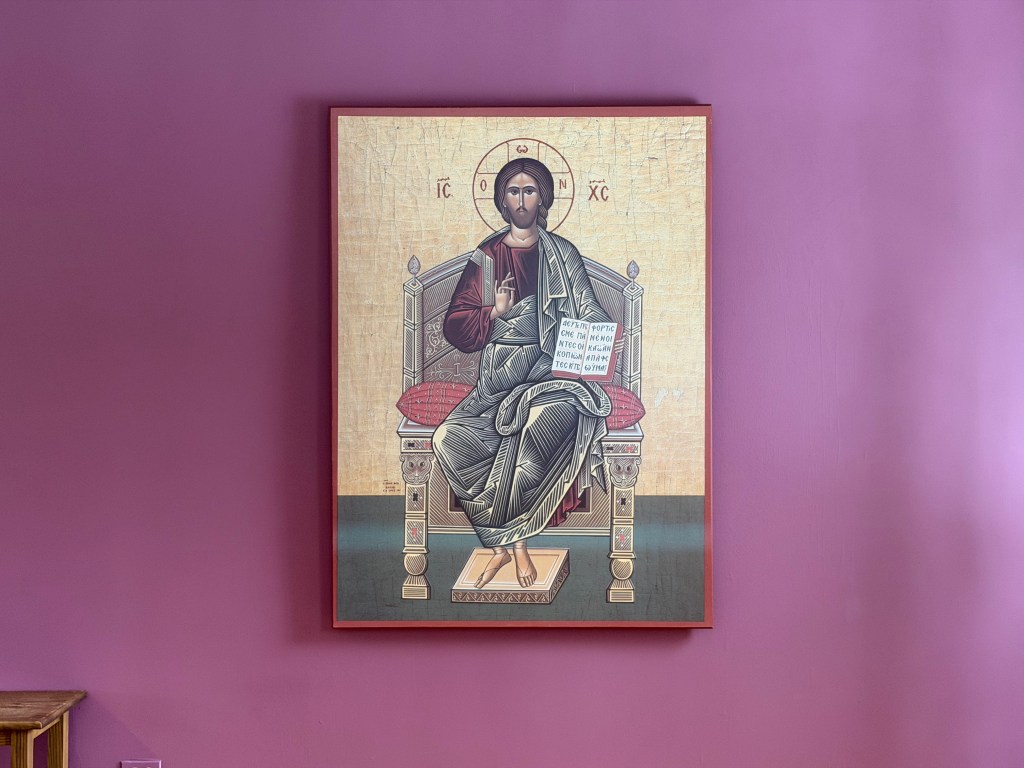
Photo: Icon of 1546 by Theophanes the Cretan, Monastery of Stavronikita Mount Athos.

Link for the Mass for Monday, June 23, 2025

Will we choose death or life?

“[Y]ou will die in your sin” (John 8:21).

Jesus continued his discussion with the Pharisees but they still remained on different planes of understanding. Jesus coming from above and the Pharisees remaining below. Jesus came to meet us in our humanity to free us from what binds us to the physical realm alone. For God created man in his image and likeness and although we retain our image, we lost our likeness when Adam and Eve disobeyed God’s command: “And the LORD God commanded the man, saying, ‘You may freely eat of every tree of the garden; but of the tree of good and evil, you shall not eat, for in the day you eat of it you shall die'” (Genesis 2:16-17).

In establishing this first covenant with Adam, God sought to invite him to not only participate in a relationship with his very own creation, he sought to have man perfected through obedience and participation in God’s life. When Adam and Eve disobeyed God, through their sin, suffering and death entered the world and was made worse in their lack of willingness to repent. The separation from the source of any living, mortal being leads to death. Separation from God means death.

God did not give up. He continued to seek to re-establish a relationship and covenants with his children, seeking to do so through Noah, Abraham, Moses, and David, until the appointed time when he sent his Son to help to shine the light on our fallen world. He brought the light to reveal the truth of the way back to the Father, the way to restore the glory and likeness to the Father that all of humanity was created to participate in.

Some of the Pharisees still did not understand that Jesus was telling them about being the Son of God that the Father has sent. He continued to reveal his intimate knowledge of the Father so that they could see, believe, and come to know the Father as he does. Jesus also gave them a clear choice that those who continued to reject him were choosing darkness and sin over the light and life of Christ and so will die in their sin. Those who believe in Jesus will become one with him in his divinity. They will not only continue to share in the image of the Father, but they will also be restored to experience their likeness of him.

This is the holiness we are all called to participate in. We are called to repent and renounce the attachments to the things of this world. Jesus shows us our deepest hunger, which is to grow in our relationship with him and his Father. Jesus’ consistent obedience, doing nothing on his own, saying only what the Father taught him, and always doing what was pleasing to his Father was a constant untying of the knots of Adam’s disobedience and a constant growing in intimacy that we are invited to participate in.

Jesus’ sharing of this intimacy with his Father started to shine through the darkness. The beautiful ending line of today’s gospel account is that while at the beginning some of the Pharisees were still struggling to understand him, they now began “to believe in him” (John 8:30). The question for us to ponder is, do we see and believe?


Photo: Making time to be still, to breathe, to think, helps us to better hear God speaking in the silence of our hearts.

Link for the Mass readings for Tuesday, April 8, 2025

Do we believe in the One whom God has sent?

God heard the cry of his people who were suffering from enslavement in Egypt. God called and sent Moses to free them. Pharoah did not accept the request of Moses to let his people go and instead put more pressure on his slaves to fulfill their daily quota of bricks as before, though now without providing the straw that they needed to accomplish the task (cf. Exodus 5). The Hebrew slaves did not take out their frustrations on their oppressors but on Moses. This pattern of complaint continued time and again, even after their freedom was assured and they wandered in the desert. Even thought they were free, they complained regularly when things got tough, and stated that they were better off in their slavery and dependency on the Pharaoh instead of placing their trust and dependency upon God.

God the Father sent his Son to free us from our slavery to sin, just as he sent Moses to free the Hebrews enslaved under Pharaoh. How many times do we, like our ancestors, also complain, preferring our life of sin, a life of mere existence, over embracing the gift of a life lived to the full because it is what we know. Even worse there are too often those in positions of spiritual leadership who abuse their power, look out for their own interests, instead of guiding and serving the people entrusted to their care.

Jesus is recorded in today’s Gospel addressing those who are missing, “how God has made his will known to the people, the Father who sent me has testified on my behalf. But you have never heard his voice nor seen his form, and you do not have his word remaining in you, because you do not believe in the one whom he has sent” (Jn 5:37-38). God the Father has sent his Son to reveal his will but too many do not have eyes to see or ears to hear.

Those who are learned “search the Scriptures, because [they] think [they] have eternal life through them; even they testify on my behalf. But [they] do not want to come to me to have life” (Jn 5:39-40). What is hidden in the Hebrew Scriptures is revealed in the New Testament: the New Covenant made with Jesus and all of creation. The prophecies of old testify that the Messiah will come as a suffering servant, he will unify the nations, cleanse the Temple, and the enemies of God will be placed at his feet. These affirmations are presented and known by those who study the sacred texts, yet they still do not recognize the signs that the Messiah is in the very midst of them.

Even Moses testified of Jesus when he said: “I will raise up for them a prophet like you from among their kindred, and will put my words into the mouth of the prophet; the prophet shall tell them all that I command” (Deuteronomy 18:18). Yet the successors of Moses would not even believe in his writings, so Jesus said how would they believe in his words?

Jesus shows us in our Gospel reading today how the people of his time could have known he was who he claimed to be. This is true for us today as well. If we are sincerely seeking God who has and continues to make his will known, we will find him in philosophy, mathematics, the sciences, literature, his creation, in our service to each other, in truths of other faith traditions, but the fullness of the Father is revealed in our encounter of him through his Son, “whom he has sent”. Do we have eyes to see or will we miss God’s invitation because we do not believe in “the one whom he has sent”?

Jesus is also revealed in the Hebrew Scriptures and the Bible. To understand the New Testament we must understand the Old, for Moses and the prophets testify to his coming and Jesus came not to abolish but to fulfill the Law and the Prophets. Do we leave the Bible on the shelf like any other book? If we do read it, do we do so as if it were a dead letter, or do we read and hear it as it is truly meant to be read and heard, as the living Word of God proclaimed? We are more than a people of the book. We are a people of encounter.

The Father makes himself known to us through the presence of his Son and the love of the Holy Spirit. To experience the truth of this reality we are invited to accept his invitation of relationship. As we reach out to God, we come to realize that he is already present and reaching out to us through his Son. We do not need to run to God, because he is already running to meet us, waiting to hold us in his loving embrace, now and forevermore!

—————————————————

Painting: “Christ in the Desert” by Ivan Kramskoi. Jesus suffered for us, and so can embrace us in our suffering because he understands.

Link for the Mass readings for Thursday, March 3, 2025

We need to be willing to see each other beyond surface judgments.

In the Gospel reading today, Jesus is accused of being an agent of Beelzebul, the prince of demons, because he was exorcising a demon from a man that was mute. Jesus addressed the critique and showed the polarizing nature of the onlookers who were unwilling to see the healing before them for what it was. Jesus then stated the obvious: “Every kingdom divided against itself will be laid waste and house will fall against house” (Lk 11:17).

If Jesus was an agent of the prince of demons, he was not a very good one. Satan seeks to sow discord and division. Jesus seeks to bring about unity. Now it is true, that five verses later in the Gospel of Luke, Jesus is recorded as saying: “Do you think that I have come to establish peace on the earth? No, I tell you, but rather division” (Lk 12:51). Anyone feeling a bit confused? Welcome to the wonderful world of the Bible!

To understand Scripture, we need to understand the context of the whole of Scripture, not just isolated verses. Throughout the ministry of Jesus, he seeks the unity that all may be one as he and the Father are one (cf. John 17:21), yet he has consistently experienced those that rejected his message and healings as witnessed in today’s Gospel account. Because of their hardness of heart, they are unwilling to acknowledge that Jesus is the Son of God and so there must be a reason for how he performs exorcisms and miracles.

The reason is that Jesus drives out demons, “by the finger of God” (Luke 11:20). His listeners would have picked up on this referential term, for the Pharaoh’s magicians and sorcerers made this same statement when they could no longer produce the effects of Moses and Aaron’s plagues after their infesting the land with gnats (Exodus 8:19). So just as Moses and Aaron were operating through the will, the finger of God, so too was Jesus.

In so doing, Jesus demands a choice. Then and now. We need to decide if we are either going to be for him or against him (cf. Lk 11:23). The division Jesus is talking about results from those who choose not to recognize that Jesus is who he says he is and reject him and those who accept him for who he is and follow him. This choice continues to cause division within households, families, and friends even today.

The greater take away from this verse and Jesus’ teachings as a whole, is that when we are unified, embracing the gift of our diversity, we are stronger than when we are divided by limiting ourselves to mere labels. In our modern context, labels, such as liberal and conservative are not helpful, whether they are being used in a political or religious context. Life is not as black and white as many would like it to be. It is certainly easier to cast labels, but interactions with people and developing relationships are much more nuanced. We are not mere cardboard cut outs, or caricatures.

To better understand the essence of who we are as human beings demands greater time and experience of each other than an outward appearance or isolated statement may portray. Many more of us, if we shake off any label for a moment, could honestly admit to believing in and supporting issues that are important to us from both sides of the so called left or right.

Many times, once we have cast a label, we believe that we have “defined” the person. They are classified in their box and tied up in a neat and pretty bow, and woe to the person who resists being boxed and bowed. I remember reading from one of the books from the tracker, Tom Brown, Jr., in which he described how many people when seeing a bird, such as a blue jay, robin, or crow, are often satisfied with the label, the naming of it, and move on from that sighting self-satisfied. They think that in that simple identification they now have come to understand all that there is to know about that particular species of bird. So much of the essence of one of God’s amazing creatures is missed by such a simplistic and limiting classification!

Unfortunately, we do the same with each other. We can prejudge others, as did some of the crowd who said that Jesus cast out this demon because he was in league with Beelzebub instead of through the power of God. We can also falsely believe we know everything there is to know about a person or group we prejudge. This is a very limiting and divisive approach. Jesus invites us to encounter people, to spend time, get to know one another, and break bread with each other just as Jesus did. In spending time with one another and being open to dialogue, the caricatures can be filled in with some substance and we can come to know a little better the person beyond the prejudgment.

If it walks like a duck and quacks like a duck, it may very well be a duck, but the duck is also so much more than its classification. This is much truer for us as human beings as well.

———————————————————————————

Photo: Spending quiet time with Jesus helps us to know him and to better see others as he sees them.

Link for the Mass readings for Thursday, March 27, 2025

Let us honor God with open minds and hearts to his will.

Jesus reacted to the criticism of not observing ritual washing prior to eating that was leveled at him from the Pharisees and scribes by recalling the tradition of the Prophets through the words of Isaiah: “This people honors me with their lips, but their hearts are far from me” (Mk 7:6). For Jesus, following the law for the law’s sake is an empty act. What is more important is encountering God, experiencing his love and forgiveness, developing a relationship with him, being transformed by him, and restoring what has been lost. Human beings were created in God’s image and likeness, but through sin, lost that likeness. Jesus sought to help bring God’s children back into right relationship with his Father so as to be able to glorify him by serving others and inviting others into communion with him. Jesus challenged the hyper scrupulosity and exactitude of the rules that had nothing to do with being humble servants of and growing in relationship with God.

Just laws and practices are enacted to build up and empower through discipline and clear boundaries. They help keep us from being enslaved to our passions and sins and instead lead us to freedom for excellence, for fulfillment, and to experience a heart on fire with an ever-growing love that yearns for a relationship with God and each other, like a deer does for running streams.

As with any game we play, there are rules and regulations, there are referees and officials to keep order. When the rules enforced encroach on the flow of the game, such that they inhibit the freedom of play, the game is stunted. When there is no enforcement, the game quickly devolves into chaos. When the rules are consistent, they provide the structure and boundaries that limit abuse, allow for the game to flourish, and the players to experience the freedom to actualize their potential, and as such, there is the experience of the true, the good, and the beautiful.

The first time I saw people skate, at around seven years, I was enraptured. My father was working on a project at our local, ice rink. We had not gone there to skate, and yet, I refused to leave until he took me on the ice. It didn’t matter that the only skates to fit my feet were figure skates or that my first attempt was a dismal failure. What mattered was that I made it to the ice and the joy of that experience inspired me as I learned the rules of balance, how to stop, and what a toe kick was and was not for. Soon I had the freedom not only to skate but to join a hockey team. The freedom and joy I felt any time I skated or played hockey, I still carry with me.

The Church, when we are at our best, is the same. We don’t lead with the rules and moralizing, but instead, we share our time, presence, and the joy of our faith. We empower and support one another as we enter into the play between our finite freedom and God’s infinite freedom. We have been created for and seek a deep and intimate relationship with him that will lead us to a deeper transformation of our hearts and minds. With both open to God’s guidance, we can better identify and discern between the voice of the enemy and God. There is a unique balance between the rules and the freedom of play in ice skating as well as our relationship with God.

Loving someone does not mean we allow them to do whatever they want, but in willing their good, we offer invitations, options, establish boundaries, and offer corrections, that will provide opportunities for growth, maturity, and authentic freedom. We are going to make mistakes, I have made plenty. The key is recognizing that we are on a journey together. As we walk together, we support and learn from one another. In this way, the boundaries and rules we follow are meant to set a foundation for healthy relationships and actualizing who God invites us to be; joyful, human beings that are fully alive!

———————————————————————————

Photo: Getting back on the ice with Jack and Christy, Christmas Eve day, 2023, in the city of my birth, Hartford, CT.

Link for the Mass readings for Tuesday, February 11, 2025

Jesus is stronger than any evil and will free us from anything that binds us.

Jesus and his disciples have entered the Gentile territory of the Gerasenes. As soon as they get out of the boat a man possessed by an unclean spirit rushes up to him. He himself was in a worse state than the storm that Jesus had stilled. He called himself Legion as he was possessed by many demons. He had been living in the tombs, away from society, family, and friends, some of whom had made multiple attempts to restrain him, cure him, bring him back to his right mind, but to no avail. The encounter with Jesus ultimately brought about the result of this man “sitting there clothed and in his right mind” (Mk 5:15). Jesus was able to liberate this man from his desperate state. If you have not done so, I recommend reading the full account (Mk 5:1-20).

Many scoff at the healing power and miracles of Jesus, and they certainly would also discount demonic possession. Though rare, there are still cases today. A strict approach of scientism that only accepts the empirical, only that which can be measured by the five senses, discounts not only the divinity of Jesus and the reality of God but any talk of a spiritual realm. This is unfortunate because this is a limited approach to understanding the fullness of creation. We ourselves are both physical and spiritual. A healthy embrace and experience of both will help us to better appreciate and understand the world around us.

Too many today are in the same need of experiencing the liberating power of Jesus as the Gerasene. Just as chaotic and tumultuous, especially among too many of our youth, are those who are consumed and imprisoned by the vice grip of addiction. Family members and friends reach out desperately to help, to provide aid, and find themselves in the same situation as those who sought to care for this man who had been living in the tombs. Somehow this man caught “sight of Jesus from a distance, he ran up and prostrated himself before him” (Mk 5:6). There must have been some ember at the core of who he was that could still move and bring himself to Jesus.

Far too many are suffering, bound, and shackled by a wide range of addictions, obsessions, disordered affections, and oppressions that plague far too many today, as well as the rare cases of possessions. Evil seeks to distort, disfigure, divide, dehumanize, and separate all of us from the goodness and wholeness that God intends. This growing epidemic damages individuals, families, and friends and could benefit from a unified approach of the best that science, psychology, counseling, prayer, the sacraments, spiritual direction, and when needed, exorcisms can offer.

Jesus can reach into even the deepest darkness of our internal entanglements and help to reveal any disordered affections. Yet we must choose, as did the Gerasene demoniac, to surrender to Jesus. May we resist the temptation to flee from him, and instead run into his open arms. Resting in the grip of his loving embrace, we will come to know that we are not alone in our suffering, that our deepest anguish, sin, and wounds can be healed.

Jesus is stronger than any evil that seeks to bind and separate any of us. He shared this in his parable of “tying up the strong man” (Mark 3:27) which is on vivid display as he casts out Legion from the Gerasene man. Let us continue to place our trust in the name of and the power of Jesus and intercede for all those who are suffering from any form of disordered affections, addictions, and/or afflictions emotionally, psychologically, or spiritually. May Jesus lead all of us to experience deliverance and freedom from any affliction no matter how small or large, so that we may experience the right ordering of our minds, hearts, and souls to God’s will, and like the Gerasene man, not only experience the fullness of his healing but also go to share the good news of our experiences to help to bring the invitation of healing to others.

—————————————————————————————–

Photo: Not even the strongest of chains can bind us when we seek the healing power of Jesus to free us.

Link for the Mass readings for Monday, February 3, 2025