Greed corrupts our hearts, giving sets our hearts free.

Take care to guard against all greed, for though one may be rich, one’s life does not consist of possessions” (LK 12:15).

Jesus wisely warns us to resist the temptation of greed, which can be defined as an intense, selfish desire for something. Here Jesus addresses the greed of material wealth, but we can also have unhealthy selfish desires for anything. Jesus also stated that “one’s life does not consist of possessions.” Material goods are finite and will not fulfill us. They can be good when used for the purpose they were intended for and in moderation.

God provides for our needs. Fostering an attitude of thanksgiving for that which we have received and then being good stewards helps us to resist the temptation of greed. St Clement of Alexandria (150-215 AD) wrote: “How could we do good to our neighbor if none of us possessed anything.” God does bless us, and from what we have been given we are to assist those in need. The problem comes when we interfere with the flow of receiving what God has given us by hoarding what we have received and rationalizing our unwillingness to share. Also, when we look to our wealth as our safety net, instead of God’s providence, we begin to cling to what we have and develop an unhealthy attachment. We buy into a false security in placing our trust in material wealth. We need to remember that the material and finite here below will not satisfy nor will it last, we need to set our heart and mind to God and the things above first and foremost.

Acts of almsgiving, willing the good of and support for one another in need, will help us to resist the temptation of greed and help us to be open conduits of God’s mercy. Pope Leo XIII (1810-1903 AD) wrote that “Once the demands of necessity and propriety have been met, the rest of your money belongs to the poor.” How many of us are willing to put that quote on our bathroom mirror? More so, put it into practice? How about posting this quote from John Chrysostom (349-407 AD) over our closet and reading it before we enter: “The man who has two shirts in his closet, one belongs to him; the other belongs to the man who has no shirt.”

God has given us the greatest gift we could ever receive, his Son, Jesus. In so doing, he has given us the gift of our salvation which is a reason to rejoice! He loved us and all of creation into being and is loving us into eternity. We are invited to participate in the love experienced between the Father and the Son and the Holy Spirit.

We do this best when we resist clinging to the material and finite and instead being thankful for the gift of life and invitation to be in relationship with his Son. May we resist clinging to and instead share that which we have received from God, our infinite source and spring of eternal Love. We will be fulfilled and joyful, not by how much we have saved up in our bank accounts, but by how much love we invest in serving one other.


Photo: No sunset is the same. Each one has its own unique beauty and to watch provides a wonderful gift. We receive the gift God gives us and let it go. A good rhythm to practice in our daily lives.

Link for the Mass readings for Monday, October 20, 2025

“From the fullness of the heart the mouth speaks.” What are we filling our hearts with?

“A good person out of the store of goodness in his heart produces good, but an evil person out of a store of evil produces evil; for from the fullness of the heart the mouth speaks” (Lk 6:45).

We can experience hardships, trials, and suffering. We may have experienced traumas, and even come face to face with evil. Yet, we are not evil because of what happens to us, nor how we are tempted. Neither are we defined by any trauma, suffering, or abuse. We have been created good by a loving God.

Negativity, sin, hate, and evil, can be seductive, can lure us to rationalize and decide that what we may think of as good in the moment, is in reality, just an apparent good or not good at all. To encounter or experience a word or act of unkindness, negativity, or even violence, we may feel justified in retaliation, yet if we speak or act in this way, we perpetuate the negativity or evil we seek to stand up against. In The Strength to Love, a collection of Dr. Martin Luther King’s sermons he wrote:

“Returning hate for hate multiplies hate, adding deeper darkness to a night already devoid of stars. Darkness cannot drive out darkness; only light can do that. Hate cannot drive out hate; only love can do that. Hate multiplies hate, violence multiplies violence, and toughness multiplies toughness in a descending spiral of destruction.”

At the moment we have a thought in our mind, we want to be aware of it and decide where and from whom this thought is coming from. Then, what to do with that thought. Many thoughts come from ourselves, others come externally from our experiences, our observations, our concupiscence – our tendency to sin, and yes even some from demonic influences.

What we listen to, read, and/or watch on a regular basis matters. We need to discern each thought or influence that comes our way. It is important to be aware what we are feeding on, literally and figuratively, and honestly assess our thoughts before we speak and act. Thinking through and deciding on what we will say and do is different from immediately or impulsively reacting.

Consuming the things of this world will lead to a different way of life than meditating and pondering on the things from above (cf. Colossians 3:1). Spending time in prayer and following Jesus’ commands will help us to bear the fruit of the Spirit: “love, joy, peace, patience, kindness, generosity, faithfulness, gentleness, self-control”(Galatians 5:22-23). Honestly examining our conscience daily will help us to purify that which is deadening and replenish that which will nourish.

Violence and the worst of our humanity continue through multiple media outlets, also, they horrifically materialize in real time, and ad nauseam on 24/7 cable coverage. The starting place to counter evil is to resist returning evil for evil, and to learn and put into practice Jesus’ teachings which will help to expose the darkness in our own hearts. We will see more precisely how to clear out the plaque of our own fears, wounds, frustrations, disruptions, and disordered affections. Then there will be more room for the love of the Holy Spirit to flow. With our hearts flowing with love, we will react less, listen, think, and speak better, and choose to act in ways that promote healing, understanding, forgiveness, reconciliation, and love.

——————————

Photo: Would that each of our hearts were open and receptive to God’s love as these flowers.

Link for the Mass readings for Saturday, September 13, 2025

May we, with John, contemplate the true gift we have received.

Jesus Christ is born for us. Jesus Christ dies for us. Jesus Christ conquers death and rises again for us. Because of our place in time, December 27, 2024 AD – Anno Domini, In the year of our Lord, we are capable of experiencing his life, suffering, death, Resurrection, and Ascension into Heaven. The important question we need to answer is, “Does this new fact, this new reality in human history, make a real difference in our lives?”

Christmas did not end two days ago. We are still in the Octave of Christmas. The Church celebrates two octaves in the Church liturgical calendars, Christmas and Easter. These eight days are celebrated as such to impress on us the solemnity of the event of remembrance. From the vigil celebration of Christmas Eve on December 24 to January 1, the Solemnity of Mary the Mother of God, we celebrate the significant event of the Incarnation, the Son of God, the second Person of the Trinity becoming one with us in human history. The Masses celebrated within the Octave of Christmas, as well as the readings of Evening Prayer in the Liturgy of the Hours, reflect the celebration of Christmas Day each day for the eight days. It is like having a week-long birthday party.

If we are solely focused on gifts, the returning of gifts, and celebrations apart from the celebration of Jesus’ birth, if we are removed from the liturgical cycle and rhythm of the Church, it is easy to fall into the post-Christmas blues because it does feel like everything is done but the returning of gifts and getting a good after Christmas deal. Christmas music has been alive and well on many radio channels for weeks, but at some point on Christmas Day and often the following day, they stop. They stop at the time when they ought to begin!

The material and finite, no matter how wonderful, even our closest relationships, will never satisfy our deepest hunger and thirst. If you are experiencing any post-Christmas blues, today is great opportunity to let go of the material for a bit and enter into the gift of silence, and to spend some meditating and contemplating on what will satisfy. The greatest gift that we have been given, we began to celebrate again two days ago. The Son of God changed human history by his conception and birth and we are invited to participate in God’s great theodrama of human transformation. Today’s Gospel reading is a fast forward from this birth we are celebrating and the gift that keeps on giving, the reality of the purpose of the incarnation.

Jesus was born to die, to show the fullest extent of his obedience to his Father. In trusting his Father, Jesus died, experienced our greatest fear of death, and through the power of the Holy Spirt, conquered death and rose again. Mary Magdalene was the first to experience the empty tomb and shared this good news with the apostles. Peter and John ran to see. John arrived first. John remained outside, possibly out of respect, to allow Peter to go in first. Peter saw the empty tomb except for the burial clothes. When John entered, “he saw and believed” (Jn 20:8).

Are we willing to take the time to ponder as John did? To see beyond the merely finite and physical? To be willing to be still. Silent. To allow God to speak to us in the silence of our hearts? John, Mary, and Peter’s lives were changed and transformed because they encountered Jesus and chose not to ignore him or run away, but to give their lives to him. We are invited to do the same. Our hearts were created for this relationship with Jesus and our hearts will be restless until we allow ourselves to slow down, embrace the gift of silence, and allow ourselves to hear him speak in the silence of our hearts that we too may believe.

————————————————————–

Painting: Close up of St. John the Evangelist by Vladimir Borovikovsky

Link for the Mass readings for Friday, December 27, 2024

Repentance is a “conversion of the heart”.

In today’s Gospel, we read about two accounts of horrific deaths. The first is at the hands of Pontius Pilate, who has not only ordered the execution of Jesus’ fellow Galileans but had their blood mixed with “the blood of their sacrifices.” In the second incident, Jesus brought up the tragic accident in which eighteen people died “when the tower of Siloam fell on them.” 
In both cases, Jesus rejected the common notion of the time that these incidents were caused by God’s punishment and focused instead on the importance of repentance. Jesus stated quite emphatically, that, “Do you think that because these Galileans suffered in this way they were greater sinners than all other Galileans? By no means! But I tell you, if you do not repent, you will all perish as they did” (cf. Lk 13:1-5)!
Jesus was emphatic about helping his followers understand the purpose of his coming. Jesus provided meaning and fulfillment in this life as well as being the way to the truth of eternal life in the next. Yet, to experience the benefits of his invitation, people needed to repent from their focus on self, misunderstandings of God, and the false substitutions that the world offered by having a change of heart and mind and turning back to God, the very source of their being. This is just as true for us today.
To repent and surrender to Jesus is not some submissive bowing to a tyrant but an acceptance of the aid offered by the divine gardener. Our repentance gives permission to Jesus to cultivate the ground of our being to rid us of that which sickens us and instead allow him to fertilize us with his word and grace in such a way that we are renewed. Jesus tends to our growth such that we can be more aligned with the will of his Father and the love of the Holy Spirit. In these ways, we are forgiven, healed and can better mature so that we will bear fruit that will last.
To repent is a good thing. As is written in the Catechism of the Catholic Church, line 1431: “Interior repentance is a radical reorientation of our whole life, a return, a conversion to God with our whole heart, an end of sin, a turning away from evil, with repugnance toward the evil actions we have committed. At the same time, it entails the desire and resolution to change one’s life, with hope in God’s mercy and trust in the help of his grace.”
When Jesus shared in his first public message: “Repent and believe in the Gospel” (Mark 1:15), he invited then and invites us still today to a new way of seeing, hearing, experiencing, and living our lives. No longer do we have to live in fear, be bound by addiction, and/or entrapped by our sins. As we open our heart and mind to Jesus, he reveals to us with his loving light that which is preventing us from experiencing the love of God more deeply and growing in our relationship with him more intimately. Let us trust in Jesus’ mercy, welcome the gift of his grace, repent, and allow our hearts and minds to experience conversion and transformation..

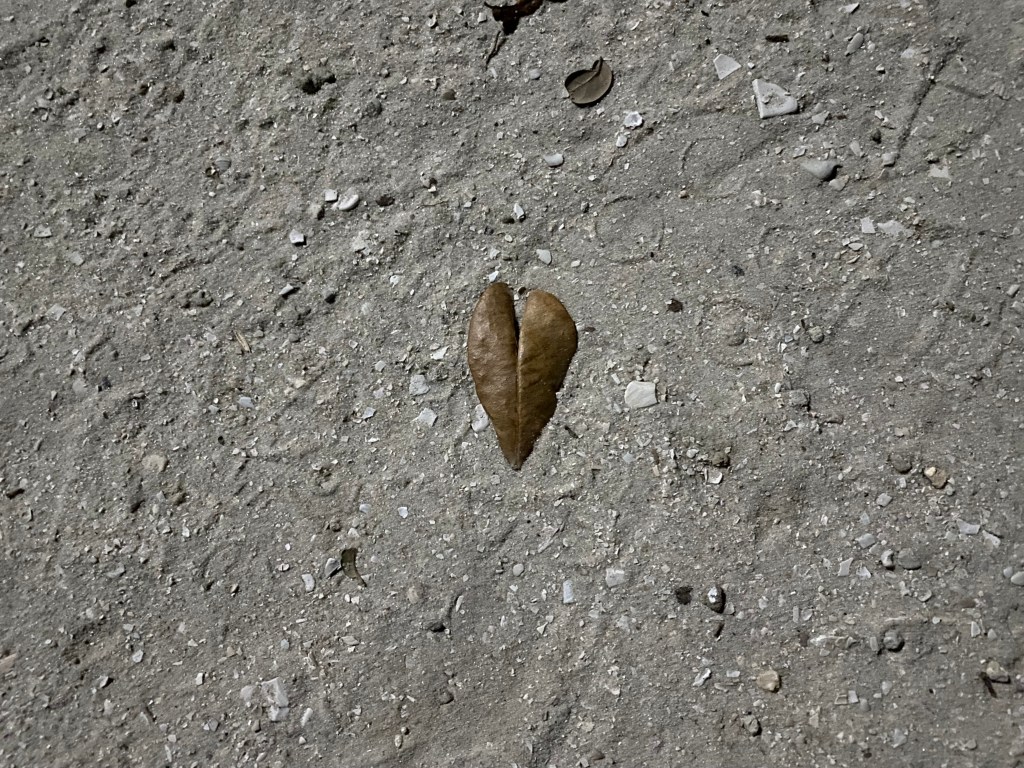
Photo: Heart found during Rosary walk in Riverside Park, Vero Beach. When we repent, Jesus receives our brittle hearts and infuses them with his water of life.
Link for the Mass readings for Saturday, October 26, 2024