Material happiness is fleeting but the joy fueled by Jesus is eternal.

Blessed are you when people hate you, and when they exclude and insult you, and denounce your name as evil on account of the Son of Man” (Lk 6:22).

The Beatitudes are contrary to much of what too many of us are tempted by when seek our satisfaction, security, and fulfillment in what St. Thomas Aquinas calls the substitutes that we put in place of God: power, fame, wealth, and pleasure. What is more, we may resist Jesus’ teachings because we do not agree, there are behaviors we may not be willing to let go of, we don’t understand them, or we find them too hard.

In today’s Gospel account from Luke, Jesus taught his disciples how to attain the kingdom through five blessings and four woes. Jesus’ message is a universal message, an invitation to and for all who have ears to hear and a heart open to receive. These teachings though challenge us to place our trust, not in the things of this world but in Jesus. That which is finite and material are fleeting and passing and cannot fulfill us. We will always be wanting more and we are never satisfied. In placing our trust in Jesus, he will lead us to his Father, and it is in building that relationship that we will experience true happiness and fulfillment for the deepest core of our being is made to be in communion with God and only he can fulfill our deepest need.

This is an inviting offer, yet when putting Jesus’ teachings into practice in our everyday lives we will receive opposition from those in our lives and from ourselves from within. Another word for blessed is happy. Can we really be happy if we are as Jesus said, poor, hungry, weeping, and when people insult and hate us? Yes. When we seek to live out these beatitudes with the help of Jesus, we will find that we are indeed happier when we are not attached to material goods, when we are more moderate in our consumption, and when we are not attached to outcomes as we want them fulfilled and when we are not seeking immediate gratification. We will experience much more joy and freedom if we are not gauging our every thought, word, and action based on what others think and instead be free to live our lives by following God’s will.

To be blessed, happy, and fulfilled in this life can be fleeting, like trying to catch the wind, if we seek to do so by acquiring more material things and having things our way as we want it, when we want it, on our terms alone. We will experience true happiness and deeper joy when we are willing to let go of our attachments to the things of this world and instead, place building a relationship with Jesus as our primary practice.

If we are serious about being his disciples, then a good place to start is learning and living the beatitudes. This is no easy task but as we come to better understand what they require, we are willing to let go and allow the Holy Spirit to heal and work through us, “we will rejoice and leap for joy” (Lk 6:23)! Joy because we can experience the good things that God wants to give us.

When we can see the difference between God’s gift of grace, the very gift of his life he wants to impart in us, and the apparent glittering of goods and false truths we have been seeking to provide for our security and foundation, we will be less apt to be ensnared by them. Slowly and surely, step by step, making time each day for prayer, reading and meditating upon what we learn in scripture, struggling with them, yet trusting in Jesus and putting them into practice, we will experience the love of Jesus, the eternal source of our joy, and we will drink from the well that never runs dry!

————————————————-

Photo: Fireworks this past July 4. They have passed, but the joy in serving at Holy Cross continues to grow!

Link for the Mass readings for Wednesday, September 11, 2024
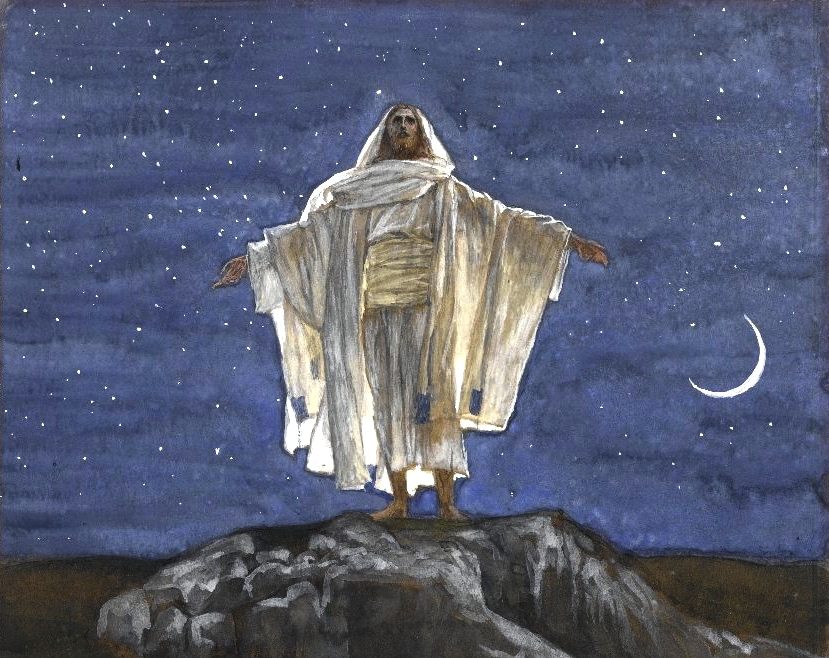
As we pray consistently with Jesus, our lives will change.

Jesus departed to the mountain to pray, and he spent the night in prayer to God (Lk 6:12).

In the midst of a busy ministry, Jesus spent time alone with God in prayer. In Luke’s Gospel, Jesus often did so before making important decisions, as in today’s reading that recorded the choosing of his Apostles. Prayer is an important, foundational principle to experiencing and knowing God as well as discerning his will for living a fully human life.

The Mystery of God is not a problem to be solved. In our language today, we often use mystery and problem interchangeably, as, “I lost my keys, it is such a mystery.” Strictly speaking, the loss of keys is a problem that can be solved. We can backtrack our steps, and through a process of elimination, the problem becomes smaller until we solve the whereabouts of the missing keys.

We cannot solve or prove God exists as if he is a problem to be solved. This is because God is not a being, not even the supreme being. God is a mystery that transcends any finite dimension of reality. We have nothing to measure him by, we cannot prove his existence, nor can we solve him as we would a problem.

Yet we can come to know God intimately just as Jesus did. Even though God is transcendent, beyond our reach and comprehension, he is at the same time closer to us than we are to ourselves. We come to know God through his invitation, and as we enter into the mystery of his reality through developing a relationship with him, as we come to know him. He does not become smaller, but vast, always beyond our comprehension and reach. His mystery is luminous as if we were in a completely dark room and someone turned on and shined a flashlight into our eyes. We wince from its brightness, yet in time, our eyes adjust and we eventually are able to see what was beyond our ability apart from the light. Jesus wants us to experience and embrace the mystery of the radiance and warmth of his Father’s light and love.

Jesus called each apostle by name. He calls us by name too. When we accept the call to be a follower of Jesus, when we are baptized, receive our first Holy Communion, and are confirmed, when we participate in the Mass at least weekly and Confession regularly, when we pray, read the Bible, and serve others, our lives will no longer be the same.

We will begin to experience the life of Jesus within us. We will begin to see also what is incompatible. What thoughts and behaviors we may have allowed for ourselves in the past, in the light of Christ, we now see for ourselves that which is no longer acceptable because it separates us from the love of God. We come to see our lives apart from God and with God. We are given the freedom to choose death or life.

Jesus meets us in the chaos of our lives and invites us to something better, a life that is real. Jesus loves us in this moment and does not lower the bar but empowers us to reach the height of his truth and divine law. Jesus is there for us and we remain close to him when we are consistent in prayer, in reading and meditating upon and putting into practice his word. Breathe upon breathe, day after day, we will be drawn ever deeper into the mystery of the Trinity and experience the intimacy of communion and relationship with God that we have been created for.

————————————

Painting: James Tissot – Jesus Goes Up Alone on a Mountain to Pray, 1886-1894

Link for the Mass readings for Tuesday, September 10, 2024

Jesus gave his life that we might have life.

Jesus said to them, “The Son of Man is to be handed over to men, and they will kill him, and he will be raised on the third day.” And they were overwhelmed with grief (Mt 17:22-23).

This is the second time in the Gospel of Matthew that Jesus shares with his disciples that he will die soon. They are overwhelmed with grief because their focus is on the first part of Jesus’ statement that he will be handed over to death. They do not understand or yet comprehend the second part about how he will be raised on the third day. How could they? There was no point of reference for them. Jesus did bring three people back to life during his ministry, but Jesus would not be merely resuscitated as they were and just die again. Jesus would resurrect and conquer death.

For us, we can read today’s Gospel about the impending death of Jesus and gloss over it a bit too easily. Because we celebrate Easter each year, we celebrate that Jesus has risen. Yet, do we give ourselves time to ponder the wonder and reality of the Resurrection of Jesus? Does the fact of the Resurrection, the reality that Jesus has conquered death and become the firstborn of the new creation really have relevance in our lives?

The life, death, and Resurrection of Jesus matters! The missing piece for those for whom this statement doesn’t register any relevance may be that they do not want to think about death all that much. To be honest, none of us really want to come face to face with our own mortality, and most of us don’t until we or a loved one is forced to.

Beginning the summer after my freshman year of college, I began working the second shift in a nursing home as a CNA. It was the first time that I experienced death up close through the care of the residents. They were not merely patients, they had become more like family.

The first death I experienced surprised me. I was with a woman holding her hand as she peacefully gave up her last breath. I was surprised and blessed by the peace I felt. Another time, I had the opposite experience. When I arrived at work and went directly to a man named Richard whose health had been slipping, only to find his bed empty. I felt the loss and the grief begin to rise and then found out he had not died, only his room had been changed.

The important lesson that I learned from these, the other experiences of death since then, and especially when faced with JoAnn’s diagnosis of pancreatic cancer, is that life is fragile. To appreciate life, the people in our lives, and not to take anyone or any moment for granted is important. Life goes too quick, even in the best-case scenarios. All that God has given us is a gift and it is important to appreciate and thank God for those people he has brought into our lives as well as all that he has given us.

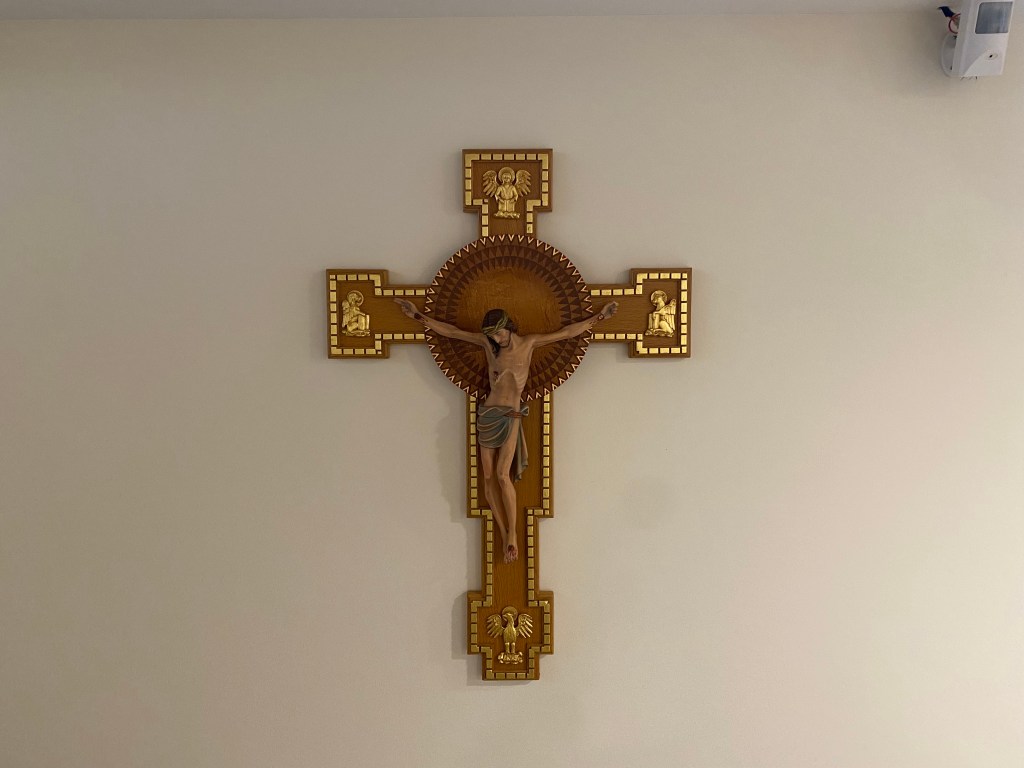
Jesus understands each of our struggles and tribulations, our sins and our failings, as well as our deepest hopes and dreams. Jesus also knows about our deepest fear of death, for he, as a human being, experienced the reality of his impending death in the Garden of Gethsemane. He sought to help his apostles prepare for his death though they did not understand. The crucifix, the beautiful sacramental object of Jesus on the Cross, is a reminder to us all that death does not have the final answer, Jesus, fully human and fully divine, does.


Photo: Crucifix in the adoration chapel of Holy Cross Catholic Church, Vero Beach, FL.

Link for the Mass readings for Monday, August 12, 2024

Body and Blood, Soul and Divinity

Last week we ended the gospel account with these words from Jesus: “I am the bread of life; whoever comes to me will never hunger, and whoever believes in me will never thirst” (Jn 6:35).

Jesus is offering these words from the context of how his Father has constantly provided for his people as seen in the examples of the Hebrews being freed from their slavery from Egypt, and then God providing bread from heaven in the form of manna. Jesus multiplied the five loaves and fish to provide for the thousands. In our first reading today, God sends an angel to feed Elijah a hearth cake and water to give him nourishment and strength for his forty-day journey.

As a good Father, God provides for his children. He also loves us so much that he is willing to risk that we will reject his offer, which unfortunately, many people have done for generations. Yet, God remains faithful, awaiting the time to help and provide need when there is an opening.

This week we heard the reaction of the people to Jesus’ statement that he himself is the bread of life, he will be the one to satisfy the people’s hunger and his thirst, their deepest hunger, their soul hunger. He is inviting the people to receive him so that they will never have to hunger again. Jesus is not met with open arms of wonder, but “grumbling.”

This word was not chosen at random. This is the same word that was used to describe the Hebrews who were freed from their slavery and provided for by God but instead of being grateful for their freedom and God’s care, they sought for what they left behind. They complained that with Moses and God they were in a worse state than when they were enslaved in Egypt.

The people witnessed Jesus multiplying of the five loaves and two fish and they were amazed with the physical manifestation of that miracle, but now as Jesus is going deeper into the spiritual reality, they, as did his own hometown crowd, balk. And even respond in a similar fashion. Who does this Jesus think he is saying that he came down from heaven? “Do we not know his mother and father” (Jn 6:42). Apparently not!

Mary is his mother, but Joseph is not his father. His Father is God. Jesus is the Son of God who became man in the womb of Mary. While remaining fully divine as Son, he takes on human flesh and becomes fully human. His appearance is that of any other man, on the surface he appears to be the son of Joseph and Mary. Jesus is the incarnation of the Son of God the Father. He is the bread of life that has come down from heaven to nourish us physically and spiritually.

Jesus does not soften his language as he continues. He affirms that he knows God the Father because he has come from the Father and he invites those who are listening to believe in this truth and for those who do, they will have “eternal life.” Jesus does not stop there but continues to share how as “living bread”he will give life forever and then he goes over the top: “the bread I shall give for the life of the world is my flesh.”

If Jesus was concerned about their grumbling when he said he was the bread come down from heaven, he didn’t show it here by stating that he will give his own flesh. This is not symbolic language to recall the quail God sent in the desert either. Jesus was offering his own flesh.

This he did in giving his life to the full on the Cross and will be represented again on the altar at each Mass. People were having trouble understanding how Jesus could have come down from heaven, how he could be the bread from heaven, and now what were they going to do with his statement that he was going to give his flesh to eat? They were having trouble understanding what Jesus was saying because they did not understand who he is.

Understanding who Jesus is helps us to understand the Bread of Life discourse we have been exploring these past two weeks. At the surface, the physical level, even with the miracles that Jesus performs, even those who are eyewitnesses, do not see Jesus being anyone other than a human being, extraordinary to some, ordinary to many others, just the son of Joseph and Mary. And yet, Jesus is so much more.

Jesus is the Son of God come down from heaven, he took on flesh in the womb of Mary, lived, died, and conquered death so that he could ascend, return to the Father, not as he came as fully divine but now fully divine and fully human. This is how he can give us his Body and Blood in the appearance of bread and wine, because he has transcended time and space. He truly is the Bread of Life. We like the crowd are given a choice.

God the Father, God the Son, and God the Holy Spirit do not impose, they invite, they draw us in with tender chords of love. They give us the free will to either reject their invitation or to ascent with our faith and accept their invitation to participate in their communion of love.

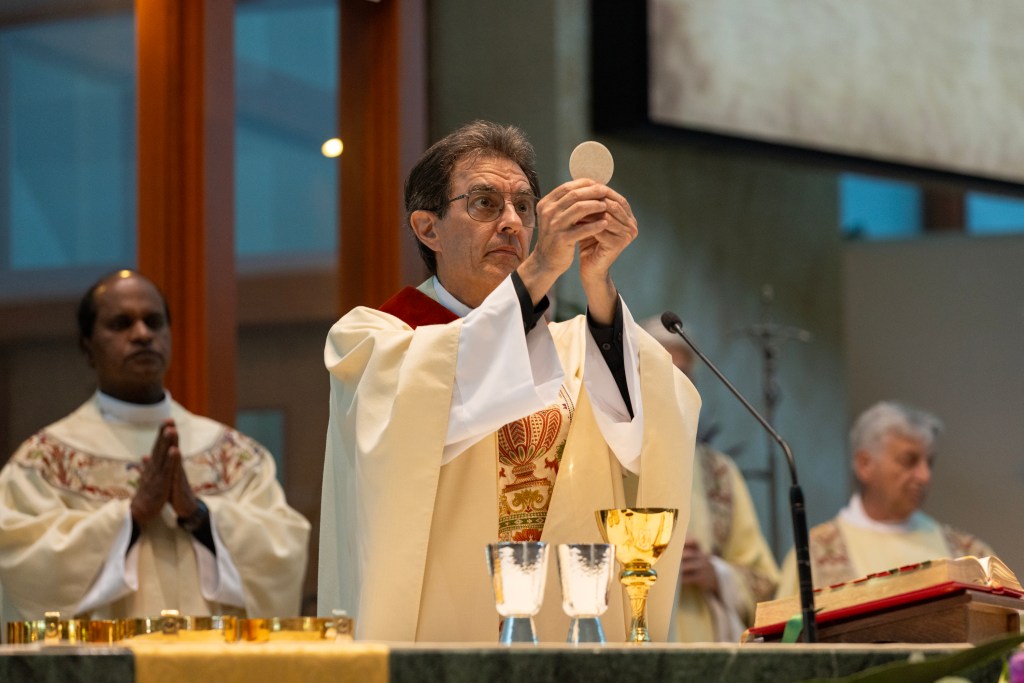
In the Mass, Jesus will come among us again through the power of the Holy Spirit and the words of institution: the words of Jesus said in the first person by the priest. Jesus is the bread of life who will again come down from heaven, not as the same human body that walked among the apostles and the crowd, but in his glorified body that has ascended into heaven. Although the appearance of the bread and wine will remain, the substance will be transfigured to be the Body and Blood, Soul and Divinity, the source and summit of our faith!!! Today we will receive our daily bread, the superabundant bread of life that will satisfy the deepest yearning of our souls and sustain us as we journey through this life to the next!


Photo: First Mass of Thanksgiving at St Peter Catholic Church; I am blessed at each Mass to hold in my hands, the Body and Blood of Christ.

Link for the Mass readings for Sunday, August 11, 2024

Let us die to selfishness, and rise in love for one another.

Jesus said to his disciples: “Amen, amen, I say to you, unless a grain of wheat falls to the ground and dies, it remains just a grain of wheat; but if it dies, it produces much fruit.(Jn:12:24).

In reading this verse, I was transported back to Middle School. Our sixth-grade class was dismissed to head to the cafeteria for the Science Fair. As I drew closer, I could hear some unintelligible chanting going on. Of course, I was curious and craned my neck to see over the other students filing in as we entered our destination. As I drew closer and saw a circle of kids taunting and circling someone, I stopped. I heard muffled groans and then saw one of my friends standing in the center of the circle, his forearms pulled up to cover his face. No one was laying a hand on him, but the heckling was inflicting enough damage. I froze not knowing what to do or how to act.

I don’t remember how the situation was resolved, but I do remember how badly I felt that day, and still do for not doing anything. I also withdrew from my friend when I saw him later because I felt so bad for not speaking up or stepping in. I wasn’t there for him as he was harassed nor did I provide comfort later because I was still only thinking of myself, my shame, and not his feelings or his need. That day, I remained just a grain of wheat that did not fall to the ground and die. I was unwilling to die to myself, unwilling to stand up for my friend, and unwilling to provide any comfort.

When we find ourselves in situations when another human being’s dignity is being diminished, Jesus implores us to resist loving our life, assessing first our own self-interest, or we will lose it. Instead, we are to “hate our life” in this world (cf. Jn 12:25) by thinking of others first, instead of ourselves. Challenging.

We start where we are instead of seeking some abstract ideal of changing the world in some utopian way. Jesus worked person to person, encounter by encounter, and invites us to do the same. We start with family and friends. Resist taking any moment we have with them for granted. We reach out then to our workplaces, schools, and/or community in our everyday interactions. No matter who we meet or interact with may we be respectful, engage with courtesy, patience, kindness, and understanding. As we take these concrete steps, we might be more willing to help the next time we witness the opposite.

Jesus, please grant us the courage to love, to will the good of the other. Give us the eyes to see and the ears to hear the cry of the poor; those who are demeaned, belittled, or dehumanized. Holy Spirit, inspire us to be that grain of wheat that dies to our own self-centered and fallen self, such that we are not just silent bystanders. Loving God and Father, empower us to stand, speak up, and act on behalf of the dignity of those who are vulnerable, those who do not have access, and/or the avenue to speak up for themselves.

———————————————————————–

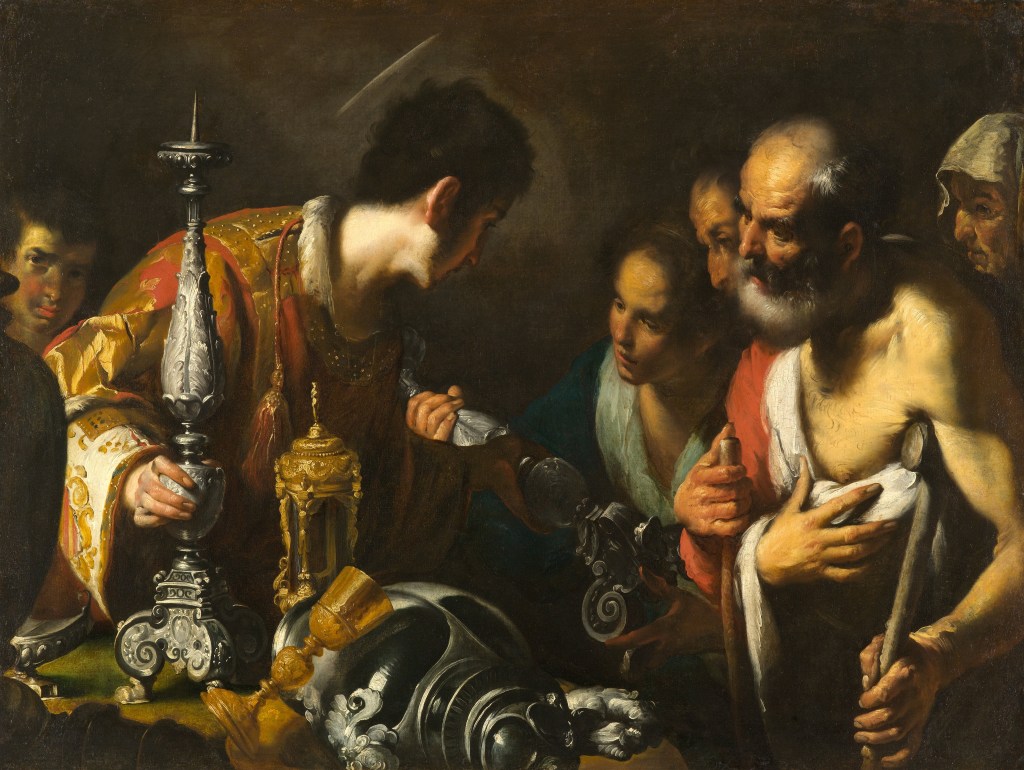
Painting by Bernardo Strozzi of St Lawrence, the third-century deacon and martyr. Lawrence was asked by the Roman prefect to bring the wealth of the church to help maintain the Roman army. Three days later, Lawrence returned with the blind and lame, lepers, orphans, and widows and said to the prefect, “These are the treasure of the Church.” St Lawrence on this your feast day, pray for us!

Link for the Mass readings for Saturday, August, 10, 2024

Aligned with God’s will, there are no limits.

“Where did this man get such wisdom and mighty deeds? Is he not the carpenter’s son?” (Mt 13:54-55).

Many people wonder what Jesus did from the age of twelve until he began his ministry around the age of thirty. Today’s reading gives us some insight into that question. Most likely, Jesus did nothing extraordinary, he was just as ordinary as any other first-century Palestinian Jew living in the small town of Nazareth, with a population of about 250 to 500 people.

Jesus most likely worked as a carpenter. This was rough, menial work, and as a day laborer, a position that was looked down upon. We can even see evidence of this in the Gospel accounts. Mark describes Jesus as the carpenter, the son of Mary, Matthew in today’s account portrays Jesus as the carpenter’s son, and Luke and John just refer to Jesus as Joseph’s son, leaving out any reference to carpenter altogether. Most scripture scholars believe Mark was written first, so we can see a progression in the biblical tradition moving quickly away from identifying Jesus as a carpenter.

Jesus’ return to his hometown and his teaching was first met with wonder. The question arose, “Where did he get such wisdom and how did he work such mighty deeds?” But wonder soon turned to judgment. Who is he? Isn’t he just the carpenter of Nazareth, no better than any of us. In effect, “Who does he think he is?” Not only does this show that Jesus probably lived a very simple peasant life, but that Jesus’ social status was set in stone.

The people’s hearts and minds were closed to Jesus. THEY KNEW who he was and there was no way someone like him could do what they had heard, so they “took offense at him… And he did not work many mighty deeds there because of their lack of faith” (Mt 13:57-58).

How many times have we judged someone? Have we said to ourselves, “I know who he or she is.” We box them in, not as they are, but as WE see them, as we define or label them. We look at another individual not as a person with dignity, but as a two-dimensional caricature to satisfy our own prejudgments and lack of vision. We also do this to ourselves when we resist God’s invitation to grow and follow his plan for us.

Maybe we have had a similar experience as Jesus did in returning to his hometown, in that we have sought or are seeking to move beyond our particular social status, or follow a dream or career out of the norm of familial or community expectations. No matter our age, through no fault of our own, by pursuing this path some or many may feel threatened.

One day Bruce Lee challenged Stirling Silliphant to run five instead of his usual three miles. Into their fourth mile, Stirling said, “if I run any more, I’m liable to have a heart attack and die.” Bruce then said, “die.” And ran off. Sterling was so mad he finished the five miles, approached Bruce and asked him why he said that.

Bruce replied, “Because you might as well be dead. Seriously, if you always put limits on what you can do, physical or anything else, it’ll spread over into the rest of your life. It’ll spread into your work, your morality, into your entire being. There are no limits. There are plateaus, but you must not stay there, you must go beyond them. If it kills you, it kills you. A man must constantly exceed his level” (p. 23).

Jesus rebukes limiting attitudes and perspectives. God the Father has a plan for all of our lives and invites each one of us to resist limiting ourselves and each other. Jesus, the carpenter, invites everyone to embrace the infinite possibilities that will arise when we participate in his life and the Holy Spirit seeks to free us from the shackles, those limitations imposed from within and without, that bind all of us so that we may be free to receive the fullness of and share the Father’s love.
———————————————————————–
Photo: Paused during Rosary walk to look off into the horizon, Riomar Beach, Vero Beach.

Link for the Mass readings for Friday, August 2, 2024

Stirling Silliphant story accessed from Bruce Lee: The Art of Expressing the Human Body, compiled and edited by John Little.

Parallel Gospel accounts: Mark 6:3, Matthew 13:55, Luke 4:22, and John 6:42

There is a treasure of great value hidden and yet in our midst.

Jesus said to his disciples: “The Kingdom of heaven is like a treasure buried in a field, which a person finds and hides again, and out of joy goes and sells all that he has and buys that field” (Mt 13:44).

God is hiding in plain sight. God is in our midst, present to all of us, a wonderful treasure just waiting to be found. God’s eternal love and grace is ever reaching out to us. Our soul hungers, yearns, and seeks for that love, whether we know it or not. It is when we seek satisfaction, filling this deepest of our desires in material and finite pursuits alone, that we miss the true treasure. When we sin, create idols, seek the allure of apparent goods, we block our access to the very union we seek, we are not satisfied, and our desire increases all the more because we are seeking to fill that deepest void with everything but the one who wants to fill us to overflowing.

The saints and the mystics are those who have found the treasure of God’s will in their lives, they have experienced his love and mercy, and they have given themselves fully to God. They have encountered the living God in the mundane events of their lives and given all to be immersed in his communion. They “are amplifiers of every person’s more hidden life of faith, hope, and love. Their lives help us to hear the interior whispers and see the faint flickers of divine truth and love in ourselves and others. The Christian mystics point the way to fully authentic human life by illustrating what it means to be a human being, what life means: eternal union (which begins here) with the God of love” (Egan 1996, ix-xx).

God speaks in the silence of our hearts. Setting aside regular time to be still will help us to hear his whisperings. Opening our hearts and minds to God and seeking him in all things will help us to recognize those faint flickers and God-incidences present in our daily experiences. We can also experience Christ by reading and meditating on his Word, as well as reading the lives of the mystics and the saints, those who have found the treasure of Jesus’ presence and want to share it: St Francis of Assisi, St Teresa of Avila, St John of the Cross, St Therese of Lisieux, St Mother Teresa, and so many others are leading and urging us on to experience the rich encounter of the loving God of Jesus Christ.

Another who found this great treasure was St. Ignatius of Loyola (1491-1556), whose memorial we celebrate today. “While reading the life of Christ our Lord or the lives of the saints, he would reflect and reason with himself: ‘What if I should do what St. Francis or St. Dominic did?'” (Luis Gonzalez, The Liturgy of the Hours, vol III, 1975, 1566).  Might we ask this same question and so find the great treasure in our midst which is to experience the love of God in the depths of our souls, to love as Jesus loves us, as we continue our journey to become saints.

St. Ignatius, Pray for us!
———————————————————————–

Photo: Rosary walk Riomar Beach, Vero Beach.

Egan, Harvey D. An Anthology of Christian Mysticism, Second Edition. Collegeville, MN: Liturgical Press, 1996.

Link for the Mass readings for Wednesday, July 31, 2024

No darkness will overcome the love of the Holy Spirit.

“Explain to us the parable of the weeds in the field.” He said in reply, “He who sows good seed is the Son of Man, the field is the world, the good seed the children of the Kingdom. The weeds are the children of the Evil One, and the enemy who sows them is the Devil.” (Mt 13:36-39).

In this parable of the wheat and the weeds, Jesus is addressing the ancient question of why God allows evil and how are we to deal with it. Why do bad things happen to good people? As a starting point, we need to recognize that God is God, and we are not; meaning that we are not capable of reading the mind of God. Any answer to explain how and why God allows suffering will be insufficient. A second reality is that the Devil exists, though he is a created being. An angelic being, yes, but not equal in any way to God.

God is not a being. At best we can say he is Infinite Act of Existence, he is, or as God told Moses, “I am who am” (Exodus 3:14). God did not create evil, he only created good. “God looked at everything he had made, and found it very good” (Genesis 1:31). The Devil, Satan, the one who opposes, was created good also, as a high archangel, Lucifer, yet he chose to turn away from the will of God, and those angels who followed him are demons. God is greater than the Devil and his demons, and his good is greater than the evil they sow.

Evil is not so much a created thing, but a deprivation, or distortion of the good. God does not create evil, but he does allow it, and even though we cannot understand the reasons why God allows or permits evil or suffering, it is not a sufficient reason to say that God does not exist. This is especially true if we are seeking to grasp spiritual realities and truths from purely physical and rational means alone. We are indeed rational beings, who seek to know and to understand that which is good, but we are so much more. As human beings, we are physical AND spiritual, so need not limit ourselves to the merely sensate and empirical realm alone.

To better be guided by God, to hear his voice in the silence of our soul, to be fulfilled, our hearts and minds need to be open to the will of the Holy Spirit working in our lives. We are called to be people of prayer. As we mature spiritually and deepen our relationship with God, we will come to experience God as did Job: “I know that you can do all things, and that no purpose of yours can be hindered. I have dealt with great things that I do not understand; things too wonderful to me, which I cannot know” (Job 42: 2-3). In essence, Job acknowledged and accepted that God was in control, and he was not, and though he could not grasp everything, he trusted in the will of God for his ultimate good.

How do we deal with evil then? We need to surrender our pride and control over to God and acknowledge that he is in charge and knows what is best for us. We need to choose to put God first above ourselves and everything and everyone else. Our fundamental option, our telos, our end goal, is to embrace the reality that we are striving to be in a relationship with God. From the moment of our conception, we are a living, craving, hunger, and desire to be one with God and one another. This is true of the atheist and the mystic alike, whether we believe it or not. As we embrace this reality, put God first and focus on him, no matter what arises, we will begin to experience his presence in not only our everyday lives but begin to feel his presence with us in the midst of our suffering. We will come to know that he is stronger than any pain or evil, his grace is greater than any of our sins, and he will guide us through and give us what we need to endure.

Our loving God and Father has given us the means to understand suffering and evil especially in sending his Son to enter into our humanity, to suffer with us, even suffering his own unjust death on the cross. Our deepest prayer is when we willingly offer up our suffering and enter into the Mystery of the Passion of Jesus. Jesus, the pure and innocent one, beaten and crucified, understands our pain and agony, our cry for the horrors of injustice, and he understands the presence of evil. Jesus himself, asked not to be crucified, though he relinquished in saying, “Not my will but yours be done” (Lk 22:42).

In that acknowledgment, Jesus faced the utter evil, horror, betrayal, and injustice of humanity, his crucifixion. In taking upon himself the sin of the world on the Cross, he even felt his separation from his and our Father. Through his complete surrender into God forsakenness, into his death, and descent into hell, Jesus made the Resurrection possible. He conquered suffering, evil, and death forever, he brought about a greater good, through the evil of the crucifixion. No matter what trials we face, our Father has the last word over sin, suffering, and even our death.

We may not receive a sufficient answer or justification to suffering but we can experience the challenges we face with our hope intact by trusting that God hears our prayers and is present in our trials and tribulations. We receive help best when honest in our prayer, even when we are angry, afraid, doubtful, or frustrated. We will not find Jesus when we deny or run from our challenges. We will find him with his arms wide open and waiting for us when we are willing to ask and accept his help, and then enter into, face our suffering and pain.

We are not alone in our suffering. When we resist running from our pain, denying, or trying to distract or divert ourselves, and bring what we are going through to Jesus, he will provide a way and accompany us through every twist and turn. He understands what we are going through because he experienced the worst of human sin; he was betrayed, beaten, crucified, and died. We experience hope because Jesus has already won the battle and he sends us the Holy Spirit to give us the strength to endure.

No darkness can or will overcome the love of the Holy Spirit. Aligned with God we will be victorious even in the face of the greatest evil that confronts us. Let us trust in Jesus and each other, face whatever storm that arises with confidence and courage as did Jesus when he set his face toward Jerusalem. Empowered by the Holy Spirit we shall overcome.
———————————————————————–

Photo: Prayer connects us to the Light that shines in the darkness and is not overcome by it. Rosary walk North Hutchinson Island looking back at the mainland, Vero Beach, FL.

Link for the Mass readings for Tuesday, July 30, 2024

May we embody the boldness and faith of St. Martha.

Enough of waiting. They had sent word to Jesus while Lazarus was dying but still alive, and he did not come. Now Jesus is close to their home, and Martha does not wait for him to come to her but “went to meet him” (Jn 11:20). She went boldly, and most likely, did not hold back any of the full range of her hurt and pain.

Martha’s words expressed her anguish. “Lord, if you had been here, my brother would not have died” (Jn 11:21). She believed in Jesus, knew of his power to heal, but could not understand why he did not come. She could not understand because she could only see the loss of her brother which was right in front of her. He was dead and now in a tomb.

It is true that Jesus came too late to heal his friend, it is also true that he felt the pain of his friends. What Lazarus had to go through in his death and what Martha and Mary were experiencing in their grief. That is why he wept. But Jesus came with a purpose, and what he came to do was beyond their wildest imaginings. Jesus came to restore Lazarus to life.

What is so amazing is that as Martha speaks with Jesus, she is not aware of what Jesus is about to do. And when Jesus asks her if she believes that he is the “resurrection and the life” she says without missing a beat: “Yes, Lord, I have come to believe that you are the Christ, the Son of God” (Jn 11:27). Martha believed Jesus was the Christ before the raising of her brother and even while still experiencing the rawness of her grief.

Martha’s boldness and faith give us a model of how to face the challenges in our lives. We are to go to Jesus with them directly and believe that he is the Christ the Son of God. What may at first appear to be hopeless is not. Our loving God and Father will always bring about a greater good, even when it does not seem possible in the moment of our trials and tribulations. And even death, our own or of our loved ones, no longer has the final say, Jesus does. For those of us who die with Christ will rise with him because Jesus opened up heaven for us in the humanity he assumed.

Let us begin and continue our day ahead with the boldness and faith of Martha. We, like her, will not be free of the pain and suffering of life this side of heaven but we will not have to go through any of it alone as long as we believe in and turn to Jesus.

————————–

Icon: Close up of Icon of St. Martha, Monastery Icons.

Link for the Mass readings for Monday, July 29, 2024

“This is my Body”… “This is my Blood”

This Sunday, and for the next five Sundays we are being invited to participate in an adventure. Each week we will journey together through the pages of Chapter 6 of the Gospel of John. The beauty of this chapter and the road we will walk side by side is one that means everything to us as followers of Jesus Christ. And as we will see, not everyone in the written account, in fact only a few, make it through to the end.

My hope is that each one of us here today not only make it through the journey, but that we are transformed, and our faith is renewed. What Jesus unveils for us with each verse of his teaching is the miracle of miracles, the sign of signs, God from God and Light from Light. Jesus will be sharing with us his Bread of Life discourse. Jesus will reveal that he is truly the Bread of Life come down from heaven. Jesus, the Son of God, becomes one with us in our humanity so that we can become one with him in our divinity. He comes even closer when he gives us himself in the appearance of bread and wine to be consumed.

My invitation for you during these dog days of summer is to get out your Bible, dust it off, if it has been a while since you have pondered its pages, and then slowly, prayerfully, each day over the next month, read, pray and meditate with John Chapter 6 and so come into each Mass even better prepared to receive the miraculous gift that Jesus wants to share with us.

We begin our journey by joining the “large crowd” following Jesus. They have gathered around him because they have seen or have heard about his healings, his exorcisms, and his teaching with authority and they are hungry for more. They are not aware of how hungry they are, and what will truly satisfy their deepest hunger. This is just as true for each of us. As Jesus watches them gather, he wants to not just satisfy their immediate hunger, but also to set the stage to reveal for them the deeper hunger of their soul.

Jesus seeks the same for his Apostles and so asks them, “Where can we buy enough food for them to eat” (Jn 1:5)? Philip is stymied and doesn’t have a clue, but Andrew steps forward to share, “There is a boy here who has five barley loaves and two fish”. I can see Jesus’ eyebrows raise here as he looks to Andrew with some hope in his heart that Andrew is getting it. But then as Andrew continues he also assumes the posture of Philip, “but what good are these for so many” (Jn 1:9). So close, Jesus might have said and then sighed with a smile as he received the loaves and fish.

We know what happens next, Jesus took the five loaves and two fish, gave thanks to his Father, and all ate their fill and with enough left over to fill “five wicker baskets” (Jn 1:13). This miracle transpired with the little that was given, and remember Andrew received this meager amount from a boy.

In the ancient near East, children had no rites. Imagine this boy’s reaction. He was wise enough to bring food for the long trek back for him and his family, and now he had none. He was willing to give away his food and yet how would this be enough? Would he now go hungry too? Instead of running away at break neck speed when Andrew approached him for his food, the boy trusted and gave all he had. Was there something the boy saw in Jesus, just enough of a spark of faith to trust. There must have been because he gave and all were filled because he did so.

With the little that we give Jesus, when we trust in Jesus and let go, as the boy did, and as we surrender to his will, miracles happen. Jesus could have created food out of nothing, as his Father created the universe out of nothing, but he sought the participation of those around him. This happens at every Mass. The bread and wine that are brought to the altar represent the little that we bring to Mass. Our financial offerings yes, but also our prayers, our petitions for ourselves and intentions for others, as well as our deepest hunger.

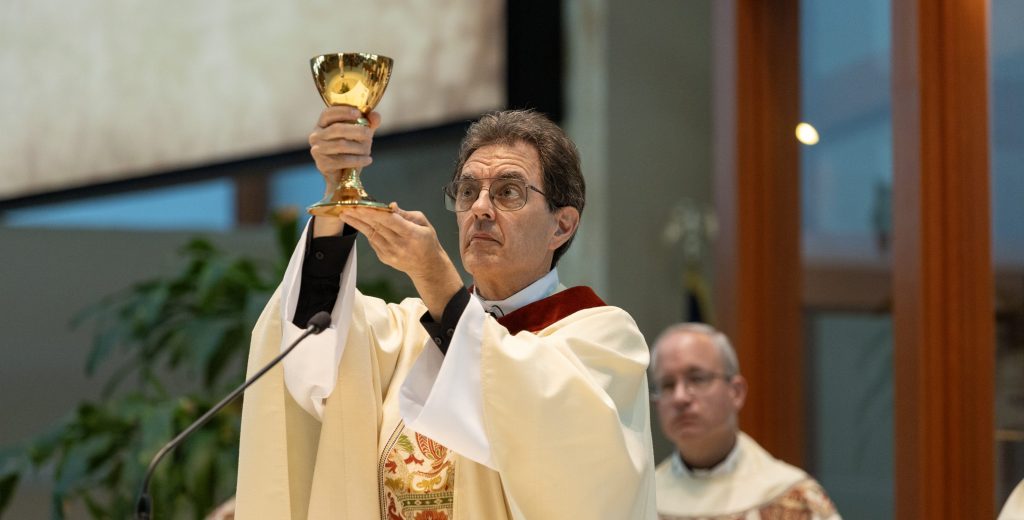
Jesus receives what we give and multiplies it just as he did with the multiplication of the loaves. The priest takes the bread first and then the wine into his hands and speaks the words of Jesus again and through the power of the Holy Spirit, the bread and wine become the Body and Blood of Jesus. How do we know this to be true? Because Jesus said then and we hear his words again at each Mass:

“This is my Body”.

“This is the chalice of my Blood”.

In the miracle of Jesus multiplying the five loaves and three fish to feed the thousands, he was setting the stage for the miracle we get to experience at each Mass. The appearance of bread and wine remains, but its substance, the reality at the core, has been changed to become the Body and Blood of Christ. This miracle we don’t just read about, but can experience and receive him again and again to satisfy the deepest hunger of our souls.

We are just beginning, the journey continues next Sunday!


Photo: Blessed to be a priest participating in the miracle of turning bread and wine into the Body and Blood of Christ during Mass each day!

Link for the Mass readings for Sunday, July 28, 2024