It is wonderful to be found. It is wonderful to be reconciled.

Those who edited the lectionary readings for the day chose to present the parable of the lost son and skip the parable of the lost sheep and the lost coin. This trilogy of parables is all found in Luke chapter 15. Reading the three together allows us to get a better sense of what Jesus is revealing to us. There is great joy in finding what has been lost, there is great joy in being found! Maybe we can recall something or someone that had been lost and then found, or have we ever experienced a time where we have been lost or separated, or a time when we have experienced a time of reconciliation from someone that we have been estranged?

I was somewhere in the age range from about six to eight when I came to the realization that I was separated from my parents in the Enfield Mall. I believe it was close to Christmas and we were in the toy store. I must have become distracted by something interesting, and stayed to investigate, while my parents and sister continued on. At some point, I became aware of that fact. It did not take long for the anxiety and fear to rise within me and the tears to well up. I walked through a few isles with no success in finding my family and then I headed toward the entrance that led out into the main mall.

Before continuing, I remembered my mother telling me that if I ever got lost, that I was to stay where I was, and she would find me. As I stood indecisively and wondering what to do, a woman noticed my predicament and led me to a stone bench outside the store. We sat and she stayed with me until my parents returned. I am sure the time of separation seemed a lot longer to me than the actual time, and much of the memory is fuzzy, but the anxiety of separation had an impact on me as did the relief and joy of reconciliation!

In my story as well as each of these parables, there is a great joy for that which has been lost and found. How many of us are not even aware of our separation from God or each other? While I was in my own world of material wonder, I was left behind. The son who had squandered every bit of the inheritance he asked of his father before his death, realized not so much that he had really messed up, but that he was in a dire situation, and he made the right decision to come back home. His father never stopped looking for him, he actually saw his son returning “while he was still a long way off” and “filled with compassion. He ran to his son, embraced him and kissed him” (Lk 15:20).

This father is not seeking his son to bow before him and prove his repentance, his loyalty, and allegiance. The father runs to his son without hesitation. This act is no small thing, for an elder to run to a younger family member was unheard of and simply not done. He was breaking this social taboo, most likely to redirect the focus away from his returning son; the one who had betrayed his father, the son who would receive glares and snide remarks. Instead, the father rushed out with a reckless abandonment of love to embrace his son. The jaw-dropping, followed by echoes of gossip surely rose in chorus about the father’s present actions, not his son’s past actions.

God is watching and waiting, seeking opportunities to run to us with compassion and love to welcome us home as the father did in the parable of the prodigal son. God is also like the shepherd who does the absurd in his outpouring act of love, leaving the ninety-nine sheep to go and find the one stray. God seeks for each and every one of us just like that shepherd. God is represented by the woman who rejoices over finding one seemingly insignificant coin, for God rejoices in our turning back to him because not one of us is insignificant to him. We are all precious to God, each in our own unique way, and he loves us more than we can ever imagine.

No matter the reason that we have strayed, no matter the temptations and distractions we have fallen for, and/or how far we have wandered away, God loves us more than we can ever mess up. Lent is a season to open our eyes and recognize where we are in our relationship with God and with each other, to recognize the separation our choices have caused. To say, “I am sorry.” “Please forgive me.” and “I forgive you.” are powerful words of healing. This is how we can turn back to God and those we are estranged from within our lives. There is indeed great joy in the healing of relationships and reconciliation! Lent is a time to be found, Lent is a time to come home.

——————————————————————–

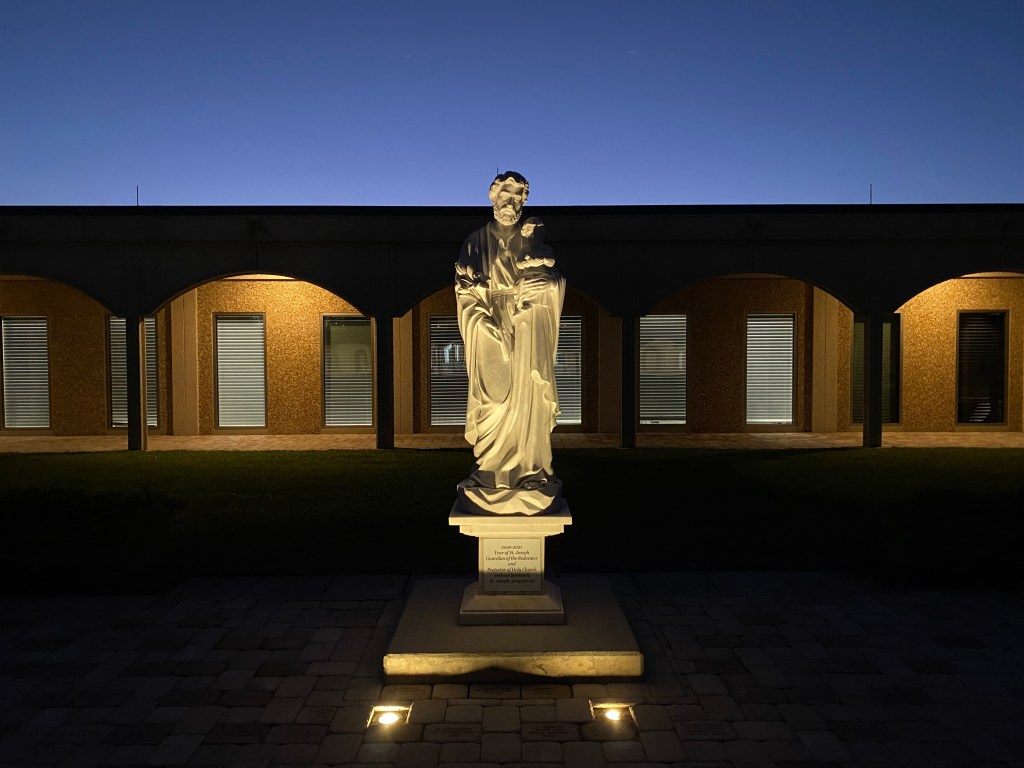
Photo: St. Joseph with Jesus in his arms, St. Vincent de Paul Regional Seminary, Boynton Beach.

Link for the Mass readings for Saturday, March 2, 2024

Are we willing to receive the Kingdom of God which is at hand?

The ten brothers of Joseph are envious of and hated him so much that they plotted to kill him. The Pharisees are planning to do the same with Jesus. Both Joseph and Jesus are beloved sons of their father, both will be sold for silver, and betrayed. Joseph remains faithful to God in his slavery in Egypt and through God’s providence will save the same brothers who betrayed him as well as all of his people from famine such that: what his brothers meant for ill, God would bring about for a greater good.

Jesus, the Son of God, is sent after his Baptism to call the descendants of the same people Joseph saved back to the God of Abraham, Isaac, Jacob, and Joseph. And yet, many of the Pharisees and priests are not about to receive this message or the invitation to repent and believe the Gospel, because most of them do not believe they need to or are not willing to. Joseph was able to save his own father and brothers and his people for a time, but they would eventually die. The offer of the salvation that Jesus presented is an eternal one and yet many of the chief priests and the Pharisees closed their minds and hearts to him, so much so that they were seeking to arrest and kill him. Jesus appealed to them to change by sharing the parable of the Tenants.

At the close of the parable, Jesus said to them, “the Kingdom of God will be taken from you and given to a people that will produce its fruit” (Matthew 21:43). The leaders were the stewards of God’s Kingdom and could inherit and be a part of it, but they would not accept the Son sent by his Father, the landowner, who is God, and it would be taken from them.

Who then is the Kingdom of God to be given to? Those who are willing to repent and believe in the Gospel for the kingdom is present in Jesus. Jesus reaches out his hand to us. Will we refuse or are we willing to place our hand in his and walk with him where he will lead us?

When we take his hand, we will still feel the wound of the nail that pierced him through. Like Thomas, do we realize that we are holding the hand of our Lord and our God? Do we realize that Jesus was willing to give his life for you and me for this very moment in time?

Receive this gift to spend with Jesus. Share with him what is in your heart and on your mind. Breathe and be still and listen to what he would like to share with you. Trust in Jesus and this time together.


Photo: Some quiet time with Jesus this past Sunday, St. Vincent de Paul Regional Seminary, Boynton Beach, FL.

Link for the Mass readings for Friday, March 1, 2024

Are we willing to see another as human in their need?

The Parable of the Rich Man and Lazarus from the Gospel of Luke 16:19-31 is well worth the read. Jesus challenges us through parables such as these. For many in Jesus’ time who were followers of the God of Abraham, they believed that those who had wealth and status in society did so, for the most part, because they were blessed by God. When the rich man and the beggar, Lazarus, die, I am sure Jesus paused to allow his listeners to imagine what would happen to these two men. Many would not have predicted what happened next.

Lazarus was taken up “by angels to the bosom of Abraham” (Lk 16:22). The rich man found himself suffering from the torment of flames, such that he was parched, begging just for a drop of water from Lazarus (cf. Lk 16:23-24). Abraham, the model of faith and father of Judaism, was not sitting with the rich man, who must have always been seated at the highest places in his day, but now that seat, at the bosom of Abraham, was offered to Lazarus. There was no hope at this moment for the rich man to cross over because of the wide chasm that separated them. An ironic subtlety was afoot as well in Jesus’ telling of the parable to the Pharisees. Lazarus the poor beggar is named, whereas the rich man is not.

How does the rich man come to this state of suffering and separation? This is the life he lived prior to his death. He walked over or by Lazarus day after day not giving him even a second look. Lazarus would have been grateful even for the mere scraps that fell from this rich man’s table, much like the rich man now sought just a drop of water from the finger of Lazarus. The rich man committed the root offense from which sprouts much of our sin; he failed to bother, to care, to love his brother, to will his good.

Jesus’ parable of the Rich Man and Lazarus, echoes very closely Matthew 25:40, “whatever you did for one of the least brothers of mine, you did for me.” How we treat others matters. Failing to care, to reach out to those in need around us is sinful. We, probably like those who first heard this parable, experience time and again, a wicked mind storm that swirls with reasons, rationalizations, and justifications as to why we do not reach out to help others. The majority, if any, are not valid. We are invited to give and to love joyfully from a natural, not a hesitant disposition, to provide aid and support.

Almsgiving is one of the three pillars of Lent. The first step in giving of our time, talent, or treasure is to be people of prayer. Spending time with God helps us to know him, his will, and his voice and we will then grow to see him in all things and all people. As we experience, rest, and abide in his love and come to know his voice, we will be more apt to say, “Here I am!” We will also be more aware of those who are in need from the unborn to those in the later stages of their life and everywhere in between. This can be in our own families, home, workplaces, schools, or wherever we go!

Once we are aware, the challenge is knowing how best to provide help. Our response will be unique for each person. What we want to resist is feeding the wind and the waves of indecision and excuses for not helping and instead take a breath and stop. Let our eyes adjust so that we can see the person before us as a human being, as a sister or a brother with dignity, value, and worth.

Everyone wants to belong, to be a part of, to be loved. Then, in the next moment seek the guidance of Jesus, be present, and allow God to happen through us in whatever form or act of kindness that may take. No matter how small, loving another makes a difference. Seeing another, seeing another as human, seeing their need, acknowledging their presence, and seeking God’s guidance on how best to help is a good place to start.

——————————————————————-

Photo of woodcut Jesus and leper by Mabel Royds. Are we willing to see Jesus in others and allow them to see Jesus in us?

Link for the Mass readings for Thursday, February 29, 2024


Peace comes when we align our will with our Father’s will.

Look at me, serve me, I want, are attitudes and dispositions that tempt us. Fame, honor, power, prestige may be another way of making the same point, which is that we often have a hyper-focus on self and self-promotion. Social media offers more of a platform to fuel this temptation. If we think this is something new with the advent of modern technology, we can look at today’s Gospel of Matthew to see that we have been operating from this posture for a very long time.

Jesus, for the third time, was attempting to prepare his disciples for his passion. He said: “Behold, we are going up to Jerusalem, and the Son of Man will be handed over to the chief priests and the scribes, and they will condemn him to death and hand him over to the Gentiles to be mocked and scourged and crucified, and he will be raised on the third day” (Mt 20:18-19).

The response of the mother of James and John (the two brothers make the request themselves in the Gospel of Mark) is actually not that surprising if we spend any time with people. She disregards what Jesus just mentioned about his imminent death and requests that when Jesus assumes his seat of power that her two sons will be number one and number two. The other disciples were quite indignant, and I can imagine what followed was not a pretty sight.

Jesus shares directly with the brothers that to give them a place at his right and left “is for those for whom it has been prepared for by my Father” (Mt 20:23). He addresses them all by letting them know that the preeminent place in his kingdom, whoever is to be first, is the one who serves his brother and sister.

Jesus is encouraging us this Lent to take the focus off ourselves and get out of our heads. To let go of I, me, and mine. Even when we let go a little, we will feel more peace. We will be able to take a few more deep breaths. We can experience this as well when we get outside, look up, and see the expanse of the sky. We’re no longer thinking about ourselves but touching the gift of our eternal nature and call to be one with God. Instead of feeling contraction, we can experience a sense of expansion.

When we allow ourselves to take a breath, we can then let go of the stress and the strain and the needless energy we expend following the distractions, diversions, and temptations that keep us on a treadmill pace. We can then instead spend a few moments with Jesus, and he can, as he did today with the apostles, correct any ways in which our mindset is not aligned with his Father’s will. We can then place God’s priorities for our life first, properly order our own, or let go of any that are not of his will.

When we are able to breathe, receive, and abide in God’s love, discern and make decisions from his guidance, we are changed and transformed. We will experience healing and renewal. We will begin to experience the fruit of the spirit: “love, joy, peace, patience, kindness, generosity, faithfulness, gentleness, self-control” (Galatians 5:22-23). In this way we can let go of being first or best, sitting at the right or left of Jesus, and instead, rest in being who we are as loved by God. As we experience more of the love of God, it is easy to let go of the need to be served and be more willing to serve and share the love we have received.

——————————————————————————

Photo: Looking up and outward, and breathing deep! St. Vincent de Paul Regional Seminary, Boynton Beach, FL.

Link for the Mass readings for Wednesday, February 28, 2024

Jesus sets a high bar, but will also give us the strength we need to reach it.

There are many polls, surveys, and discussions about why fewer people participate in formal faith traditions, while at the same time many people are still hungry for God. Some people still profess to be spiritual but identify less with organized religion. There are a handful of causes why, but Jesus may be shedding light on two possible ones. Jesus discusses in today’s Gospel from Matthew: “For they preach but they do not practice. They tie up heavy burdens hard to carry and lay them on people’s shoulders, but they will not lift a finger to move them” (Mt 23:3-4).

We have an innate sense that alerts us to hypocrisy and when many seek something deeper in their life and they get slapped in the face with leaders and practitioners in faith traditions preaching one way in public while living another, it is damaging. The Catholic Church is still reeling from not only those clergy who have abused children, but those bishops who have covered up the abuse. This certainly is the height of hypocrisy in that those entrusted to shepherd the people of God were preying on their own flock.

As horrific as these acts are, there are so many other ways we are not practicing what we preach. It is easy to give up and walk away and say this is not my problem, to point fingers and justify our own acts of hypocrisy by saying well at least I am not that bad. Yet even this evil within the Church does not change the truth that Jesus is the way, the truth, and the life. He is the source of our being and fulfillment.

We are followers of Jesus, and that means the standard we strive for is how he lived his life. Jesus always pointed the way to the Father. We as human beings are finite and so are going to make mistakes and sin. While Jesus is our model, even more, he is the source for our living faithfully to his teachings. When we open our hearts and minds to him, his love will work through and transform us. He will reach others through us as well when we are willing to stand up for the dignity of those entrusted to us within our realm of influence.

If we want to guide someone it is not enough to say this is what you need to do and live accordingly. We need to practice and live what we are guiding others to do, be willing to accompany, assist, and walk with someone along the way. As a Christian, just giving someone the Bible and say there you go, that’s all you need, and quote a couple of scripture passages is not enough. If we are sharing a principle to put into practice and we are not willing to lift a finger to help them, or worse do the opposite, we do more damage than if we said nothing.

Jesus calls us to resist judging and condemning, to love our enemies, to be forgiving, and merciful. Powerful actions to live up to, heavy burdens to lift indeed. To say that the bar Jesus sets is high is an understatement, but he lived them out. We not only learn how to act from reading about the life and teachings of Jesus but even more importantly, he still gives us the power and assists us to live them out too.

Jesus challenges us even more than the scribes and Pharisees, but he is willing to help us carry the load. When we are willing to see where we fall short of the goals that he sets for us, ask for his forgiveness, and accept his help, we will grow. From our own experiences of falling down and getting back up, we are better able to help others to be disciples, by guiding, modeling, and walking with them. The most important guidance we can give anyone is to lead people in such a way that they have an encounter and experience of Jesus for themselves, so even when we fall, they will still have Jesus as their ultimate guide and they can then help us up and we can continue to journey together, side by side.

————————————–

Photo: Attending Mass at St. Luke Catholic Church, Ellington, CT over Christmas break. Nice to experience Mass in different parishes each day while away!

Link for the Mass readings for Tuesday, February 27, 2024

“Be merciful, just as your Father is merciful.”

My wife, JoAnn, asked me on a couple of occasions what were the favorite clothes of mine that she wore that I would like her to pack for our trip. I said the ones that you feel most comfortable in. She also shared with me what clothes she liked on me, including a pair of black, skinny jeans.

The reason we were having this conversation was because we were moving to Los Angeles. JoAnn had been diagnosed with Stage IV Pancreatic Cancer and we were moving to LA, for her final months this side of heaven.

With all packed, JoAnn flew ahead to Los Angeles with Jack. I would follow two weeks later after I finished out the school year. When I arrived and we were unpacking, JoAnn said, “You didn’t pack your black, skinny jeans.” The look on her face pierced my heart. We didn’t talk about it again.

About four months later and a few days after JoAnn died. The image of the look on her face came back to me again, and with some time to think, I realized that JoAnn was focusing on the clothes because these would be our last weeks together and why not dress in clothes that we both liked on each other. I was devastated that I missed it. The feeling also brought up times throughout our marriage where I did not make the time to listen to JoAnn, where I was impatient, and even treated her with contempt.

In that moment I experienced a deep sense of contrition at how I must have hurt JoAnn in those times. I cried as I walked to the cathedral in downtown LA which was about a half mile away. I got myself together and then fell apart again as I confessed to the priest. When I finished, he said that JoAnn forgave me, and that God forgave me.

Mercy, in Hebrew – Chesed – tender compassion.

God’s mercy, his tender compassion, is what I felt in that moment.

This is what Jesus is calling us to receive and be in our Gospel today. We are to be merciful, just as our Father is merciful with us.

Lent is a time to experience the mercy, forgiveness, and love of God. We do so when we are willing to be humble enough to allow Jesus to show us our sin, where we have fallen short of loving him, ourselves, and one another as he has created us to be. When we see our sin, Jesus does not condemn, berate, or demean us. If we experience any of that, know it is the devil seeking to isolate and separate us from the mercy, forgiveness, and love God wants to embrace us with.

All God asks of us is to be ourselves, to be who he has created us to be and that is his beloved daughter or son. All the other things we think we need to be, we can let go of. We can let go of all the anxiety, stress, and confusion about who we think we ought to be and just breathe deeply, receive, rest, and abide in the love our Father wants to share with us. When we live from this experience of God’s love, we will be in a better place. And when we mess up, we just need to be contrite, confess, be forgiven, do penance, and begin again.

As I shared my experience above, I encourage you to think of a time when you have experienced God’s mercy, chesed – his tender compassion. Rest in that moment and return to it again and again today and this week. When we return to and experience these anchor moments of God’s mercy for us, we will remember who and whose we are, and we will better be able to share God’s mercy, forgiveness, and love with others.


Photo: Treasure each moment you have with those you hold close to your heart. Even in the best of circumstances, time goes too quickly and the unexpected can happen. Let those you love, know you love them, with your thoughts, words, faces, and actions.

Link for the Mass readings for Monday, February 26, 2024

Jesus invites us to share in his divinity.

“Here I am” (Genesis 22:1)!

Abraham said this twice in today’s account from the book of Genesis. The first time was when God called Abraham to offer his son, Isaac, up as a sacrifice and the second time was when God’s angel called out to Abraham asking him to not offer his son as a sacrifice.

Hopefully, we have not become dulled by hearing this story before. This is a horrific act that God is requesting of Abraham. This would not be a natural response from our place of time and experience. Yet, for Abraham, he would have known of those who would have killed their children by offering them to the gods of the people of the land of Canaan. God meets Abraham in his own history of time and place.

God reached out to Abraham in a way that he would understand, but that still did not lessen the sacrifice that Abraham was willing to make. He and his wife Sarah were childless for decades, and God promised to give them a son way beyond child bearing years. God followed through on his promise and now God was asking Abraham to give Isaac back as a “holocaust”, a full burnt offering. Despite the anxiety and trepidation that Abraham must have experienced, he heard God’s call clearly and followed without hesitation. He left the next morning.

Isaac also had a part to play. We do not know his age, most likely a young teenager, but we know he is old and strong enough to carry the wood for the burnt offering on his back. Isaac was carrying the wood upon which he would be offered up. Isaac allowed himself to be bound with no account of his resistance to his binding and placed on the wood where he would give his life. He was clearly strong enough to stop his elder father and get away but accepted that he would be the sacrifice. God, through his angel, stopped Abraham from doing what God himself would do with his own Son.

God sent, his only begotten Son to become human and live the fullness of a human life. Jesus, like Isaac, would carry the wood of his sacrifice, most likely the cross beam of his cross. He also passively submitted to those nailing him to the cross. As St. Paul wrote, “He who did not spare his own Son but handed him over for us all” (Romans 8:32) was no generic or abstract sacrifice. God our Father sent his Son to die as a sacrifice by taking upon himself the full weight of each of our individual sins. Jesus was willing to follow the will of God all the way to his death.

How often have we taken the time to ponder this reality, that God was willing to give his only begotten Son for us and that Jesus was willing to give his life for us? Not in some abstract way, but personally. Jesus died for you and for me. Jesus seeks an intimate relationship with us, just as he did with Peter, James, and John.

In today’s gospel account, Jesus took these three up the mountain and revealed his divine personhood to them. This, as his miracles, was to reveal a foretaste of the fullness of the coming kingdom. The transfiguration was also an opportunity to empower and strengthen Peter, James, and John for the trial to come in which Jesus would willingly, like Isaac, go to be sacrificed. The only difference is that Jesus would not be spared, he would give his life on the Cross for us all. Jesus has given us everything of himself, holding nothing back.

The willingness of Jesus to give his life, expresses the fullness of our theological virtues: faith, hope, and love. He had faith in his Father, he trusted his Father. Even though he did not fully understand in his humanity the fullness of what his death meant, he had faith and so said, not my will but yours. From that faith in his Father, he had hope and could continue with allowing himself to be arrested, beaten, tortured, and crucified. Even on the Cross when he felt the separation between himself and his Father, he still had hope that God would bring about a greater good.

That greater good would become our salvation and the salvation of the world. Jesus gained for us access to the trinitarian communion of Love. God was willing to sacrifice his only Son, his Son was willing to be sacrificed, so that we human beings made in our Father’s image and likeness could be restored to our original glory by the love shared between them, God the Holy Spirit. The glory of the Lord, that Jesus revealed to Peter, James, and John is now available to us because Jesus became one with us in our humanity, to suffer and die for us so that we can experience his divinity.

We participate in the transfiguration of Jesus and enter into the trinitarian communion of love that each of the three persons of the Trinity share when we are willing die to our fallen and selfish nature and choose to love one another as God loves us.

The three pillars of Lent, prayer, fasting, and alms giving, all help us with this process. As we choose to make time to pray, we are putting God first by answering his invitation to do so and spend time with him. When we fast from food and activities, we come to see that there is more to us than just the physical. The physical is good, but without temperance and restraint we can slip into attachment and addiction. Fasting can free us from both. As we give alms, we choose to see other’s needs above our own, and are willing to provide for them. We are also better able to discern between our needs and wants. In doing so, our sacrifice becomes tangible, and we are putting our love into action.

We participate in these three acts of penance so we can better see the temptations and diversions of this world that are leading us away from God and who he calls us to be. As we are able to repent from and remove those obstacles, we can, like Abraham, Moses, Elijah, and Jesus, better hear the word of our Father and act upon it. Hopefully then, each Lent we grow more in the gifts that God has given us at our Baptism: faith, hope, and love for God, ourselves, and each other. In this way, throughout the year, we will better be able to hear God call us, and we can say without hesitation, “Hear I am!” And then do his will.


Photo: Taste of the transfiguration during evening prayer Saturday evening, St. Vincent de Paul Chapel, St. Vincent de Paul Regional Seminary, Boynton Beach, FL.

Link for the Mass readings for Sunday, February, 25, 2024

Love our enemies? Yeap.

“You have heard that it was said, You shall love your neighbor and hate your enemy. But I say to you, love your enemies, and pray for those who persecute you, that you may be children of your heavenly Father” (Mt 5:43-45). With these words, Jesus continues to raise the bar of discipleship and outlines what the pursuit of love truly is.

For many people, as Bob Dylan wrote and Joan Baez has sung, “love is just a four-letter word.” But the love that Jesus calls us to is not merely romantic, emotional, or mere sentimentality. There is nothing wrong with feelings of infatuation because in experiencing falling in love, we are drawn out from ourselves to another. This experience of love has no depth though and when it is channeled and disciplined, it can mature to the wonderful gift of friendship.

The bond of friendship and family goes beyond mere attraction and is built through shared interests and experiences. Through sharing our lives with others, working through conflicts, trust is built, and relationships will hopefully grow and deepen. Jesus, though, is calling us to mature in our growth of loving even beyond friendship or familial ties. If we love those who willingly love us in return, greet only our brothers and sisters, only those in our clique, group, tribe, or political party, what is the recompense or satisfaction in that? Agape, in Greek, loving without conditions, with little or no chance of mutual exchange, is what Jesus is calling us to strive for.

How can Jesus ask us to love an enemy or pray for someone who persecutes us? St. Thomas Aquinas can be of help. He defines the love that Jesus describes as willing the good of the other as other. We make an act of the will, a free choice to accept the person as they are, to see them, not from our limited, finite perspective but as God sees them, as a person with dignity. Jesus does not teach that we condone violence or abuse or dehumanization. We just don’t act in kind and meet hate with hate. Jesus is calling us higher so we can help to end cycles of violence and not continue to fuel the fire of hatred and division with retaliation.

On our own, we may not even conceive of the possibility, but we can be assured that if Jesus has asked us to strive for this height and depth of love, he will provide the means and support. We love others unconditionally by allowing Jesus to love others through us. We love one person at a time and strive to reach the summit of loving our enemy. Even when we fall short, how much better would our country and the world be if we sought this as our goal? To counter divisiveness, fear, and hatred, we need to choose to engage in an act of the will to love one another as Jesus loves us.

As St. Polycarp, Bishop of Smyrna in the second century who was martyred at 86 years old, was a disciple of John the Apostle who was a disciple of Jesus, taught, “True love desires not only one’s own salvation, but the salvation of all our brothers.” He put his words into practice. As Roman soldiers came to arrest him, he welcomed them and offered them food and drink before they led him to his death.

—————————————

Photo: Rosary walk and praying with Jesus, Mary, John, and Polycarp. St. Vincent de Paul Regional Seminary, Boynton Beach, FL.

Link for the Mass readings for Saturday, February 24, 2024

Let us reflect the love of Christ with our thoughts and our words.

Jesus calls us to be holy, each and every one of us. Our life is to be lived with the end goal being our ascent to heaven, to be in union with our Loving God and Father for all eternity, and to assist others to do the same. Jesus provides for us a concrete example of the heights to which we are called to reach: “You have heard that it was said to your ancestors, You shall not kill; and whoever kills will be liable to judgment. But I say to you, whoever is angry with his brother will be liable to judgment, and whoever says to his brother, Raqa, will be answerable to the Sanhedrin, and whoever says, ‘You fool,’ will be liable to fiery Gehenna” (5:21-22). Jesus is building on the Torah, the Law or the Teachings, by helping us to realize that we can not only kill with weapons but also inflict dehumanizing damage with our words.

To resist this temptation of inflicting mortal wounds, we need to start participating in a deeper examination of conscience which gets to the roots of our own thoughts, words, and actions. If we are not able to discipline our thoughts, what will follow is undisciplined words, and then undisciplined actions, which can lead to entertaining and embracing the deadly sin of wrath. Wrath is unbridled anger that leads someone away from the capacity to think or behave in a rational manner, such that this individual would no longer acknowledge the dignity of the person they would inflict their wrath upon.

Jesus is helping us to see that we can be free of the temptation of wrath if we recognize the danger and destruction of unleashing words as weapons. He offers us the examples of calling someone, Raqa, meaning something along the lines of an air-head or an idiot, and calling someone a fool. These words directed at another have no other cause than to demean, degrade, and belittle. This language, and worse, has no business coming out of the mouths of a disciple of Christ if we are serious about being one of his followers.

I remember a moment in sixth or seventh grade unleashing a derogatory word or two directed at a classmate. Even though they were loosed in jest, I felt a sinking feeling in my gut after hearing myself say them. God gave me a graced moment to feel, contrition, actual sorrow for the negativity and poison I had unleashed with my words. I remember making a commitment to myself not to speak that way toward another person going forward.

We need to be aware that words have the power to wound or to heal. If we are serious about following Jesus, then a wonderful practice this Lent can be to commit to fasting from gossip and from words that belittle, divide, diminish, or dehumanize and replace them with words that empower, unite, uplift and acknowledge the dignity of others. Even when we disagree with another’s point of view, we can do so by still respecting the person and fostering a posture of dialogue.

May we also commit to resisting and not feeing negative or dehumanizing thoughts when they arise. Even when we have defensive musings, resulting from another’s disparaging tone, words, or actions, we need to resist entertaining them. Instead, we can ask for the strength from the Holy Spirit to develop a more mindful disposition that seeks to understand instead of react and to hold each other accountable with respect. We can also give ourselves time regularly to be still and enjoy time outside to let go and unwind. It is important to get enough rest as well. Ultimately we need to consciously choose to love: to will the good of each other as our first step in encountering one another as human beings, as beloved daughters and sons of God.

—————————————————————

Photo: The simple act of looking up can make a difference in our attitude and emotional state. Give it a try and see! Rosary walk, St. Vincent de Paul Regional Seminary, Boynton Beach, FL.

Link for the Mass readings for Friday, February 23, 2024

“Who do you say that I am?”

Jesus asked, “Who do people say that the Son of Man is” (Mt. 16:13)?

Peter answers Jesus by saying that Jesus is: “The Messiah, the Son of the Living God” (Mt: 16:16).

What does Peter’s response have to do with our lives? Does he really care about our everyday challenges, struggles, and tensions? Yes, he does because Jesus is the Christ the Son of the living God. Jesus is Emmanuel, God with us. Jesus is one with us. The infinite reality of God is present within each human being that exists because Jesus became one with us in our humanity so that we can be one with him in his divinity.

We have been created in God’s image and likeness and this is true from the moment of our conception through each stage of life until natural death. The unfortunate effects of Orignal sin are that our image has been distorted and our likeness to God has been lost. We have not been totally corrupted but we have been wounded and we need to be healed and restored.

Jesus experiences our suffering personally. Whatever we may be going through, whether it be a temporary or chronic illness, loss of job, conflict and tensions with family, friends, colleagues, and/or classmates, as well as experiencing feelings anxiety, confusion, and/or lack of direction, mourning and grieving over the death of those we hold close to our hearts: Jesus feels our pain and suffering.

The suffering of humanity is not something abstract for Jesus because Jesus knows each and every one of us intimately and uniquely. He knows us better than we know ourselves and is the one who cares about us and what we are experiencing. Also, he is no stranger to suffering.

Jesus not only cares, he loves us and will walk with us no matter what we may be facing right now. Jesus is inviting us this morning and this Lent to trust in him, to allow his light to shine in those places of darkness, those places where anxiety and fear have a hold, and those places where we need to let go because we give them more priority in our lives than we do God.

A good question to ponder and meditate on this morning is: Who is Jesus for us and are we willing to invite him into our situations and allow God to happen in our lives?

—————————————————————————–

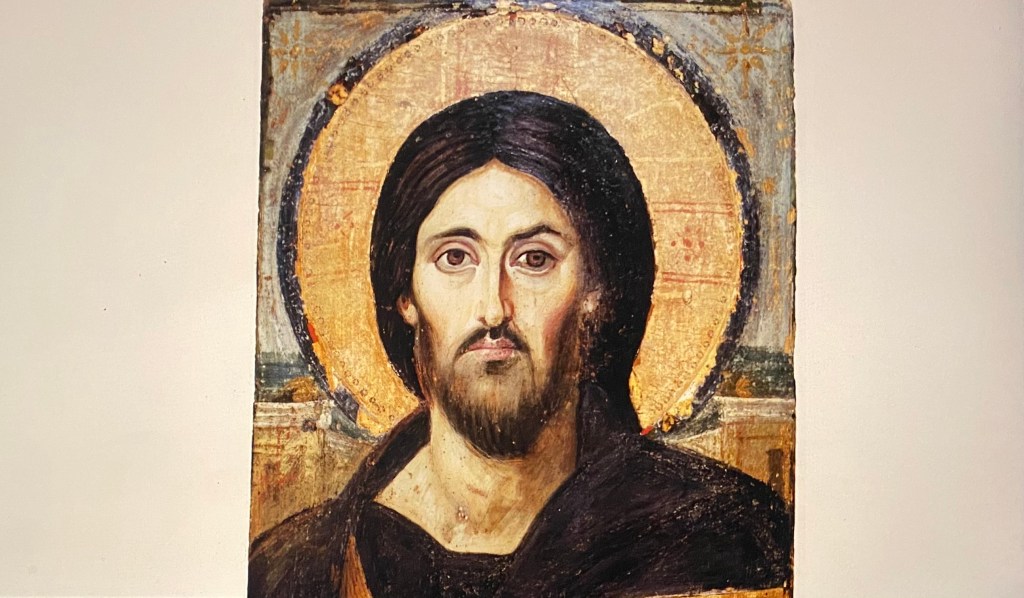
Photo: Closeup of a 6th century icon of Jesus from St Catherine’s Monastery.

Link for Mass readings for Monday, February 22, 2024