May we realize where we are lost and return to our Father.

In today’s Gospel from Luke we encounter the well known parable of the Prodigal Son. With the parables it is important not to skip over who Jesus is talking to, just so we can dive into the parable itself. Jesus is speaking to tax collectors and sinners. They are drawn to him. The Pharisees and scribes are also present. They are drawn to him also, but are not celebrating but complaining.

With these two groups now focused on Jesus, he shares his parable. Three main characters are present in the telling, the younger son, the father, and the older son. The younger son represents the tax collectors and sinners. They have embraced the sin of Adam and Eve in taking for themselves that which God would have freely given to them. They have squandered their inheritance and separated themselves from the relationship and love of God. Yet, as the son realized, and the tax collectors and sinners are coming to see in Jesus, all that the material life offers is limited, and it does not fully satisfy. They, like the younger son who returned from the “distant country”, are prepared to come home.

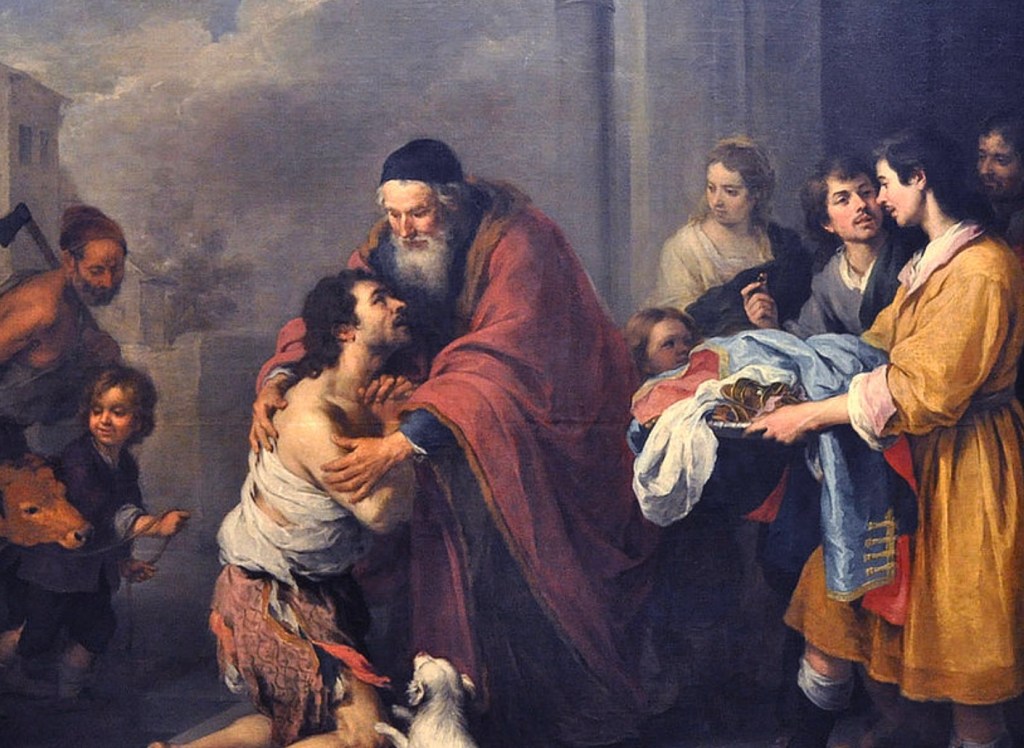
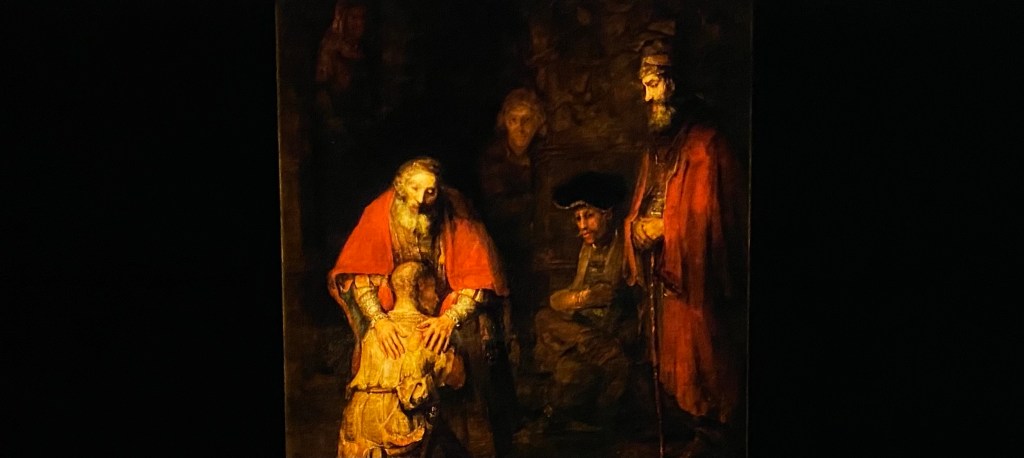
The wonderful light and joy of the parable is that: “While he was still a long way off, his father caught sight of him, and was filled with compassion.” The father then did the unthinkable as: “He ran to his son, embraced him and kissed him” (Lk 15:20). The father never held a grudge, but also never gave up or stopped looking for a sign that his son would return. His racing to meet his son showed the outpouring of love and mercy that this father had for his son. This uncharacteristic action would also certainly draw attention to himself, and take the focus away from the wagging of tongues that would have certainly begun regarding his son’s return.

In covering the son with a robe and placing a ring on his finger, the father showed his forgiveness, and restored the bond and covenant that was broken. He still considered him his son. The party that began was a celebration of this fact. As the festivities continue, the parable turns to the older son, and again, the father goes out to meet him. The elder son meets his father with anger. Filled with not only self righteousness, but also revealing that even though he remained with the father he did so with no love or joy. He too was looking for more from the father than the greatest gift he offered him, which was his relationship, his love.

The parable of the Prodigal Son ends with an invitation to all those who had gathered around to listen to Jesus. The tax collectors and sinners were invited to come home to their father, to turn away from their pursuit of the empty and false substitutes of wealth, power, pleasure, and honor. They were invited to be born again from their life of death, to be embraced as the children of God that they were, embrace their relationship, and restore their covenant with him.

The Pharisees and scribes also were invited as was the elder son. They were invited to turn away from judgment and instead celebrate the return of those who were willing to repent, to turn away from sin and to turn back to God and come home. Those who had been lost had now been found. In doing so, they would realize that they too were lost, and separated from the loving relationship of God.

We are loved by our God and Father, more than we can ever mess up. God loves us as his daughters and sons, even when we are lost in our sin. Who do we identify with in this parable? Are we willing to recognize that the God of Jesus Christ has always been watching for us, always reaching out for us, always running out to meet us, welcome us as we are, and urging us to come home to be with him? God is running to meet us and embrace us. Will we run away from him or run to him? God could also be inviting us to come in and celebrate with those who have been lost and now have been found. Will we choose our pride and judgment or will we like Jesus be willing to draw close and be part of the family?


Painting: Rembrandt’s “Return of the Prodigal Son”
The Mass readings for Sunday, March 30, 2025

Would we accept Jesus reaching out to those we consider “Gentiles” – other?

The people in Jesus’ hometown synagogue in Nazareth are incensed, rise up to drive him out of town, “and led him to the brow of the hill on which their town had been built, to hurl him down headlong” (Lk 4:29). What got Jesus’ hometown crowd so twisted and contorted? Not only did he stand up earlier in this account of Luke and proclaim that he, the carpenter, was the fulfillment of the prophecy of Isaiah, but it was to the widow of Zarephath that Elijah came and Naaman the Syrian that Elisha healed.

All three of these points may be a big ho-hum to us, but they were a big deal to his people. Being a carpenter, more likely a simple day laborer, was not high on the social status ladder even in a poor town like Nazareth. The gospel writers even show the sensitivity of this. In the Gospel of Mark, Jesus is mentioned in this scene as  “the carpenter” (6:3), in Matthew, “the carpenter’s son” (13:39), and in today’s Gospel of Luke, “Joseph’s son” (4:22). By the time we get to Luke’s account, Jesus is not even associated with the trade of carpenter, how could someone of such simple and humble means assert the mantle of a prophet, let alone the Messiah?

Jesus does not go quietly in the night as the people’s wonder at his words turn to doubt and consternation. Jesus instead gives two seemingly obscure examples of people who receive God’s blessings. There were many widows and lepers in Israel, but it was to the widow of Zarephath that Elijah came and from Elisha that Naaman the Syrian received healing. The significance of these two people was that they were Gentiles, they were other, they were not part of the chosen people. Jesus is aligning himself in the prophetic tradition of Isaiah with the universal promise of God’s salvation that would also go out to the Gentile world. Jesus is invoking a choice that will consistently ripple throughout the remainder of his public ministry. People will either embrace his universal ministry or they will oppose it.

Jesus said to his own people, from his hometown, “Amen, I say to you, no prophet is accepted in his own native place” (Lk 4:24). We may look and wonder why Jesus would say such a thing and why after speaking of the widow of Zarephath and Naaman the Syrian that these same people were “filled with fury” and sought to throw him headlong out of town. One concrete reason is that Gentiles had been oppressing the Jewish people for generations. Beginning with the slavery they experienced in Egypt, the conquering of the ten northern tribes of Israel by the Assyrians, the Babylonians decimated the remaining southern tribes, exiled, and destroyed the Temple. After their return from exile, they suffered the occupying power of the Greeks, and during the time of Jesus’ preaching, the Romans. The hope of most Jews was that the Messiah would come to evoke a military uprising and overthrow their Roman occupiers.

Jesus’ hometown crowd was none too happy with Jesus’ universal message. We might too quickly judge them, but if we resist domesticating Jesus and allow ourselves to hear his words echoed today from our podiums and ambos, might we feel some of the same angst that the people of Nazareth felt? Who might we not be willing to welcome into the universal invitation of salvation that Jesus is still inviting us to experience in our day?

Would we embrace his message or begin to cross our arms and seethe? Would we too want to rise up and reject Jesus outright? If we are humble this Lent, we can walk up to Jesus and ask him to heal us of our own prejudices and biases, we can come to realize what gifts he has given us, and ask him to show us what ways we can bring glad tidings to those in our families, parishes, and communities. The choice is ours. Will we be an obstacle to Jesus’ healing or welcome the Holy Spirit to fall afresh upon us?


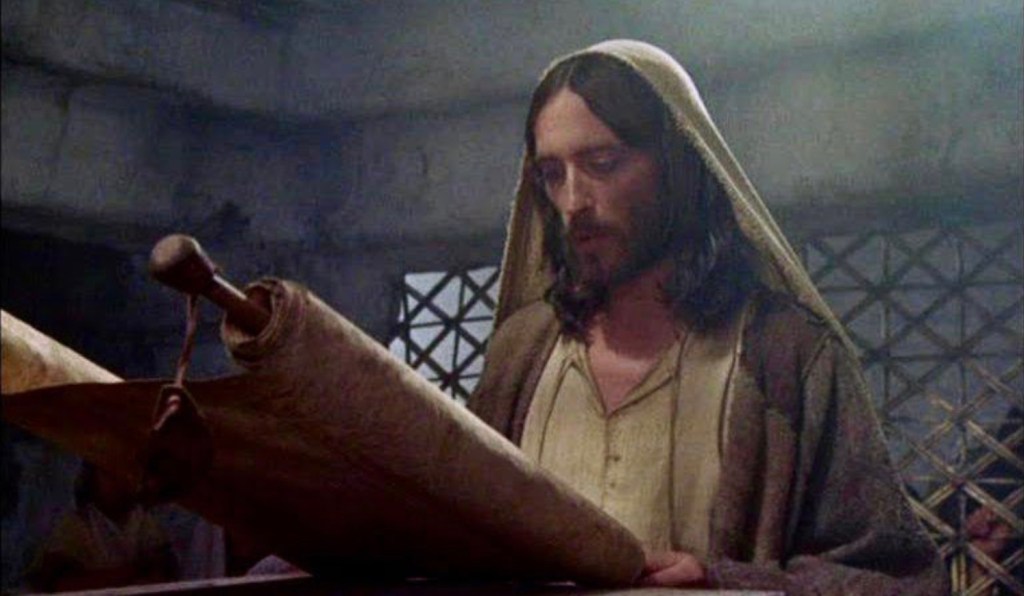
Photo: Jesus in the synagogue of Nazareth from Jesus of Nazareth, Franco Zeffirelli film, 1977

Link for the Mass readings for Monday, March 24, 2025

Lent is a time for reconciliation and to come home to the Father.

Those who edited the lectionary readings for the day chose to present the parable of the lost son and skip the parable of the lost sheep and the lost coin. This trilogy of parables is found in Luke chapter 15. Reading the three together allows us to get a better sense of what Jesus is showing. There is great joy in finding what has been lost, there is great joy in being found! Maybe we can recall something or someone that had been lost and then found, or have we ever experienced a time where we had been lost or separated, or a time when we have experienced a time of reconciliation from someone that we have been estranged from?

I was somewhere in the age range from about six to eight when I came to the realization that I was separated from my parents in the Enfield Mall in Connecticut. I believe it was close to Christmas and we were in the toy store. I must have become distracted by something interesting, and stayed to investigate, while my parents and sister continued on. At some point, I became aware of that fact. It did not take long for the anxiety and fear to rise within me and the tears to well up. I walked through a few isles with no success in finding my family and then I headed toward the entrance that led out into the main mall.

Before continuing on I remembered my mother telling me that if I ever got lost, that I was to stay where I was and she would find me. As I stood indecisively and wondering what to do, a woman noticed my predicament and led me to a stone bench outside the store. We sat and she stayed with me until my parents returned. I am sure the time of separation seemed a lot longer to me than the actual time, and much of the memory is fuzzy, but the anxiety of separation had an impact on me as did the relief and joy of reconciliation!

In my story as well as each of these parables, there is a great joy for that which has been lost and found. How many of us are not even aware of our separation from God or each other? While I was in my own world of material wonder, I was left behind. The son who had squandered every bit of the inheritance he asked of his father before his death, realized not so much that he had really messed up, but that he was in a dire situation, and he made the right decision to come back home. His father never stopped looking for him, he actually saw his son returning “while he was still a long way off” and “filled with compassion. He ran to his son, embraced him and kissed him” (Lk 15:20).

This father is not seeking his son to bow before him and prove his repentance, his loyalty, and allegiance. The father runs to his son without hesitation. This act is no small thing, for an elder to run to a younger family member was unheard of and simply not done. He was breaking this social taboo, most likely to redirect the focus away from his returning son; the one who had betrayed his father, the son who would receive glares and snide remarks. Instead, the father rushed out with a reckless abandonment of love to embrace his son. The jaw-dropping, followed by echoes of gossip surely rose in chorus about the father’s present actions, not his son’s past actions.

God is watching and waiting, seeking opportunities to run to us with compassion and love to welcome us home as the father did in the parable of the prodigal son. God is also like the shepherd who does the absurd in his outpouring act of love, leaving the ninety-nine sheep to go and find the one stray. God seeks each and every one of us just like that shepherd. God is represented by the woman who rejoices over finding one seemingly insignificant coin, for God rejoices in our turning back to him because not one of us is insignificant to him. We are all precious to God, each in our own unique way, and he loves us more than we can ever imagine.

No matter the reason that we have strayed, no matter the temptations and distractions we have fallen for, and/or how far we have wandered away, God loves us more than we can ever mess up. Lent is a season to open our eyes and recognize where we are in our relationship with God and with each other, to recognize the separation our choices have caused, and begin to turn back to God and those we are estranged from within our lives. There is indeed great joy in the healing of relationships and reconciliation! Lent is a time to be found, Lent is a time to come home.

——————————————————————–

Painting: “The Return of the Prodigal Son” by Esteban Murillo

Link for the Mass readings for Saturday, March 22, 2025

Jesus never tires of forgiving and loving us.

Luke records Jesus being critiqued for eating with tax collectors and sinners. Jesus responds to the criticism from the Pharisees and the scribes by sharing three parables, two of which we read today, and the third, the Prodigal Son, which is often reserved for reading on Sunday during this liturgical cycle of readings.

The two parables we are given today display the love that God the Father has for his children. Though we may not find being compared to a sheep or a coin endearing, the imagery of the shepherd going to find the one lost sheep and the woman searching all over her house for the one lost coin is a message well worth meditating upon.

Someone hearing this parable might say, “Why bother looking for the one sheep when you have ninety-nine other sheep or why bother looking for one insignificant coin when you have nine other ones?” But if we reflect upon this parable for a bit we might recall a time or feel right now that we may be lost or insignificant. What Jesus is telling us is that we matter. That God loves us more than we can ever imagine, and he is constantly seeking us out. God is the creator of the vast expanse of the cosmos while at the same time he cares for each and every one of us. He cares for you as if you were the only person in the world.

We do not need to look for God so much as we need to just stop, be still, and notice he is already waiting for us. If we feel a bit worn, misunderstood, lost, lonely or underappreciated, rest assured. God cares. God is present, yes, even in the midst of any conflicts, challenges, trials and/or tribulations that we may be going through. Even if we have separated ourselves from him through our sin, Jesus loves us more than we can ever mess up and he is the shepherd that watches over us and seeks us out even when we walk away from him. Return to him and allow yourself to experience the healing balm of his forgiveness.

As we return, we can let go, breathe, and allow ourselves to experience the loving embrace of Jesus and allow ourselves to be loved, to be filled up, and so have more to share with someone we encounter who may also need to know that they matter, they have dignity, are not alone, and that they too are loved.


Photo: One of my favorite pencil drawings by Kathryn J. Brown, 1982

Link for the Mass readings for Thursday, November 7, 2024

Let us turn over our anxiety to and receive from Jesus his peace.

“Martha, Martha, you are anxious and worried about many things. There is need of only one thing. Mary has chosen the better part and it will not be taken from her” (Lk 10:41-42).

My wife, JoAnn, used to have more than a few spirited discussions on this Gospel passage each time that it arose because at first reading it appears that Jesus does not show any empathy or regard for Martha’s gift of hospitality nor for all the work she is doing. All the men are sitting around listening to Jesus with Mary doing the same, and who is left to do all the work? Martha.

It is not only deacon’s wives who carry extra weight and burdens in support on the home front to allow their husbands the time to serve, (While JoAnn was still alive, the time it took me to write these daily posts was less time I spent with JoAnn or less time to devote to the needs of our home) but many wives who are full-time homemakers, run in-home businesses or carry a job outside the home, as well as caring for the children, overseeing the bills, the day to day grind, find themselves at times, rightly so, underappreciated, undervalued, and not respected for all they do.

Husbands can do a better job of being present, more patient, respectful, and attentive to their wives and be more of an equal partner on the journey. All of us, female or male, could also be better served when we follow this pattern of attention and priority: For those married as well as single put God first, then family, work, and our unique vocation.

With all the above as a prelude, I do not believe that Jesus was disregarding Martha. Especially in the Gospel of Luke, there are many instances in which Jesus empowers women so far beyond the cultural reality of his time. We read this as we do any biblical account from our twenty-first-century mindset. Contextually, the men sitting at the teacher’s feet in a different room, the women cooking, and most times eating separately were commonplace for those in the ancient near east of the first century AD. Mary was the only person out of step with the times.

Jesus said that Martha was worried about many things. Mary could have been one of those worries, and not so much that Mary wasn’t helping in the kitchen, but because she was breaking the social norm of sitting with the men. When Martha calls Jesus to redirect Mary, she probably expects him to support her plea. Yet, Jesus acknowledges that “Mary has chosen the better part” of sitting and having her primary focus be on him. I can visualize Martha being taken aback at first, but then slowly feeling the muscles in her face relax as the lightbulb went on, she chooses to let go of her anxiety, take her apron off, throw it to the side, and sit down next to Mary.

There is biblical evidence that beyond the Twelve, Martha, Mary, and Lazarus, were Jesus’ friends. When Jesus came four days after the death of Lazarus, as soon as Martha heard Jesus was outside, she, not Mary, came immediately out to Jesus, and in that exchange, it was Martha who made the claim that Jesus was the Messiah, the Son of God (cf Jn 11:27). Would she have had this insight, the same as Peter, if she was still holding a grudge?

Our modern reaction and push back to this Martha and Mary account in Luke may not so much be a reflection on Jesus but how poorly men have treated women over the generations and how poorly women continue to be treated even today. No matter their ages, young, old, and everywhere in between, women are human beings created in the image and likeness of God. No one has the right to abuse, demean, disparage, devalue, or exploit any woman. Women are to be appreciated, heard, respected, cherished, and valued.

God has given each of us gifts and ways to participate in his Father’s plan. May we seek to be still and rest in Jesus’ presence as Mary, and hopefully Martha, did. In this way, our anxiety can begin to reside as we experience feeling safe and we will come to know and experience his love. Doing so will help us to better know Jesus, his voice, and his teaching, know and follow his will, love others as he loves us, and live our lives respecting, encouraging, and supporting one another with the gifts and guidance that God has given us.


Photo: One of the ways that I sit at Jesus’ feet and experience his peace, Rosary walks on our campus here at Holy Cross, Vero Beach. Praying for the west coast of Florida and all in the path of Milton.

Link for the Mass readings for Tuesday, October 8, 2024

Curiosity from a distance, like Herod, or intimate, Lord and Savior, like Teresa?

‘Who then is this about whom I hear such things?'” And he kept trying to see him” (Lk 9:9).

Herod Antipas, the ruler over Galilee and Perea, heard stories about Jesus. The range of his thoughts, expressed by Luke, is confusion to curiosity. Herod may have started to feel concern over the possibility of a growing revolt, some guilt for his execution of John the Baptist, or just curiosity to see what this man was all about. Could this Jesus accomplish even half of the things Herod had heard about him? One question that did not seem to cross Herod’s mind was, did he have any interest in changing his life and becoming a follower of Jesus?

Herod was not the only one in Luke’s Gospel who asked questions about who this man, Jesus, was. Nor did the asking of those questions die with Jesus on the cross. They continued after his resurrection and ascension, they continued into the first centuries of the Church, which led to the calling of the first ecumenical councils which dealt directly with who Jesus was, and they continued in each following century and continue today. There are even at present in some academic circles, the question arising as to whether Jesus even existed at all.

One could ask why this question about Jesus persists? One answer is that we are finite beings seeking to understand an infinite Mystery. The full comprehension of the reality of Jesus existing as fully human and fully divine, dying on the cross, conquering death through his resurrection and ascending to the Father transcends even the wonderful intellect and ability to reason that we have been blessed with. Also, Jesus’ invitation is a universal but personal one. Each individual person has to encounter Jesus for her or himself.

Jesus called the Twelve, one by one as well as Mary Magdalene, St. Irenaeus, St Thomas Aquinas, St Francis and Clare of Assisi, St Catherine of Siena, St Teresa of Avila and St John of the Cross, St Ignatius, St Mother Teresa, Thomas Merton, Dorothy Day, and he calls each one of us as well. He did not call us to just merely embrace a new philosophy, a new ethical way of life, or even a new religion. Jesus called and calls us to be a part of his Body, the Mystical Body of Christ.

Who is Jesus, Herod asks in today’s Gospel? It is a good question for us to ask as well. For me, Jesus is the Christ, the Son of the living God, who became incarnate, becoming one with us in our humanity so that we could become one with him in his divinity. This same Jesus who called others through the ages invites us to follow him today as well and he continues to walk this journey with us whether we say yes or no to his invitation. We are just aware of and receive more of his help when we say yes!

Life with Jesus isn’t perfect, and we will at times echo St. Teresa of Avila, who stated after she was thrown from a carriage into a mud puddle, “If you treat your friends this way, it is no wonder you have so few.” But we will, as did Teresa, also experience moments of inexpressible joy, of wonder and exhilaration, and feel blessed when Jesus works and loves through us.

St. Teresa of Avila had a deep and intimate relationship with Jesus and knew him as her closest friend because she heard him knocking and let Jesus in. She spent determined and intentional time consistently with him. She spent an hour before and an hour after Mass each day. She set aside specific, daily anchor times of personal prayer, meditation, and contemplation which allowed her times of closeness that she could then experience Jesus as well in her daily activities. She was able to share with him her joys and frustrations because Jesus was that close to her.

Let Jesus not be just a passing curiosity as he was with Herod Antipas. Jesus is standing, knocking, (cf. Revelation 3:20) inviting us to open the door and let him in. Jesus is inviting us as he did with Zacchaeus to come down from the tree and take him to his home (cf. 19:5). Jesus is calling us to come and follow him as we read with Matthew just a few days ago (cf. Matthew 9:9-13). Jesus is not just some person from history. True, he died at a specific point in time and yet also was resurrected at a specific point in time, and he is alive and well, and inviting us to follow him today. All Jesus waits for is our, “Yes.” and a few steps. Jesus will take care of the rest!


Photo: Spending some quiet time with Jesus before heading to the land of dreams.

Link for the Mass readings for Thursday, September 26, 2024

Let us harden not our hearts, instead let us trust in Jesus, and put on new wineskins.

“Rather, they pour new wine into fresh wineskins, and both are preserved” (Mt 9:17).

Mark, Matthew, and Luke all record Jesus’ reference of pouring new wine into fresh wineskins. What Matthew adds is, “and both are preserved.” Luke adds: “[And] no one who has been drinking old wine desires new, for he says, ‘The old is good.’”

The Gospel authors are reflecting on the tensions of those who would reject Jesus and those who would follow him and his new way. The new wine is to accept the Gospel, the Good News of the kingdom of God in their midst, and to do so means to change one’s mind and heart. “The tension, and often incompatibility, between the old and the new is part of every religious tradition and attends every change within that tradition. Matthew and Luke wrestled with it and adapted it to their community situation. Contemporary Christians have no less a challenge” (The Gospel of Mark, Donahue, SJ, p. 109). Matthew shared with his community that Jesus is the new Temple, for the old one had been destroyed in 70 AD. Following him in fact meant that both the old and new covenants would be preserved. Jesus did not come to abolish the law and prophets. Instead, he came to fulfill them and even raise the bar and challenge his followers even more.

We are invited to wrestle as well. The Church is called to change, to be transformed by the Living God. Many say the Church needs to change this and that, not realizing that we are the Church, the People of God, the Body of Christ. If the Church is to mature and grow each of us needs to embrace Jesus’ offer of the transforming love of God and be willing to be made anew through the guiding presence of the Holy Spirit. This invitation is a call to let go of those disordered affections, physical and emotional attachments, habits, lifestyles, behaviors, mindsets, and addictions that are weighing us down or worse holding us in bondage and slavery. To cling to that which is not of God keeps us separated from God. Much of the material and finite things we hold onto prevents us from receiving the new life God wants to pour into us.

Jesus has come to set us free from the old wine that will lead us astray. He is introducing some new wine. We are invited to sip and savor his teachings and actions as recorded in the Gospels. Even when they might be challenging, we do not have to be afraid of the change and transformation Jesus is calling us to experience. God wants the best for us, and he will give us the strength and discipline to move forward step by step, for as St. Irenaeus wrote: “The glory of God is man fully alive!” Jesus is inviting us to live our lives and live them to the full!

To become new wineskins, Jesus invites us to soften our hearts. Let us resist the temptation to harden them and dig in our heals because we are afraid that what God may be asking of us will be too hard or make us miserable. Jesus calls us to trust. As we take a breath or two, and trust him, we will begin to feel safe and be able to let go of those selfish and sinful inclinations that keep us constricted and rigid. We will also be able to step out beyond our comfort zones, ones that may have truly been good but were not intended to be the end goal. 

As we learn to trust, we will also learn to love as Jesus loves. We will then expand and open our minds and hearts more to receive the new wine Jesus wants to pour into us. We are called to go beyond the foundation of our identities that we have found safety and comfort in and become free to be people of integrity. Our identity gives us roots but our integrity gives us wings to fly.

It was hard for me to think of living my life without JoAnn after she died. It was hard to let go of teaching, first at Rosarian Academy and then at Cardinal Newman, and it was hard to leave, even after the intensity of the past two years of seminary, but Jesus was leading me to put on a new wineskin yet again. I am typing away, now as a priest, in my new office. I have been welcomed and blessed by the new wine poured out through the hospitality and kindness of Fr. Tom, the staff, clergy, and parishioners here at Holy Cross Catholic Church. 

Each time we have the courage to come to God in stillness, he will reveal to us that which distracts and diverts us from going deeper. As we trust Jesus and cut away the ties that bind us, as we are willing to be more and more conformed to Jesus, as we trust him and let go of our biases, prejudices, and fears, we expand and become more of our authentic and true selves and grow to be truly who Holy Spirit is leading us to be with his tender chords of love. 


Photo: Celebrating my first Mass of Thanksgiving at St. Peter Catholic Church.

Donahue, John R. S.J., and Daniel J. Harrington, S.J. The Gospel of Mark. Vol. 2 of Sacra Pagina, edited by Daniel J. Harrington, S.J. Collegeville, MN: Liturgical Press, 2002.

Parallel Scriptural accounts: See Mark 2:22, Matthew 9:16-17 and Luke 5:37-39

Link for the Mass readings for Saturday, July 6, 2024

It is wonderful to be found. It is wonderful to be reconciled.

Those who edited the lectionary readings for the day chose to present the parable of the lost son and skip the parable of the lost sheep and the lost coin. This trilogy of parables is all found in Luke chapter 15. Reading the three together allows us to get a better sense of what Jesus is revealing to us. There is great joy in finding what has been lost, there is great joy in being found! Maybe we can recall something or someone that had been lost and then found, or have we ever experienced a time where we have been lost or separated, or a time when we have experienced a time of reconciliation from someone that we have been estranged?

I was somewhere in the age range from about six to eight when I came to the realization that I was separated from my parents in the Enfield Mall. I believe it was close to Christmas and we were in the toy store. I must have become distracted by something interesting, and stayed to investigate, while my parents and sister continued on. At some point, I became aware of that fact. It did not take long for the anxiety and fear to rise within me and the tears to well up. I walked through a few isles with no success in finding my family and then I headed toward the entrance that led out into the main mall.

Before continuing, I remembered my mother telling me that if I ever got lost, that I was to stay where I was, and she would find me. As I stood indecisively and wondering what to do, a woman noticed my predicament and led me to a stone bench outside the store. We sat and she stayed with me until my parents returned. I am sure the time of separation seemed a lot longer to me than the actual time, and much of the memory is fuzzy, but the anxiety of separation had an impact on me as did the relief and joy of reconciliation!

In my story as well as each of these parables, there is a great joy for that which has been lost and found. How many of us are not even aware of our separation from God or each other? While I was in my own world of material wonder, I was left behind. The son who had squandered every bit of the inheritance he asked of his father before his death, realized not so much that he had really messed up, but that he was in a dire situation, and he made the right decision to come back home. His father never stopped looking for him, he actually saw his son returning “while he was still a long way off” and “filled with compassion. He ran to his son, embraced him and kissed him” (Lk 15:20).

This father is not seeking his son to bow before him and prove his repentance, his loyalty, and allegiance. The father runs to his son without hesitation. This act is no small thing, for an elder to run to a younger family member was unheard of and simply not done. He was breaking this social taboo, most likely to redirect the focus away from his returning son; the one who had betrayed his father, the son who would receive glares and snide remarks. Instead, the father rushed out with a reckless abandonment of love to embrace his son. The jaw-dropping, followed by echoes of gossip surely rose in chorus about the father’s present actions, not his son’s past actions.

God is watching and waiting, seeking opportunities to run to us with compassion and love to welcome us home as the father did in the parable of the prodigal son. God is also like the shepherd who does the absurd in his outpouring act of love, leaving the ninety-nine sheep to go and find the one stray. God seeks for each and every one of us just like that shepherd. God is represented by the woman who rejoices over finding one seemingly insignificant coin, for God rejoices in our turning back to him because not one of us is insignificant to him. We are all precious to God, each in our own unique way, and he loves us more than we can ever imagine.

No matter the reason that we have strayed, no matter the temptations and distractions we have fallen for, and/or how far we have wandered away, God loves us more than we can ever mess up. Lent is a season to open our eyes and recognize where we are in our relationship with God and with each other, to recognize the separation our choices have caused. To say, “I am sorry.” “Please forgive me.” and “I forgive you.” are powerful words of healing. This is how we can turn back to God and those we are estranged from within our lives. There is indeed great joy in the healing of relationships and reconciliation! Lent is a time to be found, Lent is a time to come home.

——————————————————————–

Photo: St. Joseph with Jesus in his arms, St. Vincent de Paul Regional Seminary, Boynton Beach.

Link for the Mass readings for Saturday, March 2, 2024

Have courage, have faith, trust in Jesus.

“Jesus, aware at once that power had gone out from him, turned around in the crowd and asked, ‘Who has touched my clothes'” (Mk 5:30)? The woman could have slipped away, she could have stood still and said nothing. Had anyone seen her touch his clothes. Jesus’ disciples were bewildered that Jesus even asked such a question with so many pressing about him. No matter, the woman approached with “fear and trembling” and told him the truth.

In coming forward and telling the truth, this woman was showing tremendous courage. She had just broken a serious, social taboo. She touched Jesus in public as a woman and having been hemorrhaging for twelve years, would have been considered ritually unclean. Her touch would have rendered Jesus unclean. The opposite happened. Both Jesus and the woman knew she was healed the moment she touched his garment. Jesus did not admonish her but publicly recognized her faith.

All the while as this scene transpired, Jairus must have been in agony, knowing how close his daughter was to death, and Jesus actually, stopped and took precious time to even engage with this woman. Finally, they were about to resume their journey when the terrible news came that his daughter had passed away. What might have flashed through his mind in that moment? The time Jesus took to talk with her, could that have made the difference?

Other details surely crossed his mind. As a synagogue official he would have known the taboos she crossed as a woman who was the lowest of low. She would have also been frail and pallid from her condition, at death’s door herself, yet she had mustered such courage and faith. As these and other thoughts raced through his mind, Jesus said to the man, “Do not be afraid, just have faith” (Mk 5:36).

Jairus had just experienced a powerful expression of just such faith with this woman, probably someone until this very moment who he would have shown disdain for. Maybe just maybe, if he could muster the same faith as her, Jesus could bring his daughter back to life. Could his and the woman’s eyes met at that moment? Could a light have then shone in the darkness of his despair? Jesus would heal his daughter, by taking her hand and commanding her to rise and walk.

How many of us have been or have known someone who has experienced the anguish Jairus, whose daughter was near death, was going through, or the woman who had been suffering for twelve years with hemorrhages and receiving no help and all but lost hope? How many of us know of such healings that still happen today? How many of us have though experienced the opposite? Where we experienced no healing, we wondered where Jesus was, and why did he allow this to happen, or did not step in to help?

The best we can do in times of trial and dire need is to summon the courage of the woman suffering from hemorrhages and trust in Jesus. He may or may not bring the outcome we seek. But I assure you that he is present with us through our pain and suffering, whether we feel his presence or not. Sometimes he allows the unthinkable to happen, of which we cannot even comprehend at the time, to bring about a greater good. Often, we are not able to see that until a later date when we are able to look back.

Remember also, that even death does not have the final say. Jesus does because he has conquered death. Jesus and we who participate in his life are victorious. Healings do still happen. Ultimately, faith is placing our trust in our God and Father who loves us, who is present with us no matter what, and carries us in our darkest hour. He sent his Son to walk with us and encourage us as he did with Jairus: “Do not be afraid, just have faith” (Mk 5:36). Let us place our hand in his, face what is before us, and be on our way together.


Photo: The light of Jesus shines even when the sun doesn’t. Rosary walk as storm clouds gathered a few weeks ago, St. Vincent De Paul Regional Seminary, Boynton Beach, FL.

Link for the Mass readings for Tuesday, January 30, 2024