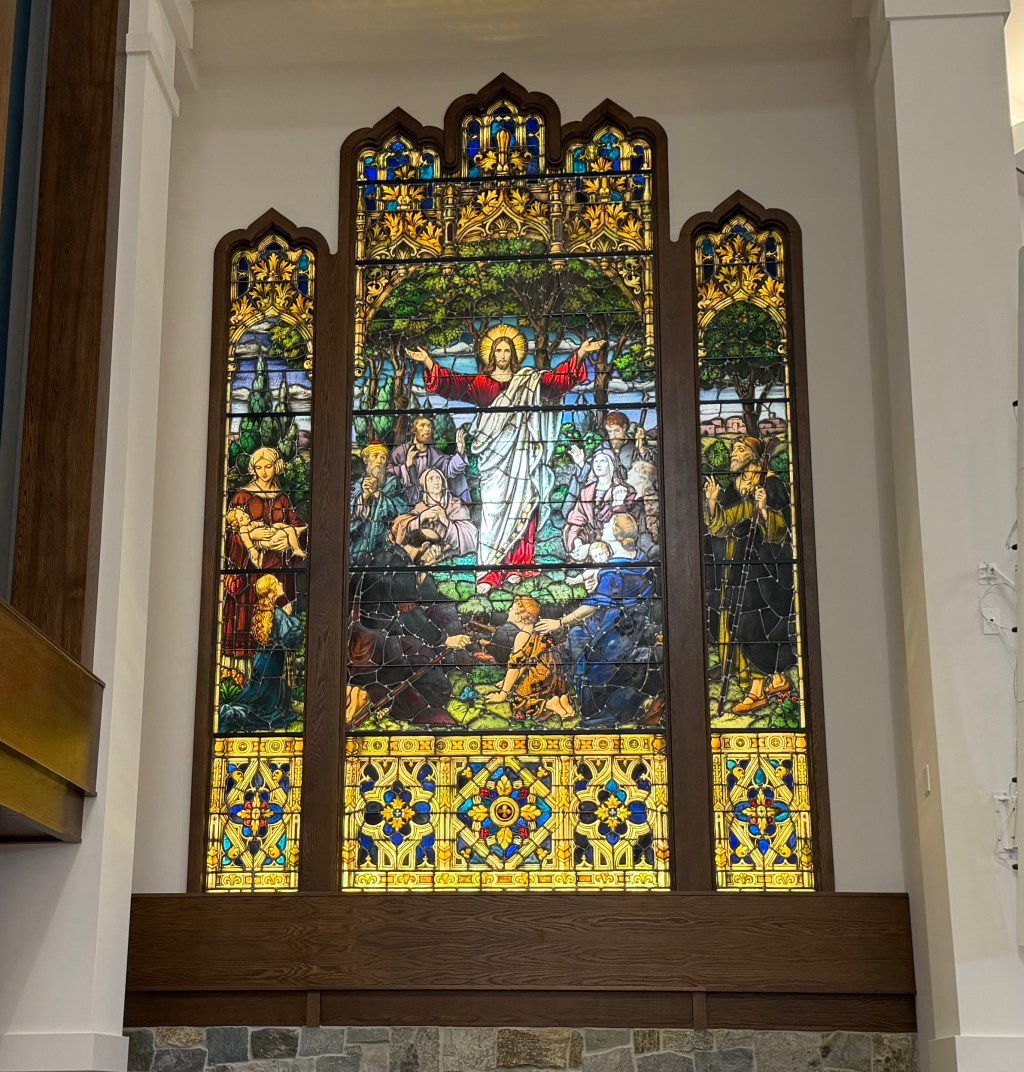
We are better prepared for the unexpected when our relationship with Jesus grows daily.

Jesus said to his disciples: “Gird your loins and light your lamps and be like servants who await their master’s return from a wedding, ready to open immediately when he comes and knocks” (Lk 12: 35-36).

As disciples, we need to be ready for the coming of Jesus. Yes, for when he comes again at the end of time, but just as importantly, to be prepared for his coming each day in the midst of our lives. If we do not prepare to encounter him daily, the likelihood of us being prepared for his coming again will be slimmer, and only the Father knows the time or the hour.

To plan something means that we outline all that needs to be done down to the last detail. This can be an advantage especially when we are dealing with blueprints for a home or building. By having detailed plans we can be sure that we have the proper materials and tools, an estimated budget, and hire the help needed to accomplish the goal. I have been blessed to experience this process as we have been overseeing the rebuilding and renovation of our church which was damaged a year ago.

There are many areas in our life where planning has its advantages. Planning our spiritual life is important, deciding when and how we are to pray, meditate, study, engage in Bible and spiritual reading and/or which service we are going to attend, establishing a routine of spiritual direction, time for fellowship and small groups, and how, when and where we can serve others. These are all plusses for planning.

The challenge with planning pops up when we become too attached to the plan and we leave no room for the Holy Spirit, no awareness for the knock at the door because we are so focused on sticking to the plan. Thanksgiving and Christmas dinners are on the horizon. How many times have we experienced planning a dinner with guests, gotten stressed when things did not go exactly as planned and spent more time adhering to the plan and its execution such that we missed engaging with those we were working so hard to provide hospitality for? Martha learned this lesson.

Preparing is akin to planning, in that we get ready for an endeavor but we are more flexible to other options not governed by our fixed mind and our sense of being in control. Jesus calls us to be prepared to receive him at any moment. Are we prepared to encounter and be present to a classmate, colleague, family member, or neighbor who asks for help at an inopportune time, the homeless person in need, the undocumented immigrant, migrant, or refugee looking for safety and security, the unborn striving to actualize his or her potential, the coworker that has not been the most pleasant, the person that we perceive as somehow different from us – who we keep at arm’s length?

The complementarity of planning and preparing shows best when unexpected events in life arise. When we heard of JoAnn’s diagnosis we went into planning mode, and as anyone who has spent any time with JoAnn knows, she was in her element when there was some planning to be done. There were many things in those final months we planned for and for the most part, they came together. There were also interruptions and blocks to the plan where we needed to adjust, sometimes without notice. Preparing helped us to be flexible and so open to following the guidance of the Holy Spirit.

Even before JoAnn’s diagnosis, she often said that life was hard. She saw many people suffering and couldn’t understand why people couldn’t be kinder to one another. St. Oscar Romero wrote, “It would be beautiful if people saw that their flourishing and the attainment of their highest ideals are based on their ability to give themselves to others.” In her suffering, JoAnn focused less on her condition and became more compassionate and empathetic.

We can better give ourselves to others when we focus less on ourselves, and resist following the voices of our fears, wounds, and insecurities. We are much better prepared when we invite Jesus into our poverty so that we will instead experience courage, healing, and security grounded in his love for us. When we daily trust and follow Jesus in each situation, ground ourselves in his love, we will experience life more fully, handle challenges more gracefully, and our hearts will expand and be more compassionate toward others.


Photo: Beautiful stained glass of those trusting in Jesus from our neighbors at St. John of the Cross.

Link for the Mass readings for Tuesday, October 21, 2025

“John is his name.”

Zechariah had not spoken since the time he encountered the angel Gabriel. Gabriel shared with Zechariah that his wife Elizabeth, though barren and past childbearing age, would give birth to a son and his name would be called John. The time for the fulfillment of Gabriel’s prediction had now come to pass, Elizabeth gave birth, and with friends and relatives gathered around on the eighth day for his circumcision and naming. Elizabeth announced that her son will be named John. Those with her balked, “There is no one among your relatives who has this name” (Lk 1:61).

There may also be some hesitancy because John, or יוֹחָנָן, Yôḥanan in Hebrew, means one who is graced by God. Who did Elizabeth think she was naming her son by this sacred name? They then appealed to Zechariah. He would support his wife by writing on a tablet that “John is his name.” Zechariah confirmed Elizabeth’s words and: “Immediately his mouth was opened, his tongue freed, and he spoke blessing God” (Lk 1:63-64).

Filled with the Holy Spirit, Zechariah spoke what we call today the Benedictus or Canticle of Zechariah, the beginning lines of which read: “Blessed be the Lord, the God of Israel; for he has come to his people and set them free. He has raised up for us a mighty Savior, born of the house of his servant David” (Lk 1:68-69).

Zechariah did not proclaim that John was the Messiah. As Christians, we believe that Micah prophesied that John was to be the herald of the Messiah. He prepared the way for the coming of the Lord. The Benedictus, like the Magnificat, is a song of great promise. This is why the Church proclaims that they are to be prayed every day in the recitation of the Book of Christian Prayer or the Liturgy of the Hours. We are living in the time of its fulfillment.

The year 2024 A.D. does not stand for after the death of Jesus, it stands for anno domini, in the year of our Lord. We live in the in between times of Jesus’ first coming as we prepare for his next coming. We live in great joy because we can prepare to receive Jesus everyday. This is why St. Paul wrote to the Philippians, we are “to rejoice always.” No matter the external circumstances or internal angst, our Lord Jesus the Christ, the Son of the living God is at hand, to forgive and heal us, accompany and deliver us, give us guidance and strength!

In the midst of continuing violence, war, polarization, endless forms and acts of dehumanization, fear, and growing anxiety, we will celebrate again this Wednesday. We will celebrate Christmas, the reality that the Son of God agreed to be sent close to us, to become human, to die, and conquer death so that he can be with us and lead us into eternity. John helped to prepare the way to receive Jesus by calling people to repentance. May we seek his intercession as we remember his birth today to prepare well in these final days of Advent so to better remember and celebrate again the reason for the season. Our Savior has come. Sin, suffering, and death do not have the final answer. Jesus does.

May we heed the call of John and Jesus to repent so that we may receive God’s forgiveness and grace and be freed from our entanglements with sin. May we let go of anything that separates us from our relationship with God and resist the temptation to curve in upon ourselves which leads us to death. Let us turn away from our pride and the false promise of self sufficiency and instead depend upon and place our trust in Jesus who offers us life. Each and every day, with the courage of John, let us prepare the way of the Lord and “give people knowledge of salvation” that Jesus is at hand so that God may “guide our feet into the way of peace.”


Photo: St. Elizabeth and John the Baptist by Krysten Brown, The Saints Project

Link for the Mass readings for Monday, December 23, 2024 A.D.

Jesus is coming, let us prepare.

In the fifteenth year of the reign of Tiberius Caesar, when Pontius Pilate was governor of Judea, and Herod was tetrarch of Galilee… (Lk 3:1).

This may be an odd verse to focus on in Advent, or anytime when sharing a reflection, but there is a point to this historical tidbit of information offered by Luke. Jesus, the Son of God, born of the virgin Mary, was born in time, and in a place. The gospels are not myths, they are not fairy tales, nor are they works of historical fiction. Luke’s account would fall better into the genre of Greco-Roman history, although, the gospels have their own unique expression as a genre. The gospel writers were interested in the historical Jesus, but they were more than mere biographies. Their primary focus was to present theological insights that help us to understand who Jesus is and his teachings that we can put into practice, but not that, but to also come to know him in our time and place, and be transformed by him and his love for us.

The Son of God was obedient to his Father and was willing to be sent to become a human being conceived in the womb of Mary.  This truth has relevance to us because it means that Jesus experienced what we experience as human beings. From the moment of his conception and moving forward, through his birth, life, death, resurrection, ascension, and continuing today, he experienced and experiences what we experience as humans, even temptation although he never sinned.

In Luke’s presentation and setting the stage for Jesus’ birth, he shared a shady cast of characters: Tiberius Caesar, Pontius Pilate, Annas, and Caiaphas to name a few. Although lost on most of us today, these political and religious leaders were not known for their virtuous living. Yet those in the time of Luke’s writing would have recognized that they were examples of human depravity. Jesus was born in a time and a place of darkness. He was and continues to be the Light of God who has come into the darkness of the fallen human condition.

To prepare the people for this coming, Luke presents the preaching of John the Baptist. Though the son of the priest, Zechariah, John rejected the political and religious status quo. He did not preach in Jerusalem nor the Temple, but in the wilderness. His message to “Prepare the way of the Lord” was a call in unison with Baruch from our first reading.

Baruch, the secretary of the prophet Jeremiah, shared God’s promise in which Jerusalem was invited to, “stand upon the heights; look to the east and see your children gathered from the east and the west at the word of the Holy One, rejoicing that they are remembered by God” (Baruch 5:5). The children who are to rejoice were those scattered children of Israel. The northern ten tribes of Israel who were first exiled by the army of Assyria in 722 BC, and the greater majority who never would return. Also, in 587 BC, the remaining tribes of Judah and Benjamin were defeated and their majority exiled to Babylon. Jerusalem and the Temple was destroyed. Baruch’s promise offered hope for that time when the twelve tribes that were exiled and scattered would be reunited and return from the east and the west.

John the Baptist came to announce that time. The messiah was at hand. The ancestors of those who returned to Jerusalem after the Babylonian exile, were waiting for the coming of the fulfillment of the promise of the prophets, and John the Baptist was telling them that this long awaited time was upon them. John was telling them to get ready, to “Prepare the way of the Lord.” Jesus is coming.

This is the first coming of Jesus we prepare to celebrate at Christmas. Each Advent is a time for us to prepare not only to celebrate Christmas, to remember Emmanuel, God with us, but to prepare for his second coming or our personal judgment when our time on this earth this side of heaven is coming to an end. Whichever comes first, either reality is time, not for sorrow, but instead for joy.

This is the joy that St. Paul encourages the Philippians to experience and we can as well. “I am confident of this, that the one who began a good work in you will continue to complete if until the day of Christ Jesus” (Philippians 4:6). May we rest in the same confidence, that as we repent, trust in God, and put into practice his teachings that we will be ready to experience Jesus coming into our lives each day and he will work through us to bring about our salvation and those he calls us to serve.

Luke invites us to look back on this time when a world in darkness waited with bated breath for the Light to come to set things right. To bring proper order back to the political and religious state of affairs. Luke offers us, through the words of John the opportunity to ponder the meaning of what it means for us to “Prepare the way of the Lord”. We make a way for the Lord, when we open our minds and hearts to him, so that we might believe more and more each day, not only that Jesus came to us as our savior, but that he is with us and we can receive his love with each breath we take, and we will be prepared for when he comes again, each day, at the end of time, and when it is our time to go home.


Photo: Rosary walk back in mid October.

Link for the Mass readings for Sunday, December 8, 2024

When we prepare, we will be ready.

Jesus said to his disciples: “Gird your loins and light your lamps and be like servants who await their master’s return from a wedding, ready to open immediately when he comes and knocks” (Lk 12: 35-36).
As disciples, we need to be ready for the coming of Jesus. Yes, for when he comes again at the end of time, but just as importantly, to be prepared for his coming each day in the midst of our lives. If we do not prepare to encounter him daily, the likelihood of us being prepared for his coming again will be slimmer, and only the Father knows the time or the hour.
To plan something means that we outline all that needs to be done down to the last detail. This can be an advantage especially when we are dealing with blueprints for a home or building. By having detailed plans we can be sure we have the proper materials and tools, an estimated budget, and hire the help needed to accomplish the goal. There are many areas in our life where planning has its advantages. Planning our spiritual life is important, deciding when and how we are to pray, meditate, study, engage in Bible and spiritual reading and/or which service we are going to attend, establishing a routine of spiritual direction, time for fellowship and small groups, and how, when and where we can serve others. These are all plusses for planning.
The challenge with planning pops up when we become too attached to the plan and we leave no room for the Holy Spirit, no awareness for the knock at the door because we are so focused on sticking to the plan. Thanksgiving and Christmas dinners are on the horizon. How many times have we experienced planning a dinner with guests, gotten stressed when things did not go exactly as planned and spent more time adhering to the plan and its execution such that we missed engaging with those we were working so hard to provide hospitality for?
Preparing is akin to planning, in that we get ready but are more flexible to other options not governed by our fixed mind and our sense of being in control. Jesus calls us to be prepared to receive him at any moment. Are we prepared to encounter and be present to a classmate, colleague, family member, or neighbor who asks for help at an inopportune time, the homeless person in need, the undocumented immigrant, migrant, or refugee looking for safety and security, the unborn striving to actualize his or her potential, the coworker that has not been the most pleasant, the person that we perceive as somehow different from us – who we keep at arm’s length?
How about planning and preparing for those unexpected events in life that appear all of a sudden? When we heard of JoAnn’s diagnosis we went into planning mode, and as anyone who has spent any time with JoAnn knows, she was in her element when there was some planning to be done. There were many things in those final months we planned for and for the most part, they came together. There were interruptions to the plan where we needed to adjust, sometimes without notice. Preparing helped us to be flexible in those unexpected moments, to be open to the guidance and leading of the Holy Spirit helped us to feel blessed during a tremendously challenging time.
Most recently here at Holy Cross, we were well prepared here in Vero Beach for Hurricane Milton, but needed to be flexible with the surprising onslaught of the tornadoes that touched down. With the quick response from the leadership of our diocese, we have been able to clear much of the damage to the trees, and even though still not able to celebrate Mass in church, our great staff was able to pull together and create a beautiful space this weekend to celebrate in our hall. Ideal? No, but that we were and will continue to be able to come together and make adjustments as needed, we can again worship and pray together. A blessing and gift to be thankful for.
Even before JoAnn’s diagnosis, she often said that life was hard. She saw many people suffering and couldn’t understand why people couldn’t be kinder to one another. St. Oscar Romero wrote, “It would be beautiful if people saw that their flourishing and the attainment of their highest ideals are based on their ability to give themselves to others.” We can better to do so when we are willing to prepare each day to spend time with Jesus, to grow in our relationship with him, so in times of change and challenge, we will know his voice, follow his will, so to heal, grow, be flexible, and adjust as needed so to be ready and helpful to one other when needed.

Photo: We’re still standing! Our cross remained atop Holy Cross Catholic Church!
Link for the Mass readings for Tuesday, October 22, 2024