Jesus invites us to repent so to “experience a radical reorientation of our whole life”.

In today’s Gospel, we read about two accounts of horrific deaths. The first is at the hands of Pontius Pilate, who has not only ordered the execution of Jesus’ fellow Galileans but had their blood mixed with “the blood of their sacrifices.” In the second incident, Jesus brought up the tragic accident in which eighteen people died “when the tower of Siloam fell on them.” 

In both cases, Jesus rejected the common notion of the time that these incidents were caused by God’s punishment and focused instead on the importance of repentance. Jesus stated quite emphatically: “Do you think that because these Galileans suffered in this way they were greater sinners than all other Galileans? By no means! But I tell you, if you do not repent, you will all perish as they did” (cf. Lk 13:1-5)!

Jesus consistently proclaimed repentance in the hope of helping his followers understand the purpose of his coming. Jesus provided meaning and fulfillment in this life as well as being the way to the truth of eternal life in the next. Yet, to experience the benefits of his invitation, people needed to repent from their focus on self, misunderstandings of God, and the false substitutions, and disordered affections that the world offered by having a change of heart and mind and turning back to God, the very source of their being. This is just as true for us today.

To repent and surrender to Jesus is not some submissive bowing to a tyrant but an acceptance of the aid offered by the divine gardener. Our repentance gives permission for Jesus to cultivate the ground of our being to rid us of that which sickens us and instead allow him to fertilize us with his word and grace in such a way that we are renewed. Jesus tends to our growth such that we can be more aligned with the will of his Father and the love of the Holy Spirit. When we repent and confess, we are forgiven, healed, and begin to mature so that we will bear fruit that will last.

To repent is a good thing. As is written in the Catechism of the Catholic Church, line 1431: “Interior repentance is a radical reorientation of our whole life, a return, a conversion to God with our whole heart, an end of sin, a turning away from evil, with repugnance toward the evil actions we have committed. At the same time, it entails the desire and resolution to change one’s life, with hope in God’s mercy and trust in the help of his grace.”

When Jesus shared in his first public message: “Repent and believe in the Gospel” (Mark 1:15), he invited then and invites us today to a new way of seeing, hearing, experiencing, and living our lives. We all sin and fall short of the glory of God. As we turn back to Jesus and open our hearts and minds to him, he reveals with his loving light that which is preventing us from experiencing the love of God more deeply and growing in our relationship with him more intimately.


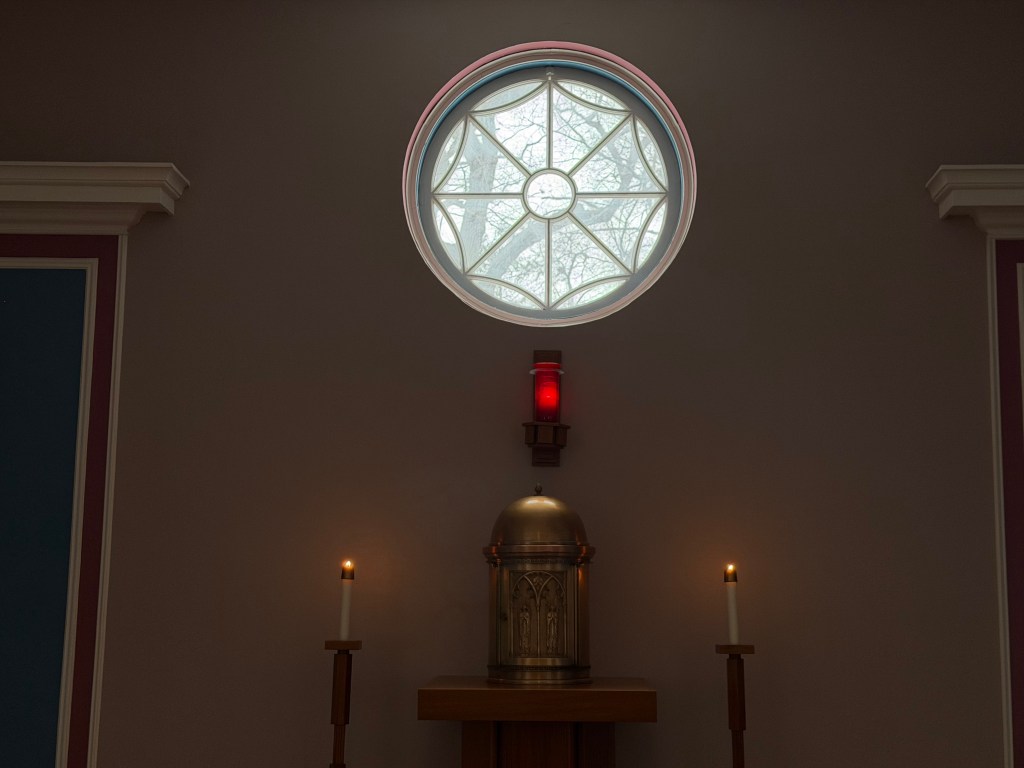
Photo: Quiet time to experience a holy hour with Jesus. Being still is a way to repent, to turn back to Jesus, and away from the distractions. In his presence then, we can allow our mind to quiet, and we can rest in him.

Link for the Mass readings for Saturday, October 26, 2025

Will we choose to remain in the darkness or follow Jesus into the light?

“He brought in the head on a platter and gave it to the girl. The girl in turn gave it to her mother” (Mark 6:28).

The momentum that led to the death of John the Baptist could have slow and the direction could have taken a different course. It did not even slow but only escalated. Once Herod Antipas offered to the girl “even half of his kingdom”, she went in haste to her mother. Without hesitation her mother asked for John the Baptist. There was a slight hesitation on Herod’s part when he received the request, but no one spoke about the atrocity or horror of this request. Herod, as would Pontius Pilate, gave in to the pressure of not saving a life, for even there no one spoke out against what was coming, but in taking the life of an innocent man, which the executioner executed efficiently.

John’s crime, what he was arrested for, was calling Herod and Herodias to repent, to turn away from the sin of adultery they were committing and to turn back to God. John sought to help this couple to see that their actions not only were leading to their own demise, but that they were leading many of their subjects with them. Each person chose to play their part in John’s death, they chose their own ego-drama over and above the principal actor before them playing out God’s theo-drama.

This horrific account, if it was not bad enough on its own, was a foreshadowing of another – John’s cousin. Jesus would also be tried, condemned, and crucified for choosing to speak God’s word of repentance, to invite others within ear shot to turn away from that which was keeping them from God. Many were not only closed to the idea of repentance, they not only ignored his message, but also called out for his death, “Crucify him” (Mark 15:13)!

John and Jesus were faithful to hearing and following the will of God. They exhibited true courage in their willingness to give their lives, and because they have done so, they have opened up for us the path to eternal life. Where do we find ourselves in the account of the beheading of John the Baptist and the crucifixion of Jesus? Are we on the side of the indifferent that will watch them die without a word, are we on the side of rejecting the light of God and choosing the darkness of our own sin? If our conscience is pricked, do we resist following the temptation of the Holy Spirit and listen to the lies of the enemy and follow him instead?

Is there another option than those witnessed in the Gospel accounts? Yes, those of Mary and the Apostles. They, despite the cultural, political, familial, internal, and even religious pressures of the time, chose to trust in Jesus and follow him, even when they didn’t understand. This is revealed powerfully when Jesus asked the Apostles at the end of the Bread of Life discourse, “Do you also want to leave?” Simon Peter answered him, “Master, to whom shall we go? You have the words of everlasting life” (John 6:67-68).

With each thought, word, and decision we make, we need to take the time to pause and discern what voices we are listening to. If they don’t align with the will of God, we need to follow the lead of John and Jesus and renounce them. Otherwise, we can get caught up in a momentum of thoughts that can lead to actions that can lead to some dark places we don’t want to go. The Holy Spirit can help us to change course, even when we have walked away… If we are willing to stop, take a breath, and listen. It is never too late to repent. It is never too late to turn away from sin, return to God, and get back on the path that leads to eternal life.


Photo: There is much distraction, diversion, and temptation that the enemy will place in our way. If we remain in and follow the light of Jesus he will “rescue our feet from the snare” (cf. Psalm 25:15).

Link for the Mass readings for Friday, August 29, 2025

Are we willing to accept the invitation and then show up for the wedding feast?

“The Kingdom of heaven may be likened to a king who gave a wedding feast for his son” (Mt 22:2).

Throughout the Gospels, Jesus not only talked about feasts but he is recorded as often celebrating table fellowship with others. Those he ate with ranged from people who were considered sinners to the religious elite among the Pharisees.

In the parable from today’s Gospel, Jesus presented a range of reactions to the invitation already supposed to have been accepted to a great, wedding banquet offered by the king for his son. The custom of the time for a wedding feast, which often was a celebration that would not last just a day but often a week. A first invitation would be sent out, and when accepted, at the time to begin the banquet, a second invitation would be sent for those to now come to enjoy the festivities.

In Jesus’ parable, the first group are so caught up in their own lives, that they are not willing to break away from their daily activities. The second group rejects the invitation outright and does so violently, by mistreating and even killing the servants of the king. The retribution of the king is swift and punitive. Then he sent his servants out into the streets, “and gathered all they found, bad and good alike,” and they welcomed the invitation and said yes to the invitation “and the hall was filled with guests” (Matthew 22:10).

God invites us into a relationship with him, but we must be willing to repent, to change our hearts and minds to see the invitation for what it is, then decide to receive an eternal gift. Those who refused were unwilling to change their plans, as well as others who, with hearts of stone, were outright hostile, willing to abuse and even kill the servants. Are we willing to choose our busyness over time with God each day or will we stubbornly hold on to our own self-reliance and pride and refuse God’s gift?

Near the end of the parable, Jesus presents a curious fellow that the king found present without the proper attire. This is not a literal indictment of not having the proper clothes, but the wedding garment imagery may be a recognition of a willingness to receive the benefits of the invitation without a yes to the responsibility involved. A desiring to reap the gift with accepting the responsibility. We need to be willing to take off the clothes of our old way of life, our ways of sin, self-indulgence and reliance, and receive the wedding garments offered to us by the king who seeks to clothe us “with the garments of salvation;” and cover us “with the robe of righteousness” (see Isaiah 61:10).

We are invited to participate in the banquet of eternal life with God. The invitation is freely given, yet it requires that we dress for the occasion. Again, this dress is no material garment of fine linen and gold embroidery, but our willingness to repent, to turn away from those idols, that which we have placed or put before God, to have our hearts and spirits renewed. We are invited to be a part of God’s new creation by participating in the life of his Son, the firstborn of the new creation.

We see this played out in salvation history as well. God the Father offered this invitation of the eternal banquet to the patriarchs, judges, prophets, and the people of Israel, to be one with him that they might shine brightly before all so to make his will and glory known to the world. In God’s timing, he sent his Son to fulfill that mission of invitation and to be with us in our present moment and in our present condition in life. Jesus meets us where we are right now in our everyday experiences and tells us that “the feast is ready.”

We are invited each day to begin again, to pray, to turn away from our selfish ways, to receive a new heart and a renewed spirit. God invites us but we need to be willing to let go of our idols, our disordered affections, and attachments. We are called to be transformed and perfected through our participation in the life of Jesus and through the purifying fire of the Holy Spirit.

Our yes demands accountability. We can’t just show up dressed for the part and take up space. Our ultimate attire is the transformation from within, in which our posture changes from a curving in upon ourselves to an opening and willingness to praying with and being guided by God, to devote our time, discipline, talent, and treasure to serving at the banquet and inviting others to attend.

“Many are invited, but few are chosen” (Mt 22:14). The first step is saying yes to the invitation. The second step is to be prepared for and be ready to come when the time for the wedding feast is announced. We need to be willing to allow the Holy Spirit to renew our hearts and minds, to take up our cross, to know and follow the Father’s will, serve and sacrifice by the giving up of ourselves in love. The way to the banquet is no easy path, but we can take comfort in the truth that we do not walk alone. Jesus guides and empowers us when we are willing to follow.


Painting: The Adoration of the Mystic Lamb, the central painting from the Ghent Altarpiece painted by Hubert and Jan Van Eyck in the 15th century.

Link for the Mass readings for Thursday, August 21, 2025

“Remove the wooden beam from your eye first”!

For many of us, judging one another is almost as automatic as breathing. As we encounter someone we have instant internal judgments. We judge looks, clothes, actions, inactions, homes, cars, and material items. We judge our family, spouses, friends, colleagues, classmates, leaders, enemies, celebrities, as well as those we consider different as well as those we determine to keep at arm’s length. Much of what gets our attention is what Jesus is addressing in today’s Gospel, negative judgments.

Jesus said to his disciples: “How can you say to your brother, ‘Let me remove that splinter from your eye,’ while the wooden beam is in your eye? You hypocrite, remove the wooden beam from your eye first; then you will see clearly to remove the splinter from your brother’s eye” (Mt 7:4-5).

There are positive judgments that bring about effective change for the good. In a court case, our hope is that the judge is learned in the law and guides the lawyers and jury in ways of sound judgment such that justice with mercy is served. For us to do likewise in our everyday interactions with one another, Jesus shares that we need to remove the wooden beam from our eye first before we are able to remove the splinter in another’s.

Through this hyperbolic image of someone attempting to remove a splinter in someone else’s eye all the while the wooden beam protruding out of his own eye prevents him from coming close enough to actually be of any help! To remove the beam from our own eye, Jesus is inviting us to change our hearts and minds such that we are no longer hardened by negative and condemning judgments toward others based on our own unbridled biases and prejudices. May they soften such that they are open to the mercy and love of Jesus. This does not mean that we accept any and all behaviors, actions, and inactions from ourselves and others. Jesus did not do so.

He is willing to enter our chaos, to embrace any and all of us who will receive the invitation of his healing embrace. Next, through his love, Jesus walks with us, convicts us, and shines his light to reveal to us our slavery of sin. Then he calls us to repent, to turn away from our sinful ways and turn instead toward that which is True, Good, and Beautiful.

As we acknowledge and turn away from our sin, we participate more in the life of Jesus. We are then healed from our own limitations, weaknesses, self-centered perceptions, denial and suppression of our anxieties and wounds that so often fueled our biases and prejudices. As we experience God’s forgiveness and love, we begin to heal, and that beam becomes smaller, and we are able to see others as God sees them, as human beings endowed with dignity because we have been created in the image and likeness of God.

Repentance, forgiveness, and growing in love helps us to collaborate and participate in Jesus’ work of redemption and how we can participate in taking the log out of our own eyes. We can then better assist others in  removing their splinters. When we are willing to admit to our own shortcomings, weaknesses, and failures, and are open to healing, learning, and growing from those experiences, we are then in a better position to meet others in their own chaos, to journey side by side, help others to repent, heal, and to be transformed into who God is calling us to be.

Let us commit to allowing Jesus to help us to remove our beams of judgment so that we can be more understanding, merciful, and forgiving. We will be blessed in doing so, for Jesus also taught that as we judge, so will God judge us. As we repent and are forgiven, so may we forgive and show mercy. In receiving forgiveness and forgiving, in repenting from sin and judgmentalism, our souls will find rest and we will experience God’s peace.


Photo: Icon of 1546 by Theophanes the Cretan, Monastery of Stavronikita Mount Athos.

Link for the Mass for Monday, June 23, 2025

May we realize where we are lost and return to our Father.

In today’s Gospel from Luke we encounter the well known parable of the Prodigal Son. With the parables it is important not to skip over who Jesus is talking to, just so we can dive into the parable itself. Jesus is speaking to tax collectors and sinners. They are drawn to him. The Pharisees and scribes are also present. They are drawn to him also, but are not celebrating but complaining.

With these two groups now focused on Jesus, he shares his parable. Three main characters are present in the telling, the younger son, the father, and the older son. The younger son represents the tax collectors and sinners. They have embraced the sin of Adam and Eve in taking for themselves that which God would have freely given to them. They have squandered their inheritance and separated themselves from the relationship and love of God. Yet, as the son realized, and the tax collectors and sinners are coming to see in Jesus, all that the material life offers is limited, and it does not fully satisfy. They, like the younger son who returned from the “distant country”, are prepared to come home.

The wonderful light and joy of the parable is that: “While he was still a long way off, his father caught sight of him, and was filled with compassion.” The father then did the unthinkable as: “He ran to his son, embraced him and kissed him” (Lk 15:20). The father never held a grudge, but also never gave up or stopped looking for a sign that his son would return. His racing to meet his son showed the outpouring of love and mercy that this father had for his son. This uncharacteristic action would also certainly draw attention to himself, and take the focus away from the wagging of tongues that would have certainly begun regarding his son’s return.

In covering the son with a robe and placing a ring on his finger, the father showed his forgiveness, and restored the bond and covenant that was broken. He still considered him his son. The party that began was a celebration of this fact. As the festivities continue, the parable turns to the older son, and again, the father goes out to meet him. The elder son meets his father with anger. Filled with not only self righteousness, but also revealing that even though he remained with the father he did so with no love or joy. He too was looking for more from the father than the greatest gift he offered him, which was his relationship, his love.

The parable of the Prodigal Son ends with an invitation to all those who had gathered around to listen to Jesus. The tax collectors and sinners were invited to come home to their father, to turn away from their pursuit of the empty and false substitutes of wealth, power, pleasure, and honor. They were invited to be born again from their life of death, to be embraced as the children of God that they were, embrace their relationship, and restore their covenant with him.

The Pharisees and scribes also were invited as was the elder son. They were invited to turn away from judgment and instead celebrate the return of those who were willing to repent, to turn away from sin and to turn back to God and come home. Those who had been lost had now been found. In doing so, they would realize that they too were lost, and separated from the loving relationship of God.

We are loved by our God and Father, more than we can ever mess up. God loves us as his daughters and sons, even when we are lost in our sin. Who do we identify with in this parable? Are we willing to recognize that the God of Jesus Christ has always been watching for us, always reaching out for us, always running out to meet us, welcome us as we are, and urging us to come home to be with him? God is running to meet us and embrace us. Will we run away from him or run to him? God could also be inviting us to come in and celebrate with those who have been lost and now have been found. Will we choose our pride and judgment or will we like Jesus be willing to draw close and be part of the family?


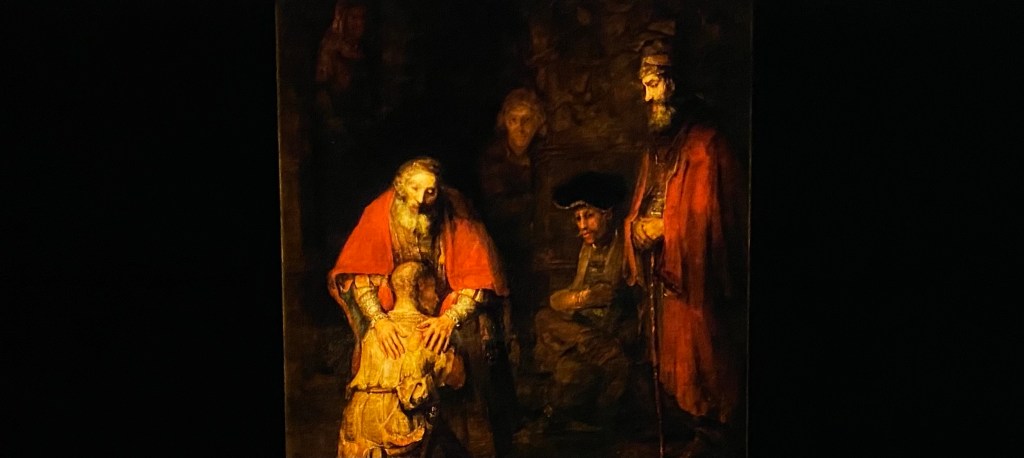
Painting: Rembrandt’s “Return of the Prodigal Son”

The Mass readings for Sunday, March 30, 2025

Jesus helps us to repent, to prune, and to uproot so that we may receive the life of God within us.

In today’s Gospel, Jesus presented the importance of repentance, of changing our minds and hearts, to turn away from our sins and to turn back to God. This means we need to acknowledge anything that we are placing before God. Anything or anyone that we place before God is going to be off the mark, for we are to seek God and his kingdom first and all else then has a better chance to be properly ordered as we grow in our relationship with God.

In our first reading, Moses is faced with an interesting sight, a bush on fire. The interesting feature is that this bush is not being burned. Moses draws closer and is welcomed by the voice of God to remove his sandals and approach. Moses does and God calls Moses further to go to Egypt to free his people. Although, we do not read in this account about Moses resistance to this invitation, Moses does resist but repents from his hesitation and lack of trust in God and follows his guidance. Because he does so, Moses frees the Hebrews from their slavery.

Jesus then in the Gospel of Luke has been sent as was Moses, but God to free us from our slavery to sin. He recalls to historical tragedies in which men from Galilee are horrifically and sacrilegiously killed at the hand of Pontius Pilate, and then tragically, how eighteen people were killed when the tower of Siloam fell on them. In both cases, Jesus stated that the reason for their deaths was not because of their sins while at the same time after relaying each account he shared with his listener’s: “If you do not repent, you will all perish as they did” (Luke 13:3, 5).

Just the prophetic rhetoric that causes the jaw to drop and the mind to be shaken awake. Jesus will follow with a gentler expression of the mercy of God by sharing the parable of a fig tree. The owner of the orchard wants to cut it down because it has born no fruit. The gardener appeals to the owner: “‘Sir, leave it for this year also, and I shall cultivate the ground around it and fertilize it; it may bear fruit in the future. If not you can cut it down.’” (Luke 13:8-9).

Jesus is the gardener who has asked to cultivate, prune, and weed. This is why since he began his public ministry he said, “This is the time of fulfillment, the kingdom of Heaven is at hand, repent and believe in the Gospel” (Mark 1:15). Jesus’ mission is to help us to understand the importance and need to repent, to turn away from sin and turn back to God. He is inviting us to nothing less than “a radical reorientation of our whole life, a return, a conversion to God with all our heart, an end of sin, a turning away from evil, with repugnance toward evil actions we have committed” (Catechism of the Catholic Church, 1431).

Jesus does not define us by our worst mistakes, yet he also recognizes that we cannot just go along and do whatever we want to do on our own terms apart from God. In doing so, we will continue to not bear fruit because with each action and decision opposed to the will of God, the source and sustenance of our lives, our growth becomes stunted and disordered.  Jesus meets us where we are, loves us as we are, and then cares enough to show us the branches that need to be pruned and the weeds that need to be uprooted. Are we willing to receive his love and nourishment? Are we willing to repent and begin to prune and uproot? If so, pray this prayer with me to Jesus.

Jesus, help me to recognize that your grace is sufficient and builds upon our nature. May we trust in you as our Divine Gardener to: prune our pride, that we may bear the fruit of humility; our envy, that we may bear the fruit of mercy; our anger, that we may bear the fruit of meekness; our greed, that we may bear the fruit of generosity; our lust, that we may bear the fruit of chastity; our gluttony, that we may bear the fruit of temperance; our sloth, that we may bear the fruit of diligence; and our sadness, that we may bear the fruit of joy.


Photo: One of our oaks struck by the tornado last year. The dead limbs were cut, branches pruned, and new life has begun.

Link for the Mass readings for Sunday, March 23, 2025

Lent is a time for reconciliation and to come home to the Father.

Those who edited the lectionary readings for the day chose to present the parable of the lost son and skip the parable of the lost sheep and the lost coin. This trilogy of parables is found in Luke chapter 15. Reading the three together allows us to get a better sense of what Jesus is showing. There is great joy in finding what has been lost, there is great joy in being found! Maybe we can recall something or someone that had been lost and then found, or have we ever experienced a time where we had been lost or separated, or a time when we have experienced a time of reconciliation from someone that we have been estranged from?

I was somewhere in the age range from about six to eight when I came to the realization that I was separated from my parents in the Enfield Mall in Connecticut. I believe it was close to Christmas and we were in the toy store. I must have become distracted by something interesting, and stayed to investigate, while my parents and sister continued on. At some point, I became aware of that fact. It did not take long for the anxiety and fear to rise within me and the tears to well up. I walked through a few isles with no success in finding my family and then I headed toward the entrance that led out into the main mall.

Before continuing on I remembered my mother telling me that if I ever got lost, that I was to stay where I was and she would find me. As I stood indecisively and wondering what to do, a woman noticed my predicament and led me to a stone bench outside the store. We sat and she stayed with me until my parents returned. I am sure the time of separation seemed a lot longer to me than the actual time, and much of the memory is fuzzy, but the anxiety of separation had an impact on me as did the relief and joy of reconciliation!

In my story as well as each of these parables, there is a great joy for that which has been lost and found. How many of us are not even aware of our separation from God or each other? While I was in my own world of material wonder, I was left behind. The son who had squandered every bit of the inheritance he asked of his father before his death, realized not so much that he had really messed up, but that he was in a dire situation, and he made the right decision to come back home. His father never stopped looking for him, he actually saw his son returning “while he was still a long way off” and “filled with compassion. He ran to his son, embraced him and kissed him” (Lk 15:20).

This father is not seeking his son to bow before him and prove his repentance, his loyalty, and allegiance. The father runs to his son without hesitation. This act is no small thing, for an elder to run to a younger family member was unheard of and simply not done. He was breaking this social taboo, most likely to redirect the focus away from his returning son; the one who had betrayed his father, the son who would receive glares and snide remarks. Instead, the father rushed out with a reckless abandonment of love to embrace his son. The jaw-dropping, followed by echoes of gossip surely rose in chorus about the father’s present actions, not his son’s past actions.

God is watching and waiting, seeking opportunities to run to us with compassion and love to welcome us home as the father did in the parable of the prodigal son. God is also like the shepherd who does the absurd in his outpouring act of love, leaving the ninety-nine sheep to go and find the one stray. God seeks each and every one of us just like that shepherd. God is represented by the woman who rejoices over finding one seemingly insignificant coin, for God rejoices in our turning back to him because not one of us is insignificant to him. We are all precious to God, each in our own unique way, and he loves us more than we can ever imagine.

No matter the reason that we have strayed, no matter the temptations and distractions we have fallen for, and/or how far we have wandered away, God loves us more than we can ever mess up. Lent is a season to open our eyes and recognize where we are in our relationship with God and with each other, to recognize the separation our choices have caused, and begin to turn back to God and those we are estranged from within our lives. There is indeed great joy in the healing of relationships and reconciliation! Lent is a time to be found, Lent is a time to come home.

——————————————————————–

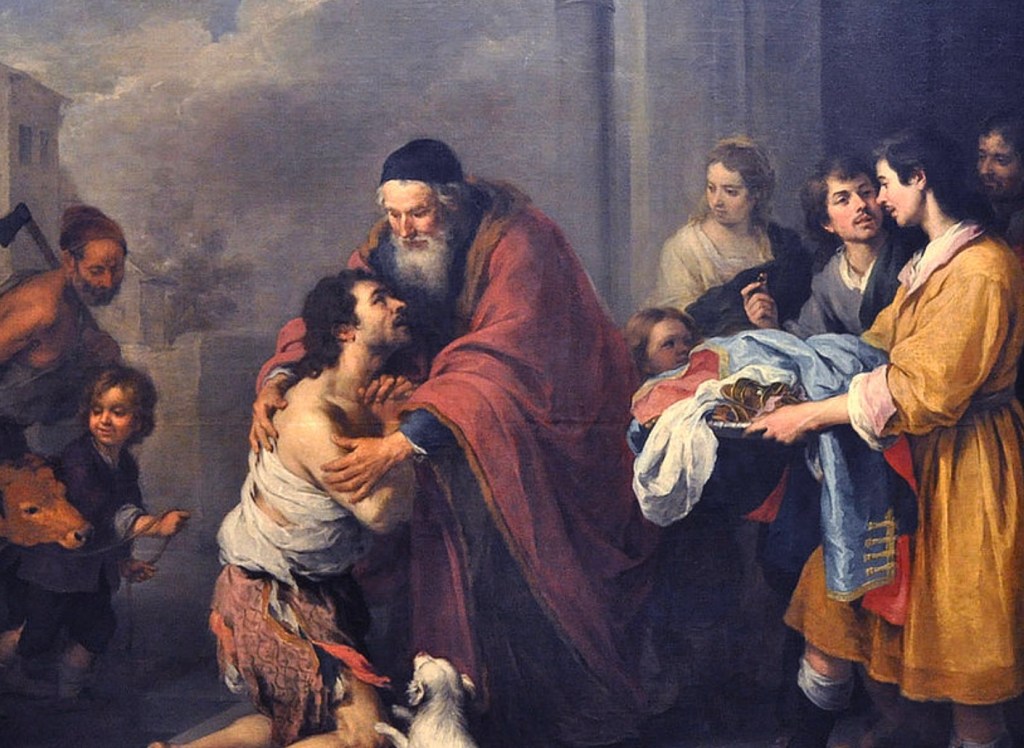
Painting: “The Return of the Prodigal Son” by Esteban Murillo

Link for the Mass readings for Saturday, March 22, 2025

Whoever follows Jesus will not walk in darkness, but will have the light of life.

What we think, say, do or do not do, has consequences for ourselves and others. The smallest act of kindness, like suggesting, as Jesus did in today’s Gospel, of giving someone a drink of water goes a long way. The reality that 2.2 billion people do not have adequate access to the most basic of needs, safe drinking water (water.org), is an amazing and disheartening statistic. The most serious of sins in this regard is not bothering to care. Jesus shared clearly, in the Gospel of Matthew (cf. chapter 25), that what we do to the least of our brothers and sisters, we do to him.

We have a choice to act in ways: that limit or provide access for people seeking such basic necessities as food, water, and shelter; that harm or hurt; that divide or unify. Jesus uses graphic, hyberbolic words in today’s Gospel, such as “If your hand causes you to sin, cut it off. It is better for you to enter into life maimed than with two hands to go into Gehenna, into the unquenchable fire” (Mk 9:41-50). Jesus does not literally mean that we are to cut off our hand or foot, or pluck out our eye, but he is showing us the seriousness of sin. Sin cuts us off from the source of our life who is God. Identifying and repenting from our sins is important for our physical as well as our spiritual well being now and in the life promised to come after our death.

Sin invites us to walk a path that leads to death. God invites us to walk a path that leads us to life. “Although many people nowadays think of sin primarily as breaking a rule or violating a law, in Jewish Scripture, the word ‘sin’ (Hebrew chatá) literally means to ‘miss the mark’ or to ‘miss the path‘ (Pitre, 54).” God is inviting us to share in his life now and for all of eternity. We can walk away and chart our own course apart from God’s guidance or we can walk the path that he lights for us to follow. Jesus spoke bluntly and graphically to show his followers and us that to miss the mark, to sin, to chart our course on our own will have deadly consequences.

This is why Jesus began his public ministry echoing the prophetic tradition and John the Baptist when he stated, “This is the time of fulfillment. The kingdom of God is at hand. Repent and believe in the gospel” (Mark 1:15). Jesus came as a light to reveal to us our sins so that we can turn away from any illusions, false promises, and apparent goods that we are attached to, repent from them, and turn back to choosing to follow God first. Our lives will be much better when we seek first the kingdom God and see the world not as man does but as God does.

Venial sins hurt our relationship with God but mortal sins rupture our relationship with God. The antidote is the same for each, to be sorry for our sins, confess them, be willing to perform the penance to atone for our sins, so that we can be absolved, forgiven, and return to the path that leads to life. A daily examination of the Ten Commandments is a good place to start. The first three have to do with our relationship with God and the seven following have to do with assessing how we love our neighbors.

Examining the seven deadly or capital sins: wrath, sloth, gluttony, lust, greed, envy, and pride are also very important to examine. Asking the Holy Spirit to help us to see any of these sins which are the root of all of our sins is not an exercise in shame or condemnation. We do so in an effort to strengthen our will, to identify and renounce them so that we can be freed and healed from the unhealthy attachments and disordered affections that lead us astray. What can help us to overcome the temptation to any of these sins is to engage in practices to develop the virtues: meekness, diligence, temperance, chastity, generosity, and humility, that will counter each of the seven deadly sins listed above.

When we turn away from God and engage in thoughts, words, and actions that are divisive, dehumanizing, and self serving; when we rationalize and justify behavior that goes against our Gospel values and our consciences, we play a part in contributing through our personal sins to the condition of original sin that plagues our world. When we act in these ways, we are off the mark and going against God’s plan that we pray for each day: “May your kingdom come, may your will be done on earth as it is in heaven.”

Jesus is not calling us to jump out of bed today and amass heroic acts of virtue, nor is he asking us to change all alone, and all at once. The disciples took time to get on board with his message. It will take time for us to learn and grow as well. Jesus loves us more than we can ever imagine and when we open our hearts and minds to receive his love daily, we will grow in the humility necessary to identify and repent from our sins and grow in virtue.

——————————————————————

Photo: Hike through Runyon Canyon Park, Los Angeles.

Pitre, Brant. Introduction to the Spiritual Life. Image: New York, 2021.

Link for the Mass readings for Thursday, February 27, 2025

Let us repent and believe.

“This is the time of fulfillment. The Kingdom of God is at hand. Repent, and believe in the Gospel” (Mk 1:15).

With these words as recorded by Mark, Jesus begins his public ministry in time and space and we in 2025 begin the first week of Ordinary Time together. Whether we are in the season of Christmas, Easter, or Ordinary Time, each day is an opportunity to be thankful and celebrate our life for this continues to be “the time of fulfillment”. The Kingdom of God is still at hand because Jesus is still present with us.

We are not alone on our journey. The Son of God became human, as we just celebrated this Christmas season, and as we will celebrate in Easter, he died and rose again. This was no mere resuscitation like with Lazarus who rose and died again. Jesus conquered death and became the firstborn of the new creation. Ordinary Time is the season in which we not only study the life and teachings of Jesus but hopefully continue to be willing to be more conformed to his Body and the will of his Father through the love of the Holy Spirit.

One of the things that may hold us back from embracing the gift of the Kingdom of God in our midst is that we have often chosen to place our focus on other distractions or diversions or placed ourselves first before God and others. Jesus calls us to reorient our lives in urging us to repent, to turn away from the false reality that we are the center and author of our own lives, such that we come to realize the truth that God is our true author and director. To repent also means to open ourselves to his love, to place our trust in him, and to be assured that God accepts us as we are, right now at this very moment.

We do not repent so that God will love us. We do not have to do anything or act perfectly or say the right prayer for God to love us. We just need to “move the Lord out of the category of ‘polite company’ and into that of intimate friend to whom one can tell everything” (Barry 1987, 55). To repent means to turn back to the God whose arms are wide open ready to embrace us. We are given the opportunity to see where we have turned away from God. Let us run into his waiting embrace and receive the forgiveness, mercy, and love that he offers us.

The call to repent that Jesus accentuates is a continuation of the preaching of the prophets and John. What he adds to repentance is to believe. To believe is to “trustingly accept and yield to what God is doing in him. The kingdom is near enough that anyone who so chooses can reach out and lay hold of it through faith (Healy 2008, 42). As we turn back to God, reorient our minds to his guidance and direction, reflect on how much he has blessed us, we will better make an ascent to believe.

To “repent and believe” is a good way to begin our journey into Ordinary Time together. May we resist the temptation to hold anything back and share more with our Father and grow closer to God each day. Let us trust in Jesus who encourages us to resist limiting God and the possibilities he places before us. Instead of attempting to bend his will toward ours, may we allow the love of the Holy Spirit to expand our hearts and minds such that we will believe in and trust God more so to be like a pencil in his hand.


Photo: A good way to reorient our minds and hearts to the will of God and to believe is to slow down and make time to pray. Doing so at the side chapel in the Cathedral of Charleston this past June.

Barry, S.J, William A. God and You: Prayer as a Personal Relationship. NY: Paulist Press, 1987.

Healy, Mary. The Gospel of Mark. Grand Rapids, MI: Baker Academic, 2008.

Link for the Mass readings for Monday, January 13, 2025

Repentance is a “conversion of the heart”.

In today’s Gospel, we read about two accounts of horrific deaths. The first is at the hands of Pontius Pilate, who has not only ordered the execution of Jesus’ fellow Galileans but had their blood mixed with “the blood of their sacrifices.” In the second incident, Jesus brought up the tragic accident in which eighteen people died “when the tower of Siloam fell on them.” 
In both cases, Jesus rejected the common notion of the time that these incidents were caused by God’s punishment and focused instead on the importance of repentance. Jesus stated quite emphatically, that, “Do you think that because these Galileans suffered in this way they were greater sinners than all other Galileans? By no means! But I tell you, if you do not repent, you will all perish as they did” (cf. Lk 13:1-5)!
Jesus was emphatic about helping his followers understand the purpose of his coming. Jesus provided meaning and fulfillment in this life as well as being the way to the truth of eternal life in the next. Yet, to experience the benefits of his invitation, people needed to repent from their focus on self, misunderstandings of God, and the false substitutions that the world offered by having a change of heart and mind and turning back to God, the very source of their being. This is just as true for us today.
To repent and surrender to Jesus is not some submissive bowing to a tyrant but an acceptance of the aid offered by the divine gardener. Our repentance gives permission to Jesus to cultivate the ground of our being to rid us of that which sickens us and instead allow him to fertilize us with his word and grace in such a way that we are renewed. Jesus tends to our growth such that we can be more aligned with the will of his Father and the love of the Holy Spirit. In these ways, we are forgiven, healed and can better mature so that we will bear fruit that will last.
To repent is a good thing. As is written in the Catechism of the Catholic Church, line 1431: “Interior repentance is a radical reorientation of our whole life, a return, a conversion to God with our whole heart, an end of sin, a turning away from evil, with repugnance toward the evil actions we have committed. At the same time, it entails the desire and resolution to change one’s life, with hope in God’s mercy and trust in the help of his grace.”
When Jesus shared in his first public message: “Repent and believe in the Gospel” (Mark 1:15), he invited then and invites us still today to a new way of seeing, hearing, experiencing, and living our lives. No longer do we have to live in fear, be bound by addiction, and/or entrapped by our sins. As we open our heart and mind to Jesus, he reveals to us with his loving light that which is preventing us from experiencing the love of God more deeply and growing in our relationship with him more intimately. Let us trust in Jesus’ mercy, welcome the gift of his grace, repent, and allow our hearts and minds to experience conversion and transformation..

Photo: Heart found during Rosary walk in Riverside Park, Vero Beach. When we repent, Jesus receives our brittle hearts and infuses them with his water of life.
Link for the Mass readings for Saturday, October 26, 2024