
Is the lord of the sabbath the Lord of our lives?

Then he said to them, “The Son of Man is lord of the sabbath” (Lk 6:5).

The disciples were traveling with Jesus, they gathered food where they could. In today’s Gospel, they picked heads of grain and rubbed them in their hands to make them easier to chew. The critique of those Pharisees, presumably, walking along with or close by to Jesus, was that his disciples were breaking the sabbath law by working and thus not keeping it holy.

The reason for this was that pious Jews would often practice what is called, building a hedge around the Torah, meaning that they would institute practices beyond the original law so that there would be no way of breaking it. Fr. Bill Burton, ofm, shared an example that has stuck with me since my Scripture studies in seminary.

There is a prescription in Exodus 23:19, that states that you should not cook a kid (baby goat) in its mother’s milk. So as not to even come close to breaking this law, observant Jews developed the practice, which continues from many today, to not cook any meat and dairy together; thus the idea of building a hedge around the Torah.

The hedge in today’s reading had to do with what constituted work and what did not to keep the sabbath rest intact and keep the sabbath holy. Jesus settled the debate by claiming that he was the lord of the sabbath.

The lord of the sabbath needs to be the Lord of our lives. We live in a fallen world, but even at its best, we live in a finite and fragile world. We as human beings can only do so much. The best we can do is to use our intellect and ability to reason while at the same time seek to discern God’s will and direction so that we may access the spiritual resources that God offers to us in our everyday affairs, especially when tragedy strikes.

Tragedy, pain, and suffering happen in our independent lives directly and in our world collectively, the list and variety are vast and varied. Each situation arises for different reasons, some sensible and others with no apparent rhyme or reason. The why to our own personal or broader national and international sufferings we may not ever receive an answer. Yet, in each instance, we are not abandoned, we are not alone. We need not despair because the Holy Spirit works with and through us when we turn to him and allow our hearts and minds to be open to his love working through us.

The Holy Spirit, through Mary’s yes, helped to bring our world a savior. When his time came, he healed, exorcised, preached and sought the unification of his people so to unify all of humanity. Many of the Pharisees could not accept that Jesus was the Messiah and instead saw him as a threat. In their minds, Jesus was disobeying God. If he wasn’t God incarnate, they would have been correct. That is the decision we need to make. If he is God, Jesus needs not only to be the lord of the sabbath, but the Lord of our lives, in and out of season, during our trials as well as our joys and celebrations.

—————————–

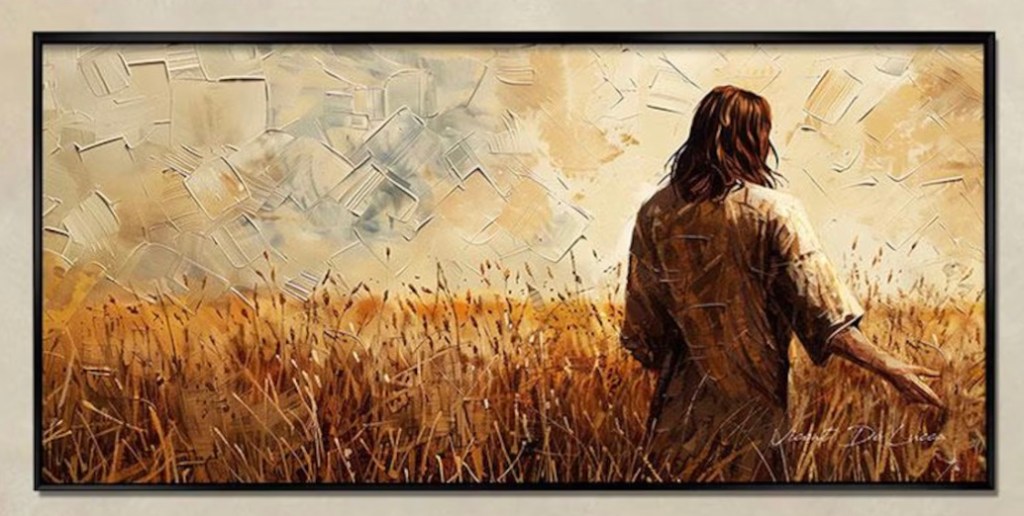
Photo: Jesus in the Wheat Field” by Hangwallz on Etsy

Link for the Mass readings for Saturday, September 6, 2025

May we resist the hardening our hearts and allow ourselves instead to be moved with compassion.

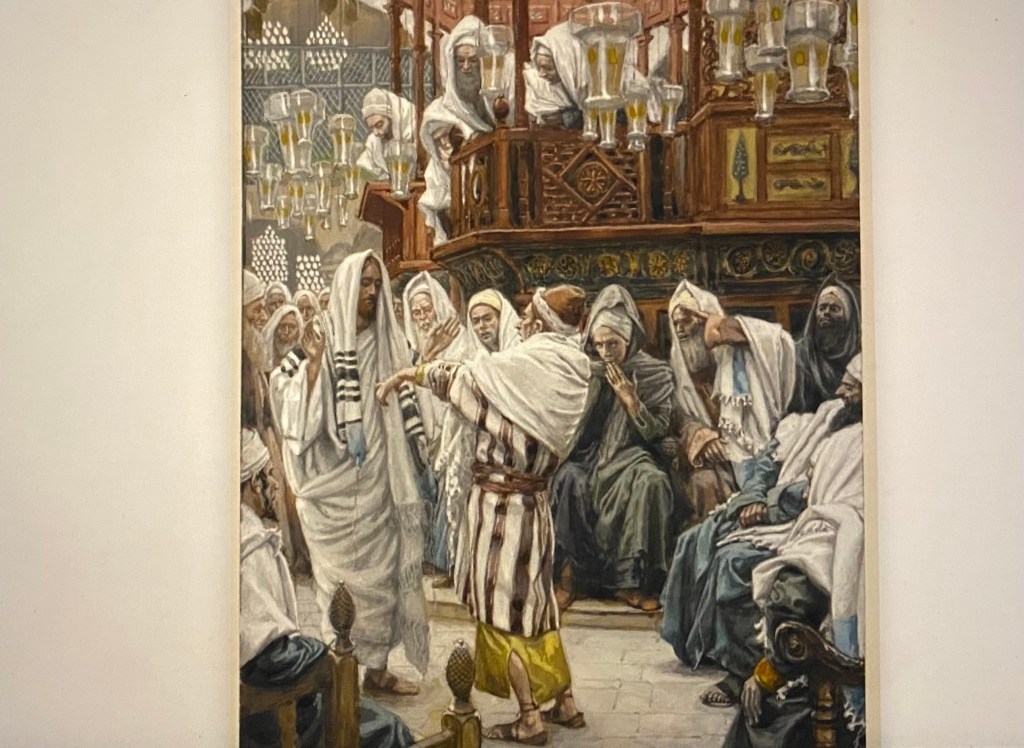
In today’s Gospel scene, Jesus enters the synagogue and sees a man with a withered hand. The eyes of the Pharisees are on him to see if, yet again, Jesus will heal on the Sabbath. Jesus is clear in his mind what he is going to do, though before doing so, he calls the man up and asks the Pharisees, “Is it lawful to do good on the sabbath rather than to do evil, to save life rather than to destroy it” (Mk 3:4)?

Jesus here is giving them a no-brainer of a question. Of course, one is to do good rather than evil on the Sabbath, to save life rather than destroy it! Yet, the Pharisees remain silent. Jesus expresses anger and grief. This may not only be an obvious question but more Jesus could be meeting the Pharisees on the ground of Scripture that they are using against Jesus. 1 Maccabees 2:41 records the account of the Maccabeans deciding to take up arms on the Sabbath to defend themselves against attack. With this in mind, Jesus may be appealing to those Pharisees that were challenging him to choose to see the healing of this man as a greater good. Unfortunately, their “their hardness of heart” shows they were not appreciative of the scriptural assistance.

At the peak of this fifth conflict in Marl, may we stop and imagine ourselves present in the synagogue and witnessing Jesus looking at the Pharisees and the Pharisees looking back at him. Ever been present when tensions were very high and there was dead silence? Imagine what was going through the mind of the guy standing in between them with the withered hand?!!!

The anger rising in Jesus may have had to do with the unwillingness of the Pharisees to show any compassion at all for this man. That they would hold so tightly to their self-righteous stance to refuse to even have a discussion about the matter. Not even to say in effect, “Yes, Jesus of course, it is lawful to do good, to save a life but what you are doing is unorthodox.” No. They refuse to dialogue. Their faces are set like flint, they dig in their heels. Even though Jesus is inviting them to take just a step to consider another alternative, they instead harden their hearts. In their silence, they are choosing evil over good, to destroy life rather than saving it. Pride has reared its grotesque head.

Jesus breaks the silence as he says to the man, “Stretch out your hand.”

The man is healed, but instead of rejoicing, and sharing the good news as Andrew did with his brother Simon, the Pharisees leave immediately to find the Herodians and begin to plot to not only undo Jesus but “to put him to death.” They who would refuse to see a mean healed on the Sabbath, did not hesitate to plan someone’s death on the Sabbath.

We have witnessed in today’s Gospel the evil of pride. We have witnessed the mercy of God presented and rejected. As is stated in the Catechism of the Catholic Church: “There are no limits to the mercy of God, but anyone who deliberately refuses to accept his mercy by repenting, rejects the forgiveness of his sins and the salvation offered by the Holy Spirit” (1864). That is what Jesus is angry about. Not only do the Pharisees resist any move in the slightest direction toward compassion, or their own repentance, they further separate themselves from the love of God. They start with a principle of defending the law, and walk out seething with a premeditated intent to kill Jesus, and on the Sabbath!

With each choice of putting self over another, pride grows. Its appetite is insatiable. Pride is known as the mother of all sins because of its disordered focus on self at the expense of all others and all else. The deadliest component of which is in direct opposition to God and separation from the very life force of our existence.

May we choose a different approach to Jesus, by surrendering our wills to him this day. May we ask him to reveal the darkness that dwells within us and grant us the humility to call it out and renounce anything that is not of God. May God grant us the courage to repent and the willingness to receive the healing touch of the Holy Spirit such that we might be transformed into Jesus’ image and likeness, so to know him and our Father more. May we reject evil and choose the good, reject pride and choose love, reject death and choose life. With each person we encounter today, may we reject the temptation to withdraw or scowl and instead offer a smile, a hand of welcome, and a listening ear.

———————————————————————-

Painting by James Tissot.

Catholic Church. “Article 8: Sin,” in the Catechism of the Catholic Church, 2nd ed. Vatican: Libreria Editrice Vaticana, 2012.

Link for the Mass readings for Wednesday, January 22, 2025

May we choose to align ourselves with the Lord of the Sabbath and lead with love.

“The sabbath was made for man, not man for the sabbath. That is why the Son of Man is lord even of the sabbath” (Mk 2:27-28).

In making the above statement, Jesus was not discrediting or devaluing the observance of the Sabbath. He was weighing in on one of the common debates that Jewish people engaged in about what was considered work, and thus what could and could not be done on the Sabbath. Jesus went deeper to address the origin of the Sabbath observance in that it, “commemorates God’s creative and saving action for humanity, and alleviating hunger might be an example” (Donahue and Harrington, 112).

Although, the Pharisees who confront Jesus are most likely looking at a strict interpretation of Exodus 34:21 in which even during the time of harvest, one “must rest” on the Sabbath. The rubbing off of the husks in their hands to access the kernels of wheat within constituted such work. Jesus offers David and his followers doing the same thing in their time of hunger when they were fleeing from the soldiers of King Saul. In claiming this account, Jesus is aligning himself and his disciples with King David and his men. The Pharisees in this comparison would then be aligned with the followers of King Saul.

God created us, formed us, and breathed life into us. God seeks intimacy and closeness between himself and us his created beings, his children. God is our source and we are interconnected in our relationship with him and with one another. God continues to deal with us in a personal way. The Torah, the Law or the Teachings, is meant to enhance the intimacy and closeness of that relationship with God and one another, to provide boundaries and definition so that we can resist going astray.

Jesus came not to abolish but to fulfill the Law, to restore it from distortion, while at the same time bring it to a higher level. When asked what commandment is the greatest, Jesus announced that we are to Love God with all our heart, soul, mind, and strength and we are to love our neighbor as ourselves (cf. Mk:12:30-31). To live out this commandment then, we need to foster our relationship with God if we are to experience his love, mercy, and forgiveness, to fill up to overflowing, so to share with others what we have received, otherwise, we have nothing to give.

With or without a relationship with God we can experience emptiness, anxiety, fear, and loneliness. Without a relationship with God, and the community of the Church, we are more vulnerable to the temptations to satiate our hunger with the material, finite, and false goods, that are readily available, and hungering more, falling deeper into the lures of power, pride, prestige, ego, and addiction. We then seek to protect that false sense of self at all costs, and react defensively, as we feed our fear and pride. We buffer ourselves off from the very one we have been created for, and those we consider as other. In following this path, we isolate ourselves from God and one another and this provides fertile ground in which fear, prejudice, sexism, and racism can grow along with the manifestation of the dehumanization and objectifying of human beings.

As a part of the Church and actively engaged, we are constantly reminded that we are not alone and that all of us and creation are interconnected. As Pope Francis shared in his homily in 2018: “Having doubts and fears is not a sin. The sin is to allow these fears to determine our responses, to limit our choices, to compromise respect and generosity, to feed hostility and rejection. The sin is to refuse to encounter the other, the different, the neighbor when this is, in fact, a privileged opportunity to encounter the Lord.”

The Pharisees that were confronting Jesus felt threatened. They refused to see who he was. We know there were other Pharisees that came to trust in and follow Jesus, Nicodemus and most famously, Saul who became Paul. They were able to see past their blind spots and come to believe that Jesus was the Son of Man, the Son of God. We are offered a choice to see Jesus as a liar, a lunatic, and blasphemer, or as our Lord.

My invitation is for us to align ourselves with the Lord of the Sabbath, who walked with his disciples among a field of wheat one day, and who is now our Bread of Life this day. Empowered by the Eucharist we are filled with the love of Jesus, we will then better be able to let no evil talk to pass our lips and to say only the good things that people need to hear (cf. Ephesians 4:29). Receiving God’s love, we will better be able to will each other’s good, even toward those who profess hate. Feeding hate will only contribute to it. Meeting hate with love can provide an invitation for hearts to soften. As with Dr. King, whose memorial we celebrated yesterday, we are called to be instruments of the light to dispel the darkness and conduits of love to transform hate.

———————————————————

Photo: Rosary walk among the sea oats back in July, Riomar Beach, Vero Beach, FL.

Donahue, S.J., John R., and Daniel J. Harrington, S.J. The Gospel of Mark in Sacra in Sacra Pagina Series, vol. 2. Collegeville, MN: Liturgical Press, 2002.

Pope Francis full text of homily at Mass on World Day of Migrants and Refugees, Sunday, January 14, 2018: http://saltandlighttv.org/blogfeed/getpost.php?id=79091
Link for the Mass readings for Tuesday, January 21, 2025

Let us reflect the light of the mercy of Jesus as the moon reflects the light of the sun.

I say to you, something greater than the temple is here. If you knew what this meant, I desire mercy, not sacrifice, you would not have condemned these innocent men. For the Son of Man is Lord of the sabbath.” (Mt 12:6-8).

Jesus continues to rock established regulations and practices. Here he is challenging the understanding of the Sabbath itself when justifying the accusations leveled toward his disciples who were picking and eating grain on the Sabbath, and he does so in a profound way by saying that,“something greater than the temple is here.” Present in the heart of the temple, the area called the Holy of Holies, was the ark of the covenant. Atop the ark was the lid called the mercy seat of God. Jews believed that this was where God sat and when the blood of atonement was offered from sacrifices, God’s mercy was offered to the people. In the temple then, was the mercy seat, the very presence of God.

Jesus’ claim that he is greater than the temple is putting him on the same level as God. A blasphemous statement to say the least, unless of course, he is God. Jesus even doubles down by claiming that he is the Lord of the sabbath; Jesus used this latest challenge by those Pharisees seeking to trap him to help to reveal to them, his disciples, and us today that Jesus is God!

In quoting Hosea 6:6: “I desire mercy, not sacrifice”, Jesus is not only saying that he is the something greater, but that his Way is something greater. One of the foundational points of the Way of Jesus is mercy. Through the incarnation, the Son of God dwelt among us, became one with us in our humanity. He restored our dignity in the midst of our brokenness and sin. What Jesus said, in defending his disciples eating from the grains of wheat on the Sabbath, he is saying to us today: “What is owed to every human being on the basis of his or her human dignity is personal respect, personal acceptance, and personal care” (Kasper 2014, 202).

We grow closer to God and one another when we put Jesus’ teachings into practice. This is especially true when we bestow acts of mercy on our neighbor. “The works of mercy are charitable actions by which we come to the aid of our neighbor in his [or her] spiritual and bodily necessities. Instructing, advising, consoling, comforting are spiritual works of mercy, as are forgiving and bearing wrongs patiently. The corporal works of mercy consist especially in feeding the hungry, sheltering the homeless, clothing the naked, visiting the sick and imprisoned, and burying the dead. Among all these, giving alms to the poor is one of the chief witnesses to fraternal charity: it is also a work of justice pleasing to God” (Catechism of the Catholic Church).

Jesus came among us not to condemn us, but to forgive, instruct, and advise, to comfort, console, and provide care and accompany us in our needs. He extends mercy as his starting point, as his invitation. Jesus was and continues to be willing to join us in the midst our chaos. He does not wait for us to be perfect or worthy. He only asks if we are willing to allow him to love and heal us and then are we willing to enter the chaos of others and allow him to work through us to provide the same. Reviewing and examining our consciences with the spiritual and corporal works of is a good place to start. Praying about and deciding which one(s) to put into practice is a good next step. 

—————————————

Photo: Rosary walk, view from the midpoint of the Merrill P Barber Bridge, Vero Beach, FL.

Link for the Mass readings for Friday, July 19, 2024

Kasper, Walter. Mercy: The Essence of the Gospel and the Key to Christian Life. NY: Paulist Press, 2004.

Catholic Church. Catechism of the Catholic Church: Revised in Accordance with the Official Latin Text Promulgated by Pope John Paul II. Vatican City: Libreria Editrice Vaticana, 1997.

Any part of our hearts in need of healing?

The hypocrisy scale is over the top in today’s Gospel. Each day this week these particular Pharisees have been not only seeing the glass regarding Jesus, half empty, but in today’s account, they are no longer seeing the glass! There is some validity in keeping the Sabbath day holy as I shared yesterday, but today they have thrown that out as well.

The issue today is that when Jesus entered the synagogue he saw a man “who had a withered hand” (Mark 3:1). Of course, Jesus is going to heal the man and on cue, the Pharisees are crouched to see if he is going to do so as well, on the sabbath. Jesus then asks a revealing question: “Is it lawful to do good on the sabbath rather than to do evil, to save life rather than destroy it” (Mark 3:4). Crickets… not a peep from the Pharisees.

Jesus gave them an opportunity to see not only their hypocrisy but revealed to them the darkness of their own hearts. Jesus is about to heal this man, “to do good on the sabbath” and the Pharisees, not only don’t see the gift of this man’s healing and so allow themselves to find healing from their own hardened hearts, but they leave to plan to destroy Jesus’ life. They choose to do evil on the sabbath and justify it by condemning Jesus for healing a man’s hand.

Why such hardness of heart? We aren’t given that insight. In some way they may be threatened by Jesus as King Herod was when he heard of the announcement of Jesus from the Magi from the east. An encounter with Jesus demands a choice, because he is the truth, he is the light that reveals the darkness. It can be easy to see the darkness in others like the Pharisees today.

The man’s hand is restored, and the Pharisees have just left seething with steam coming out of their ears. Each of us are now are invited to step into the scene. Are we willing to step into the synagogue with Jesus? He is facing you right now. His eyes have softened, they are inviting and loving you right in this moment. Is there a healing that you need? Is there a part of your heart that is hardened or wounded that you are willing to share? Is there any unforgiveness, sadness, anxiety that may be constricting your heart?

If you are willing, take that step, open your heart to your Lord and Savior this morning in your own unique way and trust him to reveal to you where we could use a healing or if you know, ask him.


Photo: My view each morning before as I start my day. I have been blessed with a lot of healing heart to heart time with the Divine Physician over the past year and a half.

Link for the Mass readings for Wednesday, January 17, 2024

May we bring some of the sabbath into today.

“May the Father of our Lord Jesus Christ enlighten the eyes of our hearts, that we may know what is the hope that belongs to our call” (Ephesians 1:17-18).

When we seek God first in all we think, say and do we will experience more peace in our lives. Taking time to begin our days by opening our heart and mind to God, receiving, resting, and abiding in his love helps us to have eyes to see a little more clearly than if we get up at the last minute and rush into the day at breakneck speed.

We see the importance of this in today’s Gospel. The Pharisees are following Jesus and his disciples to catch him breaking the law so they can bring charges against him. Jesus and his disciples are walking on the Sabbath. The Sabbath is a key identifying feature for the Jewish people.

The Sabbath is a day of rest in which the people are to remember his saving act of freeing them from their slavery in Egypt, honor God and his covenant with his people, and it is also a remembrance that God is the creator who rested on the seventh day and so made this day holy in which no work was to be done. The sabbath rest is one way to help the people to remember who they are as human beings created in God’s image and likeness.

Unfortunately, these Pharisees are seeking to subvert the law for their own agenda. Instead of having the eyes of faith to see God in their midst, on the Sabbath they are seeking to find a way to trap the One who is seeking to heal and save them from their scrupulosity. Jesus does not disregard the gift of the sabbath but seeks to restore it to its proper order as he heals on the Sabbath and allows his disciples to feed themselves when they are hungry. In Jesus saying, “the Son of Man is the lord even of the sabbath” (Mark 2:28) he is harkening back to the dignity of humanity who has been created very good.

We have been created very good. We are God’s beloved daughters and sons. May we give ourselves some time to begin this day in stillness and be grateful for the gift of this day, the gift that we have a God that loves us and wants the best for us, and return throughout the day no matter our schedule to give ourselves moments of rest and renewal, to spend time in God’s presence to be still, to be loved, and to be a light to others that we meet.


Photo: Looking up to the heavens and taking some deep, slow breaths is a good way to rest and reset!

Link for the Mass readings for Tuesday, January 16, 2024