“No. He will be called John.”

Zechariah had not spoken since the time he encountered the angel Gabriel. Gabriel shared with Zechariah that his wife Elizabeth, though barren and past childbearing age, would give birth to a son and his name would be called John. The time for the fulfillment of Gabriel’s prediction had now come to pass, Elizabeth gave birth, and with friends and relatives gathered around on the eighth day for his circumcision and naming. Elizabeth announced that her son will be named John. Those with her balked, “There is no one among your relatives who has this name” (Lk 1:61).

There may also be some hesitancy because John, or יוֹחָנָן, Yôḥanan in Hebrew, means one who is graced by God. Who did Elizabeth think she was naming her son by this sacred name? They then appealed to Zechariah. He supported his wife by writing on a tablet that “John is his name.” Zechariah confirmed Elizabeth’s words and: “Immediately his mouth was opened, his tongue freed, and he spoke blessing God” (Lk 1:63-64).

Filled with the Holy Spirit, Zechariah spoke what we call today the Benedictus or Canticle of Zechariah, the beginning lines of which read: “Blessed be the Lord, the God of Israel; for he has come to his people and set them free. He has raised up for us a mighty Savior, born of the house of his servant David” (Lk 1:68-69).

Zechariah did not proclaim that John was the Messiah. As Christians, we believe that Micah prophesied that John was to be the herald of the Messiah. He prepared the way for the coming of the Lord. The Benedictus, like the Magnificat, is a song of great promise. This is why the Church proclaims that they are to be prayed every day in the recitation of the Book of Christian Prayer or the Liturgy of the Hours. We are living in the time of its fulfillment.

The year 2025 A.D. does not stand for after the death of Jesus, it stands for anno domini, in the year of our Lord. We live in the in between times of Jesus’ first coming as we prepare for his next coming. We live in great joy because we can prepare to receive Jesus everyday. This is why St. Paul wrote to the Philippians, we are “to rejoice always.” No matter the external circumstances or internal angst, our Lord Jesus the Christ, the Son of the living God is at hand. Jesus has come to forgive, heal, accompany and deliver, give us guidance and strength. Jesus has come to save us!

In the midst of continuing violence, war, polarization, endless forms and acts of dehumanization, fear, and growing anxiety, we will celebrate again this Thursday. We will celebrate Christmas, the reality that the Son of God agreed to draw close to us. To become human, to die, and conquer death so that he can be with us and lead us into eternity. John helped to prepare the way to receive Jesus by calling people to repentance. May we seek his intercession as we prepare well in these final days of Advent so to better remember and celebrate again the reason for the season. Our Savior has come. Sin, suffering, and death no longer have the final answer. Jesus does.

May we heed the call of John and Jesus to repent so that we may be freed from our entanglements with sin, receive God’s forgiveness, and so better experience his grace and love. May we let go of anything that separates us from our relationship with God and resist the temptation to curve in upon ourselves which leads us to death. Let us turn away from our pride and the false promise of self sufficiency and instead depend upon and place our trust in Jesus who offers us eternal life. Each and every day, with the courage of John, let us prepare the way of the Lord and “give people knowledge of salvation” that Jesus is at hand so that God may “guide our feet into the way of peace.”


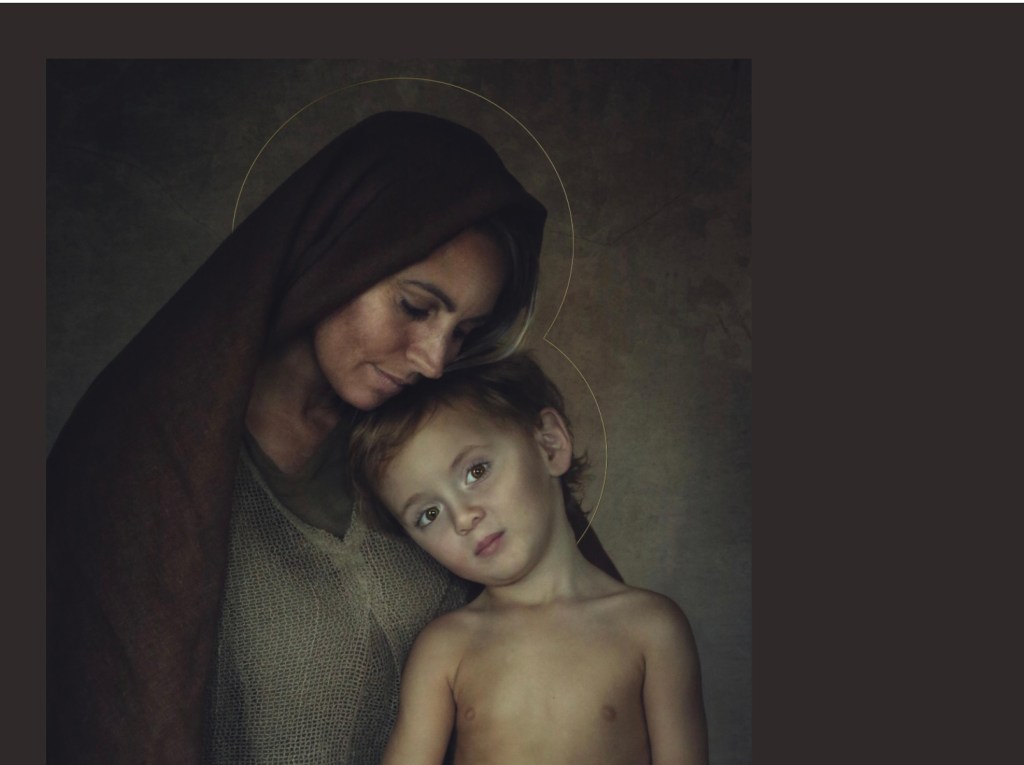
Photo: St. Elizabeth and John the Baptist by Krysten Brown, The Saints Project

Link for the Mass readings for Tuesday, December 23, 2025

May we too seek Jesus and come when he calls!

Yet again, as in the Gospel from yesterday, the crowd gets in the way of someone seeking access to Jesus. The wall of people that has gathered around Jesus does not appear to be overtly keeping Zacchaeus from seeing Jesus. They may be so focused on seeing him themselves that they are not aware. Yet, there is also the strong possibility that the people were aware that this man was trying to get through. They knew Zacchaeus, and many judged him to be the sinner of sinners.

He was the chief tax collector of the area and he was most likely reviled by most in his community. He would have also likely have been considered unclean because he was breaking the commandment of not stealing, which he and the majority of the tax collectors did at the time. As the chief tax collector he was also dealing with the Gentile occupiers. It is likely that each time Zacchaeus attempted to nudge by to get through a gap to get a better look, the individuals may have closed the way such that he could not get through.

Zacchaeus would not be thwarted. He ran ahead of the crowd and climbed a sycamore tree. From his perch he was not only able to see Jesus, but Jesus saw him and said, “Zacchaeus, come down quickly, for today I must stay at your house” (Lk 19:5). Jesus did not see a tax collector or a sinner, he saw a seeker. Someone who was willing to humble himself by climbing a tree, much like a child.

Jesus did not see the 99% nor the 1%. Jesus saw and sees people in need of compassion and mercy. He sees those lost that need to be found, those sick in need of healing, those alone who sought to belong. Jesus did not meet Zacchaeus with judgment but with love and compassion, and that made all the difference for this man’s conversion.

Jesus was willing to draw close to the one so many despised. By inviting himself to dine with Zacchaeus in his own home, Zacchaeus must have felt overwhelmed with emotion. Maybe for the first time in his life, he felt welcome instead of disdain. He repented without hesitation to the unconditional invitation and love he had received: “Behold, half of my possessions, Lord, I shall give to the poor, and if I have extorted anything from anyone I shall repay it four times over” (Lk 19:8). Unlike the other rich man who left sad (Lk 18:18-23) because he was not willing to relinquish his riches, Zacchaeus was filled with joy because he could.

This expressive act of generosity arose from his encounter with Jesus. This exchange offers the invitation for us also to receive Jesus in the same way and the invitation to greet others more openly as well. One way to do so is to resist the temptation to “grumble”, to gossip, to pre-judge, and/or to dehumanize one another. Salvation came to Zacchaeus’ house in the person of his savior and in the act of his repentance.

Life is hard enough without adding more barriers or negativity. Jesus wants to dwell with us too. While at the same time, he challenges us to see beyond the exterior caricatures we project on to others, and instead invites us to seek to know the heart and character of the person. We can do so when we stop grumbling, are willing to approach others with an understanding heart and mind, and be willing to spend time to get to know one another.


Painting: Zacchaeus in the Sycamore Awaiting the Passage of Jesus by James Tissot.

Link for the Mass readings for Tuesday, November 18, 2025

The will of God is that all of humanity will be saved through his Son, Jesus.

“For this is the will of my Father, that everyone who seeks the Son and believes in him may have eternal life, and I shall raise him on the last day” (Jn 6:40).

This is our hope and what we believe, that we who encounter Jesus, believe in, know him, and follow him shall have eternal life. God’s will, what he created all of us for, is to be in communion with him and one another in this life and the next. A word of assurance that I often lean on is from the book of Wisdom from our first reading today, “The souls of the just are in the hand of God, and no torment shall touch them. They seemed, in the view of the foolish, to be dead; and their passing away was thought an affliction and their going forth from us utter destruction. But they are in peace” (Wisdom 3:1-3).

The miracle of Jesus raising the daughter of the Roman official, Jairus, embodies these verses from Wisdom. As Jesus entered the home of the official many were “making a commotion” and Jesus dismissed them stating: “Go away! the girl is not dead but sleeping.” He was ridiculed by the crowd but paid them no heed. He went to the girl, took her hand, “and the little girl arose” (cf. Mt 9:18-26).

Jesus assured his followers as he assures us today that the will of his Father is that all will be saved. Experiences like the raising of Jairus’ daughter, the son of the widow from Nain, and Lazarus, were not only seeds of hope planting the promise of his resurrection to come but a foretaste of the raising of humanity on the last day. His disciples witnessed Jesus’ actions and words, and not only kept these experiences in their hearts but shared them.

Through the Gospels we are able to enter into and experience the encounters Jesus experienced with others again and again. We also experience Jesus each time we pray, participate in the sacraments, communal worship, and in our willingness to love one another through concrete actions of sacrifice and service. In each of these moments, we are conformed and shaped into who we have been created and called by God to be in this life and the next.

This All Souls Day we celebrate the gift that Jesus was victorious over sin and death, not only for himself but for all of us. Unlike those he raised from the dead and died again: “We know that Christ, raised from the dead, dies no more; death no longer has power over him” (Romans 6:9). The difference between All Saints yesterday, and the commemoration of all souls today, is that we pray for those who have died still in need of the purifying fire of God’s love. Just as “gold in the furnace” (Wisdom 3:6) is purified, so God purifies those in purgatory. Let us pray for them today that they may be freed from any stain of sin so to also join the communion of Saints!

“Merciful Father, hear our prayers and console us. As we renew our faith in your Son, whom you raised from the dead, strengthen our hope that all our departed brothers and sisters will share in his resurrection, who lives and reigns with you and the Holy Spirit, God, forever and ever” (Prayer for All Souls, from the Liturgy of the Hours).


Photo: For All Saints, we ask the saints to pray for us, for all souls, we pray for them that they may be saints. I pray for JoAnn and many each day. Who are you praying for?

Link for the Mass readings for Sunday, November 2, 2025

“Your faith has saved you.”

“Ten were cleansed, were they not? Where are the other nine” (Lk 17:17)?

Jesus makes this statement to the Samaritan who fell at his feet praising God and thanking him for his healing. The other nine received the same physical healing. Some of them may have seen this man turn back and go to Jesus, yet each one of them continued on their way to see the priests as Jesus had directed them. The purpose of this was so that they could be pronounced clean, and so re-enter the life of communal worship and living among their people. I am sure they were ecstatic to do so.

Jesus healed all ten of their leprosy without even saying a word of healing. The catalyst to receive this miraculous healing was their obedience to Jesus’ command to show themselves to the priest. They did so without hesitation and as they walked they all experienced healing. Yet, one of them sensed something deeper still.

Could the others have experienced something similar? If so, many were probably so excited about the healing that they did sense anything beyond the healing. Others may have sensed something but dismissed it, and a few, may have noticed the Samaritan turn back to Jesus, but could not or would not change course to return to say thank you.

The Samaritan that comes to Jesus in gratitude experienced something deeper than his physical healing. He recognized God’s activity in his life and so praised God at Jesus’ feet. He then also praises Jesus, placing Jesus on the same level as God and opening himself to a relationship and communion with him. Jesus acknowledged this step of faith. This man heard an invitation from within, in the quiet of his heart, and resisted any distraction that may have tried to dissuade him. Jesus then said, “Stand up and go; your faith has saved you” (Luke 17:19).

In following the gratitude that welled up from within, this man received more than just physical healing that day, he received salvation, “your faith has saved you.” This means not just that his body was restored and made whole again, but that the separation from his relationship with God had been reconciled.

God invites us in so many gentle and small ways in the silence of our hearts to be more engaged: in a relationship with him, in our own lives, and the lives of others. We too can crowd out the invitation by keeping ourselves busy, distracted, and/or diverted. We can hear the whisper but discount it outright for many selfish reasons, we can also be led astray by the cacophony of mind noises that is fed by our fears, prejudgments, or apprehensions. Yet, we can also be like this Samaritan. We can hear and experience the invitation of God, act on his lead, surrender to Jesus, and be saved.

———————————————————————

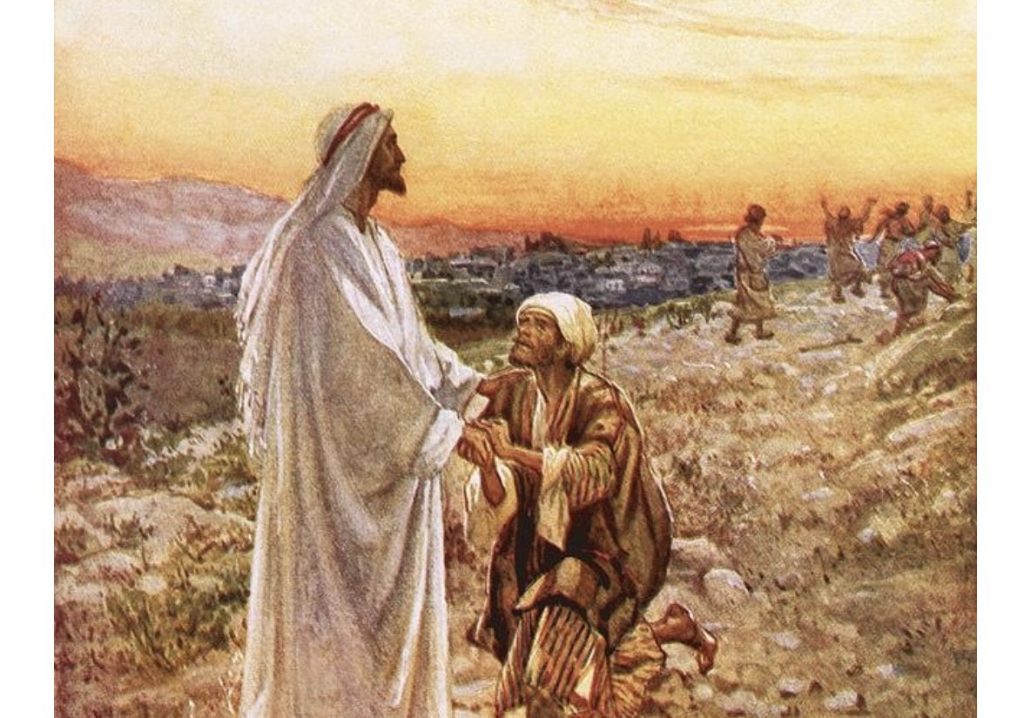
Painting: “Jesus With the One Leper Who Returned to Give Thanks” by William Brassey Hole

Link for the Mass readings for Sunday, October 12, 2025

Jesus invites us to share in the love he and his Father share.

Jesus bestowed his love and his grace upon his Apostles as a gift. The fundamental option, our ultimate end goal, that which we seek from the very depths and core of our being, is to experience the same love that the Apostles experienced. The Creator of all that exists, the One who so transcends our comprehension, that is so beyond our ability to comprehend fully, has come close to us, become one with us in the person of his Son, and loves us more than we can ever imagine.

This reality, the core of the deposit of faith that they received, was not to be hoarded, buried, or to be shared with a select few. This living gift of grace was to be shared by the Apostles, the ones who Jesus called by name, who he hand-picked to receive his message and then sent them forth to proclaim his word. They were to protect it for the purpose of transmitting it accurately to their successors so that it would then be passed on to each successive generation who would receive and make it relevant for their own time.

Jesus said to his Father in his farewell discourse, as recorded by John that: “I made known to them your name and I will make it known, that the love with which you loved me may be in them and I in them” (Jn 17:26). Through our participation in the love of Christ, we are perfected and conformed by his will such that we too can experience and share in the love of the Father.

The Trinity is at the heart of the Gospel, the Good News. The Trinity is a divine communion of three Persons, Father, Son, and Holy Spirit. We have been created with a burning hunger and desire to experience this same communion. Why do we resist saying, “Yes” or more fully embracing this joyous invitation? St Thomas Aquinas in his Summa Theologiae, or Summa, outlines four substitutes or temptations that we may put in place of our highest hope and good; these are wealth, honor, pleasure, and power. In and of themselves, these are not unhealthy desires, as long as God is first and we orient ourselves to them from God’s perspective. Then they will be properly ordered by God’s direction and will.

When we assume the posture of pride, believing that we are the center of our lives and we seek wealth, power, pleasure, and/or honor for our own sake and self-aggrandizement, each will be distorted and disordered. These finite pursuits will leave us empty, or worse lead us into the crippling slavery of addiction. How many times have there been reports of someone who has amassed most or all of these four, and then come to a place of such despair and emptiness that they had taken their own lives?

Through a properly ordered sense of power grounded in love, defined by St Thomas, as the willing the good of the other, those in positions of power and privilege are called to be a voice for those who otherwise would not have a voice. Those with access to wealth, are to recognize that this is a gift from God, and they are to be good stewards of what they have received to help and support others, not only in the limited stance of a hand-out but as a primary means to provide a hand up. To accompany and shepherd those who do not have access such that they can arrive at the point where they can be provided with access, skills, and means to participate in the dignity of meaningful work and gainful employment.

The ultimate goal of pleasure is to embrace the Beautiful, the gift that God provides in which we can experience and enjoy the wonders of his creation. At the same time, we can be participants in the expression of creativity through the arts as well as our everyday actions by finding joy in our interactions with one another. If honor, fame, and glory arise in the faithful, they arise not for their own sake or as to heighten the focus on themselves. This attention comes with the responsibility to further radiate the light and love of God so to evangelize and draw others to the Good, the True, and the Beautiful, as did Peter when he preached and three thousand came to accept the love of Christ. When Pope Francis visited the United States the news for a week was filled with joy and hope. When St Mother Teresa accepted the Nobel Peace Prize she began her speech by saying, “As we have gathered here together to thank God for the Nobel Peace Prize” and ended with the words, “God bless you!” These are all examples of God being the source and focus to bring about the proper alignment and use of wealth, power, pleasure, and fame.

Jesus revealed the love with which his Father loves him and sent him to share with us. He invites each and every one of us to receive and live in the love that he shares with his Father such that we may experience the very presence of the Holy Spirit dwelling within us. May wealth, power, pleasure, and honor, not be distractions or diversions to our embracing the love of God, but a means to radiate his light and love, and to provide opportunities and access for others who otherwise would not have any access.

“Humanity’s participation in the divine communion is the goal of the Father’s saving plan, indeed, the goal of the whole of human history” (Martin and Wright). Relationship with God is to be our fundamental option, our ultimate goal, such that we strive to open our hearts and minds daily to breathe, receive, rest, and abide in his love, be filled with, and experience his joy, and radiate his presence through thought, word, and deed. In this way, we are sent to accompany others, to share God’s presence and love with those who are in need of hope.

In respecting, serving, standing up for the goodness and dignity of each person; in teaching and guiding others to experience the truth; and above all to help others to encounter the beauty and love of the Holy Spirit; we provide others the opportunity to experience the transforming love of the Trinity. As disciples, may we turn away from sin and all that divides, and share our witness and testimony of love and service as led by the Holy Spirit. As we do so, we will help us to make our corner of the world a little bit better today than it was yesterday and to take one step closer toward helping others to realize the salvation and unity that Jesus gave his life for.

————————————————————————————————–

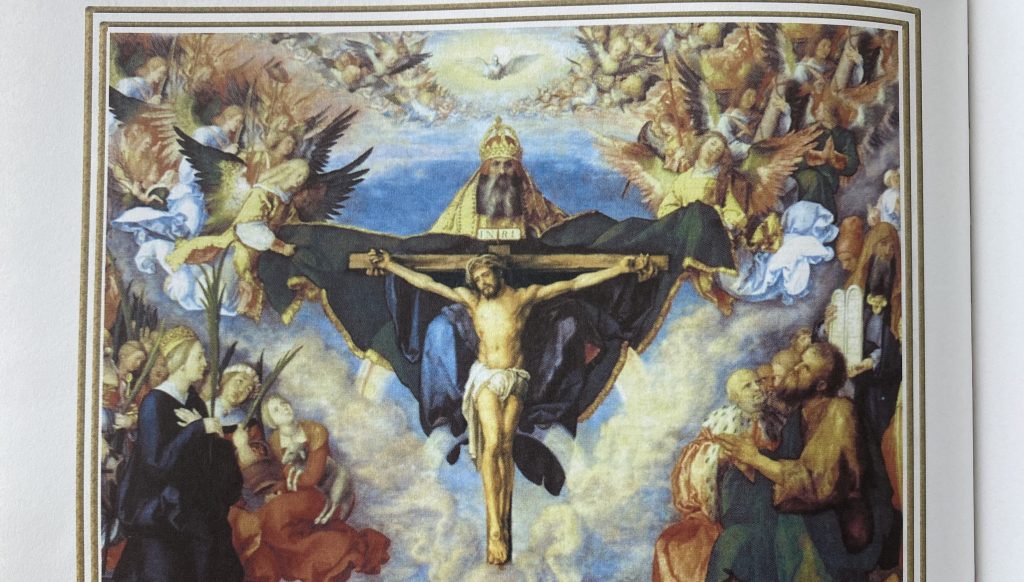
Photo: Accessed from Roman Missal. p. 497. Jesus showed his love for us in giving us all of himself on the cross, holding nothing back.

Martin, Francis and Wright VI, William M. The Gospel of John. Grand Rapids, MI: Baker Academic, 2015.

Link for the Mass readings for Thursday, May 5, 2025

Are we willing to see Jesus and see others as Jesus sees them?

Yet again, as in the Gospel from yesterday, the crowd gets in the way of someone seeking access to Jesus. The wall of people that has gathered around Jesus does not appear to be overtly keeping Zacchaeus from seeing Jesus. They may be so focused on seeing him themselves that they are not aware. Yet, there is also the strong possibility that the people were aware that this man was trying to get through. They knew Zacchaeus, and many judged him to be the sinner of sinners.

He was the chief tax collector of the area and he was most likely reviled by most in his community. He would have also likely considered to be unclean because he was breaking the commandment of not stealing, which he and the majority of the tax collectors did at the time. Each was the chief tax collector who was then also dealing with the Gentile occupiers. It is likely that each time Zacchaeus attempted to nudge by to get through a gap to get a better look, the individuals may have closed any gap each time such that he could not get through.

Zacchaeus was not thwarted. He ran ahead and climbed a sycamore tree. From his perch he was not only able to see Jesus, but Jesus saw him and said, “Zacchaeus, come down quickly, for today I must stay at your house” (Lk 19:5). Jesus did not see a tax collector or a sinner, he saw a seeker. One who was also willing to humble himself by climbing a tree, much like a child.

Jesus did not see the 99% nor the 1%. Jesus saw and sees people in need of compassion and mercy. He sees those lost that need to be found, those sick in need of healing, those alone who sought to belong. Jesus did not meet Zacchaeus with judgment but with love and compassion, and that made all the difference for this man’s conversion.

Jesus was willing to draw close to the one so many despised. By inviting himself to dine with Zacchaeus in his own home, Zacchaeus must have felt overwhelmed with emotion. Maybe for the first time in his life, he felt welcome instead of disdain. He repented without hesitation to the unconditional invitation and love he had received: “Behold, half of my possessions, Lord, I shall give to the poor, and if I have extorted anything from anyone I shall repay it four times over” (LK 19:8).

This expressive act of generosity arose from his encounter with Jesus. This exchange offers the invitation for us also to receive Jesus in the same way and the invitation to greet others more openly as well. One way to do so is to resist the temptation to “grumble”, to gossip, to pre-judge, and/or to dehumanize one another. Salvation came to Zacchaeus’ house in the person of his savior and in the act of his repentance.

Life is hard enough without adding more negativity. Jesus wants to dwell with us too. While at the same time, he challenges us to see beyond the exterior caricatures we project on to others, and instead invites us to seek to know the heart and character of the person. We can do so when we stop grumbling, are willing to approach others with an understanding heart and mind, and be willing to spend time to get to know one another.


Painting: Zacchaeus in the Sycamore Awaiting the Passage of Jesus by James Tissot.

Link for the Mass readings for Tuesday, November 19, 2024

Jesus conquered sin on the cross that we may be free from sin in our lives.

“That servant who knew his master’s will but did not make preparations nor act in accord with his will shall be beaten severely” (Lk 12:47).
Jesus, as did the prophets, spoke in ways that can be jarring. The purpose was to shake his listeners out of a dull stupor and to make clear his point. In today’s Gospel passage, Jesus addressed Peter’s question: “Lord, is this parable meant for us or for everyone” (Lk 12:41)? Jesus was most likely speaking to Peter and the Twelve. They are the ones he entrusted with continuing his mission. And just as he had been clear to point out those Pharisees who had abused their positions, he was being just as clear with Peter and the apostles. Jesus wanted to make sure that his successors were not to continue on with business as usual. What Jesus required of them was not just for themselves, but those whose care they had been entrusted with and beyond them to all the nations. His parable was for both the Twelve first and foremost, and then to everyone.
Unfortunately, we have witnessed those in Church leadership who have in effect, “beat the menservants and the maidservants, to eat and drink and get drunk” (Lk 12:45) on their own power. Those who have: abused children, covered abuse, skimmed off the top of the donations from the blood, sweat, and tears of their parishioners’ donations, limited access to positions within the leadership of the Church to only male or clergy, been unmerciful confessors, held up the sin of one group or groups while turning a blind eye to others. These and other forms of hypocrisy do irreparable damage.
The world has been darkened by sin and it has crept into the Church. Even though all of us have been wounded we have not been destroyed by sin. The Son of God entered into the condition of our fallen nature, became one of us, one with us, in all things except sin and yet was willing to take the sin of the world upon himself on the Cross, conquering sin and death. Even when those in his name have participated in and perpetuated in that which Jesus warned his Apostles against, we are not to lose heart nor hope. I agree with Bishop Robert Barron that we are called out of “the realm of hatred, racism, sexism, violence, oppression, imperialism, what Augustine termed the libido dominandi (the lust to dominate).”
We are called to be children of the light. We do so by doing whatever Jesus tells us to do. There have been many throughout the ages as well as up to and including our own present time who have done just that. The saints have embraced the light of Christ allowing it to reveal to them their sins. With humility and contrition, they confessed their weaknesses, failures, sins, and from this place of surrender, they have been forgiven, healed, and transformed. They have become an empty cup able to be filled to overflowing with the love of Jesus. May we too be willing to be emptied of that which is not of God, so that we may receive the healing salve of the Father’s Love and be filled to overflowing also. May the love that we have received then spill over into the lives of those within our reach.

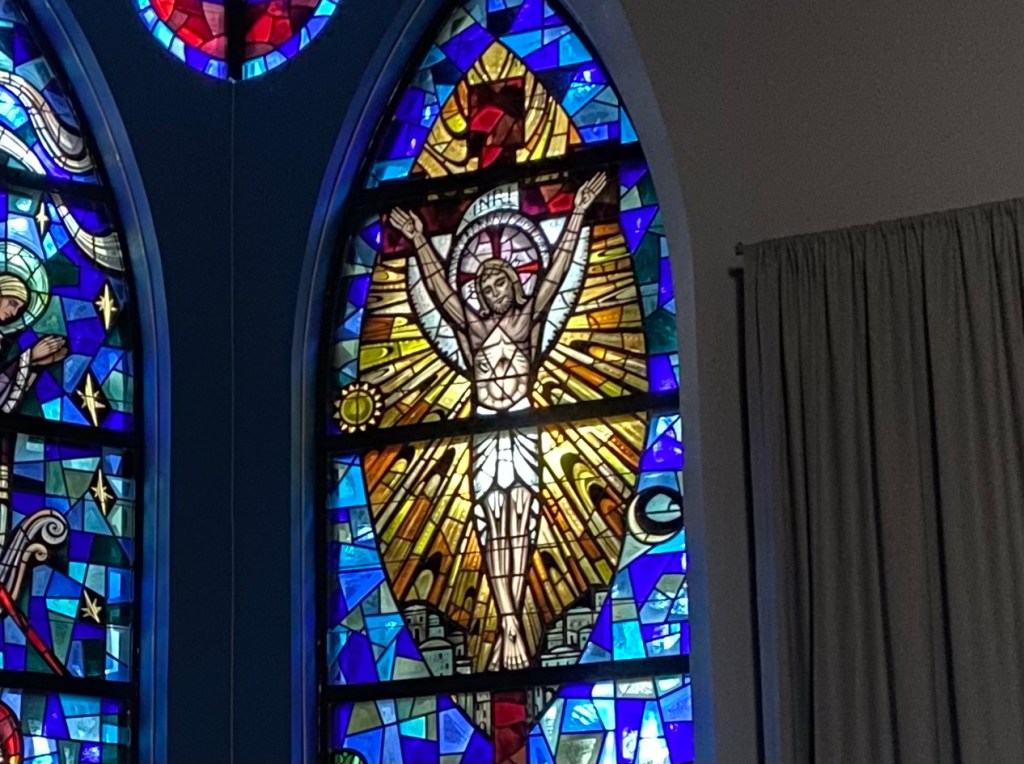
Photo: Stained glass behind the altar of Holy Cross Catholic Church.
Barron, Robert. Catholicism: A Journey to the Heart of the Faith. NY: Image, 2014
Link for the Mass readings for Wednesday, October 23, 2024

Behold Jesus on the Cross and be healed.

“In punishment the LORD sent among the people saraph serpents, which bit the people so that many of them died” (Numbers 21:6).

What kind of God would bring poisonous snakes upon his children? When Jesus taught his disciples about prayer didn’t he say, “Is there anyone among you… if a child asks for a fish, will give it a snake? If you then, who are evil, know how to give good gifts to your children, how much more will your Father in heaven give good things to those who ask him” (Mt 7:10).

Is God a loving Father or a harsh taskmaster?

He is a loving Father who not only wants his children to live but to live life to the full. God freed his people from slavery and was not only leading them to the promised land but also providing for and protecting them on the way. And yet, the people consistently grumbled and then rose up against Moses.

God chose to share with them a stark image of their choice of opposition to him by sending the serpents. The imagery of the serpent would have come to mind quickly to the people. For it was the serpent who tempted Eve and Adam and led them to their Fall. As St. Ephrem the Syrian (306-373 AD) wrote: “The serpent struck Adam in paradise and killed him. [It also struck] Israel in the camp and annihilated them” (Word on Fire Bible, p. 643).

We as Christians interpret the serpent in Genesis as Satan, which in Hebrew means adversary or opposer. Those of the people who rose up against God opposed him as Satan did. God revealed to them who they were serving in their rebellion and also showed them that if they rejected God and his love, protection, and provision, what the consequences to that choice would look like. Apart from God they will die. Trusting in and following God, even when the desert held no promise, they will live. “This particular punishment is another way of insisting that negativity necessarily follows from rebellion against God’s will” (Barron, p. 641).

When the people saw their sin in opposing God, they correctly repented. Moses again interceded for them, and God provided the healing antidote. He guided Moses to place a bronze image of a poisonous serpent on a pole. All who then looked upon it, were cured. In seeing clearly what had led to their poisoning, they could renounce it and receive God’s mercy, forgiveness, and healing. “Somehow, seeing sin for what it is serves to disempower the hold it has upon us” (Barron, p 641).

Jesus, the divine Son of God becomes one with us in our humanity to reveal to us the path to participate in his divinity. He shows to us our own rebelliousness, pride, and sins that separate us from God. Jesus has not come to condemn us for our sin but to save us, to free us from our slavery to sin. Jesus took the sin of the world upon himself as he was lifted up on the Cross. As he shared with Nicodemus, “just as Moses lifted up the serpent in the wilderness, so must the Son of Man be lifted up, that whoever believes in him may have eternal life” (Jn 3:14-15).

This is why we celebrate the feast of the Exaltation of the Holy Cross this day each year. What was a wicked sign of oppression and horrific suffering has now become a sign for our salvation. As we look upon the crucifix, we are reminded of the suffering that Jesus bore. Jesus took upon himself “all the dysfunction of the fallen human race” (Barron, p. 642).

When we look upon Jesus hanging on the cross, we see death but also the path to eternal life when we are willing to renounce, repent, atone for, and seek forgiveness for our sins. For on that Cross is where Jesus died for each and every one of us, and in so doing conquered the sin and death brought into the world by Adam and opened up for us the door to eternal life through his resurrection.


Photo: St Mary Chapel, St, Vincent de Paul Regional Seminary, Boyton Beach, FL.

Link for the Mass readings for Saturday, September 14, 2024

Word On Fire Bible: The Pentateuch. Elk Grove Village, IL: Word on Fire, 2023.

May the light of Jesus lead us out of our darkness.

“I came into the world as light, so that everyone who believes in me might not remain in darkness” (Jn 12:46).
What might be the darkness that Jesus refers to? It could be anything that turns us within ourselves, turns us away from that which is True, Good, and Beautiful. This can be prejudice, ignorance, cynicism, sin, violence, hatred, war, division, dehumanization, and the list goes on

A major root that keeps us in this darkness is fear. Jesus offers us the light of his Father. He encourages us to leave our self-imposed imprisonment by loving us as we are, more than we can imagine, and more than we can ever mess up. Christianity is not just a set of moral principles, a set of doctrines, a philosophy, or a theology. Christianity is about an encounter with a person, the Son of God, Jesus the Christ.

The light of Jesus leads and invites us to experience that which we have been created and are restless for – an intimate relationship with God the Father and each other. Through the light of his love, Jesus reveals to us those apparent goods, false substitutes, and idols that distract and keep us separated from deepening our relationship with God. We come to know our Father when we are willing to receive the love of the Holy Spirit, to be ourselves free of our masks, and are moved to share that love with each other.

Jesus, please shine your light within and before us so that we may identify and resist any selfish impulse or reaction based on any fears or past hurts. Heal and guide us so that we may instead love you and others as you have loved us. Help us to identify when we are walking away from you, and to resist and renounce that which leads us away from you. Help us to also recognize when we are walking with you and that which leads us closer to you so we may rest, receive, and abide more in your love and presence.

Help us to be aware of, offer to be of help, reach out to others in need, be present and willing to listen, and/or choose to be more understanding, supportive, and encouraging. With each experience may we believe in you more and reflect your light outward so that others may come to see and to believe in you so to come from the darkness and into the light!


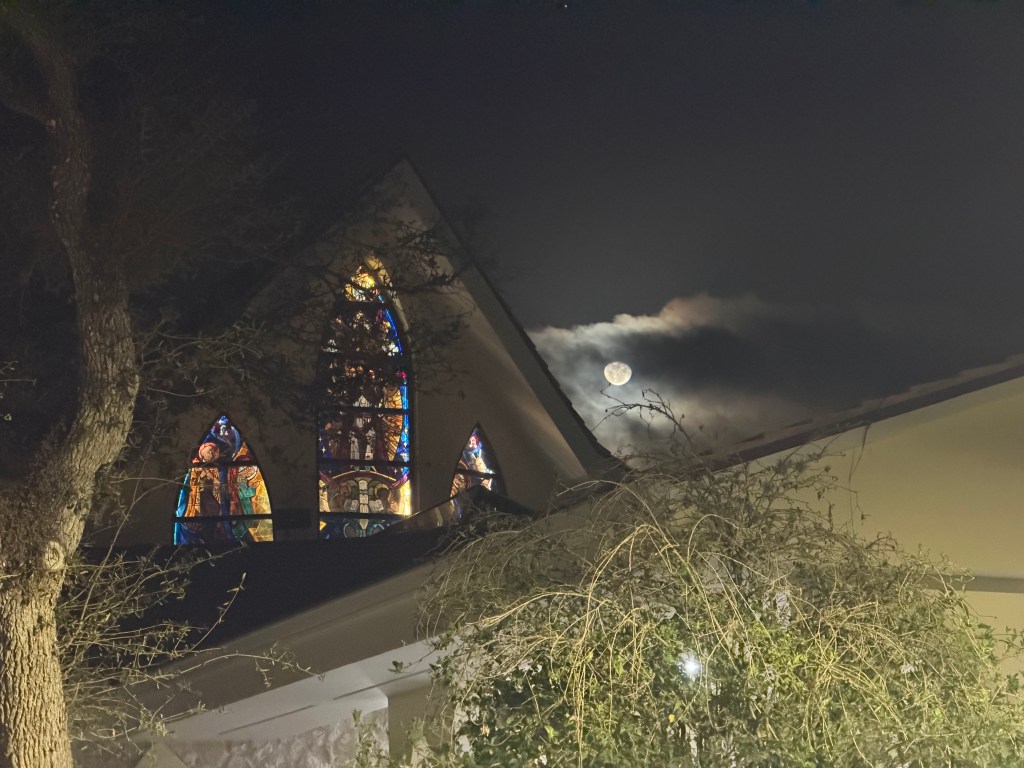
Photo: Full moon rising as I was finishing my Rosary walk. St. Vincent de Paul Regional Seminary, Boynton Beach, FL.

Link for the Mass readings for Wednesday, May 24, 2024

Let us believe, in Jesus who opens up heaven for us.

Jesus continues his conversation with Nicodemus in today’s Gospel from John. In the opening verse, Jesus outlines why he came into the world: “God so loved the world that he gave his only-begotten Son, so that everyone who believes in him might not perish but might have eternal life” (Jn 3:16). God has created us out of love and shepherds us out of love. God loves what he has created, and in his order and timing, he sent his Son to enter humanity to become one with us, to heal us and invite us to come out of the shadows and dark recesses of turning in upon ourselves, from living in fear and sin, and to walk with him in relationship.

To love we need to risk being rejected. Jesus entered humanity as we all did, in the utter vulnerability of the womb. His very life was at risk from the moment of conception. Mary, a young woman, betrothed to Joseph, in a time and culture in which a woman found to be with child and not from her husband, could be stoned to death. Mary could have made a different choice, Joseph could have made a different choice, but both chose to follow the will of God. They resisted the temptation to close in upon themselves and make an isolated decision based on their own needs, anxieties, and fears. While all of creation held its collective breath, Mary and Joseph trusted God, they chose the light, they chose to protect life.

“Whoever believes in him will not be condemned, but whoever does not believe has already been condemned, because he has not believed in the name of the only-begotten Son of God” (Jn 3:18). Jesus did not come to condemn, he came to redeem, to save, to love us into eternity. For love to be real, it must be truly free. Free to the full extent that it can be rejected. Otherwise, what is experienced by the other is coercion, conditions, manipulation, pressure, but not love. The Son of God entered the womb of Mary risking rejection by her, Joseph, and/or their extended family.

Those who, like Mary and Joseph, believe in Jesus will come to have eternal life, and those who do not have already been condemned, not by God but by themselves. This is true because instead of accepting the invitation of the Source of life they are turning away. Those rejecting God have been invited to receive his love also, but for reasons they may or may not be aware of, say no. We who follow Jesus are to be his presence of love among those we encounter, even those who shy away or reject him. We may be the only Bible someone ever reads.

Satan tempts and condemns us when we fall. God does not. “God so loved the world that he gave his only-begotten Son, so that everyone who believes in him might not perish but might have eternal life” (Jn 3:16). We, even in our brokenness, imperfections, and sin, are loved by Jesus. Don’t listen to the father of lies who would say anything different. Jesus has not come to condemn but to invite us to receive his love, healing, and forgiveness. Only if we are unwilling to seek his forgiveness, we are not sorry, and/or we are not willing to change, will we not be forgiven, because we give nothing to Jesus to forgive.

There is nothing Jesus will not forgive us for, nothing, that is why he instituted the sacrament of Reconciliation. When we seek his forgiveness, are sorry for our sins, confess to the priest, seek to change with Jesus’ help and do penance, we will be absolved and forgiven.

We are free to reject or accept the offer of Jesus’ love. As Pope Francis wrote: “We are called to be holy by living our lives with love and by bearing witness in everything we do, wherever we find ourselves.” As we are forgiven, receive, and experience the love of Jesus, may we seek to love those we encounter as Jesus has loved us. If there are any that we might not include in everyone, may we be willing to allow Jesus to love them through us until we can.


Photo: Looking up to the things of heaven as I began my Rosary walk – St. Vincent De Paul Regional Seminary, Boynton Beach, FL.

Link for article on Gaudete et Exultate (“Rejoice and Be Glad”)

Link for the Mass readings for Wednesday, April 10, 2024