Walking with Jesus will help us to experience the joy of the Father and the Holy Spirit.

“All things have been handed over to me by my Father. No one knows who the Son is except the Father, and who the Father is except the Son and anyone to whom the Son wishes to reveal him” (Lk 10:22).

God the Father knows God the Son and God the Son knows God the Father. They do not just know about each other, they know each other with a deep intimacy that is far beyond our human comprehension. Contemplating this reality can fill us with hope especially when we come to realize that Jesus is the Son of God who has come into our lives so that we can participate in the trinitarian communion of the Father and the Son and the love shared between them, who Jesus “rejoiced in” (Lk 10:21), the Holy Spirit!

Jesus has come as an agent of reconciliation, to restore our relationship with God, to undo the effects of the sin of separation that has so ruptured and wounded our relationship with him, each other, and his creation. Our hope this Advent is that we can come not just to a better understanding of God, but to restore our relationship with God and grow in intimacy with him through our participation in the life of his Son. Doing so, will also help us to do the same in our present relationships. Healing can happen when each of us are open to the Holy Spirit.

May the Advent season not get away from us before it even starts because of the external distractions from the material, commercial, and everyday busyness, nor from the everyday internal mental and psychological challenges that threaten. Choosing to be still, to breathe deep, and spend some time in God’s gift of creation, to enter into his natural rhythm, and bask in the wonder and vast expanse of it all can help us to step away from the distractions for even a little bit. In those moments we can find rest, reset, and react less. Reacting less helps relationships to heal.

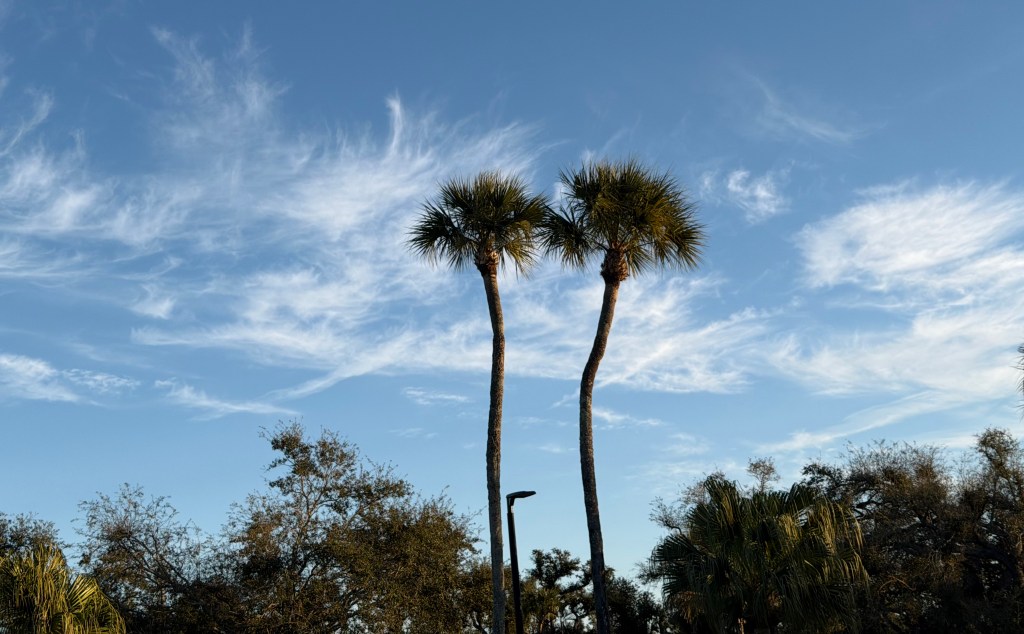
I have done a lot of traveling in my life, but wherever I have gone, spending a year in the Bronx, six months in Los Angeles, a summer on the Pine Ridge and Rosebud Reservations, growing up and living in Connecticut for my first thirty years, or the last thirty years here in Florida, I have sought to spend time looking up at the sky. When I allow days to pass and I do not do so, I feel different and not for the better.

All of creation echoes the wonder and adoration of the gift that the season of Advent offers: Jesus, who became one with us in our humanity so we can become one with him in his divinity, invites us to participate in a deeper walk with his Father, the creator of heaven and earth, the one who knit us together in our mother’s womb, and who knows us better than we know ourselves! Please spend some time with God today in quiet reflection and allow him to love you where you are and as you are and rejoice in the Holy Spirit! Then share that joy with those in your lives.

———————————————————————————–

Photo: Walking on the way to our church hall for a meeting, turned back, and looked up. Wow. God is so good!

Link for the Mass readings for Tuesday, December 2, 2025

The Holy Spirit will help us to continually embrace wonder and experience truth.

Benjamin Franklin is quoted as saying, “Wise men don’t need advice. Fools won’t take it.” Most of us may fall somewhere in the middle. Hopefully, we are less foolish and moving more along to path of gaining wisdom. Jesus continues his best efforts in today’s Gospel to offer guidance and assurance to his disciples that the Holy Spirit will continue to be their guide after his departure. “I have much more to tell you, but you cannot bear it now. But when he comes, the Spirit of truth, he will guide you to all truth” (Jn 16:12-13a).

Surely, Jesus could see the dimming lamps in the eyes of his disciples. As discussed yesterday, comprehending the death of the Messiah, his Resurrection, and return to the Father was a bit much to digest. Also, there was only so much that they could grasp with their finite intellect. Until they experienced the infused contemplative insights given to them by the Holy Spirit, there was only so much the apostles were going to be able to digest of what Jesus was sharing with them about the inner life of the Trinity, the divine communion of love between he Father, and the Son, and the Holy Spirit.

Yet, Jesus, though, still needed to share what his Father gave him to share, and the disciples were to take in what they could. Jesus’ death and Ascension were not to put an end to their learning, deepening of their understanding, or further developing their relationship with Jesus and his Father. The Holy Spirit would continue what Jesus started, and would to lead them to all truth, the fullness of the foundational relationship that is the source of all that exists, the Holy Trinity.

Anyone involved in teaching anyone anything or learning something for one self will know, that just telling someone something does not mean that learning has happened. There is a process of introduction, integration, practice, review, mistakes, corrections, and adjustments until some proficiency is achieved. With the disciples, this is the same. Jesus did not just present things once and move on to the next order of business. That is why John declared at the end of his Gospel that: “There are also many other things that Jesus did, but if these were to be described individually, I do not think the whole world would contain the books that would be written” (Jn 21:25).

I am sure a part of what John was talking about here were the lessons, corrections, and guidance Jesus offered. Just as Joseph modeled for and guided Jesus in his trade in carpentry, so Jesus learned from him through observation, practice, mistakes, adjustments, and corrections. Jesus guided his disciples in the same way, as a mentor with his apprentices. He was now assuring them that even though he would be leaving them, the guidance and leading would continue with the support of the Holy Spirit.

The lessons about the immanence of God, God within himself as a Trinitarian communion, that Jesus taught were not as concrete as sawing, hammering, and planing wooden beams though. God is not a being, not even a supreme being, meaning that he transcends our ability to comprehend the fullness of his reality. We will never fully comprehend God or exhaust the richness and the depth of our relationship with God. What the apostles and the saints to follow and we can still experience today is God’s grace building on his nature. When we read, pray, and meditate with these sacred texts, the Holy Spirit will communicate with us and grant us insights beyond any intellectual endeavor.

On the human level, we are guilty of malpractice in our relationships when we assume that we know everything there is to know about someone else. The gift of the person, the human being, is that we are ever-developing and growing in the mystery and wonder of who we are and who we are called to be. We can always surprise each other. If this is true for us in our relationships with each other, it is much more so in our relationship with God. Once we get to one level of understanding, we plateau for a time, but that is not the end of the journey, that is only a time to savor, to ponder, and contemplate until we are ready to go ever deeper into the truth that the Holy Spirit will reveal to us.

Our tradition teaches us that the fullness of God has been revealed in Jesus Christ, which is true, yet to comprehend that revelation will take a lifetime and continue on into eternity just to scratch the surface. St Thomas Aquinas (1225-1274), a Dominican Friar, who is considered the Angelic Doctor of the Church, was one of the top theological influences during the Scholastic Period, yet close to the end of his life he had a deep and intimate encounter with God in which he came to realize that all of his intellectual achievement, all that he had written, mattered no more than a pile of straw compared to that which God had revealed to him in a single moment of infused contemplation.

Arguably one of the wisest persons of his time, and some would say one of the most brilliant minds ever, was also one who was steeped in daily prayer and continued to be open to the majestic wonder of the glory of God. May we too continue to embrace the gift of wonder, the gift of learning, and never settle, rest and savor yes, but continue to learn and grow, to seek and hunger for the Good, the True, and the Beautiful, to continually have our hearts and minds open to allow the Holy Spirit to guide us “to all truth”!


Photo: A momentary pause during my Rosary walk to observe the interplay between some mangrove stems and barnacles. Many invitations to experience God’s wonder when we get out and about!

Link for the Mass readings for Wednesday, May 28, 2025

Quiet time with God in his creation helps us to be still, to grow closer to God and each other.

“All things have been handed over to me by my Father. No one knows who the Son is except the Father, and who the Father is except the Son and anyone to whom the Son wishes to reveal him” (Lk 10:22).

God the Father knows God the Son and God the Son knows God the Father. They do not just know about each other, they know each other with such a deep, infinite intimacy that is far beyond our human comprehension. Contemplating this reality can fill us with hope especially when we come to realize that Jesus is the Son of God who has come into our lives so that we can participate in the trinitarian communion of the Father and the Son and the love shared between them, the Holy Spirit!

Jesus has come as an agent of reconciliation, to restore our relationship with God, to undo the effects of the sin of separation that has so ruptured and wounded our relationship with him, each other, and his creation. Our hope this Advent is that we can come not just to a better understanding of God, but to more intimately know and restore our relationship with God through our participation in the life of his Son.

May the Advent season not get away from us before it even starts because of the material, commercial, and busyness that threatens. A good practice to help us to slow our pace is to spend some time in the gift of God’s creation, to enter into its natural rhythm, and bask in the wonder and vast expanse of it all.

One of the activities that I enjoyed most with JoAnn, was our evening walks. I have continued this practice most evenings since her death as well. During my time at seminary, my spiritual director invited me to pray the Rosary during these walks, which I did and have enjoyed very much. Each night walking around the lake at the seminary and looking up and around, praying, walking, and breathing was a wonderful and peaceful experience.

As I drew closer to ordination, one of my concerns regarding possible placement was whether or not I would be assigned to an area in which I could continue my evening Rosary walks and have access to the wonderful vistas that the seminary afforded. I have been blessed by our bishop that he assigned me to Holy Cross. Not only have I been blessed with even more wonderful natural views, I have been blessed with an incredible family and community here. With each step and interaction, I continue to be blessed and drawn deeper into intimacy with God and feel more of his peace and joy.

All of creation echoes the wonder and adoration of the gift that the season of Advent offers: Jesus invites us to participate in a deeper walk with his Father, the creator of heaven and earth, the one who knit us together in our mother’s womb, and who knows us better than we know ourselves! With each breath and step we take, each prayer that we pray, each willingness to engage lovingly with another, will lead us into deeper intimacy with the Father, the Son, and the Holy Spirit and each other.

———————————————————————————–

Photo: Although darker on these December Rosary walks, still many interesting views. “A light has shined in the darkness and has not overcome it” (John 1:5).

Link for the Mass readings for Tuesday, December 3, 2019

Each day is an opportunity to experience the miracles and wonders of God.

The feeding of the five thousand that we encounter in today’s Gospel from John is reported in each of the four Gospels. The only other incident that is recorded in all four is the Resurrection accounts. This point is relevant because biblical scholars look to the multiple attestation theory as one means as to whether an account in the Gospel record is more or less plausible. Having the same account present in each of the four is strong evidence in support for that event happening.

From a different perspective, there are those that embrace scientism meaning that they will not believe in anything that cannot be measured, experimented upon, or proven within the realm of the five senses. For those ascribing to this strict interpretation, religion and accounts of miracles are often dismissed as superstition, that if something indeed did happen, there is a scientific explanation to dismiss the miraculous. Even some believers may discount the record of the feeding of the five thousand as more of a symbolic representation of the generosity and service encouraged by Jesus such that everyone gave their small share and there was enough for all, not that he was able to multiply the bread and fish.

These perspectives of downplaying the miracle of multiplication seek to reduce or limit Jesus to just his humanity, but he is so much more. Jesus is human, fully human, yes, but he is also fully divine. Coming to understand the wonder of the unity of the divinity and humanity of Jesus can help us better understand the reality of our world and cosmos. One of the core aspects of who we are as human beings is that we are people of wonder. The physical sciences are tools that we have in our toolbox that we can access to help us to understand our physical realm, while at the same time we also have spiritual tools that aid us in understanding both physical and spiritual realities. The physical sciences actually emerge precisely because of our spiritual pursuit to understand the wonders of God’s creation. In accessing both faith and reason, we come to have a broader picture, more pieces of the puzzle in which to put together and better experience our world.

When we limit or explain away the miracles of Jesus, we rob ourselves of a more accurate picture of the reality of creation. One concrete example of this is when our third president, Thomas Jefferson, took a sharp object and painstakingly cut out verses from the Bible and pasted them to blank pages. He did so in columns of Latin and Greek on one side of the paper and French and English on the other. This eighty-four-page tome is commonly called the Jefferson Bible, but the president titled it: The Life and Morals of Jesus of Nazareth. This text offers a human portrayal of Jesus that dismisses anything divine.

If we remove ourselves from the divine, and 99.9% of our life, experience, interests, and thought is spent in the finite material realm, we will miss a deeper expression of who we are as human beings and disconnect ourselves from much of the joy and gift of life. It stands to reason then why we would find it hard to believe in miracles, the mystical, the spiritual. In the miracles is not a self-aggrandizing move on Jesus’ part, but a move of love and empathy. Jesus is moved, time and again, to reach out in love, to care for and support those who are in need. Even more, the miracles are pointing to our final destination which is beyond the limits of this finite reality! As we read in today’s account of the feeding of the five thousand, Jesus is showing what living life to the full is all about: being in communion with God and one another.

We need to resist the temptation to write off too quickly the miracles of Jesus presented in the Gospels and still happening today. May we also not dismiss the gift and value of the sciences. By approaching our world with a both/and approach, we will get a better understanding of and appreciation for not only the gift and wonder of creation but also who we are as human beings. God has imparted within us the ability to access and develop both our faith and reason, to think critically, and to pray and meditate deeply.

Jesus, as the firstborn of the new creation, embodies the reality of the fullness of who God in the depths of our souls has created us to be, human and divine. Jesus is still present to us today, knocking on the doors of our hearts, minds, and souls. If we only follow the moral and social teachings of Jesus, as did Thomas Jefferson, we will experience some benefit, but we will limit ourselves because we will be cutting out the very life force that sustains those virtues we hope to aspire to. We will access the fullness of all that God the Father offers us when we open the door to his Son this Easter Season, let the Holy Spirit in, and offer the little we have and watch how much he can multiply our simple gifts.

Let us continue to journey together, to read and pray together the Gospels of Matthew, Mark, Luke, and John. May we resist rejecting outright what we do not understand or comprehend, and instead be willing to ponder the wonders of miracles, the gifts of God’s grace that builds on our nature, the reality of God-incidences all around us, and embrace the eternal foundation and ground of our being which is the Trinitarian Love of God.


Photo: Morning prayer back on retreat at Our Lady of Florida Spiritual Center, North Palm Beach, FL.

Link to the Mass readings for Friday, April 12, 2024

Let’s embrace the wonder of God’s creation and one another.

There is a sadness and an ache that accompanies today’s readings. David sins again and many people suffer because of the choices he makes as leader. In the Gospel of Mark, Jesus preached and taught in his “native place”, but for the most part, his words were not received. Because of the lack of faith of his hometown crowd, their unwillingness to trust in him, Jesus did not perform many healings or exorcisms. He was not able to bring those who knew him for the majority of his life into deeper communion with his Father.

The whole reason that the Son of God became man was to bring light to a world suffering in darkness and to reconcile humanity to their rightful place as sons and daughters of his Father. And yet, those closest to him refused the invitation such that: “he was not able to perform any mighty deed there, apart from curing a few sick people by laying his hands on them. He was amazed at their lack of faith” (Mk 6:6).

Is our world today becoming more and more like Jesus’ “native place”? Is Jesus taken for granted? Do we pay attention to him at all? Many expend more energy on cynicism, taking care of number one, and an uncritical acceptance of empiricism or scientism. Again, a sad state because science is an awesome gift. Science and faith come from the same source, our intrinsic ability to embrace the wonder of God’s creation! These two are not incompatible. Authentic faith seeks understanding. A questioning and searching mind are the ingredients for a living, relevant, and vibrant faith, and life.

Faith without reason, as well as reason without faith, leads to a more limited understanding of the vast expanse of our world. Scientism is limiting the very gift of science itself because it stops when the questions get really interesting, when the exploration goes beyond the measurable, the sensate experiences as we know them. Faith without reason can devolve into mere superstition and legalism.

Jesus invites us to resist setting limits, settling for a minimalist or cynical approach, and the hardening of our hearts. He instead is inviting us to open ourselves up to the limitless possibilities God opens up before us! There is so much to experience in God’s creation if we just slow down and are still enough to experience the wonder of our everyday moments all around us.

The Holy Spirit works through each of us when we resist keeping each other at a distance and placing each other in a box. Many of Jesus’ own people could not see Jesus as anyone other than a simple carpenter and son of Mary. There was no way he could do all the things people were saying about him.

May we resist the lie that we know all there is to know about each other. There is so much wonder to the gift of each individual, especially when we allow ourselves to expand by following the will of God for our lives and helping each other to do the same. We can experience so much more by embracing our faith and reason, opening our hearts and minds to the wonder and glory of God and each encounter with one another. As we do so, we will begin to experience God’s greatest joy, the human being fully alive!

———————————————————————–

Photo: Short morning walk yesterday, enjoying some blue sky and sight of the moon. Mary has often been compared to the moon as she reflects the light of her Son!

Link for the Mass readings for Wednesday, January 31, 2024