Jesus will lead us to our fulfillment, if we are willing to listen and follow.

“At the sight of the crowds, his heart was moved with pity for them because they were troubled and abandoned, like sheep without a shepherd” (Mt 9:36).

There is much that pulls at us for our time and attention. Jesus witnessed the anxieties, struggles, pain, and feelings of being lost regarding those in his midst. Are we so different today? Jesus knows the Father, he knows the joy and fulfillment of what being in a full relationship with him entails. Jesus saw then and sees in us now how lost can become, how easily distracted and diverted can be, he knows how many things we put before our relationship with God, and he “is moved with pity.”

Jesus’ heart goes out to us, he yearns to be one with us, he loves us, but in that very act of love, he risks. He loves us so much, that he is willing to let us choose ourselves, others, or a myriad of other pursuits over him. Jesus invites us to the joyful experience of developing a relationship with him so we can come to know his Father, while at the same time he does not impose himself on us. We are given the whole world to choose from or we can choose him. Who do we put first? Is God a priority in our life? If we find that God is at best an after-thought, or at worst a no thought, instead of getting to know God better, what is it that we are choosing over him?

Jesus invites us, but too often we miss, ignore, or do not follow through on his invitation. Too often we choose other pleasures, distractions, diversions, temptations, and/or apparent goods. With time and experience, we may come to see the emptiness of the lure of these worldly promises, as well as begin to recognize that our attachments and disordered affections often lead to many of our troubles, trials, stresses, and anxieties. We are often led astray because we are seeking address our underlying experiences of unfulfillment, abandonment, and/or loneliness. There is only one source, one person, that will ultimately fulfill our innermost longing; God our Father.

I am not advocating for a rejection of the material world. All that God has created is good. We are human beings and a part of God’s glorious creation. Nor do I believe that we are souls trapped in this body waiting to be released upon our death. As human beings, we are a unique unity of body and soul. The key to our fulfillment, finding meaning and belonging is choosing to put God first. In establishing a firmer relationship with God, we can better discern that which we need to let go of, and/or how to reorder that which God wants to remain. Once we establish God as our firm foundation, even the challenges and trials that arise with not disturb our peace.

This might be the moment to be still and evaluate where we are in our lives and to ponder who we belong to. Jesus offers to lead us, just as he has led his disciples through the ages. Those of every age have experienced trials and tribulations and found the promises of this world fleeting. What made the difference for the saints was that they said yes to the call of the Shepherd and then followed him. Are we willing to slow down, to breathe, and listen to the Shepherd’s invitation today? Are we willing to follow his lead?


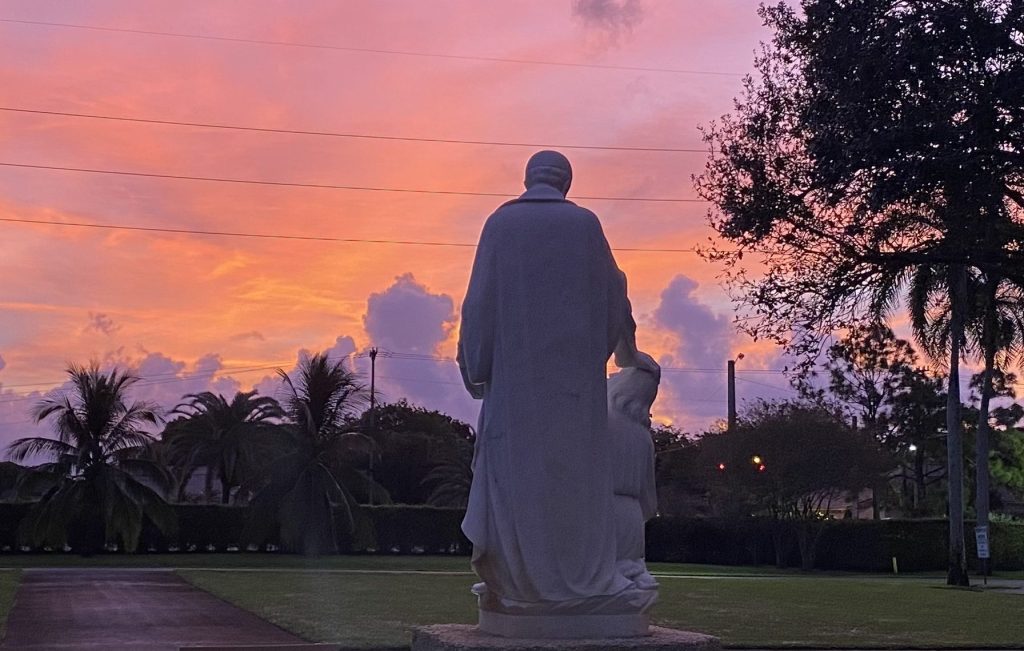
Photo: Rosary walk Sunday evening, Veteran’s Memorial Island Sanctuary, Vero Beach.

Link for the Mass readings for Tuesday, July 9, 2024

May we also trust and have courage to reach out to Jesus in our need.

“If only I can touch his cloak, I shall be cured.” Jesus turned around and saw her, and said, “Courage, daughter! Your faith has saved you.” And from that hour the woman was cured (Mt 9:21-22).

Just to touch his cloak may seem a small and insignificant act, but by doing so, this woman showed tremendous courage. Suffering from hemorrhaging for twelve years, broke from spending all her resources to be healed, she risked. She could have been severely punished, beaten, or stoned for this small act. Under the Levitical code, her condition deemed her unclean, in the same category as a leper, a pariah. Touching someone else in that condition would then make them unclean. Yet, in that small touch, that great act of courage, “power had gone forth from him” (Mk 5:30), and she was completely healed. Not only did the woman exhibit the courage to touch Jesus, but to admit she had done so when Jesus questioned who had touched him.

In calling the woman who touched him out, Jesus was not condemning her, Jesus was acknowledging her faith and restoring her to the community from which she had been ostracized. Jesus restored her dignity. How many women today still feel and experience the pain of exclusion, not having access to the full and equal benefits of society and the Church? How many people are still considered outcasts and pariahs in our communities?

Pope Francis in his general audience from August 31, 2016, stated: “Once again Jesus, with his merciful behavior, shows the church the path it must take to reach out to every person so that each one can be healed in body and spirit and recover his or her dignity as a child of God”. We too then are to treat each person we encounter, in-person and online, with dignity, love, mercy, and respect.

The courage and persistence of the woman with a hemorrhage from today’s Gospel led her to reach out to touch Jesus even though she was crossing social norms. Jesus affirmed her move. May we also place our trust in Jesus, have the same courage to reach out to Jesus for our needs, when in our weakness, and to seek his guidance. While at the same time, may we be available and willing to allow Jesus to work through us to provide healing and support for those in our realm of influence who are in need.


Painting: James J. Tissot, The Woman with the Issue of Blood (1886-94)

Link for the Mass readings for Monday, July 7, 2024

When we are willing, God will transform our hard hearts to living hearts.

“Hard of face and obstinate of heart are they to whom I am sending you” (Ezekiel 2:4).

Each of our readings present the closed and stubborn attitude, the obstinate and hard of heart turned in upon itself that closes itself off from God. The interesting point also is that for Ezekiel, those whose hearts are hardened are the people God has chosen for himself. In the Gospel, the people to reject Jesus are those who are from his own hometown of Nazareth. These are not enemies but family and kin.

It is easy to point fingers at those in these accounts who are closed to God, who harden their hearts, who are obstinate in the face of God’s truth. We need to be careful though that we don’t miss where we are obstinate, where we are closed and dig in our heals to the invitation of the Holy Spirit who is speaking in the silence of our hearts. Are we willing to listen, are we willing to slow down long enough to listen?

Saul, who is the author of today’s second reading to the Corinthians is a good example to follow. One for whom was the best and brightest of his time. He studied under the premiere rabbi, Gamaliel. He was fluent in Hebrew and Greek, he knew the Law and the teachings of the prophets inside and out, and yet when the new way of Jesus, who did not come to abolish but to fulfill the Law came, his heart was so hardened, so obstinate, that he rose up to persecute the followers of Jesus.

Then, on the road to Damascus, he encountered the risen Jesus. Jesus did not condemn him who ordered St. Stephen’s stoning, he asked him a simple question. “Saul, Saul, why are you persecuting me?” Saul was blinded, his whole life came to an abrupt halt and in that encounter with Jesus, his heart of stone was softened and he became one of the most prominent promoters of this new way that he fought so hard to crush.

We are invited by Jesus, as he did with Paul, to turn away from the temptations that led him and some of the other Israelites to rebel against God, and instead to open our hearts and minds as did Ezekiel to hear the Spirit speaking in us. That means we need to make time to be still and to listen, for as St. Mother Teresa spoke, “We need to find God, and he cannot be found in noise and restlessness. God is a friend of silence.”

We are also invited to let go of closing ourselves off from our preconceptions and limitations as those residents of Nazareth who could not see beyond the simple carpenter they knew from his youth. A good answer for what Jesus was doing in those “hidden years” before his public ministry is – nothing spectacular. He was a simple day laborer, a peasant. Those who had lived with him most, knew him the least, and even though they were astonished at his teaching, that astonishment quickly shifted to a hardening of heart such that they took offense at the one who was offering them their salvation and he was “not able to perform any mighty deed there.”

Jesus invites us in this moment to become a friend of silence. We can do so with some simple steps that will help us to soften our hearts, unclench our fists, and help our shoulders to come out of our ears. We begin first by taking some slow, deep breaths and then to rest there in those breaths. Next we begin to feel our body again and notice where the tension is, so we can feel the stress and strain, and let it work its way out. Then rest in God’s word. Choose a word or phrase from today’s reading that touched you, a word or phrase from the Our Father or Hail Mary, or from one of the psalms, like Psalm 42, “Hope in God I will praise him still, my savior and my God.” And repeat it and let it become alive in your heart.

Breathing deeply and slowly shifts the momentum of our frantic, daily pace, and God’s word helps us to shift our focus from ourselves, our challenges, and any stress or anxiety, and instead to begin to feel safe and see what is real and true. As we breathe and rest with his word, our hearts and minds can be more open to receiving God’s guidance and by remaining there, not only will our hearts begin to soften, but we will also be more willing to follow his direction. When we breathe and rest in God’s word, we begin to experience his love, and receive his guidance. This is the place that we want to abide, so that we may release any stress or strain, experience his peace, and grow closer to God and each other, and make our decisions not by reacting but acting from God’s direction. When we find ourselves slipping and tightening, we just simply return to each of the above steps.

As with any discipline, these simple steps will become more fruitful with consistent practice. When we are feeling more anxious or emotional, sitting or standing still and breathing, and feeling those parts of our body touching the chair, our feet on the floor, any points of contact, will help our body to feel grounded, safe, and begin to reset itself from the fight or flight mode we often slip into. Resting in God’s word can also help us to feel him close and again to begin to feel safe. For God is our rock and our firm foundation. Let us trust in our God and Father, his Son who he sent to guide us, and the love of the Holy Spirit, so that we can too will experience his love and presence. We will do so when we become a friend of silence.


Photo: While on my Rosary walk last night, I came upon this gift along the path. When we are willing to become friends of silence, we will experience God’s love!

Link for the Mass readings for Sunday, July 7, 2024

Let us harden not our hearts, instead let us trust in Jesus, and put on new wineskins.

“Rather, they pour new wine into fresh wineskins, and both are preserved” (Mt 9:17).

Mark, Matthew, and Luke all record Jesus’ reference of pouring new wine into fresh wineskins. What Matthew adds is, “and both are preserved.” Luke adds: “[And] no one who has been drinking old wine desires new, for he says, ‘The old is good.’”

The Gospel authors are reflecting on the tensions of those who would reject Jesus and those who would follow him and his new way. The new wine is to accept the Gospel, the Good News of the kingdom of God in their midst, and to do so means to change one’s mind and heart. “The tension, and often incompatibility, between the old and the new is part of every religious tradition and attends every change within that tradition. Matthew and Luke wrestled with it and adapted it to their community situation. Contemporary Christians have no less a challenge” (The Gospel of Mark, Donahue, SJ, p. 109). Matthew shared with his community that Jesus is the new Temple, for the old one had been destroyed in 70 AD. Following him in fact meant that both the old and new covenants would be preserved. Jesus did not come to abolish the law and prophets. Instead, he came to fulfill them and even raise the bar and challenge his followers even more.

We are invited to wrestle as well. The Church is called to change, to be transformed by the Living God. Many say the Church needs to change this and that, not realizing that we are the Church, the People of God, the Body of Christ. If the Church is to mature and grow each of us needs to embrace Jesus’ offer of the transforming love of God and be willing to be made anew through the guiding presence of the Holy Spirit. This invitation is a call to let go of those disordered affections, physical and emotional attachments, habits, lifestyles, behaviors, mindsets, and addictions that are weighing us down or worse holding us in bondage and slavery. To cling to that which is not of God keeps us separated from God. Much of the material and finite things we hold onto prevents us from receiving the new life God wants to pour into us.

Jesus has come to set us free from the old wine that will lead us astray. He is introducing some new wine. We are invited to sip and savor his teachings and actions as recorded in the Gospels. Even when they might be challenging, we do not have to be afraid of the change and transformation Jesus is calling us to experience. God wants the best for us, and he will give us the strength and discipline to move forward step by step, for as St. Irenaeus wrote: “The glory of God is man fully alive!” Jesus is inviting us to live our lives and live them to the full!

To become new wineskins, Jesus invites us to soften our hearts. Let us resist the temptation to harden them and dig in our heals because we are afraid that what God may be asking of us will be too hard or make us miserable. Jesus calls us to trust. As we take a breath or two, and trust him, we will begin to feel safe and be able to let go of those selfish and sinful inclinations that keep us constricted and rigid. We will also be able to step out beyond our comfort zones, ones that may have truly been good but were not intended to be the end goal. 

As we learn to trust, we will also learn to love as Jesus loves. We will then expand and open our minds and hearts more to receive the new wine Jesus wants to pour into us. We are called to go beyond the foundation of our identities that we have found safety and comfort in and become free to be people of integrity. Our identity gives us roots but our integrity gives us wings to fly.

It was hard for me to think of living my life without JoAnn after she died. It was hard to let go of teaching, first at Rosarian Academy and then at Cardinal Newman, and it was hard to leave, even after the intensity of the past two years of seminary, but Jesus was leading me to put on a new wineskin yet again. I am typing away, now as a priest, in my new office. I have been welcomed and blessed by the new wine poured out through the hospitality and kindness of Fr. Tom, the staff, clergy, and parishioners here at Holy Cross Catholic Church. 

Each time we have the courage to come to God in stillness, he will reveal to us that which distracts and diverts us from going deeper. As we trust Jesus and cut away the ties that bind us, as we are willing to be more and more conformed to Jesus, as we trust him and let go of our biases, prejudices, and fears, we expand and become more of our authentic and true selves and grow to be truly who Holy Spirit is leading us to be with his tender chords of love. 


Photo: Celebrating my first Mass of Thanksgiving at St. Peter Catholic Church.

Donahue, John R. S.J., and Daniel J. Harrington, S.J. The Gospel of Mark. Vol. 2 of Sacra Pagina, edited by Daniel J. Harrington, S.J. Collegeville, MN: Liturgical Press, 2002.

Parallel Scriptural accounts: See Mark 2:22, Matthew 9:16-17 and Luke 5:37-39

Link for the Mass readings for Saturday, July 6, 2024

Ordained a priest of Jesus Christ!

Saturday was an incredible day of God’s grace and love outpoured to overflowing. Hard to put the experience into words. May attempt to do so in the days to come but for now:

Thank you!!!

I thank all of you who came to witness my ordination or Mass of Thanksgiving or both in person or online. I also thank those of you who shared cards and gifts, none of which I have had a chance to unwrap or open yet!

If you did not get a chance to come or view online, would like to or see again, here are the YouTube links to do so:

—————-
Photo: My prayer card. Please pray for me that I may be like a pencil in God’s hand. Be assured of my prayers for you. 🙏🏼🙏🏼🙏🏼

Where heaven and earth meet

The Mass is where heaven and earth meet. This is especially true at the Holy sacrifice of the Eucharist where the bread and wine become the Body and Blood of Jesus.

Baptism is the entrance sacrament in which we are incorporated into the Mystical Body of Christ. My baptism was one of the first steps that started me on the path that will lead to my total surrender when I will lie face down with my seminarian brother Dcn. Joshua before the altar in the sanctuary of St. Ignatius this Saturday.

Hoping to experience the closeness of those who left this world for the next, like my godparents, both holding me in this picture, as well as JoAnn, my aunt Patty who just died this morning, other family members and those I hold close to my heart as I am being ordained and celebrate my first Mass with one foot on earth and the other in heaven.

“Love one another, as I love you.”

“This is my commandment: love one another as I love you” (Jn 15:12).

God created us to be loved, and to love. The love that Jesus is talking about is unconditional and not just relegated to those closest to us, although, hopefully, in our families and friendships is where we first experienced being loved and learned to love in return.

The love that Jesus commands of us as his followers, is a going out from, a giving of ourselves to one another. We are not to seek in return but are to empty and give ourselves away. The return we get is from experiencing the infinite wellspring and source of the Holy Spirit that rises up within us. The more we hold back, the less we receive, the more we give, the more we experience. We are to resist withdrawing our love and assuming a selfish posture that leads to us becoming more like a stagnant pool. Instead, we are to remain open so that we allow the living stream of God’s infinite love to flow through us.

The love Jesus commands is not selective. Love is accepting the interruption and choosing to be present. Love means stopping, setting aside our agendas, and accompanying another. Love is also not coercion and manipulation, it is accepting another as they are and where they are, inviting them to experience God’s love and healing. Love is sharing the journey of life together. St Thomas Aquinas has written it best: Love is to will the good of the other as other. This is more than mere emotion, feeling, or sentiment but seeking the best for someone else and to rejoice in their becoming fully alive. We are also not a doormat. We hold people accountable – for to love is also to be clear about respecting our and another’s dignity.

This practice of love is also not exclusive but universal. Yes, we are to love those in our family, community, place of worship, tribe, political party, and nation, while at the same time we must be willing to go out from our comfort zones and protected bubbles to risk opening ourselves up to those who we feel are different, those who do not see the world as we see it, and even those we consider our enemies. This does not mean we have to agree or even like someone else, but we are commanded to love, to respect the dignity of the person as our starting point.

A dialogue grounded in love means that we state clearly our beliefs, our thoughts, and dreams, but also allow others to do the same. In this way, though we may differ in our points of view, we can see how we are much more alike than we are different. When we talk at and over one another, demean, belittle, or are condescending, we dehumanize. In an open dialogue, we begin to encounter the person and the prejudicial caricature we carry begins to dissolve. Instead of keeping each other at arm’s length, we can instead learn to embrace and grow from one another. From a place of mutual, loving dialogue, we can recognize and remember again who we are, friends, brothers and sisters, children of God all on this journey we call life.

—————————————————————-

Photo: Jesus’ greatest act of love for each of us, his life that we might have life and have it to the full. Sanctuary of Our Lady of Florida Spiritual Center, North Palm Beach, FL.

Mass readings for Thursday, May 2, 2024

Praying the Our Father helps us to stay connected and close to Jesus!

Today we return to Jesus’ teaching that he is the vine, and we are the branches. The key points of this teaching are that apart from Jesus we can do nothing, and all things are possible when we stay connected to him!

The goal for us then as disciples of Jesus is to stay connected to Jesus. One way that can help is the Our Father or Lord’s prayer. This is the prayer that Jesus taught his apostles when they asked him to teach them to pray, and since that day when he taught them, generation after generation, up to and including this moment, this prayer has been prayed!

Rote prayers are powerful, but they can also lose their punch if we are not attentive to what we are saying. One helpful way to revisit the Lord’s Prayer is to do so from the perspective of allowing it to help us to see how these words can come alive in our meditation and help us to grow in our relationship with Jesus and stay connected to him.

Our Father, who art in heaven, hallowed be thy name…

These first words help us to get in touch with the reality that God is God, and we are not. We are his created beings. God is completely transcendent and beyond us while at the same time intimately close in that we can have a relationship with him. This happens not because of anything we can do, for God is so beyond our comprehension that we will never be able to comprehend him. We can grow our relationship with God because he has made us in his image and likeness, he comes close to us, most especially in the sending of his Son to be human with us so that we can be divine like him. God is so far beyond us as infinite, yet as St. Augustine taught, closer to us than we are to ourselves.

Thy kingdom come, thy will be done on earth as it is in heaven…

We remain close to Jesus and so with our Father and experience the love of the Holy Spirit as we grow in relationship with him, trust him, and follow his guidance. We need to resist the temptation of going it alone, thinking we know better than God, and not including him in our discernment. His kingdom is made more present when we collaborate with him, when we follow his will so that what is practiced in heaven, intimacy with God, will happen on earth. In following the will of God to love as Jesus loves us, we take care of one another, empower and challenge one another, and will each other’s good.

Give us this day our daily bread…

When we trust God, he will not only provide for our needs, but he will also provide himself in the Eucharist. We can get no closer than consuming his Son whom he sent. We are divinized, made like God as we consume the Body and Blood of Jesus. Our regular participation in the Mass transforms us, strengthens us, and unites us. Heaven and earth become one during the celebration of the Mass!

And forgive us our trespasses as we forgive those who trespass against us…

Forgiveness we do not do well, but it is a powerful way to unite, a powerful way to heal and grow in our relationship with God and one another. When we have the humility to seek forgiveness and forgive, we experience healing and maturation. We free ourselves from hate and division because we resist the temptation of curving in upon ourselves and perpetuating the hurt that has been committed. We can choose instead to trust in God and collaborate with him to bring about healing and transformation.

Lead us not into temptation but deliver us from evil…

God does not tempt us, but he does allow us to be tempted. He loves us so much that he is willing to risk that we will choose someone or something over him. Our closeness and intimacy with Jesus grow, when we trust and choose to be with him of our own free will. Each yes to Jesus, each moment we devote to him increases the love we receive and experience such that we will better see the lies, the false illusions, and the temptations of the enemy that lead us away from our Father.

The father of lies tempts us and condemns us when we fall. Our Father leads us gently with tender chords of love, forgives us even when we reject him, and never tires of forgiving us. He invites us to turn back to him, time and again, no matter how far we think that we have turned away. When we turn back to him, we will become aware that he is right there with his arms wide open waiting for us, to embrace us and love us more than we can ever imagine!

As we meditate on each part of the Our Father in this way, Jesus will offer each of us our own unique ways of remaining connected to him as a branch is to the vine, and so with trusting in Jesus, all things are possible.

Amen!


Photo: Praying in the adoration chapel of Our Lady of the Angels Cathedral, Los Angeles, CA back in 2019.

Link for the Mass readings for Wednesday, May 1, 2024

Jesus offers us peace, are we willing to receive his peace and put it into practice?

Have you ever wondered why there is so much violence? How many countries, including our own, were founded on taking of lands by force and oppression of aboriginal peoples? Has there ever been a time without war? How many of our youth and citizens die from gun violence and mass murders? So many examples of road rage, domestic abuse, human trafficking, terrorism – foreign and domestic, and the myriad of random acts of violence that occur everyday?

We often hear goodwill speeches, petitions, and intercessions ringing from our pulpits and prayer groups, participate and see people march, and vote for change. There are those working in the trenches, putting their own lives at risk, matching their words and their deeds, yet do any of these efforts make a difference?

Amidst our own experiences, directly and indirectly, and with the constant temptation of cynicism and despair biting at our heels, the words of Jesus are proclaimed in today’s Gospel from John: “Peace I leave with you; my peace I give to you” (Jn 14:27).

The peace that surpasses all understanding, the peace that is not of this world, has been and continues to be offered to us as a gift. Many have indeed said, “If there is a God, well then, why doesn’t he do anything?” He has. The reality is, the peace that God shares through his Son, is one person at a time. This is why when he rose from the dead, he only appeared to those he chose and not the whole world. Even if he had, these experiences, in time, would have been attributed to mere myth and legend. Jesus must be encountered personally, and his relationship is built with each person in each generation. What we pass on as disciples are our experiences of our relationships with him. Our accounts and presence provide for others the opportunity to open their hearts and minds to receive and enter into their own encounter and relationship with Jesus, to accept the gift of his grace and peace.

This peace that Jesus offers is not some abstract formula and the command to love is not some pie in the sky universal love for all. The acts of peace and love Jesus shares throughout the Gospel are very concrete, individual, and personal. Jesus interacts with people as people, not as numbers. He interacts and directs us to do the same, by encountering, accompanying, and loving a person. The real question is not why isn’t God doing anything? The real question is why have we left the gift of his peace that he has given us unwrapped?

If we want peace, our heart and mind must be open to receive it, to embrace it, and to live it in the most minute of details. Having the room to receive it means that we must be willing to let go of our own weapons of hate, prejudice, cynicism, racism, paternalism, and the like. God created us as beings who are interconnected, which means that what one does affects all, for the sun rises and sets on the good and the bad alike.

If we want peace, we need to be more aware and mindful of our thoughts, words, actions, and even the expressions on our faces. The thoughts that we feed are the ones that bear fruit in our words and deeds. Figuratively and literally, we need to be willing to “beat our swords into plowshares and our spears into pruning hooks” (cf. Isaiah 2:4).

This verse becomes real in our lives when we disagree with someone and resist being disagreeable and respectful of the person. When we make a mistake, we resist beating ourselves up and instead look to learn from our missteps and begin again. We also need to be willing to offer the same understanding and patience to someone who speaks or acts in a way that gets under our skin.

Can we really bring about world peace? In some abstract form, for all people, for all time, no. What we can do, is make a choice to respect the dignity of each person we encounter. We can offer a smile, a random act of kindness, an encouraging ear or word, we can be patient and understanding, even with someone who we have kept at a distance. What we need to decide today, is whether or not we really want to receive the peace that Jesus offers and to put it into practice, person to person as he did.

—————————————————————

Photo: With Fr. Ed O’Brien during a moment of stillness before my ordination as a permanent deacon, September 7, 2013. Seeking to be an instrument of his peace as his priest in a few more days.

Link for the Mass reading for Tuesday, April 30, 2024