bible


May we, with John, contemplate the true gift we have received.
Jesus Christ is born for us. Jesus Christ dies for us. Jesus Christ conquers death and rises again for us. Because of our place in time, December 27, 2024 AD – Anno Domini, In the year of our Lord, we are capable of experiencing his life, suffering, death, Resurrection, and Ascension into Heaven. The important question we need to answer is, “Does this new fact, this new reality in human history, make a real difference in our lives?”
Christmas did not end two days ago. We are still in the Octave of Christmas. The Church celebrates two octaves in the Church liturgical calendars, Christmas and Easter. These eight days are celebrated as such to impress on us the solemnity of the event of remembrance. From the vigil celebration of Christmas Eve on December 24 to January 1, the Solemnity of Mary the Mother of God, we celebrate the significant event of the Incarnation, the Son of God, the second Person of the Trinity becoming one with us in human history. The Masses celebrated within the Octave of Christmas, as well as the readings of Evening Prayer in the Liturgy of the Hours, reflect the celebration of Christmas Day each day for the eight days. It is like having a week-long birthday party.
If we are solely focused on gifts, the returning of gifts, and celebrations apart from the celebration of Jesus’ birth, if we are removed from the liturgical cycle and rhythm of the Church, it is easy to fall into the post-Christmas blues because it does feel like everything is done but the returning of gifts and getting a good after Christmas deal. Christmas music has been alive and well on many radio channels for weeks, but at some point on Christmas Day and often the following day, they stop. They stop at the time when they ought to begin!
The material and finite, no matter how wonderful, even our closest relationships, will never satisfy our deepest hunger and thirst. If you are experiencing any post-Christmas blues, today is great opportunity to let go of the material for a bit and enter into the gift of silence, and to spend some meditating and contemplating on what will satisfy. The greatest gift that we have been given, we began to celebrate again two days ago. The Son of God changed human history by his conception and birth and we are invited to participate in God’s great theodrama of human transformation. Today’s Gospel reading is a fast forward from this birth we are celebrating and the gift that keeps on giving, the reality of the purpose of the incarnation.
Jesus was born to die, to show the fullest extent of his obedience to his Father. In trusting his Father, Jesus died, experienced our greatest fear of death, and through the power of the Holy Spirt, conquered death and rose again. Mary Magdalene was the first to experience the empty tomb and shared this good news with the apostles. Peter and John ran to see. John arrived first. John remained outside, possibly out of respect, to allow Peter to go in first. Peter saw the empty tomb except for the burial clothes. When John entered, “he saw and believed” (Jn 20:8).
Are we willing to take the time to ponder as John did? To see beyond the merely finite and physical? To be willing to be still. Silent. To allow God to speak to us in the silence of our hearts? John, Mary, and Peter’s lives were changed and transformed because they encountered Jesus and chose not to ignore him or run away, but to give their lives to him. We are invited to do the same. Our hearts were created for this relationship with Jesus and our hearts will be restless until we allow ourselves to slow down, embrace the gift of silence, and allow ourselves to hear him speak in the silence of our hearts that we too may believe.
————————————————————–
Painting: Close up of St. John the Evangelist by Vladimir Borovikovsky
Link for the Mass readings for Friday, December 27, 2024
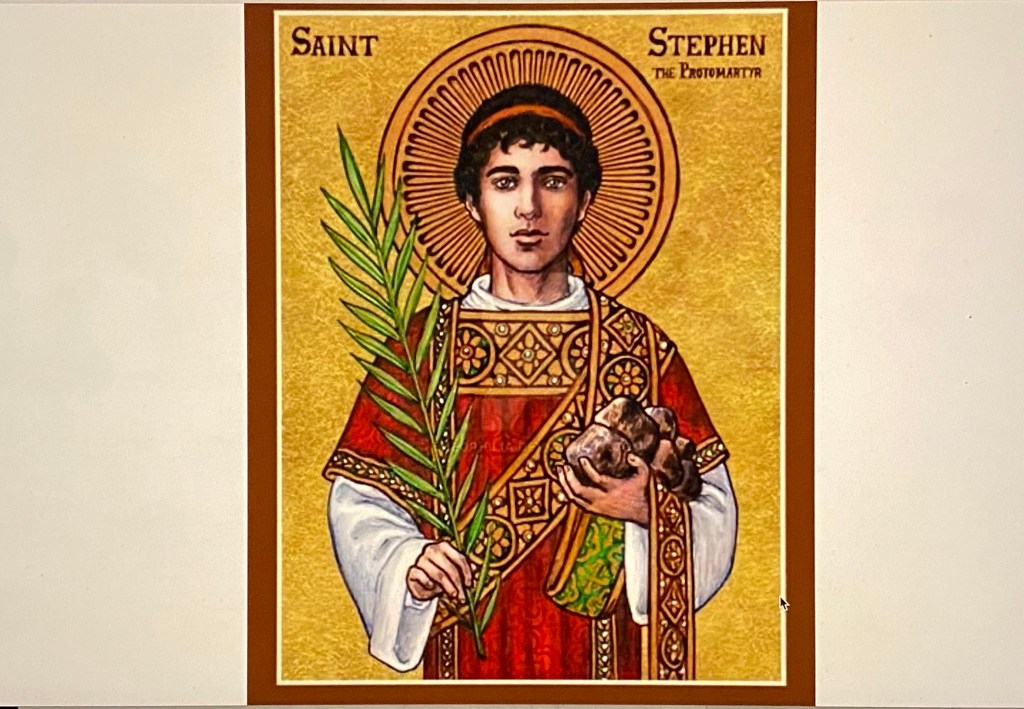
When we trust in the will of God and persevere, we will be saved.
“You will be hated by all because of my name, but whoever endures to the end will be saved” (Mt 10:22).
Why are we talking about being hated the day after Christmas? One reason could be that Jesus, this baby whose birth we just celebrated is “the light that shines in the darkness” (Jn 1:5). The very reality of Jesus is that he is the light that exposes darkness, he is the very embodiment of Love that exposes evil and hatred.
St. Stephen, whose feast we celebrate today, and whose death we read about in the first reading from Acts, experiences his words personally. For he is killed for the sole purpose of speaking the Gospel. While during his persecution he sees and communicates how even the heavens open for him. The reaction to those who hear his words are infuriation and they then throw him out of the city and “stone him” (cf. Acts 7:54-59).
Stephen radiated the light, love, and wisdom of Jesus and like Jesus he was put to death. His persecutors felt threatened by the light instead of welcomed to let go of the darkness that held them bound. Jesus exposes the truth of those dark places within our own hearts, minds, and the very depth of our being as well. What is our response? Will we also reject the light, not aware that it is an invitation to healing and to wholeness?
We may wince at the luminous brightness of Jesus’ light and resist the intimacy of the love he seeks to share. We may unconsciously do so, because we have so often faced so much of the opposite; hurt, pain, betrayal, and lack of understanding or acceptance, that we assume a defensive crouch is best to protect our false sense of self, when in fact that is just what we are invited to let go of. As time passes and we keep to the shadows, we risk becoming ingrained in our fear and pride and our posture of protecting our ego.
Yet, to be fully alive, we need to embrace the light, not hide from it. When we are open to the healing touch of Jesus and receive the gift of his light in our lives, we begin to die to our false self and the lies that we have believed. Allowing ourselves to breathe and rest in God’s loving presence helps us to heal, indentify, and allow Jesus to transform our vice to virtue. Once we allow ourselves to be loved by Jesus, we begin to recognize that we are turned in upon ourselves, and then we can adjust our posture and begin to open ourselves to him. We also begin to recognize that we are not the center of the universe.
As we follow the model of John the Baptist, St. Stephen, the other saints, we become less so that Jesus becomes more in our lives. We too will face the same rejection that Jesus faced. We will be labeled crazy, out of step, simple-minded, irrational, and worse. Yet we are to resist returning to a defensive posture, to refuse to react in kind, but instead, to be present, call upon and trust in the Holy Spirit to give us the words to speak, and allow God to happen. We are to remain open, accepting of the person where they are and as they are, and share the same transformative mercy, love, and forgiveness of Jesus that we have received from our attacker.
Change, maturation, and growth are not easy. As disciples, we are to be disciplined and persevere, while at the same time remember that our redemption does not come from our own doing or willing it to be so on our efforts alone. Our healing, restoration, and transformation come first and foremost from a willingness to accept the invitation to experience a deepening of our relationship with Jesus. When we accept his invitation to walk with him, and trust him, we will receive the healing salve of his love, mercy, and forgiveness. We will then heal from and let go of our biases, prejudices, hatred, and selfishness.
Transformation is not a one-time event. Christmas is not just a day, it is not just a season. Christmas is a time when we can recommit to allowing Jesus to enter into and to transform our lives each and every day, each and every moment, with each and every decision. When we are tempted in any way, let us call on the name of Jesus, trust in him, take a few deep breaths, and we will better be able to resist that which seeks to divert us.
In becoming human, Jesus lived showing us that this life was not all there is. The fullness of our lives are to be lived in and for God his Father. When we, like, Jesus, Stephen, and the saints, trust and obey God’s will, no matter where that will lead, we will be transformed, whole, and more alive than we can ever imagine, in this life and the next.
————————————————————————–
Photo: St Stephen the Protomartyr – icon by Theophili Saint Stephen, pray for us!
Link for today’s Mass readings for Thursday, December 26, 2024

“And the Word became flesh and made his dwelling among us” (Jn 1:14).
If there are ever words to meditate and ponder upon these are them! The danger is becoming complacent or indifferent to the reality that they present, or to the idea that this is just any other day that we just endure, get through, and go on to the next day. Instead, may we embrace the promise and invitation they convey to us as individuals, as a people, and for all of creation.
The Word, Logos, in the Greek, who was, who is, and who always will be, the Second Person of the Holy Trinity, has become one with us. We are the minutest of minutest speck of specks present in the whole of the cosmos. And yet, we have been graced by the presence of God who became man for each and every one of us, each individual person, so we can be one with him. He became human that we might become divine through our participation in his life.
The Mystery we celebrate today is that God took on flesh, becoming fully human, while at the same time, remaining fully divine. He did not just appear to be a man for a time and cast off his humanity like a worn cloak. The Son of God was conceived in the womb of Mary, developed as you and I did, and when born let out a gasp and a cry indicating that the Savior was born to us. Joseph and Mary gazed in wonder at the gift of their Son, the gift of the Incarnation for the whole world.
Christmas Day is the celebration of new life. Not just the birth of any baby, but through his coming into the world, a new beginning for humanity and creation. We do not just celebrate the baby who would become a great teacher and moral template, but the coming of our Savior. Jesus – his name meaning, one who saves – is the reality and the hope that we may be, just as the ancestors of Jesus we can read about in the genealogy of Matthew (see Mt 1:1-25)wounded and even a bit broken, but not undone, not unmade, not destroyed but saved from our faults, fears, sins, traumas and our slavery to sin. God’s grace is greater than our suffering, wounds, our worst mistakes, misjudgments, and most grievous faults.
Though darkness may appear to reign with ongoing wars, violence, political and racial division, injustice, and the unfortunate long and unseemly endless list of disharmony; no matter what we may be struggling with: the anxiety and stresses of daily life, this season, mounting bills, the concern of a medical condition for ourself or a loved one, doubts and fears, or that this will be the first, fifth, or tenth Christmas that we no longer have our loved one(s) by our side, darkness has not won.
No matter what personal challenges we may be facing, today we celebrate that “A light shines in the darkness and the darkness did not overcome it” (Jn 1:5). This is a day to breathe, to experience hope, a peace that surpasses all understanding, and to rejoice, to reconcile. A day to recommit to the light, to the baby who would later call himself, “the way, and the truth, and the life” (cf. Jn 14:6).
Let us renounce and repent from anything that is not of God so that we can embrace this baby wrapped in swaddling clothes, that also died and was wrapped in a shroud; the baby who was born in a cave because there was no room for him and no willingness from anyone to let him in, that would also be laid in a tomb after dying for us; and the baby who was placed in a manger, a feeding trough for animals, because he would also become the Bread of Life that we may feed on him and have life eternal.
This baby came to help us to actualize the truth and realization that: “We cannot save ourselves. We can only open ourselves to the hope that comes to us from without, from others, ultimately from one Other” (Lohfink 2014, 255). The One other whose birth we celebrate today: “The Light of the human race” (Jn 1:4).
Merry Christmas and may God bless you and all you hold close to your heart!
Painting: Adoration of the Shepherds by Gerard van Honthorst
Lohfink, Gerhard. No Irrelevant Jesus: On Jesus and the Church Today. Collegeville, MN: Liturgical Press, 2014.
Link for Christmas, Mass of the Day, Wednesday, December 25, 2024

May we receive God’s light and love, so to dispel any darkness, and walk in his peace.
“In the tender compassion of our God, the dawn from on high shall break upon us, to shine on those who dwell in darkness and the shadow of death, and to guide our feet into the way of peace” (cf Luke 1:78-79).
This promise of the Holy Spirit is spoken by the father of John the Baptist, Zechariah, as his ability to speak has returned to him after he confirmed that his son, as Elizabeth stated was to be called John. This evening at the Christmas Vigil we will begin to celebrate whaat we have been preparing all Advent to celebrate – the fulfillment of those beautiful words. The fulfillment of the promise made to Abraham, Isaac, Jacob, the Judges, David, and the Prophets. We will celebrate that the Son of God is Emmanuel, God with us. He is the fulfillment of the promises preserved in the Old Testament and he is to be a light to the nations.
The words of Luke were as relevant to those he wrote to in his day as they are to us as well in our day. God’s tender compassion has surrounded us and has been a part of us since before our conception. He knows the number of hairs on our head and he knows each one of us by name. Totally transcendent, infinite beyond our beyond our wildest imagination, comprehension, beyond all space and time, while at the same time, God knows each one of us more intimately than we know ourselves. He cares for us, guides us, and invites us to experience his joy and the fulfillment of who he has created us to be.
The ultimate love that God expresses is that he invites us to be in relationship with him and we are given the choice to say “no” or “yes”. He gives us the freedom to choose anything but him. Some would say, he should just make us follow him. That would not be love, but oppression and tyranny. The invitation to receive the light of God is a gentle one, and when we say “yes”, he enters our life and begins to heal and transform us from within to the level and pace we are willing to accept. The choice remains, we can recede back into the darkness or continue to walk into his brilliant light.
When we accept the invitation of relationship and follow God’s guidance we will better be able to identify the darkness and the lies of the enemy that cloud our discernment and keep us from experiencing the fullness of his grace. Choosing to allow the light to dawn in every aspect of our being, our wounds, our prejudices, our defense mechanisms, our false comforts, all those areas where we deny the truth or where we are supporting false realities or apparent goods, will help us to let go of unhealthy attachments so that we will be free to receive his light and love.
May we continue to repent and prepare our hearts and minds as we celebrate the gift of the incarnation one more time. Let us, “who dwell in darkness and the shadow of death,” not hide or withdraw from God’s invitation, and instead walk into the “dawn from on high,” so that God may “guide our feet into the way of peace.” The closer we are to God, the more we experience his love and his peace, that peace that surpasses all understanding, and having received, then we are better able to share his love, light, and peace with others each day of the Christmas season and into the new year.
Photo: Morning Rosary walk experiencing the dawn from on high at the end of a winter retreat back in January, 2023.
Link for the Mass readings for Tuesday, December 24, 2024

“Blessed are you who believe.”
If you attend Mass daily or pray with the daily Mass readings, you may wonder, “Didn’t I just hear or read this account?” You would be correct, as this was the same Gospel reading as Saturday morning’s daily Mass. The difference comes in with the other readings.
The first reading from Micah may seem a bit obscure and we might be moved to question what does this have to do with getting ready for the coming of Jesus? Bethlehem would be our first clue. Bethlehem is the city of the birth of David. Micah shared that, “from you shall come forth for me one who is to be ruler in Israel; whose origin is from of old, from ancient times” (Micah 5:1). Micah is prophesying that the messiah will be no mere shadow of David, nor a mighty judge like Samson. This one has his origins “from of old”, beyond time. This messiah will be God with us. Both Matthew and Luke pick up on this in their nativity accounts (Matthew 2:1-2 and Luke 2:4-20) that we will read on Christmas.
So what about Ephrathah? Jews from the time of Jacob until those practicing today would pick up the reference to Ephrathah right away as being the burial place of Rachel the mother of Joseph and Benjamin, and beloved wife of Jacob. Though not the birth mother of the twelve sons of Jacob, Rachel was considered the matriarch, the mother of Israel. Jacob’s name, after wrestling with the Lord all night, was changed to Israel.
Echoes of Rachel being the mother of Israel also arose from the prophet Jeremiah when he wrote of her by name as weeping over her the fall of Jerusalem at the hands of the Babylonians. And yet, God sends comforting words through the prophet: “There is hope for your future – oracle of the LORD – your children shall return to your own territory” (Jeremiah 31:15-17).
We can see with the early Church Fathers that David was the premier king of Israel while at the same time he was foreshadowing Jesus the one “from of old” as Micah predicted. Rachel is a foreshadowing of Mary, the mother of Jesus, the mother of the Twelve Apostles, the fulfillment of the gathering in of the lost twelve tribes of Israel and the mother of the Church. She, like Rachel, would also suffer at the death of her children, but also be the intercessor for them through her suffering.
Mary is the new Rachel and also the new Eve because Mary’s obedience unties the knots of Eve’s disobedience. As we learned in the second reading to the Hebrews, God has no pleasure in sacrifice but takes pleasure in those doing his will. God delights not sacrifice but obedience. Mary, before becoming the mother of the Messiah, the mother of God, was obedient with her “yes” at the Annunciation. As Jesus said, the one who does the will of his Father was his mother (cf. Matthew 12:46-50). Who followed the will of the Father better than Mary?
Very soon after her “yes”, and the conception of Jesus in her womb, Mary went in haste to see Elizabeth. Each celebrating the gift of new life in each of their wombs. And how is Mary greeted by her elder cousin? With reverence, which was unheard of. The youth revered the elder family members during Jesus’ time. After hearing the words of Mary’s greeting, experiencing her son leaping in her womb, Elizabeth is moved by the Holy Spirit to proclaim blessing upon Mary: “Blessed are you among women and blessed is the fruit of your womb” (Luke 1:42). Elizabeth does so with great joy, “crying out in a loud voice.”
May Elizabeth and Mary’s joy reach into the depths of our souls. May we be open to believe.
May we believe that Jesus is the Son of God who became man. That Jesus came into the world not just to be a great rabbi and teacher, not just to perform miracles and cast out demons, nor just to be the messiah, that Jesus came not just to live, but that he came to die, to give his life for us, and in so doing become our savior. This birth we are about to celebrate was just a foreshadowing of his impending death.
As Bishop Fulton Sheen wrote, “He was laid in a stranger’s stable at the beginning, and a stranger’s grave at the end… He was wrapped in swaddling bands in His birthplace, He was again laid in swaddling clothes in His tomb… It was not so much that His Birth cast a shadow on His life, and thus led to his death; it was rather that the Cross was there from the beginning, and cast its shadow backward to his birth…” (The Life of Christ).
Jesus, as the fulfillment of the law and the prophets, is inviting us in these final days of Advent to do as he, Mary, and Elizabeth did, to follow the will of his Father. What joy we too will experience when we open ourselves up to the reality of the gift that God has given us, his Son, and so rejoice with Elizabeth and Mary that we too have a part to play in salvation history!
Photo: May these words and picture help you to experience some quiet time to pray and ponder about the connection between the birth and death of Jesus and the life he has called us to live.
Source for Bishop Sheen quote and background information from Dr. Brant Pitre, Mass Readings Explained, The Fourth Sunday of Advent Year C, Christmas and the Cross
Link for the Mass readings for Sunday, December 22, 2024

When struggling with impatience, let us remain faithful and trust in God’s will.
The Gospel of Luke and today’s first reading from the Book of Judges both continue the theme of divine intervention through angelic messengers and the message they convey is new life. The wife of Manoah, not named, and Zechariah, the husband of Elizabeth, both receive the message of an impending birth. The miraculous claim here is that both women are beyond child bearing age.
For women of ancient Israel, this was a tremendous cause for shame; for many women, their worth was defined by their ability to bear children. This was in evidence in the words of Elizabeth. When she was aware she had conceived she said, “So has the Lord done for me at a time when he has seen fit to take away my disgrace before others.” (Lk 1:25). Her shame and anguish, her long period of barrenness, was coming to an end.
Many women today feel similar anguish and shame in that they desire to have a child and are not able to. There are many reasons this may be, but there may also be a plan that God has in place that is not readily apparent at the time. One may be God’s timing, for Mary it was too soon! For Manoah’s wife and Elizabeth it was about time! But in each case God had his plan and timing in mind. For some women there may be another way of serving other than being a birth mother.
Adoption or foster parenting of children who are in desperate need of safe, stable homes are direct options. Some more indirect ways could be assisting in caring for nieces and nephews, cousins, teaching catechesis or working with youth groups. Other ways to serve could be through more time consuming active ministries, vocations, or jobs. There can also be underlying medical conditions as well as the stress of trying too hard. I know of two occasions where when each couple adopted, shortly thereafter both couples were blessed to conceive a child. I cannot imagine wanting to give birth to my own child and not be able to do so, nor can I imagine the inner anguish that may cause. I do believe God has a plan for each of us and when we align ourselves with his will we will truly be happy and fulfilled.
Advent is a time of waiting and anticipation. There are periods of waiting in all of our lives and we can certainly feel impatient with God and ourselves. We have certain expectations, intentions, and plans that we would like to see fulfilled, but often are not capable of seeing far enough down the road to notice if those plans are apparent or actual goods. The light at the end of a tunnel could actually be a train!
When we remain faithful like Manoah’s wife, Elizabeth, and Mary, and resist the temptation to go off on our own, while seeking to understand God’s will, we will find fulfillment and joy. Each of us are called to bear Christ to a worn and weary world desperately in need of new life! We will also enjoy the time of waiting more when we are trusting that God is preparing us for what we seek or something even greater than we can ever imagine!
———————————————————————–
Photo: God will give us enough light to see a few steps ahead. When we walk those steps, he will offer some more light for the next few.
Link for the Mass readings for Thursday, December 19, 2024
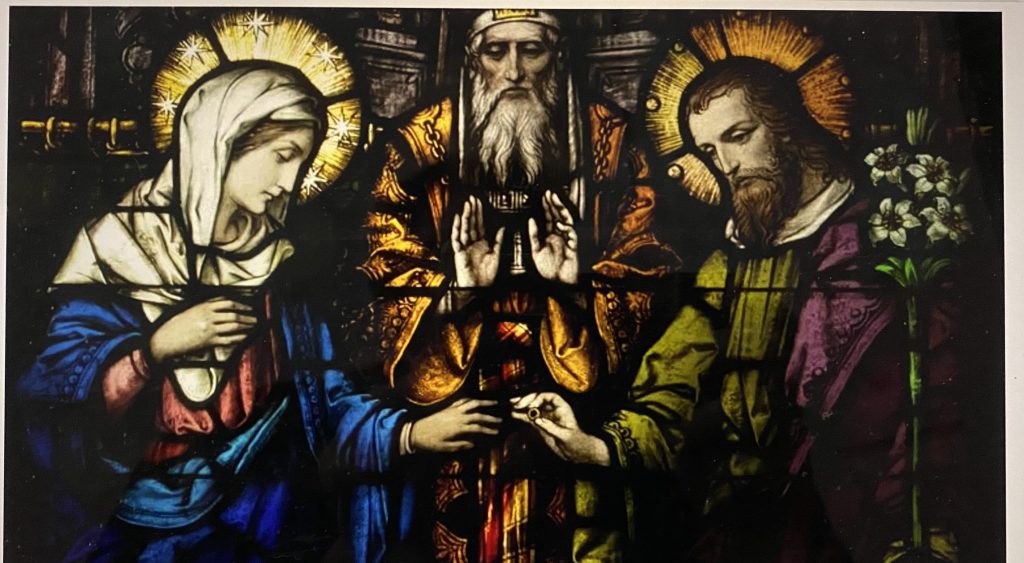
Mary and Joseph, a yes to God and a yes to life.
Joseph heard the news that Mary, his betrothed, was with child. He clearly knew the child was not biologically his. Scripture does not account for the thoughts or emotions of Joseph, but whatever inner turmoil he did have, he came to a decision that would not expose Mary to shame. He was not going to make a public spectacle of Mary, but instead decided to divorce her quietly. Before he made his final decision though, Joseph made an excellent choice regarding the discernment of serious matters. He slept on the idea before acting.
During Joseph’s sleep, the angel of the Lord delivered a message. “Joseph, son of David, do not be afraid to take Mary your wife into your home. For it is through the Holy Spirit that this child has been conceived in her. She will bear a son and you are to name him Jesus, because he will save his people from their sins” (Mt 1:20-21). When Joseph awoke, he did as the angel of the Lord had commanded him and took his wife into his home (Mt 1:24).
From their encounter with God’s messengers, both Mary and Joseph trusted in God’s will, and “that has made all the difference” to quote Robert Frost’s poem, “The Road Not Taken.” Because of Mary and Joseph’s “yes” to God and to family, the Son of God became man and opened up heaven for us in the humanity he assumed.
God often works in the same way when dealing with us. What may appear to be absurd, unimaginable, or downright impossible, is indeed possible when we align our will with God’s will. This is the week of Joy in Advent.
The source of joy does not come from external experiences but from an encounter with and acceptance of God’s invitation. Joy is an experience of communion with the love of God. This has been given to us in greater measure because Jesus became one with us, and so upon his ascension into heaven, we too can experience the loving communion he experiences with his Father. We also experience the love of the Holy Spirit in our encounter with family and friends, this exchange of giving and receiving of ourselves in conversation, shared experiences, and in resolving challenges and conflicts together.
Mary and Joseph both received incredible news, that neither of them fully comprehended. They could have easily responded in a different way. Instead, they trusted in God, they chose family, and because they did, we can rejoice not just during this week but as we heard from the past Sunday from Paul, we are to rejoice always!
Mary and Joseph followed God’s lead and were willing to allow their unborn child, Jesus, to come to full term. Because they were willing to risk public ridicule and worse, Jesus entered into our human condition. There may be a difficult situation we are dealing with, we may feel we are on our own, and that there is no way out, and/or no help on the horizon. God will make a way and reveal it to us through his Son. We may not understand either, but like Mary and Joseph, let us trust in God, one another, and experience that we are not alone.
Jesus, Mary, and Joseph, please intercede on our behalf this Advent Season such that we may better be able to resist the temptation of taking each of our family members for granted, but instead choose to be appreciative and thankful for one another. Help us to react less and breathe deeply more. Help us to be more understanding, patient, and willing to forgive, such that even though we have experienced past hurts, conflicts, disagreements, and different points of view, we may ultimately experience time and again the joy of being there for one another, through thick and thin.
Photo: Stained glass window of the betrothal of Joseph and Mary, from the Church of the Immaculate Conception in Connellsville, PA by Nancy Bauer.
Link for the Mass readings for Wednesday, December 18, 2024

A few moments of stillness can transform our days and lives.
Today’s Gospel account is from Matthew’s record of the genealogy of Jesus. Jesus, the Son of God, is fully divine, while at the same time he is also fully human. Here Matthew presents the lineage of Jesus’ human line from Abraham to his father Joseph (foster father, in that Joseph was not Jesus’ biological dad, but no one would not have made that distinction in Jesus’ time.) and his mother Mary.
Jesus was part of a people and a family, he was born at a particular time and in a particular place. If you go through this genealogy with a fine-tooth comb, there are gaps, but Matthew was more concerned with the line of faith than a strict historical account. Matthew also included women in this listing, which was not common in ancient patriarchal societies. Looking at their stories in Scripture will also show that they were not at all the most morally upright, but more importantly, each played a significant part in God’s plan of salvation.
As Catholics and Christians, this is our heritage as well. We are spiritual Semites. Genealogies have become more popular in recent years as can be seen by the different advertisements for DNA test kits. There is a natural instinct to reach out for these because we want to belong and to be a part of. To understand who we are, we seek to understand where we have come from. To be able to go forward, we need to reach behind. Jesus was to the people of Judah, and is a part of the succession from Abraham and his clan, to the twelve tribes of Jacob, to the unified nation of Israel under David.
Joseph is heir to the thrown in this line of succession that was thought to have been lost when Jerusalem was conquered by the Babylonians. When Joseph died, Jesus was next in line. Jesus will lead like no other before him or that will ever come again. Jesus brought God’s movement of grace beyond the nation of Israel to fulfill the promise that they be a light to the nations, a universal invitation for all.
Through our Baptism, we become part of that lineage of Jesus. No blood test needed. We are not alone, no longer estranged, no longer separate, or on the peripheries. We belong to the Body of Christ. Yet many, even those who profess their belief in Christ, are missing his greatest gift of faith, which is developing a relationship with him now. Let us not be complacent and settle for Christian in name only or walk away from our birthright.
In these final days of Advent, as we draw closer to the celebration of Christmas, may we also set aside a little more time to spend with Jesus. If our schedule is revving up, may we bring Jesus into our busy. The second Person of the Trinity was willing to draw close to us in the incarnation that we are about to celebrate. Even if there is not a lot of time in our days, let us periodically take a few conscious, deep and slow breaths at some key moments so that we may draw close to Jesus who is at hand. This can be as simple as taking three slow, deep breaths – one for each person of the Trinity.
Just those short moments can be a powerful reset because even in that little turning of our hearts and minds to God, we can rest in the loving gaze that Jesus wants to share with us. We can receive his love and invite him to walk with us in all that we do. We can yoke ourselves to Jesus so that we do not travel these days alone, because he is more than willing to share our burdens, and he will give us to strength to carry on.
We are never alone if we remember Jesus is present in our everyday experiences. We just need to remember to turn to him. In so doing, each breath will bring our shoulders out of our ears, we will react less, and experience greater clarity in the choices and decisions we make. Practicing in this way, we will have more joy in our being loved by God, so that we can have more joy in our doing.
Photo: Brief stop during Rosary walk outside our church here at Holy Cross. Praying we will be able to return by Easter!
Link for the Mass readings for Tuesday, December 17, 2024

 Spiritual Stepping Stones