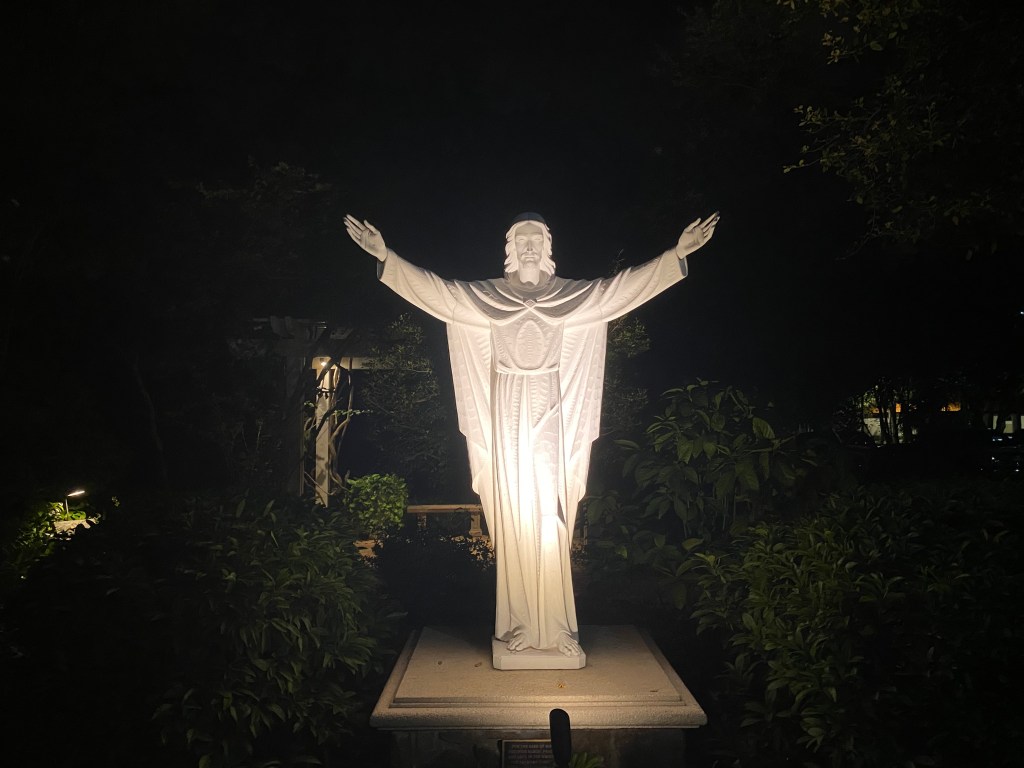
The Divine Physician is inviting us to experience forgiveness, healing, and his love.

Think about how good we feel after coming to be on the other side of healing from a bad cold or the flu, recovering from a twisted ankle, a broken collar bone, or other health conditions. We experience a feeling of wholeness that was missing during the midst of our suffering where we may have pondered a time or two whether we would ever get better.

The same can be said for estranged relationships. The distance of separation can be agonizing, an inner gut-wrenching experience that gnaws away at us. We wonder if there can ever be a coming back together. Then when reconciliation, forgiveness, and amending of the brokenness of relationships does happen, we can experience such a relief, lightness and joy, that we never imagined possible while in the midst of the gut wrenching angst, conflict, and separation.

Sin separates us from one another, and unchecked sin can build and multiply like cancerous cells. The Pharisees and the scribes questioned why Jesus was eating with tax collectors and sinners, and Jesus replied: “Those who are healthy do not need a physician, but the sick do. I have not come to call the righteous to repentance but sinners” (Lk 5:32).

Jesus is truly a light in the darkness. For Levi and his friends, who just settled for the path they were on, thinking and feeling, this is the best it was going to get, were given a choice, an invitation, a new way. A great celebration of fellowship ensued in Levi’s home because these men and women, who had been outcasts, who were separated from the greater community were forgiven, welcomed, and embraced. They were loved by Jesus as they were. They did not have to change first for Jesus to call Levi and gather with them.

They were welcomed into the kingdom and reign of God. Their ticket to reconciliation and healing was accepting the invitation of Jesus, to receive and experience his love and welcome. Levi and the other sinners did not run from the light of Jesus, but were willing to recognize their need for healing, were willing to repent, to turn away from their prior ways of life and so were reborn!

They were divinized because of their willingness to participate in the life of Jesus. Levi would continue to follow Jesus such that it was no longer he who lived, but Christ who lived in him (cf. Galatians 2:20)!

Jesus invites us each day, as he invited Levi in today’s Gospel, to follow him. We are given the same invitation and opportunity for healing and for discipleship. Will we resist rationalizing and justifying our sinful thoughts, actions, and habits, welcome the light of Jesus that reveals our venial and mortal sins, and admit that we are in need of healing, and repent so as to be forgiven and released from all the energy we have expended in protecting and hiding from ourselves and our God who loves us more than we can ever mess up?

Quietly spending time daily, especially in the evening and recalling our day, by asking Jesus to reveal to us those ways in which we have not lived according to his will is a wonderful practice. Those sins we call to mind we can confess on the spot and Jesus will forgive us. As we recognize recurring actions or more serious sins, we will need a more direct human encounter by embracing the Sacrament of Reconciliation. Reconciliation is a gift of mercy and healing where we can experience firsthand the healing grace of Jesus.

Jesus loves us as we are. Yet holding on to our sin, keeps us at a distance from experiencing the greater breadth and depth of his love. We only need to be willing to be contrite, to embrace sorrow for the harm we have inflicted with our personal sins and go to the Divine Physician in our time of prayer and/or Reconciliation. Once absolved, the heavy weight is lifted, and we are healed. We are then better able to engage in penance to atone for our sins committed, better able to forgive others as we have been forgiven, and to love as we have been loved!

——————————————————————–

Photo: Rosary walk over Thanksgiving break, St. Peter Catholic Church, Jupiter, FL.

Link for the Mass readings for Saturday, February 17, 2024

May our hearts beat in time with the heart of Jesus.

Today is February 16, 2024, A.D. The letters, AD, stand not for after death or analog to digital, but Anno Domini. This is a Latin phrase that means in the year of our Lord. We are living in the age of the Church, as well as in between the time when Jesus experienced his life, suffering, death, resurrection, and ascension into heaven until he will come again.

In the Gospel of Matthew, we read today about the account of Jesus comparing himself to a bridegroom: “The days will come when the bridegroom is taken away from them, and then they will fast” (Mt 9:15). In a sense, the bridegroom has been taken from us, in another sense, he is closer to us now than he was when he was with his disciples when he walked the earth. The fullness of his reign though will not be consummated until Jesus comes again. While we wait, when we are willing to set aside other distractions and be still, we can hear and feel the beating of his Sacred Heart.

We need food for our survival, but we don’t need as much as we think we do! Fasting from food is not the only focus of our Lenten fast. The discipline of fasting provides an opportunity to keep our passions in check. By resisting the impulse of instant gratification, we better discern between apparent goods and the actual Good in our lives. When we navigate through the maze of distractions, diversions, temptations, and allurements on a physical level, we can begin to go deeper into the spiritual reality to begin to expose some of the demons and unclean spirits that we may be feeding, such as “distrust, apathy, and resignation” that Pope Francis talked about in his 2018 Ash Wednesday homily.

Pope Francis mentioned that these three demons “deaden and paralyze the soul of a believing people.” He continued by stating that: “Lent is the ideal time to unmask these and other temptations, to allow our hearts to beat once more in tune with the vibrant heart of Jesus.”

When we are willing to discipline our impulsiveness, to slow down, to take a breath, to be more aware, we can begin to see more clearly our complacency, contempt, and indifference. We can then be more open to God’s invitation to enter into a relationship with him and each other. We can then better assume the posture of John the Apostle by resting our head on the chest of Jesus (cf John 13:25), such that our hearts will beat in the same rhythm as his Sacred Heart.

This is the gift of contemplation that drives us to service. This is the same rhythm that beat in the prophet Isaiah who reminds us in today’s first reading what true fasting is all about:  “releasing those bound unjustly, untying the thongs of the yoke; Setting free the oppressed, breaking every yoke; Sharing your bread with the hungry, sheltering the oppressed and the homeless; Clothing the naked when you see them, and not turning your back on your own” (Isaiah 58:6-7).

————————————————————————

Photo: Mosaic of Sacred Heart of Jesus, Sacred Heart Hall, St. Vincent de Paul Regional Seminary, Boynton Beach, FL.

Link for Pope Francis homily:
https://aleteia.org/2018/02/14/pope-francis-offers-a-worksheet-for-lent-check-it-out/

Link for the Mass readings for Friday, February 16, 2024

Let us not be corrupted by the leaven of the enemy but be nourished by the water of life.

Today’s account from the Gospel of Mark is a continuation of what we read yesterday when Jesus convicted the Pharisees for demanding a sign. He recognized their hardness of heart and hypocrisy and with the opportunity of being together in the boat, Jesus seized on this encounter as a teachable moment. He wanted to warn those of his inner circle to be aware not to follow the same path of corruption when he enjoined them: “Watch out, guard against the leaven of the Pharisees and the leaven of Herod” (Mk 8:15).

The disciples missed the point as they focused on the literal reality that they only had one loaf of bread among them. Jesus’ intent was to warn his followers about the danger of pride, seeking honor, power, and fame which had lead many of the Pharisees and Herod astray. To be his followers, striving to place themselves first would be not only the undoing of each of them but also this posture would undermine those they would be charged to care for.

Unfortunately, too many have not heeded this lesson that Jesus offered in today’s Gospel regarding being aware of the corrupting leaven of many of the Pharisees and Herod. Just as the effects of original sin has wounded humanity, so it has also affected those in the Church. Throughout the ages, clergy and laity alike have succumbed to the temptations of placing the focus first on our needs and on ourselves instead of God first and loving and serving others as he loves us.

Yet throughout the worst corruption and abuse throughout the generations, the Church is still here. God continues to work through many who are faithful to his invitation and follow his will in simple ways, living lives of quiet service. It is unfortunate that there are those who leave because they see hypocrisy, injustice, abuse, and corruption. For it is those of us with eyes to see and ears to hear that need to stay and continue to be true to the teachings of Jesus in our daily lives. Frustrations will arise for we are all imperfect and fall short of the glory of God, yet we must remain persistent as James mentioned in our first reading.

At the same time, we need to be aware of the sinful leaven that would seek to undo each of us. It is easy to point fingers outward. God does not tempt us, but in respecting our free will, he does allow us to be tempted. May we resist the temptations of the enemy, seek nourishment in the Eucharist, to live simple and holy lives, while seeking to be aware of the needs of others, and work to serve, protect, and empower the dignity of those in our midst each day. We need to remember to lean on Jesus to give us the strength and clarity on how best to help to heal his wounded Body.

——————————————————

Photo: Like a tree planted near fresh water, may our roots reach out to be nourished by Jesus, the water of life. Rosary walk, St. Vincent De Paul Regional Seminary, Boynton Beach, FL.

Link for the Mass readings for Tuesday, February 13, 20214

Sign or trust?

“Give me a sign!”

Often, when we ask for a sign, we have a preconceived notion of what we are seeking, and we want God’s stamp of approval on it. The impetus is coming from us, seeking to bend the will of God to our will. More often than not this approach will end in frustration. The Pharisees in today’s account are asking for a sign. Jesus has already been preaching with authority, healing, casting out unclean spirits and demons, encountering the unclean and restoring them to the community and right worship, and this is not enough?

We can understand how: He sighed from the depth of his spirit and said, “Why does this generation seek a sign? Amen, I say to you, no sign will be given to this generation”(Mk 8:12). The majority of the Pharisee’s minds were set. Jesus knew there was nothing he could say or do to prove to them he was who he said he was; the kingdom of God at hand. If they had not the eyes to see and the ears to hear there was no argument, point, or sign that would have changed their minds. Jesus sighed from the depths of his spirit because their hearts were hardened such that they closed themselves off from the gift of the grace he sought to share. He then got into the boat to go to the other shore, to share his message with others: “This is the time of fulfillment. The kingdom of heaven is at hand. Repent and believe in the gospel” (Mk 1:15).

The question for us today is, do we believe, do we really believe, that Jesus is who he says he is; do we believe that Jesus is “the way, the truth, and the life” (Jn 14:6)? Do we seek to bend God’s will to our own will or seek to align our will with his? The woman with the hemorrhage for twelve years, the woman whose daughter was possessed, the friends with the man with the withered hand, and the leper, did not ask for a sign, they asked for a healing. They trusted, believed, and risked getting closer to Jesus so as to encounter him despite the barriers in place to prevent them. In each of these cases, Jesus recognized their faith, and each received the healing they sought.

In our discernment, we need to be aware of our intent. There is a subtle distinction, but it is important. Are we seeking proof, a sign, or are we willing to surrender, believe, and seek to understand God’s will, as Mary did when she asked, “How can this be” (Lk 1:34)? Are we demanding proof, a three-point plan from God before we follow his lead, or do we trust his invitation, and seek to understand how he wants us to act, knowing that he will reveal what we need to do each step of the way? Often, if we knew the end result and full ramifications of his original request, our doubt would crush our spirit before we even started.

Let us embrace a posture of faith seeking understanding today, trust in Jesus, and seek to align our will with our loving God and Father. May we make time to be still and enter a place of prayer and to open our hearts and minds to the leading of the Holy Spirit. May we with confidence, say in the words of Mary, “May it be done to me according to your word” (Lk 1:38), then arise, grasp the hand of her Son, Jesus, and face head-on that which is before us, to accomplish what he calls us to do, knowing that with Jesus, we can overcome any obstacle that is placed before us.

————————————————————————————–

Photo: God sharing a sign is different than us demanding one! Evening Rosary walk back in September, St. Vincent de Paul Regional Seminary, Boynton Beach, FL.

Link for the Mass readings for Monday, February 12, 2024

When we are willing to allow Jesus to come close and touch us we too are healed.

Moved with pity, he stretched out his hand, touched him, and said to him, “I do will it. Be made clean” (Mk 1:41). Jesus felt compassion when he heard the plea of the leper. He went out from himself and did the unthinkable in his time and place and touched the leper. Jesus saw not a leper, not someone unclean, not someone to stay away from, but a brother. Jesus met the person before him and in an act of love gave him what he had not experienced in who knows how long, human touch. In so doing, he brought this man back to life. Being a leper meant his was isolated from family, friends, and worship. Now healed he could return from his exile.

When is the last time we have been moved with pity, with compassion, to suffer with and feel the pain of another? In so many ways, we too are like the leper, starving for love and affection. Even if we are not aware or willing to admit it. Too many of us are living a life of isolation and aloneness to different degrees, even among our families and friends. We are starving to be heard, to be acknowledged, to be touched, to be loved in healthy ways. It is no wonder why anxiety disorders, addictions, and unhealthy practices in many forms are on the rise.

Jesus knows and has experienced the loneliness we all feel in our hearts. He feels our distance and hunger. He seeks to draw close to us as he did with the man with leprosy who called out to him. The Son of God entered our human condition and encounters us to experience the fullness of our brokenness, lead us to experience what we want to keep distant from within ourselves, bring us to healing so we can see the promise of the fullness of who we really are and called to be. Jesus encountered people, he did not see them as others. He seeks to encounter us, each and everyone of us, personally and uniquely. He seeks to draw close, to touch, and to heal us.

He does so in a most intimate and powerful way in the Eucharist where we are able to receive and consume him. He becomes organically a part of us and we a part of him.

So transformed by our encounter, may we follow the lead of Jesus and make an effort today and each day to see each other as brothers and sisters loved by Jesus as much as he loves us. No matter who we come across may we not avert our eyes but be drawn into another’s gaze and offer at the least a smile. In that simple act, we acknowledge to that person that they do exist. As social beings, we long to be touched, and it is good that we can do so again, after coming out of the different periods of Covid that we have experienced.

We can draw close even in our hyper-sexualized culture by being models of building chaste relationships, offering expressions of healthy touch, establishing, and respecting healthy boundaries. We can draw close by resisting the temptation to talk at or over one another, seeking to fix one each other, and instead listen, understand, and hear another share their pain and be willing to accompany each other through our struggles, as well as share in our joys. We can seek to forgive and be forgiven.

We can only do so in a healthy way when we allow God to draw close to us and develop our relationship with him. Through the experience his healing touch and the love of the Holy Spirit we can heal from our wounds and so heal our present relationships and build new, and healthy ones. By taking the risk of drawing close as Jesus did and continues to do, we can begin to encounter one another, really see each other, heal, and build up the wounded Body of Christ in our midst.


Photo: Rosary walk, St. Vincent De Paul Regional Seminary, Boynton Beach, FL. Contemplating heaven and earth.

Link for the Mass readings for Sunday, February 11, 2024

Any willingness to share, Jesus will multiply.

As Christians we are called to be disciples of Jesus, to learn his teachings, and follow his ways. We are also called to be apostles in that we are to go out, proclaim, and share that he is who he said he is, and how he has affected our lives. Often when we are reminded of this message though, we may feel inadequate. We may question what it is that we can even possibly offer to help build up the kingdom of God. We may feel we have nothing to share, nothing to give, nothing to say, or that what the Lord asks of us, we do not know how to accomplish.

The disciples express similar feelings today for the latter point. Jesus shows concern for the thousands who had just listened to him for three days and are readying to depart. He is concerned that they are hungry and that some may collapse on their way home. The disciples look about bewildered as to how they could possibly feed the vast crowd. Then Jesus asked, “How many loaves do you have” (Mk 8:5)? They responded that they had seven loaves and two fish. Jesus would go on to feed, not only the whole multitude gathered, but when all ate their fill, seven baskets of bread fragments were left over.

We may not know how to take active steps to live our faith out in our daily lives, we may not even be aware of how to begin. On the other hand, we may have actually been engaged in service, but have started to coast, gotten complacent. If we are not moving ahead in the spiritual life, we are moving behind.

Each day is a new opportunity to begin again, and a good way to do so is to place ourselves in the presence of Jesus. We can sit before a statue, a picture, or an icon of him, we can look out a window, sit on a porch, or go outside. Any place that we can just be still and close our eyes will work. Then take some deep breaths, be silent and return to today’s Gospel account. The need of the people that were with Jesus for three days was hunger. As you reflect, what is your need? What needs might there be in your family, friends, neighbors, colleagues, or classmates? What needs in your community?

As you ponder these questions, resist any temptation to self-censor. Allow any need or needs to arise. Once you identify a concern, listen to the same words Jesus asked, “What do you have, what can you offer?”

You may not have an immediate answer. Stay with the question for a period of time, take it with you throughout the day if need be. Resist looking for the big response, a grand plan. Ask yourself what you can offer, no matter how small. Your willingness to share and to help, Jesus can multiply and bring about amazing results.

The disciples only gave seven loaves and two fish, which seemed insignificant to feed the thousands, and yet, Jesus multiplied that meager amount to feed all present with seven baskets left over. Jesus provides, Jesus works through us. The question we need to answer is not are we worthy, wise, or strong enough? The question we need to answer is, “Are we willing?”


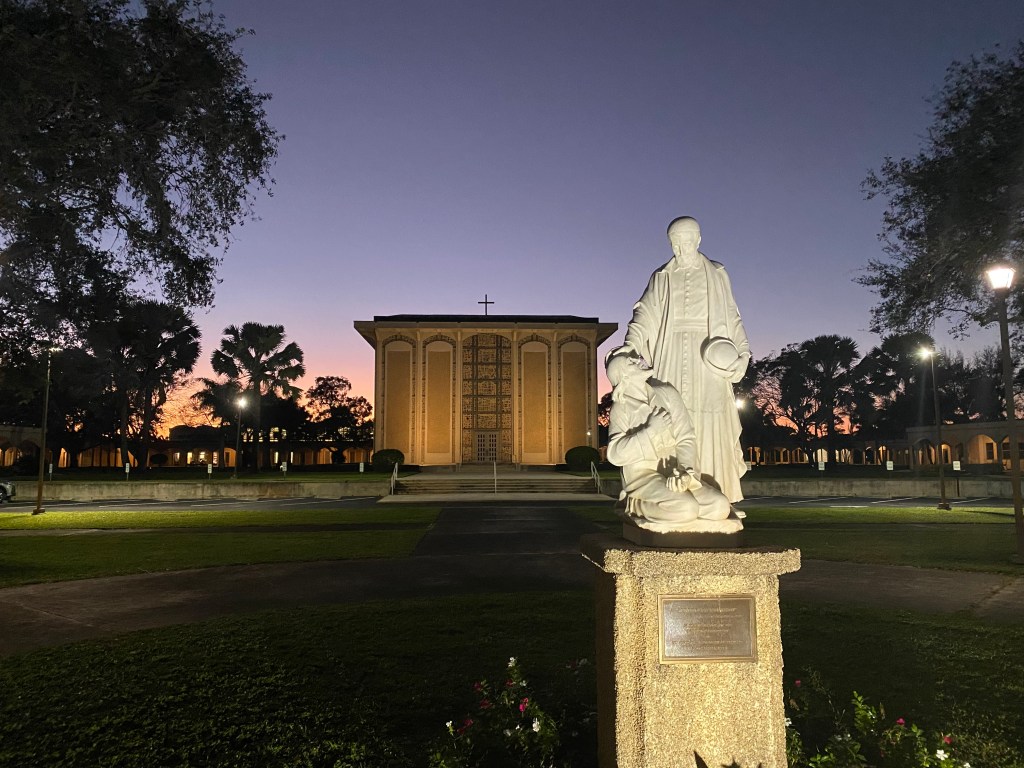
Photo: St. Vincent De Paul, our patron saint at the seminary, was willing to help and Jesus touched many through him. Entry to St. Vincent De Paul Regional Seminary, Boynton Beach, FL.

Link for the Mass readings for Saturday, February 10, 2024

Jesus invites us to listen.

Those who witnessed Jesus healing the man who was deaf with a speech impediment grasped something more than just the healing when they stated: “He has done all things well. He makes the deaf hear and the mute speak” (Mk 7:37). With these words, they were acknowledging the deliverance of Israel by the Lord, promised by the prophet Isaiah, when he mentioned how, “the eyes of the blind will be opened, the ears of the deaf will be cleared” (Isaiah 35:5).

The beauty of this healing may be missed by us in the modern age because of the graphic nature of the details used by Mark. Jesus places his fingers in the man’s ears, spits into his own hands, and then touches the man’s tongue. Jesus is mixing his own saliva with this man in need of healing. We don’t even share drinks from the same bottle anymore as we used to do when we were kids! And with what we have dealt with regarding Covid, this imagery can seem incomprehensible!

Yet, what Jesus is showing is the intimacy of communion that he offers. He gave the very essence of his own being that it would be mingled with this man. This physical teaching is an image or icon, of how the Son of God, in no way diminishing the fullness of his divinity, entered into the very real corporality of our humanity. He became one with us so that we can become one with him. This was true then and it is still true for us today!

We all suffer physical, emotional, psychological, and spiritual trials. But we also suffer from not being able to hear God’s word, and so are mute in speaking his word. Jesus, even if he does not provide a healing or an immediate solution to a trial, is present in our lives. We are invited to consciously resist the temptation of avoiding our own suffering, pain, or challenges and instead are invited to embrace and enter into them. We are not expected to do this alone, but to bring our need for healing to Jesus. In this way, we are aligning our suffering with his on the Cross. When we choose to offer up our pain and suffering on behalf of another, we participate in Jesus’ redemptive suffering. Others can experience relief and healing from our sacrifice in participation with Jesus.

This act of the will gives meaning to our suffering such that we do not endure what we are going through in vain. May we face, head-on, that which rises before us, actualizing the guidance of Jesus as well as the advances of modern medicine, science, and psychology, embracing a posture that engages both faith and reason. Our approach will be best if we are more mindful and balanced with our discernment. Just masking struggles without dealing with the root causes will only prolong and possibly worsen the condition.

Jesus invites us to step away with him and hear his healing word: “Ephphatha!” so that we too can be healed from our deafness to the needs of those around us and be open. Be open to receive his love so that we can be more present to and love one another. Jesus also wants to heal others through us. With ears more open to the voice of his Father, we become more aware of the needs of others. We can let go of our needs, our ego, and be present. One of the best gifts of healing we can offer is to really listen to and hear someone. People will experience a lot less anxiety and suffering when they feel that they have been heard and this is also one of the best ways that we can show another that we care and love them.

——————————————————————————————-

Picture: Evening Rosary walk last Fall. Time in silence helps us to listen. St. Vincent de Paul Regional Seminary, Boynton Beach, FL.

Link for the Mass reading for Friday, February 9, 2024

Model of courage and faith

In today’s encounter between Jesus and the Syrophoenician woman, we can observe again the crossing of societal norms by both the woman and Jesus. She, very much like the woman who had been hemorrhaging for twelve years, was desperate and approached Jesus. She was willing to not only risk breaking the social taboo of speaking with Jesus, but she was also willing to do so by walking into the home where Jesus was staying and fall at his feet.

Jesus’ response to her begging sounded more like he was possessed himself rather than the healer she sought out: “Let the children be fed first. For it is not right to take the food of the children and throw it to the dogs” (Mk 7:27). This woman was not fazed by Jesus calling her a dog, she wasn’t leaving without receiving healing for her daughter, even if that meant she was putting her life in danger. Her retort, “Lord, even the dogs under the table eat the children’s scraps”, emphasized this point. It was also the key that opened the door for the disciples and us to witness a consistent pattern with Jesus.

We saw the same situation with the woman who was experiencing the hemorrhage (cf. Mk 5:25-34). Both women had the faith and courage to approach Jesus and both received the healings they sought and were affirmed by Jesus. The outcome of this encounter was also like the one Jesus had with another gentile, the Roman centurion, who said that he was not worthy for Jesus to enter under his roof (cf. Matthew 8:8). In both accounts, Jesus healed solely by his word from afar. What is important to Jesus is not whether they are male or female, Jew or Gentile. What matters if the person’s faith! Do they trust in him or not?

Do we have the courage, faith, and trust in Jesus as shown by the Syrophoenician woman in today’s Gospel? When we let nothing hinder us from drawing closer to Jesus, including relinquishing the reigns of being our own masters, acknowledging that God is God and we are not, believing that Jesus is truly the Son of God, that he is still present and active in our lives, and we have no reason to be anxious or afraid, miracles still do happen! Jesus said that if we have faith, even the size of the mustard seed, we can move mountains (cf. Mt 17:20).

We don’t need a lot of faith, a mustard seed is tiny. Just that little amount of trust in Jesus is enough for God to happen! Remember the feeding of the five thousand with just a loaf of bread and a few fish! When we believe with childlike trust that Jesus will provide, he will. It may not be as immediate as with the Syrophoenician woman or it may. What is important is that we can mature and grow in our faith such that we know Jesus, trust that he loves us, wants the best for us, and that he will always be there for us. It is also important to renounce any of the mind noise that may arise to counter these truths.

No matter what we might be dealing with today, let us be inspired by the Syrophoenician woman, and bring our petitions or intentions to him. Bring any anxieties, fears, trials, and/or tribulations to him, lay our burdens at his feet, and take his hand. With Jesus all things are possible. Jesus has not nor will he ever abandon us. He cares for and loves us. Jesus the Christ, the Son of the living God is our Savior and Redeemer, is present, is the kingdom of God at hand, and will see us through step by faithful step.


Photo: Icon of Syrophoenician Woman by Br. Robert Lentz, OFM

Link for the Mass reading for Thursday, February 8, 2024

We can choose to defile and demean or understand and empower each other.

“[W]hat comes out of the man, that is what defiles him” (Mk 7:20).

Jesus offers a list in today’s gospel of what can be unleashed from within and then directed out toward others. These are examples of what defiles because, at some level, we make the decision to think about, speak, and put into action those thoughts, words, and actions.

To resist the temptation to defile ourselves and others, we can follow the lead of the writer from the letter to the Hebrews who offered a wonderful verse, which I pray each morning in my recitation of the Office: “Encourage each other daily while it is still today” (Hebrews 3:13). There are many that we will encounter or hear about each day that will do the exact opposite.

Our goal each moment is to resist spending any time or energy in supporting any thoughts, words, or actions that demean, belittle, or dehumanize. We can call those out who do so, stand up for those impoverished from these attacks who do not have a voice, but we must not succumb, engage, or in any way be lowered to the negativity unleashed. Otherwise, we become an agent in perpetuating the same vileness and poison already unleashed.

Our thoughts, words, and actions matter because we are all interconnected. Even what we ponder can be projected on our faces and directed outward without saying one word. Thoughts entertained can lead to words and actions that wound. We need to approach each moment more thoughtfully, resist reacting, and instead take some slow breaths, think, and pray about our response before we choose what to say or do. The only time our silence can be harmful is when we refuse to stand up for others when they disregard the dignity of a person.

Let us choose this day to align our thoughts, words, and actions with those of Jesus. What we think, say, and do to our brothers and sisters, we say and do to Jesus (cf. Mt 25:35-45). We resist defiling ourselves by never letting evil talk pass our lips and instead thinking, speaking, and acting in ways that empower, convict, and build up others. Our effort is strengthened when we choose to forgive any negativity hurled at us and instead meet the darkness with the light of compassion and understanding. We are not alone in our efforts when we call upon the help and strength of Jesus as we strive to become ambassadors of his transforming love.

————————————————————————————————-

Photo: We can learn a lot about loving and caring for one another from the Holy Family. St. Vincent De Paul Regional Seminary, Boynton Beach, FL.

Link for the Mass readings for Wednesday, February 7, 2024

Discipline and love can lead to freedom.

Jesus reacted to the criticism of not observing ritual washing prior to eating that was leveled at him from the Pharisees and scribes by recalling the tradition of the Prophets through the words of Isaiah: “This people honors me with their lips, but their hearts are far from me” (Mk 7:6). For Jesus, following the law for the law’s sake is an empty act. What is important is encountering God, experiencing his love and forgiveness, developing a relationship with him, being transformed by him, and restoring what has been lost from being created in his image and likeness, so as to be able to glorify him by serving others and inviting others into communion with him. Jesus challenged the hyper scrupulosity and exactitude of the rules that had nothing to do with being humble servants of God.

Just laws and practices are those that are enacted to build up and empower people through discipline and clear boundaries. They help keep us from being enslaved to our passions and sins and instead lead us to freedom for excellence, for fulfillment, and to experience a heart on fire with an ever-growing love that yearns for a relationship with God and each other, like the deer that yearns for running streams.

As with any game we play, theatrical or musical performance, there are rules and regulations, there are referees, officials, directors, and conductors to keep order. When the rules enforced encroach on the flow of the game or performance, such that they inhibit the freedom of play, the communal interplay is stunted. When there is no enforcement, the opposite happens and all devolves into chaos. When the rules are consistent, they provide the structure and boundaries that limit abuse, allow for a freedom to flourish, and all those engaged to experience the freedom to actualize their potential, and as such, there is the experience of the true, the good, and the beautiful.

The first time I saw people skate, I was enraptured. I think I was seven. My father was working on a project at our local ice rink and even though we were not there to skate, I refused to leave until he took me on the ice. It didn’t matter that the only skates to rent that fit my feet were figure skates. It didn’t matter that my first attempt was a dismal failure. What mattered was that I made it to the ice and the joy of that experience carried me as I learned the rules of balance, how to stop and what a toe pick was and was not for. Soon I had the freedom not only to skate but to join a hockey team. The freedom and joy I felt any time I skated or played hockey, I still carry with me to this day.

The Church, when we are at our best, leads love and joy of what we believe and live in our everyday lives. We don’t lead with the rules and moralizing, but instead, we share our time, presence, and the joy of our faith. We empower and support one another as we enter into the play between our finite freedom and God’s infinite freedom. We are built for a relationship with God and one another and as our relationships mature, we start to learn and share the finer points of our life of faith. We experience the meaning of why we do what we do and why certain thought patterns and actions lead us either away from or closer to God. There is a unique balance between the rules and the freedom of play.

Loving someone does not mean we allow them to do whatever they want, but in willing their good, we offer practices of discipline, invitations, options, corrections, critiques, which establish boundaries that will provide opportunities for growth, maturity, and authentic freedom and we are open to receive the same. We are going to make mistakes, I have made many. Those we let into our lives will make mistakes. The key is recognizing that we are on a journey. As we walk together, when we are willing to be patient, understanding, forgiving, and kind, we will better support and learn from one another. In this way, the boundaries, disciplines, and rules we follow are meant to set a foundation for healthy relationships and actualizing who God invites us to be; joyful, human beings that fully love and are alive!

———————————————————————————

Photo: Back on the ice over Christmas break at Bushnell Park, Hartford, CT!

Link for the Mass readings for Tuesday, February 6, 2024