Jesus cares.

Jesus is recorded, a few verses before (cf. 7:37-39) today’s Gospel,  speaking about quenching the thirst of those gathered around to listen to him. The thirst he is talking about fulfilling is spiritual thirst, that thirst which we all desire to be refreshed by, that which we have been created to receive; the thirst to belong, to be in communion, to be loved and to love in return. Jesus speaks of coming to those who thirst to be refreshed with: “Rivers of living water [that] will flow from within” (Jn 7:38). Jesus spoke of the day when he would send the Holy Spirit to well up from within the soul of each person who would follow him. All who participate in the life of Jesus would come to experience also the love shared between God the Father and God the Son, who is God the Holy Spirit.

Some who heard Jesus speaking in this way were deeply moved, they believed him to be the Prophet, others believed him to be the Messiah. Yet, there were those who could not see past their own preconceived notions. They heard his teaching, may have even been moved as well but said, “The Messiah will not come from Galilee, will he” (Jn 7:41)? Remember Nathaniel’s first reaction when Philip had told him that they had found the Messiah? Nathaniel asked if anything good could come out of Nazareth (cf. Jn 43-47). Jesus was also rejected because he was looked down upon because of his trade as a tekton, a carpenter or a day laborer.

Why the region of Galilee, the town of Nazareth itself, would be disparaged is a matter of speculation. The fact was that there were those, unlike Nathaniel, that could not see past their initial prejudices. Even though Jesus spoke and taught with authority, though as the Temple guards who were sent to arrest him said, “Never before has anyone spoken like this man” (Jn 7:46), and even when Nicodemus spoke out rationally, requesting they hear Jesus out and give him the opportunity to make his case, there were those in authority and among the people who could or would not hear Jesus. They closed themselves off to the invitation to receive the gift of the love of God. Their charge was that he was not from Bethlehem, he was not of the line of David, case closed.

Our ingrained, prejudicial attitudes and our limitations of thought can prevent us from seeing as God sees. If we are not willing to follow Jesus’ invitation to repent, will become like a stagnant pool and, as did those in today’s Gospel account from John, close ourselves off from the life giving water Jesus offers us. Many of our daily routines, habits, livelihoods, health, and very lives can be shaken in an instant with unexpected news. A catastrophic medical diagnosis, layoff, weather event, the consequences of a sinful choice crashing down. We can react out of fear and feel debilitated on one hand or with the other we can brashly deny the reality of the situation. Aristotle wrote that virtue is the means between two extremes. Courage is the means between being paralyzed with fear and excessive reckless abandon.

Another option is to surrender to and place our trust in the Jesus whom many have and still reject. I have had a few experiences with unexpected news. I have done much better when I have leaned on Jesus and trusted in him. In doing so, I have not only survived the storms I have gone through, but have become more empowered by Jesus, matured, and grew stronger. Other thougts that we can be tempted by when tragedy strikes:  Does Jesus care, why would he do this to me, or does he even exist?

The words of Pope Francis in his Ubi et Orbi message at the height of Covid are still helpful. He said that Jesus, “more than anyone, cares about us.” Jesus cares. His hand is held out before us. We can reject it or receive it, the choice is ours. Jesus is the source of living water, he is the eye in the midst of any storm, he is the light leading us through the darkness. When we choose to breathe more and react less, we will be more likely to recognize and accept the offer of Jesus’ hand as Peter did when he was sinking in the storm at sea. By taking his hand and allowing him to lead us, we will act with more prudence, be more present and mindful, and better prepared to face any challenge.

———————————————————————————-

Painting: “The Hand of God” by Yongsung Kim
Link for the Mass readings for Saturday, April 5, 2025

Let us seek to inform and not convince.

Jesus affirms who he is and whose he is in today’s Gospel of John. Despite those who do not believe that he is the Messiah, Jesus again makes his point very clear: “I did not come on my own, but the one who sent me, whom you do not know, is true. I know him, because I am from him, and he sent me” (Jn 7:28-29). Jesus is the Son of God made man and he belongs to the One who sent him, God the Father.

As Jesus was challenged in his time, he continues to be challenged today. That level of challenge has increased even to the degree that his human existence is even dismissed in some circles as a mere legend. Even as a historical figure, some speculate that Jesus did not walk the roads of Galilee and Judea as recorded in today’s Gospel. This need not be a reason for alarm. Though it is a reason to know our Tradition, the deposit of faith that has been preserved and passed on from Jesus to his Apostles and disciples, and to those early Church Fathers and Mothers named and unnamed, and passed on up to us to this day in an unbroken apostolic succession. We need to know the Bible, how to read and receive the sacred word, to understand its context, and schedule a daily time to encounter the Word proclaimed in worship as well as privately in reading, study, meditation, prayer, and contemplation.

It is important to know what we believe, who we believe in, and whose we belong to. In this way when we are challenged, we do not need to stoop into a defensive crouch, but instead listen to the person’s points, their critiques, and ask questions of what they believe and why they believe what they believe. We can defend our position while at the same time being open to understanding where our questioners are coming from. We can then respond with the truth, just as Jesus did, with an open mind and heart of surrender to allow the Holy Spirit to be present through us.

When we are anxious, defensive, argumentative, seeking to be right, or fearing to be wrong, we limit what Jesus can do through us. God is not about numbers and quotas, he is about building relationships, one person at a time. It is more important to build relationships than to win arguments. We can learn much from St. Bernadette of Soubirous who when challenged time and again regarding the validity of her experiences and encounters with Mary responded, “My job is to inform, not convince.”

Lent is a good time to learn, grow, and to continue to develop our relationship with Jesus, as we continue our journey of faith, to share what we have received in a spirit of charity and dialogue with those we interact. We are all on this journey of seeking the True, the Good, and the Beautiful together. It is important to respect and love those who have differing perspectives outside of and even within the Church, be open to the reality that we can learn from each other, and allow God to guide each of us through our common challenges and step by faithful step grow closer to God and one another.

————————————————————————–

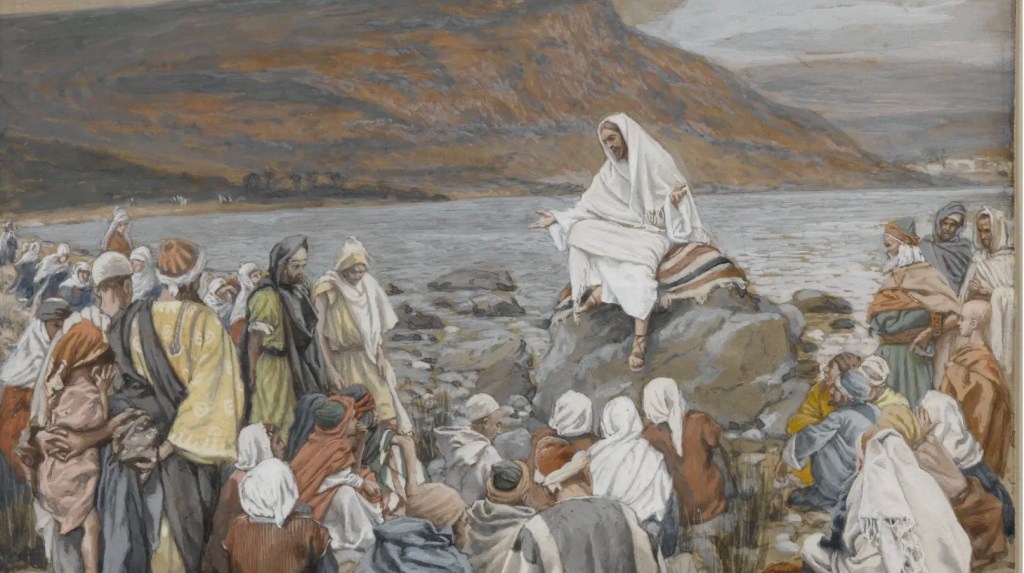
Photo: James Tissot Nantes – “Jesus Teaches the People by the Sea.” The Father sent Jesus to heal, teach, and do what he was sent him to do and Jesus did. As we come to know Jesus, his Father, and the love of the Holy Spirit, we are to do the same.

Link for the Mass readings for Friday, April 4, 2025

Do we believe in the One whom God has sent?

God heard the cry of his people who were suffering from enslavement in Egypt. God called and sent Moses to free them. Pharoah did not accept the request of Moses to let his people go and instead put more pressure on his slaves to fulfill their daily quota of bricks as before, though now without providing the straw that they needed to accomplish the task (cf. Exodus 5). The Hebrew slaves did not take out their frustrations on their oppressors but on Moses. This pattern of complaint continued time and again, even after their freedom was assured and they wandered in the desert. Even thought they were free, they complained regularly when things got tough, and stated that they were better off in their slavery and dependency on the Pharaoh instead of placing their trust and dependency upon God.

God the Father sent his Son to free us from our slavery to sin, just as he sent Moses to free the Hebrews enslaved under Pharaoh. How many times do we, like our ancestors, also complain, preferring our life of sin, a life of mere existence, over embracing the gift of a life lived to the full because it is what we know. Even worse there are too often those in positions of spiritual leadership who abuse their power, look out for their own interests, instead of guiding and serving the people entrusted to their care.

Jesus is recorded in today’s Gospel addressing those who are missing, “how God has made his will known to the people, the Father who sent me has testified on my behalf. But you have never heard his voice nor seen his form, and you do not have his word remaining in you, because you do not believe in the one whom he has sent” (Jn 5:37-38). God the Father has sent his Son to reveal his will but too many do not have eyes to see or ears to hear.

Those who are learned “search the Scriptures, because [they] think [they] have eternal life through them; even they testify on my behalf. But [they] do not want to come to me to have life” (Jn 5:39-40). What is hidden in the Hebrew Scriptures is revealed in the New Testament: the New Covenant made with Jesus and all of creation. The prophecies of old testify that the Messiah will come as a suffering servant, he will unify the nations, cleanse the Temple, and the enemies of God will be placed at his feet. These affirmations are presented and known by those who study the sacred texts, yet they still do not recognize the signs that the Messiah is in the very midst of them.

Even Moses testified of Jesus when he said: “I will raise up for them a prophet like you from among their kindred, and will put my words into the mouth of the prophet; the prophet shall tell them all that I command” (Deuteronomy 18:18). Yet the successors of Moses would not even believe in his writings, so Jesus said how would they believe in his words?

Jesus shows us in our Gospel reading today how the people of his time could have known he was who he claimed to be. This is true for us today as well. If we are sincerely seeking God who has and continues to make his will known, we will find him in philosophy, mathematics, the sciences, literature, his creation, in our service to each other, in truths of other faith traditions, but the fullness of the Father is revealed in our encounter of him through his Son, “whom he has sent”. Do we have eyes to see or will we miss God’s invitation because we do not believe in “the one whom he has sent”?

Jesus is also revealed in the Hebrew Scriptures and the Bible. To understand the New Testament we must understand the Old, for Moses and the prophets testify to his coming and Jesus came not to abolish but to fulfill the Law and the Prophets. Do we leave the Bible on the shelf like any other book? If we do read it, do we do so as if it were a dead letter, or do we read and hear it as it is truly meant to be read and heard, as the living Word of God proclaimed? We are more than a people of the book. We are a people of encounter.

The Father makes himself known to us through the presence of his Son and the love of the Holy Spirit. To experience the truth of this reality we are invited to accept his invitation of relationship. As we reach out to God, we come to realize that he is already present and reaching out to us through his Son. We do not need to run to God, because he is already running to meet us, waiting to hold us in his loving embrace, now and forevermore!

—————————————————

Painting: “Christ in the Desert” by Ivan Kramskoi. Jesus suffered for us, and so can embrace us in our suffering because he understands.

Link for the Mass readings for Thursday, March 3, 2025

Just as the Father gives life, so does his Son.

The words of today’s Gospel from John is an answer to Jesus’ healing of the man at the pool of Bethesda we read yesterday. The issue at hand for those who are incensed by Jesus’ healing is that he has done so on the Sabbath. Jesus does not help his case with his critics though. For he says he healed on the Sabbath because he was directed to do so by his Father: “For just as the Father raises the dead and gives life, so also does the Son give life to whomever he wishes” (Jn 5:21). Jesus does not make concessions with those who oppose his actions of healing. He clearly states the truth about who he is, the Lord of the Sabbath. Those that did not believe Jesus was who he said he was, believed that he was a blasphemer of the highest order and the reason why they plot to kill him.

So too in our own age, there are many ways to express our understanding and belief about who Jesus was in his time and is today. If you haven’t thought about Jesus beyond his name in a while, about who he really is and why he is relevant to our lives, then allow St. Athanasius, the bishop of Alexandria, who lived from 297 to 373 AD, to offer a point to ponder today. Athanasius held firmly to and taught with conviction that Jesus is, “the Son of God [who] became man so that we might become God” (Catechism of the Catholic Church, 480). This statement is an acknowledgment that we cannot be saved on our own merits, through our own will power, and discipline alone. We become the fullness, we actualize who we are created to be, through our participation in the divinity of Jesus the Christ.

The reality that Jesus, fully human, is at the same time the second Person of the Holy Trinity, became one with us in our humanity so that we can become one with him in his divinity is something worth meditating upon and praying about. There is much writing and discussion about how many people are leaving the Church, while at the same time so many are still hungry, starving, for a deeper, more intimate relationship with God. This is true for those who leave as well as those who remain whether either could or would articulate it in that way. Could it be that we have forgotten the foundation not only of our faith, but that we are followers of Jesus Christ?

By returning periodically to the words of St. Athanasius, meditating upon and praying with them, we just might remember who and whose we are. In this way, we will not have to face what lies before us this day alone. Jesus who healed the crippled man at the pool of Bethesda, is reaching out his hand to us today as well. He is inviting us to take his hand and allow him to lead us to experience his healing touch and divinity which we crave to experience.

————————————————————————–

Painting by Greg Olsen

Mass readings for Wednesday, April 2, 2025

Meditating on God’s word helps our will to be more conformed to his will.

Jesus recognized that the scribe, who asked him about which commandment was the greatest, “answered with understanding,” and then he said to him, “You are not far from the Kingdom of God” (Mk 12:34). What is it that the scribe understood?

The scribe understood that God “is One and that there is no other”. God is the true source of our being, our very existence. We have been created with an innate desire to be one with him. This is the longing we all feel in the depths of our soul, this is why nothing that is finite or material will ever fully satisfy us, and why we are always wanting more. This is as true for the mystic as it is for the atheist and everyone in between.

God is “One and no other” also means that we are not God, we are his created beings. God is not just one being among many, not even the supreme being. This orientation is important and foundational. We can only see from our limited perspective. What we think or believe we might need, may in fact not be truly good or beneficial for us, the shimmer may be just an apparent good, a distraction, a temptation, that will lead us away from the authentic fulfillment and meaning of life that we seek. God will guide us away from any unhealthy want, he will lead us away from temptation when we are willing to seek his guidance over and above our own. God will give us what we truly need, he will lead us to that which is, in reality, true, good, and beautiful.

Once we come to believe that God is God and we are his created beings, then we can take the next step and surrender: “to love him with all [our] heart, with all [our] soul, with all [our] mind, and with all [our] strength”. God wants all of us. We are to give all aspects of our lives to him. In our surrender to God and his will, we become capable of receiving his love and so are able to better love him in return. We all long to be loved and to love. Experiencing the love of God helps us to unconditionally love “our neighbor as our self” because through our surrender to his will we allow God to love others through us.

An interesting addition that Jesus adds to his presentation of the great commandment, is that in quoting Deuteronomy 6:4-5, he adds to the original. Along with love God with our whole heart, soul, and strength, he adds to love God with all our mind. This insert helps us to understand how we can live out this commandment.  We are to pray, to lift up our hearts and our minds to God. We can do this best when we meditate on his word daily. When we think about and continue to return to his word often we bring ourselves back into his presence and in his presence, we see better how we can give of ourselves fully to him and will be moved to love others.

As we surrender all of ourselves to God and love him in return, we will better love others (see Leviticus 19:18) as Jesus also commanded. To love God is like any other relationship. We need to spend quality time with God in stillness, be present One on one, as well as come to an awareness of God’s nearness in our daily activities. We are to resist compartmentalizing God and instead seek his presence in everything we do and through everyone we encounter.

Each of us, though prone to sin and wounded by our sin, are still not destroyed. God loves us as we are, and when we are repentant: willing to be contrite, confess, and follow through on our penance, God forgives our sins, he heals our wounds, and he transforms us. We need to stop running away from him and start running to him. One way we can do this is to love our neighbor as our self, for if we cannot love those we can see how can we love God who we can’t? Going out of ourselves and giving to another helps us to build relationships because time spent with each other breaks down the walls of separation that keep us at a distance.

Jesus’ arms are wide open before us in our neighbor. May we surrender all our heart, soul, mind, and strength into his loving embrace, receive his love and love him in return, and be willing to love our neighbor and our selves in the same way. When we understand this commandment, loving God, our neighbor and ourselves right, the other commandments will be something we will do naturally. As we enter into this practice, we too will hear Jesus say to us, “You are not far from the kingdom of God.”

—————————————————————————-

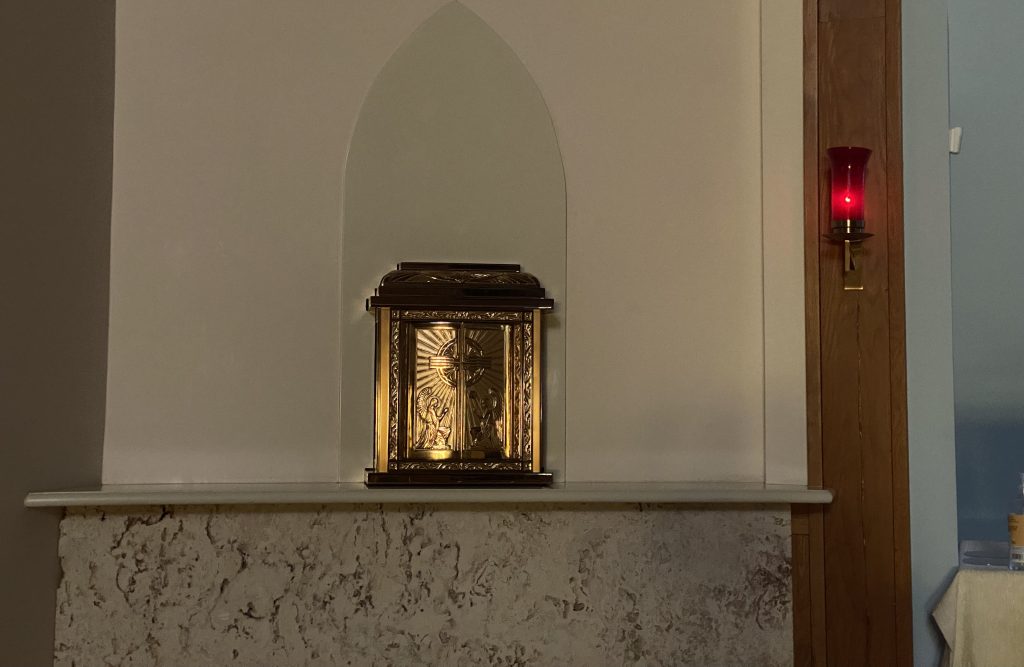
Photo: Some quiet time in our sanctuary meditating, praying, and contemplating on God’s word.

Link for the Mass readings for Friday, March 28, 2025

We need to be willing to see each other beyond surface judgments.

In the Gospel reading today, Jesus is accused of being an agent of Beelzebul, the prince of demons, because he was exorcising a demon from a man that was mute. Jesus addressed the critique and showed the polarizing nature of the onlookers who were unwilling to see the healing before them for what it was. Jesus then stated the obvious: “Every kingdom divided against itself will be laid waste and house will fall against house” (Lk 11:17).

If Jesus was an agent of the prince of demons, he was not a very good one. Satan seeks to sow discord and division. Jesus seeks to bring about unity. Now it is true, that five verses later in the Gospel of Luke, Jesus is recorded as saying: “Do you think that I have come to establish peace on the earth? No, I tell you, but rather division” (Lk 12:51). Anyone feeling a bit confused? Welcome to the wonderful world of the Bible!

To understand Scripture, we need to understand the context of the whole of Scripture, not just isolated verses. Throughout the ministry of Jesus, he seeks the unity that all may be one as he and the Father are one (cf. John 17:21), yet he has consistently experienced those that rejected his message and healings as witnessed in today’s Gospel account. Because of their hardness of heart, they are unwilling to acknowledge that Jesus is the Son of God and so there must be a reason for how he performs exorcisms and miracles.

The reason is that Jesus drives out demons, “by the finger of God” (Luke 11:20). His listeners would have picked up on this referential term, for the Pharaoh’s magicians and sorcerers made this same statement when they could no longer produce the effects of Moses and Aaron’s plagues after their infesting the land with gnats (Exodus 8:19). So just as Moses and Aaron were operating through the will, the finger of God, so too was Jesus.

In so doing, Jesus demands a choice. Then and now. We need to decide if we are either going to be for him or against him (cf. Lk 11:23). The division Jesus is talking about results from those who choose not to recognize that Jesus is who he says he is and reject him and those who accept him for who he is and follow him. This choice continues to cause division within households, families, and friends even today.

The greater take away from this verse and Jesus’ teachings as a whole, is that when we are unified, embracing the gift of our diversity, we are stronger than when we are divided by limiting ourselves to mere labels. In our modern context, labels, such as liberal and conservative are not helpful, whether they are being used in a political or religious context. Life is not as black and white as many would like it to be. It is certainly easier to cast labels, but interactions with people and developing relationships are much more nuanced. We are not mere cardboard cut outs, or caricatures.

To better understand the essence of who we are as human beings demands greater time and experience of each other than an outward appearance or isolated statement may portray. Many more of us, if we shake off any label for a moment, could honestly admit to believing in and supporting issues that are important to us from both sides of the so called left or right.

Many times, once we have cast a label, we believe that we have “defined” the person. They are classified in their box and tied up in a neat and pretty bow, and woe to the person who resists being boxed and bowed. I remember reading from one of the books from the tracker, Tom Brown, Jr., in which he described how many people when seeing a bird, such as a blue jay, robin, or crow, are often satisfied with the label, the naming of it, and move on from that sighting self-satisfied. They think that in that simple identification they now have come to understand all that there is to know about that particular species of bird. So much of the essence of one of God’s amazing creatures is missed by such a simplistic and limiting classification!

Unfortunately, we do the same with each other. We can prejudge others, as did some of the crowd who said that Jesus cast out this demon because he was in league with Beelzebub instead of through the power of God. We can also falsely believe we know everything there is to know about a person or group we prejudge. This is a very limiting and divisive approach. Jesus invites us to encounter people, to spend time, get to know one another, and break bread with each other just as Jesus did. In spending time with one another and being open to dialogue, the caricatures can be filled in with some substance and we can come to know a little better the person beyond the prejudgment.

If it walks like a duck and quacks like a duck, it may very well be a duck, but the duck is also so much more than its classification. This is much truer for us as human beings as well.

———————————————————————————

Photo: Spending quiet time with Jesus helps us to know him and to better see others as he sees them.

Link for the Mass readings for Thursday, March 27, 2025

We really can learn and put Jesus’ teachings into practice, but only with his help.

Jesus not only tells his disciples that he has not come to abolish but to fulfill the law, he constantly teaches how this is true, models how to put his teachings into practice, and empowers them to do so. This elaboration on the law and the prophets, the entirety of Jewish scripture, is highlighted well in Jesus’ Sermon on the Mount. This is evident in his Beatitudes with one example being, “Blessed are the poor in spirit for theirs is the kingdom of heaven”, and another example from his Six Antithesis show the building on the Torah more vividly: “You have heard that it was said ‘an eye for an eye,’ but I say to you offer no resistance to one who is evil”. Jesus clearly begins with quoting the law, “You have heard that is was said”, and then offers his elaboration by stating with authority, “But I say to you”.

If we seriously take the time to read through Jesus’ teachings, we will see quickly how challenging they are. Jesus is not lowering the bar of discipline for his followers, but instead, raising it. Jesus is not putting heavy burdens on us for burden’s sake, he seeks to make us holy, to guide us to be restored to our original glory that God has intended from the beginning. He himself lives what he preaches, but Jesus is no ordinary teacher or mentor. The principles that he teaches, forgiving seventy-seven times, loving our enemy, giving up all to follow him, seemed impossible to his disciples then and to us today as well.

At face value, we may think that many of Jesus’ teachings are not possible to put into practice or very practical in our day and age. This is why many people do not follow in the tradition and walk away. Attempting to do so with our willpower alone may lead to coming up short each time, and feeling more frustrated, and/or not wanting to even put in the time and effort to do so. Jesus does not expect nor desire us to accomplish living as his followers on our own efforts. Much to the opposite. We are to yolk ourselves with him and be open to the transforming power and love of the Holy Spirit acting through us. This happens when we daily invite Jesus into our lives and are humble enough to follow his lead and to ask for his help in putting into practice what he requires of us.

We become a disciple of Jesus when we are willing to study his life, learn and put his teachings into practice, and surrender ourselves to his will through prayer, discipline, worship, service, and participation in the sacraments. Ultimately though, it is nothing we do, other than ask for his help, open our hearts and minds to and allow Jesus to live his life in and through us. As we are transformed and see that with Jesus all things are possible, we are transformed by his love and conformed to his life such that we can say with Paul, it is no longer I who live but Jesus who lives in me (cf. Galatians 2:20).

The path of faith is not a sprint or a one-time event, but a marathon, a life-long journey. Each one of us can be assured that Jesus is with us for the long haul, every step of the way. No matter what trials or challenges arise, we can meet them with Jesus. We need to resist focusing on the temptations, refuse to make decisions from a fearful or reactive state, and instead lean into Jesus and on each other. We will not only make healthier decisions, we will grow stronger and closer to God and one another, no matter what arises.

————————————————————————–

Photo: View coming out of our hall after leading Tuesday night Bible study. God’s word is indeed alive!

Link for the Mass readings for Wednesday, March 26, 2025

Jesus will not let us down, and he will help us to be faithful even when we fall.

The challenge of Jesus’ convicting the hypocrisy of the Pharisees may be one for which most hearers and readers would agree with: “For they preach but they do not practice. They tie up heavy burdens hard to carry and lay them on people’s shoulders, but they will not lift a finger to move them” (Mt 23:3-4).

We have an innate sense that alerts us to hypocrisy and when hypocrisy raises its head with religious leadership it can be catastrophic because many look to our leaders, and rightly so, as representatives of the God they are to be serving. The inexcusable behavior not only affects how we look at our leaders, it also affects the way we look at the institution, as well as God. The Catholic Church is still reeling from not only those clergy who have abused children, but those bishops who have covered up the abuse.

As horrific as these acts are, and even though there have been many improvements that have been made to put practices and protocols in place, the damage is still there and will take time to heal. There also are many other ways that people have been hurt or disillusioned by the hypocritical actions and statements of priests and leaders in the church. It is easy to give up, walk away and say this is not my problem, to point fingers and justify our own acts of hypocrisy by saying well at least I am not that bad. Yet even the human frailty and fallen nature of each of us does not change the truth that Jesus is the way, the truth, and the life. He is the source of our being and fulfillment.

Even for those who have left the Church, many would say they are still spiritual. This is true because, we all have the inborn desire to be in relationship with the God who has created us. Those of us who are followers of Jesus, are to receive the message as he gave it then directed toward the religious leadership of his time, as well as it was given for his disciples, and as well as each of us who follow him today. The standard that is set and for which we strive after is to live as Jesus lived his life. Jesus always pointed the way to the Father. We as human beings are finite and we are going to make mistakes and sin. While Jesus is our model, even more, he is the source for our living faithfully to his teachings. Through his forgiveness and love working through us and directed out toward others, we are capable of standing up for the dignity of those entrusted to us within our realm of influence. For we are to be our brothers’ and sisters’ keepers.

If we want to guide someone in the ways of our faith tradition it is not enough to say this is what you need to do and live accordingly. We need to put into practice and live what we are sharing, be willing to accompany, assist, and walk with them along the way. As a Christian, just giving someone the Bible, saying there you go, that’s all you need, and quoting a couple of scripture passages is not enough. If we are sharing a principle to put into practice and we are not willing to lift a finger to help them, or worse to not put it into practice ourselves, we do more damage than if we said nothing.

Jesus has been calling us again this Lent to resist judging and condemning, to love our enemies, to be forgiving, and merciful. Powerful actions to live up to and even a heavier lift than the laws of the Pharisees. To say that the bar Jesus sets is high is an understatement, but he who lived them out calls us to do so. We not only learn how to act from reading about the life and teachings of Jesus but even more importantly, when we pray with, meditate upon, contemplate, and then seek to put into action his teachings, Jesus empowers and assists us to live them out. Apart from him we will not be able, with him all things are possible.

Even when our leaders fall, we need to remain in the Church. Nor can we use poor leadership as an excuse not to be willing to see where we sin and seek to improve. When we miss the mark, let us be humble, ask Jesus for forgiveness, and his help to continue on step by step. From our own experiences of falling down and getting back up, we are better able to help others. The most important guidance we can give anyone is to help them to encounter and experience Jesus for themselves. Even when we fall, they will still have Jesus as their ultimate guide. Then we can hold each other accountable and help each other as we continue our journey through this life side by side.

————————————–

Photo: Mosaic of Christ Blessing, in the cathedral in Cefalu, Sicily, Italy. Cover image from The Gospel of Matthew by Mitch and Sri, Baker Academic, 2010.

Link for the Mass readings for Tuesday, March 18, 2025

Jesus reveals to us his divinity and love through the Transfiguration and the Cross.

In our lives we experience periods of both desolation and consolation. There is an ebb and flow where we suffer from trials and also celebrate joys. The key to living a life of faith is to see God in both types of experiences. Jesus provided a period of great consolation for Peter, John, and James, the inner circle of the Twelve with the purpose carrying them through the deepest desolation to come on the cross. While he was praying his face changed in appearance and his clothing became dazzling white (Lk 9:29).

Jesus revealed his divine nature to his disciples in an awe provoking display that would prepare them for the next mountain that he would ascend, the cross on Golgotha. Not only was the Transfiguration a foreshadowing of his death, it may as well have also been a foretaste of Jesus rising from the dead in the Resurrection and his ascent to the Father at the Ascension.

Each year we are given opportunities to experience the wonders of Jesus’ significant moments of revelation in his Transfiguration, the Passion, Death,  Resurrection, and Ascension. In entering into the yearly rhythm of the liturgical season as well as providing ourselves with anchor moments daily to pray, meditate, and contemplate with Sacred Scripture, we can begin to experience the life and presence of Jesus in our everyday experiences. May we resist the temptation to miss a transfigured moment, because we are seeking our security in those things or persons other than God first.

Jesus came to this mountain, traditionally Mount Tabor, to pray. To lift his heart and mind to the Father in a place of the heights, away from the everyday hustle and bustle, a place where the peak met with the sky, a place where heaven and earth met. He did not go alone but invited the three of his inner circle, Peter, John, and James. Moses, whose burial place was unknown and was thought to possibly have been lifted up to heaven and Elijah, who rose up in a chariot of fire, were both present as well. Their presence most likely impressing the stamp of approval of the Law and the Prophets.

Jesus invites us to let go of our pride, fear, and any sin that may prevent us from journeying to the mountain top. We can experience moments of transfiguration in our daily lives when we acknowledge that God breaks into our lives at that moment when we need him the most, recognize the assistance he has given us, and/or has revealed to us the path and direction we were to take. Our natural response is to offer prayers of thanksgiving, recognizing that we don’t walk alone, that God and those he sends to help us are a tremendous support.

Jesus cares and is also present in our desolations. Many of us run from our suffering, we are afraid of the cross. And yet, it is through the cross that we come to experience the Resurrection. We may not be aware, but when we run away from our suffering, we are running away from Jesus who awaits us with his arms wide open to embrace us in our suffering; to comfort, heal, and transform us. To receive the healing embrace from Jesus, we need to be willing to enter into our suffering.

The older I get, the crucifix becomes more and more of a consolation. His body broken, emptied out for us on the cross, represents his unconditional love for us. He gave everything he had, holding nothing back. He took upon himself our sin, our anxieties, fears, and selfishness, and transformed the worst of our fallen nature through his love such that we are invited to be redeemed. The crucifix is not a sign of despair, but of hope and transfiguration, for it reminds us that no matter what we go through or are going through, what trial that we may be in the midst of at this very moment, Jesus has experienced it. He is now, and will be present with us.

Looking at, praying with, and meditating upon Jesus on the Cross has provided me moments of transfiguration, granting me the courage that I did not have to face various conflicts, challenges and trials so to grow and mature as Jesus calls. As he looks down from the cross he continues to love me despite my sin, my weakness, and failures, and is willing to lead and accompany me onward, so that I too may be continually renewed and transformed.

We were not there with Peter, John and James to experience Jesus’ transfiguration, but when we are blessed to participate in the gift of the Mass, we climb the holy mountain and sit at the feet of Jesus and are able to experience the transformation of the bread and wine that become the Body and Blood of Jesus the Christ the Son of God who became one with us in our humanity so that we can become one with him in his divinity. With each reception of the Eucharist, we are more and more transfigured by his holiness and become more and more like Jesus. As we receive him in that intimate encounter, may we also listen to the words of his Father and “listen to him” (Luke 9:35) and the words of his mother, “Do whatever he tells you” (John 2:5).
________________________________________
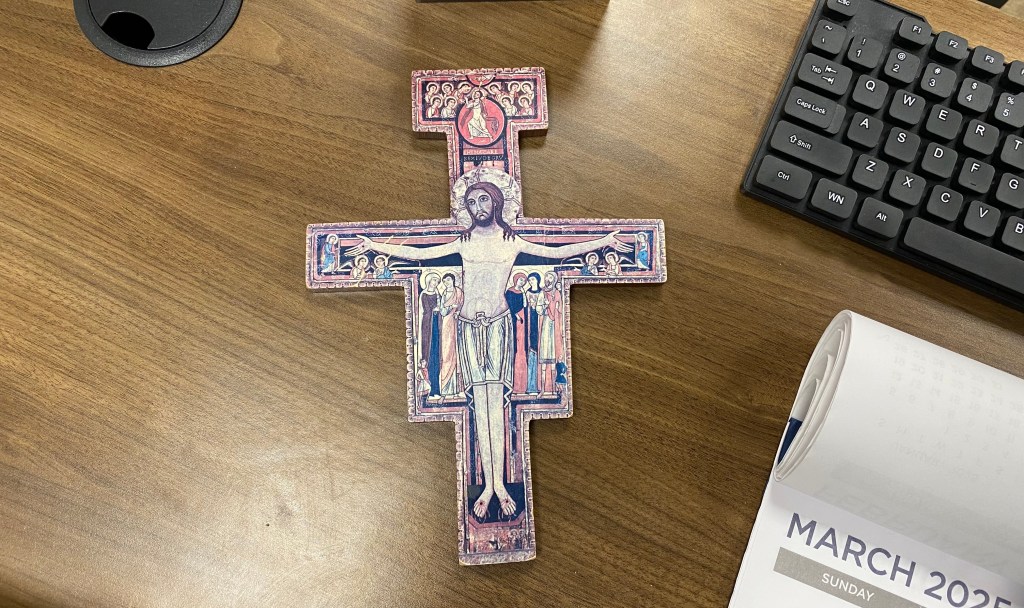
Photo: The crucifix that I have had with me since my early twenties and which is now on my office desk.

Link for the Mass readings for Sunday, March 15, 2025

How we treat one another with our thoughts, words, and actions matters.

Jesus calls us to be holy, each and every one of us. Our life is to be lived with the end goal being our ascent to heaven, to be in union with our Loving God and Father for all eternity, and to assist others to do the same. Jesus provides for us a concrete example of the heights to which we are called to reach: “You have heard that it was said to your ancestors, You shall not kill; and whoever kills will be liable to judgment. But I say to you, whoever is angry with his brother will be liable to judgment, and whoever says to his brother, Raqa, will be answerable to the Sanhedrin, and whoever says, ‘You fool,’ will be liable to fiery Gehenna” (5:21-22). Jesus is building on the Torah, the Law or the Teachings, by helping us to realize that we cannot only kill with weapons but also inflict dehumanizing damage with our words.

To resist this temptation of inflicting mortal wounds, we need to start participating in a deeper examination of conscience which gets to the roots of our own thoughts, words, and actions. If we are not able to discipline our thoughts, what will follow is undisciplined words, and then undisciplined actions, which can lead to entertaining and embracing the deadly sin of wrath. Wrath is unbridled anger that leads someone away from the capacity to think or behave in a rational manner, such that this individual would no longer acknowledge the dignity of the person they would inflict their wrath upon.

Jesus never settled for a minimalist approach to our faith. He is helping us to see that we can be free of the temptation of wrath if we recognize the danger and destruction of unleashing words as weapons. He offers us the examples of calling someone, Raqa, meaning something along the lines of an air-head or an idiot, and calling someone a fool. These words directed at another have no other cause than to demean, degrade, belittle, and harm. This language, and worse, has no business coming out of the mouths of a disciple of Christ. If we are serious about being one of his followers, we need to make a decision regarding how we think, speak, and act.

I remember a moment in sixth or seventh grade unleashing a derogatory word or two toward a classmate. Even though they were loosed in jest, I felt a sinking feeling in my gut after hearing myself say them. God convicted my heart in that graced moment and I felt contrition, actual sorrow for the negativity and poison I had unleashed. I remember making a commitment to myself not to speak that way toward another person going forward.

We need to be aware that words have the power to wound or to heal. If we are serious about following Jesus, fasting from gossip and from words that belittle, divide, diminish, or dehumanize is a good practice to engage with this Lent. Jesus wants us to remove any and all obstacles that would prevent us from growing in sharing his unconditional love with one another. Instead of an unkind word we can share words that empower, uplift, and comfort or at least listen more and speak less. Even when we disagree with another’s point of view, we can do so by still respecting the person and fostering dialogue.

Our words are not enough. Our words will be more kind when we are willing to go deeper and resist entertaining negative or dehumanizing thoughts. Even when we have defensive musings resulting from another’s disparaging tone, words, or actions, we need to resist entertaining them. Instead of reacting, we can breathe, pray for the strength from the Holy Spirit for understanding, hold each other accountable when necessary with respect, and ultimately seek to love, to will the good of each other in all circumstances. We begin this by praying for one another and seeing each other as brothers and sisters.

—————————————————————

Photo: May God bless you with a peaceful mind and heart this day that you can share with others!

Link for the Mass readings for Friday, March 14, 2025