Praying persistently helps us to grow in our relationship with God and one another.

Jesus told his disciples a parable about the necessity for them to pray always without becoming weary (Lk 18:1).

In the parable that Jesus offered in today’s gospel account, he is not saying that persistence in prayer is changing God or somehow bending his will to our’s. We are not wearing him down like the woman did with the judge. God does not need us. God is completely and totally self-sufficient. We are the ones who need him. Our persistence, our daily habit of prayer, changes us, transforms us, helps us to develop our relationship by interacting with God more consistently. Things happening in our lives help us to see that we are fragile and vulnerable and in need of help. Our persistence in prayer will help us to experience that we are not alone in our challenges. When we are dealing with a crisis or very real trauma, our persistence and faithfulness in prayer will help us to experience the closeness of Jesus in our midst as he accompanies us through our suffering and grants us the strength not just to endure but to overcome.

In fact, the practice of stopping everything and praying for five minutes when a crisis arises, often helps us to resist slipping into a fight or flight mode and helps us to resist reacting automatically based on our emotions. Consciously choosing to breathe while praying helps us to act more prudently than impulsively. We may also come to see that what we thought was a crisis, may have been more of a problem to be solved rather than something catastrophic. Our instant reactions to perceived crises can often escalate an issue rather than de-escalate one.

In the greater scheme of things, God answers all prayers of petition or intercession by saying yes, no, or not yet. Most seem to fall in the not yet or not the way we originally intended category. Remaining patient and faithful can help us to move away from seeking to conform God to our will and instead allow him to expand our hearts and minds to his will. Through this expansion, we can come to see the situation from a broader perspective. Our persistence in prayer also helps us to move away from seeking instant gratification and instead trust more in God’s will and timing. Sometimes we are blessed for unanswered prayers because with time, hindsight, and some distance, we find our original request was more an apparent than an actual good.

Persistence in prayer is also a discipline that deepens the roots of our relationship with God. Ready access through our modern technology, higher internet speeds, one-click access, and overnight shipping, can offer plusses, but we have to be careful that this mindset does not shape our mental, psychological, and spiritual growth. Physical fitness, wisdom, or spiritual maturity is not instantaneous. More importantly, development as human beings and our relationships take time, experience, discipline, prayer, and trust in God’s plan.

Patience, persistence in prayer, freeing ourselves from attachment, developing an authentic and intimate relationship with God and one another are all worth the effort. We need to take some time to breathe deeply, slow down our pace, discipline ourselves to resist even seeking small acts of instant gratification each day. No matter how busy, it is important to slow down. Even when we stop to pray and feel like nothing has happened and that doing so feels like a waste of time, God is present. God loves us, has our back, and we can trust in that.


Photo: Blessed to have a moment to pray evening prayer back at St. Peter Catholic Church. Keeping our eyes on Jesus helps us to quiet our minds.

Link for the Mass readings for Saturday, November 15, 2025

Good to reflect as we end each day what we are grateful for.

Jesus said in reply, “Ten were cleansed, were they not? Where are the other nine? Has none but this foreigner returned to give thanks to God?” Then he said to him, “Stand up and go; your faith has saved you” (Lk 17:17-19).

Bloodline doesn’t matter, gender doesn’t matter, nation doesn’t matter, ethnicity or race doesn’t matter. Ask Mary the mother of Jesus, ask Mary Magdalene, ask the woman who suffered from hemorrhages for twelve years, ask the Roman centurion whose slave was dying, ask the Samaritan leper what matters. Each of them will share with us that what matters is our belief and faith in Jesus the Christ.

The lifeblood of Christianity is our belief in and developing of our relationship with Jesus, the Son of God, who made his dwelling among us. St Irenaeus of Lyons (born in Smyrna about 135-140 AD and died about 202-203 AD) in his work Against the Heresies wrote: “The Word of God, our Lord Jesus Christ, who did through His transcendent love, become what we are, that he might bring us to be even what He is himself.”

That Jesus became one with us in our humanity so that we can become one with him in his divinity is something to be thankful for! Many times when we are feeling down, maybe it is because we are focusing on what we do not have or who is not in our life instead of being thankful for who or what we do have. A way to adjust our perspective is to stop for a few moments and think about three things we are grateful for.

The leper from today’s Gospel helps us to take the next step. Once we allow ourselves to be aware of what we are thankful for, let us thank the One who made what we have possible. Our time on earth is too short to allow the temptations of indifference and complacency to take hold. May we be more aware and choose to reach out to those who are important in our lives and tell them how thankful we are that they are in it, how much they mean to us, and how much we love them. Including God the Father for his constant and abiding presence, the wonderful gift of the invitation of his Son, Jesus, to share in his divinity, and the Holy Spirit who loves us so that we may love one another.


Photo: Looking up can help us to pause and be grateful.

Link for the Mass readings for Wednesday, November 12, 2025

We have been created to love and to serve as Jesus loves and serves.

“When you have done all you have been commanded, say, ‘We are unprofitable servants; we have done what we were obliged to do'” (Lk 17:10).

This closing line from our Gospel reading today can be a hard verse to digest at first glance, especially with our track record of slavery in the U.S. We need to remember and recognize that this was a teaching that Jesus shared in a different time period, in a different culture, and in a place far removed from any clear modern context. The master/slave relationship is also a theme that Luke returns to often.

Another important point to touch upon when reading the Gospels is that when Jesus made the statement that, “we are unprofitable servants; we have done what we are obliged to do”, we are not to read this verse in isolation from the full context of Scripture. Jesus also shared a parable about a master and servants in which when the master returns, he waits on them (Luke 12:35-40). Jesus himself modeled this same service at the last supper when he washed his disciples’ feet (cf. Jn 13:1-17). This was the lowest of menial tasks. St Paul wrote to the Galatians informing them that in the Body of Christ there is no Jew or Gentile, slave or free, male nor female (cf. Galatians 3:28). The ultimate point is that God is God and we are not. We all have a part to play in participating in and promoting the kingdom of God by following his lead.

As a disciple of Jesus, we are not to seek adulation and glory. We are to serve God and one another without hesitation. We serve God because he is the director and we are the directed. He is the master and we are the servant. In aligning ourselves in this way, we also experience the intrinsic joy of following his will. As we follow Jesus’ lead and guidance, we grow in our relationship with him, his Father, and experience more of the love of the Holy Spirit. As the apostles followed Jesus, there came a point where he said to them that he no longer called them servants but his friends (see John 15:15). That is to be our hope as well.

No task is too menial or beneath us, nor do we need to be concerned about doing big and grandiose things. We just need to be obedient and act as God leads. Instead of reacting, losing our temper, fuming in anger, or twisting ourselves in anxious knots, we each can choose to smile, to hold a door, to respect and appreciate one another, to be patient and present to one another. When conflicts arise, breathe and ask the Holy Spirit to guide us before we react. We serve best when we listen with understanding, give others the benefit of the doubt, forgive, and allow ourselves to love and serve as God directs us.

Pope Leo shared during a recent gathering of bishops on September 11, 2025 that: “Service is neither an external characteristic, nor a way of exercising a role. On the contrary, those whom Jesus calls as disciples and proclaimers of the Gospel, in particular the Twelve, are required to have inner freedom, poverty of spirit and readiness to serve, which are born of love, to embody the same choice made by Jesus, who made himself poor in order to enrich us (cf. 2 Corinthians 8:9). He manifested the style of God, who does not reveal himself to us in power, but in the love of a Father who calls us to communion with him.” We may not be bishops, but we are disciples. We begin in simple ways and with each act of kindness, our hearts expand, we are moved to serve, to love and to grow in communion with God and one another. As St. Mother Teresa said, we are to be a pencil in God’s hand. In our willingness to be moved by God to serve, we as well as those in our realm of influence that we serve, will be better for the effort.

———————————————————

Photo credit: In giving ourselves prayerful pauses we can experience God’s love and so are recharged to love and serve some more.

Link of Pope Leo’s address to the bishops

Link for the Mass readings for Tuesday, November 12, 2025

Mammon or God? There is only one choice.

“No servant can serve two masters. He will either hate one and love the other, or be devoted to one and despise the other. You cannot serve God and mammon” (Lk 16:13).

Jesus consistently emphasizes the priority of making God primary in our lives. Anything that moves into the slot of preeminence before God is idolatrous. Anything, even family, as we heard a few days ago. We cannot have two firsts, because either we will “hate the one and love the other, or be devoted to one and despise the other.” This balancing act is not an easy discipline.

It becomes especially challenging when we look at mammon, money, or material wealth. Many of us seek our security in having a home, insurance policies, savings, retirement plans, market investments. Setting up this security is often considered prudent. The problem is when material security becomes the foundation of our life, our fulfillment, our god.

This has certainly influenced the Church at times with movements governed by a prosperity gospel. The approach to a faith life that is not so much building up a relationship with our loving God and Father, but one of seeking God as a holy investor. There is a perspective offered on verses such as the Parable of the Sower (cf. Mark 4, Matthew 13, and Luke 8) in which the primary intent in giving is to reap a financial return of ten, twenty, or a hundredfold. God certainly wants us to be good stewards, and he will indeed bless us and wants us to be generous and cheerful with our giving, but again, if in our giving the primary intent is to receive more of our treasure, we are serving Mammon and not God.

Following are two scriptural verses and two Church Father quotes that may help us to see that in giving away and not accumulating the material, thus trusting in God for our security, is the more prudent path:

“If one of your kinsmen in any community is in need in the land which the Lord, your God, is giving you, you shall not harden your heart nor close your hand to him in his need. Instead, you shall open your hand to him and freely lend him enough to meet his need” (Deuteronomy 15:7-8).

“For I was hungry and you gave me food, I was thirsty and you gave me drink, a stranger and you welcomed me, naked and you clothed me, ill and you cared for me, in prison and you visited me” (Matthew 25:35).

“When giving to the poor, you are not giving him what is yours; rather, you are paying him back what is his” (St Ambrose of Milan, 340-339).

“If each one of us took only what is necessary for his sustenance, leaving what is superfluous for the indigent, there would be no distinction of rich and poor” (St Basil of Caesarea, 330-379).

Our reactions to the above can be a barometer as to whether we are putting gold first or God first. God is to be our source and our fundamental option. The blessing we receive, the hundredfold we seek, is to be measured in love, mercy, and generosity received and given. Pope Francis, in a 2013 address, expressed his concern “that some homeless people die of cold on the streets [and this] is not news. In contrast, a ten-point drop in the stock markets of some cities is a tragedy. A person dying is not news, but if the stock markets drop ten points it is a tragedy! Thus people are disposed of as if they were trash. Consumerism has led us to become used to an excess and daily waste of food, to which, at times, we are no longer able to give a just value, which goes well beyond mere economic parameters” (Vatican Insider).

Do we place our trust, faith, and security in Mammon, or God? Do we build up treasure for ourselves at the expense of or indifference toward others or build up our treasure in heaven, aware of and reaching out to those who are in need? Were someone to observe us objectively, and closely would they say about us, “There goes someone that lives their life believing: In Gold we Trust.” Or would they say, “There goes someone that lives their life believing: In God we Trust?”


Photo: Seeking each day to breathe slow and allow each thought, word, and deed to be filtered through God’s will.

Link for the Mass readings for Saturday, November 8, 2025

God increase our faith.

Some Pharisees came to Jesus and said, “Go away, leave this area because Herod wants to kill you” (Lk 13:31).

Even with this warning, from some Pharisees no less, Jesus continued to teach openly and publicly as well as performed healings and cast out demons. He did not fear the threat of retribution even from the likes of Herod who had killed John the Baptist. He willingly surrendered all to his Father and would continue to do so, especially not being deterred from continuing his march toward Jerusalem.

It is interesting that there are those Pharisees that are attempting to help him. Could they have been moved by the courage of Jesus? His undeterred persistence for his mission and courage makes him a very dangerous man. He cannot be controlled, threatened, or coerced. Jesus is sure of what God has sent him to do and he is going to follow through with his Father’s plan even to the point of giving his life.

Many, even those like the centurion, who did not believe in him, after he ran his spear through his side, admired his courage, and something happened in that moment such that he came to believe that he was the Messiah (cf. Mark 16:39). Many of the first-century martyrs who followed Jesus to their own deaths were a big reason for those who came to believe and also became followers of this One who died on a Cross. Tertullian, one of the early Church Fathers, living from 155 – 220 AD, went so far as to say that: “The blood of the martyrs is the seed of the Church.”

We are all called by God to be martyrs, not necessarily by shedding our blood. Martyr literally means witness. Each one of us is called by Jesus to bear witness to what we believe and the One who we believe in. Faith is a gift. If we feel that we are weak in our faith, we are in good company, because Jesus said on more than one occasion to his Apostles, the ones he would send out as his witnesses, “Oh, you of little faith.”

The Apostles continued with the little faith they had. They trusted in Jesus and continued to move forward. It is in growing our relationship with Jesus that gives us our strength. If we feel like our faith could use a little shoring up, let us not choose the path of Judas who isolated himself from the forgiveness of Jesus. Let us instead ask God to increase our faith, to allow the Holy Spirit to dwell within us and transform us, and be open to opportunities to follow his will.

Jesus, please help us to be still and hear the Father calling us, challenging us, to resist indifference and be his witnesses in our everyday lives and to be more open to follow the stirring of the Holy Spirit and put his guidance into action. Each time we say yes to the will of God, our clarity, courage, and faith increase.


Photo: We can have confidence that when we turn to the Holy Spirit, he will guide us through any storm.

Link for the Mass readings for Thursday, October 30, 2025

We become good stewards when we follow the will of our Father in heaven.

A rich man had a steward” (Lk 16:1). So begins Jesus’ telling of the parable of the dishonest steward. In this parable, the steward was placed in charge of overseeing the rich man’s affairs. Jesus is directing this parable toward his disciples. If we consider ourselves to be disciples of Jesus then he is speaking to us as well.

Might help us to understand that a steward is given the task to oversee someone’s affairs. In our case then we are overseeing God’s affairs and to be successful stewards we must remember who we are. The steward in the parable squandered the property of his master. He was not adequately fulfilling the charge he was given. Most likely because he was serving himself and his own needs instead of those of his master and as Jesus would later state, “No servant can serve two masters” (Lk 16:13).

For us to be good stewards, we must agree with the foundational principle that God is God and we are not. Maybe a pithy statement but if we don’t get this point right from the start we are going to be in trouble, because we are forgetting who we are. That is exactly the misstep with Adam and Eve. They were tempted and fell when they grasped at what God freely had given. Instead of excepting the gift of their humanity, their role as stewards, they sought to define their own path, they put themselves in the place of the master, instead of the steward, and there can only be one master and that is God.

When we place ourselves in the role of the master instead of God or attempt to force God, from our perspective, to fit into our image, then we are going to have problems. We can see the effects of this fallen reality on full display in our world today. The reason why Jesus never sinned was that he never forgot who he was. Jesus is the steward we are called to be. His mind and heart is open to following the will of God his Father. “Though he was in the form of God, Jesus did not deem equality with God something to be grasped at. Rather he emptied himself and took the form of a slave, being born in the likeness of men” (Philippians 2:6-7).

Jesus, though he was divine, did not grasp at his divinity, but received and embraced the gift of being human. That meant he was willing to be the steward and not the master. As Son, he was sent by his Father to do his Father’s will. Jesus did so with every thought, word, and deed. He showed this most profoundly in the Garden of Gethsemane. Jesus submit himself to the will of his Father and gave his life. Die he did and in willing to do so, he conquered death through the power of the Holy Spirit, rose from the dead, and leads the way for us to take up our cross and die to ourselves.

Being the steward and not the master is not easy for us because we are not willing to give up our control. When we let go though and surrender to God, we can feel safe in the assurance that God has our best interest in mind. St. Mother Teresa put it best when she sought just to be a pencil in God’s hand. By making the time to slow down and discern God’s will, we will remember who we are, God’s children. When we resist impulsively reactions, relinquish our control, and follow the lead of our Father in heaven, we will be more prudent stewards. Then we can begin to help our corner of the world to be a little more peaceful, caring, and loving.


Photo: Praying with some great stewards, Mary and Joseph.

Link for the Mass readings for Sunday, September 21, 2025

When we pray, we are loved by God, and the love of God casts out our fear.

“Then the one who had received the one talent came forward and said, ‘Master, I knew you were a demanding person, harvesting where you did not plant and gathering where you did not scatter; so out of fear I went off and buried your talent in the ground. Here it is back'” (Mt 25: 24-25).

I used to struggle with this verse of Jesus’ Parable of the Talents, not because I didn’t relate to it, but because I did. The problem was that I sided with the servant who buried his talent in the ground. What the servant did made sense to me, he kept his master’s talent safe and returned what he had been given. Historically, burying was considered a safe and acceptable practice in ancient Palestine when protecting someone else’s money. Even in reading carefully back to the beginning of the parable, I could see no reference to investing the talents. Though in the Gospel of Luke, there is an explicit demand to “trade with these until I come” (Lk 19:13). What is Jesus saying?

Actually, Jesus in this parable offers a microcosm of salvation history, the thread of which has been woven through all of Sacred Scripture from Genesis to Revelation. God, through his sovereign will, has consistently called, calls today, and will continue to call into the future a people to himself. In each age, God has bestowed upon humanity the generous gift of his grace, inviting us to receive and share in his very life, which is what we have been created for. This is a free gift, to be freely accepted or rejected. Once received though – no matter how little we choose to receive, five, two or one talent, we are directed to share what we have been given. Through a life lived of accepting, receiving, giving back to God and to one another, we are given even “greater responsibilities”.

In receiving the gift of God, himself, and sharing what he has given, ultimately his love, for God is Love, we not only mirror on earth, albeit dimly, but share in the divine communion of the love between God the Father, God the Son, and God the Holy Spirit. To reject this gift outright, or to receive some of the benefits and not to share, we cut ourselves off from the very life force and source of our being.

The message of The Parable of the Talents is as clear as it is challenging. John P. Meier summarizes that “Jesus is insistent; along with sovereign grace, serious demand, and superabundant reward comes the possibility of being condemned for refusing the demand contained in the gift. Indeed, one might argue that no aspect of Jesus’ teaching is more pervasive in the many different streams of the Gospel tradition, and no aspect is more passed over in silence today” (Meier 2016, 309).

God has created us and all of creation from the abundant outpouring of his love. Will we reject the gift of his love and invitation of communion? Will we receive, yet not actualize who we are called to be for our self and others because we would rather merely just exist, willing to be lured and entrapped by the temptations of anxiety, fear, apparent goods, and half-truths? Will we give in to the fear, too afraid to risk, to go out from ourselves to serve others? Or, will we appreciate the gift of our life and say thank you for the breath that we breathe? Are we willing to expand the love we have received by being willing to share, to multiply our talents, to embrace who God calls us to be, to love in kind, to will the good of others in the unique way God calls us to serve, whoever they may be?

I have lived the life of the wicked servant who buried his talent out of fear. I have embraced the sin of sloth by overworking and thinking I was doing good, but was it really the good God wanted me to do? As I have recognized the importance of placing prayer front and center, so that I have grown in my relationship with God, my life has become more properly ordered. I do better when I reach out and seek the hand of Jesus and accept to be led by him. I have risked and fallen, made mistakes and duffed up time and again, but have learned and persevered.

When we learn who the enemy is, are able to identify his lies, renounce and turn away from them and back to God; when we slow down instead of run from what we are afraid of and invite the Lord into these areas we will be purified, we will heal; and when we realize that the most important thing that we can do each day is pray, then we will come to know in our core, that we are not human-doings, we are human beings. God loves us as we are. As we are loved, we will then act from being loved and share the love we have received.

We are not alone. What Jesus invites, gives, and yes, demands of us, he will at the same time provide the courage, guidance, support and strength we need to carry out the task given and to bring it to fulfillment. God has a talent or two to invest. We need not fear to invest what God has given. This morning, let us breathe deep and entrust ourselves to the words of Jesus and St John Paul II who echoed them as he began his pontificate:

“Be not afraid” (Mt 14:27).

———————————————————————————-

Photo credit: dpa Picture-Alliance via AFP accessed from Aleteia

Meier, John P. A Marginal Jew: Probing the Authenticity of the Parables. Vol. 5. New Haven: Yale University Press, 2016.

Link for the Mass readings for Saturday, August 28, 2021

Resist the temptation to compare, trust and follow Jesus instead.

How many times have we looked to others instead of staying focused on what we need to do or be doing? How many times do we compare ourselves to others, assessing what we or others have or don’t have, how others are more or less confident, more or less better looking, more or less intelligent, and even, how our faith life is worse or better?

We get a taste of these questions and what our response ought to be from Jesus in today’s Gospel. The background of today’s reading is a continuation from yesterday’s, in which the author described how Jesus forgave Peter for denying him by asking him not only if Peter loved him, but how he was to put that love into action by feeding his lambs, taking care of and feeding his sheep. Jesus also had just let Peter know that Peter was going to die in his service to him.

Today, we read that upon hearing the news of his eventual death, that Peter shifts the direction away from himself.  When Peter saw him, he said to Jesus, “Lord, what about him?” Jesus said to him, “What if I want him to remain until I come? What concern is it of yours? You follow me” (Jn 21:21-22). Jesus does not definitively say what is or is not going to happen to the beloved disciple. Jesus is clear with Peter that his focus is not to be on what is going to happen to the beloved or any other disciple, but to direct his attention to following him and his will.

Our orientation as disciples of Jesus is to follow Jesus, to focus on his will for our lives and to expend our energy in such a way that promotes his will. We are to spend less time comparing ourselves to others. This is very good advice because the temptation to compare is a very slippery slope that can easily lead us to the devastating sins of gossip, pride, and envy. If we are to compare ourselves to anyone, let it be to Jesus.

Jesus calls us to be perfect as his heavenly Father is perfect, which is an impossible task if we seek to go it alone. Yet, we can become perfected through our participation in the life of Jesus the Christ. We begin when we decide to ask for Jesus to help us make a commitment to resist the temptation to compare ourselves to others. Then when the first instant of a comparative thought arises, we can replace it with a prayer of blessing directed toward another.

Moment by moment, we just need to remember that we are not alone, that we walk with Jesus. One thought, one action, one interaction at a time, we are called to surrender our will to the love of God. By taking these steps to counter the influences of a focus on self first as well as resist the comparative and/or seeking to follow a cult of personality, we can begin to shift the momentum away from increasing divisiveness, polarity and mistrust, and instead strive toward supporting, encouraging, and uplifting one another.

As we place our trust in and follow Jesus, our thoughts, prayers, and actions will change. We will become more understanding, patient, willing to engage in conflict resolution, and dialogue. To love as Jesus loves us will help us to begin to lessen the intensity of fear, prejudice, biases, and chronic stress. As we are able to then experience his peace, let our shoulders come out of our ears, then we might be willing to see each other as human beings and through God’s eyes, as beloved daughters and sons with whom he is well pleased.

————————————————————

Photo: Follow Jesus where he leads and all will be well. Back home for a quiet walk a few weeks ago.

Link for the Mass reading for Saturday, June 7, 2025

Jesus never sinned because he never doubted who he is and we can get there too!

Filled with the Holy Spirit, Jesus returned from the Jordan and was led by the Spirit into the desert for forty days, to be tempted by the devil (Luke 4:1-2).

He did so for the same reason he was baptized and crucified. Jesus experienced the temptations of Satan, the one who tempted Adam and Eve, to undo the effects of their original fall. Diabolos, translated as devil in English, means “slanderer” in Greek. Ha satan in Hebrew means accuser or adversary. Satan is the fallen angels, seeped in pride, who seeks divide, brings disorder to all that is good, and ultimately seeks death. We dismiss the reality of his presence at great risk. On the other hand we often give him more power than he deserves. Jesus is tempted, but unlike Adam and Eve, as well as the Hebrews following Moses in the desert, he does not give in. Jesus remains grounded in the will of his Father and so Satan has no power over him.

Jesus knows who he is and whose he is. Jesus is the Son of God, the second person of the Holy Trinity, who willingly was sent by his Father to conquer the effects of sin and death by taking upon himself the sin of fallen humanity. Jesus was willing to become a sin offering on our behalf.

Jesus could have dismissed Satan, yet he endured his temptation to teach us “how to triumph over temptation” (St Augustine 1976, 87). Jesus not only teaches us how, but empowers us to overcome Satan. The weakest Christian is more powerful than Satan himself, because we can call on the name of Jesus. This is not some magic incantation, but when we call on the name of Jesus, he, in the fullness of his humanity and his divinity, is present with us. God has given Jesus the name above every other name, so that as his word is spoken, every knee shall bow in heaven and on earth (cf. Philippians 2:9-10). Just as a floodlight shines in the darkness, the darkness gives way to the light. This is even more true with Jesus. Where Jesus is present there is love, such that no fear or evil can remain.

I had a dream some time ago, I am not sure how long now, but it is still just as vivid. I was sitting on a couch in the first floor of a house. The scene shifted so that I was seeing myself sitting on the couch from above and then my view was redirected to the attic. I witnessed a misshapen, dark figure rummaging through old boxes and newspapers. He embodied pure evil. I was then back in my body, and knew this creature was moving out of the attic and coming down the stairs to the room I was sitting in. My heart was pounding and I felt petrified as I heard his steps drawing closer. I was frozen in fear. In a few more moments, he came into view. What I saw was not the figure in the attic, but a handsome man, but I knew it was him. As he continued closer my fear increased, fearing that he would touch me, then a hymn came to mind. He stopped the moment I began to sing, my fear began to dissipate and I woke up.

Evil tends to present itself at first as an apparent good, as attractive, as normal, otherwise we would reject it outright. Satan and his demons are active through whispers and nudges, they look for our weaknesses and through the same tactics as peer pressure, seek to inject their poison and manipulate our actions. I am not talking about possession here, I am just talking about their divisive influence and seeking to present disorder into God’s plan of order. The most dangerous evil is the one masked in faith. Someone who can speak the verses of a Bible and quote chapter and verse does not a Christian make.

Satan himself quoted from Psalm 91 to Jesus, tempting him to throw himself off from the parapet such that the angels would protect him, catch him, and bring him down safely lest he “dash his foot against a stone.” Jesus in today’s account from Luke deftly countered each of Satan attacks with the sword of the Word of God. Even the subtle attacks of seeking to sew doubt into the reality and truth of who he was by stating, “If you are the Son of God…” Jesus did not flinch or doubt. He grounded himself in the love he had experienced from his Father, from the faith he, as fully human, learned from and experienced with Mary and Joseph, and he stood his ground until Satan left him.

Jesus’ encounter with Satan in the desert is one for us to pray with and meditate upon often because Jesus shows us how to counter his attacks. It is not with the weapons of this world but by placing our trust in God our Father and remembering, no matter how hard the father of lies tries to convince us otherwise, we too must ground ourself in the truth that we are God’s children and he loves us and seeks our best. As we trust in him with each temptation and with every aspect of our lives, our relationship and trust in him will grow.

We will no longer rationalize what we know to be unacceptable in ourselves as well as others. We leave less room for the allurements and see the lies of Satan more clearly when we keep ourselves grounded: in the truth of who we are as the Father’s beloved daughters and sons, in Jesus’ word, and in our growing relationship with the Holy Spirit.

It is important to assess our thoughts, actions, and words with honesty and humility each day, thank God where we have said yes to his will and followed through on acting where he has led us, where we have loved, and ask for forgiveness for when we have forgotten who we are and have been led astray by the father of lies. Also, it is important to ground ourselves in the Scriptures and allow the Word of God to become a daily nourishment. Reading, meditating, and praying with a few sections slowly each day will be transforming. We can start with the reading from Luke from today and with each reading, as with Jesus, the words will become as much as part of us as the air we breathe.

———————————————————————-

Photo: Jesus, though tempted, remained a light in the darkness so we can follow!

Link for the Mass readings for Sunday, March 9, 2025

ICTHYS!

In today’s gospel account, chosen because of the feast of St Paul’s conversion, we read:

Jesus appeared to the Eleven and said to them: “Go into the whole world and proclaim the Gospel to every creature” (Mk 16:15).

The Eleven, and Paul who would encounter Jesus after his Resurrection (cf. Acts 9:1-9), are commissioned with carrying the Gospel to the whole world. What did they preach? How are we do follow in their footsteps?

The earliest kerygmas, Greek for “to preach”, and in this case to preach the Gospel, were very simple but effective mnemonic devices. Each disciple was taught what was needed to be covered in sharing the Good News. One such “blueprint” was the symbol of the fish. In Greek, fish is written as ichthus. Each of the characters of ichthys represented the keywords that needed to be covered as follows:

Iésous – Jesus
Christos – Messiah or Anointed One
Theos – God
Hyíos – Son
Soter – Savior.

Jesus Christ is the Son of God our Savior.

The dynamic truth of these five words is profoundly transformative if we truly believe them. What we need to ask ourselves is, do we believe this statement to be true? If we do, how can we stop ourselves from smiling, from dancing, from sharing that Jesus is truly who he said he is!

Jesus is fully God and fully man and he became one of us so that we can become one with him. Through the Son of God’s Incarnation, Passion, Resurrection, and Ascension, we are called, as were the first disciples, to share in the divinity of Jesus. We become deified, meaning we participate in the life of God through our participation in the life of Jesus. The foundation of our faith has to do with our encounter with Jesus the Christ.

Jesus invites us and encounters us in our own unique way. No one can save another. We can only propose, invite, and present the Good News that Jesus Christ is the Son of God our Savior, and share our own experiences of this reality. Our encounter with Jesus does not need to be as brilliant as happened with Paul. More often, Jesus invites us in more quiet and subtle ways. We are to share the Gospel with joy and accompany each other on our journey by providing support, encouragement, and guidance, and let God be who he is and work through us as he will.

The Apostles and Paul, Mary the Mother of God, Mary Magdalene and the many who have continued to answer yes to his invitation through the ages up until and including our day were willing to be shaped and conformed by the love of Jesus and sent on mission. Each of us, have a part to play in salvation history, and so are invited to have our own unique experience of Jesus. As Bishop Robert Barron says often, “Our faith will grow as we give it away.” We too are called. When we say, “yes” to Jesus, we too will be shaped, conformed, and sent on mission to proclaim the Gospel, to give our faith away!
——————————————-
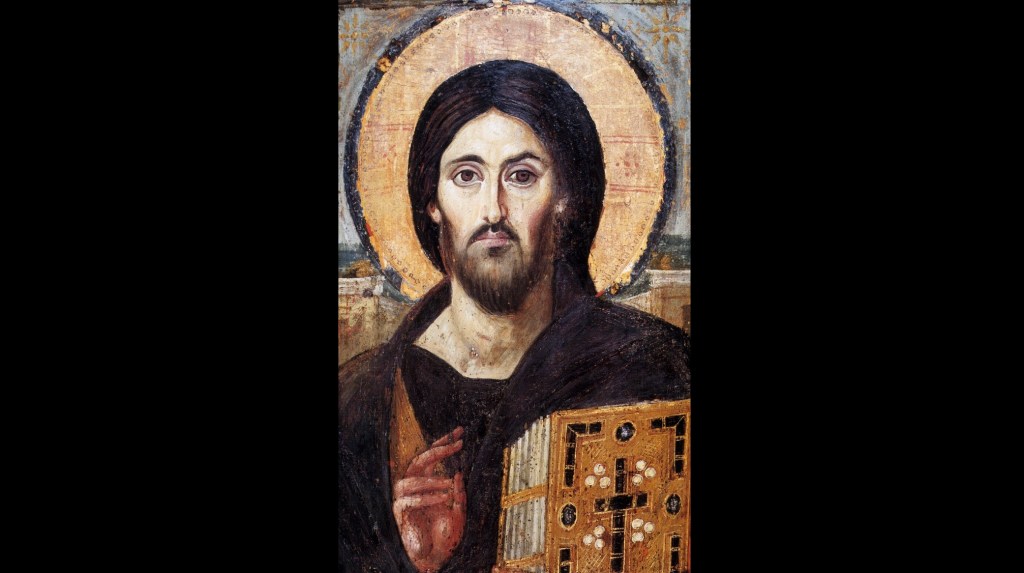
Picture: The mosaic of Jesus Christ the Pantocrator, Ruler of the Universe, at Hagia Sophia, in Istanbul, Turkey. What does he ask of you today?

Link for the Mass readings for Saturday, January 25, 2025