We can become like Jesus.

Ordinary time in the Church calendar year is anything but ordinary. It is during this season, that the primary focus of the readings chosen from the Gospels are on Jesus’ life and teachings. By making time to read, pray, and meditate upon his word, and then putting what we have learned into practice we become his disciples.

We get the word disciple from the Greek, mathētḗs, and Latin, discipulus, which both mean pupil. A pupil is one who learns from the teacher. And as we heard in today’s Gospel, Jesus is teaching his disciples that:“No disciple is superior to the teacher; but when fully trained, every disciple will be like his teacher” (Luke 6:40).

Who wouldn’t want to be more like Jesus? There are many ways to answer that question. Some possibilities come down what people’s experience of Christians have been, what their concept of Jesus is, and what they think about and decide to do with his teachings.

When we spend any time reading his teachings, we will come across some that are challenging. Just as when those who heard that Jesus is the true bread from heaven and that those who followed him would eat his flesh and drink his blood walked away. They had enough. Multiplying five loaves and two fish were one thing, but eating his flesh and blood was quite another. But the twelve stayed, for when Jesus asked them if they would leave also, Peter said, “Where else are we to go, you have the words of eternal life.”

That is the answer of a disciple of Jesus. Even when we may not understand, disagree, or don’t feel we are capable of putting into practice some of Jesus’ teachings, we can trust that what he is saying is the truth. They are not unreasonable and not impossible. We may not understand or be able to do them because we are incapable of understanding without insight from the Holy Spirit and cannot put them into practice on our own power apart from Jesus. Jesus is the Word, he is our life and the source of our strength and with him all things are possible.

Jesus has challenged us in our most recent daily readings to love our enemies and those who hate us, outlined how we will be happy by living out the beatitudes even though they may seem counterintuitive, and as he has shared today, that we are not to judge others. If we do not agree, do not feel we can, then we bring our struggle to Jesus. We ask him to help us understand how we can love our enemy, how we can forgive, and not judge. And bring to him those specific persons we call to mind.

When we trust in Jesus, are honest with him, and share where we are struggling with his teachings, while trusting in him as Peter and the other Apostles did, we will come to understand, be transformed, and grow in our relationship with him. Seeking out guidance from those who are living those teachings is also helpful. Even when we feel like we can’t love or forgive someone, as long as we are willing to invite Jesus to help us to resist judging, to love and forgive, he will do so through us, and we will make progress. We will learn from our teacher, be empowered by him, and become like him.


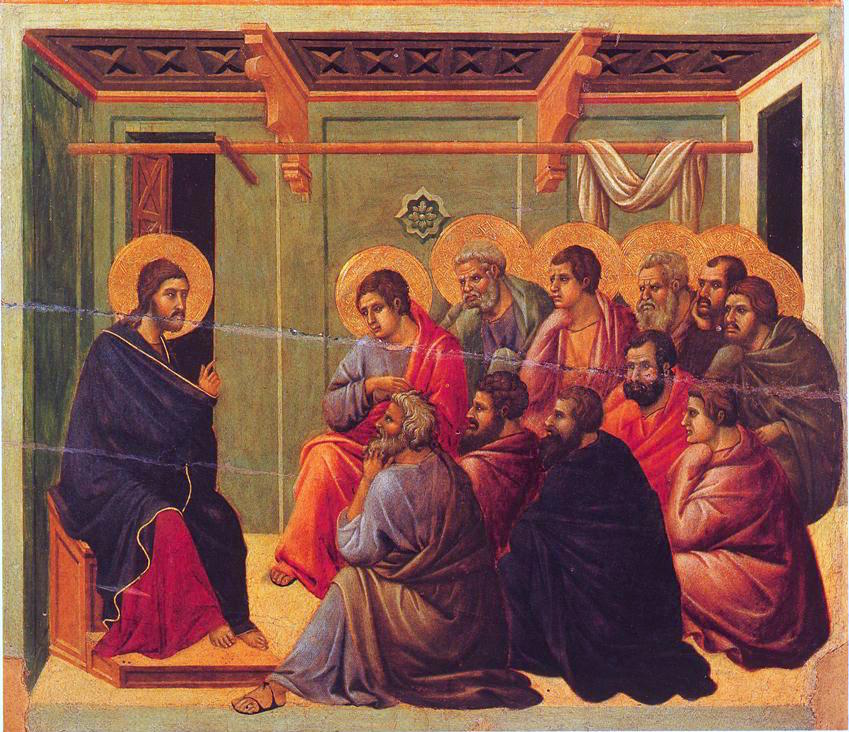
Painting: Christ Taking Leave of the Apostles by Duccio Buoninsegna

Link for the Mass readings for Friday, September 13, 2024

Jesus is calling and sending us as he did his Apostles.

“I was no prophet, nor have I belonged to a company of prophets; I was a shepherd and dresser of sycamores. The Lord took me from following the flock, and said to me, Go, prophesy to my people Israel” (Amos 7:14-15).

Amos is pushing back against Amaziah, the priest of Bethel, who told him to no longer preach in Israel. He was saying basically, if you want to preach, go back to where you came from, to Judah and preach to your people there. Amos wasn’t going anywhere. He was not there for profit nor did come through the company or guild of prophets or was he the son of a prophet. This was no profession for him, he came to Israel to share God’s message of repentance because God sent him to do so.

The Gospel message from Mark shows Jesus doing the same. He, the Son of God, who was sent by his Father, was now sending the Twelve who he had called and taught. They too, like Amos, were to rely solely on the providence of God, to trust him to give them what they needed for their ministry of going out, to evangelize; to share the good and what may be for some, the bad news.

They were to share the goodness of God the Father’s mercy, grace, forgiveness and love, while at the same time challenge the people to reform and change their lives, to repent from that which they were doing that was going against God’s will. The beauty of this both/and is outlined in Psalm 85: “Kindness and truth shall meet; justice and peace shall kiss. Truth shall spring out of the earth, and justice shall look down from heaven” (Psalm 85:11-12).

Too many times we can fall into an overemphasis on one or the other creating an either/or. A heavy-handed emphasis on justice and forgetting the tender compassion of mercy, or an overemphasis on mercy at the expense of justice. Jesus is the incarnate expression of the balance of both justice and mercy as presented in Psalm 85.

St. Paul outlines the richness of this balance in Jesus to the Church at Ephesus. For he writes, it is in Christ that we receive our blessing, in him: we receive our redemption and are forgiven, we hear the truth of his will, and we are chosen by God in Christ – before time began! We have been chosen to be holy, set apart by God for a unique purpose. We can reject or accept this offer for God loves us so much that he is willing to risk our, “No.”

Amos seemed to be saying to Amaziah that he was quite satisfied being “a shepherd and dresser of sycamores.” Yet, he assented to God’s call and went north. I understand. I was content in my teaching position and contemplating an earlier retirement, but when I asked God what he wanted me to do, he had another idea. I, like Amos, said, “Yes.”

The Apostles said, “Yes” as well and Jesus sent them out two by two. He was sending them out of their comfort zones and without the security of the material support. He was not sending them out unprepared, even though they were not to taking anything on their journey but the tunic they wore, their sandals, and a walking stick. Jesus sent them out with his authority and the commission, to preach repentance, cast out demons, anoint and cure the sick.

They were to trust and completely depend on God’s mercy and providence as they went out to evangelize. To evangelize, Jesus did not mean to advertise and convince. They were sent to share the Gospel and not worry about whether it was to be accepted or rejected. If accepted, they would stay with those who were hospitable and not leave if a better offer of lodging came along. If they were rejected, they were to “shake the dust off their feet.” They would move on. As St. Mother Teresa likewise taught her sisters, they were not sent by Jesus to be successful, they were sent to be faithful to what Jesus was sending them to say and do.

Jesus is calling us as well to repentance, so we can receive more of God’s love, be drawn closer into relationship with him, so that we can know and fulfill our own unique role in his plan of salvation history. This is a call that will stretch us beyond our comfort zones, it is a call to let go of the security in anything material and to rely and depend instead upon God first and foremost. We will face rejection and ridicule or worse, and yet, we will experience fulfillment, meaning, joy, and a love beyond anything we can ever imagine. Each day is a new opportunity to say yes to the invitation Jesus shares with us and he will provide what we need to follow him as we walk upon the path of our journey of discipleship one step at a time.


Photo: Spending some time with Jesus and the Apostles during my holy hour in our adoration chapel yesterday afternoon before celebrating the 4:30 Mass at Holy Cross Catholic Church, Vero Beach.

Link for the Mass readings for Sunday, July 14, 2024

Any willingness to share, Jesus will multiply.

As Christians we are called to be disciples of Jesus, to learn his teachings, and follow his ways. We are also called to be apostles in that we are to go out, proclaim, and share that he is who he said he is, and how he has affected our lives. Often when we are reminded of this message though, we may feel inadequate. We may question what it is that we can even possibly offer to help build up the kingdom of God. We may feel we have nothing to share, nothing to give, nothing to say, or that what the Lord asks of us, we do not know how to accomplish.

The disciples express similar feelings today for the latter point. Jesus shows concern for the thousands who had just listened to him for three days and are readying to depart. He is concerned that they are hungry and that some may collapse on their way home. The disciples look about bewildered as to how they could possibly feed the vast crowd. Then Jesus asked, “How many loaves do you have” (Mk 8:5)? They responded that they had seven loaves and two fish. Jesus would go on to feed, not only the whole multitude gathered, but when all ate their fill, seven baskets of bread fragments were left over.

We may not know how to take active steps to live our faith out in our daily lives, we may not even be aware of how to begin. On the other hand, we may have actually been engaged in service, but have started to coast, gotten complacent. If we are not moving ahead in the spiritual life, we are moving behind.

Each day is a new opportunity to begin again, and a good way to do so is to place ourselves in the presence of Jesus. We can sit before a statue, a picture, or an icon of him, we can look out a window, sit on a porch, or go outside. Any place that we can just be still and close our eyes will work. Then take some deep breaths, be silent and return to today’s Gospel account. The need of the people that were with Jesus for three days was hunger. As you reflect, what is your need? What needs might there be in your family, friends, neighbors, colleagues, or classmates? What needs in your community?

As you ponder these questions, resist any temptation to self-censor. Allow any need or needs to arise. Once you identify a concern, listen to the same words Jesus asked, “What do you have, what can you offer?”

You may not have an immediate answer. Stay with the question for a period of time, take it with you throughout the day if need be. Resist looking for the big response, a grand plan. Ask yourself what you can offer, no matter how small. Your willingness to share and to help, Jesus can multiply and bring about amazing results.

The disciples only gave seven loaves and two fish, which seemed insignificant to feed the thousands, and yet, Jesus multiplied that meager amount to feed all present with seven baskets left over. Jesus provides, Jesus works through us. The question we need to answer is not are we worthy, wise, or strong enough? The question we need to answer is, “Are we willing?”


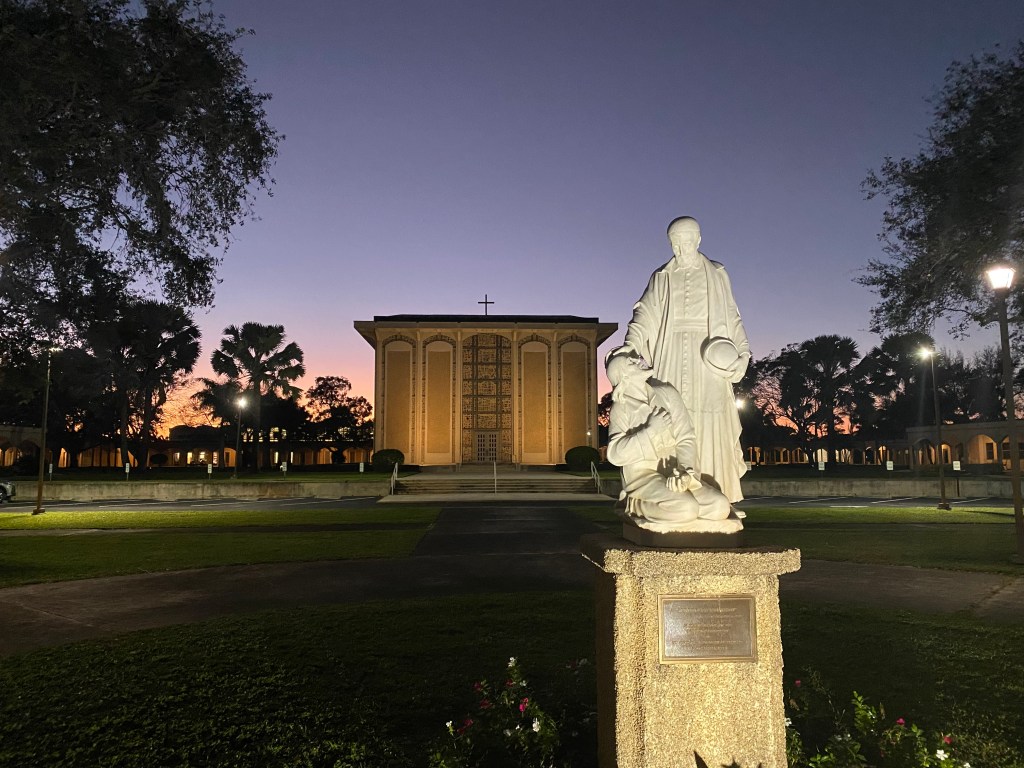
Photo: St. Vincent De Paul, our patron saint at the seminary, was willing to help and Jesus touched many through him. Entry to St. Vincent De Paul Regional Seminary, Boynton Beach, FL.

Link for the Mass readings for Saturday, February 10, 2024