When there appears to be no way, trust in Jesus the Way.

Luke records how Jesus had been teaching and healing a large crowd of five thousand men. As the day was drawing to a close, the Twelve approached him and said, “Dismiss the crowd so that they can go to the surrounding villages and farms and find lodging and provisions; for we are in a deserted place here” (Lk 9:12). The disciples appear to show concern for the many gathered. Yet the response of Jesus may reveal otherwise.

When Jesus tells them to, “Give them some food yourselves” (Lk 9:13), the disciples are stymied, for all that they had, five loaves and two fish, would barely be just enough to feed themselves. The disciples first sought to send the people away, then could see nothing but the limited resources they had, they saw lack.

What follows is the miracle of the multiplication of the loaves and the fish such that everyone present had enough to eat. “They all ate and were satisfied. And when the leftover fragments were picked up, they filled twelve wicker baskets” (Lk 9:17). This miraculous account is recorded in all four Gospels. Time and again, throughout the Gospel accounts, Jesus is  able to provide a way where there appeared to be no way.

It is interesting as well that the word the disciples used, deserted, for we are in a deserted place, is erēmos in Greek. The immediate allusion is to the Hebrews who Moses had freed from Egypt. They too were in the deserted place, the wilderness. They also say their lack and constantly grumbled to Moses that they didn’t have enough and yet, God consistently provided for them bread from Heaven, the manna. Each day they did have enough to eat.

Erēmos can also be translated as lonely, a lonely place. One thing that is common among all of humanity is that we all experience loneliness. This is partly true because we separate ourselves from the deepest desire and hunger of our soul, our hunger to be loved by God. When we allow anyone or anything to be placed before our relationship with God, we will always experience a lack because only our relationship with God will truly satisfy us. Even the best of relationships, the best of things are finite, and will not last. In establishing and developing our relationship with God, all our other relationships and appetites can be properly ordered.

The next time, we feel like we can’t, we want to give up, we feel alone or are experiencing desolation, let us turn to our loving God and Father who will provide for our needs. He provides for us at every Mass the opportunity to experience his Son, the true miracle of bread and wine becoming the Body and Blood of Jesus the Christ. We can be nourished weekly, even daily, by the “source and summit of the whole Christine life” (Lumen Gentium) so that we can have the strength to persevere, that we can persevere, we know that we really and truly are never alone, and our desolation can be transformed into consolation by experiencing the love of the Holy Spirit.

Let us not buy into the lie of lack. Where his disciples saw lack, Jesus saw a way provided for by trusting in his Father and he multiplied the five loaves so the 5,000 all had their fill. We are finite human beings living in a finite world, yet we are not alone. Jesus, fully human and fully divine, continues to still be with us, present to us, just as he was with his disciples. As with them, when we trust in Jesus, all things are possible. When there appears to be no way, Jesus is the way. “When we give ourselves to Him, we receive a hundredfold in return. Yes, open wide the doors to Christ – and you will find true life” (Pope Benedict XVI in his inaugural homily, Sattler). Trust in Jesus today!


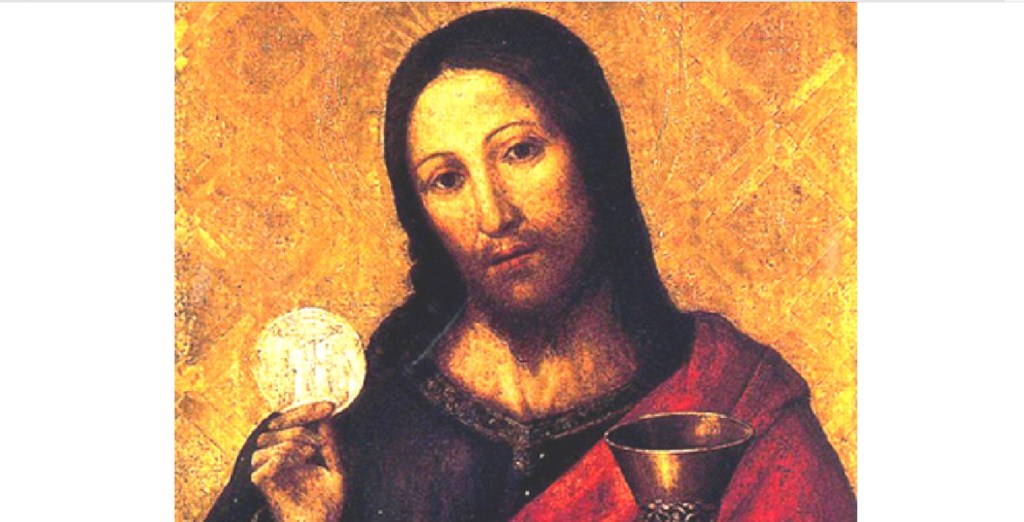
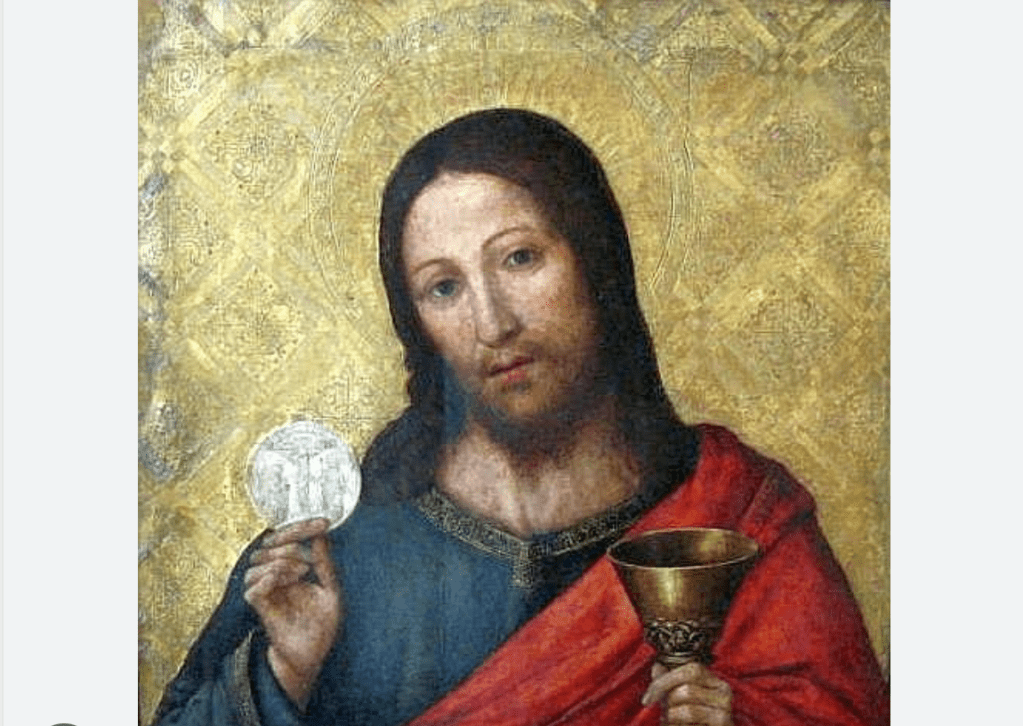
Photo: “Christ with the Host” by Paolo da San Leocadio

Link for the Mass readings for Sunday, June 22, 2025

Jesus is the “bread from Heaven” and “the Holy One of God”. Are we convinced?

Even though Jesus had fed the five thousand and they were satisfied and there was plenty more where this gift of grace came from, even though they traveled by boat and followed him to Capernaum seeking a sign, the discourse regarding eating his Flesh and drinking his Blood was just too far of a stretch for most of the disciples to take. In fact: Many of the disciples of Jesus who were listening said, “This saying is hard; who can accept it” (Jn 6:60)?

Many of his disciples walked away from Jesus at that point and returned to their former ways of life. They could not believe because they did not fully appreciate who Jesus was, the One from above, who was sent by the Father. They had not developed a deep enough relationship with him such that they could trust him and that what he said was true, they could not believe in the One whom God had sent.

Jesus then said to the Twelve, “Do you also want to leave?” Simon Peter answered him, “Master, to whom shall we go? You have the words of eternal life. We have come to believe and are convinced that you are the Holy One of God” (Jn 6:67-69). Peter’s response is one of belief, trust, and love. Peter probably had the same doubts as those disciples who left Jesus but he trusted Jesus enough that even though his teaching was hard, even inconceivable, he stayed and believed that Jesus would make sense of it for them.

May this be our response as well. When we find some of Jesus’ teachings hard to digest, let us resist the temptation to walk away. Instead, may we follow Mary’s model of pondering, as she did when Gabriel shared she would bear the Savior of the world. Mary did not understand, but trusted God, and said, “Yes.” May we also follow Peter, who most likely dealt with mixed emotions and doubts, and yet, remained firm in his belief in Jesus. Peter trusted that Jesus was the “Holy One of God”. Peter had experienced that Jesus had known what he was saying and doing before, and he would continue to trust him this time as well.

More than a good model to follow, Jesus is so much more! Jesus did not want to die, but he was willing to submit his human will to his Father because he trusted him and knew he would bring about a greater good. Jesus gave his life and in so doing he conquered death, transcending the time and space of our present dimension so that he could be present to us in the Sacrament of the Eucharist. Jesus lives, he is the firstborn of the new creation, and he wants to not only lead us to eternal life, but impart his life within us, in such an intimate way that we may consume him, that we may be one with him in this life and for all eternity! May we with Peter come to believe and be convinced, that Jesus is the Holy One of God!

“Amen. Amen.
I’m alive, I’m alive,
Because he lives.
Amen. Amen.
Let my song join the One that never ends.
Because he lives.”
The verse from Matt Maher’s song, “Because He Lives (Amen)”.

—————————————————————

Photo: Accessed from Pinterest.

Link for video: Because He Lives (Amen), Matt Maher, from cd: Saints and Sinners, 2015

Link for the Mass readings for Saturday, May 10, 2025

When we eat the Body and drink the Blood of Christ we have eternal life.

All that Jesus has been building up to is now coming to a climax. Any silent shock of disbelief or quiet murmuring has now escalated. The Jews quarreled among themselves, saying, “How can this man give us his Flesh to eat” (Jn 6:52)? Jesus hears the growing concern and disbelief. If he was speaking in a figurative or symbolic way, this would be the moment to clarify his point.

Jesus does speak, but he does not walk back or qualify his comments. Jesus doubles down: “Amen, amen, I say to you, unless you eat the Flesh of the Son of Man and drink his Blood, you do not have life within you” (Jn 6:53). Jesus does not only repeat that his disciples are to eat his Flesh but he also insists that they are to drink his Blood. Drinking or even eating meat with the blood of an animal was inconceivable for devout Jews. Also, the Greek used here in John’s Gospel for eat is trogein, which is used to describe how an animal eats, by gnawing and tearing at the flesh. The imagery that Jesus is using here is more graphic than the customary use of phagein, which would be used for chewing, as a human would chew their food.

Jesus continues to make his point that whoever does eat his Flesh and drink his Blood, will not only remain in him, but also Jesus will remain in them, and they will have eternal life. A wonderful end goal, but would any be able to make the leap of faith to get there? In tomorrow’s Gospel reading we will be able to see the response to Jesus’ claims.

Almost two thousand years later, we continue to have the opportunity to celebrate daily the person of Jesus in our midst. This happens through participating in “the source and summit of the Christian life” (Catechism of the Catholic Church, 1324), the Mass. Our hearts have the opportunity to be set on fire as we hear the word proclaimed during the Liturgy of the Word, and then Jesus is made known to us in the breaking of the bread in the Liturgy of the Eucharist. We are invited to experience an intimate encounter with the Son of God, as we consume him, Body, Soul, and Divinity.

That we eat the Flesh and Blood of Jesus may sound just as bizarre as it did to Jesus’ followers. The term we have for this miraculous transformation of bread and wine is transubstantiation. What happens at the calling down of the Holy Spirit and the words of institution which are invoked by the priest is that the substance, the reality, of the bread and wine is transfigured into the Body and Blood of Jesus, while the accidental form or appearance remains the same. So we consume Jesus’ unbloody, acceptable sacrifice. We consume his glorified body that has transcended the three dimensional realm as we know it.

Jesus is giving all of who he is corporally, holding nothing back of himself so that we receive all of him – Body and Blood, Soul and Divinity. The miracle does not stop there because in the receiving of Jesus’ fullness in the appearance of bread and wine, we also become divinized through our participation in his life as he permeates our whole being. We receive eternal life! This takes the saying, we are what we eat, to a whole new level.

This gift we get to then share. We are dismissed at the end of the Mass to go, like Mary, to bear Jesus Christ, to love others as Jesus loved us. In seeing and receiving Jesus in the Eucharist, we better see him in each other and are then inspired to serve one another. For what we do to the least of our brothers and sisters, we do to Jesus (cf. Mt 25:40). Jesus is risen, he has risen indeed, and he has not left us orphans but remains with us now and for all ages most intimately in the Eucharist! We are alive and given eternal life, because the Bread of Life lives within and among us! Amen. Alleluia!

——————————————————–

Photo: “Christ with the Host”, by Paolo de San Leocadio

Link for the Mass readings for Friday, May 9, 2025

“The bread that I will give is my flesh for the life of the world”

Those in the crowd who Jesus is speaking are those who experienced his multiplication of the loaves and fish. Step by systematic and deliberate step, Jesus is setting the stage for today’s insertion into his presentation.

Jesus begins slowly, but with each successive addition in his presentation, he is not willing to be tamed. He, as the One from above, the One who has seen and has been sent by the Father, is fully divine, as well as fully human, is speaking among those who have come to him. He has responded to the people’s request regarding how they were to “accomplish the works of God” (see John 6:28-29) and his response is that they are to believe in him, he who had been sent by God. They were to “work for food that endures for eternal life, which the Son of Man will give” (John 6:27). Jesus with the multiplication of the loaves and fish provided for those who were hungry in the moment. He provided physical nourishment. He is now moving from satisfying physical needs, to how he will provide food that will endure for eternal life. Jesus shared that he is this food, the bread from heaven, that will give life to the world.

What Jesus has shared thus far and what he shares in today’s Gospel message has been given to him to say from his Father and is for everyone who is willing to accept his invitation: “I am the living bread that came down from heaven; whoever eats this bread will live forever; and the bread that I will give is my flesh for the life of the world” (John 6:51). We have an advantage, that those listening to Jesus, did not have. We just experienced Lent and we can certainly draw a line to how Jesus certainly does give his very life, his Flesh, that is sacrificed and hung on the cross. Jesus died and experienced utter God forsakenness by giving his very life for the life the world.

But for those in the crowd who only the day before sought to unanimously make him their Messiah by popular acclamation are, with each word expressed by Jesus, growing a bit uncomfortable. This discourse is moving away from what might have initially appeared to be a figurative discussion to a more dramatic and concrete presentation with horrific implications. After an initial gasp or two, some murmuring started to circulate, maybe centering around such questions as:

“Did Jesus really just say he would give his flesh?”

“Jesus is equating himself with the bread from heaven, and the bread he is offering is his flesh?”

“Is Jesus saying what I think he is saying?”

Yes! The Jesus is stating clearly that he is the Bread of Life, and this Bread is his very Flesh. The Father has given all that he is, holding nothing back, emptying himself into the Son. The Son has received all that the Father is and returns himself, giving all that he is, holding nothing back, to the Father. This eternal giving and receiving, this eternal communion of Love shared between the Father and the Son is the Holy Spirit. Jesus is offering his listeners and continues to offer us today participation in this perichoresis, this divine dance of infinite communion. Jesus offers all that he is to be consumed. He is holding nothing back in his offer to us of his very Body.

Just as he gave all of himself on the cross, he gives all of himself, holding nothing back in his glorified Body present in the Eucharist. We are invited not only to receive all that Jesus is, we are also invited to give ourselves away in return. As we receive, we become who we eat. We are transformed by the love of Jesus’ presence in our being as we consume him so that we to, as Jesus did, give of ourselves to serve others.
—————————————-

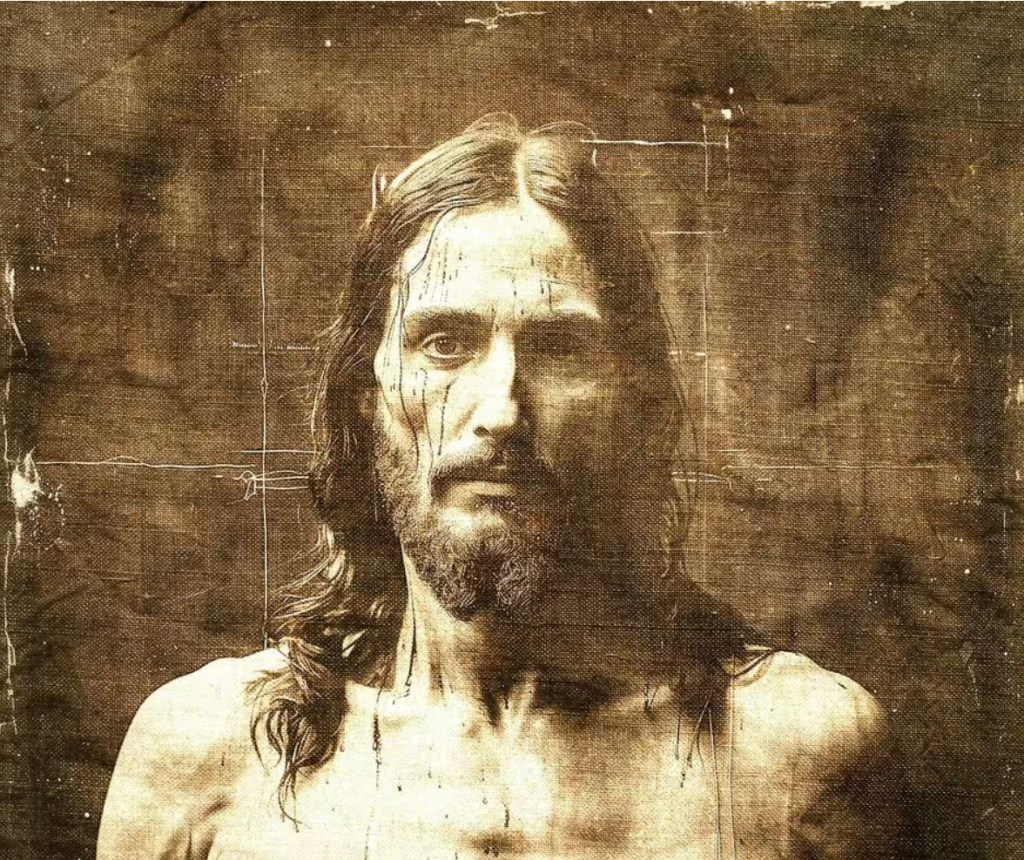
Photo: Newly generated AI image of Jesus from the Shroud of Turin.

Link for the Mass readings for Thursday, May 8, 2025

“I am the bread of life.”

Yesterday and today’s Gospel readings from John are laying the groundwork for Jesus’ Bread of Life discourse. In yesterday’s account, Jesus shared with the people who gathered about him, the people who had already received the miraculous multiplication of bread, that they were not to “work for food that perishes but for the food that endures for eternal life” and Jesus also shared that they were to “believe in the one [God] sent” (see Jn 6:27-29).
In today’s account, Jesus asserted that he was even greater than Moses. The people, who believed that Moses gave them bread from heaven, asked Jesus for a similar sign, to prove he was who he said he was. Jesus reminded them first and foremost that his Father, not Moses, had given them the bread from heaven, and also as he often did, met their request but built upon it: “My Father gives you the true bread from heaven. For the bread of God is that which comes down from heaven and gives life to the world” (Jn 6:32-33). Certainly, this offer is appealing, and so the people not only want some of this bread also, they want an endless supply of it. Jesus continued to build on the foundation he had been building to the core structure of his point: “I am the bread of life; whoever comes to me will never hunger, and whoever believes in me will never thirst” (Jn 6:35).
Jesus encouraged his listeners to pursue the food that “endures for eternal life” to believe in the one his Father sent, then he shared how his Father gave them the true bread from heaven, “for the bread of God is that which comes down from heaven and gives life to the world.” Jesus is the one his listeners are to build their relationship with, for he is the very presence of God in their midst. Jesus is the promise of eternal life. Jesus is the one sent by his Father to give life to the world. Jesus is the bread of life!
We are a living craving, hunger, and desire to be one with God and each other, and this is true for the atheist and the believer alike. That which God has created, he has created good, but the material and finite will not fulfill us. We, in short order, experience the limitations of the finite and seek something more. This is how we are wired, because ultimately, our deepest hunger, craving, and desire, is that which we seek to fulfill us, and is eternal. The only One to satisfy our eternal hunger is the bread of life, Jesus the Christ, the Son of the living God.
Do we believe this to be true? Do we believe that Jesus is the bread of life, that he is the source and sustenance, the very foundation of our being and existence?
If we have been caught up: in the business of life, in the mere existence or survival mode of the day-to-day, or stuck in our sin, addiction, wounds, or disillusionment, or if we feel like we are just running on empty. If we have just taken this reality for granted, then let us seek to, “believe in the one who God sent”, commit or recommit our selves, our very life, to the one who is our source and sustainer, Jesus, the Bread of Life. When we encounter Jesus in his glorified body, present in the consecrated host, we encounter our Savior, the bread of everlasting life who will satisfy our deepest hunger and thirst.
——————————————————————-
Photo: “…this is my BODY, which will be given up for you.”

“Behold the Lamb of God.” He who was born and died for us.

John the Baptist saw Jesus coming toward him and said, “Behold, the Lamb of God, who takes away the sin of the world” (Jn 1:29).

The only one who can take away sins is God. The unblemished lamb is the animal that is sacrificed at the Passover meal, commemorating when the angel of death passed over the Hebrews whose doorposts were marked with the blood of the lamb. The next day they were freed from their slavery under pharaoh, and the exodus event began culminating in their passing through the Red Sea to freedom.

The Son of God became human to become the Lamb of God. He experienced laughter, pain, suffering, love, tears, and all of our human condition even temptation, but he did not sin. The Son of God became human so that what he assumed in his human condition, he could redeem. As the Lamb of God, Jesus approached John for baptism, he took upon himself the sin of the world and submitted his divinity to his human condition and was willing to be baptized for repentance not because he sinned, but so that he could take upon the sin of the world upon himself. This act was also a foreshadowing of his crucifixion on the cross.

The Incarnation, the Son becoming fully human while remaining fully divine, was the premiere act of mercy, in that Jesus entered the chaos and woundedness of our lives. His allowing himself to die on the cross the greatest expression of his love. The same love that he shares with his Father, his receiving and returning all that he received to the Father and holding nothing back, we can see him doing so visibly when we look upon a crucifix. He was born and died, he gave everything, including his life for each and every one of us.

Alone we cannot be redeemed, we cannot be fully healed or restored to who we have been created to be. We need a savior. Jesus is, while at the same time, more than a model to follow or a teacher to guide us, he became one with us in our humanity to lead us up out of our brokenness and sin. In saying yes to his invitation, we can say with Paul, “yet I live, no longer I, but Christ lives in me; insofar as I now live in the flesh, I live by faith in the Son of God who has loved me and given himself up for me” (Galatians 2:20). This is the gift we have received again this Christmas, a reminder that when enter into a relationship with Jesus, he grants us the grace to access and share in the divine power of the Love experienced between God the Father, God the Son, and God the Holy Spirit.

Jesus holds his hand out to each one of us today. May we receive his hand in our own, and as our fingers touch his palm may we feel the wound there, embrace the remembrance of the nail that pierced his flesh, the pain that he endured, so we could have this very moment with him. Even in our brokenness, anxiety, confusion, fear, and sin, may we resist pulling away. May we feel the warmth of his hand grip ours. Let our gaze be drawn up to see his face, his smile, his forgiveness, and experience his infinite love for us.

I am blessed at each Mass as I hold up the consecrated host to be able to say, “Behold, the Lamb of God, behold him who takes away the sin of the world.” May we see, believe, and receive the Body and Blood of Christ. Amen.

———————————————————-

Photo: Christmas Morning Mass, Holy Cross Catholic Church, Vero Beach, FL.

Link for the Mass readings for Friday, January 3, 2025

Body and Blood, Soul and Divinity

Last week we ended the gospel account with these words from Jesus: “I am the bread of life; whoever comes to me will never hunger, and whoever believes in me will never thirst” (Jn 6:35).

Jesus is offering these words from the context of how his Father has constantly provided for his people as seen in the examples of the Hebrews being freed from their slavery from Egypt, and then God providing bread from heaven in the form of manna. Jesus multiplied the five loaves and fish to provide for the thousands. In our first reading today, God sends an angel to feed Elijah a hearth cake and water to give him nourishment and strength for his forty-day journey.

As a good Father, God provides for his children. He also loves us so much that he is willing to risk that we will reject his offer, which unfortunately, many people have done for generations. Yet, God remains faithful, awaiting the time to help and provide need when there is an opening.

This week we heard the reaction of the people to Jesus’ statement that he himself is the bread of life, he will be the one to satisfy the people’s hunger and his thirst, their deepest hunger, their soul hunger. He is inviting the people to receive him so that they will never have to hunger again. Jesus is not met with open arms of wonder, but “grumbling.”

This word was not chosen at random. This is the same word that was used to describe the Hebrews who were freed from their slavery and provided for by God but instead of being grateful for their freedom and God’s care, they sought for what they left behind. They complained that with Moses and God they were in a worse state than when they were enslaved in Egypt.

The people witnessed Jesus multiplying of the five loaves and two fish and they were amazed with the physical manifestation of that miracle, but now as Jesus is going deeper into the spiritual reality, they, as did his own hometown crowd, balk. And even respond in a similar fashion. Who does this Jesus think he is saying that he came down from heaven? “Do we not know his mother and father” (Jn 6:42). Apparently not!

Mary is his mother, but Joseph is not his father. His Father is God. Jesus is the Son of God who became man in the womb of Mary. While remaining fully divine as Son, he takes on human flesh and becomes fully human. His appearance is that of any other man, on the surface he appears to be the son of Joseph and Mary. Jesus is the incarnation of the Son of God the Father. He is the bread of life that has come down from heaven to nourish us physically and spiritually.

Jesus does not soften his language as he continues. He affirms that he knows God the Father because he has come from the Father and he invites those who are listening to believe in this truth and for those who do, they will have “eternal life.” Jesus does not stop there but continues to share how as “living bread”he will give life forever and then he goes over the top: “the bread I shall give for the life of the world is my flesh.”

If Jesus was concerned about their grumbling when he said he was the bread come down from heaven, he didn’t show it here by stating that he will give his own flesh. This is not symbolic language to recall the quail God sent in the desert either. Jesus was offering his own flesh.

This he did in giving his life to the full on the Cross and will be represented again on the altar at each Mass. People were having trouble understanding how Jesus could have come down from heaven, how he could be the bread from heaven, and now what were they going to do with his statement that he was going to give his flesh to eat? They were having trouble understanding what Jesus was saying because they did not understand who he is.

Understanding who Jesus is helps us to understand the Bread of Life discourse we have been exploring these past two weeks. At the surface, the physical level, even with the miracles that Jesus performs, even those who are eyewitnesses, do not see Jesus being anyone other than a human being, extraordinary to some, ordinary to many others, just the son of Joseph and Mary. And yet, Jesus is so much more.

Jesus is the Son of God come down from heaven, he took on flesh in the womb of Mary, lived, died, and conquered death so that he could ascend, return to the Father, not as he came as fully divine but now fully divine and fully human. This is how he can give us his Body and Blood in the appearance of bread and wine, because he has transcended time and space. He truly is the Bread of Life. We like the crowd are given a choice.

God the Father, God the Son, and God the Holy Spirit do not impose, they invite, they draw us in with tender chords of love. They give us the free will to either reject their invitation or to ascent with our faith and accept their invitation to participate in their communion of love.

In the Mass, Jesus will come among us again through the power of the Holy Spirit and the words of institution: the words of Jesus said in the first person by the priest. Jesus is the bread of life who will again come down from heaven, not as the same human body that walked among the apostles and the crowd, but in his glorified body that has ascended into heaven. Although the appearance of the bread and wine will remain, the substance will be transfigured to be the Body and Blood, Soul and Divinity, the source and summit of our faith!!! Today we will receive our daily bread, the superabundant bread of life that will satisfy the deepest yearning of our souls and sustain us as we journey through this life to the next!


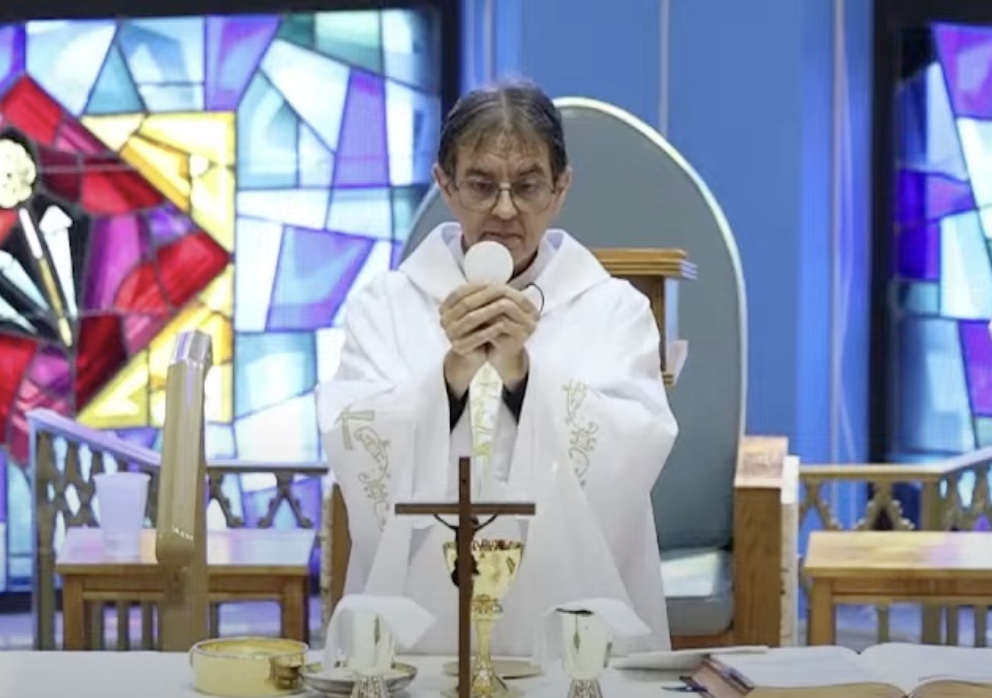
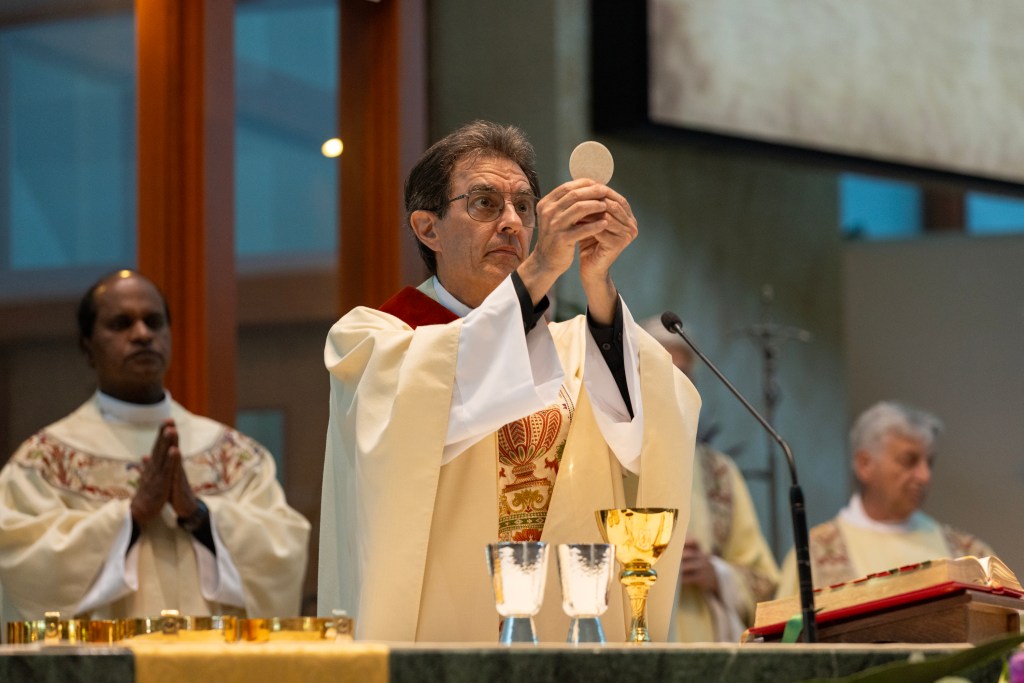
Photo: First Mass of Thanksgiving at St Peter Catholic Church; I am blessed at each Mass to hold in my hands, the Body and Blood of Christ.

Link for the Mass readings for Sunday, August 11, 2024

“This is my Body”… “This is my Blood”

This Sunday, and for the next five Sundays we are being invited to participate in an adventure. Each week we will journey together through the pages of Chapter 6 of the Gospel of John. The beauty of this chapter and the road we will walk side by side is one that means everything to us as followers of Jesus Christ. And as we will see, not everyone in the written account, in fact only a few, make it through to the end.

My hope is that each one of us here today not only make it through the journey, but that we are transformed, and our faith is renewed. What Jesus unveils for us with each verse of his teaching is the miracle of miracles, the sign of signs, God from God and Light from Light. Jesus will be sharing with us his Bread of Life discourse. Jesus will reveal that he is truly the Bread of Life come down from heaven. Jesus, the Son of God, becomes one with us in our humanity so that we can become one with him in our divinity. He comes even closer when he gives us himself in the appearance of bread and wine to be consumed.

My invitation for you during these dog days of summer is to get out your Bible, dust it off, if it has been a while since you have pondered its pages, and then slowly, prayerfully, each day over the next month, read, pray and meditate with John Chapter 6 and so come into each Mass even better prepared to receive the miraculous gift that Jesus wants to share with us.

We begin our journey by joining the “large crowd” following Jesus. They have gathered around him because they have seen or have heard about his healings, his exorcisms, and his teaching with authority and they are hungry for more. They are not aware of how hungry they are, and what will truly satisfy their deepest hunger. This is just as true for each of us. As Jesus watches them gather, he wants to not just satisfy their immediate hunger, but also to set the stage to reveal for them the deeper hunger of their soul.

Jesus seeks the same for his Apostles and so asks them, “Where can we buy enough food for them to eat” (Jn 1:5)? Philip is stymied and doesn’t have a clue, but Andrew steps forward to share, “There is a boy here who has five barley loaves and two fish”. I can see Jesus’ eyebrows raise here as he looks to Andrew with some hope in his heart that Andrew is getting it. But then as Andrew continues he also assumes the posture of Philip, “but what good are these for so many” (Jn 1:9). So close, Jesus might have said and then sighed with a smile as he received the loaves and fish.

We know what happens next, Jesus took the five loaves and two fish, gave thanks to his Father, and all ate their fill and with enough left over to fill “five wicker baskets” (Jn 1:13). This miracle transpired with the little that was given, and remember Andrew received this meager amount from a boy.

In the ancient near East, children had no rites. Imagine this boy’s reaction. He was wise enough to bring food for the long trek back for him and his family, and now he had none. He was willing to give away his food and yet how would this be enough? Would he now go hungry too? Instead of running away at break neck speed when Andrew approached him for his food, the boy trusted and gave all he had. Was there something the boy saw in Jesus, just enough of a spark of faith to trust. There must have been because he gave and all were filled because he did so.

With the little that we give Jesus, when we trust in Jesus and let go, as the boy did, and as we surrender to his will, miracles happen. Jesus could have created food out of nothing, as his Father created the universe out of nothing, but he sought the participation of those around him. This happens at every Mass. The bread and wine that are brought to the altar represent the little that we bring to Mass. Our financial offerings yes, but also our prayers, our petitions for ourselves and intentions for others, as well as our deepest hunger.

Jesus receives what we give and multiplies it just as he did with the multiplication of the loaves. The priest takes the bread first and then the wine into his hands and speaks the words of Jesus again and through the power of the Holy Spirit, the bread and wine become the Body and Blood of Jesus. How do we know this to be true? Because Jesus said then and we hear his words again at each Mass:

“This is my Body”.

“This is the chalice of my Blood”.

In the miracle of Jesus multiplying the five loaves and three fish to feed the thousands, he was setting the stage for the miracle we get to experience at each Mass. The appearance of bread and wine remains, but its substance, the reality at the core, has been changed to become the Body and Blood of Christ. This miracle we don’t just read about, but can experience and receive him again and again to satisfy the deepest hunger of our souls.

We are just beginning, the journey continues next Sunday!


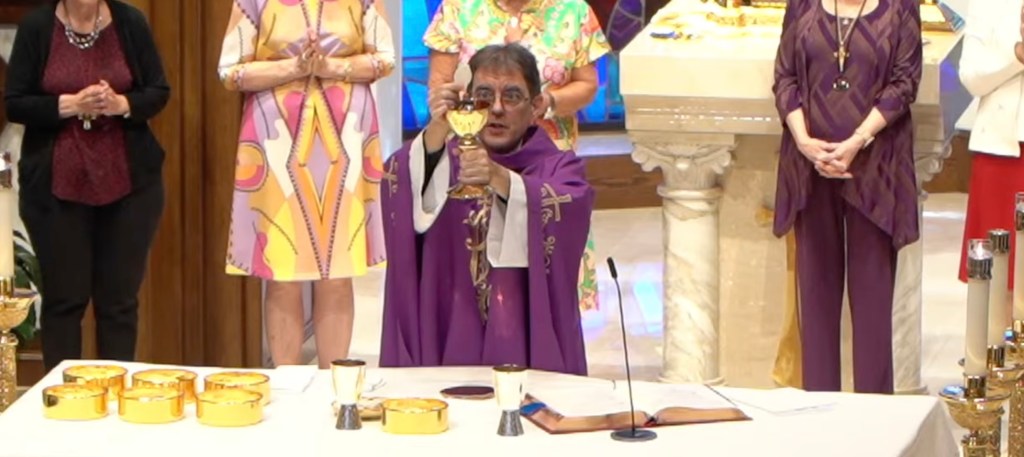
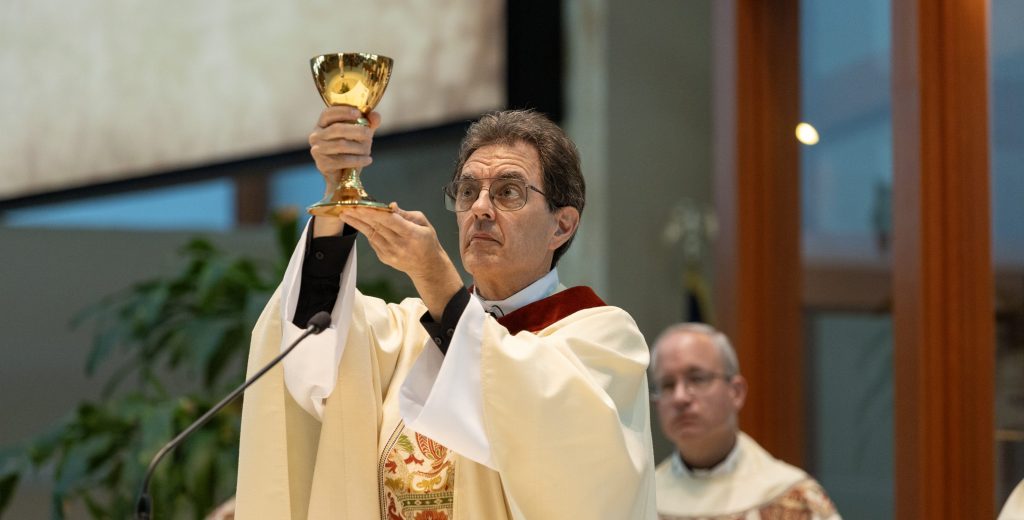
Photo: Blessed to be a priest participating in the miracle of turning bread and wine into the Body and Blood of Christ during Mass each day!

Link for the Mass readings for Sunday, July 28, 2024

Repent, receive Jesus, and bear him to others.

Return to the LORD is the plea of Hosea. In beautiful and loving language the prophet encourages Israel to come home, to leave the idols and their unfaithfulness behind. God, through Hosea, promises to heal, to love, to be “like dew for Israel.” God does not approve of Israel’s unfaithfulness, while at the same time, does not stop loving his children. With gentleness, he seeks to let his grace fall on them like the dewfall, he seeks to wash his children clean, to nourish them and satiate their thirst, to give them strength, and be the source of their life.

Jesus has come to give a visible face to the presence and promise of our God’s loving presence. He healed, cast out demons, consoled, and preached with authority. He too, in the prophetic tradition, called for repentance. Even though God never stops loving us, we cut ourselves off from his love when we choose anything and anyone over him. God must be first and we must spend time with him to grow in our relationship with him. The wonderful gift of our repentance and letting go of our control is that which is not of God is burned away like dross, and what we give to God is purified and made whole.

By trusting in and surrendering our lives to Jesus, we will heal and grow in our relationship with him, and we too like the Apostles will be sent. Jesus calls us to share the Good News of how he has been working in our lives. Not when we become perfect, but right now, even in small ways. As we receive the love of Jesus, we are to share his love with one another. We too, like Hosea, Jesus, and the Apostles will face opposition in sharing his good news. Jesus has assured us that he will send the Holy Spirit to guide us and give us the words to speak.

When we speak the words of God faithfully, that is sufficient. We are not to convince or command, but instruct and invite. As St. Bernadette of Soubirous said when pressured about the validity of her experience with our Mother Mary, “My job is to inform, not convince.” We do well to follow her lead. The Holy Spirit will work through the seeds we have planted. Let us avoid the temptation to impress and instead express the love we have received.

Jesus continually gives himself to us in the Eucharist. When we leave our sins and shortcomings in the confessional and before altar and receive Jesus, his Body and Blood, Soul and Divinity, we receive and become Christ bearers to a weary and worn world in need of repentance and hungering to experience the gentle love and forgiveness of God our Father.


Photo: First Mass of Thanksgiving at St. Peter Catholic Church. So blessed and feeling thankful to be able to share Jesus in the holy sacrifice of the Mass!!!

Link to the Mass readings for Friday, July 12, 2024

The Body of Christ

All that Jesus has been building up to, in his Bread of Life Discourse, and in each of the daily Mass readings this week, is now coming to a climax. Any silent shock of disbelief or quiet murmuring has now escalated. The Jews quarreled among themselves, saying, “How can this man give us his Flesh to eat” (Jn 6:52)? Jesus hears the growing concern and disbelief. If he was speaking in a figurative or symbolic way, this would be the moment to clarify.

Jesus speaks, but he does not walk back or qualify his comments. Jesus doubles down: “Amen, amen, I say to you, unless you eat the Flesh of the Son of Man and drink his Blood, you do not have life within you” (Jn 6:53). Jesus does not only repeat that his disciples are to eat his Flesh, but he also insists that they are to drink his Blood. Drinking or even eating meat with the blood of an animal was inconceivable for devout Jews. Also, the Greek used here in John’s Gospel for eat is trogein, which is used to describe how an animal eats, by gnawing and tearing at the flesh. The imagery that Jesus is using here is more graphic than the customary use of phagein, which would be used for chewing, as a human would chew their food.

Jesus continues to make his point that whoever does eat his Flesh and drink his Blood, will not only remain in him, but also Jesus will remain in them, and they will have eternal life. A wonderful end goal, but would any be able to make the leap of faith to get there? In tomorrow’s Gospel reading we will be able to see the response to Jesus’ claims.

Almost two thousand years later, we continue to have the opportunity to celebrate daily the person of Jesus in our midst. This happens through participating in the source and summit of our faith, the Mass and sharing in Jesus’ sacrifice and the Eucharistic banquet. Our hearts have the opportunity to be set on fire as we hear the word proclaimed during the Liturgy of the Word, and then Jesus is made known to us in the breaking of the bread in the Liturgy of the Eucharist. We are invited to experience an intimate encounter with the Son of God, as we consume him, Body, Soul, and Divinity.

That we are to eat the Flesh and Blood of Jesus may sound just as bizarre as it did to Jesus’ followers. The term we use for this miraculous transformation of bread and wine is transubstantiation. What happens at the calling down of the Holy Spirit and the words of institution which are invoked by the priest is that the substance, the reality, of the bread and wine is transfigured into the Body and Blood of Jesus, while the accidental form or appearance remains the same. We consume Jesus’ unbloody, acceptable sacrifice which still appears to be bread and wine.

Jesus is giving all of who he is corporally, fully, holding nothing back of himself so we can receive all of him. In consuming Jesus, we become more divine as he permeates our whole being. We are then dismissed at the end of the Mass to go, like Mary, to bear Jesus, to love others as Jesus loved us. By giving ourselves to others, we will also experience Jesus in each other. For what we do to the least of our brothers and sisters, we do to him (cf. Mt 25:40).

Jesus is risen, he has risen indeed, and he has not left us orphans but remains with us now and for all ages! We can have life and have it to the full when we consume the Bread of Life and so he lives within us as well as among us! Amen. Alleluia!

——————————————————–

Photo: The first time distributing the Body of Christ at my first Mass as a deacon. Looking forward to doing so as a priest soon!

Link for the Mass readings for Friday, April 19, 2024