faith


Let us rejoice, as Elizabeth and Mary did, that God is among us.
Mary “traveled to the hill country in haste” (Lk 1:39) and when she and Elizabeth got together they rejoiced in the gift of new life that God had blessed them both with. We are to rejoice too, as we remember the gift of the conception and birth of Jesus. Jesus invites us to experience a new life. What we are about to celebrate in a few days had never happened before in human history. The Son of God, the second Person of the Holy Trinity, fully divine, became a human being, fully human, just like one of us. That affirms that we are not junk, not someone’s trash to be kicked around. Our life has purpose and meaning because we are loved by God more than we can ever imagine!
We are all invited to be recreated, each and every day. Have you ever wanted a fresh start, a do-over? Well, here you go. Don’t believe any negative mind noise or other people who will actually tell you in subtle or overt ways that you are worthless or nothing. Not true! Just by our very being, the reality that we exist, says something. We have been created in the image and likeness of God and we have been created by Love to receive and to share the love we have received. We are a living craving hunger and desire to be in communion with God and one another. This is true for the atheist and the believer alike. We are called to will the good of the other as other and as they are, unconditionally. If we haven’t been all that loving lately, today is a new day to take Jesus’ hand and begin anew.
We are about to celebrate a baby’s birth. Not just any child, but the One who has always been. The Son became so vulnerable as he took on flesh as an embryo, developed as an unborn fetus, and was born as an infant, and wrapped in swaddling clothes. Mary’s Son would continue to grow, mature, and thirty-three years later, return to an even more vulnerable position on the Cross, beaten, scourged, naked, and crucified. He was born and tabernacled, made his dwelling, among us, to be one with us, so that when he mounted the cross he took our sin upon himself. Original Sin did not destroy us. We were wounded, but by his stripes, the scourging that Jesus endured for us, we have been healed. Then he conquered even death, that we could have life and have it to the full, now and into all eternity.
Jesus was born for us and he is still with us that we might not only be shown a better way but to know him, who is the Way. Jesus became vulnerable for us, being authentically who God called him to be, even when that meant rejection, time, and time again. May we too be willing to be vulnerable, to risk, to share with others who we are, free of masks and pretense. May we be present, and also walk and accompany one another.
Being there for our family and friends is important, and if we take our Christianity seriously, we must come to acknowledge, in concrete ways, person to person, that we are all brothers and sisters. Just as the sun shines on the good and the bad alike, Jesus died for us all. After his Resurrection and Ascension into heaven, he sent the Holy Spirit, the Love shared between the Father and the Son, to empower us to live as he did, in communion with his Father, to better actualize our communion with one another.
Mary and Elizabeth celebrated the joy of new life. They rejoiced over the miracles each of them experienced in being able to conceive sons. May we not only share in their joy of the gift of life, but also realize what they realized all too soon, that life goes by too fast. Both sons died a brutal death, and yet God brought about a greater good from their willingness to sacrifice their lives. John and Jesus gave us a new beginning for humanity.
Let us not take the gift of the life that we have been given, any moment, for granted. May we be open like Elizabeth and Mary to be inspired by the Holy Spirit. Let us let the people we care about know that we love them. A simple call, a card, and/or a walk can make a huge difference. Especially when in the moment of connection, we are present to each other as if no one else existed in that moment. For those for whom we may be estranged in any way, may Jesus, the Prince of Peace, help us to face those conflicts and guide us through the challenges that have kept us at a distance. May we not wait until it is too late to seek healing and reconciliation.
Making time to rest in and receive the Father’s love, we will be more open to being respectful, kind, understanding, and caring in our interactions with each person we encounter in these final days of Advent. When we catch the eye of another, offer a smile. In that simple gesture, we say to another that we care enough about them to acknowledge that they exist and that they have worth. Let the joy of Mary and Elizabeth catch like wildfire in us this Advent and let us share with haste the joy of Jesus we have experienced in our lives!
Photo: Stainglassed window of the visitation from Shutterstock.
Link for the Mass readings for Saturday, December 21, 2024

Mary’s, “yes” brought joy to the world.
Mary said, “Behold, I am the handmaid of the Lord. May it be done to me according to your word.” Then the angel departed from her (Lk 1:38).
Whether this is the first or thousandth time we have read or heard this verse, the more important question for us is how many times have we said to God, “May it be done to me according to your word”? How would it be for us to begin each day with this prayer and then at the end of the day reflect on how well we have heard and answered yes to God’s will?
Mary’s “yes” changed the course of human history. Her willingness to bear the Son of God allowed him to come close. He entered our wounded, human condition to offer us healing, forgiveness, and to lead us home to communion with his Father and each other. Jesus is the gift that keeps giving – and we receive his gift each time we, as did Mary, say “yes” to him. When we do so, we become less, as he becomes more, and the kingdom of God continues to expand.
Along with Mary, the “yes” that we make is not a one-time, “yes,” but we are to affirm a daily, moment by moment “yes”. As St Paul wrote to the Church of Thessalonica, we are to: “Rejoice always. Pray without ceasing” (1 Thessalonians 16-17). We are able to rejoice always and pray without ceasing when we say, “yes,” to God by developing and sustaining our relationship with him such that even when we experience pain, suffering, and struggles, we are not overcome or overwhelmed. When we allow Jesus to be close, we can even feel joy in the midst of them. He does not abandon us to random fate. He is our source, our refuge, and our strength, present to us in all that we experience.
Our prayers of petition for ourselves and intercession for others are another “yes” to God’s will because they are an “admission of one’s own helplessness” (Lohfink 2014, 240). Prayer is a, “no,” to pride. We cannot get through this life on our own, nor are we meant to for apart from God we can do nothing. We are all interconnected and interdependent and God is the foundation and source of our very being, and with God all things are possible.
Our willingness to ask for help and to help others are also practical ways of saying “yes” to God. There is no such thing as a “Lone Ranger Christian”. Even the Lone Ranger had Tonto. Two by two, just as Jesus sent his disciples. Prayer is a “yes” to our acknowledgment that we need Jesus to guide and help us, also to save us from ourselves! Service is a “yes” to the love we have received from him and a willingness to share this love with and receive it from others.
We are to rejoice as we are readying to begin this fourth week of Advent because we draw ever closer to celebrating the birth of Jesus who is Emmanuel, God with us. May we have the grace to experience his love in our time of meditation, prayer and serving one another. This reality was made possible by the handmaid of the Lord.
Photo: May we say with Mary, “May it be done to me according to your word” and rejoice! Accessed from Our Lady Help of Christians Catholic Church.
Lohfink, Gerhard. No Irrelevant Jesus: On Jesus and the Church Today. Collegeville, MN: Liturgical Press, 2014.
Link for the Mass readings for Friday, December 20, 2024

When struggling with impatience, let us remain faithful and trust in God’s will.
The Gospel of Luke and today’s first reading from the Book of Judges both continue the theme of divine intervention through angelic messengers and the message they convey is new life. The wife of Manoah, not named, and Zechariah, the husband of Elizabeth, both receive the message of an impending birth. The miraculous claim here is that both women are beyond child bearing age.
For women of ancient Israel, this was a tremendous cause for shame; for many women, their worth was defined by their ability to bear children. This was in evidence in the words of Elizabeth. When she was aware she had conceived she said, “So has the Lord done for me at a time when he has seen fit to take away my disgrace before others.” (Lk 1:25). Her shame and anguish, her long period of barrenness, was coming to an end.
Many women today feel similar anguish and shame in that they desire to have a child and are not able to. There are many reasons this may be, but there may also be a plan that God has in place that is not readily apparent at the time. One may be God’s timing, for Mary it was too soon! For Manoah’s wife and Elizabeth it was about time! But in each case God had his plan and timing in mind. For some women there may be another way of serving other than being a birth mother.
Adoption or foster parenting of children who are in desperate need of safe, stable homes are direct options. Some more indirect ways could be assisting in caring for nieces and nephews, cousins, teaching catechesis or working with youth groups. Other ways to serve could be through more time consuming active ministries, vocations, or jobs. There can also be underlying medical conditions as well as the stress of trying too hard. I know of two occasions where when each couple adopted, shortly thereafter both couples were blessed to conceive a child. I cannot imagine wanting to give birth to my own child and not be able to do so, nor can I imagine the inner anguish that may cause. I do believe God has a plan for each of us and when we align ourselves with his will we will truly be happy and fulfilled.
Advent is a time of waiting and anticipation. There are periods of waiting in all of our lives and we can certainly feel impatient with God and ourselves. We have certain expectations, intentions, and plans that we would like to see fulfilled, but often are not capable of seeing far enough down the road to notice if those plans are apparent or actual goods. The light at the end of a tunnel could actually be a train!
When we remain faithful like Manoah’s wife, Elizabeth, and Mary, and resist the temptation to go off on our own, while seeking to understand God’s will, we will find fulfillment and joy. Each of us are called to bear Christ to a worn and weary world desperately in need of new life! We will also enjoy the time of waiting more when we are trusting that God is preparing us for what we seek or something even greater than we can ever imagine!
———————————————————————–
Photo: God will give us enough light to see a few steps ahead. When we walk those steps, he will offer some more light for the next few.
Link for the Mass readings for Thursday, December 19, 2024
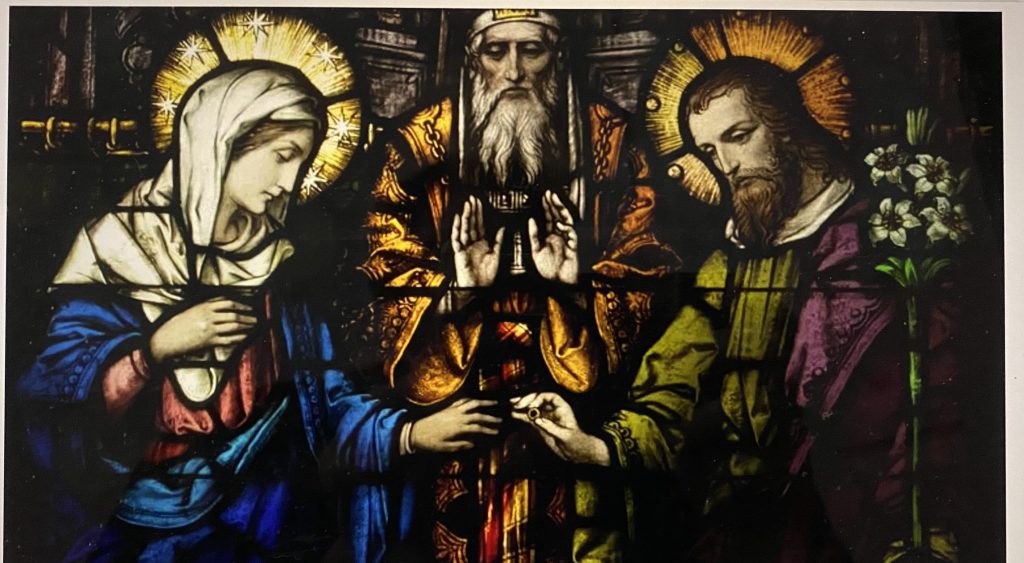
Mary and Joseph, a yes to God and a yes to life.
Joseph heard the news that Mary, his betrothed, was with child. He clearly knew the child was not biologically his. Scripture does not account for the thoughts or emotions of Joseph, but whatever inner turmoil he did have, he came to a decision that would not expose Mary to shame. He was not going to make a public spectacle of Mary, but instead decided to divorce her quietly. Before he made his final decision though, Joseph made an excellent choice regarding the discernment of serious matters. He slept on the idea before acting.
During Joseph’s sleep, the angel of the Lord delivered a message. “Joseph, son of David, do not be afraid to take Mary your wife into your home. For it is through the Holy Spirit that this child has been conceived in her. She will bear a son and you are to name him Jesus, because he will save his people from their sins” (Mt 1:20-21). When Joseph awoke, he did as the angel of the Lord had commanded him and took his wife into his home (Mt 1:24).
From their encounter with God’s messengers, both Mary and Joseph trusted in God’s will, and “that has made all the difference” to quote Robert Frost’s poem, “The Road Not Taken.” Because of Mary and Joseph’s “yes” to God and to family, the Son of God became man and opened up heaven for us in the humanity he assumed.
God often works in the same way when dealing with us. What may appear to be absurd, unimaginable, or downright impossible, is indeed possible when we align our will with God’s will. This is the week of Joy in Advent.
The source of joy does not come from external experiences but from an encounter with and acceptance of God’s invitation. Joy is an experience of communion with the love of God. This has been given to us in greater measure because Jesus became one with us, and so upon his ascension into heaven, we too can experience the loving communion he experiences with his Father. We also experience the love of the Holy Spirit in our encounter with family and friends, this exchange of giving and receiving of ourselves in conversation, shared experiences, and in resolving challenges and conflicts together.
Mary and Joseph both received incredible news, that neither of them fully comprehended. They could have easily responded in a different way. Instead, they trusted in God, they chose family, and because they did, we can rejoice not just during this week but as we heard from the past Sunday from Paul, we are to rejoice always!
Mary and Joseph followed God’s lead and were willing to allow their unborn child, Jesus, to come to full term. Because they were willing to risk public ridicule and worse, Jesus entered into our human condition. There may be a difficult situation we are dealing with, we may feel we are on our own, and that there is no way out, and/or no help on the horizon. God will make a way and reveal it to us through his Son. We may not understand either, but like Mary and Joseph, let us trust in God, one another, and experience that we are not alone.
Jesus, Mary, and Joseph, please intercede on our behalf this Advent Season such that we may better be able to resist the temptation of taking each of our family members for granted, but instead choose to be appreciative and thankful for one another. Help us to react less and breathe deeply more. Help us to be more understanding, patient, and willing to forgive, such that even though we have experienced past hurts, conflicts, disagreements, and different points of view, we may ultimately experience time and again the joy of being there for one another, through thick and thin.
Photo: Stained glass window of the betrothal of Joseph and Mary, from the Church of the Immaculate Conception in Connellsville, PA by Nancy Bauer.
Link for the Mass readings for Wednesday, December 18, 2024

A few moments of stillness can transform our days and lives.
Today’s Gospel account is from Matthew’s record of the genealogy of Jesus. Jesus, the Son of God, is fully divine, while at the same time he is also fully human. Here Matthew presents the lineage of Jesus’ human line from Abraham to his father Joseph (foster father, in that Joseph was not Jesus’ biological dad, but no one would not have made that distinction in Jesus’ time.) and his mother Mary.
Jesus was part of a people and a family, he was born at a particular time and in a particular place. If you go through this genealogy with a fine-tooth comb, there are gaps, but Matthew was more concerned with the line of faith than a strict historical account. Matthew also included women in this listing, which was not common in ancient patriarchal societies. Looking at their stories in Scripture will also show that they were not at all the most morally upright, but more importantly, each played a significant part in God’s plan of salvation.
As Catholics and Christians, this is our heritage as well. We are spiritual Semites. Genealogies have become more popular in recent years as can be seen by the different advertisements for DNA test kits. There is a natural instinct to reach out for these because we want to belong and to be a part of. To understand who we are, we seek to understand where we have come from. To be able to go forward, we need to reach behind. Jesus was to the people of Judah, and is a part of the succession from Abraham and his clan, to the twelve tribes of Jacob, to the unified nation of Israel under David.
Joseph is heir to the thrown in this line of succession that was thought to have been lost when Jerusalem was conquered by the Babylonians. When Joseph died, Jesus was next in line. Jesus will lead like no other before him or that will ever come again. Jesus brought God’s movement of grace beyond the nation of Israel to fulfill the promise that they be a light to the nations, a universal invitation for all.
Through our Baptism, we become part of that lineage of Jesus. No blood test needed. We are not alone, no longer estranged, no longer separate, or on the peripheries. We belong to the Body of Christ. Yet many, even those who profess their belief in Christ, are missing his greatest gift of faith, which is developing a relationship with him now. Let us not be complacent and settle for Christian in name only or walk away from our birthright.
In these final days of Advent, as we draw closer to the celebration of Christmas, may we also set aside a little more time to spend with Jesus. If our schedule is revving up, may we bring Jesus into our busy. The second Person of the Trinity was willing to draw close to us in the incarnation that we are about to celebrate. Even if there is not a lot of time in our days, let us periodically take a few conscious, deep and slow breaths at some key moments so that we may draw close to Jesus who is at hand. This can be as simple as taking three slow, deep breaths – one for each person of the Trinity.
Just those short moments can be a powerful reset because even in that little turning of our hearts and minds to God, we can rest in the loving gaze that Jesus wants to share with us. We can receive his love and invite him to walk with us in all that we do. We can yoke ourselves to Jesus so that we do not travel these days alone, because he is more than willing to share our burdens, and he will give us to strength to carry on.
We are never alone if we remember Jesus is present in our everyday experiences. We just need to remember to turn to him. In so doing, each breath will bring our shoulders out of our ears, we will react less, and experience greater clarity in the choices and decisions we make. Practicing in this way, we will have more joy in our being loved by God, so that we can have more joy in our doing.
Photo: Brief stop during Rosary walk outside our church here at Holy Cross. Praying we will be able to return by Easter!
Link for the Mass readings for Tuesday, December 17, 2024

In conversation and dialogue, may God be our guide.
The question raised by “the chief priests and the elders of the people” regarding what authority Jesus was teaching was not an uncommon question. Rabbis and teachers often began their presentations by sharing with their listeners who was their teacher. It would be comparable today to say what university we received our degree from.
Jesus did not do so for his authority came directly from God. Those questioning Jesus knew this and wanted Jesus to say it publicly so as to charge him with blasphemy by putting himself on the same level as God. Jesus did not give them the satisfaction. Instead of answering their question, Jesus asked one of his own. “Where was John’s baptism from? Was it of heavenly or of human origin” (Mt: 21:24)?
The answer given by the chief priests and elders to the question posed by Jesus showed further their unwillingness to accept who Jesus is. They were the shepherds of the people of Israel, yet they would not speak the truth. Instead, they offered an answer that was calculated and weighed out by taking a quick opinion poll among themselves. Their answer was lukewarm, “We do not know.”
In answering this way, their authority as leaders was diminished. For if they were the religious guardians and guides, why could they not answer the simple question regarding the origin of John’s baptism?
How about us? Do we weigh our answers solely on a perceived response or do we speak the truth? We want to be liked, respected, to belong and to fit in, to be affirmed and accepted, which is healthy and natural, but at what cost? Sometimes we feel uncomfortable speaking what we believe because we fear another’s reactions. This is even more challenging these days because a simple response can affect a harsh reaction.
Yet, to be people of integrity, to live out our baptismal call as prophets, there will be times that we need to resist the perceived and real pressures we feel, lean into the conflicts that arise, and speak what God would have us say in the moment.
As we do so, we need to remember to speak from a place of understanding and love. It is better to engage in a dialogue, not just mutually imposed monologues. A good reminder is to follow the lead of Jesus and ask more questions rather than offer ultimatums and pronouncements. Our goal in any encounter is not to impress or prove we are right and so the other is wrong, but to express what we believe and allow others to do the same. We can grow from one another when we are willing to listen.
Sometimes, God may be inviting us to be silent. We can actually move from talking past or shouting over one another, or going to the other extreme of avoiding talking altogether, when we are willing to listen first and respect another person even when we disagree.
Jesus, please forgive us for the times when we have not spoken as you have led us or when we have refused to listen and hear the perspective of another. In each moment help us to remember to breathe, to have ears to hear your guidance, to be understanding and respectful in every exchange. Give us the courage and words to speak with charity and help us to know when to be silent and to listen. Above all, with each encounter help us to love.
———————————-
Photo: Quiet times with God help us to listen more and speak less when in conversation.
Link for the Mass readings for Monday, December 16, 2024
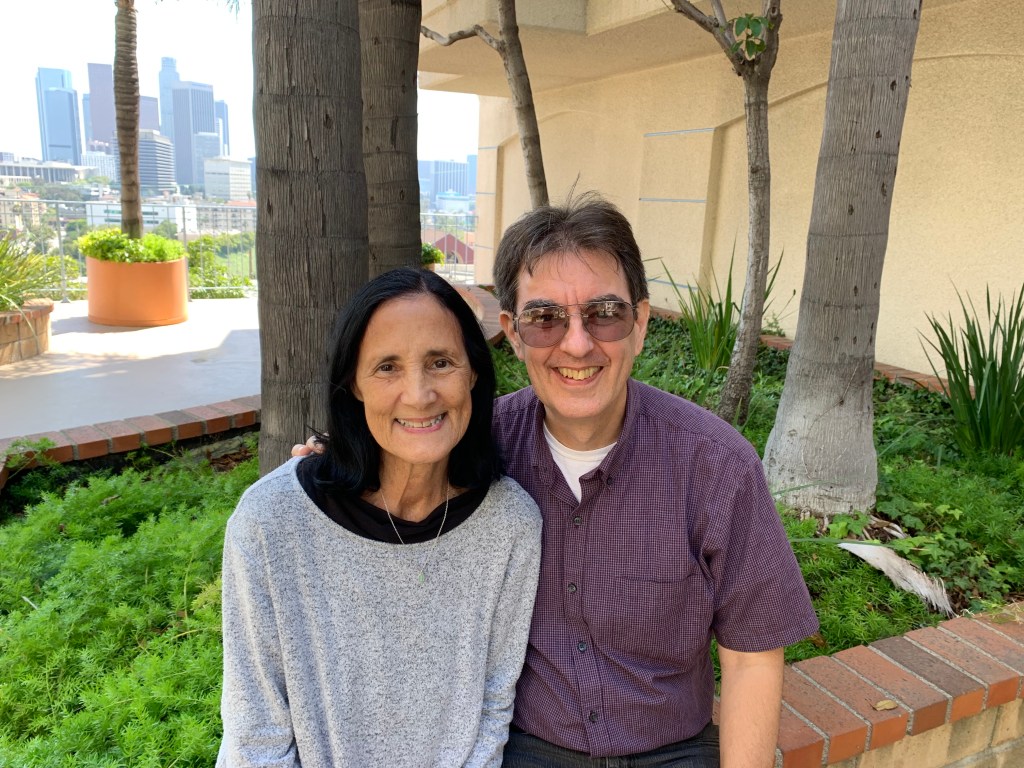
This Advent, more anxiety and stress or more joy and peace?
“Rejoice in the Lord always, I shall say it again rejoice!” (Philippians 4:4)
There is a running theme in each of our readings and why we call today, Gaudete Sunday. Gaudete is the Latin word for rejoice. We rejoice because we are half way through Advent, and Christmas, our celebration of the incarnation, is only eleven days away. We are also called to rejoice because as St. Paul wrote to the Philippians that we can rejoice always!
Can we really?
Yes, because Paul is not inviting us to rejoice, he is commanding us to do so and he did so not only once but twice. But how can we actually rejoice always? One way is to distinguish between happiness and joy. When we are happy it is because we are reacting to a pleasurable experience that we find good. Yet, what often happens when the experience goes away… so with it goes our happiness. We then seek more of the same to fill that need to be happy and we need more and more of what stimulation we seek. Our happiness can linger on a bit or return as we call to mind the memory of the experience, but even then, the memory will fade after a bit.
Joy is not dependent on external experiences. Joy is dependent on our closeness to God and the indwelling of the Holy Spirit within us. That is why even when we experience challenges, trials, and conflicts, we can still feel joy. The key is where we put our focus. Focusing on the externals, we will sink. Keeping our eyes on Jesus, like Peter, we will walk on water! As long as we stay close to Jesus, we will experience his joy within.
Paul gives us to recipe for rejoicing always when he says, “Have no anxiety about anything”. As soon as we experience the first stirrings of anxiety, we are to turn to God in prayer and thanksgiving and let our “requests be made known to God.” I first remember experiencing this when I was in my late teens. I had been experiencing a period of desolation and anxiety about the future ahead beyond high school. I had recently purchased a Bible and one evening opened it at random to Luke 12:22: “Therefore I tell you, do not worry about your life and what you are to eat, or about your body and what you will wear.”
Then I heard God letting me know that I would never win the lottery but he would continue to provide me with the means to work. He would provide for and take care of me. Having heard these words in the quiet of my heart, I then returned to reading the whole section about placing our dependence and complete trust in God. A feeling of not only joy but peace welled up within, and the anxiety and insecurity I went into the reading of the Bible with dissipated. Light and darkness, love and hate, nor anxiety and trust, cannot exist at the same time and in the same place. We actually can choose which we want to experience.
The word anxiety comes from the Greek merimnaō. Biblical scholar, Dr. Brant Pitre describes Paul’s usage of merimnaō as, “an imperative; it’s not just a suggestion. And he’s saying not to have it about anything. Now this Greek word merimnaō is closely related to the verb for ‘to remember’. So when a person is anxious about something, it keeps coming to their mind. They remember it” (Dr. Brant Pitre).
What we place our focus on is what governs our thoughts and also has a tremendous influence on what we feel. If we are consistently attentive to what we are stressed about, like a dog drilling down, worrying on a bone, we are going to be anxious – always. The other side is just as true. The more we focus on Jesus, breathe, receive, rest, and abide in his love for us, and we consistently place our trust in him in all situations, the good as well as the bad, we will move closer to aspiring to Paul’s command to, “Rejoice in the Lord always”.
We will also rejoice more often when we are willing to make time to stop and think about what we are grateful for. It is so easy to get caught up in the busy, in our work as well as our perceived recreation, pass out at the end of the day, and start over again the next. Taking time to wind down each evening away from channel or social media surfing, we could instead choose to truly relax and let go by being still, quiet and reflecting upon the day to see where God has been blessing us, where we have said, “yes” to his invitation and where we have said, ‘no.”
Calling to mind what we are thankful for and having the humility to ask Jesus for help to correct or sins and missteps, also deepens our relationship with him and rekindles the awareness of the love of the Holy Spirit within us. What then wells up again from his eternal spring is not only joy but God’s peace, that peace that surpasses all understanding. Knowing and experiencing that God is close, that his Son is at hand, will help us to experience more regularly the love that is shared between them, the Holy Spirit.
Being filled with the joy, love, and peace of God to overflowing will then move us to share what we have received with others in very practical ways. In giving and sharing the joy, love, and peace that we have received, does not diminish in any way the what we have received. Instead, our giving only increases the joy, love, and peace God has given us. Not a bad way to spend our final days of Advent which will lead us into celebrating the miracle of Emmanuel – God with us, always. And because he is, let us rejoice always!!!
Photo: A different Advent. We were preparing for Jesus to come to bring JoAnn home to heaven. Because we had a better idea of the time and hour, we were able to appreciate each moment we had together. God blessed us with his joy, love, and peace to overflowing. I still look upon the last six months we had together as a blessing.
Dr. Brant Pitre. “Anxiety and Gratitude” from his video commentary: The Mass Readings Explained.
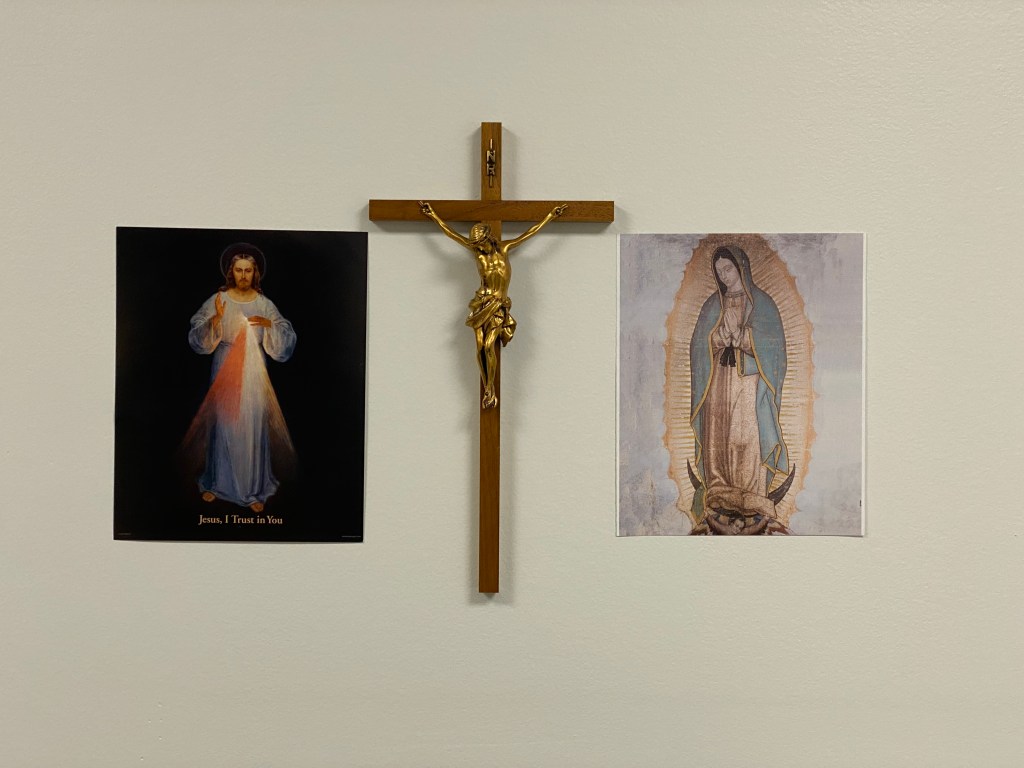
When we turn to and trust in Jesus and Mary we will have the strength to follow God’s will.
Jesus compared “this generation” to children who could not be satisfied. For when the flute was played for them they did not dance, when the dirge was played they did not mourn. There was no pleasing them. Jesus drew the parallel to the present bystanders who acted as fickle as the children. They criticized John as being possessed for practicing fasting and asceticism. They then accused Jesus of being a glutton and a drunkard because his choice of companions for table fellowship.
In today’s Gospel account, Jesus could have been addressing his detractors as well as his disciples. He encouraged his followers to be wary of wallowing in the mud of fickleness. He also wanted them to be sure that they were authentic dispensers of his truth and the will of his Father no matter the reaction of the people, for “wisdom is vindicated by her works” (Mt 11:19). Just as Jesus taught that false prophets would be revealed over time by their fruits (cf. Mt 7:16), so those who were true to his teachings would be vindicated, if not fully in this life, certainly then in the next.
Pope Francis said that “The first thing for a disciple is to be with the Master, to listen to him and learn from him” (Francis 2014, 15). May we pray for open hearts and minds eager and willing to hear the word of Jesus our Master and the courage to act upon his leading in our everyday circumstances. To do so, it is important that we slow down our pace and quiet our minds so that we can even hear his word. We also need to discern the difference between his voice, our own, as well as the many other voices, the enemy, distractions, diversions, and temptations that we hear.
God himself speaks to us in so many ways; directly in the silence of our hearts, through others, spiritual direction, small groups, fellowship, through the Bible, as well as our culture, and influences, as well as through his creation.
More often than not, we may not definitively know if what we discern or hear is coming from God. Yet, remaining paralyzed and doing nothing out of indecision will not help us to move forward. We can find support and confirmation from Scripture and Tradition, others who are wise and practiced in following God, then we can reassess our guidance and then act. If we are wrong, we learn from our mistakes, make adjustments, and begin again. If we are on the mark, this helps us to build our confidence in recognizing God’s voice.
Another important step in discipleship is that we are not to seek to impress, but to express. Adulation and acclaim for ourselves are not what we are about. Our firm intent is to become less so that Christ becomes more. We are also to resist moralizing and condemning others and instead be willing to meet people where they are, convict as needed, as we accompany and break open the word in practical ways so they see the benefits of having God in their lives. The invitation and life of a disciple of Jesus is not an easy one. Will we follow?
We need not be afraid that we cannot fulfill the teachings of Jesus in the gospels because we can’t on our own strength. That is the point. We need Jesus to do so. Just as in learning to walk, our beginning attempts more often than not ended with a thud and us sitting on the floor or ground looking up. Yet, we got up, and with continued practice, we gained strength, balance, made corrections, and so began to gain confidence and the ability to move forward, upright, step by wobbly step. When we seek the support of Mary, and we turn to and trust in Jesus, he will give us the strength to walk on.
Dr. Martin Luther King, Jr. put it more eloquently when he spoke to students at Spelman College in April of 1960. “If you can’t fly then run, if you can’t run then walk, if you can’t walk then crawl, but whatever you do you have to keep moving forward.” So it is in anything we do, but especially in the spiritual life. If we are not moving ahead we are falling behind.
Jesus, please help us to trust in you and accept your invitation to know you and your voice so that we may better know your will. Grant us the courage to follow your will, your plan for our good, and lead us on the path you would like us to go. Inspire us each day to be aware of those you would like us to serve and love. Help us to move forward one more step each day closer to you and being who you call us to be.
—————————————————————————–
Photo: Let us take the hand of Jesus and Mary as we begin each day and walk on.
Francis, Pope. The Church of Mercy: A Vision for the Church. Chicago: Loyola Press, 2014.
Link for the Mass readings for Friday, December 13, 2024
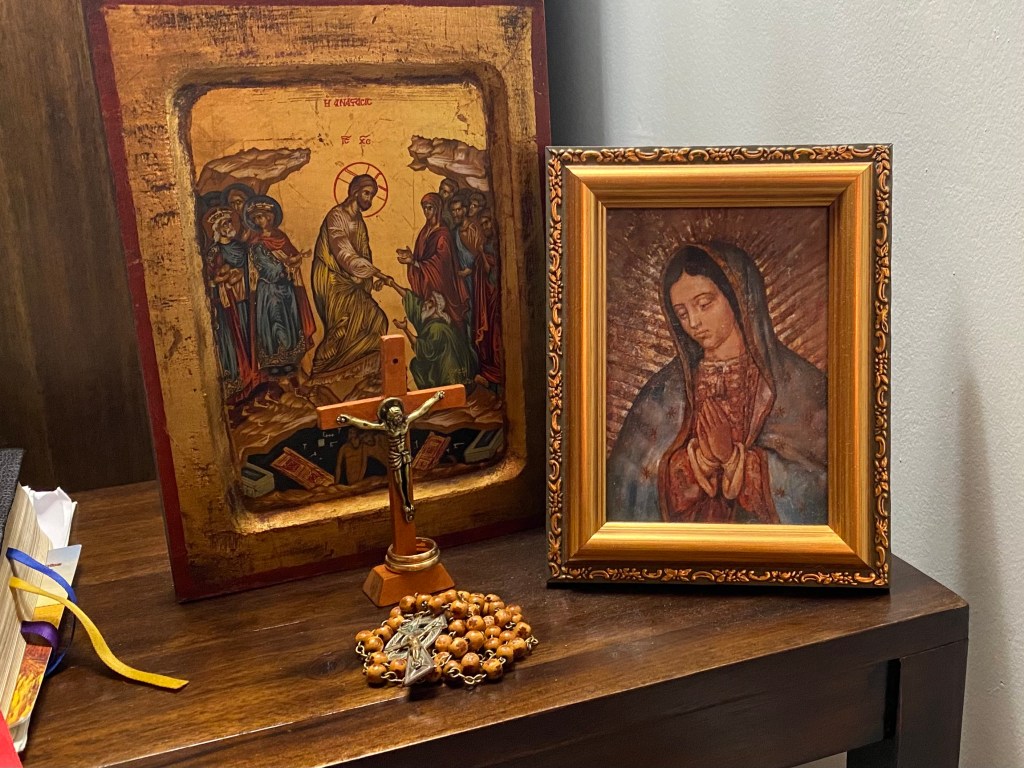
Mary’s Son will forgive us and fill us with joy!
“Mary set out and traveled to the hill country in haste” (Lk 1:39). Why? Because she was filled with joy. She had just experienced an incredible encounter with the angel Gabriel telling her that she was to bear the “holy, Son of God” (Lk 1:35). She also learned that her relative Elizabeth, who had been barren, was six months pregnant. Who better to understand and appreciate what she had gone through than Elizabeth? When we hear good news we want to share it with someone, especially when we believe another will fully appreciate our experience.
Is there a time when you felt overjoyed about something that you felt like you were going to burst and you couldn’t wait to share your experience? A memory may have already started forming in your mind, a smile and glow may already be radiating from your eyes as you re-experience that moment.
One such graced encounter I had was when I was in my early twenties and dealing with a heavy personal issue. I was living in Sharon, Connecticut at the time and had an opportunity to go to the Shrine of Divine Mercy in Stockbridge, Massachusetts to participate in a penance service. I walked up hesitantly to a kind-looking, elderly, polish Marian priest. His name alludes me now, but not his face. He radiated invitation and mercy. After a few stammering words, I let loose and shared what I had been dealing with. When he offered absolution, I felt the burden physically lift, I felt almost like levitating. Then a surge of joy welled up in me that lasted for days.
There is a great gift in sharing a burden with a trusted friend or family member, being heard and supported, and/or receiving absolution from a priest. We need to resist the temptation of turning within ourselves, trusting in the lie that we can handle our conflicts, challenges, and trials all on our own. There is a pearl of great price, God’s healing grace, that is available to us when we share our experiences. In this way, we come to realize concretely that we do not have to go through our pain and suffering alone!
Many of us are struggling with a lot, and sometimes we are not at our best, nor do we make our best decisions. We react instead of act, we get caught in the momentum of behavior that we know is not acceptable, and we continue to slide. The key is not to beat ourselves up and walk around feeling guilty. There are enough people who would be happy to sign up to do that. Instead, we will be better off to choose to practice a healthy sense of guilt, examine our conscience, be mindful, and admit when we have done something inappropriate, sinful, or wrong.
The key to reconciliation is to embrace in humility and admit our sin, be contrite – sorry for what we have done, not upset, defensive or rationalize away our behavior, and to follow the counsel of James and “confess your sins to one another, and pray for one another so that you may be healed” (James 5:16). Having experienced the joy of forgiveness, while still experiencing the grace of our reconciliation, may we be like Mary who is full of grace, and go in haste to share with others the wonderful gift we have received!
Photo: Our Lady of Guadalupe, pray for us!

