Praying the Our Father – priceless!

Jesus begins his teaching on prayer by stating that prayer is not babbling. When we pray we are to resist just saying empty words that have no meaning or worse just praying in words that we think God wants us to hear. We are to pray from our heart. We are to share honestly what we truly think and feel in the moment that we turn our hearts and minds up to God.

Prayer, first and foremost, is a response to the Holy Spirit moving within us, urging us to pray, “for we do not know how to pray as we ought” (cf. Romans 8:26). It is helpful to trust that invitation and allow ourselves to be in his presence in the chaos was well as the joys in our lives. If we are upset with God, it is important to get in touch with that feeling and share that emotion with him. As we do so and get it all out, it is also just as important to be still and listen for God’s response. To vent and walk away or tune God out is not helpful or giving him the opportunity to provide healing.

Even if we do walk away from him, our Father will not walk away from us. He will be there ready and willing to accompany us when we are ready to return, share again and are willing to be still and listen. A good example of this type of open and honest prayer from the heart will be found in reading the psalms. They cover the full range of our human emotions as well as expressions of prayers of blessing, petition, intercession, thanksgiving, and praise. We will even come across a reading like Psalm 88, which may not appeal to us at the moment, as it is such a psalm of despair, yet someone, somewhere, might be feeling that prayer. If we read it and find as we do so that we don’t relate to it, we can pray it for others you may be experiencing those emotions.

In our Gospel today, we read Matthew’s familiar version of the Lord’s Prayer or the Our Father. It presents two ways to pray. First, it is a rote prayer that we memorize word for word. The blessing of a rote prayer is that we can pray it in communion with others, as we all know the same words. Another important gift of rote prayers is that we can pray them when we are physically in pain or emotionally distraught when we feel we can’t pray.

Jesus taught his disciples this prayer and it has been prayed daily since then up to and including this moment. That is amazing reality, that we can pray today the same prayer that Jesus taught his disciples. It is a prayer we can lean on to give us strength through the storms of our lives. Praying the Our Father gives us the words to speak when we have none to begin with, and by loosening our tongues, we can come to a place where we can speak more freely with God, who as Jesus shares is our Father, and experience the peace of his presence.

The Lord’s Prayer is also a model of prayer such that each word or phrase can be a starting point to enter into a deeper and loving dialogue. There are seven petitions throughout and as with the ten commandments have a similar pattern in that the first three petitions are directed toward our relationship with God. The next four have to do with our relationship with others. As an example, we begin with the words, “Our Father.” This is a reminder that God is the Father of us all and the beginning of all prayer. His sun shines on the good and the bad alike. Our prayer begins by putting our self in his presence and recognizing that we are all interconnected.

God, our Father, is with us even when we experience fear, feel forgotten, misunderstood, or alone. God loves us more than we can ever imagine, and our every desire to pray is already a prayer because we are responding to his invitation to spend time exclusively with him. Calling on his name is a reminder that he is always present and he hasn’t forsaken us. He provides our daily bread and forgives us as we forgive others. The flip side is that God also rejoices with us, for the joy of God is the human being fully alive!

I invite you to carve out some time today to pray the Our Father s-l-o-w-l-y. Take some slow and deliberate breaths, five seconds in and five out. Allow whatever is going on in your life to enter into the recitation and remember that the best dialogue allows each party involved to spend some time listening to the other. As St Mother Teresa taught, “God speaks in the silence of our hearts.” By making some time to pause, to be still, and not rush through the prayer, to listen silently to God, we might just be able to come into the rest of our day better able to listen to each other a little better as well.

—————————————————————

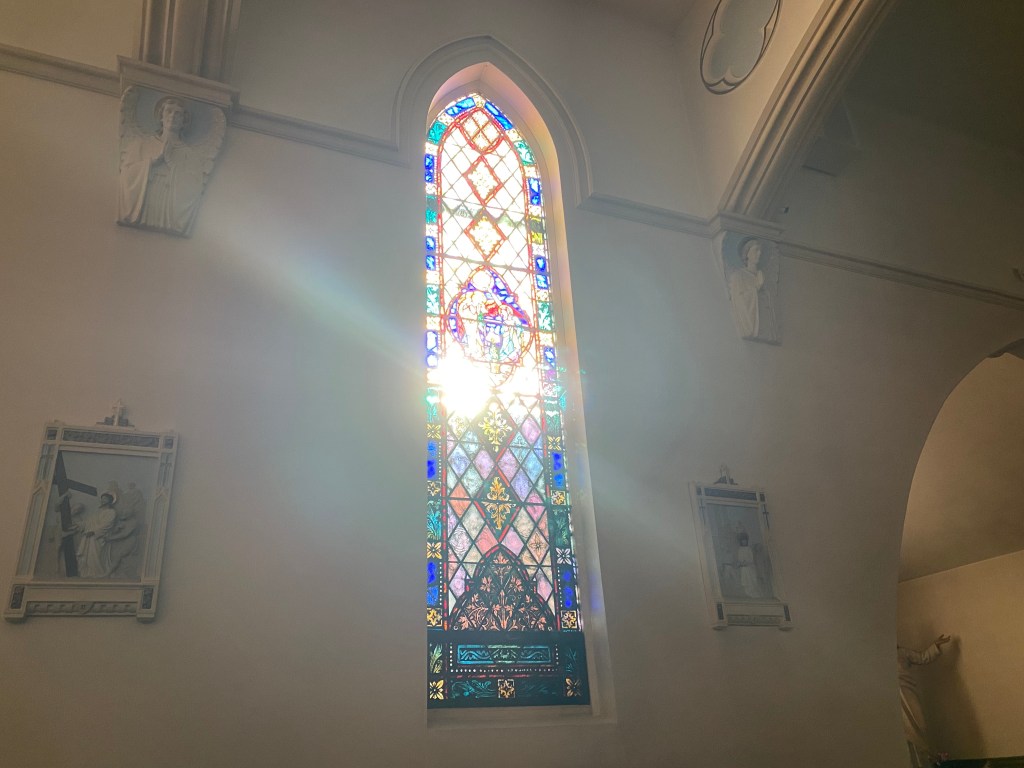
Photo: Stained glass image of John the apostle here at Holy Cross. Praying the Our Father worked out pretty well for him, may we follow his lead!

Link for the Mass readings for Tuesday, March 11, 2025

We too are called and we too can be forgiven as Levi was.

Think about how good we feel after coming to be on the other side of healing from a bad cold or the flu, recovering from a twisted ankle, a broken collar bone, or other health conditions. If you have ever experienced an asthma attack or had the breath knocked out of you, it is such a relief to able to breathe fully again. We experience a feeling of wholeness that was missing during the midst of our suffering where we may have pondered a time or two whether or not we would ever get better.

The same can be said for estranged relationships. There is a distance of separation that can be agonizing, an inner gut-wrenching experience that gnaws away at us. We wonder if there can ever be a coming back together. When there is reconciliation, forgiveness, and amending of the brokenness of relationships, we can experience such a relief, lightness and joy that we never imagined possible while in the midst of the conflict, the silence, and the separation.

Sin our relationship with God and one another, and unchecked and unbridled sin can rupture those relationships. The Pharisees and the scribes questioned why Jesus was eating with tax collectors and sinners, and Jesus replied: “Those who are healthy do not need a physician, but the sick do. I have not come to call the righteous to repentance but sinners” (Lk 5:32).

Jesus is a light in the darkness. For Levi and his friends, who were following a path into darkness. Jesus shone his light in their darkness and they realized they could walk another path and they did. A great celebration of fellowship ensued in Levi’s home because these men and women, who had been outcasts, who were separated from the greater community were forgiven, welcomed, and embraced. They were loved by Jesus as they were. They did not have to change first for Jesus to call Levi and gather with them.

They were welcomed into the kingdom and reign of God. Their ticket to reconciliation and healing was accepting the invitation of Jesus, to receive and experience his love and welcome. Levi and the other sinners did not run from the light of Jesus, but were willing to recognize their need for healing, were willing to repent, to turn away from their prior ways of life and so were reborn!

They were divinized because of their willingness to participate in the life of Jesus. Levi chose not to just be a repentant sinner, but continued to follow Jesus. He gave his whole life to him and allowed himself to be transformed. He chose not to walk along the path of darkness anymore, but once seeing the light of Jesus continued to follow the Way. He continued to follow Jesus such that it was no longer he who lived, as Paul had experienced, but Christ who lived in him (cf. Galatians 2:20)!

Jesus invites us each day, as he invited Levi in today’s Gospel, to follow him. We are given the same invitation and opportunity for healing, discipleship, and transformation. Will we resist rationalizing and justifying our sinful thoughts, actions, and habits, welcome the light of Jesus that reveals our venial and mortal sins, and admit that we are in need of healing, and repent so to be forgiven and released from all the energy we have expended in protecting and hiding from ourselves and our God who loves us more than we can ever mess up?

Quietly spending time daily, especially in the evening and recalling our day, by asking Jesus to reveal to us those ways in which we have not lived according to his will is a wonderful practice. Jesus does not reveal our sins to us to condemn or shame us, he does so in the hope that we will identify, renounce, and confess them. Then he will forgive us. Even when uncovering deeply rooted and mortal sins, through the intimate encounter with Jesus in the Sacrament of Reconciliation we will be forgiven and freed from these as well.

Jesus loves us as we are. Yet holding on to our sin, keeps us at a distance from experiencing the greater breadth and depth of his love. We only need to be willing to be contrite, to embrace sorrow for the harm we have inflicted with our personal sins, and go to the Divine Physician in our time of prayer and/or Reconciliation. Once absolved, the heavy weight is lifted and we are healed, we are better able to engage in penance to atone for our sins committed, better able to forgive others as we have been forgiven, and to love as we have been loved!

——————————————————————–

Photo: Jesus is the light that will light a path to lead us out of our own darkness.

Link to the Mass readings for Saturday, March 8, 2025

May we slow down our pace so that our hearts beat in tune with “the vibrant heart of Jesus.”

In the Gospel of Matthew, we read today about the account of Jesus comparing himself to a bridegroom: “The days will come when the bridegroom is taken away from them, and then they will fast” (Mt 9:15). In a sense, the bridegroom has been taken from us, in another sense, he is closer to us now than he was when he was with his disciples and walked the earth. The fullness of his reign though will not be consummated until Jesus comes again, but while we wait, when we are willing to set aside other distractions and be still, we can hear and feel the beating of his Sacred Heart.

We need food for our survival, but we don’t need as much as we think we do! Fasting from food is not the only focus of our Lenten fast. The discipline of fasting provides an opportunity to keep our passions in check. By resisting the impulse of instant gratification, we are able to better discern between apparent goods and the actual Good in our lives. When we are able to navigate through the maze of distractions, diversions, temptations, and allurements on a physical level, we can begin to go deeper into the spiritual reality to begin to expose some of the demons that we feed, such as “distrust, apathy, and resignation”.

Pope Francis mentioned that these three demons “deaden and paralyze the soul of a believing people.” He continued by stating that: “Lent is the ideal time to unmask these and other temptations, to allow our hearts to beat once more in tune with the vibrant heart of Jesus.”

When we are willing to discipline our impulsiveness, to slow down, to take time to recollect even with a few deep breaths, we can begin to see more clearly God’s will for our lives. We can then be more open to God’s invitation to grow relationship with him and each other. We can then better assume the posture of John the Apostle by resting our head on the chest of Jesus (cf John 13:25), such that our hearts will beat in the same rhythm as his Sacred Heart.

This is the gift of contemplation that drives us to service. This is the same rhythm that beat in the prophet Isaiah who reminds us in today’s first reading what true fasting is all about:  “releasing those bound unjustly, untying the thongs of the yoke; Setting free the oppressed, breaking every yoke; Sharing your bread with the hungry, sheltering the oppressed and the homeless; Clothing the naked when you see them, and not turning your back on your own” (Isaiah 58:6-7).

————————————————————————

Photo: Some quiet time in prayer last week after Mass while still at St Clement Catholic Church in Santa Monica, CA.

Link for Pope Francis homily:

Pope Francis offers a “worksheet” for Lent: Check it out!

Link for the Mass readings for Friday, March 7, 2025

Placing Jesus first will help us to detach from the attachments in this world.

Jesus continued build on his teaching about the entrance into the kingdom of God as the rich man walked away sad by stating, “Children how hard it is to enter the kingdom of God! It is easier for a camel to pass through the eye of a needle, than one who is rich to enter the kingdom of God” (Mk 10:24-25). The disciples are stymied, primarily because present Jewish belief held that those who had amassed wealth and riches did so because they were blessed by God. If someone who had followed the commandments of God, appeared to be blessed by God, would he or she not be a part of God’s kingdom, if not then, what was one to do?

Yesterday’s reading ended with Jesus responding to the disciples astonishment. First by stating that “For human beings it is impossible.” Jesus said this because there is nothing that we can do to earn or buy our way into heaven. It is not through perseverance, dogged determination, or will power that we are saved. Our security also is not to be placed in the things of this world, our happiness and fulfillment is not to be placed in the apparent goods and glitter of the finite things that offer comfort and pleasure. For if we place our hope in the things of this world, in our own belief that we can control our own destiny, we will be building our foundation on sand. Jesus continued, “For human beings, it is impossible, but not for God. All things are possible for God” (Mk 10:27).

There is only one way to enter the kingdom of God. A person is to say yes to his invitation. The rich man refused the invitation to come and follow Jesus. He chose his possessions over the kingdom. The disciples of Jesus chose differently. The opening line of today’s Gospel reading is given by Peter, speaking up for those, who like him, did what the rich man did not do, when he said “We have given up everything and followed you” (Mk 10:28). Jesus affirmed Peter and the other disciple’s acceptance of the invitation to come and follow him, as well as to assure those who would willingly sacrifice and voluntarily give up, house, family, or land, to follow him. He insisted that they would receive back “a hundred times more in this present age… and eternal life to come” (Mk 10:30).

Jesus, in today nor yesterday’s Gospel accounts, is not a preaching a kind of prosperity gospel or free reigning capitalism, nor is he a proponent of socialism or communism. Each of these are human socio-political, economic constructs. Jesus instead is painting a picture of the reign of God as a new family. One that exists, not of the world’s making, but of God’s design. A kingdom not of this world, though still present in it, and the good news is that all are invited to be a part of it. The apostles were on the way. They had indeed given up the material and familial to follow Jesus, but they, who argued among themselves regarding who was to be the greatest in God’s kingdom, still had their mental attachments and preconceived notions to let go of.

Those who are a part of the kingdom of God are not connected through bloodline, tribe, political party, or nation, but are united through a transformation of their hearts and minds. The followers of Jesus become brothers and sisters. They care for one another, provide hospitality, charity, support, access, means, and encouragement for one another. Together, they meet the challenges and persecutions that come from those who oppose the kingdom.

Jesus offers us the same invitation that he offered the rich man and his disciples; to follow him by letting go of that which distracts us and binds us from giving our life more fully over to him and building up his kingdom. It is helpful to assess our lives, to determine where we can let go, be less attached, and resist looking to material goods for our security and pleasure. Our true and solid foundation we will find in developing our relationship with Jesus, his Father, and the love of the Holy Spirit.


Photo: Encountering Jesus in his Word and the Eucharist at St. Clement Church, Santa Monica, CA.

Link for the Mass readings for Tuesday, March 4, 2025

“You are lacking one thing…”

A man approached Jesus seeking to know what he must, “do to inherit eternal life” (Mk 10:17). Jesus shared that following the commandments, such as: do not kill, commit adultery, steal or bear false witness; do not defraud, but do honor his father and mother (cf. Mk 10:19), would be a good place to start. The man affirmed that he had followed them all. I can imagine the eyebrows of Jesus raise and his mouth curl into a smile as he realized the sincerity of the man kneeling before him. The disciples recognized that look and held their breath.

Jesus, looking at him, loved him and said, “You are lacking one thing. Go, sell what you have, and give to [the] poor and you will have treasure in heaven; then come and follow me” (Mk 10:21).

The man, instead of overjoyed, was crushed. He had followed the prescriptions of Torah all his life, he was blessed by God with the gift of having many material goods, but in the end it was those possessions that enslaved him. He genuinely came seeking eternal life, and Jesus gave him just what he sought, and more. As Jesus called the twelve, he made the same offer to this man when he said, “come and follow me.”

The commandments are a good first step for properly ordering our lives toward God and one another. Jesus quotes overtly from the Ten Commandments as well as adds another one from Deuteronomy 24:24 in asking him not to defraud. These commandments are from the second tablet of seven regarding how we are to relate to one another. Jesus then calling him to sell what he had and to give the proceeds to the poor and follow him, was a covert invitation to put into practice the first tablet of loving God first and foremost before anyone and anything.

The Ten Commandments are the foundational stones that we are to build our discipleship on if we want to be faithful to God and to be freed from that which enslaves us. We are to put God first and when we do so all of our thoughts, words, actions, and relationships will then be properly ordered. This is what we all have been created for, as St. Augustine came to realize and expressed in the introduction of his Confessions: “You have made us for yourself, O Lord, and our hearts are restless until they rest in you”.

The man in today’s Gospel account knew what he needed to do, but was too attached to his wealth and material things to let them go. He walked away sad, because he clung to the false substitute of wealth that would not ultimately satisfy him. He placed his security and trust in wealth not in God as he had thought he had done. He like Peter saw the promise in Jesus, but unlike Peter, turned away from the One who offered him eternal life. Jesus invited him to become one of his disciples and to walk with him on the path of love, to give, share, and serve along side him, but he could not bring himself to do it. How about us?

Return to this scene in Mark 10:17-31, make the Sign of the Cross, then breathe slowly in for the count of five and out for the count of five, once for the Father, once for the Son, and once for the Holy Spirit. Read each of the words of this passage slowly, two or three times. Then set your Bible aside. Next, visualize each of the details of this account of Jesus and the rich man and place yourself in this scene. As the narrative comes to an end, and as the rich man walks away with his head bowed, see the disciples turn to face you.

You receive their looks of curiosity. Your head turns and you meet the gaze of Jesus. You feel his invitation without a word spoken between you. Like the man, you ask, “What must I do to inherit eternal life?”

Jesus holds your eyes in his. He loves you as he speaks, “You are lacking one thing…” What does Jesus say next? Allow the love and light of Jesus to touch your mind, heart, and soul. Allow him to reveal to you that which you are holding onto too tightly, that which you are attached to and need to renounce and/or release, to be healed from. What is preventing you from giving yourself completely to Jesus? You may not have an answer now. This may be a meditation that you would like to carry with you into Lent. In this moment, are you willing to resist walking away? Will you instead trust in Jesus and walk with him one step at a time and see what happens next?
————————————
Painting: “Christ and the Rich Young Ruler”, 1889, by Heinrich Hofmann

Link for the Mass readings for Monday, March 3, 2025

May the light of Jesus help to heal us from our blindness.

As Christians we are often called, along with Jews and Muslims, the people of the Book. This is in reference to our sacred texts, the Torah, the Qu’ran, and the Bible. In actuality, Christians are not a people of the Book, nor is Christianity merely an idea, philosophy, even a theology, or series of practices. Christianity and being a Christian is about an encounter with a person. That person is Jesus the Christ.

If we do not know Jesus, then the words of our Bible just become dead letters, our philosophy and theology are just intellectual exercises, and our religious observances provide little meaning or relevance for our lives. Our presence in Mass or Church can just be something we do or motions we go through.

This could be why for every one person who joins the Catholic Church today six to eight people are leaving. People leave for their own reasons, but the underlying cause could be that in their experience of Church they are not encountering Jesus, they are not feeling welcomed or a part of a community that cares about them, and/or maybe in their daily lives they are not building, nor are they aware of how to build and sustain a relationship with Jesus.

Each of us hunger and thirst to experience and know the living God. Each and every one of us seek meaning, purpose, and fulfillment in our lives. We have been created to be loved and to love, we have been created to belong, to be a part of, and to be in relationship. We live, crave, and desire to be in relationship with God and one another, and this is true for the atheist and the mystic alike.

In our Gospel reading from Luke today, Jesus is speaking to his disciples, those who have encountered him and said yes to following him. They have witnessed his exorcisms, healings, and teachings beyond the realm of comprehension. Jesus continues to guide them and believe in them even when they come up short time and again. Jesus is finishing up his Sermon on the Plain and doing so with parables that are more like proverbs.

What we heard or read today is that a blind person cannot lead a blind person, otherwise both will fall into the pit (cf. Luke 6:39-40). Jesus is speaking about more than physical sight, but spiritual sight. We all have some level of spiritual blindness. We are blind to have blind spots when we are unwilling or not able to see those thoughts, behaviors, and desires within ourselves that keep us from deepening our relationship with Jesus. Jesus invites us to experience his love, to receive his healing touch, to bask in the light of his grace so that we might see the sins he seeks to reveal to us.

Jesus meets us where we are and loves us as we are. When we receive his love, we experience that he loves us, as we are, with all of our faults, mistakes, sins, wounds, and insecurities. We can feel safe and trust in Jesus, and as we do we will experience an unconditional love beyond anything we ever thought possible. We can then welcome his healing touch, let our guard down, and lower our defenses. As we heal, we can see our sinful actions more clearly and realize the habitual vices we have allowed to develop that were fed by apparent goods, wounds, empty promises, and unhealthy attachments. We can let go of the shame.

As we experience the love of Jesus, we can then confess and allow the knots of our sins to be loosed, and feel more comfortable to let God into all the areas of our life. When this begins to happen our lives begin to change, we are transformed from the place of only focusing on our selves, our fears, and our own needs, and begin to be aware of the needs of others. We can then realize that we do have a choice, we don’t have to continue being led by the false promises, insecurities, and fears that we have reacted to. We can choose to be disciples, led back into the land of the living led by our Teacher and Lord, Jesus the Christ, the Son of the living God.

How then do we come to know, build, and sustain a relationship with this Teacher, this Jesus?

We do so by spending time each day reading, meditating, praying with, and contemplating God’s word. I remember reading from the Gospel of Luke 12:22 when I was about seventeen. The passage talked about not worrying about your life. I then felt God speak to me. He said that I would never win the lotto, but he would always provide work for me. My wife, JoAnn, and I used to read the daily readings of the Mass each evening together and then I would read a reflection such as this one. In this way, this living word of God became alive for us. Through this daily practice, JoAnn and I drew closer to God and each other.

As we step closer to Lent, we have the opportunity to allow the light of Jesus to shine even more brightly in our lives. We can do so by spending five to ten minutes a day in quiet prayer, meditating on a Gospel reading, asking Jesus to guide us, to help to see the relevance in his teachings, healings, and exorcisms for our lives. We can speak with him as the disciples did, thank him for our blessings, and just be still and breathe, opening up our hearts and minds so to be led by him. We can ask Jesus to reveal to us our sins, we can ask him to help us to remove the log in our own eye, so that we can see more clearly to help another to remove the splinter in their eye.

We encounter Jesus by learning about our faith through reading and praying with the Bible, studying the Catechism, and reading the lives of the saints, as well as other spiritual reading, videos, podcasts and the like. Examining our consciences daily with the Ten Commandments as well as well as a list of the seven capital sins can help us to better identify, renounce, and confess our sins. Praying reflectively and slowly, the Our Father or pondering with Mary the mysteries or one mystery of the Rosary can also be practices that slow us down so we can spend more time with Jesus.

When temptations arise along with the dance of negative thoughts, we can bring them to Jesus also. When a judgmental thought, urge to gossip, to say something that is negative arises, we can stop and take a few slow, deep breaths, seek Jesus in that first moment as the poison arises. By slowing down and asking for Jesus’ help we can side step our automatic reaction response and better choose instead to think and say the good things that people need to hear, things that will be instructive, empowering, and hopeful. Convicting if need be, but resisting condemnation. Our temptations will also have less power because we can more clearly see their false allure by choosing to stand out from the shadows and in the light of Jesus.

We can encounter Jesus by allowing our hearts and minds to be open to respond when he moves us to reach out to be present to someone with our thoughts, words, and actions, even in simple ways such as sharing a smile, making the time to listen, or offering support or assistance in the moment of another’s need, even when it is not convenient, or the best time for an interruption.

We can encounter Jesus in the sacraments, especially the Mass, through the word proclaimed, the music, in our fellowship together, and especially, in the Eucharist, Jesus’ Body and Blood that we will receive. This is a sacred moment of encounter with Jesus and his Mystical Body coming together as one.

Each of these examples are small, practical ways that we all can encounter Jesus in our daily lives. Jesus is already reaching out to us, inviting us to be in relationship with him and his Father. This encounter and building our relationship with him is not only for ourselves but as we come to experience, develop and deepen our relationship with Jesus, as we experience his love and mercy and how his grace builds on our nature, we heal, we are less lured by temptations, we realize that sin and death no longer have the hold they had on us.

If we have some trouble coming to Jesus, let us reach out to his mother who reflects the light and love of her Son. She will lead us gently so we can experience him and his love for us. Jesus will then become more present in our lives, heal us from our blindness and we can begin to see and share, that which is truly good, true, and beautiful. As we are willing to see our sins, renounce and confess them, and through our participation in the life of Jesus, we will be forgiven, healed, and can breathe more freely. We will be able to then remove the log from our own eyes and better be able to get closer to help others to remove the splinter from their eyes.

Mary, help us to pray for each other, support and be present to one another in our everyday experiences, wrap your mantle around us with your loving embrace so that we can feel safe and open our hearts and minds to receive the loving embrace of God our Father. Help us to trust in, listen, and follow the guidance of your Son. May we then be willing to allow the flame of the Holy Spirit to catch fire and rise within each of us such that we may go forth and set the world aflame with God’s love.


Photo: Mary reflects the light of Jesus and we are invited to be healed and do the same. Great to be back in our church to worship this weekend!

Link for the Mass readings for Sunday, March 2, 2025

Jesus seeks to welcome, embrace, and bless us as he did the children.

In today’s Gospel account, or pericope, people are bringing their children to Jesus to receive a blessing. To offer a blessing, especially this is an action a father would offer, was common. It is understandable that parents would want to bring their children to be blessed by Jesus. Even though children had very little status in the ancient near East of this time, especially in the very young because of high mortality rate, parents did care. They, as with others, sought Jesus for his healing touch, whether they needed a healing or a blessing.

Yet, the disciples step in to prevent this process from happening. Mark does not share the reason for their interference. The disciples apparently missed the lesson that Jesus sought to teach them earlier when they were arguing among themselves about who was the greatest. Jesus had then asked for a child to be brought to him and said, “Whoever receives one child such as this in my name, receives me” (Mk 9:37). This could be why Jesus was none to happy, in fact “indignant” for their interference. Jesus rebuked his disciples: “Let the children come to me; do not prevent them, for the Kingdom of God belongs to such as these. Amen, I say to you, whoever does not accept the Kingdom of God like a child will not enter it” (Mk 10:14-15).

Jesus consistently offered grace to those who might otherwise in the society of his time be prevented from receiving it. Jesus provided healings for the possessed, lepers, women, the blind, the lame, tax collectors and sinners. The very fact that this short account mentioning children is even included in an ancient near Eastern text says something profound. Jesus recognized the dignity of children as he already attempted to teach his disciples.

Children in the ancient Near East had no recognized social status. Orphans were at risk and needed to be taken care of. Children up to two years old were vulnerable in many ways and as such, experienced a high rate of infant mortality. Because of this reality, many parents may have developed an unconscious, defensive posture that they did not become too attached to their children until after they were two years of age. This harsh reality could also be a reason why these children were being brought to Jesus for a blessing.

Jesus, in his reaching out to the children to offer a blessing, impresses the point that he takes the life of children seriously and so encourages others to do so. There are historical accounts that Christians continued to take this teaching seriously. In ancient Roman society, if parents did not want a child, one recourse was to leave them in a local dump to die. Christians would retrieve the infants and bring them into their homes and raise them.

Jesus also used this opportunity as a teachable moment when he shared that “the kingdom of God belongs to such as these.” Jesus is recorded as using the image of God as a Father one hundred seventy five times in the Gospels. Jesus equating that the kingdom of heaven belongs to such as these would have been hard for his disciples to fathom. Maybe one of the reasons this message did not stick the first time. Jesus was helping his followers and us today to see the love of the Father for all his children. To enter the kingdom, we must accept that we are to depend totally on and place all our trust in God as our Father.

God has created us to be in relationship with him and one another. We need him just as much as an infant does for his or her very existence and survival. We do not buy or earn our way into the kingdom of Heaven because God and his realm is so transcendent, so beyond us, that we cannot possibly get there on our own efforts. We enter the kingdom of God through the door of his Son, who is the way, the truth and the life.

Just as Jesus opens his arms to embrace the children to receive and bless them, he seeks to do so with us. In our willingness to enter into and receive his embrace, we enter into the kingdom of our Father. It is relationship with God who we are wired for, he is our hope, our meaning, and our fulfillment. “[T]o receive the kingdom is as simple, trusting, and humble an action as receiving the embrace of Jesus. Indeed, to enter the kingdom is nothing other than to enter into a relationship with Jesus” (Healy, 201).

Thank you Jesus for the gift of loving us and revealing to us our dignity, value, and worth. Help us to accept and embrace this gift of your love so that we may love each other as brothers and sisters. Help us to promote a culture of life that recognizes and acknowledges the dignity and value of each and every person without exception from the moment of their conception, birth, throughout the ups and downs of daily life, up to and including our elder years until natural death.

——————————————————————

Photo: Stained glass depiction at the Cathedral of Our Lady of the Angels, Los Angeles, CA.Healy, Mary.

Healy, Mary. The Gospel of Mark. Grand Rapids, MI: Baker Academic, 2008.

Link for the Mass readings for Saturday, March 1, 2025

Whoever follows Jesus will not walk in darkness, but will have the light of life.

What we think, say, do or do not do, has consequences for ourselves and others. The smallest act of kindness, like suggesting, as Jesus did in today’s Gospel, of giving someone a drink of water goes a long way. The reality that 2.2 billion people do not have adequate access to the most basic of needs, safe drinking water (water.org), is an amazing and disheartening statistic. The most serious of sins in this regard is not bothering to care. Jesus shared clearly, in the Gospel of Matthew (cf. chapter 25), that what we do to the least of our brothers and sisters, we do to him.

We have a choice to act in ways: that limit or provide access for people seeking such basic necessities as food, water, and shelter; that harm or hurt; that divide or unify. Jesus uses graphic, hyberbolic words in today’s Gospel, such as “If your hand causes you to sin, cut it off. It is better for you to enter into life maimed than with two hands to go into Gehenna, into the unquenchable fire” (Mk 9:41-50). Jesus does not literally mean that we are to cut off our hand or foot, or pluck out our eye, but he is showing us the seriousness of sin. Sin cuts us off from the source of our life who is God. Identifying and repenting from our sins is important for our physical as well as our spiritual well being now and in the life promised to come after our death.

Sin invites us to walk a path that leads to death. God invites us to walk a path that leads us to life. “Although many people nowadays think of sin primarily as breaking a rule or violating a law, in Jewish Scripture, the word ‘sin’ (Hebrew chatá) literally means to ‘miss the mark’ or to ‘miss the path‘ (Pitre, 54).” God is inviting us to share in his life now and for all of eternity. We can walk away and chart our own course apart from God’s guidance or we can walk the path that he lights for us to follow. Jesus spoke bluntly and graphically to show his followers and us that to miss the mark, to sin, to chart our course on our own will have deadly consequences.

This is why Jesus began his public ministry echoing the prophetic tradition and John the Baptist when he stated, “This is the time of fulfillment. The kingdom of God is at hand. Repent and believe in the gospel” (Mark 1:15). Jesus came as a light to reveal to us our sins so that we can turn away from any illusions, false promises, and apparent goods that we are attached to, repent from them, and turn back to choosing to follow God first. Our lives will be much better when we seek first the kingdom God and see the world not as man does but as God does.

Venial sins hurt our relationship with God but mortal sins rupture our relationship with God. The antidote is the same for each, to be sorry for our sins, confess them, be willing to perform the penance to atone for our sins, so that we can be absolved, forgiven, and return to the path that leads to life. A daily examination of the Ten Commandments is a good place to start. The first three have to do with our relationship with God and the seven following have to do with assessing how we love our neighbors.

Examining the seven deadly or capital sins: wrath, sloth, gluttony, lust, greed, envy, and pride are also very important to examine. Asking the Holy Spirit to help us to see any of these sins which are the root of all of our sins is not an exercise in shame or condemnation. We do so in an effort to strengthen our will, to identify and renounce them so that we can be freed and healed from the unhealthy attachments and disordered affections that lead us astray. What can help us to overcome the temptation to any of these sins is to engage in practices to develop the virtues: meekness, diligence, temperance, chastity, generosity, and humility, that will counter each of the seven deadly sins listed above.

When we turn away from God and engage in thoughts, words, and actions that are divisive, dehumanizing, and self serving; when we rationalize and justify behavior that goes against our Gospel values and our consciences, we play a part in contributing through our personal sins to the condition of original sin that plagues our world. When we act in these ways, we are off the mark and going against God’s plan that we pray for each day: “May your kingdom come, may your will be done on earth as it is in heaven.”

Jesus is not calling us to jump out of bed today and amass heroic acts of virtue, nor is he asking us to change all alone, and all at once. The disciples took time to get on board with his message. It will take time for us to learn and grow as well. Jesus loves us more than we can ever imagine and when we open our hearts and minds to receive his love daily, we will grow in the humility necessary to identify and repent from our sins and grow in virtue.

——————————————————————

Photo: Hike through Runyon Canyon Park, Los Angeles.

Pitre, Brant. Introduction to the Spiritual Life. Image: New York, 2021.

Link for the Mass readings for Thursday, February 27, 2025

Spending time with Jesus and in his word will help us to be contemplatives in action.

An elitist posture can be dangerous in that others are excluded that ought to have access. There are those areas in which there will be limited access. Select positions such as a principal, CEO, or manager. At higher levels of sports, the arts, and civic leadership, there are limited positions available as well. Yet access ought to be granted for the most qualified. Artificial impositions regarding racial, ethnic, gender, or religious litmus tests are to be avoided. Regarding having access to God, worshipping as a community, and spreading his love and word, an elitist approach has no place.

Jesus addresses this concern in today’s Gospel from Mark. The Apostle John approaches Jesus to complain that someone who does not belong to their inner circle of disciples was healing in the name of Jesus. John even shared that they attempted to prevent this person from healing. Interesting that John was concerned that this man was not one of their number, as opposed to saying he was not a follower of Jesus. Also, this account appears shortly after John returns with Jesus to the failure of the disciples being able to exorcise the demon from the boy. This man was doing what those in the inner circle were not able to do. Jesus replied, “Do not prevent him. There is no one who performs a mighty deed in my name who can at the same time speak ill of me. For whoever is not against us is for us” (Mk 9:39-40).

Jesus shared in words what he modeled in action throughout his life. The kingdom of God is open to all those who were willing to receive him and receive the invitation of his Father to enter into relationship. That relationship with him creates a spark that ignites a fire in those of his followers to reach out to teach, preach, cast out demons, heal, and be present to others in their need in his name. The kingdom of God is not for the select few, not for the frozen chosen, or not to be an elite club. The depth of active participation is only limited by one’s willingness to be engaged in participating in the life of Jesus.

May we have ears to hear Jesus’ universal message today, seek that which unifies us more than what divides us, and, embrace his message that “whoever is not against us is for us.” This can be translated outward beyond our tradition as Catholics. There is much we can do together with Christians of other denominations, people from other faith traditions, and people of good will with no faith tradition.

There are many who are in dire need of support in our communities, states, countries, and world. May we resist the us vs. them mentality that the enemy tempts us to entangle us in and resist the temptations of indifference or feeling like we have nothing to contribute. Jesus calls us to worship communally, as well as step away daily and sit at his feet and be alone with him. In that time of intimacy, corporately and individually, we are loved, healed, transformed little by little, and sent to share what we have received from Jesus to be his contemplatives in action.

Jesus, please meet us in our time of worship and prayer, help us to come to know you, our loving God and Father better, and his will for our lives. Help us to hear and meditate upon your living word, that we may know, experience, and be transformed by the love of the Holy Spirit. May we breathe, receive, rest, renew, and abide in your love so that we may think, speak, and act from this place of being known and loved by you. Then, in the name of Jesus, when we find ourselves in situations of division, polarization, and dehumanization, we may offer the invitation to experience the healing balm of understanding, dialogue, forgiveness, love and hopefully reconciliation.

———————————————————————

Photo: Different ocean than I am used to but the same light from the sun shining on the waters. View of the Pacific off the Santa Monica Pier.

Link for the Mass reading for Wednesday, February 26, 2025

We become whole by serving the One who came to serve us.

Power and honor are attractive temptations. Power is alluring because we want to be in control. Many of us believe that control provides security and safety. Many of us believe that power provides access and control over our environment and situations as they arise. Honor has an attraction also because we want to belong, we want to be a part of. With honor and fame, we believe we will be accepted, liked, have access, without the risk of rejection.

Power and honor become a problem when they are grounded in our self and when we feel we attain them on our own initiative. They become an asset if we recognize them as gifts from God that help us to promote his kingdom. In and of themselves, power and honor are finite expressions. If they are only fueled by our insatiable desire to put our self first, front and center, we will not only constantly fall short, but we will constantly be seeking more because nothing finite can fulfill the transcendental hunger that we have to belong to someone so much greater than ourselves.

The disciples of Jesus fell for the temptations of power and honor in today’s Gospel from Mark. Jesus had just shared with them for the second time that he was to be handed over and killed and that he will rise again. The disciples do not understand what Jesus was saying to them and instead grasped at their idea of what the Messiah meant to them based on their experience and culture. In their minds, the messiah would be a powerful ruler that would overthrow the occupying army of Rome, and so they began to jockey among themselves for seats of honor in his kingdom.

Jesus was aware that the disciples were squabbling about who among them would be the greatest, even though they were not willing to admit to that fact. Jesus had been using this time as they drew closer to Jerusalem to instruct them more deeply about his role in his Father’s plan, but also guiding them in knowing theirs. Jesus sat down among them and said: “If anyone wishes to be first, he shall be the last of all and the servant of all” (Mk 9:35). Power and honor do not come by being served. True power and honor come from the source of all existence, God the Creator. Nor is the infinite power of God some impersonal force that we tap into.

True power is trusting not in the material and finite things of the world because they are unstable. True power comes from God, the one who is omnipotent, all-powerful, and worthy of all glory, honor, and praise. We receive the power of God by experiencing, developing, and sustaining our relationship with him, through participation in the life of his Son and the Love of the Holy Spirit. The path of discipleship is traveled not by those who are worthy but by those willing to follow the lead of Jesus, submitting to his will, embracing the gifts that the Holy Spirit grants us, and sharing what we have received.

Lent begins in just about a week. One thing we might want to consider is to relinquish our perceived access of control in a fallen world that is ever unstable and changing and instead place our hope and trust in the one who is our destiny, who is our hope, our refuge, and our strength: Jesus the Christ, the Son of the living God. Let us let go of the desire to be liked and affirmed by others which can lead to unhealthy attachments and instead strive to be true to who Jesus calls us to be. May we not seek our security in control and self-sufficiency but in trusting in God and serving him and his will.

——————————————————————————————-

Photo: Sculpture of Jesus at the St. Clement Church, Santa Monica, CA.

Link for the Mass readings for Tuesday, February 25, 2025