god


We can experience joy even when faced with challenges, because “we are infinitely loved.”
Photo:
Jesus sent out these twelve (Mt 10:5).
Jesus sent out his Apostles to minister in his name and share the Gospel as he did, declaring that the “Kingdom of heaven is at hand.” Our faith tradition is one of evangelizing, sharing the Good News. That means that first and foremost we need to be people of joy. We may share the most wonderful words about our faith, but if they are not backed up by a life of radiating joy, then our words will have little if any impact.
This does not mean that we are happy and buoyant every second of the day, it does not mean that we will not experience hardship, sorrow, and loss. What it does mean is that we are not defined by our suffering, the trials we face, nor the wide range of our emotions. God also calls us to face tough realities when it might be easier to remain in our comfort zone. In the midst of each of these and other challenges, we can experience hope because God is with us. He seeks to comfort us in our weeping, provide for our needs, guide us in the right way we are to walk, and give us the strength to do so with each step we take.
What defines us is God’s love for us and the joy of knowing that we are not alone in our trials. Jesus experienced the fullness of our human condition, from his conception, birth in a cave, having lived a life of hardship and poverty which led all the way into the depths of betrayal, injustice, and God forsakenness on the cross. He did not just suffer on the cross but also experienced death. Yet, through the binding force of the Holy Spirit, the love shared between Jesus and his Father, he was drawn back to life and conquered death not only for himself but for us all.
This is good news to share. How we live our lives each day and interact with others may be the only Bible that someone else will ever read. May we share the joy of our relationship with Jesus for: “Joy adapts and changes, but it always endures, even as a flicker of light born of our personal certainty that, when everything is said and done, we are infinitely loved.” – Pope Francis from his apostolic exhortation, Joy of the Gospel, line 6.
Photo: When we experience the love of God we will feel joy to overflowing!
Link for the Mass readings for Saturday, December 7, 2024

This Advent, let us trust more in Jesus and step free from the gloom and darkness and into his light and love.
St. Augustine taught that the New Testament is hidden in the Old Testament and the Old is revealed in the New. We see this presented in our readings for today. Isaiah presents how “the deaf shall hear” and “out of the gloom and darkness, the eyes of the blind will see” (Isaiah 29:18).
Jesus heals the blind men who call out to him believing that he is indeed the Son of David, the messiah, the anointed one. Jesus recognizes their faith that has healed them but he also points out that they are still in need of healing. They see, but they, like the apostles and others who are seeking the coming of the messiah, a messiah that is like David, a political and military leader that will lead a revolution to overthrow the occupying power of Rome.
Jesus told them clearly not to tell anyone what had happened, because he was not about to promote a cult of personality and nor have them portray him in a false way. Yet, share they did, their encounter with Jesus with great joy.
Though we may have eyes to see and ears to hear, are we too are also spiritually blind to who Jesus truly is. Jesus came into the world just over two thousand years ago as the visible reality of the embodiment of God who is love. Jesus calls us to be conformed to this same love. No easy task, for we are called to humility, repentance, and transformation.
The apostles and saints were those who followed Jesus and were willing to be transformed by the fire of his love. They encountered Jesus, had faith in him and believed. They then went out to share with all they met about their encounter. Will we follow the same path? Do we believe that Jesus is truly who he said he is, the Son of God, the second Person of the Trinity, who became one with us so that we can become one with him and his Father to experience the love of the Holy Spirit?
Let us pray together:
Jesus, this Advent, help me to choose to walk out from the gloom and darkness of anxiety, fear, and insecurity, and place my trust in your revealing light that I may walk with confidence on your path of love. Free me from any distractions and diversions such that I may experience the closeness you know with your Father. Please help me to place my trust in you, and heal my blindness so that I can see more clearly and reject the lies that lead me astray.
——————————–
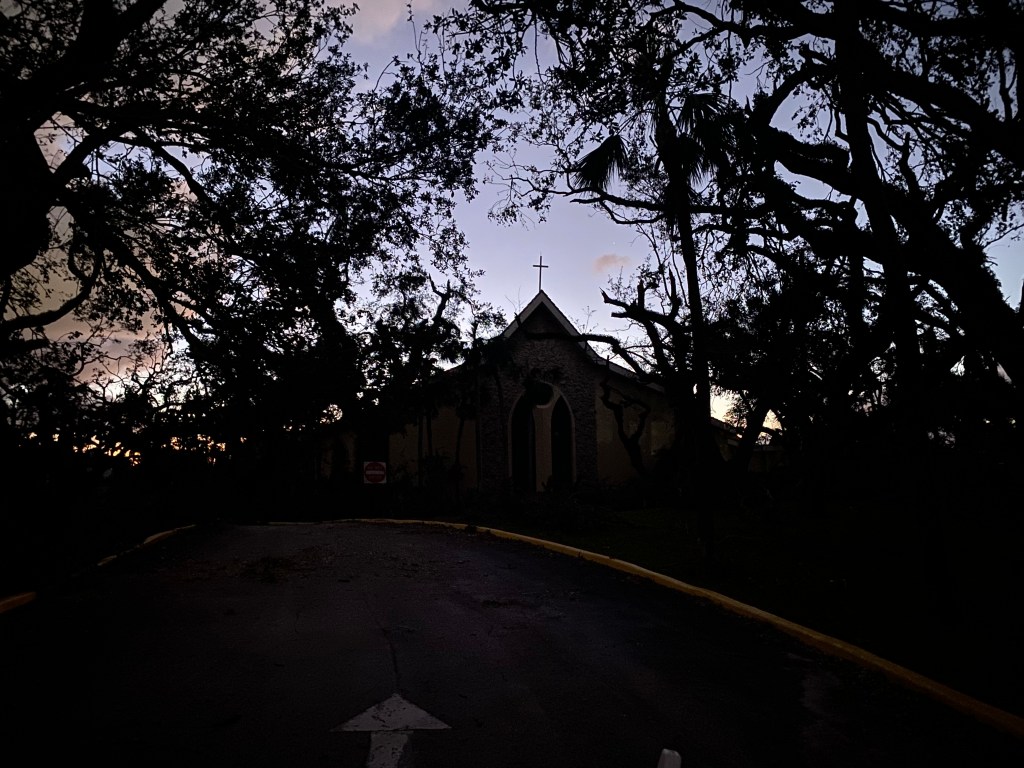
Photo: Rosary walk back home in Palm Beach Gardens, Florida.
Link for the Mass readings for Friday, December 6, 2024

When we receive and put into practice Jesus’ teachings we reflect his light and love to others.
Jesus said to his disciples: “Not everyone who says to me, ‘Lord, Lord,’ will enter the Kingdom of heaven, but only the one who does the will of my Father in heaven” (Mt 7:21).
I have written quite often, quoting and paraphrasing one of my favorite quotes from St. Irenaeus, that Jesus came to be one with us in our humanity so that we can become one with him in his divinity. In his becoming one with us in our humanity he invites everyone, no one is excluded, to participate in his divinity. Yet if everyone is invited, how can Jesus say that not everyone will enter the Kingdom of heaven?
The answer to that question is in the line that follows. The one who will enter heaven is, “the one who does the will of my Father in heaven.” If this verse does not help, then it might be helpful to understand a little about heaven, as best as we can, as the mere mortal, finite beings that we are.
Heaven is not so much a place but a state of being in relation to God, in which we are privileged to share communion and a deeper intimacy with God for all eternity. We will still not know everything about God because God is infinite and we will still be finite even in heaven. God is without limit, we are limited. We will never exhaust our relationship, never get bored with God.
Maybe a more three dimensional, an earthly example may be of help. If we were invited to play a sport, an instrument, or to act in a play, with the end goal being that we would play in the upcoming game, concert, or performance, we might feel pretty excited about the offer. We tell the coach, conductor, or director “That’s great news!” Yet, in the days that follow, we do not attend any of the practices, we do not practice the skills required to play the position, instrument, or role and we don’t return any of the follow-up invitations by phone, email, or text. The day of the big game, concert, or performance comes, we gather our self together and head on over to the arena or hall. We arrive to see the coach, conductor, or director but are denied entrance. We might say, “I don’t understand, you invited us to play!” The reply is, “Not everyone who says to me coach, coach (conductor, conductor, or director, director) is ready and prepared.”
Jesus invites us to play a part in God’s theodrama, everyone. Some say yes and some say no. Some say yes, and then don’t do anything, some say yes and do some things, some say yes and dive in. Most of us take a few steps forward and a step or two back. Just like preparing to play in a big game or perform in a big concert, or play, we need to be committed, disciplined, and persistent. Unlike a missed opportunity to participate in a game or performance, that we can correct and make another attempt down the road, we don’t want to miss the opportunity to spend eternity with Jesus in heaven.
The above analogy does not imply in any way that we earn our way into heaven, or we can do so on our own effort and will power. The bottom line is that Jesus gave his life for all of us and through his grace, we have been saved. Our salvation is a gift freely given. Yet, we have to be willing to receive and open the gift. Our time here on earth is the time we are given to: open the gift we have received, work out our salvation, not just hear but to also put into practice Jesus’ teachings, and be about building our relationship with him. As we do so, we will be transformed by and conformed to Jesus, so that we can come to know his Father as he does, and then we can reflect the light and love we have received to others.
If we want to know God’s will, we need to come to know God. Advent is a time of preparation, a time of getting to know God who is already with us and inviting us to let him into our lives. Jesus helps us to recognize and see what our lives are with and without God. He helps us to see and recognize when we are off track. Then we can better decide who we choose to follow.
When we are aware and humble enough to acknowledge that we are walking away instead of toward God, we just need to reorient ourselves, and turn back to him. God never tires of forgiving us. Let us not ever tire of asking for forgiveness. Each time we seek and receive forgiveness, our minds and hearts are expanded and we will experience more of his love. The forgiveness and love that we receive, we are then to also share.
——————————————————————————
Photo: We each reflect the light of Jesus in our own unique way.
Link for the Mass reading for Thursday, December 5, 2024

May we have compassion on others and be moved to help as Jesus did.
“Jesus walked by the Sea of Galilee, went up on the mountain, and sat down there. Great crowds came to him, having with them the lame, the blind, the deformed, the mute, and many others. They placed them at his feet, and he cured them” (Mt 15:29-30).
There is a key yet subtle point before Jesus began to heal that might be missed. Before great crowds came to him, Jesus “went up on the mountain, and sat down there.” This is no insignificant sentence. The posture of sitting on the mountain would have been recognized right away by the people of Jesus’ time. This was the posture of the teacher and sitting on the mountain a reference to Moses. Prior to the healing in this setting, as he did throughout the Gospels, Jesus taught about the reign of God. In fact, time and again, Jesus’ “works of healing took place in this context of his preaching of the kingdom of God” (Lohfink 2014, 58).
A great multitude of people came to Jesus to hear his message and also brought with them a wide range of needs. Jesus made himself available, restored, and healed those who were brought to him. He encountered them as they were in their present condition. There is no record in this Gospel account that Jesus asked for any identification, that he discussed their belief system before healing them, nor did he ask if they were Jewish or Gentile, and nowhere in this account did Jesus deny anyone who came to him. The response of those to being healed and restored was that “they glorified the God of Israel”. This is because, “where God is master, there is salvation and healing” (Lohfink 2014, 62).
The recorded accounts of mass healings in today’s Gospel are but a foretaste of the heavenly realm of eternal communion with the Father, where death will be destroyed forever. Jesus is the kingdom of heaven at hand, for as St Irenaeus wrote, “Jesus opened up heaven for us in the humanity he assumed.” Jesus came to show humanity what life with the Father is so that we could have a clear choice of what living with him is like and what living apart from his is like. Living with Jesus and following his teachings provides healing and life.
For three days, Jesus served the people who came to him, and as people were getting ready to leave, Jesus showed compassion yet again. He sought the assistance of the disciples because he did not want to send the people away hungry.
The disciples, of course, were taken aback because of the reality of the undertaking Jesus proposed. Jesus asked what they had with them and they shared just some bread and fish. Jesus took “the seven loaves and the fish, gave thanks, broke the loaves, and gave them to the disciples, who in turn gave them to the crowds. They all ate and were satisfied. They picked up the fragments left over–seven baskets full” (Mt 15:36-37).
This Advent let us make an extra effort to surrender our will to God. May we pray with and meditate upon the Gospels such that they become a living word that takes root in our hearts, may his teachings become relevant in our lives, and may they move us to also have compassion on those around us. May we resist the temptation to withhold our service because of someone’s religion, race, gender, creed, or political affiliation.
What matters is that we are willing to see in each person before us a human being with dignity and worth. Even if we feel we have little to give and that is not limited to material means, let us give as God guides us. As the disciples gave the seven loaves and fish, no where near enough to feed the thousands, Jesus multiplied what they gave him. Jesus will do the same through us. We just need to be willing to follow his lead and like Jesus be willing to feel compassion and love for others and let God happen.
—————————————————————————
Painting: The Multiplication of the Loaves by Giovanni Lanfranco between 1620-1623
Lohfink, Gerhard. No Irrelevant Jesus: On Jesus and the Church Today. Collegeville, MN: Liturgical Press, 2014.
Link for the Mass readings for Wednesday, December 4, 2024

Quiet time with God in his creation helps us to be still, to grow closer to God and each other.
“All things have been handed over to me by my Father. No one knows who the Son is except the Father, and who the Father is except the Son and anyone to whom the Son wishes to reveal him” (Lk 10:22).
God the Father knows God the Son and God the Son knows God the Father. They do not just know about each other, they know each other with such a deep, infinite intimacy that is far beyond our human comprehension. Contemplating this reality can fill us with hope especially when we come to realize that Jesus is the Son of God who has come into our lives so that we can participate in the trinitarian communion of the Father and the Son and the love shared between them, the Holy Spirit!
Jesus has come as an agent of reconciliation, to restore our relationship with God, to undo the effects of the sin of separation that has so ruptured and wounded our relationship with him, each other, and his creation. Our hope this Advent is that we can come not just to a better understanding of God, but to more intimately know and restore our relationship with God through our participation in the life of his Son.
May the Advent season not get away from us before it even starts because of the material, commercial, and busyness that threatens. A good practice to help us to slow our pace is to spend some time in the gift of God’s creation, to enter into its natural rhythm, and bask in the wonder and vast expanse of it all.
One of the activities that I enjoyed most with JoAnn, was our evening walks. I have continued this practice most evenings since her death as well. During my time at seminary, my spiritual director invited me to pray the Rosary during these walks, which I did and have enjoyed very much. Each night walking around the lake at the seminary and looking up and around, praying, walking, and breathing was a wonderful and peaceful experience.
As I drew closer to ordination, one of my concerns regarding possible placement was whether or not I would be assigned to an area in which I could continue my evening Rosary walks and have access to the wonderful vistas that the seminary afforded. I have been blessed by our bishop that he assigned me to Holy Cross. Not only have I been blessed with even more wonderful natural views, I have been blessed with an incredible family and community here. With each step and interaction, I continue to be blessed and drawn deeper into intimacy with God and feel more of his peace and joy.
All of creation echoes the wonder and adoration of the gift that the season of Advent offers: Jesus invites us to participate in a deeper walk with his Father, the creator of heaven and earth, the one who knit us together in our mother’s womb, and who knows us better than we know ourselves! With each breath and step we take, each prayer that we pray, each willingness to engage lovingly with another, will lead us into deeper intimacy with the Father, the Son, and the Holy Spirit and each other.
———————————————————————————–
Photo: Although darker on these December Rosary walks, still many interesting views. “A light has shined in the darkness and has not overcome it” (John 1:5).
Link for the Mass readings for Tuesday, December 3, 2019

Called to be still awhile and then to go out on mission.
He said to them, “Come after me, and I will make you fishers of men” (Mt 4:19).
Today’s Gospel account recalls Jesus’ call of Simon Peter, Andrew, James, and John. An interesting contextual point is that Jesus was the one doing the calling. Spiritual teachers were common during the time of Jesus within and without of Judaism. The most common practice was that the disciples sought out and came to the master. It was the rarer case that the master would search out and call his followers.
Another interesting point is that Jesus met the brothers in the midst of their everyday activities of fishing, in the midst of their work. The encounter with Jesus was not on some isolated mountain top, it was not at a revival, nor at the temple or synagogue. Jesus met them in the midst of Simon and Andrew casting their nets and James and John mending their father’s nets.
The third point from this short account is that Jesus immediately followed his invitation to Simon and Andrew with the insistence that they will be fishers of people. They are not entering their new apprenticeship with Jesus having any false notion that they will wait for others to come to them. They will travel out of their comfort zones. They were called to leave their current way of life, financial security, and to trust in Jesus as they learned about and shared the Good News that the kingdom of God is at hand.
The three points above apply directly to us as well. Jesus seeks us out and invites us to join him. Are we willing to receive this invitation and say yes as Simon, Andrew, James, and John had done. Jesus meets us in our everyday moments. He meets us in our workplaces, our interactions with family and friends, in our class and dorm rooms, as well as in our activities and leisure. He meets us in our conflicts, struggles, suffering, as well as our joys, successes, and moments of wonder. Jesus also encounters us during our unpreparedness for interruptions, in our times of prayer, and worship.
The very desire to pray does not actually begin with us. Noticing that we want to pray is our awareness of Jesus’ calling us. When we take the time to pray we slow down and become more aware of Jesus’ presence in our lives. We experience him and his love for us. Doing so, we are then more able to see him in the midst of our daily activities. The goal of taking time to step back and pray, to give us anchor moments in each day to spend quietly with Jesus, will help our times of activity to be an extension of our times of meditation and contemplation. Experiencing stillness and peace regularly will eventually carry into our daily engagements and encounters.
Jesus calls us to spend time with him and then sends us out to share what we have experienced and learned from our encounter with him. No matter how small. We will make mistakes, we will not be perfect, but as we put into practice his teachings, we will learn and grow as his disciples. Remember who he called? Peter, Andrew, James, and John. There are four Gospels full of accounts of their false starts, gaffes, and “Oops”. We grow and learn as they did, by doing. As we crawl, we will soon learn to walk, as we walk we will soon learn to run, and as we run, we will soon learn to fly!
Jesus calls us to participate in his life and to put his teachings into practice. This is the gift of transformation. We are not just a religion, a people of the book, we are a people of encounter. We encounter Jesus the Christ, the Son of the living God. Once we experience, breathe, receive, rest, and abide in his love, we are forever changed and want more. For to experience the love of God is our deepest longing, and what we have been created for. And just as we receive something wonderful in our lives, our first instinct is to share. That is what happened with the Apostles and what we are invited to experience as well.
St Andrew, pray for us!
Photo: Rosary walk: time with Jesus and Mary to be quiet, still, to wind down, and renew each evening so to be ready to serve again the next day.
Link for the Mass readings for Saturday, November 30, 2024

When we remember we will die, we will live better now.
“Heaven and earth will pass away, but my words will not pass away” (Lk 21:33).
All that exists and that we know will pass away eventually because all things are finite, they are limited and material. The readings of this week repeat the same theme that we are not to place our hope and trust ultimately in the things of this world. The longer we live, the more we will experience loss, even the death of those closest to us. I remember my maternal grandfather share with me when he was around ninety years old that most of the people he grew up with were no longer alive.
All that which is physical and finite will pass away, but the words of Jesus will not pass away. Jesus’ words are life. He is God, the second Person of the Holy Trinity. He is the Logos, the Word, the very reality of God. Hearing his word is not enough though. Once we hear his word, we are to then mediate and ponder his words, put his words into action and practice them in our lives. In doing so, Jesus becomes one with us in our humanity and we, one with him in his divinity. In God’s time, we will begin to bear fruit. We will become like the fig trees when their buds burst open.
Momento Mori is the Latin phrase that means, remember you will die. Accepting the reality of death and contemplating on our own deaths is not a morbid exercise when we enter this pondering with the end goal in mind that we will be one day be with God for all eternity. Also, those who contemplate their deaths more regularly live their lives more fully now. When we keep the our awareness of death available to us, we take our life and the lives of others for granted less because we come to see the fragile nature of our human condition. We also come to realize that we do not know the time or hour when others or we ourselves will die.
Contemplating our death from time to time, also helps us to determine who and what is important to us. Dr. Leo Buscaglia, a professor at USC, while he was still alive had assigned his students an invitation to imagine that they had one week to live. They were to come up with a list of what they would want to do for that week and with whom they would want to spend it with. After they turned in their assignments, Dr. Buscaglia then returned the papers and said, “Why not live this way now? Why do you have to wait until you are dying to start living your life more fully?”
Jesus invites us to resist the temptation to avoid uncomfortable situations as well as to resist clinging to wonderful experiences once they are gone. This healthy indifference helps us to experience the present gift of the moment where we will experience God and hear his guidance more clearly. Jesus helps us to live in this way because he lives in the eternal present. We are going to die someday, putting off until another day may be too late, so let us start living now.
Jesus, please help us to remember that we are going to die so that we may better appreciate and experience each moment. Help us to discern the path you would have us to walk, guide us through the challenges and trials that will arise, and to bloom where we have been planted. Help us to recognize that we will have less regrets when we listen to, meditate upon, and put the words of Jesus into practice, so that we may live now and experience your peace, joy, and love.
Photo: Sometimes knowing the time we have left can be a blessing. Enjoying our final two months together with JoAnn, July 4th weekend, 2019. Swan boat ride on Echo Lake in, LA.
Link for the Mass readings for Friday, November 29, 2024

May we be thankful for God, and those who have been and are still in our lives.
They stood at a distance from him and raised their voices, saying, “Jesus, Master! Have pity on us!” (Lk 17:12-13). They raised their voices and asked Jesus to have pity on them. Did the ten seeking a healing all call in unison. Did one shout out first and then each not wanting to be left out all joined in calling out? Then did their calling reach a fever pitch? Luke is not specific as to how they called out but that all of them did. Jesus then healed the their leprosy with his word, they began to praise God and may have walked away in even a more joyful raucous than their calling for their healing. Yet one, a Samaritan, after realizing he was healed, returned to thank Jesus.
It is a good practice to spend some time each day to reflect on what we are thankful for. To see where God has entered our lives and provided assistance. At times when we feel a bit down and out, or in a bit of a funk, often the reason may be that we are focusing, on what we do not have instead of on what we do have. There is a quote, I am not sure of the source, that goes: “I cried because I had no shoes, and then I came upon a man with no feet.” We can be so bombarded by the mass appeal to the material, that we forget the truly important realities of this life and the many blessings that we have been given.
Today is Thanksgiving Day, unless you are reading this the night before. Thanksgiving is a time of family coming together, which hopefully as joy filled as those lepers walking away realizing that they are healed. But with the promise of such gatherings, there is all the cleaning, setting up and the prep for the big dinner, the travel, the unresolved issues of life, and there are the wonderful gifts of diverse personalities and points of view. Making time to periodically stop and take a few breaths can make a big difference in how the day is played out. A moment of quiet may help us to be like the Samaritan leper who when realizing that he was healed, was thankful. Slowing down a bit, might just help us to appreciate each other a bit more and grumble a little less.
As Jesus reminds us, we do not know the time or the hour. Life is finite and fragile in the best case scenarios. We will not be here forever nor will those we love. November is a time in the Church when we remember those who have joined the communion of saints as well as those on the way. I know too many who have lost those close to them. And since becoming a priest, I have walked with eleven more who have journeyed from this life to the next. My prayer is that they and JoAnn are now home with God. May each of us remember those who have gone before us and be thankful for the time that we have had together, while at the same time, may we appreciate those still in our lives.
My thoughts and prayers are with you who are reading these words this day. May we allow the warm embracing arms of our loving God and Father to embrace us in a moment or two of silence. In these quiet moments, may we remember that we are never alone and that God cares for each and every one of us and our loved ones here with us, and now preparing for us in the next life to come.
Jesus, please help us to remember that life is a precious gift that you have given us, and may we appreciate every moment. Help us to be thankful for our lives and the lives of those near and far that we are blessed to call family and friends. May we also remember and pray that the Holy Spirit may provide comfort and aid for those who may be alone, struggling, or without family, food and/or a home this day.
———————————————————————————————-
Photo: Was not aware that this would be our last Thanksgiving together. A reminder to not take the time we have together for granted. Happy Thanksgiving!!!
Link for the Mass readings for Thursday, November 28, 2024
 Spiritual Stepping Stones