Jesus wants to heal and save us. Do we want to be?

Has there ever been a time when you were picked last for the team, whether on the playground, P.E., or gym class? I remember being on both sides, being picked last, and picking others to join and having to pick someone last. I preferred being chosen last much more than having to be in the situation to choose a classmate last, and it was often an agonizing situation. In our Gospel reading today, Jesus comes upon a man who has experienced even worse.

He has been in need of healing for thirty-eight years. Apparently, there was a limited time to get into the waters of the pool of Bethesda to experience the healing properties that it afforded, for each time the water stirred, while the man moved to get closer to and enter the water, “someone else gets down there before” him. This is worse than getting picked last, as he doesn’t in a sense even make the team!

But with Jesus, the last shall become first. Key ingredients are belief, faith, and a willingness to be healed. Jesus does not impose, even in the case of healing, Jesus invites. He asks the sick man, “Do you want to be well?” The man is stuck in the limitations of someone getting him to the pool. That is all the affirmation Jesus needs. The man is willing if there is someone to help. Jesus commands him to rise, pick up his mat and walk. The man is no longer the one picked over, the one ignored, the one unseen. In his encounter with Jesus, he is healed by Jesus’ word.

Jesus meets us in our need as well as the man at the Pool of Bethesda. He meets us where we are, no matter our station in life. He does not leave us on the outside looking in, he does not leave us wondering if we are loved or if we belong. He does not only come to encounter us but if we are willing, to empower us to be about the mission given to us by his Father. Jesus gives meaning and purpose to our lives. Jesus has come to save us. Each and every one of us is a gift from God and has been graced with something to contribute to others, something unique to help make the kingdom of God a reality.

Give yourself a moment of silence and stillness, without and within. Settle into a place with no or little distractions, breathe in deep and exhale a few times, then close your eyes. See yourself as you are in your present seated position, breathing, experiencing your shoulders relaxing, and just being still. Then notice Jesus. He is walking toward you as he did with the man at the Pool of Bethesda. Does Jesus remain standing, does he sit beside you, or kneel before you? As he assumes whatever posture, allow your thoughts to reflect on what you need. As you are pondering, does Jesus ask you a question? What does he ask or what does he say?

Jesus is present, right here and right now, for you. There are no boundaries, no limitations, only those you impose on yourself. Share with Jesus your need. You are no longer misunderstood, left out, or picked last. Jesus is present. Embrace this moment of time together, of knowing that you are loved, heard, and that you belong in the kingdom of God.

————————————————————————-

Painting: Some quiet time of prayer in between studying, St. Vincent de Paul Regional Seminary, Boynton Beach, FL.

Link for the Mass readings for Tuesday, March 12, 2024

Turn from darkness and prefer instead the light that has come into the world.

That the light came into the world, but people preferred darkness to light” (Jn 3:19). What is the preference of darkness over light? We have all said with St. Paul, “For I do not do what I want, but I do what I hate.” (Romans 7:25)? Now we are not always in this state of choosing darkness over light and choosing to do what we don’t want to do instead of what we want to, but we are probably guilty of entertaining both more than we are willing to admit. Why? I don’t have a definitive answer, but I can share a few ideas.

We are certainly influenced by the condition of Original Sin, that time in our ancient ancestral past where the choice to choose self over God happened and has been perpetuated generation after generation up to an including today. We can choose our self over God because that is an influence of our fallen world and have learned to live our lives that way. We create habitual patterns of behavior and then we go on automatic pilot, continuing to make the same decisions repeatedly. We also make decisions that appear to be but are not for our highest hope and good, because many of us have been wounded and we are doing the best we can to cope and survive.

Our Baptism takes care of Original Sin, but we still have concupiscence, which is our tendency to be drawn into sinful actions. We are still susceptible to temptation. What helps is recognizing that there is a God who loves us, so much so, that he sent his only Son to be one with us so we can be one with him. What helps is making more of a conscious choice to recognize and come out of the shadows, out of the darkness of our defense mechanisms, our denial, our past hurts, anxieties and fears. We need to say yes to Jesus who never sinned because for each and every temptation he received, even in Gethsemane, Jesus had one and the same answer: “Not my will but yours be done” (cf. Lk 22:42).

When we choose to surrender our life to God, by aligning our will with God’s, and by participating in the life of Jesus, we can receive and experience the love of the Holy Spirit working in our own lives. In so doing, we will find healing and forgiveness. This is not a one-time event. This is a progressive, spiritual journey that continues throughout the whole of our lives, and into eternity with God. When we notice we are beginning to slip, this awareness is good. We need to resist beating ourselves up, admit where we are, apologize as necessary, seek forgiveness, and return to loving God, ourselves, and one another.

Holy Spirit, please guide us today so that we can better resist the temptations that go before us, unlearn our negative behaviors, and create new habits to replace those that have kept us bound and shackled to our self-centered, indifferent, and unhealthy postures. Help us to identify and renounce the shadow sides of ourselves, seek to confess and allow your love to heal us, and to place our trust in the Light of Jesus, the warmth of his love, and receive the gift of his forgiveness and mercy.

Photo: St. Francis preferred and chose to follow the light of Christ. Outside our chapel, St. Vincent de Paul Regional Seminary, Boynton Beach, FL.

Link for the Mass readings for Sunday, March 10, 2024

Having the humility to confess our sins frees and heals us.

It is much easier to find fault in others, and in some cases, the act of doing so has become entertainment in private as well as publicly, and especially with social media. Gossip has a seductive allure and can be consuming. Judging others is also a way to justify and or project our own inappropriate behavior onto others. We may even place ourselves in a false sense of exalted pride. Have we ever, not just stated, but thought or prayed something along the same lines as the Pharisee in today’s Gospel? “O God, I thank you that I am not like the rest of humanity — greedy, dishonest, adulterous — or even like this tax collector. I fast twice a week, and I pay tithes on my whole income” (Lk 18:11-12).

To pray any part of this prayer stunts the growth in our spiritual life because we are focused on ourselves instead of emptying ourselves before God. Anytime we rationalize, cover over, or deny our sinful behavior we create and support habits of selfishness. Left unchecked, we can become enslaved to them. Lent is a time for healing, purification, and transformation. To be able to heal from sinful attitudes and actions that have become habits, we first must be able to acknowledge and identify them.

Over time, reading more and more lives of the saints, I have come to understand that their recognition and confession of their sinfulness was not just pious platitudes, but true expressions that they were growing closer in their relationship with Jesus. A simple example can help express where they are coming from.

When we drive our car while it is dark we don’t give much thought to the cleanliness of our windshield because we can see fine. Yet as the headlights from an oncoming car illuminate our windshield, the smudges, dirt streaks, and bug residue come into focus. This can be evident in our spiritual life as well. The more we remain in our own darkness of denial, we feel we are fine, all is right with the world. The closer we grow in our relationship with Jesus, the more his light shines in our darkness, and he reveals to us our sin.

Jesus invites us to resist the prayer of the Pharisee who justifies himself as he prays comparing himself to someone else, instead of acknowledging his own sinful actions and he instead emphasizes that we are to follow the honest humility of the tax collector, who did “not even raise his eyes to heaven but beat his breast and prayed, ‘O God, be merciful to me a sinner’”(Lk 18:13).

Now, Jesus is not saying this is the only way we pray. We have the opportunity to worship and praise the Lord joyfully, we can seek his help in praying for others through intercessory prayer or for ourselves in petitionary prayer, we can also sit in quiet meditation during adoration or out among God’s wonder of creation. Each prayer has its time and place and each type of experience of prayer helps us to grow and deepen our relationship with Jesus and each other.

True humility is brought about by our willingness to see who we are from God’s eyes and to focus on him instead of ourselves. If we want to set a standard to live up to and if we are to compare ourselves to anyone, let it be Jesus. A daily examination of conscience is a healthy practice and discipline. We just need to be willing to invite Jesus to shine his light of love into our present places of darkness. What we see then we can confess. Admitting to and experiencing the sorrow for the hurt we have caused from our sins is healing. In our willingness to confess, promise to sin no more, and do penance, we will receive his love, mercy, and forgiveness.

One prayer I have found helpful over the last few years is the Jesus Prayer. It is very simple. Sit in a comfortable space, take a few deep breaths and exhalations, then as you take the next breath in recite, “Lord Jesus Christ, Son of the living God,” and then as you breathe out say, “Have mercy on me a sinner.” You are breathing in the light of Christ and you are breathing out the darkness of your sin.

Traditional prayer ropes exist from the Eastern Orthodox tradition for this practice. They are made of wool, usually black, and have ten decades of ten beads. The bottom can also have a fringe representing the mercy of God wiping away our tears of sorrow. You can also use your Rosary. If you have neither a prayer rope or a Rosary, you have your fingers. Start with a set of ten Jesus Prayer recitations each day and pray by prayer come closer into communion with God.

—————————————————————————————

Photo: Rosary walk and looking up, just past sunset. God is good! St. Vincent de Paul Regional Seminary, Boynton Beach, FL.

Link for the Mass readings for Saturday, March 9, 2024

Jesus seeks to heal and free us from our labels.

In the Gospel reading today, Jesus is accused of being an agent of Beelzebul, the prince of demons, because he was exorcising a demon from a man that was mute. Jesus addressed the critique and showed the polarizing nature of the onlookers who were unwilling to see the healing before them for what it was. Jesus then stated the obvious: “Every kingdom divided against itself will be laid waste and house will fall against house” (Lk 11:17).

Satan seeks to sow discord and division. Jesus seeks to bring about unity. Now it is true, that five verses later in the Gospel of Luke, Jesus is recorded as saying: “Do you think that I have come to establish peace on the earth? No, I tell you, but rather division” (Lk 12:51). Anyone feeling a bit confused? Welcome to the wonderful world of the Bible!

To understand Scripture, we need to understand the context of the whole of Scripture, not just isolated verses. Throughout the ministry of Jesus, he seeks the unity that all may be one as he and the Father are one (cf. John 17:21), yet he has consistently experienced those that rejected his message and healings as witnessed in today’s Gospel account.

Jesus demands a choice. We need to decide if we are either going to be for him or against him (cf. Lk 11:23). The division Jesus is talking about results from those who choose not to recognize that Jesus is who he says he is and reject him and those who accept him for who he is. This choice continues to cause division within households, families, and friends even today.

The greater take away from today’s Gospel and Jesus’ teachings as a whole, is that Jesus is the way and the truth and the life (see John 14:6). Jesus is the Son of God made man. Some will reject this truth. Some will accept only parts of the truth that Jesus teaches, while others will say there is not objective truth. We who identify with this truth and give our lives to him as his disciples, then like Jesus, we are to embrace the gift of our diversity.

We are more united rather than divided when we resist limiting ourselves by mere labels. In our modern context, labels, such as liberal and conservative are not helpful. It is certainly easier to cast labels, but interactions with people and developing relationships are much more nuanced. We are not mere cardboard cut outs, or caricatures.

To better understand the essence of who we are as human beings demands greater time and experience with each other than an outward appearance or isolated statement may portray. Many times, once we have cast a label, we believe that we have “defined” the person. They are classified in their box and tied up in a neat and pretty bow, and woe to the person who resists being boxed and bowed.

I remember reading from one of the books from the tracker, Tom Brown, Jr., in which he described how many people when seeing a bird, such as a blue jay, robin, or crow, are often satisfied with the label, the naming of it, and move on from that sighting self-satisfied. They think that in that simple identification they now have come to understand all that there is to know about that species. So much of the essence of one of God’s amazing creatures is missed by such a simplistic and limiting classification!

Unfortunately, we do the same with each other. We make a prejudgment on a person or group of people because of a word, statement, stance on a particular issue, or particular belief. We then falsely believe we know everything there is to know about that person or group. This is a limiting and divisive approach. Jesus invites us to encounter, accompany, spend time, and break bread with people. In spending time with one another, dialoguing, and respecting each other, the caricatures can be filled in with some substance and we can come to know a little better the person beyond the prejudgment. Maybe, just maybe, someone who we have been keeping at arm’s length, we can actually grow closer to, despite our differences.

———————————————————————————

Photo: During 30-Day silent retreat, St. Joseph and Mary Retreat House, Mundelein, IL.

Link for the Mass reading for Thursday, March 7, 2024

Are we willing to see another as human in their need?

The Parable of the Rich Man and Lazarus from the Gospel of Luke 16:19-31 is well worth the read. Jesus challenges us through parables such as these. For many in Jesus’ time who were followers of the God of Abraham, they believed that those who had wealth and status in society did so, for the most part, because they were blessed by God. When the rich man and the beggar, Lazarus, die, I am sure Jesus paused to allow his listeners to imagine what would happen to these two men. Many would not have predicted what happened next.

Lazarus was taken up “by angels to the bosom of Abraham” (Lk 16:22). The rich man found himself suffering from the torment of flames, such that he was parched, begging just for a drop of water from Lazarus (cf. Lk 16:23-24). Abraham, the model of faith and father of Judaism, was not sitting with the rich man, who must have always been seated at the highest places in his day, but now that seat, at the bosom of Abraham, was offered to Lazarus. There was no hope at this moment for the rich man to cross over because of the wide chasm that separated them. An ironic subtlety was afoot as well in Jesus’ telling of the parable to the Pharisees. Lazarus the poor beggar is named, whereas the rich man is not.

How does the rich man come to this state of suffering and separation? This is the life he lived prior to his death. He walked over or by Lazarus day after day not giving him even a second look. Lazarus would have been grateful even for the mere scraps that fell from this rich man’s table, much like the rich man now sought just a drop of water from the finger of Lazarus. The rich man committed the root offense from which sprouts much of our sin; he failed to bother, to care, to love his brother, to will his good.

Jesus’ parable of the Rich Man and Lazarus, echoes very closely Matthew 25:40, “whatever you did for one of the least brothers of mine, you did for me.” How we treat others matters. Failing to care, to reach out to those in need around us is sinful. We, probably like those who first heard this parable, experience time and again, a wicked mind storm that swirls with reasons, rationalizations, and justifications as to why we do not reach out to help others. The majority, if any, are not valid. We are invited to give and to love joyfully from a natural, not a hesitant disposition, to provide aid and support.

Almsgiving is one of the three pillars of Lent. The first step in giving of our time, talent, or treasure is to be people of prayer. Spending time with God helps us to know him, his will, and his voice and we will then grow to see him in all things and all people. As we experience, rest, and abide in his love and come to know his voice, we will be more apt to say, “Here I am!” We will also be more aware of those who are in need from the unborn to those in the later stages of their life and everywhere in between. This can be in our own families, home, workplaces, schools, or wherever we go!

Once we are aware, the challenge is knowing how best to provide help. Our response will be unique for each person. What we want to resist is feeding the wind and the waves of indecision and excuses for not helping and instead take a breath and stop. Let our eyes adjust so that we can see the person before us as a human being, as a sister or a brother with dignity, value, and worth.

Everyone wants to belong, to be a part of, to be loved. Then, in the next moment seek the guidance of Jesus, be present, and allow God to happen through us in whatever form or act of kindness that may take. No matter how small, loving another makes a difference. Seeing another, seeing another as human, seeing their need, acknowledging their presence, and seeking God’s guidance on how best to help is a good place to start.

——————————————————————-

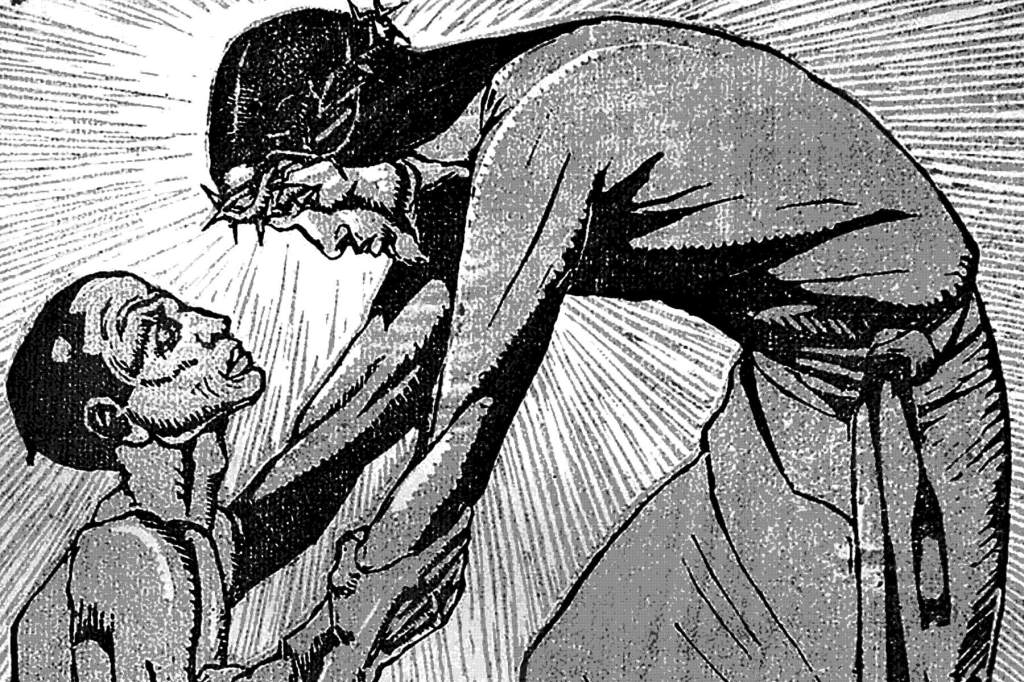
Photo of woodcut Jesus and leper by Mabel Royds. Are we willing to see Jesus in others and allow them to see Jesus in us?

Link for the Mass readings for Thursday, February 29, 2024


Jesus sets a high bar, but will also give us the strength we need to reach it.

There are many polls, surveys, and discussions about why fewer people participate in formal faith traditions, while at the same time many people are still hungry for God. Some people still profess to be spiritual but identify less with organized religion. There are a handful of causes why, but Jesus may be shedding light on two possible ones. Jesus discusses in today’s Gospel from Matthew: “For they preach but they do not practice. They tie up heavy burdens hard to carry and lay them on people’s shoulders, but they will not lift a finger to move them” (Mt 23:3-4).

We have an innate sense that alerts us to hypocrisy and when many seek something deeper in their life and they get slapped in the face with leaders and practitioners in faith traditions preaching one way in public while living another, it is damaging. The Catholic Church is still reeling from not only those clergy who have abused children, but those bishops who have covered up the abuse. This certainly is the height of hypocrisy in that those entrusted to shepherd the people of God were preying on their own flock.

As horrific as these acts are, there are so many other ways we are not practicing what we preach. It is easy to give up and walk away and say this is not my problem, to point fingers and justify our own acts of hypocrisy by saying well at least I am not that bad. Yet even this evil within the Church does not change the truth that Jesus is the way, the truth, and the life. He is the source of our being and fulfillment.

We are followers of Jesus, and that means the standard we strive for is how he lived his life. Jesus always pointed the way to the Father. We as human beings are finite and so are going to make mistakes and sin. While Jesus is our model, even more, he is the source for our living faithfully to his teachings. When we open our hearts and minds to him, his love will work through and transform us. He will reach others through us as well when we are willing to stand up for the dignity of those entrusted to us within our realm of influence.

If we want to guide someone it is not enough to say this is what you need to do and live accordingly. We need to practice and live what we are guiding others to do, be willing to accompany, assist, and walk with someone along the way. As a Christian, just giving someone the Bible and say there you go, that’s all you need, and quote a couple of scripture passages is not enough. If we are sharing a principle to put into practice and we are not willing to lift a finger to help them, or worse do the opposite, we do more damage than if we said nothing.

Jesus calls us to resist judging and condemning, to love our enemies, to be forgiving, and merciful. Powerful actions to live up to, heavy burdens to lift indeed. To say that the bar Jesus sets is high is an understatement, but he lived them out. We not only learn how to act from reading about the life and teachings of Jesus but even more importantly, he still gives us the power and assists us to live them out too.

Jesus challenges us even more than the scribes and Pharisees, but he is willing to help us carry the load. When we are willing to see where we fall short of the goals that he sets for us, ask for his forgiveness, and accept his help, we will grow. From our own experiences of falling down and getting back up, we are better able to help others to be disciples, by guiding, modeling, and walking with them. The most important guidance we can give anyone is to lead people in such a way that they have an encounter and experience of Jesus for themselves, so even when we fall, they will still have Jesus as their ultimate guide and they can then help us up and we can continue to journey together, side by side.

————————————–

Photo: Attending Mass at St. Luke Catholic Church, Ellington, CT over Christmas break. Nice to experience Mass in different parishes each day while away!

Link for the Mass readings for Tuesday, February 27, 2024

“Be merciful, just as your Father is merciful.”

My wife, JoAnn, asked me on a couple of occasions what were the favorite clothes of mine that she wore that I would like her to pack for our trip. I said the ones that you feel most comfortable in. She also shared with me what clothes she liked on me, including a pair of black, skinny jeans.

The reason we were having this conversation was because we were moving to Los Angeles. JoAnn had been diagnosed with Stage IV Pancreatic Cancer and we were moving to LA, for her final months this side of heaven.

With all packed, JoAnn flew ahead to Los Angeles with Jack. I would follow two weeks later after I finished out the school year. When I arrived and we were unpacking, JoAnn said, “You didn’t pack your black, skinny jeans.” The look on her face pierced my heart. We didn’t talk about it again.

About four months later and a few days after JoAnn died. The image of the look on her face came back to me again, and with some time to think, I realized that JoAnn was focusing on the clothes because these would be our last weeks together and why not dress in clothes that we both liked on each other. I was devastated that I missed it. The feeling also brought up times throughout our marriage where I did not make the time to listen to JoAnn, where I was impatient, and even treated her with contempt.

In that moment I experienced a deep sense of contrition at how I must have hurt JoAnn in those times. I cried as I walked to the cathedral in downtown LA which was about a half mile away. I got myself together and then fell apart again as I confessed to the priest. When I finished, he said that JoAnn forgave me, and that God forgave me.

Mercy, in Hebrew – Chesed – tender compassion.

God’s mercy, his tender compassion, is what I felt in that moment.

This is what Jesus is calling us to receive and be in our Gospel today. We are to be merciful, just as our Father is merciful with us.

Lent is a time to experience the mercy, forgiveness, and love of God. We do so when we are willing to be humble enough to allow Jesus to show us our sin, where we have fallen short of loving him, ourselves, and one another as he has created us to be. When we see our sin, Jesus does not condemn, berate, or demean us. If we experience any of that, know it is the devil seeking to isolate and separate us from the mercy, forgiveness, and love God wants to embrace us with.

All God asks of us is to be ourselves, to be who he has created us to be and that is his beloved daughter or son. All the other things we think we need to be, we can let go of. We can let go of all the anxiety, stress, and confusion about who we think we ought to be and just breathe deeply, receive, rest, and abide in the love our Father wants to share with us. When we live from this experience of God’s love, we will be in a better place. And when we mess up, we just need to be contrite, confess, be forgiven, do penance, and begin again.

As I shared my experience above, I encourage you to think of a time when you have experienced God’s mercy, chesed – his tender compassion. Rest in that moment and return to it again and again today and this week. When we return to and experience these anchor moments of God’s mercy for us, we will remember who and whose we are, and we will better be able to share God’s mercy, forgiveness, and love with others.


Photo: Treasure each moment you have with those you hold close to your heart. Even in the best of circumstances, time goes too quickly and the unexpected can happen. Let those you love, know you love them, with your thoughts, words, faces, and actions.

Link for the Mass readings for Monday, February 26, 2024

Love our enemies? Yeap.

“You have heard that it was said, You shall love your neighbor and hate your enemy. But I say to you, love your enemies, and pray for those who persecute you, that you may be children of your heavenly Father” (Mt 5:43-45). With these words, Jesus continues to raise the bar of discipleship and outlines what the pursuit of love truly is.

For many people, as Bob Dylan wrote and Joan Baez has sung, “love is just a four-letter word.” But the love that Jesus calls us to is not merely romantic, emotional, or mere sentimentality. There is nothing wrong with feelings of infatuation because in experiencing falling in love, we are drawn out from ourselves to another. This experience of love has no depth though and when it is channeled and disciplined, it can mature to the wonderful gift of friendship.

The bond of friendship and family goes beyond mere attraction and is built through shared interests and experiences. Through sharing our lives with others, working through conflicts, trust is built, and relationships will hopefully grow and deepen. Jesus, though, is calling us to mature in our growth of loving even beyond friendship or familial ties. If we love those who willingly love us in return, greet only our brothers and sisters, only those in our clique, group, tribe, or political party, what is the recompense or satisfaction in that? Agape, in Greek, loving without conditions, with little or no chance of mutual exchange, is what Jesus is calling us to strive for.

How can Jesus ask us to love an enemy or pray for someone who persecutes us? St. Thomas Aquinas can be of help. He defines the love that Jesus describes as willing the good of the other as other. We make an act of the will, a free choice to accept the person as they are, to see them, not from our limited, finite perspective but as God sees them, as a person with dignity. Jesus does not teach that we condone violence or abuse or dehumanization. We just don’t act in kind and meet hate with hate. Jesus is calling us higher so we can help to end cycles of violence and not continue to fuel the fire of hatred and division with retaliation.

On our own, we may not even conceive of the possibility, but we can be assured that if Jesus has asked us to strive for this height and depth of love, he will provide the means and support. We love others unconditionally by allowing Jesus to love others through us. We love one person at a time and strive to reach the summit of loving our enemy. Even when we fall short, how much better would our country and the world be if we sought this as our goal? To counter divisiveness, fear, and hatred, we need to choose to engage in an act of the will to love one another as Jesus loves us.

As St. Polycarp, Bishop of Smyrna in the second century who was martyred at 86 years old, was a disciple of John the Apostle who was a disciple of Jesus, taught, “True love desires not only one’s own salvation, but the salvation of all our brothers.” He put his words into practice. As Roman soldiers came to arrest him, he welcomed them and offered them food and drink before they led him to his death.

—————————————

Photo: Rosary walk and praying with Jesus, Mary, John, and Polycarp. St. Vincent de Paul Regional Seminary, Boynton Beach, FL.

Link for the Mass readings for Saturday, February 24, 2024

Let us reflect the love of Christ with our thoughts and our words.

Jesus calls us to be holy, each and every one of us. Our life is to be lived with the end goal being our ascent to heaven, to be in union with our Loving God and Father for all eternity, and to assist others to do the same. Jesus provides for us a concrete example of the heights to which we are called to reach: “You have heard that it was said to your ancestors, You shall not kill; and whoever kills will be liable to judgment. But I say to you, whoever is angry with his brother will be liable to judgment, and whoever says to his brother, Raqa, will be answerable to the Sanhedrin, and whoever says, ‘You fool,’ will be liable to fiery Gehenna” (5:21-22). Jesus is building on the Torah, the Law or the Teachings, by helping us to realize that we can not only kill with weapons but also inflict dehumanizing damage with our words.

To resist this temptation of inflicting mortal wounds, we need to start participating in a deeper examination of conscience which gets to the roots of our own thoughts, words, and actions. If we are not able to discipline our thoughts, what will follow is undisciplined words, and then undisciplined actions, which can lead to entertaining and embracing the deadly sin of wrath. Wrath is unbridled anger that leads someone away from the capacity to think or behave in a rational manner, such that this individual would no longer acknowledge the dignity of the person they would inflict their wrath upon.

Jesus is helping us to see that we can be free of the temptation of wrath if we recognize the danger and destruction of unleashing words as weapons. He offers us the examples of calling someone, Raqa, meaning something along the lines of an air-head or an idiot, and calling someone a fool. These words directed at another have no other cause than to demean, degrade, and belittle. This language, and worse, has no business coming out of the mouths of a disciple of Christ if we are serious about being one of his followers.

I remember a moment in sixth or seventh grade unleashing a derogatory word or two directed at a classmate. Even though they were loosed in jest, I felt a sinking feeling in my gut after hearing myself say them. God gave me a graced moment to feel, contrition, actual sorrow for the negativity and poison I had unleashed with my words. I remember making a commitment to myself not to speak that way toward another person going forward.

We need to be aware that words have the power to wound or to heal. If we are serious about following Jesus, then a wonderful practice this Lent can be to commit to fasting from gossip and from words that belittle, divide, diminish, or dehumanize and replace them with words that empower, unite, uplift and acknowledge the dignity of others. Even when we disagree with another’s point of view, we can do so by still respecting the person and fostering a posture of dialogue.

May we also commit to resisting and not feeing negative or dehumanizing thoughts when they arise. Even when we have defensive musings, resulting from another’s disparaging tone, words, or actions, we need to resist entertaining them. Instead, we can ask for the strength from the Holy Spirit to develop a more mindful disposition that seeks to understand instead of react and to hold each other accountable with respect. We can also give ourselves time regularly to be still and enjoy time outside to let go and unwind. It is important to get enough rest as well. Ultimately we need to consciously choose to love: to will the good of each other as our first step in encountering one another as human beings, as beloved daughters and sons of God.

—————————————————————

Photo: The simple act of looking up can make a difference in our attitude and emotional state. Give it a try and see! Rosary walk, St. Vincent de Paul Regional Seminary, Boynton Beach, FL.

Link for the Mass readings for Friday, February 23, 2024

“Who do you say that I am?”

Jesus asked, “Who do people say that the Son of Man is” (Mt. 16:13)?

Peter answers Jesus by saying that Jesus is: “The Messiah, the Son of the Living God” (Mt: 16:16).

What does Peter’s response have to do with our lives? Does he really care about our everyday challenges, struggles, and tensions? Yes, he does because Jesus is the Christ the Son of the living God. Jesus is Emmanuel, God with us. Jesus is one with us. The infinite reality of God is present within each human being that exists because Jesus became one with us in our humanity so that we can be one with him in his divinity.

We have been created in God’s image and likeness and this is true from the moment of our conception through each stage of life until natural death. The unfortunate effects of Orignal sin are that our image has been distorted and our likeness to God has been lost. We have not been totally corrupted but we have been wounded and we need to be healed and restored.

Jesus experiences our suffering personally. Whatever we may be going through, whether it be a temporary or chronic illness, loss of job, conflict and tensions with family, friends, colleagues, and/or classmates, as well as experiencing feelings anxiety, confusion, and/or lack of direction, mourning and grieving over the death of those we hold close to our hearts: Jesus feels our pain and suffering.

The suffering of humanity is not something abstract for Jesus because Jesus knows each and every one of us intimately and uniquely. He knows us better than we know ourselves and is the one who cares about us and what we are experiencing. Also, he is no stranger to suffering.

Jesus not only cares, he loves us and will walk with us no matter what we may be facing right now. Jesus is inviting us this morning and this Lent to trust in him, to allow his light to shine in those places of darkness, those places where anxiety and fear have a hold, and those places where we need to let go because we give them more priority in our lives than we do God.

A good question to ponder and meditate on this morning is: Who is Jesus for us and are we willing to invite him into our situations and allow God to happen in our lives?

—————————————————————————–

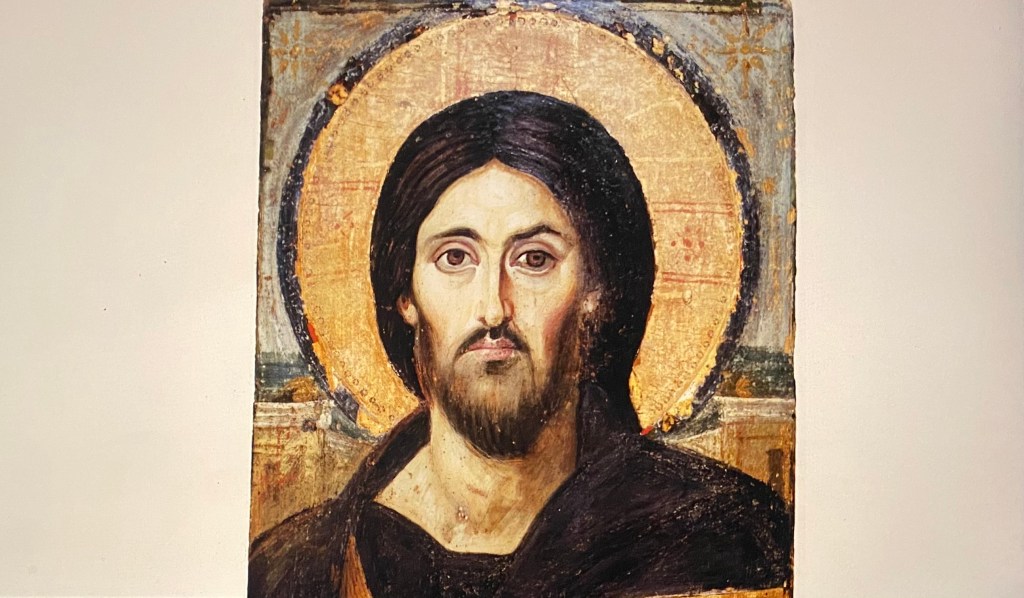
Photo: Closeup of a 6th century icon of Jesus from St Catherine’s Monastery.

Link for Mass readings for Monday, February 22, 2024