healing


When we confess our sin, trust in Jesus, and are willing to serve each other, we take a closer step to peace.
“Amen, I say to you, in no one in Israel have I found such faith” (Mt 8:10).
The one to whom Jesus was referring to was the Roman centurion who approached Jesus seeking healing for his servant. I imagine that Jesus was not only amazed by the man’s humility, in recognizing his sinfulness and that he believed that Jesus could heal from a distance with simply his word, but also that he was aware of the need and suffering of his servant and willingness to do something about it. This Roman centurion, part of the occupying power in Israel, clearly embodied the teachings of Jesus! It is from the centurion’s words that we get the words that we speak before receiving Jesus in the Eucharist during each Mass: “Lord, I am not worthy that you should enter under my roof, but only say the word and I shall be healed.”
God chose the people of Israel not for themselves alone, but that they would be a light to all peoples. As Isaiah said, all nations shall stream toward mount Zion and “from Zion shall go forth instruction, and the word of the LORD from Jerusalem” (see Isaiah 2:1-5). Jesus echoes Isaiah’s prophetic words as is recorded in today’s Gospel: “Amen, I say to you, in no one in Israel have I found such faith. I say to you, many will come from the east and the west, and will recline with Abraham, Isaac, and Jacob at the banquet in the Kingdom of heaven” (Mt 8:11). The centurion’s act of faith is one of this beginning movements of faith in Jesus that, like a few drops of water, become the beginning of a majestic waterfall.
The first point we can learn from the centurion is that he was aware that his servant was in need. A slave held no dignity, and yet, he was not invisible to the centurion. Nor was the centurion indifferent to his suffering and pain. We also need to be aware of those in our midst who are in need. We need to resist the temptation to walk around, over, or by others and be willing to embrace them in their need.
Second, like the centurion, we need to embrace humility and acknowledge our own sinfulness, and when we do so, we are better able to see the needs of others. None of us are perfect. No one person is above any other. We all have gifts as well as shortcomings. We need each other because we complement one another and we are stronger together than apart.
Third, we cannot stand on our own. The centurion knew his strengths, the authority he possessed, while at the same time he recognized his limitations. He acknowledged that he needed help. He needed Jesus. As do we. We cannot accomplish our salvation on our own merit or will power. We need a savior, for apart from Jesus, who we prepare to encounter this Advent season, we can do nothing, but with Jesus all things are possible.
Jesus is the Truth that we seek. He has sent out a universal invitation of communion for all, to Israel first and then to those from east and west, north and south. The Roman centurion modeled our response to Jesus’ presence when he recognized his own sinfulness and acknowledged it before Jesus. He was also aware of and sought healing for his servant. The centurion had faith and hope that Jesus could and would provide healing with just his word.
May we follow his example this Advent as we take time to examine our conscience, have the humility to confess our sins, to acknowledge that we need help from Jesus and others. May we be willing to seek forgiveness and be willing to forgive. May we resist the temptation to embrace fear and close ourselves off from and be indifferent to the plight and needs of others.
We have so much to offer one another when we are willing to work together instead of stand apart from or against one another. May we who have received the forgiveness and grace of Jesus and felt the embrace of his love, work to beat our “swords into plowshares
and [our] spears into pruning hooks”. We can use our words to destroy or to empower and give hope. Choosing to return hate with love, and to say the good things people need to hear, we can promote a ripple of peace that can contribute to making Isaiah’s words a bit more real: “One nation shall not raise the sword against another, nor shall they train for war again” (Isaiah 2:4). Wouldn’t it be nice if we could take a few steps closer to this reality this Advent?
——————————————————————-
Painting: Sebastiano Ricci – Christ Heals the Centurion’s Servant, 1726-1729
Link for the Mass readings for Monday, December 2, 2019

Are we willing to see Jesus and see others as Jesus sees them?
Yet again, as in the Gospel from yesterday, the crowd gets in the way of someone seeking access to Jesus. The wall of people that has gathered around Jesus does not appear to be overtly keeping Zacchaeus from seeing Jesus. They may be so focused on seeing him themselves that they are not aware. Yet, there is also the strong possibility that the people were aware that this man was trying to get through. They knew Zacchaeus, and many judged him to be the sinner of sinners.
He was the chief tax collector of the area and he was most likely reviled by most in his community. He would have also likely considered to be unclean because he was breaking the commandment of not stealing, which he and the majority of the tax collectors did at the time. Each was the chief tax collector who was then also dealing with the Gentile occupiers. It is likely that each time Zacchaeus attempted to nudge by to get through a gap to get a better look, the individuals may have closed any gap each time such that he could not get through.
Zacchaeus was not thwarted. He ran ahead and climbed a sycamore tree. From his perch he was not only able to see Jesus, but Jesus saw him and said, “Zacchaeus, come down quickly, for today I must stay at your house” (Lk 19:5). Jesus did not see a tax collector or a sinner, he saw a seeker. One who was also willing to humble himself by climbing a tree, much like a child.
Jesus did not see the 99% nor the 1%. Jesus saw and sees people in need of compassion and mercy. He sees those lost that need to be found, those sick in need of healing, those alone who sought to belong. Jesus did not meet Zacchaeus with judgment but with love and compassion, and that made all the difference for this man’s conversion.
Jesus was willing to draw close to the one so many despised. By inviting himself to dine with Zacchaeus in his own home, Zacchaeus must have felt overwhelmed with emotion. Maybe for the first time in his life, he felt welcome instead of disdain. He repented without hesitation to the unconditional invitation and love he had received: “Behold, half of my possessions, Lord, I shall give to the poor, and if I have extorted anything from anyone I shall repay it four times over” (LK 19:8).
This expressive act of generosity arose from his encounter with Jesus. This exchange offers the invitation for us also to receive Jesus in the same way and the invitation to greet others more openly as well. One way to do so is to resist the temptation to “grumble”, to gossip, to pre-judge, and/or to dehumanize one another. Salvation came to Zacchaeus’ house in the person of his savior and in the act of his repentance.
Life is hard enough without adding more negativity. Jesus wants to dwell with us too. While at the same time, he challenges us to see beyond the exterior caricatures we project on to others, and instead invites us to seek to know the heart and character of the person. We can do so when we stop grumbling, are willing to approach others with an understanding heart and mind, and be willing to spend time to get to know one another.
Painting: Zacchaeus in the Sycamore Awaiting the Passage of Jesus by James Tissot.
Link for the Mass readings for Tuesday, November 19, 2024
Are we willing to see?
He shouted, “Jesus, Son of David, have pity on me!” The people walking in front rebuked him, telling him to be silent, but he kept calling out all the more, “Son of David, have pity on me” (Lk 18:38-39)!
The difference between the blind man who shouted to Jesus and the people walking in front of Jesus was that the man knew he was blind. Those preventing access to Jesus were not aware of their spiritual blindness. Luke does not say why the people were preventing access to Jesus, just as Jesus in his parable of the Good Samaritan did not say why the priest or the Levite did not help the man dying on the road to Jericho.
Why would the people prevent the man from having access to Jesus? Especially since he was asking for pity or mercy. One practical reason could be time. They were on the way to Jericho, their mind was set to get there, and stay on the schedule they would. Another could be that the man was a beggar. He was not seen to have dignity and worth, so they attempted to quiet him so he could go back to being invisible. The Jericho road was a dangerous road, maybe this was just a setup, a way to lure Jesus into an ambush.
Ultimately, we do not know why they attempted to prevent the man access. The more important question is how often do we prevent others from accessing Jesus for similar reasons? We do not have the time, they are other, we may not see their dignity and worth as human beings, and/or we are afraid, so we keep others at arm’s length. Could it be we are just indifferent to the suffering of others?
Jesus responded differently to the call of the beggar in today’s Gospel account. He stopped and had the blind man brought to him. He made the time, saw him as a fellow brother with dignity and worth, and he took the risk to reach out to someone in need, and healed him. As Pope Francis has said, “[Jesus] understands human sufferings, he has shown the face of God’s mercy, and he has bent down to heal body and soul. This is Jesus. This is his heart” (Francis 2014, opening page).
This is to be our response as well. Even if we do not understand the suffering of another, Jesus does. We are invited to stop, to be aware, to enter the chaos of another, and trust that Jesus will be present through us to provide mercy. Are we willing to resist indifference and fear and instead see each person we encounter, not as other, but as a fellow human being? We do this best by making the time and being present. Are we willing to ask Jesus to heal our blindness that we may be willing to see the dignity and worth of each person that we meet so that those we encounter see in us the face of God’s mercy? We will be more apt to do so the more we spend time being still, breathing, resting, receiving, and abiding in God’s love.
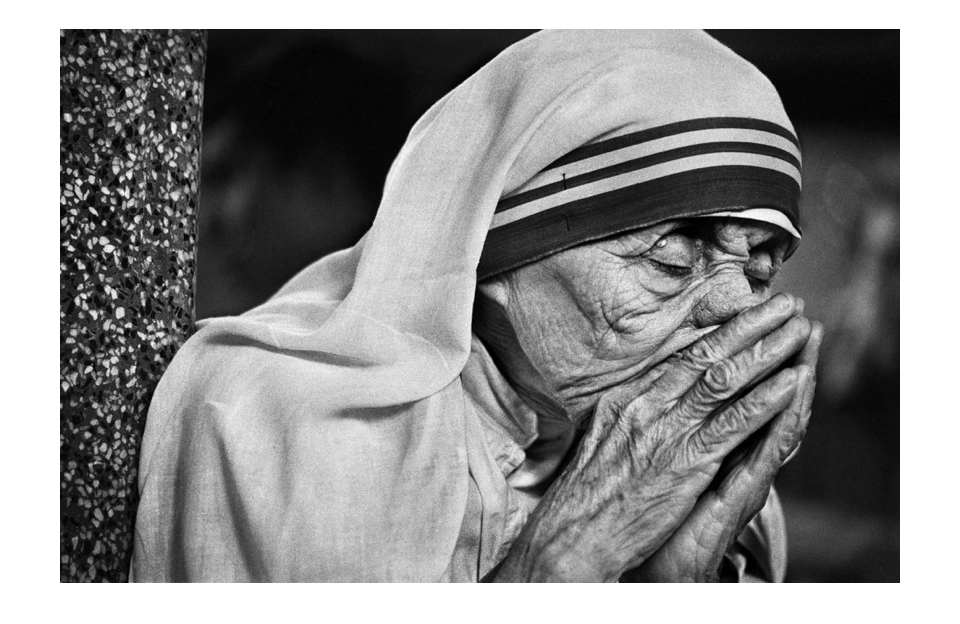
Photo: “The fruit of silence is prayer, the fruit of prayer is faith, the fruit of faith is love, the fruit of love is service, the fruit of service is peace” – St. Mother Teresa. When we put into practice the words of Mother who put into practice the way of Jesus, we will also have the eyes to see and serve Jesus in those around us.
Link for the Mass readings for Monday, November 18, 2024

To be forgiven and to forgive is a powerful healing remedy.
“If your brother sins, rebuke him; and if he repents, forgive him. And if he wrongs you seven times in one day and returns to you seven times saying, ‘I am sorry,’ you should forgive him” (Lk 17:3-4).
Forgiveness is one of the foundational principles of our faith tradition as Christians. If we question or struggle with the degree of forgiveness we engage in, we are in good company with Peter. Thinking he was being generous, Peter asked Jesus how many times should he forgive, seven times? Jesus responded, “I say to you, not seven times but seventy-seven times” (cf. Mt 18:21-22).
Luke records the exchange of the disciples asking Jesus to teach them to pray. He taught them the Our Father or Lord’s Prayer. While reciting this prayer often each day or multiple times each day, we say, “Give us this day our daily bread, and forgive us our trespasses as we forgive those who trespass against us” or “forgive us our debts as we forgive our debtors” (Mt 6:11-12).
One of the barometers of being a faithful disciple of Jesus is that we are people who practice the sacred art of forgiveness. To forgive does not mean in any way that we condone or justify the offense or even necessarily forget about it. We are to hold people accountable, as Jesus said, we are to “rebuke them” in the hope that they will repent and come to a greater appreciation and respect of our dignity and the dignity of others.
Holding on to grudges, seeking revenge, being unwilling to forgive, can be incapacitating, debilitating, and can lead to a premature as well as eternal death. What can be of help is if we can choose to be more mindful of our thoughts and actions. At the moment we experience discomfort from what someone says or does, instead of giving in to the temptation to react or to let our mind run with the offense, it is very helpful to take some deep breaths and relax our shoulders. As the negative thoughts attempt to rise again, don’t fight or feed the thoughts, just return to being aware of our breath and ask Jesus to help us be more understanding and forgiving. This will also help our body to discharge the stress and experience God’s peace.
We may struggle with being forgiving because we may not have sought or received much forgiveness ourselves. Advent is coming. It is a season to prepare to celebrate the coming of Jesus into our lives. This season provides a wonderful opportunity to prepare and participate in the Sacrament of Reconciliation. Forgiveness is a healing gift of God’s grace. Once we have felt the healing balm of forgiveness, we might be more willing to forgive others.
A good practice to engage in is to go to a place of quiet and ask God to help you to forgive someone or a few people. Even if your prayer begins, “God, I cannot forgive, I hurt too much, but help me to let go, please help me to forgive, (insert name).” Return each day until you can bring yourself to say, “I forgive, (insert name).” Visualize yourself saying that you forgive the person face to face and imagine a healing between each of you. If the opportunity presents itself you may want to say that you forgive the person directly, send an email, or write a letter – even if you do not press send or mail it.
With the intent to forgive and asking for the help of Jesus, who has forgiven us, even if in the beginning we are unwilling, with time, reconciliation is possible. Depending on the hurt that has been inflicted, you may not reach out to the other person as it may be healthier to stay apart. Forgiveness will help you to heal and not allow the person who has hurt you to continue to do so. In our willingness to forgive, there is freedom. Let us remember: “Forgive and you will be forgiven”.
——————————————————————–
Photo: An oak that had been toppled by Milton, reset in place and anchored in to heal. Much like us when we are willing to forgive.
Link for the Mass readings for Monday, November 11, 2024

Jesus lights the path for us to come together in community.
One of those at table with Jesus said to him, “Blessed is the one who will dine in the Kingdom of God.” He replied to him, “A man gave a great dinner to which he invited many. When the time for the dinner came, he dispatched his servant to say to those invited, ‘Come, everything is now ready'” (Lk 14:15-17)
Today or if you are reading this evening, tomorrow, will be the final chance to vote. We seem to be cut right down the middle and unity and striving to form a more perfect union seems to getting further apart.
Judaism was far from unified during Jesus’ time as well. The Sadducees, Pharisees and scribes, Samaritans, Zealots, and Essenes all felt they were the authentic expression of Israel. Jesus not only addressed this division by sitting down to break bread with as diverse a population as possible but he also shared parables around the same idea of the invitation to share in the celebration of a feast, as we read today.
Each encounter that we are blessed to partake in is an invitation to experience communion. We have the opportunity to interact in person, face to face, or through the myriad of social media outlets. With each opportunity, we can choose to demean, degrade, dehumanize, gossip, and defame or we can embrace the opportunity to treat each other with dignity, respect, kindness, and understanding, yes, even when we disagree.
We all have wounds. Each of us have suffered or are suffering, and we have or are experiencing pain in some form or fashion. We all seek to belong, to be a part of, and to be accepted. We need each other. When we acknowledge this reality we can begin to heal and be more understanding toward others. Yet, as Fr. Greg Boyle, SJ, writes, “If you’re a stranger to your own wound, then you’re going to be tempted to despise the wounded.”
Jesus provides a mirror for us to notice our own suffering as well as a light to reveal the path to our own healing. Being willing to see our own wounds and to be open to healing, we can be more present. When others are not respectful, we can choose instead to be patient and understanding. When someone is shares harsh words, we can resist the defensive response and instead ask if there is any way we can help. Let us strive to be a conduit of love, to will each other’s good, and to be a healing presence in our interactions with one another. Everything is now ready. Jesus invites us to the feast of community and sharing, are we willing to attend?
———————————————————————–
Photo: Rosary walk through Riverside Park, Vero Beach.
Link for the Mass readings for Tuesday, November 5, 2024

May we confess and not allow the sun to set on our sins.
In each of our readings for this Sunday, even the psalm, there is conflict. The reconciliation for this conflict is to accept and understand that God is God, and we are not. We are to place all our trust in him, follow his precepts and teachings and we will be in a much better place. Better because we will come to realize that the interpretive key to experience healing for ourselves and guidance through our conflicts, is to accept the invitation of our loving God and Father to be in relationship with him.
We have been created by an outpouring of God’s love, to receive his love, and to love God, our neighbors, and ourselves as he loves us. When we anchor ourselves in this truth, in putting God first, trusting in him and seeking to deepen our relationship with him, our lives will be more properly ordered and we will realize that not only are we not alone when we experience conflicts but we will have a firm foundation in God for guidance. When we have recognized that we have turned away from God through our sin, may we have the humility to seek forgiveness.
In our first reading then when Joshua complains to Moses because he hears about how Eldad and Medad are prophesying apart from the seventy who had come to receive the spirit God sought to bestow on them, Moses pointed out to Joshua that God can bestow the spirit on whomever he wills and, “Would that the LORD might bestow his spirit on them all” (Numbers 11:29)!
This same theme arises in the Gospel when John also complained to Jesus that someone, not one of the apostles, was driving out demons in Jesus’ name. Jesus tells him not to prevent him from doing so, “For whoever is not against us is for us” (Mark 9:40).
Both Moses and Jesus recognize and acknowledge that the power of God is at work among his people, and that this not to be prevented or inhibited in any way. That people are receiving the spirit of God and acting upon God’s guidance is what we are all to do! To give the spirit and love and for all to receive is what God wants for all of us!!! The love we have received is not for us alone, but for us to share.
James points this out clearly in his letter and reveals the danger of wealth when we cling to it and refuse to share. Wealth given by God is a gift and a gift given not for us alone. We are to be good stewards of what we have received and provide freely for those in need. We are not to grasp for wealth on our own terms apart from God’s guidance nor exploit or use others for our own gain.
One of most egregious of sins is withholding wages from workers that are due their pay; the cries of which “have reached the ears of the Lord of hosts” (James 1:4). Withholding wages of day laborers during the time of James could have devastating effects. It could mean the laborer or his family would not eat, he could not make a payment of debt and could be imprisoned, as well as other complications that posed a risk for those living day to day with no social net or means of support.
In the Gospel, Jesus shows vividly and graphically the seriousness of sin. Without mincing words, Jesus showed clearly that sin was not to be taken lightly and doing so has catastrophic effects not only in this life but for all eternity. This was especially true for those who lead others into sin. “Whoever causes one of these little ones who believe in me to sin, it would be better for him if a great millstone were put around his neck and he were thrown into the sea” (Mark 9:42).
This great millstone or donkey stone was massive. Some biblical scholars state that this stone could have weighed up to a thousand pounds. The donkey was hooked up to the stone, which was in the form of a massive wheel and then led by the donkey in a circle to pulverize wheat and other grains that was placed in a stone trough so to make flour. It is not hard to then imagine what would happen to someone who had this stone attached to his neck and thrown into the sea!
Jesus continued with more imagery by saying that it would be better to cut off a hand or a foot, and to pluck out an eye if any of these members would lead to sin. Jesus used such graphic language to show how destructive sin is in our lives, for each of us as individuals, as well as for families and communities. Sin has horrific consequences because it damages or ruptures our relationship with God and each other. The ultimate devastation would be an eternal life of separation from God.
Better to die a horrific death, than to die in a state of unrepentant mortal sin. Better to die maimed than clinging to a sin that would separate us from God for all eternity. Jesus is not wishing horrific deaths, physical dismemberments, or eternal damnation on anyone. He came not to condemn but to save humanity. His first public statement as he began his public ministry recorded back in Mark 1:15 is: “This is the time of fulfillment. The kingdom of heaven is at hand. Repent and believe in the Gospel.”
Jesus came to wake us up, to lead us away from our selfishness, our self-centeredness, and sin, to heal us from our fears and deepest wounds, and to guide us home to the very source of our being, the infinite spring of our sustenance and nourishment, the core of our deepest desire, which is to remember who and whose we are. To call us to repent, to turn back to God, and believe in the gospel, the good news, that we are God’s beloved daughters and sons. And yet, through a free act of our will, we can reject the love of our Father and choose to separate ourselves from the love that God wants to bestow upon us in this life and for all eternity.
We can also choose to make the psalmist’s words our own: “Cleanse me of my hidden faults” (Psalm 19:12). When we hide in the darkness and cling to our sin, we are listening to the father of lies who seeks division and our death. God will forgive us from anything. God never tires of forgiving us. We tire of asking. Let us come confidently into the light, into the confessional, and ask Jesus to reveal to us our sins. When we have the humility to be contrite, confess, and atone for our sins, we will know and experience Jesus’ mercy, forgiveness and love, and be reconciled to our God and one another now, in this life, and for all eternity.
Photo: Rosary walk, Riomar Beach, Vero Beach, FL.
As we allow Jesus to heal us of our pain, we can love and help others.
Jesus asked his disciples about who people said that he was and Peter, through the revelation of God answered, “the Christ of God” (Lk 9:20). Jesus then responded that “The Son of Man must suffer greatly and be rejected by the elders, the chief priests, and the scribes, and be killed and on the third day be raised” (Lk 9:22).
If you might be thinking that these verses sound familiar, it is because we heard proclaimed or read the parallel account found in Mark 8:27-35 two Sundays ago on September 15. This point never gets old. As we grow in our relationship with Jesus, we come to a deeper understanding of Peter’s words.
Jesus is indeed the Christ, the Messiah, the Son of the Living God. Yet, that meant many things to many people who were awaiting the coming of the Messiah. For most, they were hoping for a military leader to come to lead them and overthrow their Roman occupiers. As soon as Peter made his statement, Jesus clarified what kind of Messiah that he would be, a suffering servant.
As our first reading from Ecclesiastes offered, “there is an appointed time for everything” (Ecclesiastes 3:1). Even a time for suffering. Peter had trouble with understanding this and he represents us as well. One of the points of faith many of us struggle with is the same as Peter, why did Jesus have to suffer?
Jesus was willing to be sent by his Father to become human and to experience all of humanity, even the suffering of our humanity, because only that which Jesus assumed could he redeem. Also, in Jesus experiencing our suffering, even unto death, we can know without hesitation or doubt that Jesus understands our struggles and anguish. And that means we are never alone in our suffering.
The reality is that the Messiah, the Christ, the Anointed One, is Jesus. He is the suffering servant, the One willing to give his life on the Cross for all of humanity and creation. Jesus did not do this in some abstract way. He died for each and every human being that has lived, is now living, now reading these words, or ever will live. He died for you because he loves you.
To be a disciple of Jesus, we are invited to love in return. This means being willing to suffer and sacrifice for one another. Our discipleship will be ultimately expressed in love, in our willing the good of each other. We must be willing to let our hearts be moved with compassion and as St. Mother Teresa taught by, “Giving until it hurts.”
To give until it hurts means that we are willing to allow our hearts to be open to love. For our hearts to be open to the pain of another means that we must be willing to be healed. We are invited to allow the Divine Physician to remove our hearts of stone and replace them with hearts of flesh. This divine surgery happens at the Cross when we are willing to bring our suffering to Jesus whose arms are wide open and ready to embrace us.
The Suffering Servant understands our pain, experiences our pain, and can help us to experience instead of run from our pain. There is no way to cover up, go around, sidestep, and/or deny, our suffering. We must face it and experience it head on. But we don’t have to do so alone, nor can we. For what Jesus has assumed he can and will redeem. When we are ready and at the pace, we are willing to go, Jesus will heal us. For “there is an appointed time for everything.” Including our healing.
———————
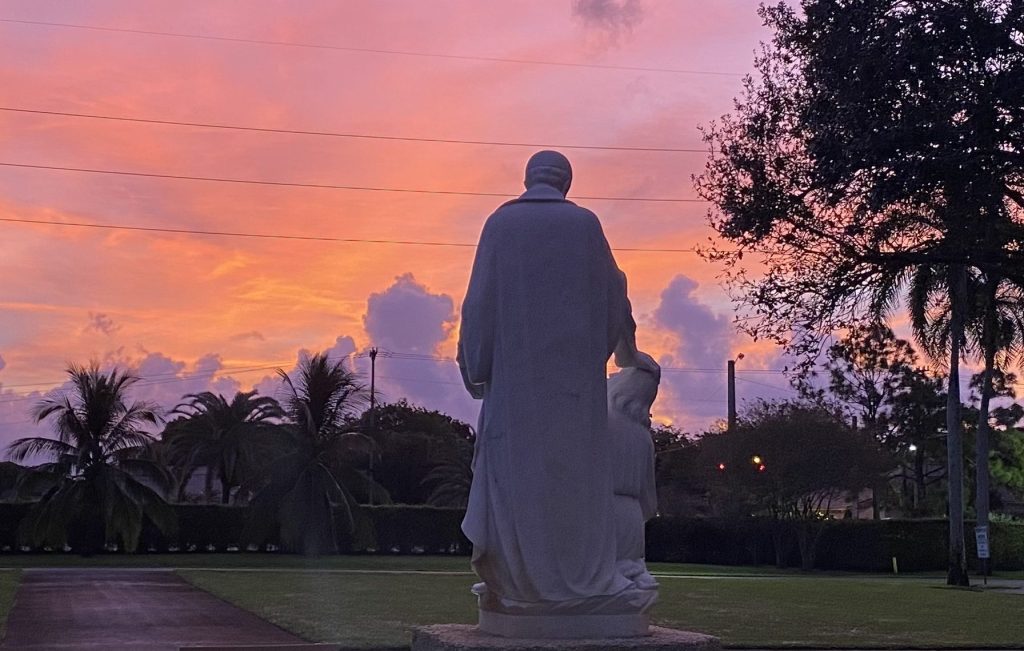
Photo: Feast day of St Vincent de Paul, who allowed Jesus to remove his heart of stone and replace it with a heart of flesh, pray for us. St. Vincent de Paul Regional Seminary, Boynton Beach, FL.
Link for the Mass readings for Friday, September 27, 2024

Jesus calls us too.
“While he was at table in his house, many tax collectors and sinners came and sat with Jesus and his disciples” (MT 9:10).
We as the Church, followers of Jesus, still have much to learn from Jesus. Today’s reading provides another wonderful example. Once Jesus begins his public ministry he is constantly on the go. Going where? Meeting people in the midst of their daily lives as he did with Matthew. And what is the response to Jesus calling Matthew, a tax collector, and then partaking in table fellowship with other tax collectors and sinners?
Matthew accepts his invitation to follow. The Pharisees question the disciples about his practice and curious onlookers follow at a distance. But to those who have, maybe for the first time in their lives, been respected as fellow human beings, their response is hope. A hope that there actually may be a path leading in from the peripheries. A hope that they no longer have to be on the outside looking in. A hope that they, for the first time in their lives might finally belong.
Jesus is shown time and again encountering the person as they are in their present circumstances and the chaos of their lives. He welcomes, is present, and embraces each person as they are. Yet he doesn’t want them to stay where they are. He invites people to be part of something greater than their self-absorbed posture, their self-imposed and externally imposed limitations and instead to actualize their potential and embrace a life of meaning and purpose. The only requirement is that they are willing to: repent, be forgiven, be healed, be loved, be human, be free, and once experiencing this encounter with Jesus, share what they have received with others.
When we are willing to follow Jesus and become his disciples as Matthew did, then we can experience the same hope for a new beginning. To follow we must have the humility to recognize our sinfulness, repent, recognize our dependence on God and our need for him and his love more than anyone or anything else. As we do so, we can begin to heal and let go of the apparent goods that we thought would bring us happiness which have instead led us astray, and renounce those false hopes that we have placed our security in.
We will find that, only in God alone will we find our fulfillment, hope, and security. Jesus invites us to experience: “one Lord, one faith, one baptism; one God and Father of all, who is over all and through all and in all” (Ephesians 4:4-6). This is the promise and fulfillment that no other pursuit or person can bring. God is the foundation and source of all, and at the same time he knows each and every one us better than we know ourselves. He invites us to grow in our relationship with him so we can know him too.
We do this best as we get to know his Son, Jesus whom he sent, not to condemn us, but to save us. Jesus draws close to us as he did with Matthew so that he can experience the chaos of our lives. He loves us in the midst of the best and the worst and invites us to experience something better. Called and willing to be healed, forgiven, and transformed like Matthew, we too, can experience God’s mercy. Jesus will then send us as well to be beacons of the light, hope, and love for those who are in need of God’s healing and peace.
——————————————————
Painting: The Calling of St. Matthew, Michelangelo Merisi da Caravaggio, 1600. We may be as surprised as Matthew, but Jesus does call us as well!

Healing happens when we are willing to see each other as human beings.
Our account from Luke today represents a wonderful picture of collaboration and harmony. The centurion, a Gentile – non-Jew, heard that Jesus was near and appealed to Jewish elders to seek out Jesus to invite him to his home to heal his slave. As Jesus was on the way, the centurion apparently had a change of heart, concerned about his sinfulness and did not want to trouble Jesus. He sent his friends to Jesus with the request to heal his slave with his word. Jesus was amazed: “I tell you, not even in Israel have I found such faith” (Lk 7:9). The slave was then healed.
Aside from the fact that no one seemed to have a problem with slavery, certainly not uncommon in the Ancient Near East, everyone involved, the centurion, his friends, Jewish elders, and Jesus, were all working together to make this healing possible. The centurion actually showed concern, not indifference for his slave. Gentiles and Jews, occupier and occupied, collaborated with one another, and Jesus did not hesitate to answer the request of the centurion, a representative of the Roman occupying army.
This Gospel scene is certainly worth meditating upon.
The centurion was aware, and he sought help for his servant who was ill and in need of healing. The interesting point is that he sought help from those he was in a position to oppress. He went to those of a different race and religious belief. This Gentile centurion asked help from the elders of the Jews. The elders recognized the need of one of their oppressors and reached out to Jesus for help. Everyone in this account did not hesitate to play their part to help a servant.
Are we willing to see, hear, speak up, and seek help for those in need around us, no matter who they may be? Can we resist apathy, indifference, and prejudice, and instead, keep our ears, eyes, and hearts open to the vulnerable among us? Are we willing to see each other as people created in the image and likeness of God? Will we treat those we encounter with dignity and respect and be willing to collaborate and work together for the good of those like us, as well as those who are different, in little ways with great love today as Jesus did, one person at a time.
When we do so, we are at our best. We are the hands and feet of the Body of Christ.
—————————————————————————————–
Photo: May we reflect the light of Jesus in our corner of the world as we resist the temptation to feed division and dehumanization and seek instead to promote healing and reconciliation, grounded in God’s love for the dignity of each human person.
Link for the Mass readings for Monday, September 16, 2024
 Spiritual Stepping Stones