God reveals himself to us when we have the eyes to see and ears to hear.

God heard the cry of his people who were suffering from enslavement in Egypt. God called and sent Moses to free them. Pharoah did not accept the request of Moses to let his people go and instead put more pressure on his slaves to fulfill their daily quota of bricks as before, though now without providing the straw that they needed to accomplish the task (cf. Exodus 5). The Hebrew slaves did not take out their frustrations on their oppressors but on Moses. This pattern of complaint continued time and again, even after their freedom was assured and they wandered in the desert. Even thought they were free, they complained regularly when things got tough, and stated that they would be better off going back to Egypt. Going back to being a slave under Pharaoh instead of placing their trust and dependency upon God.

God the Father sent his Son to free us from our slavery to sin, just as he sent Moses to free the Hebrews enslaved under Pharaoh. How many times do we, like our ancestors, also complain, preferring our life of sin, a life of mere existence, over embracing the gift of a life lived to the full because it is what we know. Even worse there are too often those in positions of spiritual leadership who abuse their power, look out for their own interests, instead of guiding and serving the people entrusted to their care.

Jesus addressed those who were missing the point of his preaching and ministry, “how God has made his will known to the people, the Father who sent me has testified on my behalf. But you have never heard his voice nor seen his form, and you do not have his word remaining in you, because you do not believe in the one whom he has sent” (Jn 5:37-38). God the Father has sent his Son to reveal his will but too many did not and today still do not have eyes to see or ears to hear.

Those who are learned “search the Scriptures, because [they] think [they] have eternal life through them; even they testify on my behalf. But [they] do not want to come to me to have life” (Jn 5:39-40). What is hidden in the Hebrew Scriptures is revealed in the New Testament: the New Covenant made with Jesus and all of creation. The prophecies of old testify that the Messiah will come as a suffering servant, he will unify the nations, cleanse the Temple, and the enemies of God will be placed at his feet. These affirmations are presented and known by those who study the sacred texts, yet they still did not recognize the signs that the Messiah was in the very midst of them.

Even Moses testified of Jesus when he said: “I will raise up for them a prophet like you from among their kindred, and will put my words into the mouth of the prophet; the prophet shall tell them all that I command” (Deuteronomy 18:18). Yet the successors of Moses would not even believe in his writings, so Jesus said how would they believe in his words?

Many of the people of Jesus’ time heard him speak, saw him heal and exorcise demons, and still did not believe. He is not as visibly present as he was, and yet, if we are sincerely seeking God who has and continues to make his presence and will known, we will find him in philosophy, theology, mathematics, the sciences, literature, the arts, sports, relationships, his creation, in our service to each other, as well as in truths of other faith traditions. The fullness of the Father though is revealed in our encounter of him through his Son, “whom he has sent”. Do we have eyes to see, or will we miss God’s invitation because we do not believe in “the one whom he has sent”?

Jesus is also revealed in Scripture, the Old and New Testaments. To understand the New we must understand the Old, for Moses and the prophets testified to his coming and Jesus came not to abolish but to fulfill the Law and the Prophets. Do we leave the Bible on the shelf like any other book? If we do read it, do we do so as if it were a dead letter, or do we read and hear it as it is truly meant to be read and heard, as the living Word of God proclaimed? We are and also more than a people of the book. We are a people of encounter.

The Father makes himself known to us through the presence of his Son and the love of the Holy Spirit. To experience the truth of this reality we need to accept his invitation to enter into and develop a relationship with him. As we reach out to God, we come to realize that he is already present and reaching out to us, especially through his Son. We do not need to run to God, because he is already running to meet us, waiting to hold us in his loving embrace, now and forevermore!

—————————————————

Photo: On the eve of taking our Cura Animarum, our pastoral care board exams, while praying the Rosary, God sent a hug – a slight but distinct rainbow around the sun! St. Vincent de Paul Regional Seminary, Boynton Beach, FL.

Link for the Mass readings for Thursday, March 14, 2024

Jesus wants to heal and save us. Do we want to be?

Has there ever been a time when you were picked last for the team, whether on the playground, P.E., or gym class? I remember being on both sides, being picked last, and picking others to join and having to pick someone last. I preferred being chosen last much more than having to be in the situation to choose a classmate last, and it was often an agonizing situation. In our Gospel reading today, Jesus comes upon a man who has experienced even worse.

He has been in need of healing for thirty-eight years. Apparently, there was a limited time to get into the waters of the pool of Bethesda to experience the healing properties that it afforded, for each time the water stirred, while the man moved to get closer to and enter the water, “someone else gets down there before” him. This is worse than getting picked last, as he doesn’t in a sense even make the team!

But with Jesus, the last shall become first. Key ingredients are belief, faith, and a willingness to be healed. Jesus does not impose, even in the case of healing, Jesus invites. He asks the sick man, “Do you want to be well?” The man is stuck in the limitations of someone getting him to the pool. That is all the affirmation Jesus needs. The man is willing if there is someone to help. Jesus commands him to rise, pick up his mat and walk. The man is no longer the one picked over, the one ignored, the one unseen. In his encounter with Jesus, he is healed by Jesus’ word.

Jesus meets us in our need as well as the man at the Pool of Bethesda. He meets us where we are, no matter our station in life. He does not leave us on the outside looking in, he does not leave us wondering if we are loved or if we belong. He does not only come to encounter us but if we are willing, to empower us to be about the mission given to us by his Father. Jesus gives meaning and purpose to our lives. Jesus has come to save us. Each and every one of us is a gift from God and has been graced with something to contribute to others, something unique to help make the kingdom of God a reality.

Give yourself a moment of silence and stillness, without and within. Settle into a place with no or little distractions, breathe in deep and exhale a few times, then close your eyes. See yourself as you are in your present seated position, breathing, experiencing your shoulders relaxing, and just being still. Then notice Jesus. He is walking toward you as he did with the man at the Pool of Bethesda. Does Jesus remain standing, does he sit beside you, or kneel before you? As he assumes whatever posture, allow your thoughts to reflect on what you need. As you are pondering, does Jesus ask you a question? What does he ask or what does he say?

Jesus is present, right here and right now, for you. There are no boundaries, no limitations, only those you impose on yourself. Share with Jesus your need. You are no longer misunderstood, left out, or picked last. Jesus is present. Embrace this moment of time together, of knowing that you are loved, heard, and that you belong in the kingdom of God.

————————————————————————-

Painting: Some quiet time of prayer in between studying, St. Vincent de Paul Regional Seminary, Boynton Beach, FL.

Link for the Mass readings for Tuesday, March 12, 2024

Be still and allow the light and love of Jesus to rise within your heart.

We hear often in the Gospels how those who believed in Jesus received healings, exorcisms, and were forgiven of their sins. We have also read accounts such as from the Gospel of Matthew that he “did not work many mighty deeds” in Nazareth “because of their lack of faith” (Mt 13:58).

In today’s Gospel account from John, Jesus speaks to a royal official whose son is close to death. Jesus said to him, “You may go; your son will live.” The man believed and in that moment his son was healed.

What do faith and belief have to do with Jesus being active in our lives? The way of the Gospel, the good news, is all about invitation and acceptance. Jesus entered our world, our reality, gently and humbly. He came as a poor infant, completely dependent on Mary and Joseph for his very survival. He lived most of his life in the obscure village of Nazareth most likely working with Joseph as a day laborer. When he began his public ministry, he did so by inviting people to be a part of his life, to enter into a relationship with him and his Father. People are free to say no or to say yes to that invitation.

Faith is trusting that what Jesus says is true and that he is who he says he is. Belief is the act of our will that aligns with our faith, our trust in him. Jesus invited the man to believe that his son was healed, and the man believed and walked away with full confidence that his son would be healed. Belief is followed by an affirmative act of the will. I can believe my car will run, but unless I get in it and turn the key, I am not going anywhere.

Just as the sun rose this morning, whether we saw it or not, Jesus is present to each and every one of us, whether we are aware or not. Jesus is inviting us to be a part of his life. Just as Jesus invited Andrew and Peter, James and John to follow him, Jesus invites us to follow him as well.

Even though the clocks have moved forward an hour, if your schedule affords you the opportunity to wake up with the sun or early in the morning while the sun is still rising this week, I invite you to do so. Find a quiet place inside or outside, call to mind anything that you are grateful for, ponder your hopes and dreams, allow any struggles, confusions, sinful patterns, needs for healing and/or forgiveness for yourselves or others to arise. As the light of the sun pierces the darkness, allow it to be an icon of Jesus’ invitation to enter your life and share with him what came up for you.

“From the east comes the one whose name is Dayspring, he who is mediator between God and men. You are invited then to look always to the east: it is there that the sun of righteousness rises for you, it is there that the light is always being born for you… So that you may always enjoy the light of knowledge, keep always in the daylight of faith, hold fast always to the light of love and peace” (Excerpt from a homily on Leviticus by Church father, Origen, who lived from 184-253).

If not that early in the morning, any time will do! Make some time to be still, embrace and be grateful for the light of Christ, the Dayspring, who rises in your heart. Breathe in deeply the love of his and our Father, believe in the truth that Jesus is the Son of the Living God, and trust that he will be with you today in all you do. Then, when you are ready, arise and walk on with the peace, confidence, and assurance that you are loved more than you can ever imagine and more than you will ever know.

——————————————————————————–

Photo: Morning prayer during 30 day silent retreat last summer,  Joseph and Mary Retreat House, Mundelein, Illinois.

Link for the Mass readings for Monday, March 11, 2024

Turn from darkness and prefer instead the light that has come into the world.

That the light came into the world, but people preferred darkness to light” (Jn 3:19). What is the preference of darkness over light? We have all said with St. Paul, “For I do not do what I want, but I do what I hate.” (Romans 7:25)? Now we are not always in this state of choosing darkness over light and choosing to do what we don’t want to do instead of what we want to, but we are probably guilty of entertaining both more than we are willing to admit. Why? I don’t have a definitive answer, but I can share a few ideas.

We are certainly influenced by the condition of Original Sin, that time in our ancient ancestral past where the choice to choose self over God happened and has been perpetuated generation after generation up to an including today. We can choose our self over God because that is an influence of our fallen world and have learned to live our lives that way. We create habitual patterns of behavior and then we go on automatic pilot, continuing to make the same decisions repeatedly. We also make decisions that appear to be but are not for our highest hope and good, because many of us have been wounded and we are doing the best we can to cope and survive.

Our Baptism takes care of Original Sin, but we still have concupiscence, which is our tendency to be drawn into sinful actions. We are still susceptible to temptation. What helps is recognizing that there is a God who loves us, so much so, that he sent his only Son to be one with us so we can be one with him. What helps is making more of a conscious choice to recognize and come out of the shadows, out of the darkness of our defense mechanisms, our denial, our past hurts, anxieties and fears. We need to say yes to Jesus who never sinned because for each and every temptation he received, even in Gethsemane, Jesus had one and the same answer: “Not my will but yours be done” (cf. Lk 22:42).

When we choose to surrender our life to God, by aligning our will with God’s, and by participating in the life of Jesus, we can receive and experience the love of the Holy Spirit working in our own lives. In so doing, we will find healing and forgiveness. This is not a one-time event. This is a progressive, spiritual journey that continues throughout the whole of our lives, and into eternity with God. When we notice we are beginning to slip, this awareness is good. We need to resist beating ourselves up, admit where we are, apologize as necessary, seek forgiveness, and return to loving God, ourselves, and one another.

Holy Spirit, please guide us today so that we can better resist the temptations that go before us, unlearn our negative behaviors, and create new habits to replace those that have kept us bound and shackled to our self-centered, indifferent, and unhealthy postures. Help us to identify and renounce the shadow sides of ourselves, seek to confess and allow your love to heal us, and to place our trust in the Light of Jesus, the warmth of his love, and receive the gift of his forgiveness and mercy.

Photo: St. Francis preferred and chose to follow the light of Christ. Outside our chapel, St. Vincent de Paul Regional Seminary, Boynton Beach, FL.

Link for the Mass readings for Sunday, March 10, 2024

Having the humility to confess our sins frees and heals us.

It is much easier to find fault in others, and in some cases, the act of doing so has become entertainment in private as well as publicly, and especially with social media. Gossip has a seductive allure and can be consuming. Judging others is also a way to justify and or project our own inappropriate behavior onto others. We may even place ourselves in a false sense of exalted pride. Have we ever, not just stated, but thought or prayed something along the same lines as the Pharisee in today’s Gospel? “O God, I thank you that I am not like the rest of humanity — greedy, dishonest, adulterous — or even like this tax collector. I fast twice a week, and I pay tithes on my whole income” (Lk 18:11-12).

To pray any part of this prayer stunts the growth in our spiritual life because we are focused on ourselves instead of emptying ourselves before God. Anytime we rationalize, cover over, or deny our sinful behavior we create and support habits of selfishness. Left unchecked, we can become enslaved to them. Lent is a time for healing, purification, and transformation. To be able to heal from sinful attitudes and actions that have become habits, we first must be able to acknowledge and identify them.

Over time, reading more and more lives of the saints, I have come to understand that their recognition and confession of their sinfulness was not just pious platitudes, but true expressions that they were growing closer in their relationship with Jesus. A simple example can help express where they are coming from.

When we drive our car while it is dark we don’t give much thought to the cleanliness of our windshield because we can see fine. Yet as the headlights from an oncoming car illuminate our windshield, the smudges, dirt streaks, and bug residue come into focus. This can be evident in our spiritual life as well. The more we remain in our own darkness of denial, we feel we are fine, all is right with the world. The closer we grow in our relationship with Jesus, the more his light shines in our darkness, and he reveals to us our sin.

Jesus invites us to resist the prayer of the Pharisee who justifies himself as he prays comparing himself to someone else, instead of acknowledging his own sinful actions and he instead emphasizes that we are to follow the honest humility of the tax collector, who did “not even raise his eyes to heaven but beat his breast and prayed, ‘O God, be merciful to me a sinner’”(Lk 18:13).

Now, Jesus is not saying this is the only way we pray. We have the opportunity to worship and praise the Lord joyfully, we can seek his help in praying for others through intercessory prayer or for ourselves in petitionary prayer, we can also sit in quiet meditation during adoration or out among God’s wonder of creation. Each prayer has its time and place and each type of experience of prayer helps us to grow and deepen our relationship with Jesus and each other.

True humility is brought about by our willingness to see who we are from God’s eyes and to focus on him instead of ourselves. If we want to set a standard to live up to and if we are to compare ourselves to anyone, let it be Jesus. A daily examination of conscience is a healthy practice and discipline. We just need to be willing to invite Jesus to shine his light of love into our present places of darkness. What we see then we can confess. Admitting to and experiencing the sorrow for the hurt we have caused from our sins is healing. In our willingness to confess, promise to sin no more, and do penance, we will receive his love, mercy, and forgiveness.

One prayer I have found helpful over the last few years is the Jesus Prayer. It is very simple. Sit in a comfortable space, take a few deep breaths and exhalations, then as you take the next breath in recite, “Lord Jesus Christ, Son of the living God,” and then as you breathe out say, “Have mercy on me a sinner.” You are breathing in the light of Christ and you are breathing out the darkness of your sin.

Traditional prayer ropes exist from the Eastern Orthodox tradition for this practice. They are made of wool, usually black, and have ten decades of ten beads. The bottom can also have a fringe representing the mercy of God wiping away our tears of sorrow. You can also use your Rosary. If you have neither a prayer rope or a Rosary, you have your fingers. Start with a set of ten Jesus Prayer recitations each day and pray by prayer come closer into communion with God.

—————————————————————————————

Photo: Rosary walk and looking up, just past sunset. God is good! St. Vincent de Paul Regional Seminary, Boynton Beach, FL.

Link for the Mass readings for Saturday, March 9, 2024

We are invited to participate in a dance of love.

Jesus recognized that the scribe, who asked him about which commandment was the greatest, “answered with understanding,” and then he said to him, “You are not far from the Kingdom of God” (Mk 12:34). What is it that the scribe understood?

The scribe understood that God “is One and that there is no other”. God is the true source of our being, our very existence. We have been created with an innate desire to be one with him. This is the longing we all feel in the depths of our soul, this is why nothing that is finite or material will ever fully satisfy us, why we are always wanting more. This is as true for the mystic as it is for the atheist and everyone in between.

God is “One and no other” also means that we are not God, we are his created beings. God is not just one being among many, not even the supreme being. This orientation is important for we can only see from our limited perspective. What we think or believe we might need, may in fact not be truly good or beneficial for us, the shimmer may be an apparent good, a distraction, a temptation, that will lead us away from the authentic fulfillment and meaning of life that we seek. God will guide us away from any unhealthy want, he will lead us away from any temptation when we are willing to seek his guidance over and above our own. God will give us what we truly need, he will lead us to that which is, in reality, true, good, and beautiful.

Once we come to believe that God is God and we are his created beings, then we can take the next step and surrender: “to love him with all [our] heart, with all [our] understanding, with all [our] strength”. In our surrender to God and his will, we become capable of receiving his love and so are better able to love him in return. We all long to be loved and to love. Experiencing the love of God helps us to unconditionally love “our neighbor as our self”. Through our surrender to his will we allow God to love others through us.

God invites us to open our minds and hearts to receive his love, to love him in return, and to love others as he has loved us. To love God is like any other relationship. We need to spend quality time with God in stillness, be present One on one, as well as come to an awareness of God’s nearness in our daily activities. We are to resist compartmentalizing God and instead seek his presence in everything we do. The sacrifice he seeks is our willingness to allow him to love others through us, especially those for whom we do not have a warm and fuzzy feeling, as this is not the unconditional love God loves with. We are to will the good of the other as they are.

Each of us is prone to sin. We are wounded but not destroyed. God loves us as we are, and when we are willing to receive his forgiveness and confess, are sorry for our sins, willing to do penance, he forgives us, he heals our wounds, and he transforms us. We need to stop running away from him and start running to him. One way we can do this is to love our neighbor as our self, for if we cannot love those that we can see, how can we love God who we can’t?

There is a wonderful dance of love that Jesus invites us to engage in. As we answer God’s invitation to spend time with him in prayer, we will see him in each other as well as in all things. As we love one another, by being there, listening, supporting, and empowering one another, we will experience more of God’s love and each other’s love. Our lives will expand, we will experience more healing, and be free from those lies and temptations that limit us and we will love ourselves more.

Jesus’ arms are wide open before us in our time of prayer, our own struggles and challenges, and in our neighbors. May we surrender all our heart, soul, mind, and strength into his loving embrace, to receive his love and love him in return, and be willing to love our neighbors and ourselves in the same way. When we get this commandment of loving God, our neighbor and ourselves right, the other commandments will be something we will do naturally. As we put this commandment into practice, we too will hear Jesus say to us, “You are not far from the kingdom of God.”

—————————————————————————-

Photo: Many ways we can see God’s hand at work. Rosary walk, last Fall. St. Vincent de Paul Regional Seminary, Boynton Beach, FL.

Link for the Mass readings for Friday, March 8, 2024

Jesus seeks to heal and free us from our labels.

In the Gospel reading today, Jesus is accused of being an agent of Beelzebul, the prince of demons, because he was exorcising a demon from a man that was mute. Jesus addressed the critique and showed the polarizing nature of the onlookers who were unwilling to see the healing before them for what it was. Jesus then stated the obvious: “Every kingdom divided against itself will be laid waste and house will fall against house” (Lk 11:17).

Satan seeks to sow discord and division. Jesus seeks to bring about unity. Now it is true, that five verses later in the Gospel of Luke, Jesus is recorded as saying: “Do you think that I have come to establish peace on the earth? No, I tell you, but rather division” (Lk 12:51). Anyone feeling a bit confused? Welcome to the wonderful world of the Bible!

To understand Scripture, we need to understand the context of the whole of Scripture, not just isolated verses. Throughout the ministry of Jesus, he seeks the unity that all may be one as he and the Father are one (cf. John 17:21), yet he has consistently experienced those that rejected his message and healings as witnessed in today’s Gospel account.

Jesus demands a choice. We need to decide if we are either going to be for him or against him (cf. Lk 11:23). The division Jesus is talking about results from those who choose not to recognize that Jesus is who he says he is and reject him and those who accept him for who he is. This choice continues to cause division within households, families, and friends even today.

The greater take away from today’s Gospel and Jesus’ teachings as a whole, is that Jesus is the way and the truth and the life (see John 14:6). Jesus is the Son of God made man. Some will reject this truth. Some will accept only parts of the truth that Jesus teaches, while others will say there is not objective truth. We who identify with this truth and give our lives to him as his disciples, then like Jesus, we are to embrace the gift of our diversity.

We are more united rather than divided when we resist limiting ourselves by mere labels. In our modern context, labels, such as liberal and conservative are not helpful. It is certainly easier to cast labels, but interactions with people and developing relationships are much more nuanced. We are not mere cardboard cut outs, or caricatures.

To better understand the essence of who we are as human beings demands greater time and experience with each other than an outward appearance or isolated statement may portray. Many times, once we have cast a label, we believe that we have “defined” the person. They are classified in their box and tied up in a neat and pretty bow, and woe to the person who resists being boxed and bowed.

I remember reading from one of the books from the tracker, Tom Brown, Jr., in which he described how many people when seeing a bird, such as a blue jay, robin, or crow, are often satisfied with the label, the naming of it, and move on from that sighting self-satisfied. They think that in that simple identification they now have come to understand all that there is to know about that species. So much of the essence of one of God’s amazing creatures is missed by such a simplistic and limiting classification!

Unfortunately, we do the same with each other. We make a prejudgment on a person or group of people because of a word, statement, stance on a particular issue, or particular belief. We then falsely believe we know everything there is to know about that person or group. This is a limiting and divisive approach. Jesus invites us to encounter, accompany, spend time, and break bread with people. In spending time with one another, dialoguing, and respecting each other, the caricatures can be filled in with some substance and we can come to know a little better the person beyond the prejudgment. Maybe, just maybe, someone who we have been keeping at arm’s length, we can actually grow closer to, despite our differences.

———————————————————————————

Photo: During 30-Day silent retreat, St. Joseph and Mary Retreat House, Mundelein, IL.

Link for the Mass reading for Thursday, March 7, 2024

Growing in faith is a life-long journey.

Jesus not only tells his disciples that he has not come to abolish but to fulfill the law, he constantly teaches how this is true, models how to put his teachings into practice, and empowers his followers to do so. In his Sermon on the Mount and Sermon on the Plain alone, we can see the development of his teaching and building on the foundation of the Torah. With his Beatitudes, such as, “Blessed are the poor in spirit for theirs is the kingdom of heaven”, and his Six Antithesis including, “You have heard that it was said ‘an eye for an eye,’ but I say to you offer no resistance to one who is evil”, we can see the further development of Jewish teaching on full display.

If we seriously take the time to read through Jesus’ teachings, we will see quickly how challenging they are. Jesus is not lowering the bar of discipline for his followers, but in fact, raising it. Jesus does so not to place heavy burdens on us for burden’s sake, not just to give us busy working, but he seeks to make us holy. He himself lives what he preaches, but Jesus is no ordinary teacher or mentor. The principles that he teaches, forgiving seventy-seven times, loving our enemy, giving up all to follow him, these seemed impossible to his disciples then and to us today as well.

At face value, we may think that many of Jesus’ teachings are not possible to put into practice or very practical in our day and age. Attempting to do so with our own willpower alone may lead to coming up short each time, and feeling more frustrated. Jesus does not expect nor desire us to accomplish living as his followers on our own efforts. We are to yolk ourselves with him and be open to the transforming power and love of the Holy Spirit acting through us. This happens when we daily invite Jesus into our lives and are humble enough to follow his lead.

We become disciples of Jesus when we are willing to study his life, learn and put his teachings into practice, and surrender ourselves to his will through prayer, discipline, worship, service, and participation in the sacraments. We do so by first being willing to receive his guidance, open our hearts and minds to and allowing Jesus to live his life in and through us. In this way, we are transformed by his love and conformed to his life such that we can say with Paul, it is no longer I who live but Jesus who lives in me (cf. Galatians 2:20).

The path of faith is not a sprint or a one-time event, but an ongoing journey. Each one of us can be assured that Jesus is with us for the long haul, every step of the way and with each temptation that arises. Even when we fall, Jesus remains with us, to forgive and heal us. When we receive and rest in God’s love, we will experience his peace, and will better be able to make decisions free from fearful or reactive responses. By leaning on Jesus and each other, we will resist temptations, make healthier decisions, rise again after we fall, and make it through each day together, with more joy, love, and peace, no matter what arises.

————————————————————————–

Photo: On retreat last January, Marywood Retreat Center. Prayed morning and evening prayer on this dock each day at sunrise and sunset.

Link for the Mass readings for Wednesday, March 6, 2024

Forgiveness is possible. We just need to be willing to ask Jesus to help us.

Forgiveness is a wonderful gift of grace and mercy. If we asked many people if they would like to receive forgiveness most would say yes. The number would most likely be less if we were to ask them how many would be willing to forgive others. If we were asked to forgive someone seven times, that number would shrink significantly, and if we were invited to forgive someone seventy-seven times, is there any among us who would say yes, any among us willing to consider doing so?

Why is forgiveness so hard for most of us? I do say most because there are those who have an openness to being forgiving. One reason could be that we have few role models. I would imagine those that are more forgiving have not only experienced positive role models but have received forgiveness themselves.

How often do we seek forgiveness from others when we have done something wrong, inappropriate, or made a mistake? We often seek to explain first, make excuses, justify, or ignore our behavior altogether. When we resist being humble, confronting our offenses, and do not seek reconciliation, we do not experience the healing balm of forgiveness. We are then less likely to be willing to offer forgiveness and more likely to hold a grudge or to seek revenge.

Yet, even if we receive the gifts of mercy and forgiveness, as the servant did in today’s parable (Mt 18:21-35), we may still choose to be unforgiving toward others. We may resist forgiveness because we have already created patterns of distancing ourselves, making someone else as other, somehow justifying the hurt and pain we feel. We think that by holding a grudge or offering another the cold shoulder, we are giving them just what they deserve.

Unfortunately, patterns of not seeking forgiveness, not willing to forgive others, allowing ourselves to bear grudges, to distance ourselves, or project negative feelings on others to cover up our own inadequacies, not only perpetuate a climate of isolation and divisiveness, but continues to multiply mistrust and further distance. When allowed to left unchecked leads to violence in too many forms.

Even in a case when someone has truly wronged us in some way, Jesus is guiding us to forgive, to make an attempt to understand why someone might act in such a way, and to shift the momentum away from the perpetual cycle of hurt and to seek to bring about healing and reconciliation.

Jesus is clear that if we are not willing to forgive, we will not be forgiven. This is true because when we are unwilling to forgive, we cut ourselves off from the love of God. We choose the hurt and pain inflicted upon us over the healing balm that God offers. The Sacrament of Reconciliation is a gift of healing, and a pattern of regular confession helps us to receive the healing and forgiveness of our loving God and Father. As we develop a regular practice of examining our conscience, experiencing contrition – true sorrow for our sins, confess, and are willing to complete our acts of penance, we are absolved and forgiven from our sins, and we will experience healing.

Forgiveness does not mean we condone another’s inappropriate actions. It means we choose to no longer participate in the cycle of hurt. Even when we feel forgiveness is impossible, are we willing? That is all Jesus requires. We forgive in the beginning when we are willing to ask Jesus to forgive through us until we can learn to forgive ourselves, like Doha Sabah Abdallah.

Doha lost her son during the bombing of her city in 2014. Doha shared her story with Pope Francis while he visited Iraq back in 2021. She said: “By imitating him [Jesus] in our sufferings, we testify that love is stronger than everything,”

Pope Francis shared how touched he was by Doha’s story of forgiveness. On his plane trip back home, Pope Francis said, “I forgive. This is a word we have lost. We know how to insult big time. We know how to condemn in a big way… But to forgive, to forgive one’s enemies. This is the pure Gospel. This hit me in Qaraqosh.”

Let us take up the mantle that Jesus holds out to us today and this Lent, seek forgiveness, be healed, and willing to forgive.

————————————————————————-

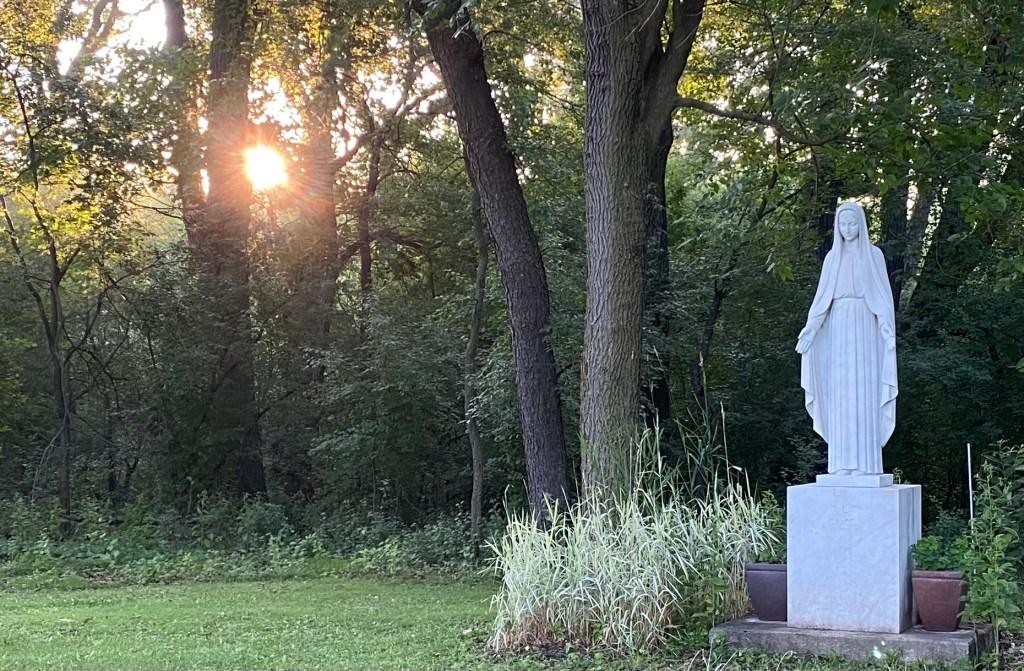
Photo: Statue of St. Vincent de Paul our patron saint. St. Vincent de Paul Regional Seminary, Boynton Beach, FL

Link for the Mass readings for Tuesday, March 5, 2024

“When the perfect comes, the partial will pass away.”

Pilgrims numbering two to four million would ascend to Jerusalem to participate in the annual observance of Passover. During this time the Jewish officials were on edge because their primary concern was to keep order and peace for fear that the Roman military occupation also in presence would step in if need be. If the centurions asserted their enforcement, it would be swift and brutal. Even the slightest infraction of civil unrest would be dealt with harshly.

Jesus whirling a whip made out of chords, driving out the merchants, turning over tables, sending coins flying would have been quite the scene! The disruption certainly would not have gone unnoticed and some biblical scholars believe this was the main incident leading to his crucifixion. In this act of cleansing the Temple, Jesus gave a visual display to his sometimes figurative teachings. Jesus came to shake things up, to wake people up from their spiritual slumber, to bring people back to right worship and praise.

Let us enter the scene of today’s gospel. We are those among the vast crowd in the temple precincts, shoulder to shoulder amidst the hustle and bustle of the day. A cacophony of words echoes about, haggling of prices for animals being purchased for sacrifice mingle with arguments over unjust money exchanges. Then we experience a lull in the crowd, we look over our shoulders and see people stepping aside, parting, and opening. Then Jesus, rope chords in hand, his face hard, and eyes set on the tables ahead of him, strides by us. We can feel the electricity of a gathering thunderstorm, and then he lets loose like a lightning bolt. The first table goes over, coins launch into the air and jingle as they scatter across the stone amidst a chorus of the money changer’s cries of outrage.

The scene shifts. A knock is heard at the door of our own home as we are in the midst of what we do on any given Sunday. We walk to the entrance and spy the same Jesus we just experienced in the temple precincts standing outside. We feel the drop in pressure of a gathering storm, we witness the same hard expression on his face, and in his hand are the same chords. If we do let Jesus in, where does his stride take him, what does he overturn and toss aside? We are invited to allow Jesus full reign and access to every nook and cranny of our home, as well as our heart, mind, and soul.

In both cases, these are not acts of Jesus having a temper tantrum or bad day. They are acts of love and purification. “For when the perfect comes, the partial passes away” (I Corinthians 13:10). Jesus, the perfect, knows what does not and what does belong in the temple as well as our homes and in our hearts. He knows what is preventing us from receiving the fullness of his and his Father’s love. Are we willing to know, to purge, and allow that which is partial to pass away, so that we may enter into a deeper life of authentic prayer, worship, intimacy of relationship with God, and service to each other?

———————————-

Painting: Rosary walk last Fall, St. Vincent de Paul Regional Seminary, Boynton Beach, FL.

Link for the Mass readings for Sunday, March 3, 2024