Jesus is offering to us his heart, are we willing to receive it?

We can observe two movements of Jesus going out to serve others in today’s Gospel. The first is evident in the beginning verse: “When Jesus saw the vast crowd, his heart was moved with pity for them, for they were like sheep without a shepherd; and he began to teach them many things” (Mk 6:34). Jesus was moved with pity or compassion and he also witnessed, beyond their immediate physical hunger their deeper, spiritual ache. hey were not even aware of the depth of their hunger.

They just had spent time with Jesus, experienced and had heard of the many other accounts of him preaching with authority, his healings, and exorcisms. They wondered if he could be the Messiah, the one who had been promised, present now in their midst. Yet, for the vast number of them, if not all gathered, they sought the kind of leader, that Jesus was not. He was not to be a mighty military leader, he would not train his followers in guerilla warfare, and Jesus would not conquer the Roman occupation with might.

After his teaching, the time grew late and he and his disciples were aware of the hunger of the crowd. The disciples only saw the five loaves and two fish that were present, barely if enough to feed the Twelve, let alone the vast multitude. Their first instinct was to send them on their way such that they could fend for themselves. Jesus, who knew the Father, knew there were no limitations to his providential care. Jesus: Then, taking the five loaves and the two fish and looking up to heaven, he said the blessing, broke the loaves and gave them to [his] disciples to set before the people; he also divided the two fish among them all (Mk 6:41).

Jesus shepherded and provided nourishment for five thousand men, so if that number was not including women and children, the number could have been easily doubled, and all ate and were satisfied (Mk 6:42). Jesus was aware of their deepest needs and provided for them. Jesus knew their spiritual hunger as well as their physical hunger, better than those who came to listen to him. This deeper desire, in time, he would provide as well.

Are we so different today? We think we know what we need, but how many times are they really apparent or disordered goods or substitutes for what we truly hunger for deep down? We continually strive to be autonomous, self-sufficient, able to control and govern our own affairs. We witness this when the disciples wanted to send off the people to get their own food, and they would deal with the meager amount they had. Yet, this is counter to who we have been created to be.

Jesus showed his disciples time and again the way of God was not self-sufficiency, but self-surrender. They were and we are to place our complete reliance on God. The deepest hunger we all have is to be loved by God. Can we allow ourselves to be loved? Will we remain still long enough to experience his love? Do we believe in some form of lie that says we are unlovable? If so, renounce it and replace it with the words of John: “In this is love: not that we have loved God, but that he loved us and sent his Son as expiation for our sins” (1 John 4:10).

To experience this love, we are invited to spend time with Jesus regularly just as we would to help nourish any human relationship. With only a small amount of bread and fish, Jesus was able to give enough to the multitude so that all were satisfied. So too, the amount of time we spend is not as important as that we spend time with him each day. The little bit of intentional time we give to Jesus, he will receive and share his love with us. Jesus requires nothing from us. When we are willing to offer him our poverty, recognize our need for, and acknowledge that we depend on him, we allow our heart to beat with the rhythm of his sacred heart.


Photo: Statue of the Sacred Heart of Jesus, grounds of USML, Mundelein, IL.

Link for the Mass readings for Tuesday, January 6, 2025

Let us pray.

Jesus told his disciples a parable about the necessity for them to pray always without becoming weary (Lk 18:1).

Jesus did not mean that we are to be kneeling in prayer 24/7, but that we are to be persistent and disciplined in our approach to prayer, just as we would be in any other activity that we seek to have the freedom to perform with fluency. I have many people share with me that they can’t pray. I can’t speak French.

In my early twenties, my paternal grandmother, Alice, invited me to live with her and my aunt, Marie-Paule, for a year in Quebec and go to university. The purpose would have been to be immersed in French for one year so that I could speak the language fluently. I regret now not taking her up on the offer. Not only would I have been able to learn a new language, but I would also have been able to develop a deeper relationship with my family in Canada.

Many of us who have entertained learning another language have not done so most likely because we have not been persistent and disciplined enough, and we have not immersed ourselves daily in the language. Many of us do not have a deeper prayer life for the same reason. If our only prayer is an occasional intention or petition and maybe a thank you, well then how fluent will we be in prayer?

Prayer is like learning a new language that takes dedicated time and energy. Just as if I had spent the time living daily with mamémère et matante, I would have not only learned more than this phrase, I would have known my grandmother, aunts, uncles, and cousins in a more intimate way.

Our very desire to pray is already an invitation from God to learn his language, and as we open our hearts and minds to his invitation and spend time together, our intimacy with him will grow as well. Schedule some one on one time with God this week, five to ten minutes a day so to start to develop a persistent pattern of being together and allow God to happen.


Photo: God speaks to us in many ways and places. When we make time each day to spend with him, we learn his language and know his voice.

Link for the Mass readings for Sunday, October 20, 2019

As we commit to a deeper relationship with God our relationships with each other will improve.

Accompanying him were the Twelve and some women (Lk 8:1-2).

A simple statement but significant regarding how Jesus again is showing us how to live our lives as his followers, his disciples. Jesus is fully human and fully divine. What he has done and continues to do as the Son of God incarnate is to draw close to us in our humanity, as human beings, so that we can enter into a relationship with him and his Father through the love of the Holy Spirit, thus becoming one with him in his divinity.

From the beginning of his public ministry, throughout his time walking this earth, and continuing on after his resurrection and ascension into heaven, he  invites people to participate in his life and the kingdom of Heaven which is at hand in his very presence. Jesus does so by building relationships. This is how Luke can write the verses that Jesus was accompanied by the Twelve and Mary Magdelene, Joanna, and Susanna. These were real people with whom Jesus developed real and intimate bonds.

Christianity is not a Lone Ranger religion, it is not the survival of the fittest, and Jesus did not teach us to pull ourselves up by our own bootstraps. We are created by God to be in communion, to be in a relationship with him and each other, to experience his love and to love one another. That means we need to ask for help from God and each other when in need and to come to the aid of, accompany, empower, and support one other.

We are invited to welcome, engage with, and make time for each other by exchanging in the stories of our tragedies and our triumphs. Let us resist the temptation of withdrawing into our own bubbles and instead, risk encountering one another. Relationships are not perfect. By putting God first, making a commitment to him and his commandments, and putting them into practice, we can better commit to being there for each other.

When we are growing in our relationship with God, he feeds the deepest core of our being as no other can. Thus fulfilled by his love for us, our insecurities that seek to derail our human relationships will diminish. We can risk being ourselves even when tempted by our fears to be otherwise. As we begin to feel safe in God’s love we can better breathe, trust, keep an open heart and mind, give the benefit of the doubt, and be more understanding, kind, and forgiving, all of which are ingredients for healthier relationships.

Jesus chooses each one of us to accompany him and to forge relationships grounded in mutual respect, where no one is last and where no person is left behind. Our addictions, insecurities, and prejudices only survive when we keep people at a distance. When we allow Jesus to come close, spend time with him and one another, we will see our weaknesses, sins and shortcomings, but also our gifts, possibilities, and promise. Conflicts will arise as we heal and purify, leading to greater intimacy. We will realize that we are not alone, we can acknowledge and reject the lies we have believed, and our relationships will heal and deepen.

————————-

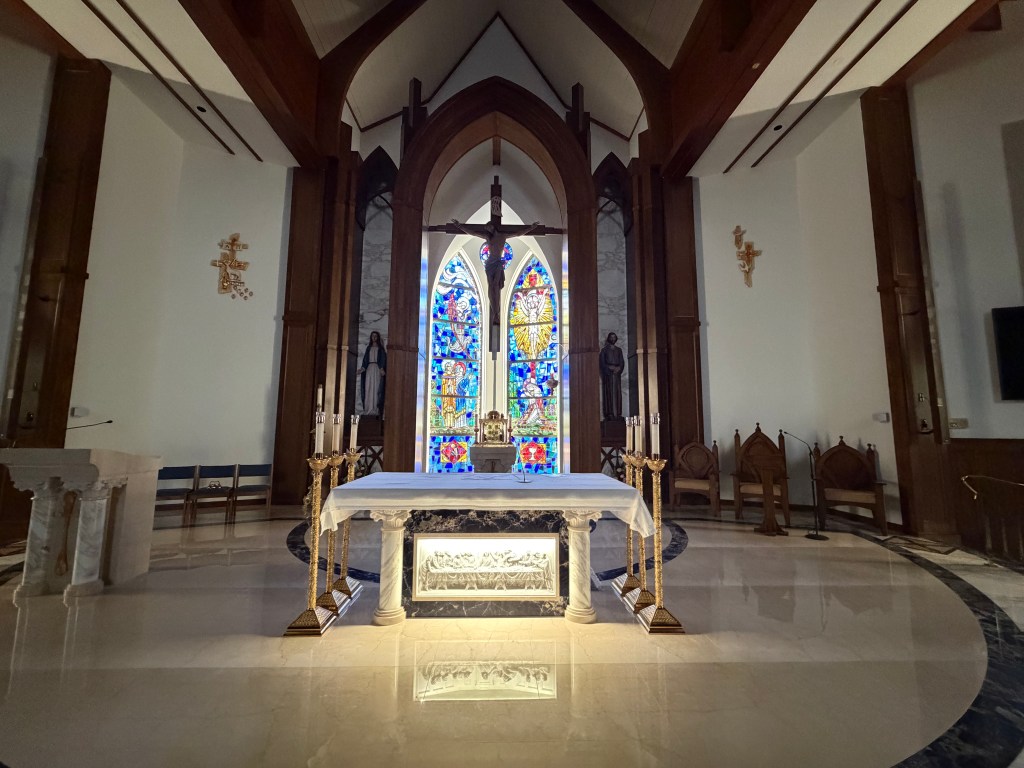
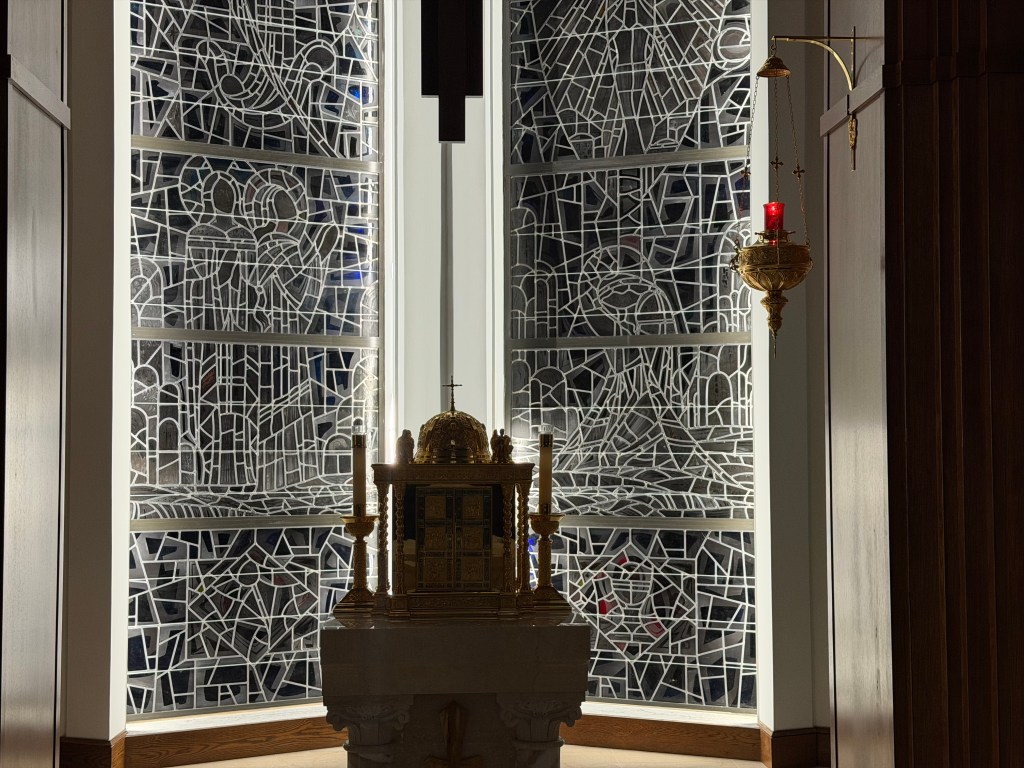
Photo: Quiet time with the Jesus and Mary in the sanctuary of St. Mary Catholic Church, Windsor Locks, CT.

Link for the Mass readings for Friday, September 19, 2025

Are we willing to accept the invitation and then show up for the wedding feast?

“The Kingdom of heaven may be likened to a king who gave a wedding feast for his son” (Mt 22:2).

Throughout the Gospels, Jesus not only talked about feasts but he is recorded as often celebrating table fellowship with others. Those he ate with ranged from people who were considered sinners to the religious elite among the Pharisees.

In the parable from today’s Gospel, Jesus presented a range of reactions to the invitation already supposed to have been accepted to a great, wedding banquet offered by the king for his son. The custom of the time for a wedding feast, which often was a celebration that would not last just a day but often a week. A first invitation would be sent out, and when accepted, at the time to begin the banquet, a second invitation would be sent for those to now come to enjoy the festivities.

In Jesus’ parable, the first group are so caught up in their own lives, that they are not willing to break away from their daily activities. The second group rejects the invitation outright and does so violently, by mistreating and even killing the servants of the king. The retribution of the king is swift and punitive. Then he sent his servants out into the streets, “and gathered all they found, bad and good alike,” and they welcomed the invitation and said yes to the invitation “and the hall was filled with guests” (Matthew 22:10).

God invites us into a relationship with him, but we must be willing to repent, to change our hearts and minds to see the invitation for what it is, then decide to receive an eternal gift. Those who refused were unwilling to change their plans, as well as others who, with hearts of stone, were outright hostile, willing to abuse and even kill the servants. Are we willing to choose our busyness over time with God each day or will we stubbornly hold on to our own self-reliance and pride and refuse God’s gift?

Near the end of the parable, Jesus presents a curious fellow that the king found present without the proper attire. This is not a literal indictment of not having the proper clothes, but the wedding garment imagery may be a recognition of a willingness to receive the benefits of the invitation without a yes to the responsibility involved. A desiring to reap the gift with accepting the responsibility. We need to be willing to take off the clothes of our old way of life, our ways of sin, self-indulgence and reliance, and receive the wedding garments offered to us by the king who seeks to clothe us “with the garments of salvation;” and cover us “with the robe of righteousness” (see Isaiah 61:10).

We are invited to participate in the banquet of eternal life with God. The invitation is freely given, yet it requires that we dress for the occasion. Again, this dress is no material garment of fine linen and gold embroidery, but our willingness to repent, to turn away from those idols, that which we have placed or put before God, to have our hearts and spirits renewed. We are invited to be a part of God’s new creation by participating in the life of his Son, the firstborn of the new creation.

We see this played out in salvation history as well. God the Father offered this invitation of the eternal banquet to the patriarchs, judges, prophets, and the people of Israel, to be one with him that they might shine brightly before all so to make his will and glory known to the world. In God’s timing, he sent his Son to fulfill that mission of invitation and to be with us in our present moment and in our present condition in life. Jesus meets us where we are right now in our everyday experiences and tells us that “the feast is ready.”

We are invited each day to begin again, to pray, to turn away from our selfish ways, to receive a new heart and a renewed spirit. God invites us but we need to be willing to let go of our idols, our disordered affections, and attachments. We are called to be transformed and perfected through our participation in the life of Jesus and through the purifying fire of the Holy Spirit.

Our yes demands accountability. We can’t just show up dressed for the part and take up space. Our ultimate attire is the transformation from within, in which our posture changes from a curving in upon ourselves to an opening and willingness to praying with and being guided by God, to devote our time, discipline, talent, and treasure to serving at the banquet and inviting others to attend.

“Many are invited, but few are chosen” (Mt 22:14). The first step is saying yes to the invitation. The second step is to be prepared for and be ready to come when the time for the wedding feast is announced. We need to be willing to allow the Holy Spirit to renew our hearts and minds, to take up our cross, to know and follow the Father’s will, serve and sacrifice by the giving up of ourselves in love. The way to the banquet is no easy path, but we can take comfort in the truth that we do not walk alone. Jesus guides and empowers us when we are willing to follow.


Painting: The Adoration of the Mystic Lamb, the central painting from the Ghent Altarpiece painted by Hubert and Jan Van Eyck in the 15th century.

Link for the Mass readings for Thursday, August 21, 2025

Let us build our spiritual homes on the love of the Father, the Son, and the Holy Spirit.

“Everyone who listens to these words of mine and acts on them will be like a wise man who built his house on rock” (Mt 7:24).

Jesus speaks to us: in the Gospels, in the silence of our hearts, through our conscience, through the words of others, in our daily activities, and through creation which has been loved into existence through collaboration with his Father and the Holy Spirit.

We can be unaware of the words he speaks, we can hear his words but not listen, hear his words but ignore, listen but not act upon them, or we can do with his words as Jesus encourages us to do. We can listen to his words and put them into action. We can experience the gentle nudge of the Holy Spirit and follow his lead. When we follow the urgings of Jesus and the Holy Spirit, no matter how small of a nudge it is, that step in alignment with the Father’s love will make all the difference. For each affirmation and putting into action their guidance helps us to experience the love of God our Father.

Jesus became one with us so that we can share in the love of his Father. Not one with us, so that we can know about him. Not one with us, so that we can say that we prophesy, cast out demons, do mighty works, cite Bible chapter and verse to show our knowledge or justify our behavior in his name. One with us so that we can share in the very life of God the Father as he and the Spirit does. 

Jesus meets us on our level and when we are willing to follow his lead, he will lead us up to the heights of participating in his divine life. Jesus has been doing just that in his Sermon on the Mount which we have been reflecting upon these past few weeks. If you are just coming in today or need a refresher, this gathering of teachings began in chapter five of Matthew and takes us up to today with chapter seven. Jesus presented us with the Beatitudes, that we are called to be salt and light, he built on the law and the prophets by giving us the six antitheses (“You have heard it said, but I say to you…” statements), he taught us to pray the Our Father, that we are to depend and place our trust in God and not the things of this world, we are to refrain from judging others, we are not to cast our pearls before swine, we are to do to others as we would have them do to us, we are to seek to enter through the narrow gate, and to be aware of false prophets.

The teachings of Jesus in chapters five, six, and seven of Matthew, his Sermon on the Mount, put into practice will help us to build the foundation of our spiritual houses on solid rock. The same rock that Peter built his foundation on, the Christ the Son of the Living God. May we go back through chapters five, six, and seven of Matthew and see which teaching Jesus is leading us to ponder, meditate upon, put into action, and place our next foundational stone of discipleship.

If that is a bit much, we can start with St. Irenaeus who learned from St. Polycarp, who learned from the beloved Apostle John who learned from Jesus. St. Irenaeus taught that Jesus became one with us so that we can become one with him. Jesus entered our humanity so that we can participate in his divinity. Jesus invites us to be in relationship with him, to know him, so that we can know his Father and experience the love of the Holy Spirit that he wants to share with us. The goal is that we can be one as Jesus and the Father is one.

Jesus loves us as we are, and for who we are, right now at this very moment. Jesus loves us more than we can ever imagine. Jesus loves us so much, he invites us to repent and turn away from anyone and anything that may be leading us away from God. He invites us to turn back and walk in the direction of the Father’s arms that are wide open to embrace us. When we experience God’s loving embrace, may we rest there, savor, and abide in his love. Filled up with his love to overflowing, we have a wonderful gift to share.


Photo: The Sanctuary of Madonna della Corona in the province of Verona, Italy. Photo accessed from Italiabsolutely

Link for the Mass readings for Thursday, June 26, 2025

Jesus seeks to welcome, embrace, and bless us as he did the children.

In today’s Gospel account, or pericope, people are bringing their children to Jesus to receive a blessing. To offer a blessing, especially this is an action a father would offer, was common. It is understandable that parents would want to bring their children to be blessed by Jesus. Even though children had very little status in the ancient near East of this time, especially in the very young because of high mortality rate, parents did care. They, as with others, sought Jesus for his healing touch, whether they needed a healing or a blessing.

Yet, the disciples step in to prevent this process from happening. Mark does not share the reason for their interference. The disciples apparently missed the lesson that Jesus sought to teach them earlier when they were arguing among themselves about who was the greatest. Jesus had then asked for a child to be brought to him and said, “Whoever receives one child such as this in my name, receives me” (Mk 9:37). This could be why Jesus was none to happy, in fact “indignant” for their interference. Jesus rebuked his disciples: “Let the children come to me; do not prevent them, for the Kingdom of God belongs to such as these. Amen, I say to you, whoever does not accept the Kingdom of God like a child will not enter it” (Mk 10:14-15).

Jesus consistently offered grace to those who might otherwise in the society of his time be prevented from receiving it. Jesus provided healings for the possessed, lepers, women, the blind, the lame, tax collectors and sinners. The very fact that this short account mentioning children is even included in an ancient near Eastern text says something profound. Jesus recognized the dignity of children as he already attempted to teach his disciples.

Children in the ancient Near East had no recognized social status. Orphans were at risk and needed to be taken care of. Children up to two years old were vulnerable in many ways and as such, experienced a high rate of infant mortality. Because of this reality, many parents may have developed an unconscious, defensive posture that they did not become too attached to their children until after they were two years of age. This harsh reality could also be a reason why these children were being brought to Jesus for a blessing.

Jesus, in his reaching out to the children to offer a blessing, impresses the point that he takes the life of children seriously and so encourages others to do so. There are historical accounts that Christians continued to take this teaching seriously. In ancient Roman society, if parents did not want a child, one recourse was to leave them in a local dump to die. Christians would retrieve the infants and bring them into their homes and raise them.

Jesus also used this opportunity as a teachable moment when he shared that “the kingdom of God belongs to such as these.” Jesus is recorded as using the image of God as a Father one hundred seventy five times in the Gospels. Jesus equating that the kingdom of heaven belongs to such as these would have been hard for his disciples to fathom. Maybe one of the reasons this message did not stick the first time. Jesus was helping his followers and us today to see the love of the Father for all his children. To enter the kingdom, we must accept that we are to depend totally on and place all our trust in God as our Father.

God has created us to be in relationship with him and one another. We need him just as much as an infant does for his or her very existence and survival. We do not buy or earn our way into the kingdom of Heaven because God and his realm is so transcendent, so beyond us, that we cannot possibly get there on our own efforts. We enter the kingdom of God through the door of his Son, who is the way, the truth and the life.

Just as Jesus opens his arms to embrace the children to receive and bless them, he seeks to do so with us. In our willingness to enter into and receive his embrace, we enter into the kingdom of our Father. It is relationship with God who we are wired for, he is our hope, our meaning, and our fulfillment. “[T]o receive the kingdom is as simple, trusting, and humble an action as receiving the embrace of Jesus. Indeed, to enter the kingdom is nothing other than to enter into a relationship with Jesus” (Healy, 201).

Thank you Jesus for the gift of loving us and revealing to us our dignity, value, and worth. Help us to accept and embrace this gift of your love so that we may love each other as brothers and sisters. Help us to promote a culture of life that recognizes and acknowledges the dignity and value of each and every person without exception from the moment of their conception, birth, throughout the ups and downs of daily life, up to and including our elder years until natural death.

——————————————————————

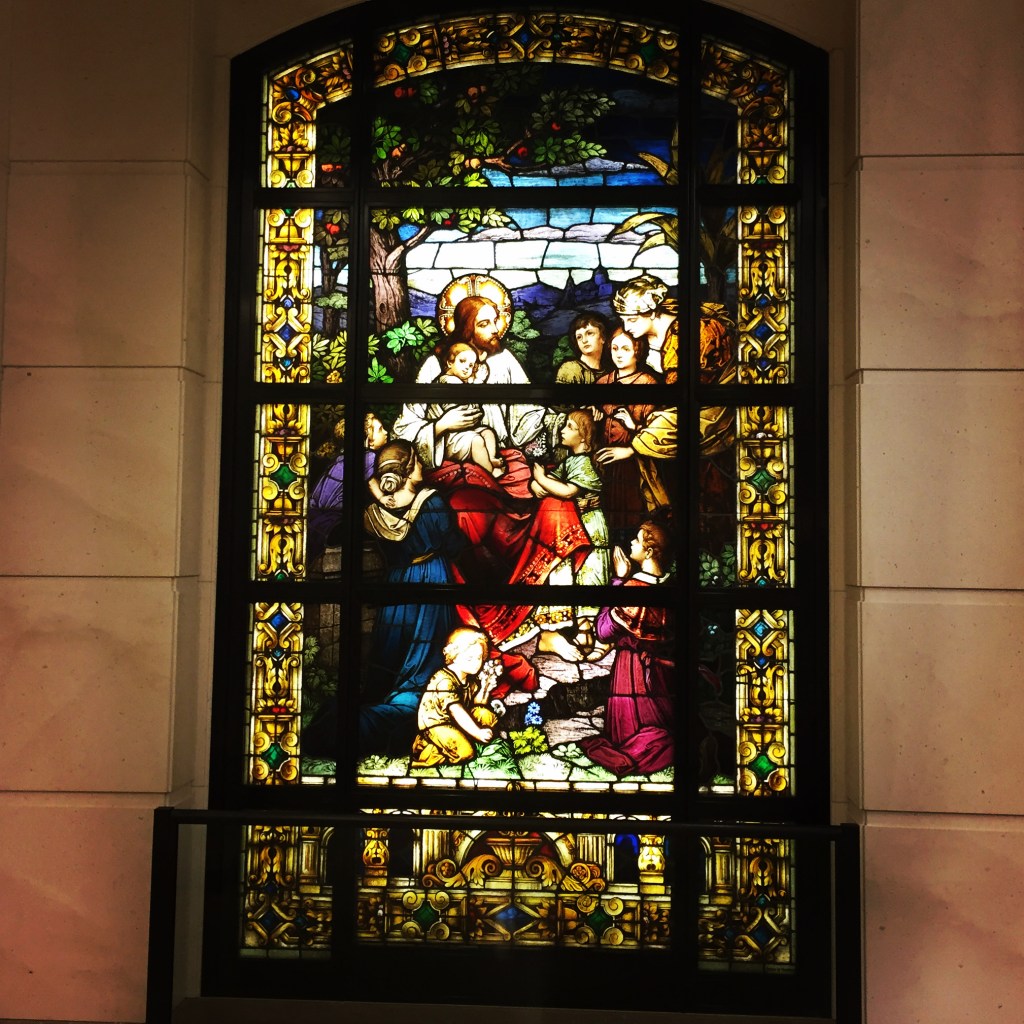
Photo: Stained glass depiction at the Cathedral of Our Lady of the Angels, Los Angeles, CA.Healy, Mary.

Healy, Mary. The Gospel of Mark. Grand Rapids, MI: Baker Academic, 2008.

Link for the Mass readings for Saturday, March 1, 2025

Experiencing God with us in everything is the gift of prayer.

“And I tell you, ask and you will receive; seek and you will find; knock and the door will be opened to you. For everyone who asks, receives; and the one who seeks, finds; and to the one who knocks, the door will be opened” (Lk 11:9).
Prayer can become frustrating when we make the time to pray and then we feel or think that nothing is happening or has happened. We may pray for a specific petition for our self, or for a particular intention for another and felt, or thought, that there was not an answer from God. One may pray a sincere, seemingly selfless prayer for a loved one, a child, a spouse, a friend, to be healed and the person still dies. They may be deeply hurt because they did what Jesus said; they asked, they pleaded and begged, but felt they did not receive the healing; that which they sought for, was not given and, instead what they found was nothing but pain and heartache from the loss; they knocked until their knuckles were raw and experienced no one on the other side.
Our attitude and orientation to prayer matters. When we sincerely turn our hearts and minds to God in prayer, something happens between us and God, though it may be beyond our cognitive grasp to understand or our sensory awareness to experience. There may indeed be emotional highs and consolations experienced in prayer, but if seeking those is the primary motivation for prayer we will find ourselves more frustrated than not. There may also be lows in prayer, dryness, even desolations, and even feeling God’s absence. Emotions are fleeting and not a good barometer when measuring the effectiveness of prayer.
Another big misconception is that we pray to God as if he were a gumball machine. It may seem a silly analogy but how many of us really do pray and only pray that way, and when we do not receive the specific thing we asked for, at the time specified, when we wanted and as we wanted, we brood and think God doesn’t care or does not, in fact, even exist. We may even slip into the barter posture. God if you grant me this, I will do that. If we are only open to receive what we want on our terms, again we are setting ourselves up for frustration.
The very desire to pray is the beginning of our awareness of God’s invitation offered to us to join him in prayer. God is the one who reaches out to us first. The answer to what or who we ask, seek, and knock is found at the end of the Gospel reading for today: “If you then, who are wicked, know how to give good gifts to your children, how much more will the Father in heaven give the Holy Spirit to those who ask him” (Lk 11:13)?
God knows what is best for us, he sees our potential, he wants us to experience joy and be fulfilled. How can we best live our lives in this world to attain that reality? We do so by receiving the Holy Spirit. Who is the Holy Spirit? The infinite, communal love expressed between God the Father and God the Son. Our goal in prayer is to enter into God’s reality, the infinite communion of Love.
Through building a relationship with God, which we are able to do through our participation and conformation to the life of Jesus, we come to see the truth of empty promises, apparent goods, substitutes to fill our emptiness and faulty defense mechanisms that we have been utilizing as guideposts to merely survive and get through life. When we stay consistent in an authentic life of prayer, we will change, we be aware and be able to let go of that which is false and will begin to bear the fruit of the Holy Spirit which are love, joy, peace, patience, kindness, goodness, gentleness, and self-control (cf. Galatians 5:22-23)?
We need to resist running away from apparent unanswered prayers, the pain of loss, and accept sometimes not knowing, and to trust that God has not abandoned us. He is with us in everything. Prayer is not primarily what we ask and that we receive. Prayer is a willingness to hear God’s invitation to enter into a deeper and more intimate relationship with him. Accepting this as a starting point will open a doorway leading into the open arms and embrace of his Son, Jesus, who awaits us in the depth of our need, confusion, grief, and pain. Even our loved ones who have died have not come to an end but have experienced a new beginning with our loving God and Father. JoAnn said in her last few weeks that she was just changing her address.
Ultimately, what we ask, what we seek, and what we knock for when we pray is to be loved, to belong, to be a part of someone greater than ourselves. We have been created as a living, craving hunger, and desire to be in relationship with God and each other. This is true for the atheist and the mystic alike. We have been created to be loved and to love. To experience God’s love in our time of prayer, it is important to make time consistently to do so, to then breathe and recollect, to be still and let our thoughts come, go, and settle down. Then we can have a conversation, speak with God and listen to him and experience the Holy Spirit in the silence of our hearts.
The Holy Spirit is the gift of prayer that is open to us all. He is the love shared between the Father and the Son, that we too can experience even during our sorrow, trials, and tribulations, as well as during our times of celebrations, overcoming, and rejoicing. This is why he is the answer to our prayers. Sometimes to be aware of his presence takes perseverance. It may not be that God is not answering, but that we are not patient enough to receive the answer. We may not be silent enough to hear. Prayer is about building a relationship and like any other relationship, we may need more time to heal and/or to build trust, and a willingness to consistently spend time together. Most importantly, we need to learn to communicate and that means learning God’s profound language of silence.

Photo: Damage from tornado taken last night. Compare to picture posted for last Sunday’s reflection. Walking in God’s silence and asking him to help all effected by this storm and us here at Holy Cross Catholic Church, Vero Beach.
Mass readings for Thursday, October 7, 2021

God has made us for communion and relationship.

Accompanying him were the Twelve and some women (Lk 8:1-2).

A simple statement but significant regarding how Jesus again is showing us how to live our lives as his followers, his disciples. Jesus is fully human and fully divine. What he has done and continues to do as the Son of God incarnate is to draw close to us in our humanity, as human beings, so that we can enter into a relationship with him and his Father through the love of the Holy Spirit, thus becoming one with him in his divinity.

From the beginning of his public ministry, throughout his time walking this earth, and continuing on after his resurrection and ascension into heaven, he  invites people to participate in his life and the kingdom of Heaven which is at hand in his very presence. Jesus does so by building relationships. This is how Luke can write the verses that Jesus was accompanied by the Twelve and Mary Magdelene, Joanna, and Susanna. These were real people with whom Jesus developed real and intimate bonds.

Christianity is not a Lone Ranger religion, it is not the survival of the fittest, and Jesus did not teach us to pull ourselves up by our own bootstraps. We are created by God to be in communion, to be in a relationship with him and each other, to experience his love and love one another. That means we need to ask for help from God and each other when in need and to come to the aid of, accompany, empower, and support one other.

We are invited to welcome, engage with, and make time for each other by exchanging in the stories of our tragedies and our triumphs. We need to resist the temptation of withdrawing into our own bubbles. Instead, let us take the risk to be vulnerable and trust. Relationships are not perfect, they will be messy, and conflicts will arise. By making a commitment to God and each other, being willing to be honest even when we are tempted by our fears to be otherwise, keeping an open heart and mind, and being willing to be understanding, kind, and forgiving, we can grow closer together.

Jesus chooses each one of us to accompany him and to forge relationships grounded in mutual respect, where no one is last and where no person is left behind. Our prejudices only survive when we keep people at a distance. When we are willing, like Jesus, to come close and spend time with one another, our biases can fade and friendships can grow. Even when it appears sometimes that our country and our world is about to tear apart at the seams, reconciliation and communion is what our faith is all about. This is why we are a joyful people and an alleluia people!

————————-

Photo: After concelebrating Mass at St. Catherine’s Catholic Church in Broad Brook, CT. Enjoyed spending time with and getting to know some of the parishioners afterwards.

Link for the Mass readings for Friday, September 20, 2024