God only wants to love us and give us rest and peace.

“You have searched me and you know me Lord… Where can I go from your spirit? From your presence where can I flee? If I go up to the heavens, you are there; if I sink to the nether world, you are present there… You have searched me and you know me Lord” (From Responsorial Psalm 139:7-8).

God knows us through and through. He knows us better than we know ourselves. And yet, we hide from him. We seek to do things on our own, even while in the same breath we say we believe in him. For most of us, it is because deep down we are listening to the father of lies and we really don’t trust our loving God and Father. We choose not from freedom as much as from our reactions based in those lies that are fueled by the wounds we have inflicted and received by living in a fallen world.

The path out of the darkness of distraction, diversion, and doubt is lit by the light of Jesus. We are invited to trust him even when our instinct is to resist the light. We judge ourselves and project that judgment on God. We listen the liar who condemns, shames us, and accuses us, and then for a good dose adds, God will not forgive us or I will keep committing the same sins over and over again so why bother? What will God think of me if I reveal this to him?

God loves us to the very depths of our being, more than we can ever imagine. We do not need to be afraid of his reaction to even our most egregious sin, because he already knows! “You have searched me and you know me Lord.” God even loves us in the very act of our committing sin. The issue is, we don’t experience his love when we choose something else over him. We don’t experience his love when we don’t come to him for forgiveness. We don’t experience his love when he forgives us and we don’t forgive ourselves.

We experience his love when we repent. When we turn away from our sin and turn back to God. We may turn away from our sins out of guilt, but turning away or white knuckling with our will power alone is why we continue to fall for the same temptations. We need to turn away from the sin and turn to Jesus and allow ourselves to experience God’s love. Then filled with his love, we can resist the temptations awaiting us.

God has searched us to our very core, he knows the worst about us and loves us anyway. We can stop running and burying ourselves in busyness, distractions, diversions, false promises, and disordered affections, and instead allow ourselves, even if for only a few minutes today, to trust Jesus who is holding out his hand to lead us to a place of peace and rest. A peace and rest nothing in the world can give.


Photo: Moments of quiet, like a sunset walk can help us to slow down enough to experience God’s love for us. (University of St. Mary of the Lake)

Link for the Mass readings for Wednesday, August 27, 2025

Making time to be still and listen, can help us to correct an ill advised course.

As Jesus and his companions shared the Passover, Jesus offered this morsel, “One of you will betray me” (Mt 26:21). I am sure that this bitter herb shifted the mood of the meal and fellowship. Each apostle asked if they were the one to betray him. There is no recorded response, though the assumption is that Jesus says no to each, except for one.

A unique feature about this exchange was that each of the disciples in asking Jesus if they would betray him prefaced their request by calling him, Lord. In doing so, they acknowledged that Jesus was the Messiah. When Judas addressed Jesus he called him, Rabbi. He did not acknowledge Jesus as his Lord. Could this be a tell regarding why Judas was willing to turn Jesus over because he did not believe Jesus to be the Messiah, that he too believed Jesus to be a blasphemer?

Jesus’ response to Judas was an affirmation of truth: “You have said so” (Mt 26:25).

Jesus offered this affirmative response two other times, confirming each time the truth presented to him. When Caiaphas asked if he was the Messiah and then later with Pilate when he asked Jesus if he was the king of the Jews. In answering in the affirmative to Judas, was Jesus giving him the opportunity to look at himself in the mirror? Jesus knew that Judas would betray him, he did not have to make this point known. Judas could have remained silent, yet he asked, as did the others who went before him. Could he have been contemplating shifting his prior determination of betrayal? Was Jesus inviting Judas to acknowledge what he had agreed to do, confess, change course, and ask for forgiveness?

Judas chose his course of action to betray Jesus, and unfortunately, even with Jesus’ intervention, Judas was not able or willing to stop or change course. Judas fulfilled his agreement with the chief priests to turn Jesus over. Often we set a similar course of action and even when Jesus makes an attempt to intercede on our behalf, we do not slow down enough to hear.

God speaks to us in the silence of our hearts but too often we are focused on or diverted by other things and we do not hear. We can instead allow fear, anxiety, pride, prejudice, or anger to be our guide. We can be too blind to see or too determined to do it our own way, regardless of the consequences. Our interpretation of our experience may be that the momentum is already too strong to turn around. That it is too late to change course.

We need to know in the depth of our being, that it is never too late to change course, to make amends, to repent, and to turn back to God. The first step is being willing to be still or aware enough to hear or see his guidance. The second step is to be willing to look in the mirror and see what Jesus presents to us, accept what we see, and then seek his forgiveness. Yet, sometimes we feel we are digging ourselves into a hole that we can’t escape from. The answer is that we need to just stop digging and put the shovel down. Jesus will meet us in the deepest of the holes we have dug for ourselves and when we are willing lift us out.

————————————————————–

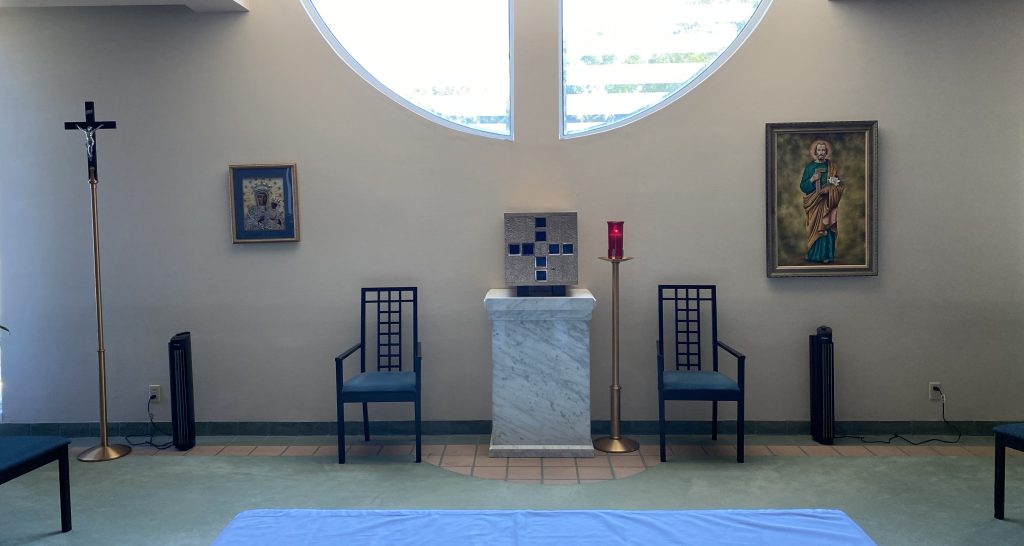
Photo: Blessed to have some time to be still and pray a holy hour in the chapel at the cathedral of St. Ignatius of Loyola.

Link for the Mass readings for Wednesday, April 16, 2025

Jesus offers us something greater than what we are experiencing right now.

There is something greater here! Something greater than the wisdom of Solomon and something greater than the preaching of Jonah. Someone greater than the kings and the prophets who went before. Jesus.

Following the way of Jesus is a faith we are called to live daily. This is not a part-time vocation. We all have a unique gift in the dignity we have been conceived and been born with. We have a unique way to express and live out our dignity as well. We have been created in the image of God, but through sin, we have lost our likeness to him. We are tempted, misdirected, distracted, and diverted from experiencing God’s love for us and plan for our lives and this can lead us away from God and our likeness to him. Jesus calls us back to spend time with God so we can be forgiven, healed, and begin to restore our likeness as we rekindle our relationship. This is the path to holiness that we are all called back to and will experience when we allow ourselves to be still and rest with the Lord and in his word daily.

As Jesus taught, often in his parables, the kingdom of Heaven on earth starts small, like a mustard seed, like yeast, and develops slowly when nurtured. Lent is a good time to slow down, step back, take a retreat even while in the midst of our everyday activities. We just need to insert some intentional and dedicated time to spend with God and God alone each day. In doing so, we will better come to know him, his word, and guidance.

One of the reasons we may feel a bit restless is that we are engaged in activities in our lives that miss the mark of who we were created for. We are missing the relationship with God that he is inviting us to participate in because we are allowing ourselves to be distracted and too busy to see where we have been led astray. The sign of Jonah that Jesus offers us is repentance. The whole of Nineveh repented even though Jonah was hoping that they would not and be punished by God! Jesus seeks our repentance, our willingness to turn back to see the open arms of God and Father wide open ready to receive us, to lead us back to the truth of who we are as his beloved daughter or son.

If you are feeling a bit restless, on edge, or out of sync, I invite you to make some time to be still and breathe, this can be while in the shower, when you have some breakfast, a morning walk, or taking a sip of coffee or tea. During this time ask God for some guidance. We can ask him to help us see those areas that we need to repent from and let go of, those thoughts, words, and actions that keep us distracted, redirected, and off-kilter as to who God is calling us to be. We can then confess to him and receive his forgiveness and reconciliation.

God invites us to come to the silence to also be able to sit with our wounds and traumas. Many times we do not want to be still or quiet because there may be unresolved issues, hurts, and/or pain that we would rather not face. We may even believe in the lie that if we actually allow ourselves to feel what is deep down there, that we will become completely undone. God is present and waiting, inviting us to come to experience acceptance and love as we are, to feel safe to be vulnerable and honest and from this place of truth, begin with simple steps to walk the path to our freedom.

Jesus said in today’s Gospel that, “There is something greater here.” Christianity is not a secret sect. We are called to share the joy, the forgiveness, healing, and reconciliation we experience from God with others, even with, as Jonah found out, our enemies. We are to look for opportunities to offer a smile, an encouraging word, to reach out to someone we have been meaning to connect with for a while, in person or far away, and/or someone that we may sense just needs a listening ear. We can also can ask for God’s patience so that we may react less and become more understanding. Just as we are hurting, so are so many others.

Lent can be a joyful time when we enter into the season with the intent to deepen our walk with the One who is wiser than Solomon and preached repentance and reconciliation. With our hearts and minds turned back and open to God, Lent will not so much be a drudgery to endure, but a joyful embrace of the opportunity for experiencing a change of mind such that we are more open to dialogue, forgiveness, healing, sharing the joy, reconciliation, and contributing to building up the kingdom of God one healing at a time! Hurt people can hurt people, and hurt people can also experience the healing of Jesus and help to be an advocate of healing for others.

———————————————————-

Photo: May Jesus help to ignite that fire within us that can help us to return to who we are and are called to be as God’s beloved.

Link for the Mass readings for Wednesday, March 12, 2025

“John is his name.”

Zechariah had not spoken since the time he encountered the angel Gabriel. Gabriel shared with Zechariah that his wife Elizabeth, though barren and past childbearing age, would give birth to a son and his name would be called John. The time for the fulfillment of Gabriel’s prediction had now come to pass, Elizabeth gave birth, and with friends and relatives gathered around on the eighth day for his circumcision and naming. Elizabeth announced that her son will be named John. Those with her balked, “There is no one among your relatives who has this name” (Lk 1:61).

There may also be some hesitancy because John, or יוֹחָנָן, Yôḥanan in Hebrew, means one who is graced by God. Who did Elizabeth think she was naming her son by this sacred name? They then appealed to Zechariah. He would support his wife by writing on a tablet that “John is his name.” Zechariah confirmed Elizabeth’s words and: “Immediately his mouth was opened, his tongue freed, and he spoke blessing God” (Lk 1:63-64).

Filled with the Holy Spirit, Zechariah spoke what we call today the Benedictus or Canticle of Zechariah, the beginning lines of which read: “Blessed be the Lord, the God of Israel; for he has come to his people and set them free. He has raised up for us a mighty Savior, born of the house of his servant David” (Lk 1:68-69).

Zechariah did not proclaim that John was the Messiah. As Christians, we believe that Micah prophesied that John was to be the herald of the Messiah. He prepared the way for the coming of the Lord. The Benedictus, like the Magnificat, is a song of great promise. This is why the Church proclaims that they are to be prayed every day in the recitation of the Book of Christian Prayer or the Liturgy of the Hours. We are living in the time of its fulfillment.

The year 2024 A.D. does not stand for after the death of Jesus, it stands for anno domini, in the year of our Lord. We live in the in between times of Jesus’ first coming as we prepare for his next coming. We live in great joy because we can prepare to receive Jesus everyday. This is why St. Paul wrote to the Philippians, we are “to rejoice always.” No matter the external circumstances or internal angst, our Lord Jesus the Christ, the Son of the living God is at hand, to forgive and heal us, accompany and deliver us, give us guidance and strength!

In the midst of continuing violence, war, polarization, endless forms and acts of dehumanization, fear, and growing anxiety, we will celebrate again this Wednesday. We will celebrate Christmas, the reality that the Son of God agreed to be sent close to us, to become human, to die, and conquer death so that he can be with us and lead us into eternity. John helped to prepare the way to receive Jesus by calling people to repentance. May we seek his intercession as we remember his birth today to prepare well in these final days of Advent so to better remember and celebrate again the reason for the season. Our Savior has come. Sin, suffering, and death do not have the final answer. Jesus does.

May we heed the call of John and Jesus to repent so that we may receive God’s forgiveness and grace and be freed from our entanglements with sin. May we let go of anything that separates us from our relationship with God and resist the temptation to curve in upon ourselves which leads us to death. Let us turn away from our pride and the false promise of self sufficiency and instead depend upon and place our trust in Jesus who offers us life. Each and every day, with the courage of John, let us prepare the way of the Lord and “give people knowledge of salvation” that Jesus is at hand so that God may “guide our feet into the way of peace.”


Photo: St. Elizabeth and John the Baptist by Krysten Brown, The Saints Project

Link for the Mass readings for Monday, December 23, 2024 A.D.

Jesus is coming, let us prepare.

In the fifteenth year of the reign of Tiberius Caesar, when Pontius Pilate was governor of Judea, and Herod was tetrarch of Galilee… (Lk 3:1).

This may be an odd verse to focus on in Advent, or anytime when sharing a reflection, but there is a point to this historical tidbit of information offered by Luke. Jesus, the Son of God, born of the virgin Mary, was born in time, and in a place. The gospels are not myths, they are not fairy tales, nor are they works of historical fiction. Luke’s account would fall better into the genre of Greco-Roman history, although, the gospels have their own unique expression as a genre. The gospel writers were interested in the historical Jesus, but they were more than mere biographies. Their primary focus was to present theological insights that help us to understand who Jesus is and his teachings that we can put into practice, but not that, but to also come to know him in our time and place, and be transformed by him and his love for us.

The Son of God was obedient to his Father and was willing to be sent to become a human being conceived in the womb of Mary.  This truth has relevance to us because it means that Jesus experienced what we experience as human beings. From the moment of his conception and moving forward, through his birth, life, death, resurrection, ascension, and continuing today, he experienced and experiences what we experience as humans, even temptation although he never sinned.

In Luke’s presentation and setting the stage for Jesus’ birth, he shared a shady cast of characters: Tiberius Caesar, Pontius Pilate, Annas, and Caiaphas to name a few. Although lost on most of us today, these political and religious leaders were not known for their virtuous living. Yet those in the time of Luke’s writing would have recognized that they were examples of human depravity. Jesus was born in a time and a place of darkness. He was and continues to be the Light of God who has come into the darkness of the fallen human condition.

To prepare the people for this coming, Luke presents the preaching of John the Baptist. Though the son of the priest, Zechariah, John rejected the political and religious status quo. He did not preach in Jerusalem nor the Temple, but in the wilderness. His message to “Prepare the way of the Lord” was a call in unison with Baruch from our first reading.

Baruch, the secretary of the prophet Jeremiah, shared God’s promise in which Jerusalem was invited to, “stand upon the heights; look to the east and see your children gathered from the east and the west at the word of the Holy One, rejoicing that they are remembered by God” (Baruch 5:5). The children who are to rejoice were those scattered children of Israel. The northern ten tribes of Israel who were first exiled by the army of Assyria in 722 BC, and the greater majority who never would return. Also, in 587 BC, the remaining tribes of Judah and Benjamin were defeated and their majority exiled to Babylon. Jerusalem and the Temple was destroyed. Baruch’s promise offered hope for that time when the twelve tribes that were exiled and scattered would be reunited and return from the east and the west.

John the Baptist came to announce that time. The messiah was at hand. The ancestors of those who returned to Jerusalem after the Babylonian exile, were waiting for the coming of the fulfillment of the promise of the prophets, and John the Baptist was telling them that this long awaited time was upon them. John was telling them to get ready, to “Prepare the way of the Lord.” Jesus is coming.

This is the first coming of Jesus we prepare to celebrate at Christmas. Each Advent is a time for us to prepare not only to celebrate Christmas, to remember Emmanuel, God with us, but to prepare for his second coming or our personal judgment when our time on this earth this side of heaven is coming to an end. Whichever comes first, either reality is time, not for sorrow, but instead for joy.

This is the joy that St. Paul encourages the Philippians to experience and we can as well. “I am confident of this, that the one who began a good work in you will continue to complete if until the day of Christ Jesus” (Philippians 4:6). May we rest in the same confidence, that as we repent, trust in God, and put into practice his teachings that we will be ready to experience Jesus coming into our lives each day and he will work through us to bring about our salvation and those he calls us to serve.

Luke invites us to look back on this time when a world in darkness waited with bated breath for the Light to come to set things right. To bring proper order back to the political and religious state of affairs. Luke offers us, through the words of John the opportunity to ponder the meaning of what it means for us to “Prepare the way of the Lord”. We make a way for the Lord, when we open our minds and hearts to him, so that we might believe more and more each day, not only that Jesus came to us as our savior, but that he is with us and we can receive his love with each breath we take, and we will be prepared for when he comes again, each day, at the end of time, and when it is our time to go home.


Photo: Rosary walk back in mid October.

Link for the Mass readings for Sunday, December 8, 2024

Are we willing to see Jesus and see others as Jesus sees them?

Yet again, as in the Gospel from yesterday, the crowd gets in the way of someone seeking access to Jesus. The wall of people that has gathered around Jesus does not appear to be overtly keeping Zacchaeus from seeing Jesus. They may be so focused on seeing him themselves that they are not aware. Yet, there is also the strong possibility that the people were aware that this man was trying to get through. They knew Zacchaeus, and many judged him to be the sinner of sinners.

He was the chief tax collector of the area and he was most likely reviled by most in his community. He would have also likely considered to be unclean because he was breaking the commandment of not stealing, which he and the majority of the tax collectors did at the time. Each was the chief tax collector who was then also dealing with the Gentile occupiers. It is likely that each time Zacchaeus attempted to nudge by to get through a gap to get a better look, the individuals may have closed any gap each time such that he could not get through.

Zacchaeus was not thwarted. He ran ahead and climbed a sycamore tree. From his perch he was not only able to see Jesus, but Jesus saw him and said, “Zacchaeus, come down quickly, for today I must stay at your house” (Lk 19:5). Jesus did not see a tax collector or a sinner, he saw a seeker. One who was also willing to humble himself by climbing a tree, much like a child.

Jesus did not see the 99% nor the 1%. Jesus saw and sees people in need of compassion and mercy. He sees those lost that need to be found, those sick in need of healing, those alone who sought to belong. Jesus did not meet Zacchaeus with judgment but with love and compassion, and that made all the difference for this man’s conversion.

Jesus was willing to draw close to the one so many despised. By inviting himself to dine with Zacchaeus in his own home, Zacchaeus must have felt overwhelmed with emotion. Maybe for the first time in his life, he felt welcome instead of disdain. He repented without hesitation to the unconditional invitation and love he had received: “Behold, half of my possessions, Lord, I shall give to the poor, and if I have extorted anything from anyone I shall repay it four times over” (LK 19:8).

This expressive act of generosity arose from his encounter with Jesus. This exchange offers the invitation for us also to receive Jesus in the same way and the invitation to greet others more openly as well. One way to do so is to resist the temptation to “grumble”, to gossip, to pre-judge, and/or to dehumanize one another. Salvation came to Zacchaeus’ house in the person of his savior and in the act of his repentance.

Life is hard enough without adding more negativity. Jesus wants to dwell with us too. While at the same time, he challenges us to see beyond the exterior caricatures we project on to others, and instead invites us to seek to know the heart and character of the person. We can do so when we stop grumbling, are willing to approach others with an understanding heart and mind, and be willing to spend time to get to know one another.


Painting: Zacchaeus in the Sycamore Awaiting the Passage of Jesus by James Tissot.

Link for the Mass readings for Tuesday, November 19, 2024

May we be willing to see and cut the ties that bind.

“Jesus began to reproach the towns where most of his mighty deeds had been done, since they had not repented.” (Mt 11:20).

Anyone who encounters Jesus is invited to change. Jesus shines the light of his love and mercy into the darkness of our own fallen nature, where we are wounded, sinful, and broken. He invites us to repentance, healing, and reconciliation. He invites us to actualize who we truly are. A wonderful invitation, but why would we turn away? The darkness may be too dark, or the light may be too bright.

Facing our own darkness and pain is not easy and can be frightening as well as intimidating. That is why we are so vulnerable to temptations, distractions, and diversions. We may not be able to sit still because we want to keep moving so as not to face our fears and the root causes of our suffering, nor let go of our false senses of security, control, and the glitter of apparent goods. We also may not be able to accept the fullness of our goodness, of who God calls us to be, and the realization of who we really are.

Jesus invites us to stop, to breathe, to enter into his stillness and silence where we can hear the word of his Father and experience the love of the Holy Spirit. In this experience of silence, we come to encounter the choice to change our hearts and minds. We are invited to repent: to turn away from and let go of that which keeps us from growing closer in our relationship with God and becoming more fully alive.

God loves us more than we can ever mess up, more than we can ever imagine, and he does not define us by our worst mistakes. Jesus’ arms are wide open to receive us in the midst of our deepest wounds, fears, pain, sin, and suffering but we must be willing to stop running and be still long enough to experience and feel his forgiving, loving, and healing embrace. At the same time, we need to be willing to accept who we truly are and called to be apart from our false self. We are often too self-critical and judgmental of ourselves which keeps us wrapped up in ourselves.

Our challenge is to accept who we are as God’s children and who he calls us to be. While at the same time, we are to surrender to Jesus and make him our Lord. All the saints have come to this same place in their encounters with Jesus. The light of Christ reveals their sin, and they see where God is calling them to go free of that which keeps them bound. And so, they begin to cut the chords and strings that bind. For a bird bound by even the smallest of strings will not be able to fly until the string is cut.

May we allow Jesus to reveal to us the chords and strings that bind us so that we can cut them and be set free from the fowler’s snare!


Photo: Moment of pause while on my Rosary walk on Veteran’s Memorial Island Sanctuary, Vero Beach, FL.

Link for the Mass readings for Tuesday, July 16, 2024

The sun is setting on Lent as we begin Holy Week.

A core group within the leadership of Israel has decided. They will not deny themselves their power, prestige, and their place. They will not take up their cross and follow Jesus, the way, the truth, and the life. They will not allow the teaching and momentum of the growing number of those following Jesus to continue unchecked. As Passover drew nearer, thousands of people were coming up to Jerusalem to purify themselves for the great feast.

This meant the Romans would have many more centurions in place to keep the peace. The division and commotion that Jesus was causing could cause conflict and unrest and then swift and violent retribution from the Roman presence. The Sanhedrin, the Jewish High Council, followed the lead of the high priest, Caiaphas, who said, “You know nothing, nor do you consider that it is better for you that one man should die instead of the people, so that the whole nation may not perish” (Jn 11:49-50). With these words, they began to plan how to put to death the carpenter of Nazareth.

With the words of Caiaphas, the sun began to set on the life of Jesus. These words affect us even today as they usher in the sunset of our Lenten observance. The gift of our liturgical readings allows us to relive the story of our faith. Lent has given us a time to reflect and to meditate upon who Jesus is. Is he just a carpenter, another teacher, a holy man from the past, or is he each of these, but someone so much more. Is he the Son of God who became one with us in his humanity so that we can become one with him in his divinity?

Do we see his teachings and life as a threat as did the Sanhedrin? Do we like our life the way it is, such that we do not want Jesus to come into our home and start turning over the tables and disrupting our order and comfort? Or do the Gospels cut us to the heart and inspire us to shake off our complacency, our indifference, our cynicism, our comfort, our routine.

Jesus evades the centurions, because his hour is not yet, but when his Father willed it, Jesus was willing to give his life, not just in an abstract way, but very personally: for each and every one of us. Does that mean anything? Jesus gave everything for us. Does this truth spark a desire to acknowledge our sins, to repent, and to begin anew? Are we willing to open our hearts and minds to his love that transforms, are we willing to spend some time in quiet and allow Jesus to speak in the silence of our hearts, are we willing to be encouraged to fast, to pray, meditate, and to be moved with compassion to help those in need?

As Holy Week begins with the Vigil Mass for Passion Sunday may we meditate on the words of Caiaphas, “consider that it is better for you that one man should die instead of the people, so that the whole nation may not perish” (Jn 11:49-50). Caiaphas did not know that what he proclaimed would be so true, that the One, Jesus, would die, not only so the nation would not perish, but that all humanity could be saved.

Jesus died for each and every one of us that we might have life and have it to the full. As the sun sets this Saturday evening, may it not be just another rotation of the earth on its axis, but an opportunity to commit once again to die to our false selves, our egos, our self-centered postures, to be forgiven, and healed, and take up our cross and follow Jesus into Holy Week.
———
Photo: From Rosary walk last fall, SVDP Regional Seminary, Boynton Beach, FL

Link for the Mass readings for Saturday, March 23, 2022