repentance

Repentance is a “conversion of the heart”.
In today’s Gospel, we read about two accounts of horrific deaths. The first is at the hands of Pontius Pilate, who has not only ordered the execution of Jesus’ fellow Galileans but had their blood mixed with “the blood of their sacrifices.” In the second incident, Jesus brought up the tragic accident in which eighteen people died “when the tower of Siloam fell on them.”
In both cases, Jesus rejected the common notion of the time that these incidents were caused by God’s punishment and focused instead on the importance of repentance. Jesus stated quite emphatically, that, “Do you think that because these Galileans suffered in this way they were greater sinners than all other Galileans? By no means! But I tell you, if you do not repent, you will all perish as they did” (cf. Lk 13:1-5)!
Jesus was emphatic about helping his followers understand the purpose of his coming. Jesus provided meaning and fulfillment in this life as well as being the way to the truth of eternal life in the next. Yet, to experience the benefits of his invitation, people needed to repent from their focus on self, misunderstandings of God, and the false substitutions that the world offered by having a change of heart and mind and turning back to God, the very source of their being. This is just as true for us today.
To repent and surrender to Jesus is not some submissive bowing to a tyrant but an acceptance of the aid offered by the divine gardener. Our repentance gives permission to Jesus to cultivate the ground of our being to rid us of that which sickens us and instead allow him to fertilize us with his word and grace in such a way that we are renewed. Jesus tends to our growth such that we can be more aligned with the will of his Father and the love of the Holy Spirit. In these ways, we are forgiven, healed and can better mature so that we will bear fruit that will last.
To repent is a good thing. As is written in the Catechism of the Catholic Church, line 1431: “Interior repentance is a radical reorientation of our whole life, a return, a conversion to God with our whole heart, an end of sin, a turning away from evil, with repugnance toward the evil actions we have committed. At the same time, it entails the desire and resolution to change one’s life, with hope in God’s mercy and trust in the help of his grace.”
When Jesus shared in his first public message: “Repent and believe in the Gospel” (Mark 1:15), he invited then and invites us still today to a new way of seeing, hearing, experiencing, and living our lives. No longer do we have to live in fear, be bound by addiction, and/or entrapped by our sins. As we open our heart and mind to Jesus, he reveals to us with his loving light that which is preventing us from experiencing the love of God more deeply and growing in our relationship with him more intimately. Let us trust in Jesus’ mercy, welcome the gift of his grace, repent, and allow our hearts and minds to experience conversion and transformation..
Photo: Heart found during Rosary walk in Riverside Park, Vero Beach. When we repent, Jesus receives our brittle hearts and infuses them with his water of life.
Link for the Mass readings for Saturday, October 26, 2024

Humility, contrition, and confession are the pillars for forgiveness, love, and peace.
Logistically, to our modern minds, the setting of this verse may appear confusing. How could this “sinful” woman be standing behind Jesus such that her tears would fall on his feet? When we think of someone sitting and eating, we imagine them doing so by sitting in a chair. Thus, the feet would be toward the front of the person.
During the time period Jesus lived, the customary practice when eating was not to sit at all but to recline. Thus, the woman was standing behind the feet of Jesus as he reclined, and her tears fell on his feet. She then knelt down, dried his feet with her hair, and then anointed Jesus’ feet with the ointment she brought for him.
She did not rationalize, deny, ignore, or come grudgingly nor wait for Jesus to call her out, she came not asking for healing but with true contrition for her sins. Being in the presence of Jesus, when we are open to his love and experience his compassion, we are pierced to the heart with our own sorrow for the hurt we have caused others through our sinful actions.
Those quick to point the finger at other’s sins, like Simon who judged this woman, are less apt to be aware of the depth of their own sin and thus “the one to whom little is forgiven, loves little” (Lk 7:47). We are not forgiven less because God is not willing to forgive but because God will not go against our free will. If we are unaware or unwilling to bring our sins forward in a contrite manner, we are cutting ourselves off from the healing forgiveness God wants so much to share with us. But if we, like the woman in today’s Gospel account, are willing to bear our soul with humility and sorrow we will not only be forgiven but experience a deeper outpouring of God’s love. The one who confesses truthfully, fully, and contritely is forgiven more and thus will love more.
We are offered the same gift of grace and forgiveness as she received. What if instead of hiding from, being in denial of, rationalizing, or justifying our sins, we acknowledged them and sought the healing forgiveness of Jesus as she did? In opening our hearts and minds to the forgiving and purifying love of the Holy Spirit there is pain, as there is in any healing, but there is also freedom. When we trust Jesus as she did with our deepest and darkest sins, we too can be forgiven, healed, and freed of the shackles that bind us and experience his love.
Don’t believe the lies of the enemy. God loves us more than our worst mistakes and sins. When we trust him, are contrite, confess, and willing to atone for our sins, the truth will set us free, and we will experience God’s love more fully and his peace more deeply.
Photo: Good to be still, quiet, breathe, and examine our lives from time to time.
Link for the Mass readings for Thursday, September 19, 2024

Jesus is calling and sending us as he did his Apostles.
“I was no prophet, nor have I belonged to a company of prophets; I was a shepherd and dresser of sycamores. The Lord took me from following the flock, and said to me, Go, prophesy to my people Israel” (Amos 7:14-15).
Amos is pushing back against Amaziah, the priest of Bethel, who told him to no longer preach in Israel. He was saying basically, if you want to preach, go back to where you came from, to Judah and preach to your people there. Amos wasn’t going anywhere. He was not there for profit nor did come through the company or guild of prophets or was he the son of a prophet. This was no profession for him, he came to Israel to share God’s message of repentance because God sent him to do so.
The Gospel message from Mark shows Jesus doing the same. He, the Son of God, who was sent by his Father, was now sending the Twelve who he had called and taught. They too, like Amos, were to rely solely on the providence of God, to trust him to give them what they needed for their ministry of going out, to evangelize; to share the good and what may be for some, the bad news.
They were to share the goodness of God the Father’s mercy, grace, forgiveness and love, while at the same time challenge the people to reform and change their lives, to repent from that which they were doing that was going against God’s will. The beauty of this both/and is outlined in Psalm 85: “Kindness and truth shall meet; justice and peace shall kiss. Truth shall spring out of the earth, and justice shall look down from heaven” (Psalm 85:11-12).
Too many times we can fall into an overemphasis on one or the other creating an either/or. A heavy-handed emphasis on justice and forgetting the tender compassion of mercy, or an overemphasis on mercy at the expense of justice. Jesus is the incarnate expression of the balance of both justice and mercy as presented in Psalm 85.
St. Paul outlines the richness of this balance in Jesus to the Church at Ephesus. For he writes, it is in Christ that we receive our blessing, in him: we receive our redemption and are forgiven, we hear the truth of his will, and we are chosen by God in Christ – before time began! We have been chosen to be holy, set apart by God for a unique purpose. We can reject or accept this offer for God loves us so much that he is willing to risk our, “No.”
Amos seemed to be saying to Amaziah that he was quite satisfied being “a shepherd and dresser of sycamores.” Yet, he assented to God’s call and went north. I understand. I was content in my teaching position and contemplating an earlier retirement, but when I asked God what he wanted me to do, he had another idea. I, like Amos, said, “Yes.”
The Apostles said, “Yes” as well and Jesus sent them out two by two. He was sending them out of their comfort zones and without the security of the material support. He was not sending them out unprepared, even though they were not to taking anything on their journey but the tunic they wore, their sandals, and a walking stick. Jesus sent them out with his authority and the commission, to preach repentance, cast out demons, anoint and cure the sick.
They were to trust and completely depend on God’s mercy and providence as they went out to evangelize. To evangelize, Jesus did not mean to advertise and convince. They were sent to share the Gospel and not worry about whether it was to be accepted or rejected. If accepted, they would stay with those who were hospitable and not leave if a better offer of lodging came along. If they were rejected, they were to “shake the dust off their feet.” They would move on. As St. Mother Teresa likewise taught her sisters, they were not sent by Jesus to be successful, they were sent to be faithful to what Jesus was sending them to say and do.
Jesus is calling us as well to repentance, so we can receive more of God’s love, be drawn closer into relationship with him, so that we can know and fulfill our own unique role in his plan of salvation history. This is a call that will stretch us beyond our comfort zones, it is a call to let go of the security in anything material and to rely and depend instead upon God first and foremost. We will face rejection and ridicule or worse, and yet, we will experience fulfillment, meaning, joy, and a love beyond anything we can ever imagine. Each day is a new opportunity to say yes to the invitation Jesus shares with us and he will provide what we need to follow him as we walk upon the path of our journey of discipleship one step at a time.
Photo: Spending some time with Jesus and the Apostles during my holy hour in our adoration chapel yesterday afternoon before celebrating the 4:30 Mass at Holy Cross Catholic Church, Vero Beach.
Link for the Mass readings for Sunday, July 14, 2024
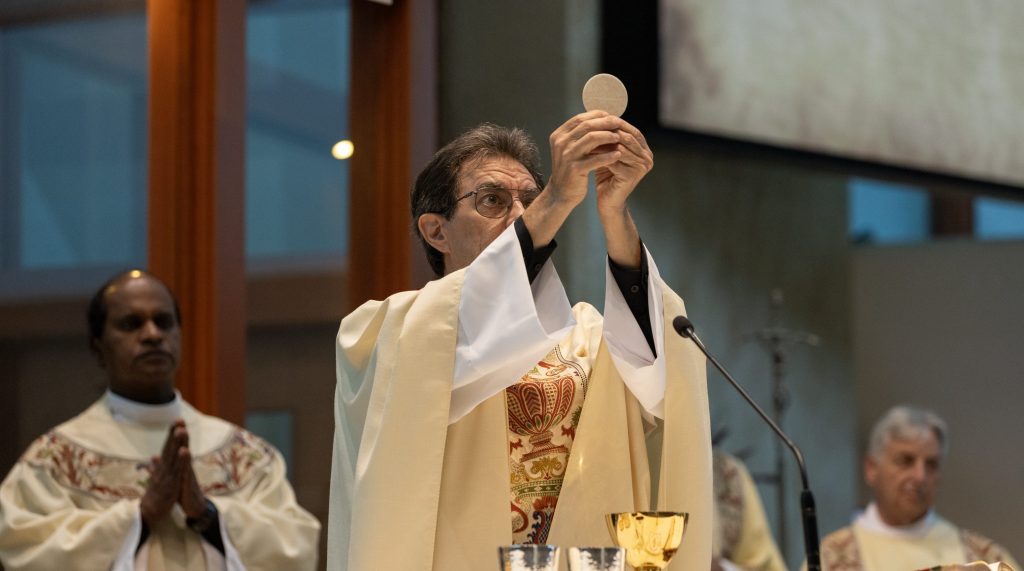
Repent, receive Jesus, and bear him to others.
Return to the LORD is the plea of Hosea. In beautiful and loving language the prophet encourages Israel to come home, to leave the idols and their unfaithfulness behind. God, through Hosea, promises to heal, to love, to be “like dew for Israel.” God does not approve of Israel’s unfaithfulness, while at the same time, does not stop loving his children. With gentleness, he seeks to let his grace fall on them like the dewfall, he seeks to wash his children clean, to nourish them and satiate their thirst, to give them strength, and be the source of their life.
Jesus has come to give a visible face to the presence and promise of our God’s loving presence. He healed, cast out demons, consoled, and preached with authority. He too, in the prophetic tradition, called for repentance. Even though God never stops loving us, we cut ourselves off from his love when we choose anything and anyone over him. God must be first and we must spend time with him to grow in our relationship with him. The wonderful gift of our repentance and letting go of our control is that which is not of God is burned away like dross, and what we give to God is purified and made whole.
By trusting in and surrendering our lives to Jesus, we will heal and grow in our relationship with him, and we too like the Apostles will be sent. Jesus calls us to share the Good News of how he has been working in our lives. Not when we become perfect, but right now, even in small ways. As we receive the love of Jesus, we are to share his love with one another. We too, like Hosea, Jesus, and the Apostles will face opposition in sharing his good news. Jesus has assured us that he will send the Holy Spirit to guide us and give us the words to speak.
When we speak the words of God faithfully, that is sufficient. We are not to convince or command, but instruct and invite. As St. Bernadette of Soubirous said when pressured about the validity of her experience with our Mother Mary, “My job is to inform, not convince.” We do well to follow her lead. The Holy Spirit will work through the seeds we have planted. Let us avoid the temptation to impress and instead express the love we have received.
Jesus continually gives himself to us in the Eucharist. When we leave our sins and shortcomings in the confessional and before altar and receive Jesus, his Body and Blood, Soul and Divinity, we receive and become Christ bearers to a weary and worn world in need of repentance and hungering to experience the gentle love and forgiveness of God our Father.
Photo: First Mass of Thanksgiving at St. Peter Catholic Church. So blessed and feeling thankful to be able to share Jesus in the holy sacrifice of the Mass!!!

Confession – Intimate and healing encounter with Jesus.
“So they went off and preached repentance” (Mark 6:12).
They, being the Twelve Apostles, preached repentance. There is a pattern. John the Baptist called people to a baptism of repentance. The first words of Jesus’ public ministry were, “This is the time of fulfillment. The kingdom of heaven is at hand. Repent and believe in the Gospel” (Mark 1:15). And now in today’s Gospel, the Twelve are going off two by two preaching repentance.
What does repentance have to do with us almost two thousand years later? What repentance had to do then. We all have in the deepest part of us a yearning to belong, to be part of, to be loved. We want to be seen, heard, and understood. We want our lives to have meaning, fulfillment, and a sense of worth and dignity. This deepest longing has been placed in us to be filled by God and as we receive and abide in God’s love, we are better able to encounter and share his love with each other.
The problem is that since the Fall, we all fall short of the glory of God. The good news is that we have not been totally corrupted. We are still good. Even though we have intentionally and consciously chosen to turn away from God and seek to feed our deepest longings with something or someone other than God. We can change. We can come to realize that who and whatever we place before the Father separates us from a deeper and more intimate communion with him.
We can realize that when we sin, we turn away from God, isolate ourselves from God, and feel the loneliness of that choice. This worsens when we decide that we don’t need God, that we are self-sufficient, and can take care of ourselves. Our hunger grows and is unsatisfied by the finite ways we try to fill our infinite hunger. The answer then is to slow down, be still, and listen to the invitation of God that he constantly offers and then to decide to repent, to turn back to him, to change our heart and mind.
What we see in the path blazed by John the Baptist, Jesus, and then his Apostles are the seeds of the Sacrament of Confession which Jesus will institute with the Twelve in the upper room after his Resurrection. Jesus has experienced the loneliness of the separation that we all feel in our sinful state. Only he felt it much more intimately and profoundly as he received the full assault of the weight of all our sin on the Cross. And what did Jesus do when he met the same Twelve who betrayed him? He forgave them and called them to forgive others in his name.
Jesus instituted the Sacrament of Confession to help provide the healing we need to repent and to turn back to the Father. He gave this gift to the Apostles who then passed it on to their followers, and who then successively passed this gift on through each generation of priests to our present day. Confession is a grace, a bridge that leads back to the Father that keeps on giving for those who come to receive this miracle of healing. “Confession is the personal gift of redemption, always unique, to each person, just as each person can accept and apply it” (Confession, Adrienne von Speyr, p. 93).
God the Father loves us more than we can imagine, and he wants us to experience his love. Confession is one of the most intimate ways we can experience his love. We are only as sick as our secrets. In Confession, we can bring forth the deepest and darkest of what we have done and what we have failed to do. We don’t need to buy into the lie that we will be abandoned if anyone knew. Instead, Jesus, who was abandoned, does not abandon us. Jesus forgives, loves, heals, frees, and restores us so that we can experience what we have been created for, to be loved by God and to love him and each other in return.
Photo: Rosary walk St. Vincent De Paul Regional Seminary, Boynton Beach, FL.

Repentance frees us from death and brings us life.
“This is the time of fulfillment. The kingdom of God is at hand. Repent and believe in the Gospel” (Mark 1:15).
God, who is beyond time and space, who is infinite, has a plan and a proper time and place to implement his plan. God invites. He does not impose. God invites us to participate in his plan, but he also gives us the freedom to refuse and walk away.
God called Jonah to preach repentance to the people of Nineveh and Jonah refused because he believed that they would repent, and that God would forgive them. Jonah walked in the opposite direction. That did not go so well. The ship embarked upon was caught in a terrible storm and the people threw him overboard to save themselves. Jonah spent three days in the belly of a great fish. While there, he repented to God, agreed to fulfill his vow to do God’s will. The great fish spit him back out on land and in the direction that God wanted him to go in the first place.
Jonah got the point, did as he was called to do, and the whole city was saved from the impending wrath of God. The people were saved because they repented. They turned back to God and away from their sinful ways. Jonah was not happy about it and God gave him another lesson.
Uncomfortable with the heat of the sun, God “provided a gourd plant” which gave Jonah relief. The next morning a worm ate the plant and Jonah was subjected to the hot east wind and the beating of the sun, so complained to God to take his life. God then asked Jonah, “Do you have a right to be angry over the gourd plant” (Jonah 4:9). Jonah said he did and then God pointed out how Jonah was upset over the loss of one gourd plant that came to be in one day and was lost in the next. How much would God mourn the loss of “more than a hundred and twenty thousand persons” (Jonah 4:11)?
God feels the same way about each one of us. He does not want any of us to be lost. He loves us more than we can imagine, more than we can ever mess up or sin, and he does not define us by our worst moments. God also wants us to know that this life that we have is a beautiful gift, but this is not it. All that exists besides God is finite and material and will not last. We are not to hold on too tightly to the things of this world because as St. Paul shared, “For the world in its present form is passing away” (I Corinthians 7:31).
This is not something to be down about because God sent his Son to become the first born of the new creation. He sent him at a particular time a place and Jesus came to let us know that there is something even better awaiting us – eternal life with his Father.
How do we get to share this wonderful gift? We do what Jonah and Saul who became Paul did. We follow the invitation of Jesus that I started this homily with. “This is the time of fulfillment. The kingdom of God is at hand. Repent and believe in the Gospel” (Mark 1:15).
This is the time. God dwells in the eternal present. This moment is the time for us to recognize that Jesus is with us. He is the kingdom of God present in our midst, in my typing and your reading these words. We just need to make a choice, are we going to refuse his invitation and walk away or accept his invitation to repent and surrender our lives to him?
To repent means to turn back, to reorient, to realign our lives to the will of God our loving Father. When we do so we are no longer alone. God who has always been present with us is accessible because Jesus gave his life that we might have life and have access to his Father. When we decide to turn back to him, we will experience and receive his help and enter into and continue to develop a relationship with him. Turning back to God does not mean our lives will become perfect or that our struggles, trials, and traumas will just evaporate. Turning back to God does mean that we will have his help, strength, guidance, and support.
Repentance is a lifelong journey of allowing Jesus to reveal to us that which we need to let go of, that we have placed before God, or put first instead of God, and have the humility to begin to let go. As we begin to let go, Jesus will reveal more to let go. Step by step, choice by choice, we will become less, and Jesus will become more in our lives. As we become more consistent in choosing each day and each present moment to say, “Yes,” to the will of God, we will grow closer to him and experience more joy, peace, and love in our lives.
Photo: Step by step, Jesus will guide us through this life and into heaven. My view coming back from my Rosary walk each night, St. Vincent de Paul Regional Seminary, Boynton Beach, FL.
 Spiritual Stepping Stones