God is inviting us to experience some silent moments to pray.

And when he had taken leave of them, he went off to the mountain to pray (Mk 6:46). We often read in the Gospels that Jesus went off by himself to pray. I am sure this was not a practice that he just began during his public ministry, but one that he learned and developed from Mary and Joseph. The Apostles themselves witnessed Jesus praying, and how God was primary in his life.

Pope Leo during a Sunday homily on July 20, 2025 shared, “Our relationship with God comes first… we should set aside moments of silence, moments of prayer, times in which, quieting noise and distractions, we recollect ourselves before God in simplicity of heart. This is a dimension of the Christian life that we particularly need to recover today, both as a value for individuals and communities, and as a prophetic sign for our times. We must make room for silence, for listening to the Father who speaks and ‘sees in secret’” (Mt 6:6).

Jesus prayed, he taught his Apostles to pray, and we are at our best when we are people of prayer. We become people who pray when we are willing to make friends with silence. When we show up intentionally to spend time with God, our lives begin to change. That we even desire to pray, that we even want to be closer to God, is already a prayer because we are experiencing an invitation from God to draw close to him, to develop a relationship with him, to come to know the one who knows us better than we know our self.

Fr. William Barry in his book, God and You, describes how prayer is becoming consciously aware of our relationship with God. “God is in relationship with each and every created thing in the universe and in relationship to the whole of it… whether that being is aware of the relationship or not.” The amazing thing about God is that “he will not force himself on us. He continually tries to arouse our awareness and interest in him” (Barry 1987, 12-13).

God reaches out to us in so many ways such as a majestic sunrise or sunset, the ebb and flow of the waves on a beach, and the brilliant radiance of a starlit sky. He also does so through our trials of sickness, pain, others who are being hurt, or encountering injustice. He is also present through our every day relationships and experiences. The key is to be aware of what is being stirred up within us when we experience something and allow ourselves to “wonder about the experience and its meaning” (Barry, 13).

What is most important regarding becoming people of prayer is our awareness, our becoming conscious that we have a relationship with God who is not an idea but a person. “This relationship is based on God’s actions to establish it and his desire that we become conscious of who he is and wants to be for us. Our consciousness depends on our willingness to pay attention to God’s actions, or at least to experiences that might be actions of God, and to let our desires for God be aroused” (Barry, 14).

Another question that Fr. Barry answers regarding prayer is that if God knows everything about us, why bother to pray at all? God is not just wanting information. Again, he is inviting us to enter into a relationship. He wants to know whether we believe he cares how we feel and whether we are willing to let him in, to let him know what we feel and desire. It is important to be honest in our dialogue and be willing to reveal ourselves to God, while at the same time, be open and willing to allow him to reveal himself to us. This is how we build authentic relationships with God and each other (cf. Barry, 15).

Jesus, thank you for inviting us in so many small ways each day to spend time with you. Though we can allow our harried pace, distractions, diversions, temptations, and/or pain to lead us away from the gift of your presence, please help us to slow down, to breathe, rest, and abide in the wonder of how our God and Father is present, and how the love of the Holy Spirit is working in our lives daily. Help us to realize that we don’t need to be perfect to come to you, to say the right words to be heard by you, nor that we have to say any word at all, and help us to be free to show up, rest in your loving gaze, and be with you and go from there.

——————————————————————–

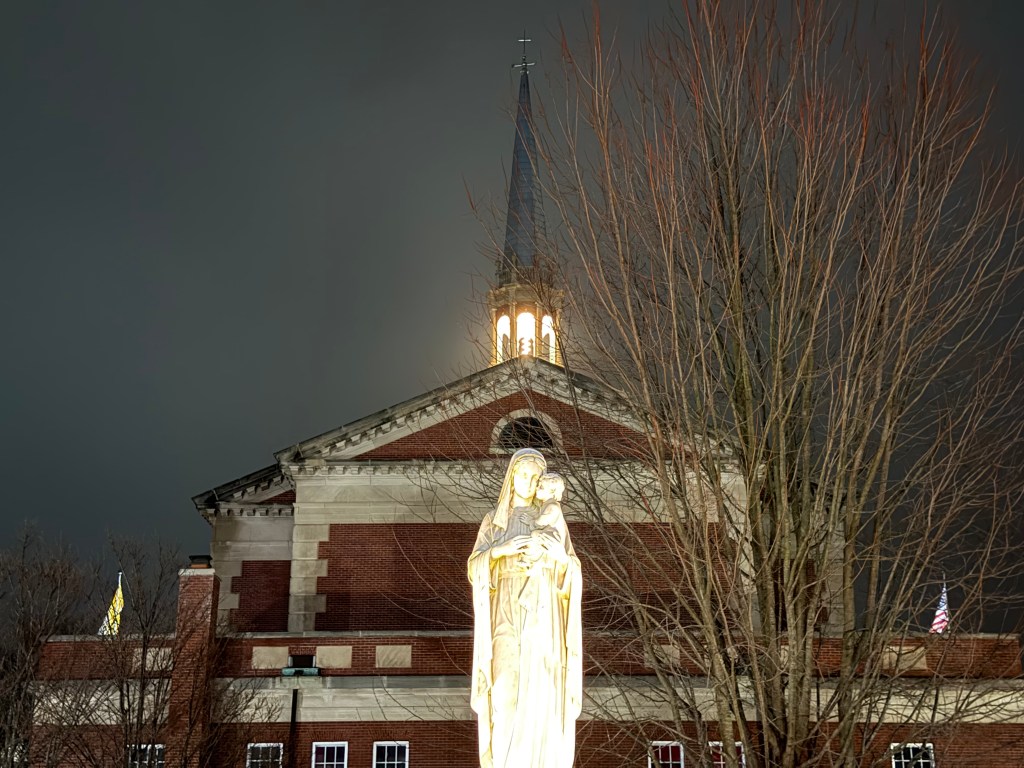
Photo: Moments when we are touched by beauty and stop, are accepted invitations to pray.

Barry, William A. S.J. God and You: Prayer as a Personal Relationship by William Barry SJ. New York: Paulist Press, 1987.

Link for the Mass readings for Wednesday, January 7, 2025

When we take the time to be still, we will see and believe.

Jesus Christ is born for us. Jesus Christ dies for us. Jesus Christ conquers death and rises again for us. Because of our place in time, December 27, 2025 AD – Anno Domini, In the year of our Lord, we are capable of experiencing his life, suffering, death, Resurrection, and Ascension into Heaven. The important question we need to answer is, “Does this new fact, this new reality in human history, make a real difference in our lives?”

Christmas did not end two days ago. We are still in the Octave of Christmas. The Church celebrates two octaves in the Church liturgical calendars, Christmas and Easter. These eight days are celebrated to impress on us the solemnity of the event of remembrance. From the vigil celebration of Christmas Eve on December 24 to January 1, the Solemnity of Mary the Mother of God, we celebrate the significant event of the Incarnation, the Son of God, the second Person of the Trinity, becoming one with us in human history.

“And the Word became flesh and made his dwelling among us” (John 1:14). The Masses celebrated within the Octave of Christmas, as well as the readings of Evening Prayer in the Liturgy of the Hours, reflect the celebration of Christmas Day each day for the eight days. It is like having a week-long birthday party. More importantly, we are invited to meditate and ponder this wonderful gift, that God has come close to dwell among us.

If we are solely focused on gifts, the returning of gifts, and celebrations apart from the celebration of Jesus’ birth; if we are removed from the liturgical cycle and rhythm of the Church, it is easy to fall into the daily harried pace again and post-Christmas blues may creep in because it can feel like everything is done but the returning of gifts and getting a good after Christmas deal. Christmas music has been alive and well on many radio channels for weeks, but at some point on Christmas Day and often the following day, they stop. They stop at the time when they ought to begin!

The material and finite, no matter how wonderful, even our closest relationships, will never satisfy our deepest hunger and thirst. If you are experiencing any post-Christmas blues, today is a great opportunity to let go of the material for a bit and enter into the gift of silence, and to spend some time meditating and contemplating on who will satisfy our deepest longing. The greatest gift that we have been given, we began to celebrate again two days ago.

The Son of God changed human history through his conception and birth and we are invited to participate in God’s great theodrama of human transformation. Today’s Gospel reading is a fast forward from this birth we are celebrating and the gift that keeps on giving, the reality of the purpose of the incarnation.

Jesus was born to die. He obeyed and trusted his Father at every stage of his life, even in the garden and on the cross. He died and experienced our greatest fear: death. That Mary, Peter, and John, “saw the burial cloths there, and the cloth that had covered his head, not with the burial cloths but rolled up in a separate place” was not just a random detail. Grave robbers would not have taken his body without the cloths of the corpse. When Lazarus was called out of his tomb, he shuffled out still tied in his burial cloths and his head still covered. Lazarus was resuscitated but would die again. “Something radically different has happened to Jesus” (Martin and Wright, 333).

The Holy Spirt overshadowed Mary at Jesus’ conception, helped Jesus conquer death and rise again, and through the Holy Spirit again, Jesus is made present through the priest at each celebration of the Mass. Mary Magdalene was the first to experience the empty tomb and shared this good news with the apostles. Peter and John ran to see. John arrived first. John remained outside, possibly out of respect, to allow Peter to go first. Peter saw the empty tomb except for the burial clothes. When John entered, “he saw and believed” (Jn 20:8).

Are we willing to take the time to ponder as John did? To pause and to be still. To allow God to speak to us in the silence of our hearts? John, Mary, and Peter’s lives were changed and transformed because they encountered Jesus, and no matter the challenge, gave their lives to him. We are invited to do the same. We were created to be in relationship with Jesus and our hearts will be restless until we allow ourselves to slow down, embrace the gift of silence, be led by the Holy Spirit, and so that in his presence in the Eucharist, we too may experience him, see, and believe.

————————————————————–

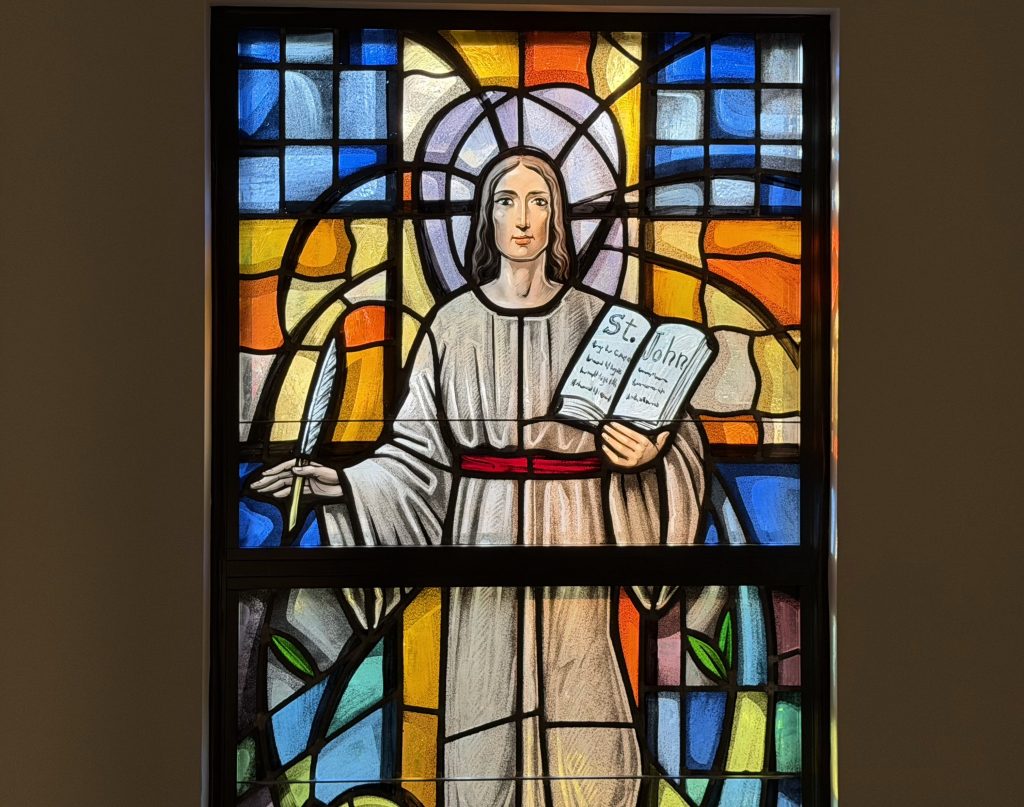
Painting: St. John stained glass window from Holy Cross CC, Vero Beach, FL

Link for the Mass readings for Saturday, December 27, 2025

A prayerful pause can make a big difference.

“I have great sorrow and constant anguish in my heart” (Romans 9:2). Paul is sharing his great pain because his own people are rejecting the gospel of Jesus. Paul can certainly relate because he not only rejected but persecuted anyone who followed Jesus, the person he came to believe is truly the Messiah.

Jesus also experiences the same aguish as he is meeting yet again opposition as he heals a man with dropsy, a condition in which some part of his body was suffering with swelling. Instead of recognizing and rejoicing in the healing just witnessed, the people judge Jesus for healing on the sabbath.

In response, Jesus points out the obvious by asking, “Who among you, if your son or ox falls into a cistern, would not immediately pull him out on the sabbath day” (Luke 14:5)? No answer but crickets… Jesus, as he often does, builds his case from the lesser to the greater. Just as he did with the parable of the unjust judge who made a just verdict, and an unwilling neighbor gave bread to his persistent friend in the middle of the night, how much more will God provide for his children? He wants all of us to be saved. The healings of Jesus are invitations to the ultimate healing we all seek which is the restoration and reconciliation of our relationship with God.

We need to be careful that we don’t fall into the tunnel vision of some of the scribes and the Pharisees by limiting Jesus in our own lives because we are choosing our fears, insecurities, or doubts over his guidance. I have done both. I have resisted, chosen not to act, beaten myself up over it (which does not work because we are still focused on ourselves and not Jesus), and prayed to improve the next time. I have followed without hesitation. I have also hesitated and then acted. Each time I was willing to risk and follow Jesus, I have experienced his consolation and our relationship has grown stronger.

I invite you to listen to Jesus today and ponder where he might be leading you and in what way to act regarding yourself or another who may be in need of healing. Grant yourself a quiet moment to examine where you may be resisting his invitation no matter how small, trust him, and take the risk to love. With each thought we entertain, choice we make, word we speak, may each go through the filter of the Holy Sprit. Ask, God is this what you want me to think, choose, or say? If yes, go forward. Instead of a knee-jerk reaction, let us give ourselves a prayerful pause with the Lord.


Photo: There are some great views we receive when we stop and look up with a prayerful pause!

Link for the Mass readings for Friday, October 31, 2025

“Souls of prayer are souls of great silence.”

“Are not five sparrows sold for two small coins? Yet not one of them has escaped the notice of God. Even the hairs of your head have all been counted. Do not be afraid. You are worth more than many sparrows” (Lk 12:6-7).

Some thirty-five plus years ago I was in high school and either in my junior or senior sociology or psychology class, my teacher mentioned that if we thought Stephen King told amazing tales, we ought to definitely read the Bible. He keyed in especially on the imagery expressed in the Book of Revelation. My teacher’s comment piqued my interest because at the time I enjoyed reading Stephen King, though I had not spent any time reading the Bible.

My teacher’s words stayed with me beyond that class period. A few weeks or months later I remember going to Waldens, a bookstore, at the Enfield Mall in the next town over from where I grew up in East Windsor, Connecticut. I purchased a King James Bible. I don’t remember reading it right away, but shortly sometime after, I do remember leaving a party. I don’t remember anything about the party or why I left, but when I arrived home, I remember going up to my room and for some reason grasping my new Bible. I then opened it at random and began reading. The verse above was what I read, and it was the first time I can remember experiencing God speaking to me.

It was not a booming voice emanating from the burning bush that was directed to Moses, the room didn’t shake, nor did the lights flicker. Yet, in that quiet and still moment, I heard in my mind, “You will not ever win the lottery, but like the sparrows, I will take care of you. I will always give you the ability and means to work.” God has proven true to his word. I have not won the Mega Millions, Lotto, or the Power Ball here in Florida. It is also true that you can’t win if you don’t play and I haven’t. I won’t because God has provided me with the opportunity to have regular, gainful employment and even though experiencing some tight financial times through the years, God has provided beyond work through the kindness of friends, families, as well as some amazing assistance outside of the norm at times.

Does God still speak to us as he spoke to the people in the Bible? Absolutely! God speaks to us directly, through his written word in our personal reading, in our time of communal worship, and when we listen to homilies. He also speaks to us through the sacraments, music, art, movies, through others, through our serving each other, through his creation, and a myriad of other infinite possibilities.

The question is not so much, does God still speak to us? The question is why don’t we hear him? One way is to ask God to help us to recognize his voice. So we can be like the sheep that come to learn the shepherd’s voice. Another way is to stop and be still for set periods of time each day. Doing so gives us the opportunity for reflection, to ask God to reveal times in the past where he has spoken and we were not aware. When we examine and reflect on our day, with God’s help, we can look back and see where God has been with us and reached out to us.

Not only do we need to make a consistent time each day to pray but we need to stay long enough to listen! Some reasons we may not hear God is because we feel we are too busy to pray, and if we do pray, we are doing or talking, not listening, and not allowing God to do. We also may not make the time to be still long enough to hear. God’s silence is also a profound answer and silence is often his language. Just like learning any new language we only become fluent the more we immerse ourselves in the language. Are we willing to be open and believe that God speaks to us? Are we willing to spend time daily in silence and learn God’s language?

St. Mother Teresa of Calcutta was, and she learned from her own experience that: “In the silence of the heart God speaks. If you face God in prayer and silence, God will speak to you. Then you will know that you are nothing. It is only when you realize your nothingness, your emptiness, that God can fill you with Himself. Souls of prayer are souls of great silence.”

God knows us better than we know ourselves and loves us more than we can ever imagine. We can trust God and believe that any time spent with him will be to our benefit. Our Loving God and Father cares for and provides for us as he does the sparrows. Are we willing to answer his invitation to spend time with him and to listen for his word or his silence? God is not telling us to get up and do something. He is inviting us to be still and let him do something!


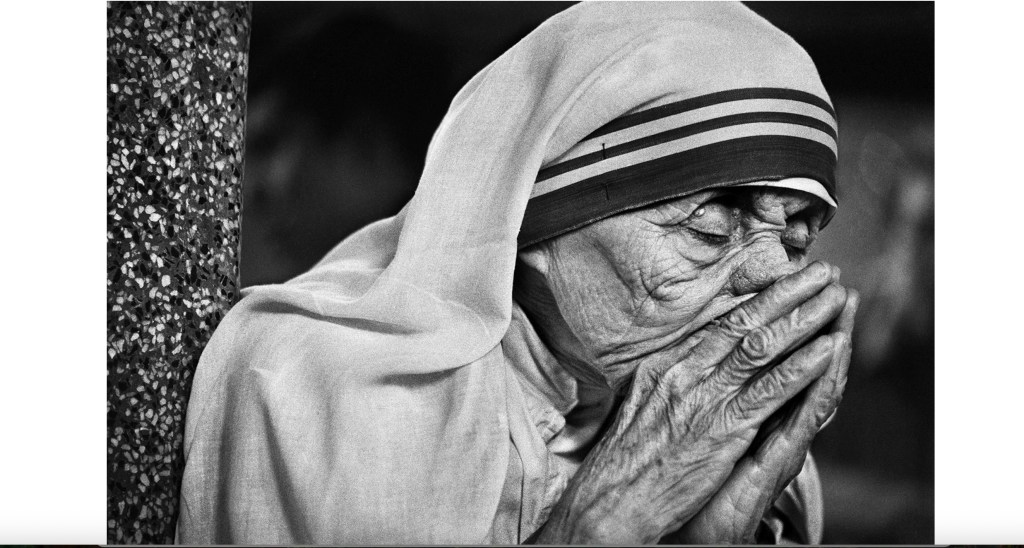
Photo: St. Mother Teresa at prayer in Kolkata, 1995, taken by Raghu Rai.

Link for the Mass readings for Friday, October 17, 2025

Spending consistent time alone with God will help us to get to know Him.

Jesus departed to the mountain to pray, and he spent the night in prayer to God (Lk 6:12).

In the midst of a busy ministry, Jesus spent time alone with God in prayer. In Luke’s Gospel, Jesus often did so before making important decisions, as in today’s reading that recorded the choosing of his Apostles. Prayer is an important, foundational principle to experiencing and knowing God as well as discerning his will for living a fully human life.

The Mystery of God is not a problem to be solved. In our language today, we often use mystery and problem interchangeably, as, “I lost my keys, it is such a mystery.” Strictly speaking, the loss of keys is a problem that can be solved. We can backtrack our steps, and through a process of elimination, the problem becomes smaller until we solve the whereabouts of the missing keys. We cannot solve or prove God exists as if he is a problem to be solved. This is because God is not a being, not even the supreme being. God is a mystery that transcends any finite dimension of reality. We have nothing to measure him by, no point of reference, we cannot prove his existence, nor can we solve him as we would a problem.

God is so beyond our finite minds, and yet, we can come to know God intimately. Even though he is transcendent, beyond our reach and comprehension, Augustine let us know that he is at the same time closer to us than we are to ourselves. We are only capable of knowing God because he created us with the capacity to do so. We come to know God through his invitation, and as we enter into the mystery of his reality through developing a relationship with him, we come to know him.

God does not become smaller because he is infinite, always beyond. His mystery is luminous as if we were in a completely dark room and someone turned on and shined a flashlight into our eyes. We wince from its brightness, yet in time, our eyes adjust and we eventually are able to see what was beyond our ability apart from the light. Jesus wants us to experience and embrace the mystery of the radiance and warmth of his Father’s light and love.

Jesus called each apostle by name. He calls us by name too and invites us to pray with him as he prayed when he walked this earth. Prayer is the most important thing that we can do every day and our prayer begins to mature when we move away from only saying words and directing those words toward a Person. We move away from knowing about God, having an idea, philosophical or theological approach with God, and come to sit with him.

Why not pray everyday and often? One reason is because the devil and his minions know how important and imperative praying is. Praying with God and coming to know him is the last thing the enemy wants us to do and he will distract, divert, tempt, and lead us to do anything but pray. If we resist and make the time for prayer, he will tempt us to keep our time of prayer superficial, speaking words, but not directing them to a Person or quieting our minds and allowing ourselves to be still and listen to God’s voice.

“To know God as the person He really is, it requires being alone with Him frequently. Without actual time spent with God, there is a danger that we will never come to know Him as his own person” (Sattler, 28). St. Mother Teresa also encouraged her sisters in the same way asking, “Do you really know the living Jesus, not through books, but by being with him in your heart” (Sattler, 20)?

Sometimes we resist being still and quiet with God because our minds are so full of everything but God, maybe because we are afraid of aspects of ourselves that we would rather not see or admit. God sees the fullness of who we are and loves us there. He wants to help, but will not do so uninvited. Our relationship with Jesus grows when we invite him into our pain, our sins, and our fears, as well as our aspirations and our dreams.

Be not afraid to make friends with silence. In the silence, we will face our mental maelstroms, yet as we breathe more intentionally and call on Jesus’ name, we will begin to feel safer, slow down, and our minds will begin to quiet. Then we can begin an honest conversation with God, speaking and listening, sharing the good, the bad, and the ugly, and allowing God to love us there. That is when our prayer begins.

————————————

Photo: Evening walk with Jesus

Sattler, Fr. Wayne. Remain in Me and I in You: Relating to God as a Person not an Idea. Manchester, NH: Sophia Institute, 2025.

Link for the Mass readings for Tuesday, September 9, 2025

When we make time to be silent, we will receive the greatest of treasures.

Jesus said to his disciples: “The Kingdom of heaven is like a treasure buried in a field, which a person finds and hides again, and out of joy goes and sells all that he has and buys that field” (Mt 13:44).

God is hiding in plain sight, in our midst, and present to all of us. God’s kingdom is a wonderful treasure just waiting to be found. God’s eternal love and grace is ever reaching out to us. Our soul hungers, yearns, and seeks for that love, whether we know it or not. It is when we seek satisfaction, filling this deepest of our desires in material and finite pursuits alone, that we miss what is present right before us. When we sin, create idols, seek the allure of apparent goods, we block our access to the very union we seek, then we are not satisfied and our desire increases all the more. We can attempt to keep filling that hunger with more or different apparent and material goods and yet, we will continue to feel empty and unfulfilled. God acts in the everyday events of our lives, but we limit being aware of those experiences by waving them off as mere coincidences. Each time we do so, we miss the opportunity the great treasure Jesus offers.

The saints and the mystics are those who have found this great treasure, they have experienced his love, forgiveness, and mercy. They have encountered the living God in the mundane events of their lives and given all to be immersed in his communion. They “are amplifiers of every person’s more hidden life of faith, hope, and love. Their lives help us to hear the interior whispers and see the faint flickers of divine truth and love in ourselves and others. The Christian mystics point the way to fully authentic human life by illustrating what it means to be a human being, what life means: eternal union (which begins here) with the God of love” (Egan 1996, ix-xx).

Like metal detectors that some people walk the beaches with to find a hidden treasure, the Holy Spirit invites us to enter into silence. It is in silence that we will find our truest gift, God who yearns to speak to us in the silence of our hearts. Setting aside time to be still will help us to hear his whisperings in those moments of silence and when we hear and follow through on his promptings, we will begin to hear him in our daily activities.

Opening our hearts and minds to recognize those faint stirrings will help us to recognize God’s ongoing presence. We can also experience Christ by reading, meditating, praying, and contemplating on his Word, as well as the lives of the saints, who are willing to offer us their treasure maps: St Francis of Assisi, St Teresa of Avila, St John of the Cross, St Therese of Lisieux, St. Ignatius of Loyola, and St Mother Teresa. Each have experienced and are urging us on to experience the rich encounter of the God of Jesus Christ.

In spending time regularly in silence with the Holy Spirit, we encounter and receive the love of God and come to realize that we are not human doings but human beings. We can let go of the weight of the stress and strain we have been carrying, of having to process anything, and instead be still and rest in God’s loving embrace. St. Theresa of Avila wrote that, “We always hear about what a good thing prayer is; our constitutions oblige us to spend many hours in prayer. Yet, only what we ourselves can do in prayer is explained to us; little is explained about what the Lord does in a soul, I mean about the supernatural” (Sattler, 135). Spend some time today allowing God to do – so that you can be!

———————————————————————–

Photo: Came upon this family during an evening Rosary walk on the campus of St. Mary of the Lake.

Egan, Harvey D. An Anthology of Christian Mysticism, Second Edition. Collegeville, MN: Liturgical Press, 1996.

Sattler, Wayne. And You Will Find Rest. What God Does in Prayer. Manchester, NH: Sophia Institute, 2024.

Link for the Mass Readings for, Wednesday, July 28, 2021

Slowing down will help us to be one as Jesus and his Father are one.

“Holy Father, keep them in your name that you have given me, so that they may be one just as we are one” (Jn 17:11).

Jesus is well aware of the temptations of the world, recognizes that the disciples will need the protection of his intercession, that they will remain faithful only if they remain in his love and in relationship with him. The unity that the Father and Son share is an eternal and infinite communion. Jesus, as the Son of God, continued to be one with his Father, while fully experiencing his humanity. As a human being, Jesus faced the same temptations present in this world that we face. The difference is that with each choice that he made, as a human being with a free human will, he chose to be faithful to his Father at each and every opportunity, and so his unity of his humanity remained intact and deepened.

Jesus sought the same unity that he shares with his Father for his disciples and he seeks the same for us today. His hope is that we may be one as he and the Father are one. Yet, he is not going to pull us out of the world for that to happen. “I do not ask that you take them out of the world but that you keep them from the Evil One” (Jn 17:15). The disciples then and us today, are to do as Jesus did. We are to welcome the invitation to be in a relationship  with God, come to know his will, and share it with those we encounter in our realm of influence. We are not to be transformed by the world, but we are to allow God to transform us by the renewal of our minds and hearts. As we do so, we can also bring Jesus’ light into the darkness as God works through us one person at a time.

Following the will of God is not easy. Many distractions, diversions, and temptations pull at us and attempt to draw us away from being faithful and true to God, ourselves, and who God calls us to be. Many times these distractions not only appear to be, but are good. The challenge is not whether we are good or evil, we are being good or doing good, but are we doing God’s will, are we doing what God is calling us to do?

Being able to stop, be still, quiet our mind, and just breathe for a sustained period of time can help us to learn to recollect. Often when we attempt to spend time in prayer, we finish at the moment we are really just getting ready to begin and wonder why nothing is happening! Making time to recollect grants us the opportunity to transition from the busy to making friends with silence.

We can deepen our relationship with Jesus and his Father when we slow down our pace, become still within, because we are better able to hear his voice. We are also in a better place to receive the gifts that the Holy Spirit seeks to impart, his guidance to discern his direction, as well as the courage to follow his will. If any fear or anxiety arises, we just need to remind ourselves to trust that God will provide the means and support we need, for we are not meant to do what he calls us to do on our own.

St. Mother Teresa taught that, “in the silence of the heart, God speaks.” We are better able to recognize God’s voice and the people he places in our lives to help us when we embrace consistent moments of stillness. We are better able to identify the temptations and pitfalls along path when we go slower. We grow in discipline, persistence, and dedication when we allow ourselves to be nourished by God’s love and encouragement. When we are willing to change, to be transformed, to grow, and take the risk to trust in Jesus, we, like the disciples, will experience the love and oneness Jesus and his Father seek to share with us.

————————————————————————–

Photo: Meditating on the Glorious Mysteries (back in April before the newest renovations).

Link for the Mass for Wednesday, June 4, 2025

May we, with John, contemplate the true gift we have received.

Jesus Christ is born for us. Jesus Christ dies for us. Jesus Christ conquers death and rises again for us. Because of our place in time, December 27, 2024 AD – Anno Domini, In the year of our Lord, we are capable of experiencing his life, suffering, death, Resurrection, and Ascension into Heaven. The important question we need to answer is, “Does this new fact, this new reality in human history, make a real difference in our lives?”

Christmas did not end two days ago. We are still in the Octave of Christmas. The Church celebrates two octaves in the Church liturgical calendars, Christmas and Easter. These eight days are celebrated as such to impress on us the solemnity of the event of remembrance. From the vigil celebration of Christmas Eve on December 24 to January 1, the Solemnity of Mary the Mother of God, we celebrate the significant event of the Incarnation, the Son of God, the second Person of the Trinity becoming one with us in human history. The Masses celebrated within the Octave of Christmas, as well as the readings of Evening Prayer in the Liturgy of the Hours, reflect the celebration of Christmas Day each day for the eight days. It is like having a week-long birthday party.

If we are solely focused on gifts, the returning of gifts, and celebrations apart from the celebration of Jesus’ birth, if we are removed from the liturgical cycle and rhythm of the Church, it is easy to fall into the post-Christmas blues because it does feel like everything is done but the returning of gifts and getting a good after Christmas deal. Christmas music has been alive and well on many radio channels for weeks, but at some point on Christmas Day and often the following day, they stop. They stop at the time when they ought to begin!

The material and finite, no matter how wonderful, even our closest relationships, will never satisfy our deepest hunger and thirst. If you are experiencing any post-Christmas blues, today is great opportunity to let go of the material for a bit and enter into the gift of silence, and to spend some meditating and contemplating on what will satisfy. The greatest gift that we have been given, we began to celebrate again two days ago. The Son of God changed human history by his conception and birth and we are invited to participate in God’s great theodrama of human transformation. Today’s Gospel reading is a fast forward from this birth we are celebrating and the gift that keeps on giving, the reality of the purpose of the incarnation.

Jesus was born to die, to show the fullest extent of his obedience to his Father. In trusting his Father, Jesus died, experienced our greatest fear of death, and through the power of the Holy Spirt, conquered death and rose again. Mary Magdalene was the first to experience the empty tomb and shared this good news with the apostles. Peter and John ran to see. John arrived first. John remained outside, possibly out of respect, to allow Peter to go in first. Peter saw the empty tomb except for the burial clothes. When John entered, “he saw and believed” (Jn 20:8).

Are we willing to take the time to ponder as John did? To see beyond the merely finite and physical? To be willing to be still. Silent. To allow God to speak to us in the silence of our hearts? John, Mary, and Peter’s lives were changed and transformed because they encountered Jesus and chose not to ignore him or run away, but to give their lives to him. We are invited to do the same. Our hearts were created for this relationship with Jesus and our hearts will be restless until we allow ourselves to slow down, embrace the gift of silence, and allow ourselves to hear him speak in the silence of our hearts that we too may believe.

————————————————————–

Painting: Close up of St. John the Evangelist by Vladimir Borovikovsky

Link for the Mass readings for Friday, December 27, 2024

Each day it is good to take time to rest and renew with Jesus.

Verses that we read, such as: “Come to me, all you who labor and are burdened, and I will give you rest” (Mt 11:28) really hit the spot, they arrive at the right time. I am sure that if you are reading these words you may also welcome Jesus’ invitation. Yet what is the labor and burden that we need to rest from? Teachers, administrators and students, of which I was a part for decades are coming into crunch time now as the end of the quarter or term is coming. Those in other occupations also work long hours, and sometimes, two or three jobs, just to get by.

Many also who oversee and care for their home, others with children, elder parents, family members, and dealing with family issues that can be enormous, especially at this time of year. Add to the above Christmas preparations: decorating, putting up lights, shopping, buying presents, cooking, baking, writing and mailing Christmas cards crushing can also add to feeling weighed down.

Unfortunately, there are way too many who are not so much burdened by work but the lack of access to gainful or meaningful employment. They are burdened with keeping the bills paid and a roof over their heads as the temperatures fall. Some have no home or family, they are burdened with getting from day to day, seeking ways to get food, clean clothes, a place to wash and relieve themselves. Christmas cards are a distant thought. Many others are burdened and living in fear that they or their family member or members may be deported.

Speaking of fear, how many of us are burdened by fear, anxiety, stress, and strain from a myriad of swirling reasons? Concerns about our family, community, country, and the world are a burden that can also weigh heavily. Advent and Christmas, even when life is more stable, are still times in which many buttons can be pressed and many stressors can be triggered. What is the adage that is offered when family and friends gather? Resist talking about politics, religion, and… we all can add a few others.

If you are feeling weary and worn as we draw close to the midway point of this Advent Season, it is a good opportunity to make some time to just stop and take a slow, deliberate breath. Notice your shoulders coming out of your ears. Embrace the invitation of Jesus and rest in him. Allow the burdens to come to mind, then visualize yourself giving them to Jesus, open yourself to his guidance, ask for his help for the day to day challenges, and seek who may be best able to assist you in any particular situation. Slowing down may help us to become more aware of any sins that we feel burdened by. This is a good time to rest and trust in the forgiveness of Jesus and confess to him in the Sacrament of Reconciliation. Jesus will forgive you and bring you a lightness and fresh start!

Our God “does not faint or grow weary, and his knowledge is beyond scrutiny. He gives strength to the fainting; for the weak he makes vigor abound” (Isaiah 40:28-29). We do not have to deal with anything alone. We have help and support. My friend, Pastor Jerry Scott, taught me years ago a life lesson which I still return to, more often in my fifties than in my twenties. When a person is chopping down a tree, exerting a lot of energy and effort, but finding the results insufficient, he or she needs to realize that they need to step back, take a breath, and sharpen their ax. With a little rest, renewal, and a sharpened blade, the job can be accomplished in half the time.

Let’s figuratively do the same daily with each of our endeavors. Let’s resist just putting our heads down and plowing through with blinders on and instead take some time to stop and assess from time to time what we need, where we need help, and yoke ourselves to Jesus for his guidance and strength. As Jesus carries the burden with us, as we follow his will, we can work smarter instead of harder. In developing a pattern and place of trust and hope in him, seeking his guidance and direction this Advent, we will renew our strength and soar as with eagle’s wings; we will run and not grow weary, we walk and not grow faint (cf. Isaiah 40:31)!


Photo: From 30 Day silent retreat I did in July 2023. Still seek each day some time to plant a few seeds of silence.

Link for the Mass readings for Wednesday, December 11, 2024

What might help us to grow closer to God? Some silence.

Jesus appointed seventy-two other disciples and said to them, “Go on your way; behold, I am sending you like lambs among wolves. Carry no money bag, no sack, no sandals”(Lk 10:3-4).

The opening of today’s Gospel continues the same theme of the past few days and that is the call of a radical dependence on God. Jesus sent his disciples out with no money, no credit cards, no sack, no luggage, no sandals, no Crocs. They were to rely solely on divine providence. They were taught by Jesus to believe and trust in the Father, and now they would put both to the test.

How well could we fare today? Are we even willing to leave the house or go to the next room without our cell phones?

Jesus meets us and accepts as we are and where we are but calls us to go deeper, to invite us to expand beyond our present understanding and practices. We may say to ourselves that we are not capable of being a great saint like the Apostles, but that would miss the point of who a saint is. A saint is not necessarily one who sought to be great but one who was willing to surrender all to God, and most doing so, step by step. They accepted and put into practice what God invited them to do.

We are given the same invitation that the saints have received but we may still be allowing ourselves to be lured away by distractions, diversions, demands, material enticements, and emotional twists and turns. It is good to assess often, if not daily, where and how we expend our energy and time. How much of what we are thinking about and spending our time doing is aligned with God’s will? The material things we have accumulated, are there things we can let go of? What we have, what we think, and how we spend our time, is good to discern and be more intentional about.

If you might feeling a bit overwhelmed or may be doing ok but feeling like you would like to have some more time with God, St. Mother Teresa offers us some good advice. “God speaks in the silence of the heart.” Making some time for silence is a good place to start. Find a comfortable place to sit, take some deep slow breaths, and then ask God to reveal to you what he would like you to bring into your life and by doing so what you would need to let go of to make the space. Who better to guide us than the one who gave and continues to sustain our life?

————————————-

Photo: A quiet moment at the end of my Rosary walk

Mass readings for Thursday, October 3, 2024