We can choose reaction and revenge or understanding and forgiveness.

“Lord, do you want us to call down fire from heaven to consume them?” Jesus turned and rebuked them, and they journeyed to another village (Lk 9:54-56).

James and John’s request of Jesus ought to be recognizable to many, if not all of us. How many times when feeling slighted or disrespected do we want to act in kind or offer some retribution to our perceived offender? Many times, we don’t even think, we just react overtly back or we engage in our own tumultuous internal maelstrom.

Jesus rebuked James and John’s request immediately and moved on. He did not allow the rejection of the Samaritans to deter his course for even one second. Jesus had his face firmly set. His time was approaching and to Jerusalem he was headed. Also, he knew there would be a time for the Samaritans to believe. That time was not yet.

Our starting point in putting this gospel into practice is to decide that Jesus has chosen the better course. Seeking revenge is not the way. Not looking left or right, but keeping our eyes fixed on the will of God is the way to proceed. If we can agree with that as our starting point, then we can seek to understand what Jesus can teach us when encountering others.

First, our approach to others extending unkind behavior toward us is to be one of understanding. We are all dealing with a lot, and much of what others are dealing with are unknown to us. If we approach another’s unkind or disrespectful action from a place of understanding instead of seeking revenge, we will have a better chance of not reacting in kind and also possibly being able to help another to get in touch and reveal something they are struggling with. St. Ignatius’ counsel to give the other person the benefit of the doubt is a solid practice.

Often a negative response may come from misunderstandings. In giving the person the benefit of the doubt to explain their understanding of what happened in a given situation, helps to de-escalate the situation instead of adding fuel to the fire . We are not mind-readers and we also are not the best of communicators so resisting jumping to rash conclusions is a better course of action.

Along with being understanding and giving someone the benefit of the doubt, is to receive other’s action with humility. Maybe, we have done something to cause hurt toward another, intentionally or unintentionally. By taking a moment to pause, we can assess if we have done something to instigate the action we are receiving. Taking responsibility for that which we have done and apologizing for it, we create a better bridge for reconciliation.

We are responsible for our thoughts, words, and actions. We cannot dictate or change the behaviors of others nor are we to be doormats for another’s abuse nor take on their stuff either. We are to approach conflicts and obstacles with patience, understanding, a willingness to bring clarity, to give the benefit of the doubt, and humility for acknowledging what we have done and what we have failed to do. If another is not willing to hear reason after multiple attempts or closed, we move on.

We pray for and respect the dignity of the person whether we agree or disagree with the outcome while holding them accountable at the same time. Jesus is very clear that we are to love, meaning that we are to will each other’s good. That means putting the prayer he taught us, the Our Father into practice: We need to be willing to forgive.

None of these steps are easy. Human relationships are difficult in the best of scenarios, but still well worth the effort. None of us are perfect. When we do our best to follow these principles as well as other practices not mentioned to work toward reconciliation and build relationships, our conflicts will become moments of grace. Conflicts will become opportunities that help us to grow closer together rather than further apart. Inviting Jesus into the conflict is the most important step, for he can help us to see others from his infinite perspective instead of our limited perspective.

—————————————————

Photo: Spending time in quiet and prayer, especially in reading the book of God’s creation, helps us to slow down so that when we return to our interactions with people again, we can begin more peacefully.

Link for the Mass readings for Tuesday, September 30, 2025

We can all have more compassion and help to raise each other’s spirit.

When the Lord saw her, he was moved with pity for her and said to her, “Do not weep.” He stepped forward and touched the coffin; at this the bearers halted, and he said, “Young man, I tell you, arise” (Lk 7:13-14).

Jesus’ immediate response to this woman was pity or compassion. The original Greek word used was splanchnizomai, meaning that Jesus was moved from the very depths of his bowels. The emotional depths to which Jesus was moved to reach out and help the widow of Nain, shows us his humanity. Jesus’ healing of the widow’s son, bringing him back from the dead, shows us his divinity. The entire event shows us the best of who we ought to aspire to be as his followers.

Instead of fear, judgment, prejudice, or indifference, may we instead follow the lead of Jesus and seek to understand, to place ourselves in the shoes of the vulnerable, misunderstood, and on the margins. May we start with those we interact with everyday in our families, our school and workplaces, our communities and places of worship. May our hearts, not be hearts of stone, but hearts of flesh so to be moved from the very depths with the same compassion and love of Jesus toward those, who, like the widow, are vulnerable and at risk.

We can all be more welcoming, hospitable, willing to walk with others and to share in their journeys. We can do this simply in our day-to-day interactions. Whenever we encounter another, may we resist that reactions of judgment, prejudice, or indifference that arise and instead be willing to be moved by compassion and concern and be present.

Listening and hearing each other’s stories, needs, and engaging in conversation are helpful in opening up relationships. Taking the time to smile, to listen, to respect one another even when disagree and being willing to work through conflicts, as well as giving others the benefit of the doubt, helps us to build and strengthen relationships.

Jesus looked upon those he interacted with as family. This widow who was weeping as she looked upon the dead body of her son was not a stranger to Jesus, but a sister in pain. Jesus was moved with compassion and immediately came close to help. He met and engaged with each person and treated everyone he came in contact with in the same way, as human beings. This was true with even those he was in conflict with like many of the Pharisees.

Jesus loved and showed people compassion and invited them to be free from that which bound them to their slavery to sin. He came to remind all of us of who and whose we are as his Father’s beloved children. “For whoever does the will of my Father in heaven is my brother, and sister and mother” (Mt 12:50).

JoAnn often prayed for God to reveal to her one person that she could help each day. When we ask, God will guide us and grant us greater awareness regarding those we can help. Our Father will also give us the means to be present and to assist. We may or may not be called to raise the dead, but we can all lift each other’s spirits, have compassion for one another, and see each other more as Jesus sees us, as brothers and sisters, not as somehow less or other, but each with dignity.

Come Holy Spirit, please stretch us beyond our comfort zones, beyond our limitations, and soften our hearts so that we too, like Jesus, may allow ourselves to be moved by compassion. Please help us to regularly and with more intention stop, breathe, and be more patient, understanding, and kind. Help us to love more, and with each person we interact with, to will each other’s good so that each of us are better for having met.

———————————————————-

Painting: “The Resurrection of the Widow’s Son at Nain” by James Tissot, 1890, online collection from the Brooklyn Museum

Link for the Mass readings for Tuesday, September 16, 2025

“…whoever says to his brother, Raqa, will be answerable to the Sanhedrin…”

As was presented yesterday, Jesus made it clear that he did not come to abolish the law or the prophets but he came to fulfill them. In his Sermon on the Mount as recorded by Matthew, Jesus offered practical ways in which we can find fulfillment and happiness. In today’s account, he introduces the first of six antitheses. With these apparent contrasting statements, beginning with, “You have heard that it was said” followed by, “But I say to you”, Jesus provided for his disciples the way to avoid the trap that some of the religious leaders of his time fell into: “I tell you, unless your righteousness surpasses that of the scribes and Pharisees, you will not enter into the Kingdom of heaven” (Mt 5:20).

The scribes and Pharisees that Jesus pointed out were those who believed that they were following the letter of the law, but their hearts were not changed. They may have been adhering to the external provisions of the law, but there was no transformation, their hearts were hardened, they were focused more on their own access to honor and power. They were also imposing strict adherence to the law without providing the support or means for others to achieve what the law imposed. The law became more important than the dignity or value of the person. Jesus recognized the law, but also realized that it was in place to help to provide guidance and discipline so one could better resist the temptations of our fallen nature. The law was to be a foundation to be built upon, not the end goal in and of itself.

Just as children need clear boundaries and structures in place to provide a clear path toward healthy development, this is also true for those of us growing and maturing spiritually. We need to learn to crawl, to build strength and balance before we can take those first wobbly steps. With continued support, we are then able to walk and soon run. Jesus is not only providing the means to go through each of these stages in our faith life, figuratively teaching each of his disciples and us today to not only crawl, walk, and run but to also be able to fly as we seek to reach the heights that Jesus is willing to raise us to!

The Beatitudes and six antitheses are challenging because each one of them goes counter to much of the way the structure of our fallen world has been governed for centuries. If we are to catch the fire that Jesus has come to set, we need not only to read, pray, meditate, and contemplate upon on the teachings of the Sermon on the Mount, we need to also see their relevance and practicality to our time and place today, and begin to put them into practice. As Christians, our faith ought not to be shaped and informed by our culture, but we are to be shaped and conformed by the Gospel of Jesus the Christ, so to shape and inform our culture.

Today we start with the first antithesis: “You have heard that it was said to your ancestors, You shall not kill; and whoever kills will be liable to judgment. But I say to you, whoever is angry with his brother will be liable to judgment, and whoever says to his brother, Raqa, will be answerable to the Sanhedrin, and whoever says, ‘You fool,’ will be liable to fiery Gehenna (Mt 5:21-22). The seeds of anger begin to sprout in our mind from our knee jerk reactions to a perceived or actual threat, from our hearts hardened by prejudgments, prejudices, and/or a reflection of our level of spiritual immaturity.

Jesus addresses the known provision against murder. He then builds a hedge around the Torah. If one does not want to break the law, another is imposed so as to protect one from even getting close to breaking the first. If we can resist the temptation to react and instead step back for a moment, take some deep breaths, pray, and seek the guidance of the Holy Spirit, we will be less likely to criticize, judge, demean or dehumanize another, and then there is much less chance for our anger to grow into wrath, that left unbridled could lead to murdering someone.

Jesus is also saying that our words matter, that they have the power to destroy or to create. Calling someone Raqa, Aramaic for a block-head or idiot, and then calling someone a fool, would “be liable to fiery Gehenna” (Mt 5:22). How much more egregious are we today? How polarized we have become inside and outside of the Church because of the level of demeaning words, tone, and language that is spoken, condoned, and justified? This has a ripple effect that poisons our family, relationships, and spreads to the wider culture, politics, and the Church with growing hateful rhetoric, overt expressions of prejudice, and violence.

Instead of settling for two dimensional caricatures of one another, we can go deeper when we are willing to spend time with and get to know each other. Jesus challenges us to slow down and see the person before us with dignity and respect. When we resist reacting, giving in to our biases, and prejudgments, and instead recognize the value and dignity of each person, we will have a better chance of building relationships. We will also be more apt to reform policies and structures that respect the dignity of each person in the womb, after birth, and at each stage and condition of life until natural death.

May we all take some time today to reflect on Jesus’ teaching about how we think, speak to and about, and act toward one another. May we examine our conscience and seek forgiveness for those times we have thought, condoned, or justified thoughts, words, and/or actions that have been belittling, dehumanizing, and demeaning directly or while with others, we approved by our manner or our silence.

Jesus, please impart within us your infusing power of justice, love, and mercy so that we will be more inspired to live out your teachings in our daily lives. Help us to strive to encounter each other grounded in mutual respect and understanding as our brothers and sisters, no matter our race, ethnicity, creed, and/or gender, and to commit to building a culture of life and dignity for all, not in some abstract utopian way, but in the concrete moments of our everyday experiences, one person and one encounter at a time.

——————————————————————–

Photo: Let us listen to Jesus and do whatever he tells us.

Link for the Mass readings for Thursday, June 12, 2025

May we experience the love of God, so we can know him and each other better.

“Now this is eternal life, that they should know you, the only true God, and the one whom you sent, Jesus Christ” (Jn 17:3).

This is our goal, to know God. Eternal life, or heaven, is not only experienced when we die. Through experiencing the life of Jesus we can have a foretaste of heaven now. We can experience this as the joy that rises up from within, that is not merely pleasure, which is a response from the stimulation of our senses and which dissipates once the experience ends. Nor is joy even happiness which comes from the lasting memories of these pleasurable experiences. The experience of joy is not based on external situations and sensations, joy comes from an encounter with the living God who is present to us, closer to us than we are to ourselves.

We often first experience this joy, this closeness to God when we experience love exchanged between ourselves and another. Even a love that begins in infatuation is a drawing out of ourselves toward another. The hope is that this love matures and develops into a friendship.

This maturation happens when we spend time getting to know each other’s interests, goals, and dreams. We experience another as a person, and with time and continued trust, we begin to risk and allow our masks to be taken off. Inevitably, when relationships begin to mature, they will go through times of miscommunication, misunderstanding, and conflict. The relationship will come to a crossroads, but this does not mean that the relationship will come to an end. If the relationship devolves into abuse, dehumanization, and self-gratification alone, the relationship will end. But if there is a willingness to forgive, to work together, to meet each other with humility and seek mutual understanding, relationships will grow stronger and deeper. This is the fertile soil where love grows.

Our first experience of developing relationships is in our families. None of us are perfect, so none of us have had a perfect family life. Familial relationships develop in a similar fashion as listed above. We all go through ups and downs. The more that we can be present to one another, support one another, communicate and love one another, the more likely our familial relationships and friendships will also mature and grow.

Many of us hope to attain a place within where we can accept and love ourselves and develop mature relationships with a core group of family and friends. Most of us could be quite happy with that. Even as Jesus invites and guides us to reach this point of development, he continues to press us to strive to love beyond family, friends, and tribe. All of us are ultimately called to an unconditional love that sees in others a brother and sister seeking to be better stewards of God’s creation. This is not some utopian philosophy. Love happens through one concrete encounter, one person at a time. As we love God and one another, we lift all of humanity and creation up.

This will not happen through our own will power or discipline alone. Placing self over God and others, isolates and disconnects us from the True, the Good, and the Beautiful. God is not some transcendent, impersonal force, nor is God an omnipotent, tyrannical overlord. The God of Jesus Christ is a God of love, for “God is love, and whoever remains in love remains in God and God in him” (1 John 4:16). Jesus invites us into a relationship with him and his Father to experience the love of the Holy Sprit. When we assent to this invitation, we come to know and experience a foretaste of heaven on earth.

Jesus, please help us to experience the love of God by coming to know you, and in truly knowing you come to better know each other. May we see each other as God our Father sees us, as a unique gift that has never been nor ever will be again. Help us resist reacting to the rough edges and exterior projections of our inner wounds and instead guide us to be more compassionate and understanding, and willing to see the truth and fullness of the potential of each person. Help us to allow God to love others through us today, one person and one encounter at a time.

———————————————————

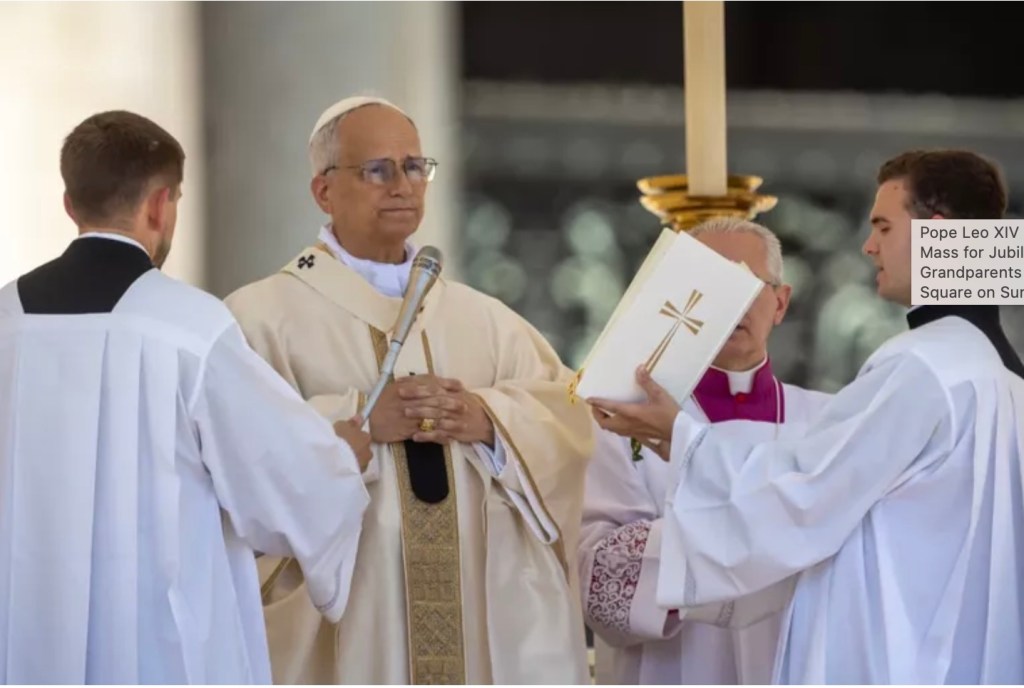
Photo: “The Father does not love us any less than he loves his only-begotten Son. In other words, with an infinite love” – Pope Leo from his Sunday, June 1, 2025 homily. (credit fromDaniel Ibáñez/CNA/ EWTN accessed from ncregister.com).

Link for the Mass readings for Tuesday, June 3, 2025

Tired of division and polarization, how about we practice forgiveness and mercy?

Polarization, division, and finger-pointing continue to seem to be the order of the day on the national level. Unfortunately, it is taking a firmer hold at the community and familial level and within the Church as well. Instead of looking for someone to blame for the cause of this situation, we need to look in the mirror and honestly assess how we are contributing to division instead of seeking to uphold the motto of the United States of America – E Pluribus Unum – Out of Many One; or instead of upholding a motto of our faith – “That they may all be one” (John 17:21).

It is important to take a step back, take a breath or two or three, and examine our conscience and honestly acknowledge how we are contributing to the divisiveness and polarization through our own thoughts, words, and actions. Then we will be in a better position to act instead of react. We can disagree and offer different points of view and seek different approaches to solve problems respectfully when we are willing to engage in dialogue and collaboration instead of forcing or seeking to prove our own point.

A beginning place for us this Lent can be to understand and put into practice what Jesus said in the opening of today’s Gospel:

“Be merciful, just as your Father is merciful” (Lk 6:36)

Mercy, from the Hebrew word chesed, meaning to show tender compassion, can help us to turn the momentum away from disunity and polarization toward respecting the gift of our diversity while at the same time embracing our unity.  Fr. James Keenan, S.J. defines mercy as the willingness to enter into the chaos of another. Instead of imposing our point of view, mercy is the willingness to draw close instead of keep someone at a distance, to come to know instead of prove wrong, and to make a concerted effort to understand instead of prejdudge.

When we aspire to be merciful we seek to hear first and assess thoughtfully what has been said, even when the message conveyed is heated, derogatory, and inflammatory. There may be some truth in the maelstrom of what has been spewed. Jesus also encourages us to stop judging and condemning. We are limited by our own finite natures as it is. We are not God and are not capable of fully reading another person.

In most cases, we do not know another’s struggles, anxieties, fears, traumas, and experiences. When encountering one another we need to resist the knee-jerk reaction to judge, and instead, listen first, allow someone to vent without taking offense, and without seeking a way to “fix” them or a problem.

Jesus also reminds us to forgive. As God forgives us we are also invited to forgive others, to let go of grudges. Not to do so means allowing the poison injected into us to spread instead of seeking the healing antidote of forgiveness. The one who has wounded us has walked away and if we are not willing to forgive we continue to do harm to ourselves as we allow that wound to fester.

It is much easier to stay in our shell or bubble. We feel protected and safe so no one can hurt us, but that is not the posture Jesus would have us assume, for in doing so we remain focused on our self. Staying in our bubble suffocates us, stunts our growth, and limits our potential as human beings created in the image and likeness of God. Jesus calls us, not to cave in upon ourselves, but to go out from ourselves, to be agents of love and mercy.

Each day we have a choice. We can withdraw and remain indifferent seeking to protect ourselves, we can choose to dig in our heals to prove we are right and contribute to disunity and polarization, or we can seek to be merciful and build relationships. We can hear and put into practice Jesus’ teachings to resist the temptation to judge and condemn, and instead seek to understand, listen, and forgive. In our willingness to forgive, we can promote healing and invite others to forgive. Let us choose today to allow the Holy Spirit to expand our hearts and minds that we may become more understanding, forgiving, and merciful just as our heavenly Father is merciful.

——————————————————————————

Image: Blessed to receive a touch of God’s forgiveness and mercy many times while at prayer in St. Vincent de Paul Regional Seminary Chapel.

Link for the Mass readings for Monday, March 17, 2025

A little awareness and an act of kindness can make a huge difference.

In today’s Gospel from Luke, Jesus compares the Kingdom of God to a mustard seed and yeast. Each of these elements is not only small but they are tiny. Though with the proper environment, resources of sustenance, water, and sunlight, this seed will germinate, sprout, and grow into a large bush. Yeast, a single-celled organism, is the catalyst for assisting dough to rise, strengthen, and ferment, thus providing a more appealing and tasty bread.

Jesus offered these simple examples from everyday agrarian life that his listeners understood from experience. If we have planted seeds or made our own homemade bread, we too are in a better position to relate to these two small parables as well.

Throughout the Gospels, Jesus lives out the parables by engaging person to person. Jesus’ interactions happened concretely, through walking along the road and breaking of bread together, sharing stories, teaching, healing, and exorcising demons with his touch, and he still does so today. The smallest, genuine act of kindness or love can seem insignificant and may even go unnoticed by many, but it is significant to the individual who is on the receiving end and can reveal dramatic results over time.

There is a story that expresses this point called, “A Simple Gesture” from the story collection, Chicken Soup for the Soul. The short tale describes how one day a boy named Mark was walking home from school and came upon another boy who had tripped and dropped all of his books and many other items. Mark offered to help carry some of the load of the other boy, who, as they walked home, found out was named Bill. They talked about common interests and when they approached Bill’s home, Bill invited Mark in for a Coke and to watch some T.V. They spent the afternoon together, then interacted on occasion for the rest of their time in middle school and into their high school years.

Three weeks before their graduation, Bill asked Mark if they could talk. Bill shared that the reason that he had been carrying all of that stuff home on the day they had first met was because he didn’t want to leave a mess for anyone else to clean up. Bill had planned to commit suicide that evening. Bill continued to share that, after their original encounter and afternoon together, he realized that if he had killed himself that day he would have missed more opportunities to talk and laugh. Bill finished the conversation by saying, “So you see, Mark, when you picked up my books that day, you did a lot more. You saved my life” (Canfield and Hansen, 35-36).

Personal encounters were how Jesus helped others to realize that the Kingdom of God was at hand. Just as in the example of how Mark, in making the simple effort to help Bill pick up his personal items, helped to shift the momentum away from a potential suicide attempt. This action shows how Jesus can continue to work through us today.

Like a modern-day Good Samaritan parable, “A Simple Gesture”, helps us to see that when we are aware of and engage in opportunities to help and act with genuine care, no matter how small, we can have a dramatic effect on another’s life. Unfortunately, the opposite is also true.

Many people have a lot on their plate, we may not be aware of even half of what they are going through. That is why we need to be attentive and open to the move of the Holy Spirit in our lives. He will lead us out beyond ourselves so that we notice others. In doing so, we can become like the mustard seed, or the yeast, in another’s life. Through a smile, a hello, a bent ear to listen, we can make a connection and then offer a simple act of kindness. What may appear to be minuscule or mundane at the moment, may, in fact, be life-changing and transforming for a lifetime.


Photo: My seminarian brothers helped me to get my nose out of the books to enjoy a Marlins game back in April of ’23.

Canfield, Jack, and Mark Victor Hansen. Chicken Soup for the Soul: 101 Stories to Open the Heart and Rekindle the Spirit. Deerfield Beach, FL: Health Communications, 1993.

Link for the Mass readings for Tuesday, October 29, 2024

“When tempted to answer her sharply, I made haste to smile”. – St. Thérèse of Lisieux

“Lord, do you want us to call down fire from heaven to consume them?” Jesus turned and rebuked them, and they journeyed to another village (Lk 9:54-56).

James and John’s request of Jesus ought to be recognizable to many, if not all of us. How many times when feeling slighted or disrespected do we want to act in kind or offer some retribution to our perceived offender? Often, we do not even think, we just react or we engage in our own tumultuous, internal maelstrom.

Jesus rebuked James and John’s request immediately and moved on. He did not allow the rejection of the Samaritans to deter his course for even one second.

The most helpful response to today’s Gospel is to affirm that Jesus’ response to the Samaritan’s lack of hospitality is a healthier one than that of James and John. If we can agree with resisting to react as our starting point, then we will have a better chance to seek to understand what Jesus can teach us when encountering others.

One approach to others extending unkind behavior is to be understanding. We are all dealing with a lot, and much of what others are dealing with are unknown to us. If we approach another’s unkind or disrespectful action from a place of understanding instead of seeking revenge, we will have a better chance of not reacting in kind and possibly being able to help another to get in touch and reveal something they are struggling with.

Often a negative response may come from misunderstandings. Another response can be one of giving the person the benefit of the doubt. We are not mind-readers and we also are not often the best of communicators so resisting jumping to rash conclusions is a better course of action.

A third approach is to receive a critique with humility. Maybe, we have done something to cause hurt toward another, intentionally or unintentionally. By taking responsibility for that which we have done and apologize for it, we create a better bridge for reconciliation.

We are only responsible for our own actions. We cannot dictate or change the behaviors of others nor are we to be doormats for another’s abuse. We will experience healthier interactions when we approach conflicts and obstacles with patience, understanding, and humility for acknowledging what we have done and what we have failed to do. Even with a more understanding approach, sometimes there are those who will not be open to our efforts. St. Thérese of Lisieux found herself annoyed by one of the sisters. Whenever Thérèse saw her she would pray for her and wrote that, “when tempted to answer her sharply, I made haste to smile and change the subject”.

A smile can go a long way as well as praying for and respecting the dignity of each person we feel challenged by. There is a path between aggressive reaction and passive submission. Jesus is very clear that we are to love in all situations. We will each other’s good by clearly communicating our experience of our interaction, are willing to forgive and seek forgiveness, and to love each other through our idiosyncrasies, mistakes, and sins.

Human relationships are difficult in the best of scenarios, but still well worth the effort. Above all, when conflicts arise it is important to take a few deep breathes, pray, seek, and rely on the guidance of Jesus, and when possible seek out those who we trust. In this way, we will be less apt to react, have a healthier outlet for our frustrations, and instead see some options available that will help us to grow and mature in our relationships.

—————————————————

Photo: St. Thérèse of Lisieux pray for us!

Link for the Mass readings for Tuesday, October 1, 2024