“Whoever humbles himself like this child is the greatest in the Kingdom of heaven.” – Jesus

“Whoever humbles himself like this child is the greatest in the Kingdom of heaven. And whoever receives one child such as this in my name receives me” (Mt 18:4-5).

Children during the time of Jesus were seen if at all, to have little worth. They were vulnerable, had little if any status in society. They were often nothings, nobodies, and completely dependent on their parents for survival. Jesus invites a child to come to him, identifying himself with the child, as a response to the disciples’ question as to who would be considered the greatest in the Kingdom of heaven.

Jesus taught his disciples, and us today that we need to be completely dependent on God our Father, just as a small child is totally dependent on his or her parents. What leads us to greatness in the Kingdom of heaven is our turning away from the temptation to curve in upon ourselves, resisting the urge to feed our ego, place ourselves first, and as St Thomas Aquinas taught, resisting the cultural lures and substitutes for God: power, pleasure, honor, and wealth.

We are also to reject the image of the Übermensch, the super man, popularized by Friedrich Nietzsche, the 19th century German philosopher. Nietzsche wrote that God was dead and promoted the idea that humanity needed to create a world that would create new values based on the power of their will alone. Supermen and women striving for complete autonomy and self-sufficiency. Jesus teaches the exact opposite. We need to place our complete dependency and trust in God and rely on him for everything.

Participating in the reign of God is not one of lordship over another. Instead we are to assume the humility to accompany, walk along with, and serve each other along our journey in this life. Jesus embodied this reality. He as the Son of God entered into our human condition. He did not grasp at his divinity but instead surrendered it to his humanity. While remaining fully divine, he became human when through the power of the Holy Spirit was conceived in the womb of Mary, developed through his period of gestation, and was born into our world. As an infant and child, he was completely dependent on Mary, Joseph, and God his Father.

As Jesus continued to grow as a young child, he experienced the fullness of the human condition. He laughed, he cried, he got sick, he was tempted, he felt pain, he experienced heartache and joy. Throughout his life, and especially during his public ministry, he experienced human suffering up close and personal. He understood the suffering of his neighbor and experienced his own human and finite limitations. He loved and wept as we saw in his encounters with Lazarus, Martha, and Mary.

Jesus invites us to relate to God as our Father often in the Gospels, in the best sense of that intimacy of dependence. St Thérèse of Lisieux got this. “Jesus has chosen to show me the only way which leads to the Divine Furnace of love; it is the way of childlike self-surrender, the way of a child who sleeps, afraid of nothing, in its father’s arms.” Accepting Thérèse’s image is an acknowledgment that we are dependent on God and others, that we are not self-sufficient, that we are not capable of living radically independent lives, nor are we supposed to. God created us to be loved and to love, to be in community, to care for, empower, and support one another.

Our guardian angels, whose memorial we celebrate today, are at the ready awaiting our call. When we have the humility to ask for their help, we will realize that we are not alone. When we experience some supernatural support, from God, his angels and saints, we might just be willing to seek help from and support each other. We can offer a shoulder to lean on, a smile, a hug, a voice that speaks for the voiceless, a soul open to pray with and for others, an ear to hear, and we can embody the courage to serve and stand up for the dignity of others.

St Mother Teresa was willing to come close and pick up that first dying man in the street. She did not ask his religion, was not concerned if he was of a different race or nationality, was not afraid to risk illness or injury by attending to him. She knelt down and was present to him in his time of dire need. We are at our best when we follow Jesus, St. Thérèse and St Mother Teresa, the saints, and our guardian angels, place our dependency and complete trust in God’s hands and accompany each other by doing little things with great love.


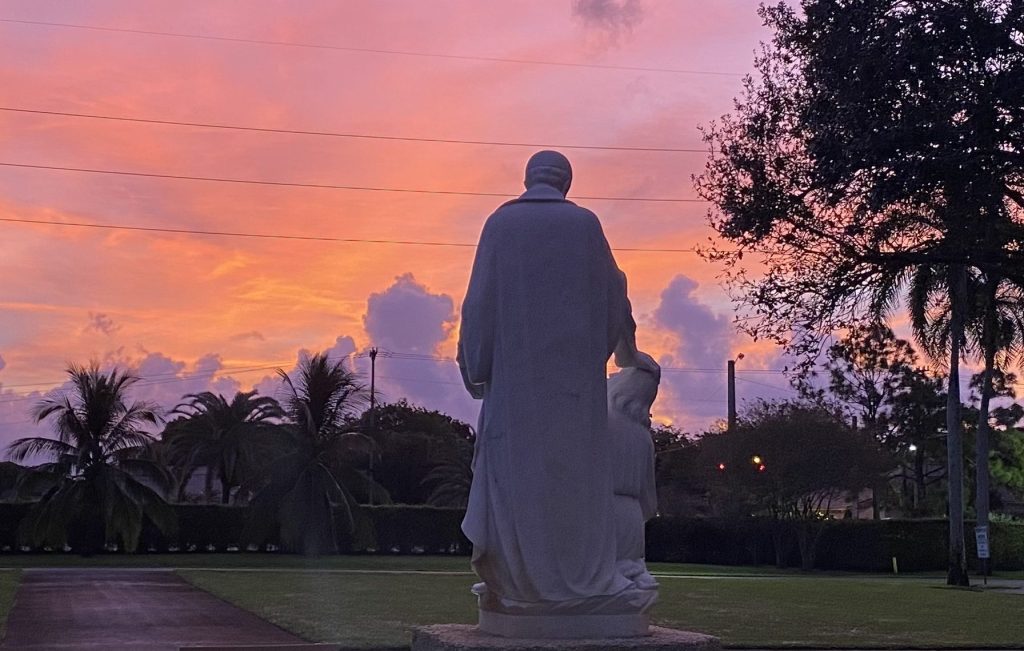
Photo: To be loved and love in return is why we are here at this time.

Mass readings for Wednesday, October 2, 2024
“When tempted to answer her sharply, I made haste to smile”. – St. Thérèse of Lisieux

“Lord, do you want us to call down fire from heaven to consume them?” Jesus turned and rebuked them, and they journeyed to another village (Lk 9:54-56).

James and John’s request of Jesus ought to be recognizable to many, if not all of us. How many times when feeling slighted or disrespected do we want to act in kind or offer some retribution to our perceived offender? Often, we do not even think, we just react or we engage in our own tumultuous, internal maelstrom.

Jesus rebuked James and John’s request immediately and moved on. He did not allow the rejection of the Samaritans to deter his course for even one second.

The most helpful response to today’s Gospel is to affirm that Jesus’ response to the Samaritan’s lack of hospitality is a healthier one than that of James and John. If we can agree with resisting to react as our starting point, then we will have a better chance to seek to understand what Jesus can teach us when encountering others.

One approach to others extending unkind behavior is to be understanding. We are all dealing with a lot, and much of what others are dealing with are unknown to us. If we approach another’s unkind or disrespectful action from a place of understanding instead of seeking revenge, we will have a better chance of not reacting in kind and possibly being able to help another to get in touch and reveal something they are struggling with.

Often a negative response may come from misunderstandings. Another response can be one of giving the person the benefit of the doubt. We are not mind-readers and we also are not often the best of communicators so resisting jumping to rash conclusions is a better course of action.

A third approach is to receive a critique with humility. Maybe, we have done something to cause hurt toward another, intentionally or unintentionally. By taking responsibility for that which we have done and apologize for it, we create a better bridge for reconciliation.

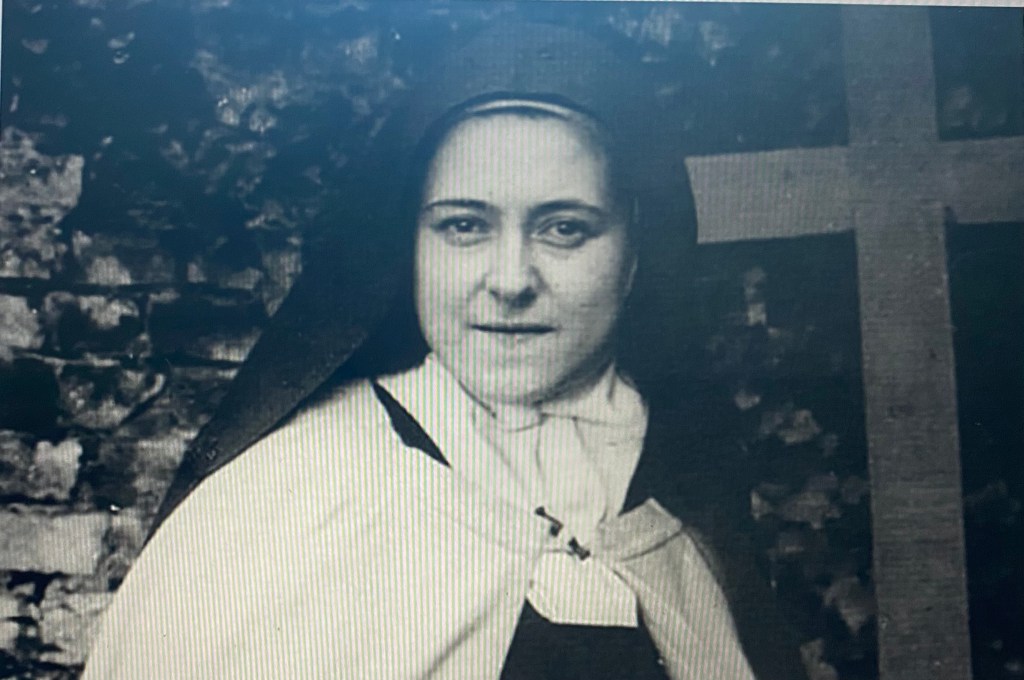
We are only responsible for our own actions. We cannot dictate or change the behaviors of others nor are we to be doormats for another’s abuse. We will experience healthier interactions when we approach conflicts and obstacles with patience, understanding, and humility for acknowledging what we have done and what we have failed to do. Even with a more understanding approach, sometimes there are those who will not be open to our efforts. St. Thérese of Lisieux found herself annoyed by one of the sisters. Whenever Thérèse saw her she would pray for her and wrote that, “when tempted to answer her sharply, I made haste to smile and change the subject”.

A smile can go a long way as well as praying for and respecting the dignity of each person we feel challenged by. There is a path between aggressive reaction and passive submission. Jesus is very clear that we are to love in all situations. We will each other’s good by clearly communicating our experience of our interaction, are willing to forgive and seek forgiveness, and to love each other through our idiosyncrasies, mistakes, and sins.

Human relationships are difficult in the best of scenarios, but still well worth the effort. Above all, when conflicts arise it is important to take a few deep breathes, pray, seek, and rely on the guidance of Jesus, and when possible seek out those who we trust. In this way, we will be less apt to react, have a healthier outlet for our frustrations, and instead see some options available that will help us to grow and mature in our relationships.

—————————————————

Photo: St. Thérèse of Lisieux pray for us!

Link for the Mass readings for Tuesday, October 1, 2024

We do better when we depend on God.

The Apostle John attempted to prevent someone from casting out demons in Jesus’ name because he was not one in their “company”, he was not one of those handpicked by Jesus as one of the Twelve. This person casting out demons in Jesus’ name was not like Simon the Magician (see Acts 8:9-25) who sought to buy the power of God from the Apostles to perform feats to boost his own fame and ego. He was doing what the apostles were doing and in the proper way, by invoking the name of Jesus.

Jesus said to him, “Do not prevent him, for whoever is not against you is for you” (Lk 9:50). The important part about being a disciple is surrendering to the will of God. Jesus consistently pointed this out to his followers. Being a disciple of Jesus had nothing to do with whether or not someone was in or out of their company, or whether or not they were related to Jesus, as was recorded just in the last chapter, “My mother and my brothers are those who hear the word of God and do it.”

Jesus, in today’s Gospel, is pointing out the danger of groupthink for its own sake. This is something we desperately need to get in our present-day and age. What is important is not putting our self, our family, our tribe, our party, or our nation first. What is important is putting God first.

The man in today’s Gospel did not rely on his own strength or willpower but called on the name of Jesus to cast out demons and he did so not because he was seeking to be great but following the lead of the Holy Spirit. John was more focused on the fact that this man wasn’t in their company, instead of being amazed that he was exorcising demons in the name of Jesus. The man was doing what Jesus had called the apostles to do. Maybe John had been a bit jealous that this man was doing a better job of it as well.

We and John can learn a bit from the humility of Job from our first reading. After losing all his livestock, workers, and children, Job turned to God in humility and said: “Naked I came forth from my mother’s womb, and naked shall I go back again. The LORD gave and the LORD has taken away; blessed be the name of the LORD” (Job 1:21-22).

“Blessed be the name of the LORD!” Job felt the anguish and pain of his loss but kept the proper perspective and trusted in God. God gave, took away, he would give again. John’s misstep and rash judgment of the man could have come from the fact that he and the other apostles were arguing about who was to be the greatest. They had taken their focus off of God and were focusing upon themselves. Jesus reminded them that the one who is least is the greatest. The one who is willing to depend on God, as a small child depends on their parent for everything, will have greater access to God as did this man and Job.


Photo: Flowers I came upon on my Rosary walk, “they neither toil nor spin, yet I tell you, not even Solomon in all his glory was not clothed like one of these” (Luke 12:27). Let us seek God’s will for our lives and radiate his love!

Link for the Mass readings for Monday, September 30, 2024

May we confess and not allow the sun to set on our sins.

In each of our readings for this Sunday, even the psalm, there is conflict. The reconciliation for this conflict is to accept and understand that God is God, and we are not. We are to place all our trust in him, follow his precepts and teachings and we will be in a much better place. Better because we will come to realize that the interpretive key to experience healing for ourselves and guidance through our conflicts, is to accept the invitation of our loving God and Father to be in relationship with him.

We have been created by an outpouring of God’s love, to receive his love, and to love God, our neighbors, and ourselves as he loves us. When we anchor ourselves in this truth, in putting God first, trusting in him and seeking to deepen our relationship with him, our lives will be more properly ordered and we will realize that not only are we not alone when we experience conflicts but we will have a firm foundation in God for guidance. When we have recognized that we have turned away from God through our sin, may we have the humility to seek forgiveness.

In our first reading then when Joshua complains to Moses because he hears about how Eldad and Medad are prophesying apart from the seventy who had come to receive the spirit God sought to bestow on them, Moses pointed out to Joshua that God can bestow the spirit on whomever he wills and, “Would that the LORD might bestow his spirit on them all” (Numbers 11:29)!

This same theme arises in the Gospel when John also complained to Jesus that someone, not one of the apostles, was driving out demons in Jesus’ name. Jesus tells him not to prevent him from doing so, “For whoever is not against us is for us” (Mark 9:40).

Both Moses and Jesus recognize and acknowledge that the power of God is at work among his people, and that this not to be prevented or inhibited in any way. That people are receiving the spirit of God and acting upon God’s guidance is what we are all to do! To give the spirit and love and for all to receive is what God wants for all of us!!! The love we have received is not for us alone, but for us to share.

James points this out clearly in his letter and reveals the danger of wealth when we cling to it and refuse to share. Wealth given by God is a gift and a gift given not for us alone. We are to be good stewards of what we have received and provide freely for those in need. We are not to grasp for wealth on our own terms apart from God’s guidance nor exploit or use others for our own gain.

One of most egregious of sins is withholding wages from workers that are due their pay; the cries of which “have reached the ears of the Lord of hosts” (James 1:4). Withholding wages of day laborers during the time of James could have devastating effects. It could mean the laborer or his family would not eat, he could not make a payment of debt and could be imprisoned, as well as other complications that posed a risk for those living day to day with no social net or means of support.

In the Gospel, Jesus shows vividly and graphically the seriousness of sin. Without mincing words, Jesus showed clearly that sin was not to be taken lightly and doing so has catastrophic effects not only in this life but for all eternity. This was especially true for those who lead others into sin. “Whoever causes one of these little ones who believe in me to sin, it would be better for him if a great millstone were put around his neck and he were thrown into the sea” (Mark 9:42).

This great millstone or donkey stone was massive. Some biblical scholars state that this stone could have weighed up to a thousand pounds. The donkey was hooked up to the stone, which was in the form of a massive wheel and then led by the donkey in a circle to pulverize wheat and other grains that was placed in a stone trough so to make flour. It is not hard to then imagine what would happen to someone who had this stone attached to his neck and thrown into the sea!

Jesus continued with more imagery by saying that it would be better to cut off a hand or a foot, and to pluck out an eye if any of these members would lead to sin. Jesus used such graphic language to show how destructive sin is in our lives, for each of us as individuals, as well as for families and communities. Sin has horrific consequences because it damages or ruptures our relationship with God and each other. The ultimate devastation would be an eternal life of separation from God.

Better to die a horrific death, than to die in a state of unrepentant mortal sin. Better to die maimed than clinging to a sin that would separate us from God for all eternity. Jesus is not wishing horrific deaths, physical dismemberments, or eternal damnation on anyone. He came not to condemn but to save humanity. His first public statement as he began his public ministry recorded back in Mark 1:15 is: “This is the time of fulfillment. The kingdom of heaven is at hand. Repent and believe in the Gospel.”

Jesus came to wake us up, to lead us away from our selfishness, our self-centeredness, and sin, to heal us from our fears and deepest wounds, and to guide us home to the very source of our being, the infinite spring of our sustenance and nourishment, the core of our deepest desire, which is to remember who and whose we are. To call us to repent, to turn back to God, and believe in the gospel, the good news, that we are God’s beloved daughters and sons. And yet, through a free act of our will, we can reject the love of our Father and choose to separate ourselves from the love that God wants to bestow upon us in this life and for all eternity.

We can also choose to make the psalmist’s words our own: “Cleanse me of my hidden faults” (Psalm 19:12). When we hide in the darkness and cling to our sin, we are listening to the father of lies who seeks division and our death. God will forgive us from anything. God never tires of forgiving us. We tire of asking. Let us come confidently into the light, into the confessional, and ask Jesus to reveal to us our sins. When we have the humility to be contrite, confess, and atone for our sins, we will know and experience Jesus’ mercy, forgiveness and love, and be reconciled to our God and one another now, in this life, and for all eternity.


Photo: Rosary walk, Riomar Beach, Vero Beach, FL.

Link for the Mass readings for Sunday, September 29, 2024

The horizon we gaze upon has an effect on the life we live now.

The term horizon is often defined as where the earth and sky meet. This is actually an apparent horizon or sensible horizon because we see an apparent plane based on our observation point. If we are able to broaden our viewpoint and look beyond the present location we are standing at on the earth, say from the space shuttle, we could then experience a rational or celestial horizon: where the great circle of the celestial sphere whose plane passes through the center of the earth is parallel to the celestial horizon of a given position. Journeying deeper into space we could discuss event horizons, the boundaries marking the limits of black holes.

Before delving any deeper and getting lost in space, let’s return to earth and today’s Gospel where Jesus stated: “Pay attention to what I am telling you. The Son of Man is to be handed over to men” (Lk 9:44). What Jesus offers to us in this statement is the horizon of the cross, the place where heaven and earth meet, where the physical and the spiritual, where the finite and infinite meet.

Many of Jesus’ followers were and are still confounded by the cross. As Paul wrote to the Church at Corinth: “For Jews demand signs and Greeks look for wisdom, but we proclaim Christ crucified, a stumbling block to Jews and foolishness to Gentiles, but to those who are called, Jews and Greeks alike, Christ the power of God and the wisdom of God” (1 Cor 22-23).

Paul echoes what Jesus was talking about – his imminent fate and our ultimate horizon – death. None of us will be able to avoid the final result of our mortality. Jesus taught both through his words and in his death that to be truly free we need to be willing to lose our life to gain it. We have to face and walk through our deepest fears to grow. Our life is not lived until we give it away.

The more willing we are to face the reality of our own death, the less likely we are to take the time we have for granted, and the better we can live our lives here and now. During our final four months together, JoAnn and I experienced God’s grace because we faced the reality that her time was near, we embraced the gift of the time we had together, and through the prayers of so many, we experienced the infinite presence of the love of God in our midst.

There is so much we can experience and enjoy, but if we only limit ourselves to that which we can experience with our physical senses alone and attempt to deny our own mortality, we limit ourselves and distort the sacredness of life. What makes us fully human, alive, and fulfilled is an embrace of both the physical and the spiritual, of both reason and faith, seeking the horizon where the finite and infinite meet, where earth and heaven come together.

This union happens most perfectly in Jesus Christ, who is fully human and fully divine. Jesus helps us to  experience the beauty of God’s creation and our relationships. This happens best when we are willing to enter with him into, instead of resist, the natural rhythm of life and death. We come to appreciate the truth of how fragile our lives really are.

This is not a truth to run from but to embrace. And as we do, we will be less apt to take each other for granted and instead better appreciate one another. We will also be able to slow down and rest more in the moments that God offers in which we can experience foretastes of heaven now. In doing so, we will better prepare ourselves for that time when Jesus will lead us into our own death so that we may rise with him and experience a new and infinite horizon.


Photo: Rosary walk and pause, Riomar Beach, Vero Beach, FL.

Link for the Mass readings for Saturday, September 28, 2024

As we allow Jesus to heal us of our pain, we can love and help others.

Jesus asked his disciples about who people said that he was and Peter, through the revelation of God answered, “the Christ of God” (Lk 9:20). Jesus then responded that “The Son of Man must suffer greatly and be rejected by the elders, the chief priests, and the scribes, and be killed and on the third day be raised” (Lk 9:22).

If you might be thinking that these verses sound familiar, it is because we heard proclaimed or read the parallel account found in Mark 8:27-35 two Sundays ago on September 15. This point never gets old. As we grow in our relationship with Jesus, we come to a deeper understanding of Peter’s words.

Jesus is indeed the Christ, the Messiah, the Son of the Living God. Yet, that meant many things to many people who were awaiting the coming of the Messiah. For most, they were hoping for a military leader to come to lead them and overthrow their Roman occupiers. As soon as Peter made his statement, Jesus clarified what kind of Messiah that he would be, a suffering servant.

As our first reading from Ecclesiastes offered, “there is an appointed time for everything” (Ecclesiastes 3:1). Even a time for suffering. Peter had trouble with understanding this and he represents us as well. One of the points of faith many of us struggle with is the same as Peter, why did Jesus have to suffer?

Jesus was willing to be sent by his Father to become human and to experience all of humanity, even the suffering of our humanity, because only that which Jesus assumed could he redeem. Also, in Jesus experiencing our suffering, even unto death, we can know without hesitation or doubt that Jesus understands our struggles and anguish. And that means we are never alone in our suffering.

The reality is that the Messiah, the Christ, the Anointed One, is Jesus. He is the suffering servant, the One willing to give his life on the Cross for all of humanity and creation. Jesus did not do this in some abstract way. He died for each and every human being that has lived, is now living, now reading these words, or ever will live. He died for you because he loves you.

To be a disciple of Jesus, we are invited to love in return. This means being willing to suffer and sacrifice for one another. Our discipleship will be ultimately expressed in love, in our willing the good of each other. We must be willing to let our hearts be moved with compassion and as St. Mother Teresa taught by, “Giving until it hurts.”

To give until it hurts means that we are willing to allow our hearts to be open to love. For our hearts to be open to the pain of another means that we must be willing to be healed. We are invited to allow the Divine Physician to remove our hearts of stone and replace them with hearts of flesh. This divine surgery happens at the Cross when we are willing to bring our suffering to Jesus whose arms are wide open and ready to embrace us.

The Suffering Servant understands our pain, experiences our pain, and can help us to experience instead of run from our pain. There is no way to cover up, go around, sidestep, and/or deny, our suffering. We must face it and experience it head on. But we don’t have to do so alone, nor can we. For what Jesus has assumed he can and will redeem. When we are ready and at the pace, we are willing to go, Jesus will heal us. For “there is an appointed time for everything.” Including our healing.

———————

Photo: Feast day of St Vincent de Paul, who allowed Jesus to remove his heart of stone and replace it with a heart of flesh, pray for us. St. Vincent de Paul Regional Seminary, Boynton Beach, FL.

Link for the Mass readings for Friday, September 27, 2024

Curiosity from a distance, like Herod, or intimate, Lord and Savior, like Teresa?

‘Who then is this about whom I hear such things?'” And he kept trying to see him” (Lk 9:9).

Herod Antipas, the ruler over Galilee and Perea, heard stories about Jesus. The range of his thoughts, expressed by Luke, is confusion to curiosity. Herod may have started to feel concern over the possibility of a growing revolt, some guilt for his execution of John the Baptist, or just curiosity to see what this man was all about. Could this Jesus accomplish even half of the things Herod had heard about him? One question that did not seem to cross Herod’s mind was, did he have any interest in changing his life and becoming a follower of Jesus?

Herod was not the only one in Luke’s Gospel who asked questions about who this man, Jesus, was. Nor did the asking of those questions die with Jesus on the cross. They continued after his resurrection and ascension, they continued into the first centuries of the Church, which led to the calling of the first ecumenical councils which dealt directly with who Jesus was, and they continued in each following century and continue today. There are even at present in some academic circles, the question arising as to whether Jesus even existed at all.

One could ask why this question about Jesus persists? One answer is that we are finite beings seeking to understand an infinite Mystery. The full comprehension of the reality of Jesus existing as fully human and fully divine, dying on the cross, conquering death through his resurrection and ascending to the Father transcends even the wonderful intellect and ability to reason that we have been blessed with. Also, Jesus’ invitation is a universal but personal one. Each individual person has to encounter Jesus for her or himself.

Jesus called the Twelve, one by one as well as Mary Magdalene, St. Irenaeus, St Thomas Aquinas, St Francis and Clare of Assisi, St Catherine of Siena, St Teresa of Avila and St John of the Cross, St Ignatius, St Mother Teresa, Thomas Merton, Dorothy Day, and he calls each one of us as well. He did not call us to just merely embrace a new philosophy, a new ethical way of life, or even a new religion. Jesus called and calls us to be a part of his Body, the Mystical Body of Christ.

Who is Jesus, Herod asks in today’s Gospel? It is a good question for us to ask as well. For me, Jesus is the Christ, the Son of the living God, who became incarnate, becoming one with us in our humanity so that we could become one with him in his divinity. This same Jesus who called others through the ages invites us to follow him today as well and he continues to walk this journey with us whether we say yes or no to his invitation. We are just aware of and receive more of his help when we say yes!

Life with Jesus isn’t perfect, and we will at times echo St. Teresa of Avila, who stated after she was thrown from a carriage into a mud puddle, “If you treat your friends this way, it is no wonder you have so few.” But we will, as did Teresa, also experience moments of inexpressible joy, of wonder and exhilaration, and feel blessed when Jesus works and loves through us.

St. Teresa of Avila had a deep and intimate relationship with Jesus and knew him as her closest friend because she heard him knocking and let Jesus in. She spent determined and intentional time consistently with him. She spent an hour before and an hour after Mass each day. She set aside specific, daily anchor times of personal prayer, meditation, and contemplation which allowed her times of closeness that she could then experience Jesus as well in her daily activities. She was able to share with him her joys and frustrations because Jesus was that close to her.

Let Jesus not be just a passing curiosity as he was with Herod Antipas. Jesus is standing, knocking, (cf. Revelation 3:20) inviting us to open the door and let him in. Jesus is inviting us as he did with Zacchaeus to come down from the tree and take him to his home (cf. 19:5). Jesus is calling us to come and follow him as we read with Matthew just a few days ago (cf. Matthew 9:9-13). Jesus is not just some person from history. True, he died at a specific point in time and yet also was resurrected at a specific point in time, and he is alive and well, and inviting us to follow him today. All Jesus waits for is our, “Yes.” and a few steps. Jesus will take care of the rest!


Photo: Spending some quiet time with Jesus before heading to the land of dreams.

Link for the Mass readings for Thursday, September 26, 2024

Jesus calls us to participate in his Father’s plan.

“Jesus summoned the Twelve and gave them power and authority” (Lk 9:1).

Jesus summons us as he did the Twelve and empowers us for mission in his name. The expression of our service is unique to each of us. We might resist exploring or entering into a deeper commitment of our faith though because we might feel anxious or afraid that God may call us to do something that we would never want to do, or that we couldn’t conceive of being capable of. There also may be some trepidation even when we are clear of the direction God wants us to move in which may arise from our hesitancy to change and move out from our comfort zone. Ultimately, God wants for us what we want for ourselves deep down. We may not even know what that is, but God does.

God knows what will give us and with whom we will experience meaning, fulfillment, and joy in our lives. The challenge for us is to come to know this for ourselves as well. The work of discipleship begins by accepting the invitation of God to walk with him and trust that he knows what he is doing and where he is leading! No matter what our age, we are never too young or too old to begin or recommit to the journey along the path of discipleship. One good practice is to reflect on our dreams and desires, bring them to God in prayer, and imagine ourselves embracing what we desire.

When I first joined the Franciscans to study for the priesthood in the early ’90s, I imagined from time to time my ordination day, especially in our second year as we were thinking about taking temporary vows. When I did so, a puzzling result consistently arose. I did not imagine feeling any excitement or joy. So, a year and a half into formation, I decided to take a leave of absence. I had asked to take off a year, but the minimum time for a leave of absence was two.

Though I balked at first about the two-year time frame required, I came to see the wisdom of my formation director. I would have come back after a year. About a year and a half out then it was that I realized that my vocational path was leading me to the Sacrament of Matrimony and not Holy Orders. Eighteen months after I came to that realization, I met JoAnn. As our relationship grew and we began to talk about marriage, whenever I envisioned our wedding day, I felt excitement and joy. Each year that we had together built on the one before. We grew closer to God and each other right up until the day of her death.

God led me to the Franciscans in my mid-twenties, he then led me out, and then he led me to JoAnn. Almost three years after JoAnn’s death, he led me to seminary to be formed as a diocesan priest. Periodically when I imagined my ordination day, even though the schedule was more intense this time around, unlike during my novitiate year with the Franciscans, this time I felt excited. Now just about four months serving as a priest, it is more amazing than I could have ever imagined!

God loves us more than we can ever imagine, he has a plan for each and every one of us, and he knows what will fulfill us. When we ponder our dreams and desires, and as we investigate, research, explore potential opportunities and continue to pray and discern each step, we will come to see that as we align ourselves with God’s will that makes all the difference. We are not alone in this process, and we have a God who can see the full picture, where we see only a small part.

There will be fits and starts, missteps and slips, doubts as well as confirmations, and desolations as well as consolations. The key through it all, is to remain faithful, to continue to trust in Jesus who called us. He will continue to accompany us along the way. As he did with the Apostles, he will give us the resources and strength we need, and he will send the Holy Spirit to empower and transform our lives. The process of discerning God’s will for our lives is not just for ourselves alone. Jesus is preparing us for mission. We are transformed by the gift of God’s love to go out and share the invitation we said yes to with others!


Photo: Good to take some quiet time each day to be still and listen for God to speak to us in the silence of our hearts. Doing so a few days ago while home visiting my family and friends in CT.

Link for the Mass readings for Wednesday, September 25, 2024

We are one with the Holy Family when we “hear the word of God and act on it”!

He said to them in reply, “My mother and my brothers are those who hear the word of God and act on it” (Luke 8:21).

There are many popular genetic testing kits that are advertised on TV and through the internet. People have asked me is it possible to be a blood relation to Jesus. Jesus’ reply today can help you to save some money. Asking if we are a blood relation with Jesus is missing the point of Jesus’ life and ministry. What is important are “those who hear the word of God and act upon it.” God is to be first, even before family. We may experience a subtle shudder from this statement but to those of Jesus’ time, it would have been apoplectic. Family meant everything in the Ancient Near East.

Jesus is not making the point that we disregard family, he is instead teaching us that if we are to be authentically present to our family this will come about best by following the will of his Father. As we deepen our relationship with Jesus and put his teachings into action, we begin to bear the relational fruits of the Spirit. Would not our familial relationships be much better if we were more loving, joyful, peaceful, patient, kind, generous, faithful, gentle and practiced self-control? Jesus taught and showed from his own life that the path to fulfilling and intimate relationships flourish best when we put God first because as we grow closer in relationship with him, we also do so with those around us.

Another point we can glean from Jesus’ response in today’s Gospel is that our “family” is to transcend bloodline, tribe, and nation. Any one of “those who hear the word of God and act upon it” is spiritually akin to Jesus the Christ. The point is not that we have a genetic, lineal relation with Jesus, but that when we live and act according to his Father’s will, we are part of the universal family of God’s grace and mercy and our relationship with him and one another grows as we continue to bear the fruit of the Spirit.

As brothers and sisters in Christ, we will act with more caring and kindness, seek common ground through dialogue, be more willing to walk and accompany one another and seek to understand instead of judge. The bottom line is that we are to love one another as Jesus loves us! When we do so our lives are transformed.

To hear the word of God, we must have our hearts, minds, and souls open to hearing it proclaimed during Mass. We are also invited to read his word in our own daily time of prayer. In both situations, God’s word comes alive as he shares something of himself with us, to nourish, and give us his life. As we then receive, at times struggle with, seek to understand, and put into practice God’s word, we come to know the Father, and the Son, and the Holy Spirit, the saints, and our brothers and sisters in Christ. We are one family in the Body of Christ when we “hear the word of God and act on it.” Just imagine what our parishes and communities would look like if we all did this.

————————————

Photo: Praying with the Holy Family in the sacristy of St. Philips Catholic Church, East Windsor, CT. The church where I received my first communion and concelebrated Mass as a priest there for the first time this past Sunday.

The Mass readings for Tuesday, September 24, 2024

Let us not conceal but reveal the light of Christ!

Jesus said to the crowd: “No one who lights a lamp conceals it with a vessel or sets it under a bed; rather, he places it on a lampstand so that those who enter may see the light” (Luke 8:16).

God blesses us freely without cost and invites us, mere human beings, tiny specks on specks in the universe, to be in relationship with him. He has given us our lives, sustains us, and he is the source of our fulfillment, meaning, and joy! We do not earn nor is there anything that we can do to gain God’s grace. God loves us as we are. We are to but receive and share his love. We lose the gift of his grace and love either by refusing what has been offered, or once accepting and receiving, not doing anything with what we have received. If we are people of faith in name only, but do not follow in action, we are concealing the light we have been given.

January of 2021 was an interesting time for me. It had been just over a year since JoAnn had died and I was not only diagnosed with Covid, but it had done a number on my lungs, full blown pneumonia, as well as compromised many of my other vital organs. Fortunately, after five days on the Covid wing of the hospital and a few months then home on oxygen, I slowly recovered. As with JoAnn’s diagnosis, I accepted what was happening and trusted God and felt his peace through both of those challenges.

JoAnn was not healed in the way that I had sought but hopefully has now received the fullness of the healing that Jesus came to bring all of us, eternal life with him and his Father through the love of the Holy Spirit. My time to leave this life and head on to the next did not come in January of 2021. Through my time of recovery, I prayed and took comfort in the gift of his word each day and continued to share these reflections.

Some have certainly been better than others, but each one has been a reflection of the journey into the Mass readings of the day as well as seeing their relevance in my life, and upon returning, writing what I felt I received from God to share. These posts have hopefully been a way to reflect the light of Jesus, to light my lamp and place it on a lampstand.

My hope is that these words can also be an invitation to those of you who are reading them to take your own walk about through the God’s living word revealed in the Bible. God has been a tremendous support and companion in my daily walks with him and my prayer is that you may experience his closeness as well when you stroll through the pages of the Bible prayerfully each day. As you do so, God will soon hand you your lamp, ask you to light it, and place it on the lampstand to let it shine brightly so it may be an inspiration for others.


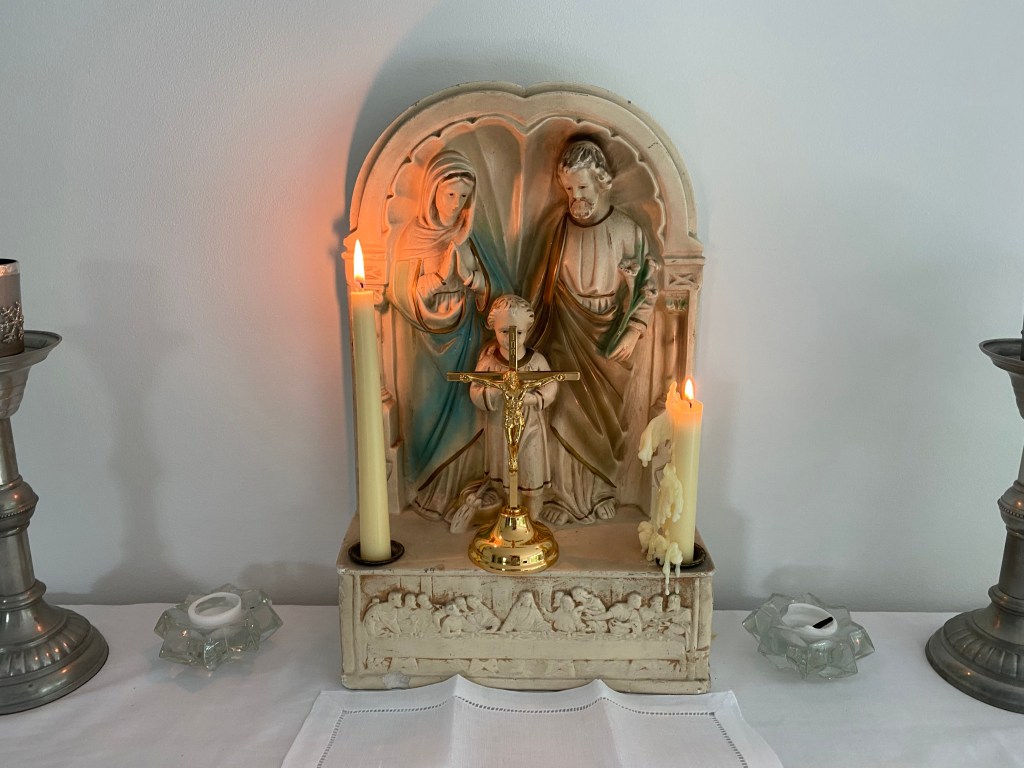
Photo: Home altar passed on from my great grandfather, to my grandmother, to my mother, to me. Just as we pass on sacramentals and family traditions, may we also pass on our faith.

Link for the Mass readings from Monday, September 23, 2024