Veni Sancte Spiritus!

There is a list of seven deadly or capital sins. They are pride, lust, greed, envy, wrath, gluttony and sloth or acedia. Acedia may be the least recognized on the list but it is one of the most dangerous, because it is the most subtle. If it is recognized at all, it is often compared to laziness, but that does not quite grasp the depth of it. The word, from its literal meaning, means a lack of care. This can manifest in our life as cynicism, finding no meaning, a minimalist approach, a resistance to discipline, a disengagement with the world around us, and ultimately a “lack of care given to one’s own spiritual life, a lack of concern for one’s own salvation” (Nault 2015, 28).

Marc Cardinal Ouellet, in his foreword to Jean-Charles Nault’s, The Noonday Devil, describes the affects of acedia on us today this way: “Left to his own devices, man ultimately despairs of ever being able to find a meaning for his existence and runs the risk of sinking into mediocrity that is just the symptom of his rejection of his own greatness as an adopted son [and daughter] of God” (Nault, 2015, 11).

Feeling the struggle of just getting by, feeling tired, worn down and worn out, getting caught up in a chronic cycle of stress can lead being susceptible to going through the motions. The possibility for our potential and for more in our lives is calling but even if we hear, we may wonder if we can ever fully achieve doing better. We can deny the very gift of our humanity, retreat into a stance that accepts the unthinkable, as long as it does not directly affect us. We grow in our indifference toward our own needs as well as the needs of others. This happens when we listen to the father of lies instead of our Father in heaven.

Today, we celebrate the power to counteract acedia as well as all those temptations that grasp at our throat seeking to choke out the divine life from growing within us. Today, we celebrate the feast of Pentecost when the Holy Spirit came upon Mary and the Apostles to empower them with divine Love.

From our Gospel reading today we read how: The disciples rejoiced when they saw the Lord. Jesus said to them again, “Peace be with you. As the Father has sent me, so I send you” (Jn 20:21). Jesus, who embraced our humanity, took upon himself our sin on the Cross, then conquered death, rose again, and freed us from our slavery to sin. The Risen One comes to us as he came to his disciples in the locked room and invites us to participate in his divine life, to share in the love he shares with the Father, who is the Holy Spirit. So when the temptations of sin arise in our mind and heart, we are to, in the words of St Benedict of Nursia, “dash them against Christ immediately” (Nault, 2015, 41).

The Holy Spirit prompts us through prayers, songs, and words of Scripture to counteract the lies and temptations that seek to lure us away from the truth of our relationship with Jesus, ourselves, and each other. One simple but powerful prayer to use is reciting the words from Psalm 70:2 “God, come to my assistance. Lord make haste to help me.” Another is “Come, Holy Spirit, fill the hearts of the faithful and kindle in them the fire of your love. Send forth your Spirit and they shall be created and you shall renew the face of the earth.” Just saying, Veni, Sancte Spiritus, or its English equivalent, Come, Holy Spirit, reciting the Jesus Prayer or simply the words, Come, Lord Jesus, and/or spontaneous words are all ways to immediately turn away from the temptations that arise and draw on the infinite power and love of God.

We are like diamonds in the ruff. We are unique and special gifts to this world, though wounded and marred by our own and the sins of others. We may feel adrift, without direction; we may feel cynical and without hope; we may feel beaten, worn out and worn down; we may feel anxious and afraid, but let us not despair or lose our ability to care, let us realize that we are not overcome or outdone. We may be wounded by indifference and complacency, but we are not defined or set in stone.

Today, on the Solemnity of Pentecost, the birthday of the Church, let us call on the same Holy Spirit that empowered Mary and the Apostles to give us the guidance and strength from our God and Father who loves us and desires for us the full actualization of who we are and who he calls us to be.

God does not want us to settle for anything less than what he calls us to be. God urges us to call on the name of his Son, Jesus, who will break the bonds of our enslavement to sin, and through our participation in his life become empowered by the Holy Spirit and be free to live the life we have been created for; a life of meaning, fulfillment, joy, love, and unity with God and one another.

Holy Spirit, please set us aflame with the fire of your love and burn off the dross of our sin so that we may be precious stones radiating your light and love in such a way that we keep our tongues from evil and our lips from speaking deceit, that we turn aside from evil and do good, that we seek and strive after the peace of God, that peace that surpasses all understanding. Lead us with your love to know the Father and his will for our lives. Help us to bear the fruit of love, joy, peace, patience, kindness, goodness, generosity, understanding, and self-control.

——————————————————————–

Photo: Veni Sancte Spiritus! Come Holy Spirit!

Nault, O.S.B., Jean-Charles. The Noonday Devil: Acedia Unnamed Evil of Our Times. San Francisco: Ignatius, 2015. If you are looking for a transformative book for summer reading, I highly recommend it!

Link for the Mass readings for Sunday, June 8, 2025

Resist the temptation to compare, trust and follow Jesus instead.

How many times have we looked to others instead of staying focused on what we need to do or be doing? How many times do we compare ourselves to others, assessing what we or others have or don’t have, how others are more or less confident, more or less better looking, more or less intelligent, and even, how our faith life is worse or better?

We get a taste of these questions and what our response ought to be from Jesus in today’s Gospel. The background of today’s reading is a continuation from yesterday’s, in which the author described how Jesus forgave Peter for denying him by asking him not only if Peter loved him, but how he was to put that love into action by feeding his lambs, taking care of and feeding his sheep. Jesus also had just let Peter know that Peter was going to die in his service to him.

Today, we read that upon hearing the news of his eventual death, that Peter shifts the direction away from himself.  When Peter saw him, he said to Jesus, “Lord, what about him?” Jesus said to him, “What if I want him to remain until I come? What concern is it of yours? You follow me” (Jn 21:21-22). Jesus does not definitively say what is or is not going to happen to the beloved disciple. Jesus is clear with Peter that his focus is not to be on what is going to happen to the beloved or any other disciple, but to direct his attention to following him and his will.

Our orientation as disciples of Jesus is to follow Jesus, to focus on his will for our lives and to expend our energy in such a way that promotes his will. We are to spend less time comparing ourselves to others. This is very good advice because the temptation to compare is a very slippery slope that can easily lead us to the devastating sins of gossip, pride, and envy. If we are to compare ourselves to anyone, let it be to Jesus.

Jesus calls us to be perfect as his heavenly Father is perfect, which is an impossible task if we seek to go it alone. Yet, we can become perfected through our participation in the life of Jesus the Christ. We begin when we decide to ask for Jesus to help us make a commitment to resist the temptation to compare ourselves to others. Then when the first instant of a comparative thought arises, we can replace it with a prayer of blessing directed toward another.

Moment by moment, we just need to remember that we are not alone, that we walk with Jesus. One thought, one action, one interaction at a time, we are called to surrender our will to the love of God. By taking these steps to counter the influences of a focus on self first as well as resist the comparative and/or seeking to follow a cult of personality, we can begin to shift the momentum away from increasing divisiveness, polarity and mistrust, and instead strive toward supporting, encouraging, and uplifting one another.

As we place our trust in and follow Jesus, our thoughts, prayers, and actions will change. We will become more understanding, patient, willing to engage in conflict resolution, and dialogue. To love as Jesus loves us will help us to begin to lessen the intensity of fear, prejudice, biases, and chronic stress. As we are able to then experience his peace, let our shoulders come out of our ears, then we might be willing to see each other as human beings and through God’s eyes, as beloved daughters and sons with whom he is well pleased.

————————————————————

Photo: Follow Jesus where he leads and all will be well. Back home for a quiet walk a few weeks ago.

Link for the Mass reading for Saturday, June 7, 2025

Jesus offers us a better Way.

When we spend time reading the Gospels, we will encounter in them that the God of Jesus Christ is a God of justice, yes, but a justice that is tempered with mercy and love, a restorative justice, not a punitive justice. God invites us to be in communion with him and one another, and to answer that call requires a transformation, a change of heart and mind. Jesus meets people where they are, accepts them as they are, while at the same time holding a mirror up to them to show how what they are doing is keeping them from the very reality of communion with his Father that they seek.

One example can be seen when Jesus encountered the Samaritan woman at the well and he asked her for a drink. What followed from that simple, while at the same time profound request, led to her humble confession that she did not have a husband to which Jesus responded: “You are right in saying, ‘I do not have a husband.’ For you have had five husbands, and the one now is not your husband. What you have said is true.” Jesus spoke to a woman and a Samaritan in public, two things that were not done in his time as it was against societal norms.

Jesus recognized the distinction, but saw instead and foremost, a human being, a woman isolated, possibly being ostracized from her community, for who else would come by themselves to fetch water in the full heat of the day? What he shared with her was respect, as he spoke to her as a person. Because of her honesty, humility, and courage, what transpired over the course of the conversation was not only her transformation but the redemption of her and her whole community. This transpired because, with joy and courage, she proclaimed the Good News even to those that had kept her at arm’s leg, and on the margins (cf. Jn 4:1-12).

Another encounter happened with Saul who was present and oversaw the stoning of St Stephen and continued his zealous persecution of the followers of Jesus. On the road to Damascus, Saul encountered the risen Jesus, who met him with the words: “Saul, Saul, why are you persecuting me” (Acts 9:4)? Again, as with the woman at the well, Jesus greeted Saul with a simple but profound question which had a tremendous effect on him. Saul was transformed from a persecutor of the Way to a follower of the Word. He would not only change his name to Paul and proclaim the Gospel to a community but to the Mediterranean world.

In today’s Gospel, Peter, who had betrayed Jesus three times, encountered Jesus who also posed a question, but this time asking it three times: “Simon, son of John, do you love me?” (cf. Jn 21:15-19). With these simple questions and Peter’s affirmative responses of yes, Jesus forgave Peter for betraying him. Peter went forward to proclaim boldly the life of Jesus at the feast of Pentecost, and three thousand were moved by his words and sought to become part of the Way of Jesus.

Jesus encountered the Samaritan woman, Paul, and Peter, and met each of them, not with condemnation, but with love and mercy. He met them on their level and then offered them a look in the mirror by asking a simple question. Jesus sought to draw them out of their own false senses of self and sin, and into the love of God. Jesus provided another way. Each person answered with truth and humility, and willingly looked at their life, turned away from what Jesus revealed and accepted his invitation to change their hearts and minds.

The justice of God is not about the punitive measure, about rubbing our noses in our own mistakes and misjudgments. Yet, if we choose our own sin over the love of God’s healing transformation, it may feel punitive, because God will allow us to feel the effects of our decisions. God gives us another choice. He has sent his Son to show us the path of love, forgiveness, and reconciliation. Jesus echoes Hosea 6:6 when he is recorded as saying, “‘I desire mercy, not sacrifice’. I did not come to call the righteous but sinners” (Mt 9:13). Jesus comes to us, as he came to the Samaritan woman, Paul, and Peter.

As we make some time for prayer, enter into any of these biblical accounts, and spend some time in silence today, let us allow ourselves to see Jesus approaching us or sitting with us. What simple, yet transformative question does he ask that reveals in what way or areas we are keeping God distant? In what way(s) do we need to change our hearts and minds? When we choose to leave behind our false self, our pride, and our ego, and instead respond with humility and contrition, true sorrow for our sins, as did the Samaritan woman, Paul, and Peter, we will be healed, transformed, and empowered to go forth to share the Good News of the love and mercy we have experienced with God.

—————————————————————————-

Photo: Close up of Heinrich Hoffman’s Christ and the Rich Young Ruler, 1889

Link for the Mass readings for Friday, June 6, 2025

Jesus invites us to share in the love he and his Father share.

Jesus bestowed his love and his grace upon his Apostles as a gift. The fundamental option, our ultimate end goal, that which we seek from the very depths and core of our being, is to experience the same love that the Apostles experienced. The Creator of all that exists, the One who so transcends our comprehension, that is so beyond our ability to comprehend fully, has come close to us, become one with us in the person of his Son, and loves us more than we can ever imagine.

This reality, the core of the deposit of faith that they received, was not to be hoarded, buried, or to be shared with a select few. This living gift of grace was to be shared by the Apostles, the ones who Jesus called by name, who he hand-picked to receive his message and then sent them forth to proclaim his word. They were to protect it for the purpose of transmitting it accurately to their successors so that it would then be passed on to each successive generation who would receive and make it relevant for their own time.

Jesus said to his Father in his farewell discourse, as recorded by John that: “I made known to them your name and I will make it known, that the love with which you loved me may be in them and I in them” (Jn 17:26). Through our participation in the love of Christ, we are perfected and conformed by his will such that we too can experience and share in the love of the Father.

The Trinity is at the heart of the Gospel, the Good News. The Trinity is a divine communion of three Persons, Father, Son, and Holy Spirit. We have been created with a burning hunger and desire to experience this same communion. Why do we resist saying, “Yes” or more fully embracing this joyous invitation? St Thomas Aquinas in his Summa Theologiae, or Summa, outlines four substitutes or temptations that we may put in place of our highest hope and good; these are wealth, honor, pleasure, and power. In and of themselves, these are not unhealthy desires, as long as God is first and we orient ourselves to them from God’s perspective. Then they will be properly ordered by God’s direction and will.

When we assume the posture of pride, believing that we are the center of our lives and we seek wealth, power, pleasure, and/or honor for our own sake and self-aggrandizement, each will be distorted and disordered. These finite pursuits will leave us empty, or worse lead us into the crippling slavery of addiction. How many times have there been reports of someone who has amassed most or all of these four, and then come to a place of such despair and emptiness that they had taken their own lives?

Through a properly ordered sense of power grounded in love, defined by St Thomas, as the willing the good of the other, those in positions of power and privilege are called to be a voice for those who otherwise would not have a voice. Those with access to wealth, are to recognize that this is a gift from God, and they are to be good stewards of what they have received to help and support others, not only in the limited stance of a hand-out but as a primary means to provide a hand up. To accompany and shepherd those who do not have access such that they can arrive at the point where they can be provided with access, skills, and means to participate in the dignity of meaningful work and gainful employment.

The ultimate goal of pleasure is to embrace the Beautiful, the gift that God provides in which we can experience and enjoy the wonders of his creation. At the same time, we can be participants in the expression of creativity through the arts as well as our everyday actions by finding joy in our interactions with one another. If honor, fame, and glory arise in the faithful, they arise not for their own sake or as to heighten the focus on themselves. This attention comes with the responsibility to further radiate the light and love of God so to evangelize and draw others to the Good, the True, and the Beautiful, as did Peter when he preached and three thousand came to accept the love of Christ. When Pope Francis visited the United States the news for a week was filled with joy and hope. When St Mother Teresa accepted the Nobel Peace Prize she began her speech by saying, “As we have gathered here together to thank God for the Nobel Peace Prize” and ended with the words, “God bless you!” These are all examples of God being the source and focus to bring about the proper alignment and use of wealth, power, pleasure, and fame.

Jesus revealed the love with which his Father loves him and sent him to share with us. He invites each and every one of us to receive and live in the love that he shares with his Father such that we may experience the very presence of the Holy Spirit dwelling within us. May wealth, power, pleasure, and honor, not be distractions or diversions to our embracing the love of God, but a means to radiate his light and love, and to provide opportunities and access for others who otherwise would not have any access.

“Humanity’s participation in the divine communion is the goal of the Father’s saving plan, indeed, the goal of the whole of human history” (Martin and Wright). Relationship with God is to be our fundamental option, our ultimate goal, such that we strive to open our hearts and minds daily to breathe, receive, rest, and abide in his love, be filled with, and experience his joy, and radiate his presence through thought, word, and deed. In this way, we are sent to accompany others, to share God’s presence and love with those who are in need of hope.

In respecting, serving, standing up for the goodness and dignity of each person; in teaching and guiding others to experience the truth; and above all to help others to encounter the beauty and love of the Holy Spirit; we provide others the opportunity to experience the transforming love of the Trinity. As disciples, may we turn away from sin and all that divides, and share our witness and testimony of love and service as led by the Holy Spirit. As we do so, we will help us to make our corner of the world a little bit better today than it was yesterday and to take one step closer toward helping others to realize the salvation and unity that Jesus gave his life for.

————————————————————————————————–

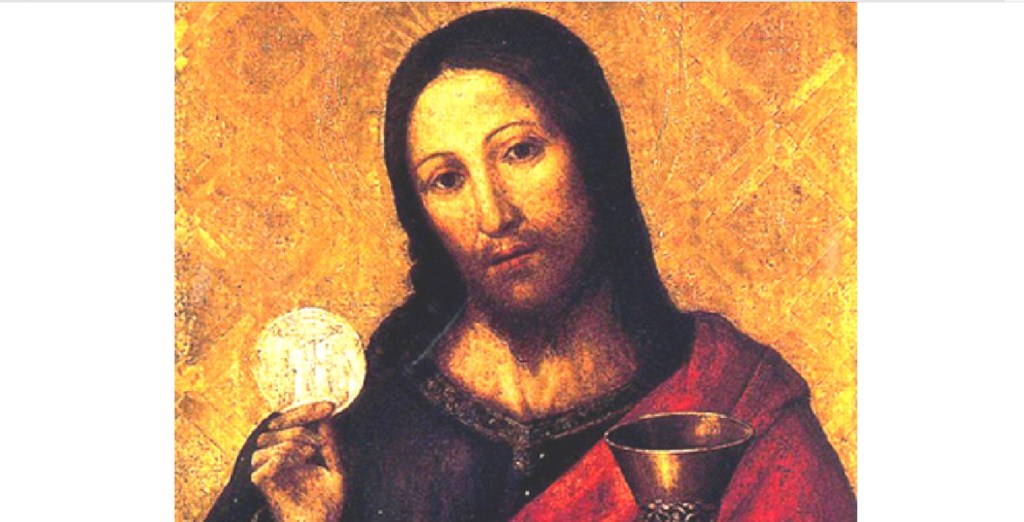
Photo: Accessed from Roman Missal. p. 497. Jesus showed his love for us in giving us all of himself on the cross, holding nothing back.

Martin, Francis and Wright VI, William M. The Gospel of John. Grand Rapids, MI: Baker Academic, 2015.

Link for the Mass readings for Thursday, May 5, 2025

Slowing down will help us to be one as Jesus and his Father are one.

“Holy Father, keep them in your name that you have given me, so that they may be one just as we are one” (Jn 17:11).

Jesus is well aware of the temptations of the world, recognizes that the disciples will need the protection of his intercession, that they will remain faithful only if they remain in his love and in relationship with him. The unity that the Father and Son share is an eternal and infinite communion. Jesus, as the Son of God, continued to be one with his Father, while fully experiencing his humanity. As a human being, Jesus faced the same temptations present in this world that we face. The difference is that with each choice that he made, as a human being with a free human will, he chose to be faithful to his Father at each and every opportunity, and so his unity of his humanity remained intact and deepened.

Jesus sought the same unity that he shares with his Father for his disciples and he seeks the same for us today. His hope is that we may be one as he and the Father are one. Yet, he is not going to pull us out of the world for that to happen. “I do not ask that you take them out of the world but that you keep them from the Evil One” (Jn 17:15). The disciples then and us today, are to do as Jesus did. We are to welcome the invitation to be in a relationship  with God, come to know his will, and share it with those we encounter in our realm of influence. We are not to be transformed by the world, but we are to allow God to transform us by the renewal of our minds and hearts. As we do so, we can also bring Jesus’ light into the darkness as God works through us one person at a time.

Following the will of God is not easy. Many distractions, diversions, and temptations pull at us and attempt to draw us away from being faithful and true to God, ourselves, and who God calls us to be. Many times these distractions not only appear to be, but are good. The challenge is not whether we are good or evil, we are being good or doing good, but are we doing God’s will, are we doing what God is calling us to do?

Being able to stop, be still, quiet our mind, and just breathe for a sustained period of time can help us to learn to recollect. Often when we attempt to spend time in prayer, we finish at the moment we are really just getting ready to begin and wonder why nothing is happening! Making time to recollect grants us the opportunity to transition from the busy to making friends with silence.

We can deepen our relationship with Jesus and his Father when we slow down our pace, become still within, because we are better able to hear his voice. We are also in a better place to receive the gifts that the Holy Spirit seeks to impart, his guidance to discern his direction, as well as the courage to follow his will. If any fear or anxiety arises, we just need to remind ourselves to trust that God will provide the means and support we need, for we are not meant to do what he calls us to do on our own.

St. Mother Teresa taught that, “in the silence of the heart, God speaks.” We are better able to recognize God’s voice and the people he places in our lives to help us when we embrace consistent moments of stillness. We are better able to identify the temptations and pitfalls along path when we go slower. We grow in discipline, persistence, and dedication when we allow ourselves to be nourished by God’s love and encouragement. When we are willing to change, to be transformed, to grow, and take the risk to trust in Jesus, we, like the disciples, will experience the love and oneness Jesus and his Father seek to share with us.

————————————————————————–

Photo: Meditating on the Glorious Mysteries (back in April before the newest renovations).

Link for the Mass for Wednesday, June 4, 2025

May we experience the love of God, so we can know him and each other better.

“Now this is eternal life, that they should know you, the only true God, and the one whom you sent, Jesus Christ” (Jn 17:3).

This is our goal, to know God. Eternal life, or heaven, is not only experienced when we die. Through experiencing the life of Jesus we can have a foretaste of heaven now. We can experience this as the joy that rises up from within, that is not merely pleasure, which is a response from the stimulation of our senses and which dissipates once the experience ends. Nor is joy even happiness which comes from the lasting memories of these pleasurable experiences. The experience of joy is not based on external situations and sensations, joy comes from an encounter with the living God who is present to us, closer to us than we are to ourselves.

We often first experience this joy, this closeness to God when we experience love exchanged between ourselves and another. Even a love that begins in infatuation is a drawing out of ourselves toward another. The hope is that this love matures and develops into a friendship.

This maturation happens when we spend time getting to know each other’s interests, goals, and dreams. We experience another as a person, and with time and continued trust, we begin to risk and allow our masks to be taken off. Inevitably, when relationships begin to mature, they will go through times of miscommunication, misunderstanding, and conflict. The relationship will come to a crossroads, but this does not mean that the relationship will come to an end. If the relationship devolves into abuse, dehumanization, and self-gratification alone, the relationship will end. But if there is a willingness to forgive, to work together, to meet each other with humility and seek mutual understanding, relationships will grow stronger and deeper. This is the fertile soil where love grows.

Our first experience of developing relationships is in our families. None of us are perfect, so none of us have had a perfect family life. Familial relationships develop in a similar fashion as listed above. We all go through ups and downs. The more that we can be present to one another, support one another, communicate and love one another, the more likely our familial relationships and friendships will also mature and grow.

Many of us hope to attain a place within where we can accept and love ourselves and develop mature relationships with a core group of family and friends. Most of us could be quite happy with that. Even as Jesus invites and guides us to reach this point of development, he continues to press us to strive to love beyond family, friends, and tribe. All of us are ultimately called to an unconditional love that sees in others a brother and sister seeking to be better stewards of God’s creation. This is not some utopian philosophy. Love happens through one concrete encounter, one person at a time. As we love God and one another, we lift all of humanity and creation up.

This will not happen through our own will power or discipline alone. Placing self over God and others, isolates and disconnects us from the True, the Good, and the Beautiful. God is not some transcendent, impersonal force, nor is God an omnipotent, tyrannical overlord. The God of Jesus Christ is a God of love, for “God is love, and whoever remains in love remains in God and God in him” (1 John 4:16). Jesus invites us into a relationship with him and his Father to experience the love of the Holy Sprit. When we assent to this invitation, we come to know and experience a foretaste of heaven on earth.

Jesus, please help us to experience the love of God by coming to know you, and in truly knowing you come to better know each other. May we see each other as God our Father sees us, as a unique gift that has never been nor ever will be again. Help us resist reacting to the rough edges and exterior projections of our inner wounds and instead guide us to be more compassionate and understanding, and willing to see the truth and fullness of the potential of each person. Help us to allow God to love others through us today, one person and one encounter at a time.

———————————————————

Photo: “The Father does not love us any less than he loves his only-begotten Son. In other words, with an infinite love” – Pope Leo from his Sunday, June 1, 2025 homily. (credit fromDaniel Ibáñez/CNA/ EWTN accessed from ncregister.com).

Link for the Mass readings for Tuesday, June 3, 2025

We are never alone, the Father is always with us.

The disciples are beginning to have a better understanding that Jesus is who he says he is, that “he came from God.” Jesus does not rest on or savor this insight and affirmation, but shares with them how, they still do not fully comprehend. He lets them know how each will leave him alone in his most desperate hour. They will do just that. Those he takes with him into the Garden of Gethsemane will fall asleep. When Jesus asks them to watch and pray with him, to be a support for him as he receives the crushing will of the Father that leads him to the cross, they fall asleep multiple times. When the guards come to arrest Jesus, led by Judas, the disciples would flee. Peter will then betray him three times.

What is interesting is that just as Jesus shares with them, that even though they, his most intimate followers, his closest friends would betray him, he says: “I am not alone, because the Father is with me. I have told you this so that you might have peace in me. In the world you will have trouble, but take courage, I have conquered the world.” 

These words are words of comfort and hope. Comfort and hope for his disciples then as well as for us today! No matter if we betray or are betrayed ourselves, we let others down or are let down, we see and experience the devastating effects of our fallen world and fallen human nature, from without and within; no matter what conflict, challenges, or tribulations rise up before us, we do not need to succumb to cynicism, hopelessness, and despair.

What is important is that we resist the temptation to curve in upon ourselves and drink from the poison of shame. In doing so, we cut ourselves off from the very source of our life and being. Having the humility to acknowledge where and when we have caused harm in any form requires embracing a healthy sense of guilt which is good. Then, instead of beating ourselves up, we are to seek forgiveness and reconciliation as well as be understanding and willing to forgive.

We also need to remember that in those times when we feel misunderstood, betrayed, or are facing the unbearable in life, we are not alone! Jesus, who experienced the same. reveals to us the way to his Father because Jesus is the Way! Seeking affirmation from the culture or the world is not the way. Our priority instead is build our relationship with Jesus, who will lead us to the Father so to experience the Love of the Holy Spirit!

Jesus is the light that shines in the darkness, and he will not be overcome by it, for he has conquered death, and has overcome the world. We are an Alleluia people because through our participation in the life of Jesus the Christ we will overcome as well when we trust in and experience the love of the Father. As an Alleluia people, we are to resist being shaped by the culture and the world, and are to instead evangelize it by authentically living out the Gospel and will of our Father as Jesus did; by sharing the light, joy, peace, and love of Christ we have received in each our interactions with one another.


Photo: The more we slow down and breathe, receive, rest, and abide in the love of God, we will know no matter what we are experiencing, we are not alone.

Link for the Mass readings for Monday, June 2, 2025

Jesus ascended up but not away! He is now closer to us than we are to ourselves.

For many of us, when we hear about the Ascension of Jesus we can be just as confused as the disciples who as recorded in the Book of Acts were standing around, looking at the sky. Also, depending on where we live, will depend on when we celebrate this solemnity. If you live in the ecclesiastical Provinces of Boston, Hartford, New York, Newark, Omaha, and Philadelphia you already celebrated Ascension Thursday on its traditional day, this past Thursday. For the rest of the country, as we do here in Florida, it is a holy day of obligation celebrated today, on Sunday. The reason for Ascension Thursday is that the Ascension of Jesus took place 40 days since the Resurrection and 10 days before Pentecost.

The Ascension is just as significant as is Jesus’ suffering and death that we remember during Lent and his Resurrection that we have been recalling during this Easter Season. Regarding what the Ascension of Jesus is, sometimes, we can understand a term better by saying what it is not. The Ascension was not an event where Jesus went up, up, and away in a beautiful balloon, or Superman zipping away to destroy an asteroid hurtling toward the earth.

The Ascension is the culminating event of the Paschal Mystery of Jesus Christ. Jesus who as the Son of God became a human being like us in the Incarnation, lived among us, experienced the joys and sufferings of life like all of us in all things but sin. Yet, Jesus took our sins upon himself on the cross. Jesus died, entered into the utter godforsakeness of death and conquered death. He rose again through the power of the Love of the Holy Spirit, not as a ghost or a spirit, but still fully God and fully man, yet his body was transfigured. In his glorified body, Jesus became the first born of the new creation.

For forty days after his Resurrection, Jesus spent time with his disciples. “Forty days (or the number forty in general) always symbolizes a time of transition, a time of purification and a time of preparation for a new stage” (Pitre). This is evident in the Noah flood account. God cleansed the world from sin and established a new covenant with Noah and his family setting the stage for a new beginning. Moses spent 40 forty days meditating with the Lord to give the people new commandments and a new covenant charting a new course for those that God had freed them from slavery in Egypt. Jesus himself spent 40 days in the desert, a transition time after his baptism and before beginning his public ministry, preparation to face the devil, and resist his temptations.

Jesus also spent forty days with his disciples after his Resurrection, to prepare them, to help them to understand the truth of the kind of Messiah he was. Not a political and military leader, but the suffering servant of Isaiah. The Son of God was sent by his Father to defeat Satan, undo his strongholds, and free us from our slavery to sin by giving his life and conquering death. He commissioned his apostles to go out to do as he had done, to cast out demons, to heal, to preach with authority, to preach repentance, and to forgive sins. They were to be martyrs, witnesses by their life, teaching to the Jews first but as well to all nations, and even giving their lives as Jesus had done to promote the faith Jesus passed on to them.

Then at the appointed time, just as Jesus descended from his Father in heaven, he would return. This time though he would ascend fully divine as well as fully human. Jesus led his followers “out as far as Bethany, raised his hands, and blessed them. As he blessed them he parted from them and was taken up to heaven” (Luke 24:50-51).

This was no simple goodbye gesture. Jesus revealed in this action his role as high priest. He blessed his followers as the high priest, Aaron, blessed the people after he had made the sacrificial offerings for their sins (cf. Leviticus 9:22). With this blessing offered, Jesus “parted from them and was taken up to heaven” (Luke 24:51). As Bishop Robert Barron explains: “The Ascension is the translation of this earthly reality into a heavenly reality.”

Jesus is no longer limited by the time and space of our present three dimensional realm. He transcends our recognized dimension and now exists at a higher pitch of existence. Just as Jesus passed through the locked door to bestow peace on his disciples, Jesus ascended to offer himself to his Father in the heavenly Temple. As we heard in the letter to the Hebrews: “Christ did not enter into a sanctuary made by hands, a copy of the true one, but heaven itself, that he might now appear before God on our behalf” (Hebrews 9:24).

Jesus gave himself as an offering for our sins and did so once for all and for all time. This is why Jesus is present to us at every Mass on Thursday or Sunday or any time that the Mass is celebrated anywhere in the world. Jesus is present to us where two or more are gathered in his name and he is present when we proclaim, read and pray with the words of the Bible. Jesus is present to all of us everywhere because we are united as one in his abiding love!

Through the event of the Ascension, Jesus brings something of our humanity to heaven and at Pentecost, which we will celebrate next week, he sent something of heaven to us in the descent of the Holy Spirit. And who is the Holy Spirit, but the Love that is breathed, that is shared between the Father and the Son.

What the Ascension means for us is that we are no longer separated from the reality of heaven. St Irenaeus wrote that, “Jesus opened up heaven for us in the humanity he assumed.” Our relationship with God our Father is made possible again because of the Ascension of Jesus. The biblical images foretell this great event, as the sky was torn open at the baptism of Jesus (Mark 1:10), as the veil was torn in two outside the Holy of Holies (Matthew 27:51) in the temple at the moment of his crucifixion, and as Jesus ascended in the fullness of his glorified body, with our humanity, to return to the right hand of the Father.

Heaven and earth have been wedded. We become part of the Church, the bride of Christ through our Baptism, we are nourished in receiving the Eucharist, and empowered in Confirmation. Through our baptism we are grafted, conformed to, and become an organic part of the Mystical Body of Christ. We are transformed, divinized, participate in the life of God through our participation in the life of Jesus. We are made holy, our image to God is restored. Jesus blesses through the priest at the end of every Mass and sends us as he did his apostles and the saints of each successive generation “to go into the whole world and proclaim the gospel to every creature” (Mark 16:15).

Having heard this Good News of the Ascension, let us not, as the two angels said about the disciples, just “stand around looking at the sky” (Acts 1:11) but go forth and share the love of his very being that we receive in the Eucharist and invite all to participate on earth what is celebrated in heaven, the love of the communion between the Father, and the Son, and the Holy Spirit. Amen! Alleluia!!!


Photo: View as I walked out of the sanctuary of St. Mark the Evangelist after celebrating my first public Mass in Spanish for the vigil of the Ascension.

Brant Pitre’s commentary on the Ascension

The Mass readings for the Sunday readings of the Ascension, June 1, 2025

May we be instruments of joy!

“But I will see you again, and your hearts will rejoice, and no one will take your joy away from you” (Jn 16:22). Jesus continues to prepare his disciples for his horrific death by offering hope that he will see them again. That he will see them again is not a typo. We can read about the exchanges between Jesus and his risen disciples. Jesus appeared to Mary of Magdalene at the tomb, he appeared to Cleopas and his companion on the road to Emmaus, and he appeared to the ten and then the eleven with Thomas. Jesus sought out those he commissioned to proclaim his Gospel message after his resurrection, just as he had done during his ministry before his crucifixion.

When Jesus did appear to them again, at the moment of recognition, there was wonder and great joy! It is hard for us to even imagine these early resurrection accounts. The disciples witnessed his brutal death, lived in fear because of the very real possibility of their own persecution and similar death, and then, they encountered the risen Jesus. St Paul would also shortly thereafter encounter Jesus on a different road, the one to Damascus en route to continue his persecution of the followers of Jesus. All of their hearts rejoiced and it was this joy that they proclaimed with boldness. The Apostles, like Jesus, led with joy and love to embark on their evangelical missions. They lived a difficult and challenging life that for many ended in their own brutal deaths, yet their joy carried them through their suffering, death, and into eternity.

Life is hard, even in the best of circumstances. There is evil present in this world, not of God’s creation, because all that he has created is good. Through the enemy’s corruption of the good that God has created, bad things happen to good people, and good people do bad things. Suffering, disease, violence, natural disasters, division, corruption, hatred, and dehumanization abound. It can be easy to succumb to the overwhelming tide of negativity and assume a mindset of cynicism, detachment, denial, defensiveness, and/or indifference. Yet this is not the response Jesus modeled nor has infused his followers through the ages with.

Our response to the evil and darkness of this world is to be bearers of the joy of Jesus! We are to be as lights shining in the darkness, providing hope for those in despair, accompanying those in their struggles, and being willing to receive help when we ourselves are in need. We cannot do any of this alone and on our own but it can be done in participation with Jesus and each other. The Apostles, disciples, and saints, who have gone before us, have shown us that it is possible to be beacons of hope in very dark places.

Pope Francis reminds us about our mission in The Joy of the Gospel (276): “However dark things are, goodness always re-emerges and spreads. Each day in our world beauty is born anew, it rises transformed through the storms of history. Values always tend to reappear under new guises, and human beings have arisen time after time from situations that seemed doomed. Such is the power of the resurrection, and all who evangelize are instruments of that power.”

With each breath, we are invited to trust that Jesus is with us, closer than we are to ourselves, filling us with his love and joy. No one can take this joy away from us, except us, if we are unwilling to share it. Let us choose to allow the light and the joy of the Holy Spirit’s love to radiate through us, no matter how small or insignificant an act of kindness it may seem. When we do so, the darkness in our realm of influence will begin to fade away.


Photo: With my brothers in our final days of seminary. Please pray for us that we may continue to live, speak, and spread the joy of the Gospel!

Link for the Mass readings for Friday, May 30, 2025

Knowing Jesus helps us to experience our grief and our grief will become joy!

Jesus continues his farewell discourse and appears to be speaking in riddles: “A little while and you will no longer see me, and again a little while later and you will see me” (Jn 16:16). We who know what is coming for Jesus understand what Jesus is talking about, but for the disciples, not so much. Jesus will be crucified and rise again from the dead. Jesus then goes on to explain further that: “Amen, amen, I say to you, you will weep and mourn, while the world rejoices; you will grieve, but your grief will become joy” (Jn 16:20). Jesus is speaking about the same two points of reference, his Crucifixion and Resurrection.

Yet, his “explanation”, would not help to clarify for his disciples. This clarification would only come when the Comforter comes, when the Holy Spirit, sent by Jesus would come to reveal to them the truth of Jesus after they experienced his resurrection, time with them, and then ascension. First, they would all have to endure with Jesus his passion, suffering, and death on the cross.

The most brutal sign of oppression during the reign of the Roman Empire was the cross. It was a weapon of terror, torture, an extreme case of punitive justice or capital punishment, and in actuality state-sanctioned terrorism. The person would be stripped of all their clothing, would be nailed by the wrists, or palms, and wrists tied, nailed by the feet, and then lifted up for public display. Then would begin their humiliation, dehumanization, and long agonizing death; a sign for anyone to think twice about challenging the authority of Rome.

The disciples wept and mourned, their hopes dashed, they were stunned, ashamed, and demoralized, while others rejoiced as Jesus and the two others beside him were lifted up. The centurions flaunted their authority and prowess. Others gathered around and jeered at who they believed to be another false prophet dying on Golgotha, the hill of the skull, where so many had gone before. Where other hopes and dreams had been crushed under Roman dominance and oppression.

Jesus was sometimes described as being hung on a tree in some letters of the New Testament because writing the word, cross, was still too raw and vivid in people’s minds. This is also why there are no depictions of Jesus on the cross before the year 200 AD, and the earliest known believed to be the Alexamenos graffito was a mocking not complementary etching of Jesus on the cross. Yet, this was not the final chapter. The grief of the Apostles would turn to joy when Jesus conquered death and rose again. The cross, this symbol of torture, would become a sign of victory over death and the grave.

Yet, one centurion got it right: “Truly this man was the Son of God” (Mk 15:39)! For many Christians today, the Crucifix and Cross are no longer a sign of oppression and fear but are displayed as a sign of the triumph and victory that Jesus has won for us. They are not magic talismans, but they are sacramental signs, concrete objects that are tangible, that we can see, wear, and hold on to. Not because of some macabre fascination with death but for the purpose of reminding us that we have a God who understands our humanity because he lived life as we do. He suffered with us in our suffering and experienced pain as we do.

Jesus cried as we cry, he laughed as we laugh, and he enjoyed table fellowship with friends as well as those on the peripheries. Jesus faced rejection, misunderstanding, trials, and tribulations, he overcame conflict and rejection, he died as we will die, yet his death was not the end. Jesus conquered death, so that through our participation in his life and resurrection we have the opportunity to rise again in Christ as well.

We are still in the Easter Season, and are drawing closer to celebrating the Solemnity of the Ascension when Jesus returns to the Father. It may seem odd, but meditating upon a crucifix is a good practice not just In Lent but anytime, even in Easter, because we are reminded of what Jesus went through and what he overcame. When we are going through a particularly rough patch, we can hold the crucifix, feel the wood, allow our gaze to fall upon the face and wounded body of our Lord. When we allow him, Jesus will embrace us with his arms outstretched to ease our suffering and pain, and also help us to overcome as he did.

Jesus is and continues to be present with us, closer even than the crucifix we hold or look upon. Even if we do not feel Jesus present, he is! Even when we pray daily and feel nothing is happening, Jesus is close, closer to us than we are to ourselves. The apostles experienced the life, death and resurrection of Jesus, their time together after the resurrection and up to his ascension, and then his leaving them again. It was not until the Holy Spirit was sent to them though that they truly got it, and saw the truth of who Jesus is. Then looking back they were able to connect the dots. Their grief became joy, and so can our’s.

——————————————————————–

Photo: We adore you, O Christ, and we praise you, because by your Holy Cross you have redeemed the world.

Link for the Mass readings for Thursday, May 29, 2025