Following Jesus and St. James, we can learn to listen, love, and serve.

“The mother of the sons of Zebedee approached Jesus with her sons and did him homage, wishing to ask him for something. He said to her, ‘What do you wish?’ She answered him, ‘Command that these two sons of mine sit, one at your right and the other at your left, in your Kingdom’” (Mt 20:21-22).

The context of this request from the mother of the sons of Zebedee, James and John, comes from reading a few verses before the quote above. Start reading at Matthew 20:17 and you will see that Jesus and his twelve apostles are heading toward Jerusalem. Jesus stops to share with them, for the third time, that he will be condemned and crucified.

Jesus’ statement of his imminent suffering and death appears to be ignored by the mother of James and John. The other ten are indignant, not because of the apparent lack of acknowledging Jesus’ statement, but about who is the greatest among them! It is easy to imagine how a chaotic scene could then insue! As Saint John Chrysostom wrote: “See how imperfect they all are: the two who tried to get ahead of the other ten, and the ten who were jealous of the two” (Chrysostom 1975, 1552)!

This event is recorded in Matthew, Mark, and Luke. Mark has James and John speaking for themselves, not their mother, as in Matthew. Luke does not even record the initial request of James and John at all but comes in at the point of the apostle’s dispute. What all record, including the Gospel of John, is Jesus’ interjection where he made it clear to his apostles that he came to serve, not to be served. To follow Jesus meant, not that James and John would be given positions of honor and power in the worldly sense, the sitting at his right or his left, but that they were to serve as he served, to love as he loved.

As disciples of Jesus, one of the most powerful ways we can serve, the most powerful ways we can love, is to be truly present, done most effectively when we actively listen. This is done when we look at each other, resist the temptation of thinking about our own needs, and/or thinking about what we are to say. We put the book down, set the work aside, turn off the tv, put away the cell phone, disengage our thoughts, and instead look at and listen to what the person before us has to say.

This discipline becomes easier when we are willing to do the same with God who we can’t see. We do so when we are willing to be still, to stop, breathe and set everything aside, even our thoughts, to be present with and listen to Jesus. One does not have to come before the other. In the course of the day, it is good to have quiet times with Jesus and also intentional time with family members, friends, colleagues, as well as those to whom, in the past, we may not have given the time of day.

Jesus came to love, to listen, and to serve. May we too give of ourselves with our time and undivided attention toward those he directs us to love, listen, and serve. When we are present with one another the other gift of grace is that we experience the love of the Holy Spirit between us. St. James surrendered his pride and learned this practice well, and he has helped me on multiple occasions. St. James, pray for us!

—————————————

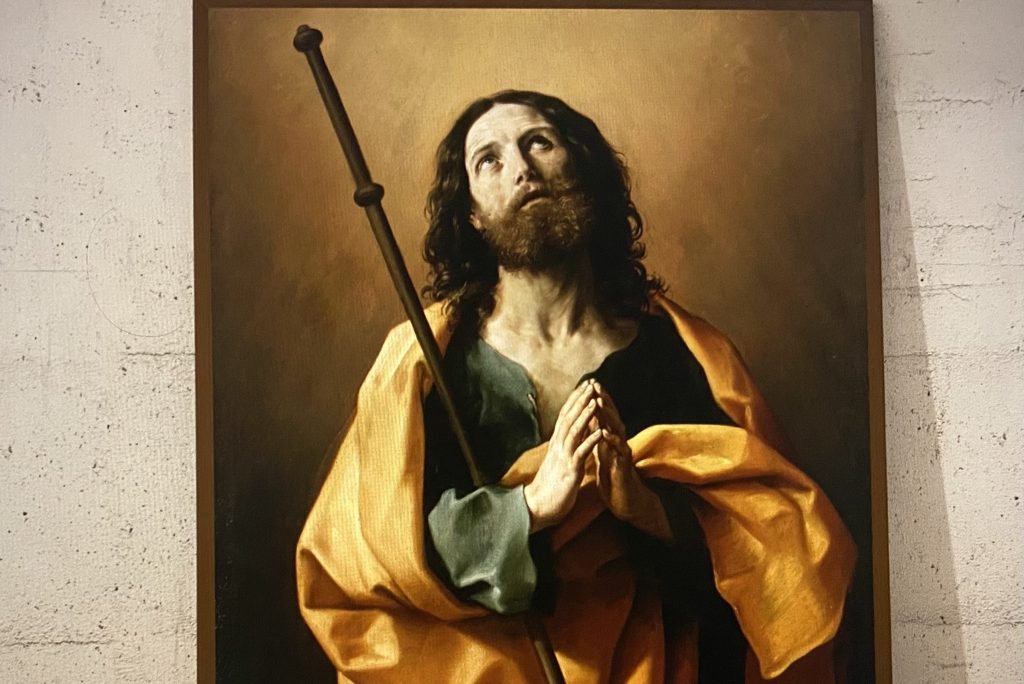
Painting: St. James by Guido Renin (1636-38)

Chrysostom, St John. Homily. The Liturgy of the Hours: According to the Roman Rite. Vol. 3. NY: Catholic Book Publishing, 1975.

Parallel Gospel passages to review:
Mark 10:35-45; Matthew 20:20-28; Luke 22:24-27 and John 13:12-17

Link for the Mass readings for Thursday, July 25, 2024

Stillness counters the threat of thorns.

“Some seed fell among thorns, and the thorns grew up and choked it” (Mt 13:7).

God wants all of us to be in relationship with him. His love for us in unconditional. He is willing to risk that we will say, “No” to his invitation of relationship rather than force us to love him, which is not love at all. God also wants the best for us, he knows the deepest desires of our heart beyond our even knowing for he sees the fullness of time, while we only see and experience a small part.

Jesus came to share the seed of his Father’s word through the teachings, healings, and exorcisms that he offered. We are recipients of each through the deposit of faith passed on generation after generation. One area that prevents us from allowing his seeds to germinate and bear fruit in our lives is when we allow the diversions, distractions, anxieties and worries to fill our mind such that they choke out the good that Jesus seeks to have develop within us.

On a physiological level, what we pay attention to fires neurons in our brains that form neural pathways. Each time we are attentive a new pathway is formed. After time, this is how our habits form and why after we do something consistently and are disciplined, the act is easier to do. It is also why a habit is hard to change in the beginning because we need to rewire those pathways.

To prevent the growth of our spiritual life from being choked out we need to practice each day stillness and focusing on God’s word. As we consistently sit in the same place each day, spend some time breathing and then focusing on reading a passage of scripture, praying, and/or pondering what God may be sharing with us, for that time we do so, we are to focus on Jesus alone. As thoughts and diversions to the contrary arise, we just bring ourselves back to Jesus and God’s word.

In time, with consistent, daily practice, we will begin to feel safe, we will experience God’s love and presence, his insights and guidance, we will heal, we will rewire our neural pathways such that it becomes easier to pray than not to pray. The thorns lose their sting, the distractions, temptations, and diversions lose their power as we begin to recognize God’s voice and follow his guidance.

Turning around unhealthy or sinful habits is not easy. When we decide to make time to spend time with God each day, while together we are attentive to only to him for that time we set aside and return to him as soon as we notice we are distracted, his seed with grow within us. Even when we feel like nothing is happening, God is happening, and we are growing and maturing.


Photo: Rooted and abiding in God’s love, we can grow free of that which seeks to choke us. Rosary walk Vero Beach, FL.

Link for the Mass readings for Wednesday, July 24, 2024

Following the will of God helps us to grow closer to Jesus and each other.

What Jesus proposes is not an either/or statement, but is meant to be a both/and statement. The end goal of our life is to be in communion with God. To attain that goal, we need to not only acknowledge that God exists but also come to know and follow God’s will. As Jesus said, “For whoever does the will of my heavenly Father is my brother, and sister, and mother.” (Mt 12:50). The challenge is that there is so much that pulls at us for our attention, so much that reaches out to divert us. People, activities, material pursuits are all vying for first place for our minds, hearts, and souls.

Then there are the challenges, demands, joy and wonders of family life. We often read, hear, and experience ourselves, how much the family is being challenged in our modern age from without and within. Many of us strive to put family first in our lives. That ought to and needs to be a priority as healthy relationships require commitment, love, sacrifice, and persistence. What Jesus offers then seems to be counter-intuitive to that reality.

Jesus is interrupted while he is teaching, and told that his mother and brothers were there wanting to see him. We would think he would say, “Great! Bring them right in, I have a place reserved for them here, front and center!” Yet, I am sure that his comment, “Who is my mother? Who are my brothers” (Mt 12:49), raised a few eyebrows and hackles.

Jesus was not choosing his disciples over his family, he was clarifying that the primacy of place of God his Father is to be first and foremost. “For whoever does the will of my heavenly Father is my brother, and sister, and mother” (Mt 12:50). Families come in many different shapes and sizes, one size indeed does not fit all. Building our relationship with our heavenly Father is the foundation toward striving toward healthier relationships.

As our ego and self-centeredness become less of a focus, we slowly come to realized we are not the center of the universe. This is no overnight or easy process, but as we surrender a little more each day to the truth that God is our Father and Jesus is our Lord, we will begin to experience the love of the Holy Spirit a little more. As the relationship of God becomes foremost in our life, we will begin to change. We will become more patient, understanding, less reactive, and more present to one another.

As we continue to mature in our spiritual life, we will also begin to experience the fruit of the Holy Spirit: love, joy, peace, patience, kindness, goodness, gentleness, and self-control (cf. Galatians 5:22-23). In sharing what we have received, we will be more available to others and better able to foster deeper relationships with our own family members, while at the same time experience a larger extended family, with those beyond blood. Let us surrender ourselves and all of our relationships to and entrust them into Jesus’ care.

Who was the closest relationship Jesus had? Mary. Not because she gave birth to him, but because who better than Mary followed the will of his Father? If life with some family members is a little bumpy right now or you just want to deepen your familial bonds, begin your day with Mary and say often, “May it be done to me according to your word” (Lk 1:38) and let God happen.


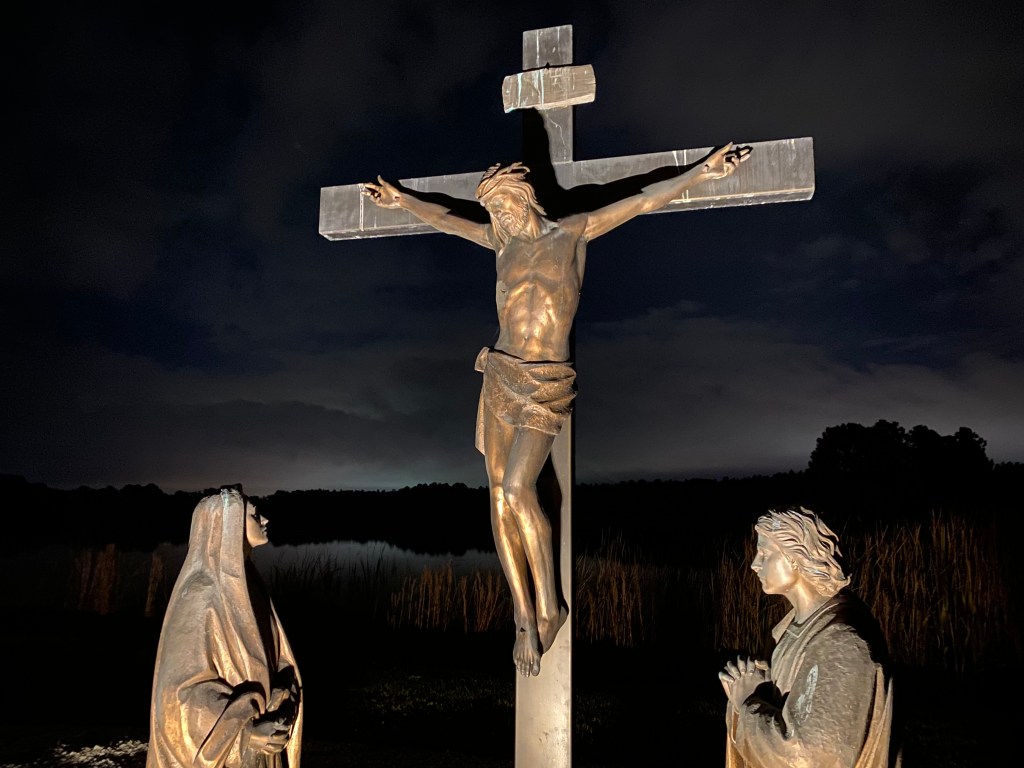
Photo: Mary and John followed Jesus all the way to the Cross. While on canonical retreat last December at Bethany Center, Lutz, FL.

Link for the Mass readings for Tuesday, July 23, 2024

Jesus will help us to discern when to walk away and when to stand firm.

In today’s Gospel from Matthew, Jesus realized that: “The Pharisees went out and took counsel against Jesus to put him to death” (Mt 12:14). Jesus did not then start to plan how he would defend himself against their plot, he did not arm his supporters, nor is there any indication that Jesus let the fact that he was a marked man bother him. What did Jesus do with this bit of news?

“He withdrew from that place” (Mt. 12:15) and cured those who followed him. Was Jesus being a coward by withdrawing? No. Jesus refused to engage or give any of his time or energy to their negativity or threat. He focused on what he was about and that was continuing the mission that God had sent him to achieve, which was to help bring about the salvation of humanity and the world and to call those who would work with him to continue his mission.

Many of us will hopefully not receive death threats, but many of us have and may witness and/or receive critical, negative, belittling, or dehumanizing looks, words, and outright actions to cause physical, mental, emotional or spiritual harm. For those of us who choose to practice publicly the teachings of Jesus, we may receive even more!

Our common response to the many forms of perceived or actual animosity directed toward us is to react. Our reactions generally are based on learned defense mechanisms we have adopted. Often when we react, we slip into survival mode, experience increased anxiety, defensiveness, anger as well as a myriad of other emotions. Hopefully, as we mature in our faith we will resist reacting, remember to breath, and call upon God’s guidance to direct us such that we can be less reactive and more attentive to how to act as advocates of God’s grace.

Life is short, let us not take a day or moment for granted, nor give away our precious time by engaging in unneeded drama or negativity. There are times that we do need to stand and speak up. Other times, as Jesus did today, we need to walk away and direct our energies elsewhere. With each challenge, may we call on Jesus for his discernment on how best to act in each situation.

The words of Teresa of Avila, Spanish saint and doctor of the Church, (1514-1582) are good ones to repeat and meditate upon: “Let nothing disturb you, Let nothing frighten you, All things are passing away: God never changes. Patience obtains all things. Whoever has God lacks nothing; God alone suffices.”


Photo: Jesus walked away from today’s threat but was willing to endure the greatest suffering of all when his appointed time had come to save and restore us to the Father. Praying in the sanctuary of Holy Cross, Vero Beach.

Link for the Mass readings for Saturday, July, 20, 2024

In Jesus, we are grounded and renewed.

“At that time Jesus exclaimed: ‘I give praise to you, Father, Lord of heaven and earth, for although you have hidden these things from the wise and the learned you have revealed them to the childlike’” (Mt 11:25).

Why did the wise and the learned, referring to some of the Sadducees, Pharisees and scribes, reject Jesus? One possibility is that Jesus challenged their idol of tradition. Even though Jesus did not come to abolish the law but to fulfill it (cf. Mt 5:17), the invitation to go deeper was and continues to be challenging. This is certainly highlighted in the six antitheses that Jesus shared during his Sermon on the Mount. Here is one such example: “You have heard that it was said, ‘An eye for an eye and a tooth for a tooth.’ But I say to you, offer no resistance to one who is evil” (Mt 5: 28). Offer no resistance to one who is evil? Not only hard to swallow for people of Jesus’ time, but for us today as well.

Jesus offered then and continues to offer us today a share in the intimacy of the Trinitarian Love of God shared between Father, Son, and Holy Spirit. To be fully alive, to share in his Love, we need to resist being governed by holding blindly on to tradition for its own sake. Instead, we need to be open to growth, change, and renewal. Gerhard Lohfink, in his book, No Irrelevant Jesus, quotes the Polish philosopher Leszak Kolakowski: “A society in which tradition becomes a cult is condemned to stagnation; a society that tries to live entirely through revolt against tradition condemns itself to destruction” (Lohfink 2014, 2).

Many have left the Church because they feel we are too steeped in tradition, rules, and laws, and yet in doing so, they have left behind the secure ground or foundation, with no anchor in their life. On the other extreme are those who remain hunkered down, entrenched in a bunker of tradition fearing the secular tide, grasping, white knuckled, to tradition, but this stifles their growth.

Both tendencies are insufficient because at root there is not a trust in Jesus. Jesus helps balance the tension between these two. He invites us to remain anchored in the Truth of the deposit of faith that he has given to us while encouraging us to go deeper in our understanding, practice of our faith and relationship with our God. If we are not moving forward in our spiritual lives, we are moving backward.

We are better when we resist the extremes of rejecting tradition altogether or idolizing tradition alone, and instead build on the foundation of Jesus Christ: “The Way, the Truth and the Life” (cf. Jn 14:6). Within the life of the Church, “we must not do away with its traditions, but at the same time, it must continually clarify, renew, and deepen them” (Lohfink 2014, 2).

—————————————

Photo: Rosary walk last night – Riomar Beach, Vero Beach FL. Just like the ebb and flow of the tides we must allow for a rhythm of expansion and contraction in our faith journeys. We are called to be grounded in Jesus and stretched beyond our comfort zones as well!

Lohfink, Gerhard. No Irrelevant Jesus: On Jesus and the Church Today. Minnesota: Liturgical Press, 2014

Link for the Mass readings for Wednesday, July 17, 2024

May we be willing to see and cut the ties that bind.

“Jesus began to reproach the towns where most of his mighty deeds had been done, since they had not repented.” (Mt 11:20).

Anyone who encounters Jesus is invited to change. Jesus shines the light of his love and mercy into the darkness of our own fallen nature, where we are wounded, sinful, and broken. He invites us to repentance, healing, and reconciliation. He invites us to actualize who we truly are. A wonderful invitation, but why would we turn away? The darkness may be too dark, or the light may be too bright.

Facing our own darkness and pain is not easy and can be frightening as well as intimidating. That is why we are so vulnerable to temptations, distractions, and diversions. We may not be able to sit still because we want to keep moving so as not to face our fears and the root causes of our suffering, nor let go of our false senses of security, control, and the glitter of apparent goods. We also may not be able to accept the fullness of our goodness, of who God calls us to be, and the realization of who we really are.

Jesus invites us to stop, to breathe, to enter into his stillness and silence where we can hear the word of his Father and experience the love of the Holy Spirit. In this experience of silence, we come to encounter the choice to change our hearts and minds. We are invited to repent: to turn away from and let go of that which keeps us from growing closer in our relationship with God and becoming more fully alive.

God loves us more than we can ever mess up, more than we can ever imagine, and he does not define us by our worst mistakes. Jesus’ arms are wide open to receive us in the midst of our deepest wounds, fears, pain, sin, and suffering but we must be willing to stop running and be still long enough to experience and feel his forgiving, loving, and healing embrace. At the same time, we need to be willing to accept who we truly are and called to be apart from our false self. We are often too self-critical and judgmental of ourselves which keeps us wrapped up in ourselves.

Our challenge is to accept who we are as God’s children and who he calls us to be. While at the same time, we are to surrender to Jesus and make him our Lord. All the saints have come to this same place in their encounters with Jesus. The light of Christ reveals their sin, and they see where God is calling them to go free of that which keeps them bound. And so, they begin to cut the chords and strings that bind. For a bird bound by even the smallest of strings will not be able to fly until the string is cut.

May we allow Jesus to reveal to us the chords and strings that bind us so that we can cut them and be set free from the fowler’s snare!


Photo: Moment of pause while on my Rosary walk on Veteran’s Memorial Island Sanctuary, Vero Beach, FL.

Link for the Mass readings for Tuesday, July 16, 2024

Jesus does demand a choice.

“Do not think that I have come to bring peace upon the earth. I have come to bring not peace but the sword” (Mt 10:34).

Words to live by from the King of Peace. The reality of this statement is the reality of his mission. Jesus entered the lives of individuals. Some said yes to following him and some said no; some saying yes and no within the same family. The image of the sword represents how sharp and stark this choice could cut. If you do not think that is true, just look at the political polarization in our country right now. The cut between democrat and republican, right and left, bleeds. And we unfortunately all witnessed the worst expression of that with Saturday’s shooting at former President Trump’s rally.

During the time of Jesus and for most within the first generation of believers, there was not a luke-warm choice. You were either for Jesus or against Jesus. Jesus was either very dangerous because he was leading people to believe he was God, he was distorting the teaching of the Jewish faithful and leading people astray, he was just crazy, or he was who he said he was. These choices would have divided families and friends. In today’s teaching, Jesus was not softening the choice. He said, “Whoever receives you receives me, and whoever receives me receives the one who sent me.”

If you believe in God, you will believe in Jesus. And the choice followed then that if one assented to that truth they followed Jesus first before anyone else. Before father, mother, brother, sister, husband or wife. Anything less is not worthy of a disciple. This stance will cause division because each person is free to reject or accept the truth of who Jesus is.

When Jesus said, “I have come to bring not peace but the sword” (Mt 10:34), he meant that we are not to settle for a false peace, a lethargic appeasement to just get along or to water down the Gospel message in the hope that others will receive it. Jesus demanded a choice from those who were to follow him then and in our time today. We are to decide whether or not we believe that Jesus is who he says he is or not. If he is, then we must follow him and put his teachings into practice which is even more of a challenge.

The good news is that Jesus, following the lead of his Father, meets us where we are and gently leads us with his tender chords of love. He is also there to pick us up when we fall, if we are willing to accept his help. We need to realize too that evangelizing does not mean we carry a mallet and bludgeon others with the true, the good, and the beautiful of our faith. We share our faith in the same way we have received it, through love, patience, and compassion. We meet people where they are and walk with them, build authentic relationships, and help them to know Jesus, develop a relationship with him, and then to slowly seek to understand and to put his teachings into practice together.

In following Jesus and putting into practice the words of the Prophet Isaiah by ceasing to do evil, learning to do good, and making justice our aim (cf. Isaiah 1:15-17), we will cause disruption and face conflict but when we trust in Jesus, respect each other as human beings, really listen to, seek to understand, and are present to one another, we will begin to see that we are beloved children of a loving God, brothers and sisters, fellow human beings, and we might just learn something from one another and maybe begin to move toward the reconciliation and healing our country so desperately needs.


Photo: E Pluribus Unum – Out of many, one – View from my Rosary walk last night at Riverside Park, Vero Beach, FL.

Link for the Mass readings for Monday, July 15, 2024

Jesus is calling and sending us as he did his Apostles.

“I was no prophet, nor have I belonged to a company of prophets; I was a shepherd and dresser of sycamores. The Lord took me from following the flock, and said to me, Go, prophesy to my people Israel” (Amos 7:14-15).

Amos is pushing back against Amaziah, the priest of Bethel, who told him to no longer preach in Israel. He was saying basically, if you want to preach, go back to where you came from, to Judah and preach to your people there. Amos wasn’t going anywhere. He was not there for profit nor did come through the company or guild of prophets or was he the son of a prophet. This was no profession for him, he came to Israel to share God’s message of repentance because God sent him to do so.

The Gospel message from Mark shows Jesus doing the same. He, the Son of God, who was sent by his Father, was now sending the Twelve who he had called and taught. They too, like Amos, were to rely solely on the providence of God, to trust him to give them what they needed for their ministry of going out, to evangelize; to share the good and what may be for some, the bad news.

They were to share the goodness of God the Father’s mercy, grace, forgiveness and love, while at the same time challenge the people to reform and change their lives, to repent from that which they were doing that was going against God’s will. The beauty of this both/and is outlined in Psalm 85: “Kindness and truth shall meet; justice and peace shall kiss. Truth shall spring out of the earth, and justice shall look down from heaven” (Psalm 85:11-12).

Too many times we can fall into an overemphasis on one or the other creating an either/or. A heavy-handed emphasis on justice and forgetting the tender compassion of mercy, or an overemphasis on mercy at the expense of justice. Jesus is the incarnate expression of the balance of both justice and mercy as presented in Psalm 85.

St. Paul outlines the richness of this balance in Jesus to the Church at Ephesus. For he writes, it is in Christ that we receive our blessing, in him: we receive our redemption and are forgiven, we hear the truth of his will, and we are chosen by God in Christ – before time began! We have been chosen to be holy, set apart by God for a unique purpose. We can reject or accept this offer for God loves us so much that he is willing to risk our, “No.”

Amos seemed to be saying to Amaziah that he was quite satisfied being “a shepherd and dresser of sycamores.” Yet, he assented to God’s call and went north. I understand. I was content in my teaching position and contemplating an earlier retirement, but when I asked God what he wanted me to do, he had another idea. I, like Amos, said, “Yes.”

The Apostles said, “Yes” as well and Jesus sent them out two by two. He was sending them out of their comfort zones and without the security of the material support. He was not sending them out unprepared, even though they were not to taking anything on their journey but the tunic they wore, their sandals, and a walking stick. Jesus sent them out with his authority and the commission, to preach repentance, cast out demons, anoint and cure the sick.

They were to trust and completely depend on God’s mercy and providence as they went out to evangelize. To evangelize, Jesus did not mean to advertise and convince. They were sent to share the Gospel and not worry about whether it was to be accepted or rejected. If accepted, they would stay with those who were hospitable and not leave if a better offer of lodging came along. If they were rejected, they were to “shake the dust off their feet.” They would move on. As St. Mother Teresa likewise taught her sisters, they were not sent by Jesus to be successful, they were sent to be faithful to what Jesus was sending them to say and do.

Jesus is calling us as well to repentance, so we can receive more of God’s love, be drawn closer into relationship with him, so that we can know and fulfill our own unique role in his plan of salvation history. This is a call that will stretch us beyond our comfort zones, it is a call to let go of the security in anything material and to rely and depend instead upon God first and foremost. We will face rejection and ridicule or worse, and yet, we will experience fulfillment, meaning, joy, and a love beyond anything we can ever imagine. Each day is a new opportunity to say yes to the invitation Jesus shares with us and he will provide what we need to follow him as we walk upon the path of our journey of discipleship one step at a time.


Photo: Spending some time with Jesus and the Apostles during my holy hour in our adoration chapel yesterday afternoon before celebrating the 4:30 Mass at Holy Cross Catholic Church, Vero Beach.

Link for the Mass readings for Sunday, July 14, 2024

Jesus leads us from the darkness of our fears into the light of his love.

Jesus said to his Apostles: “No disciple is above his teacher, no slave above his master. It is enough for the disciple that he become like his teacher, for the slave that he become like his master (Mt 10:24-25).

Following the teachings and guidance of Jesus was hard for his apostles and disciples then and it is just as challenging today. To live as authentic disciples, we need to learn from and put his teachings into practice. That means more than reading some of his teachings: love God with your whole heart, mind, and soul and your neighbor as yourself, turn the other cheek, and what you do to the least of my brothers, you did it to me, and acknowledging, that, “That is some good stuff!” Then just moving on to the next thing on the to-do list.

Living as a disciple also happens in a public way, which means public scrutiny. One thing we all have in common as human beings is that we want to belong, to fit in, and to be a part of. We risk rejection and ridicule by following Jesus and living as his disciple because we run up against our own fallen nature and the fallen nature of others. Jesus said he would be sending us as sheep among wolves yesterday and in today’s reading, he announces that we are not to be afraid of those who kill the body. Not exactly the kind of encouragement many of us are looking for.

Yet, Jesus affirms consistently that we are not to be afraid. Jesus leads us to the most important relationship that we will ever develop and that is with his Father. God cares for us, just as Jesus said, as his Father cares for the sparrows, but even more. God knows us by name, and we are his, we belong to him. Our loving God and Father has known us not only before we were born, but before all creation began. Never have we been, are we now, nor will we ever be, alone. As we risk, grow in confidence, and begin to live our life in alignment, in relationship with Jesus and God through the love of the Holy Spirit, we will begin to become unified with him so to feel a joy and a fulfillment that is unmatched.

One of the keys to living the Christian life is understanding that it is more than a philosophy, a set of teachings, or a theology. Being a Christian means allowing ourselves to be known, loved, and to build our relationship with a person. Jesus is that person. Instead of hiding or running we are invited to trust and turn to him. By admitting and giving him our weaknesses and our fears, our anxieties and overthinking, our worries and our sins, we can begin to slowdown, to breathe, and begin to reset our brain’s wiring.

As Isaiah had his mouth purged by the ember placed in his mouth by a seraphim, as Peter recognized in the presence of Jesus that he was a sinful man, we too in the presence of God will see our weaknesses, our failures and our shortcomings. The light of Christ reveals to us our darkness not to condemn us, but to free us. To bring our sin into the light, so it can be purged, that we can be purified, and ultimately deified. Jesus became one with us in our humanity so that we can become one with him in his divinity. It is precisely in turning our weaknesses over to Jesus, and admitting our utter dependence on him, that we become strong.

Acknowledging Jesus is our teacher does not mean that we will gain all the answers to life, but it does mean we will be more aware of his presence during each step of our journey through this life. Take courage, be not afraid, and like Isaiah, the prophets, the Apostles, and Mary let us say, “Yes.” to the will of God and take our next step along the path to our freedom.
————————

Photo: Rosary walk last night in Riverside Park, Vero Beach, FL.

Link for the Mass readings for Saturday, July 13, 2024

Repent, receive Jesus, and bear him to others.

Return to the LORD is the plea of Hosea. In beautiful and loving language the prophet encourages Israel to come home, to leave the idols and their unfaithfulness behind. God, through Hosea, promises to heal, to love, to be “like dew for Israel.” God does not approve of Israel’s unfaithfulness, while at the same time, does not stop loving his children. With gentleness, he seeks to let his grace fall on them like the dewfall, he seeks to wash his children clean, to nourish them and satiate their thirst, to give them strength, and be the source of their life.

Jesus has come to give a visible face to the presence and promise of our God’s loving presence. He healed, cast out demons, consoled, and preached with authority. He too, in the prophetic tradition, called for repentance. Even though God never stops loving us, we cut ourselves off from his love when we choose anything and anyone over him. God must be first and we must spend time with him to grow in our relationship with him. The wonderful gift of our repentance and letting go of our control is that which is not of God is burned away like dross, and what we give to God is purified and made whole.

By trusting in and surrendering our lives to Jesus, we will heal and grow in our relationship with him, and we too like the Apostles will be sent. Jesus calls us to share the Good News of how he has been working in our lives. Not when we become perfect, but right now, even in small ways. As we receive the love of Jesus, we are to share his love with one another. We too, like Hosea, Jesus, and the Apostles will face opposition in sharing his good news. Jesus has assured us that he will send the Holy Spirit to guide us and give us the words to speak.

When we speak the words of God faithfully, that is sufficient. We are not to convince or command, but instruct and invite. As St. Bernadette of Soubirous said when pressured about the validity of her experience with our Mother Mary, “My job is to inform, not convince.” We do well to follow her lead. The Holy Spirit will work through the seeds we have planted. Let us avoid the temptation to impress and instead express the love we have received.

Jesus continually gives himself to us in the Eucharist. When we leave our sins and shortcomings in the confessional and before altar and receive Jesus, his Body and Blood, Soul and Divinity, we receive and become Christ bearers to a weary and worn world in need of repentance and hungering to experience the gentle love and forgiveness of God our Father.


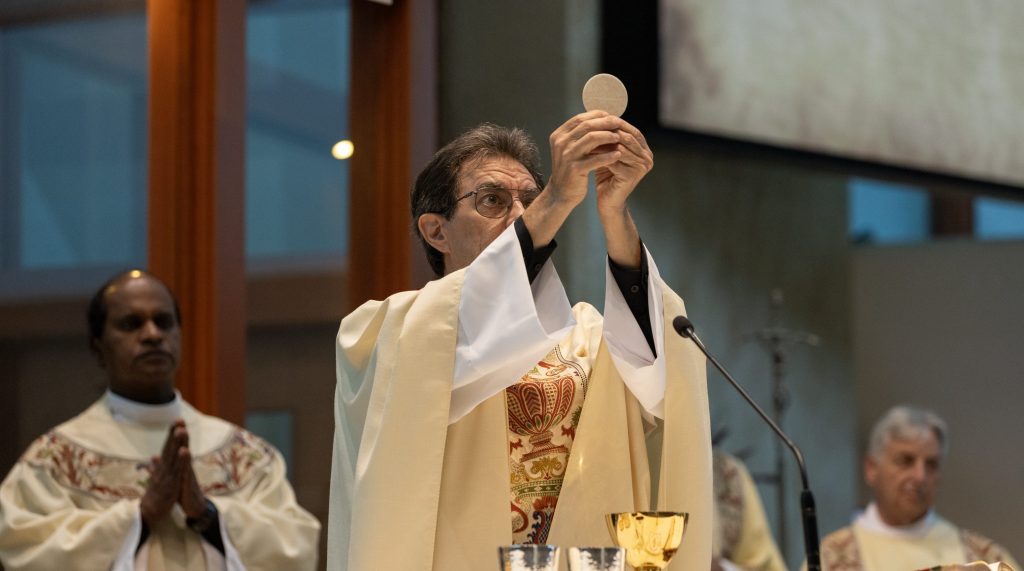
Photo: First Mass of Thanksgiving at St. Peter Catholic Church. So blessed and feeling thankful to be able to share Jesus in the holy sacrifice of the Mass!!!

Link to the Mass readings for Friday, July 12, 2024