“Speak, your servant is listening.”

God.

Even if we believe in God, do we make the time to think or ponder about God? Doing so may be difficult because there are so many diversions and distractions and we can be busy, busy, busy, and anxious about so many things that we can even take each other for granted, those who we see in a concrete and tangible way right before us.

We, being finite and so small, how can we even begin to comprehend God? He is transcendent and infinite, meaning he is not just another being among the many beings of creation. He is not even a supreme being. God is the foundation, the creator, the redeemer of all of creation. All that God has created has come to be as an outpouring of his love. Nothing would exist, we would not exist, without God. And even though he seems so far beyond our reach, God is closer to us than we are to ourselves!

Jesus helps us to understand this truth when he gives us the Lord’s Prayer. The first line tells us so much: “Our Father who art in heaven” (Matthew 6:9). The words who art, meaning who is, in heaven while we are here on earth, represents the reality that he is so beyond us. God transcends all space and time, and yet… Jesus begins this prayer, that we have been saying generation after generation since he taught his apostles and others, that the One who is in heaven is our Father. We are to address and relate to the infinite God not as some impersonal, random force, but as Father. In a healthy and whole sense, that is an intimate and close relationship.

How do we then relate to “Our Father, who art in Heaven”? The first reading and the gospel can be of help.

The young Samuel who has been dedicated by his mother Hannah to serve in the temple at Shiloh has woken up three times hearing, who he thought was the priest, Eli, call his name. Eli confirmed that it was not he who spoke. He then guided Samuel that if his name was called again, to say, “Speak, for your servant is listening” (I Samuel 3:10). Which Samuel does and God speaks.

God can speak to us directly or as Joseph and Mary experienced through the intercession of angels. This happens most often as with Samuel, Mary, and Joseph in times of quiet. As St. Mother Teresa taught, “God speaks in the silence of the heart.” It is not so much that we have to go looking for God because as the foundation of our being and our loving Father, he is already inviting us to encounter and experience him. Our very desire to seek him is our first awareness of his invitation to enter into a relationship with him. What is needed is that we learn to stop and listen, and then like Samuel, come to know and distinguish his voice.

We can also come to know God through the guidance of others. In our Gospel today, John the Baptist points his disciples to Jesus and says, “Behold the Lamb of God” (John 1:36). There are people in our lives that have experienced the voice of God, developed a relationship with him, and they can guide us as John did.

Some other ways that I have experienced God speak to me in the silence of my heart has been through my own personal reading of the Bible, times of prayer and meditation, hearing his word proclaimed in Mass, through Jesus, present in the Eucharist, through music, in experiencing the beauty of creation, spiritual direction, and experiences with many others who have guided me. None of these experiences have been booming, mystical encounters. Most have been quiet urgings, prods, and invitations.

The other challenge is that we hear so many voices inside and outside of our minds that we need to develop and discern whose voice we are listening to. Understandably, when Samuel first heard his name called, he would think it to be Eli. It took a bit for Eli to also recognize what was happening. Discerning God’s voice in the midst of so many voices in our world today is a challenge.

The enemy and the liar also seek to undo and destroy us. He and his demons will do the opposite of God and the angels. They will entice and tempt us to choose apparent goods that will lead us away from God and what will truly make us happy, then condemn us for doing so and seek to get a hold in our minds to continue to isolate us.

The voice of the Father, Jesus, the Holy Spirit, and his angels, convict us when we are doing or choosing something that leads us astray, but the choice is still ours to make as well as receiving the consequences. No matter what, God is right beside us to catch us when we fall, forgives us, and heals us when we are willing to come back to him. As soon as we do, he will embrace us with open arms.

There is no limit to the ways that God communicates to us. He knows us best and he knows what will open our hearts and minds to him most. What we need to do is learn to slow ourselves down, be willing to take some deep breaths, be still, say, “Speak, Lord your servant is listening”, continue to be still, listen in the moment and throughout the day and each day and allow God to happen!

As we more consistently do so, we will begin to discern better the deceptive voices of the enemy, be able to renounce them, and free ourselves from his grasp. We will also recognize God’s voice, experience his forgiveness, healing, and love and will be freer to live lives of meaning, fulfillment, and joy and help others to do the same.


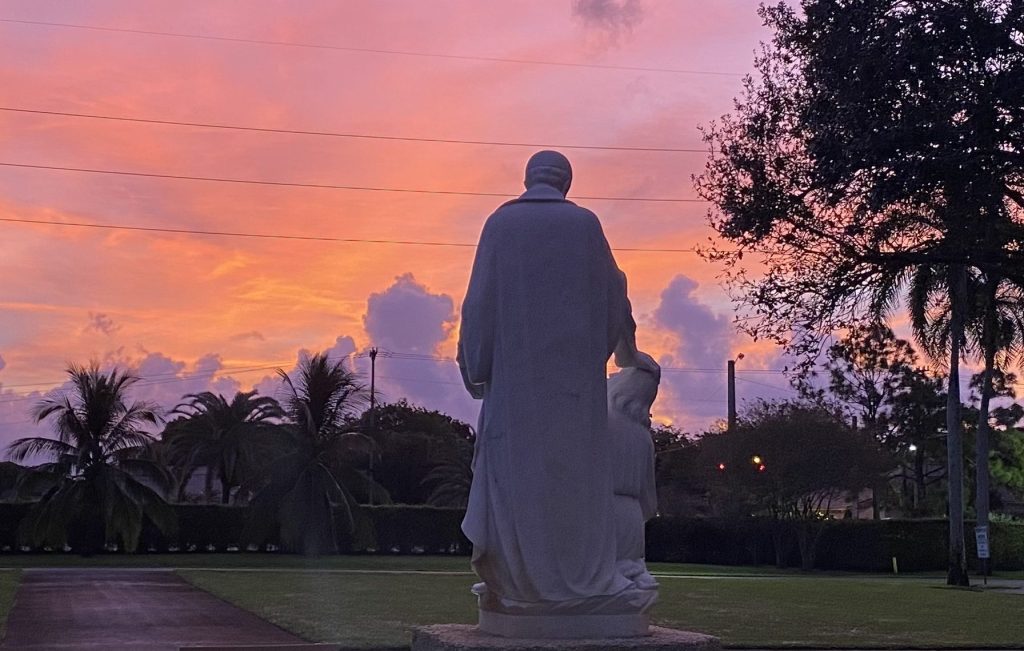
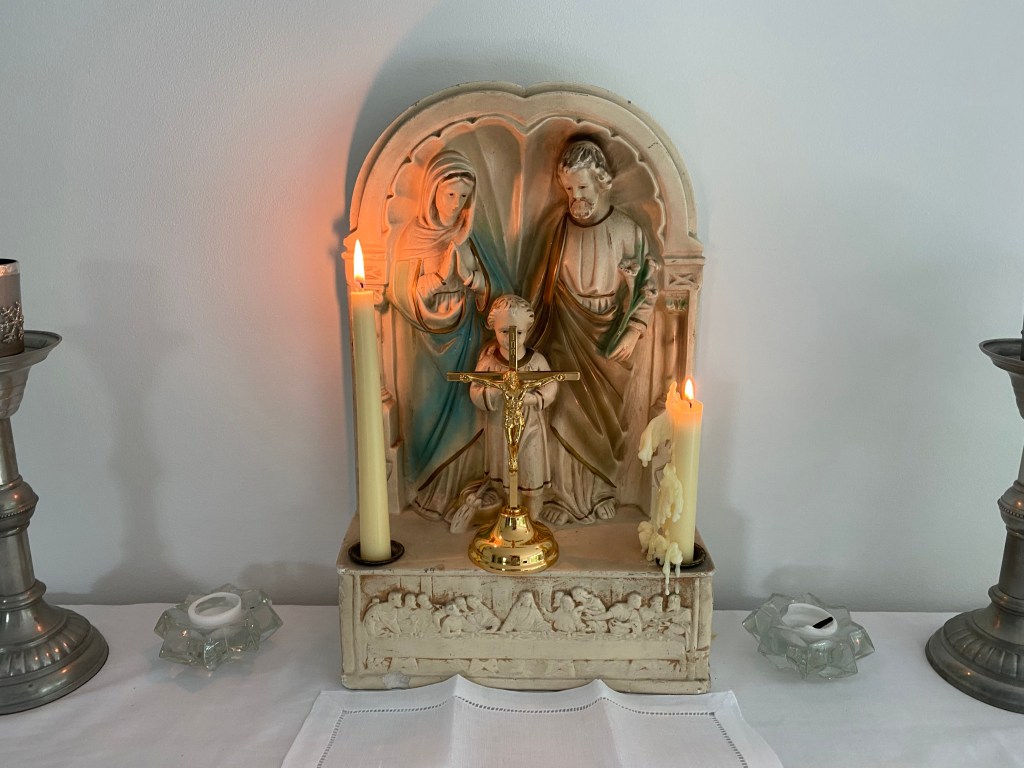
Photo: St. Mary’s Chapel, St. Vincent de Paul Regional Seminary, Boynton Beach, FL., one of my favorite places to pray and listen for God’s voice.

Link for the Mass readings for Sunday, January 14, 2023

Are we willing to follow Jesus as well?

Jesus said to him, “Follow me” (Mark 2:14).

Jesus said this to Levi also known as Matthew. As with Peter, James, John, and Andrew, there was no convincing, no preambles, or lengthy arguments, just “Come and see”, “Come and follow me, and I will make you fishers of men”, or as with today, “Follow me.” Each of these men did just that, they followed Jesus’ call and remained with him for the next three years and also were willing to give their lives for Jesus.

They did not start perfect, sin free, and ready to go. They were imperfect, were sinners, were not the best and the brightest, nor were they worthy. What all four had in common was that they heard the command of Jesus, and they were willing to follow him.

Jesus was criticized for calling Matthew and for eating with him and his friends. In doing so, Jesus was not condoning their sinful behavior, he respected them as human beings with dignity and worth first and foremost. He saw them as beloved children of his loving Father who needed help, redirection, forgiveness, and healing. His response to his critics was: “Those who are well do not need a physician, but the sick do. I did not come to call the righteous but sinners” (Mark 2:17).

Matthew and the other apostles did not answer their call just once. Each day they had to make a decision to walk away or to continue to follow Jesus. In their daily commitment, persistence, and trusting Jesus even when they did not understand him, they grew in their relationship with Jesus and were transformed. We receive the same call this morning. Jesus is saying to each of us, “Follow me.” As with Matthew and the Apostles, so with us, this is a unique call to be loved by him first and foremost. We are invited to breathe, rest, receive, and abide in his love.

This is an incredible invitation to start every day. To allow the loving gaze of the Divine Physician to rest upon us, the same eyes that looked upon Matthew, look at us. This can be as we first open our eyes, over a cup of coffee, or sitting in a quiet place we have created for ourselves. Jesus calls us in this moment and invites us to receive his love. As this becomes a part of our daily rhythm, as we begin to experience and rest in his love, we will begin to feel safe and secure in a way that nothing material can provide and nothing else but him can fill. As this foundation of love begins to grow within us, then we can begin to heal, acknowledge and confess our sins, and begin to distinguish between the voice of the enemy who wishes us ill or the voice of Jesus who seeks our freedom.

The liar asks us, “Are you worthy?” Our savior asks us, “Are we willing?”


Painting: Caravaggio’s The calling of St. Matthew

Link for the Mass readings for Saturday, January 13, 2024

Spend some time with Jesus.

In our gospel readings, over the past few days we have experienced Jesus’ initial encounters with who will become his apostles. Andrew encountered Jesus and was moved by his experience during their time together and then went to tell his brother Peter about Jesus.

Today, Philip is found by Jesus, and Jesus asks Philip to follow him. Apparently, he does, and something happens because in the next scene Philip has found Nathaniel and shared with him: “We have found the one about whom Moses wrote in the law, and also the prophets, Jesus, son of Joseph, from Nazareth.”

Nathanael hesitates as he first hears this news. What pulls him up short, even though Philip has just shared with him that Jesus is the one who is to fulfill the promise of Moses, is where Jesus is from as revealed when he asks, “Can anything good come from Nazareth?”

The Pharisees also resisted believing in Jesus because of where he was from. Despite Nathanael’s hesitancy, he trusted Philip enough to “come and see.” Unlike many of the Pharisees, when Nathanael heard Jesus say that he had already seen him under the fig tree before they met, Nathanael let go of his prejudgment and believed.

Through the Apostles who came, saw, and believed, Jesus began his Church. As they came to know Jesus, like Nathanael, each had to let go of preconceptions that limited their understandings of Jesus. Also, their limitations as finite human beings held them back. Through their trust and belief, and commitment, they deepened their relationship with Jesus, and they were transformed, made new.

Jesus met them where they were in those first encounters, and slowly but surely, with fits and starts, missteps and misunderstandings, they grew and matured. Jesus has found and calls us as well.

Like his Apostles and those who continued and continue to follow Jesus through each generation since then, we too can come and see. We can see and experience him in his word alive in Sacred Scripture, personally in our time of daily prayer and meditation, as well as proclaimed during the Mass. We can encounter him intimately and are transformed by him in the Eucharist and the sacraments. We encounter him in our serving and love of one another and in our sharing of the experiences we had with him as Andrew and Philip did.

Jesus has come to be with you right now in this moment. He has found you just as he found Philip. I invite you to read today’s gospel passage slowly (John 1:43-51). You can read once or a few times, and then slow and deepen your breath, close your eyes, and allow yourself to enter the scene you just read.

Allow yourself to enter Jesus’ memory, invite him to lead you as you walk up to stand by Philip and Nathanael. Spend some time in silence with Jesus now. See Jesus turn his face from them and look to you. Is there anything or any thoughts that may be causing you to hesitate as did Nathanael? What does Jesus say to you? How do you respond? What happens next? Do you stay with Philip and Nathanael, or does Jesus lead you off to the side to talk? This time is for you and him to spend together, to get to know one another better. These questions are only guides to get you going. You can use some or all, or disregard some or all. Trust in Jesus, he will lead you. Enjoy!


Photo: Last night’s Rosary walk, Egret Landing, Jupiter, FL.

Link for the Mass readings for Thursday, January 5, 2023

Behold the Lamb of God and follow him.

John was standing with two of his disciples, and as he watched Jesus walk by, he said, “Behold, the Lamb of God” (John 1:29).

John confessed earlier when asked if he was the messiah that he wasn’t. John knew who he was in the plan of God’s salvation. He did not claim to be more than he was but accepted his position as the one who would prepare the way for the messiah. Here he is doing just that with two of his disciples. Not seeking to hold on to them so that they would follow him but pointing to Jesus as the one to follow and give their lives to.

Andrew, one of the two of John’s disciples, would have picked up on the reference regarding the lamb of God right away. This is the lamb that would be sacrificed at the Passover meal each year. How that referred to Jesus, Andrew, Peter’s brother, and who would become one of the Twelve Apostles, would come to understand later as he experienced Jesus’ passion, death, resurrection, and ascension.

Jesus gave his life for us, not just so that we could exist, not to race through life at breakneck speed, but to live a life of meaning, purpose, fulfillment, service, in balance, and abiding in God’s love. This is not to mean that we won’t suffer. It means that as we surrender our lives to Jesus and his timetable, even when challenges arise, we can experience his peace in the midst of what we are going through.

Often, we miss John’s invitation to, “Behold the Lamb of God” because we are not paying attention, we are distracted or diverted, we are “anxious and troubled about many things.” We need to catch our breath and slow down more often than we allow ourselves to.

I have shared a lot in these morning texts about the importance of slowing down – breathing, resting, receiving, abiding in God’s love, and only a few days ago, thinking I was writing that too much. I need the reminder, as I believe we all do. Life goes too fast and so many of us hop on board the train of life that whizzes by and we are barely hanging on with one hand. That is not how God intended or wanted us to live.

One reason we may not to slow down is we aren’t ready, willing, or able to face the pain of our past nor surrender our will to Jesus and invite him to reveal to us what we need to let go of. Slowing down is not easy but with the love of God our Father is possible. We will not be crushed by what we fear to see. We will be loved, forgiven, and healed.

Berating ourselves for not slowing down does not help. We need to give ourselves permission to be kind and patient with ourselves. The thing about slowing down, is we need to slow down to slow down and that takes consistency and time of repeatedly doing so. The good news is that you have already begun the process of doing so.

A good place to ground our efforts, is to set up a sacred space in our homes that we can go to everyday, ideally the same time and same place each day. It doesn’t have to be amazing or perfect, it can and ought to be simple. Some place comfortable to sit and something to focus on like a statue, picture, candle, a view outside… The point is that you have a place to go where you can be still, focus, breath, and pray.

Best to start small and build from there. 5-10 minutes is good. A simple prayer you can start with is, “Jesus, please help me to slow down.” You can also follow John’s invitation, “Behold the lamb of God.” Behold Jesus in your imagination as Andrew did in person and follow his lead. Then just sit with Jesus and breathe. And bring either of these prayers back up when your mind drifts away. You can also start simply and slowly and stay with the sign of the Cross or the Our Father. The point is not to seek a mystical experience, not to grasp at anything. The point is to be still with Jesus. As Mary shared with me, when you show up each day, God will happen! That is true whether you experience something or not!

Creating for ourselves a sacred space and showing up there daily is a good anchor point to start with each day, and from there, we have made an intention to slow down as the first decision and action of our day. We have invited Jesus to help us, and then we can carry that intention and Jesus with us through the rest of the day and return anytime we need with a simple closing of your eyes, slowing down of our breathe, and calling on his name or short passage from Scripture. Jesus will help us to put the pieces of a balanced lifestyle together.

Remember, Jesus loves us as we are right in this moment. Nothing needs to be changed before he helps us other than inviting him to be with us and be still enough to experience him in the moment and then, one breath at a time, allow him to happen in our lives, and he will lead us step by gentle step, as Andrew and the other disciple of John did. They spent an afternoon with Jesus and their lives were transformed. Ours can be too!

Behold, trust, and spend some time with the Lamb of God!


Photo: Quiet Rosary evening walk last Monday night.

Link for the Mass readings for Thursday, January 4, 2024

Unconditional love is possible when we allow God to bestow his love on us.

“See what love the Father has bestowed on us that we may be called the children of God. Yet so we are” (I John 3:1).

Sometimes, or too many times, this truth that John is sharing with his community and with us this morning is hard to receive but these words are true. God bestows on us his love as we are right now in the moment. He is not waiting for us to do anything right, to be perfect, and/or to say the perfect prayer. Our Father just wants to love us as we are right now as we are in this moment. He loves us more than we can mess up, he loves us when we sin and even in the act of our committing sin, and he loves us more than we can imagine.

God also loves us uniquely in the way we are in most need. The key is that he loves us on his terms not ours. He knows what we need, the deepest desires of our hearts and souls. He loves us unconditionally and infinitely.

The challenge is, that our concept of what love is, has been distorted by influences of the enemy and the fallen world around us. So as the country singer, Johnny Lee, sang in 1980, we are, “Lookin’ for love in all the wrong places.” We are looking because God made us to be loved and to love in return, that is our deepest yearning and hunger: to be loved, to belong, to be seen, to be heard, and to be understood.

Time and again though, we fall because we grasp like Adam and Eve did. We want to determine love on our terms, on our conditions, believing that if we can be in control, we can be safe and won’t be hurt. The problem is that authentic love is to be received and it is just not about feelings, emotions, sentiments, comfort, or security. All of those come from the reality of love, but the foundation must be grounded in the unconditional love of God.

Authentic love is about being vulnerable to another. It is not about grasping but about receiving. It is not a presenting of ourselves in a false way that we believe another wants us to be but a willingness to be ourselves and risk that we will be rejected or accepted as we are, with our imperfections as well as our positive attributes. Love is also about sacrifice, our willingness to give ourselves to another, to be there for them. As St. Thomas Aquinas taught, “Love is to will the good of the other as other.”

Even if we have a correct understanding of love, we are still finite and have a limited point of view. Unconditional love is a love that we cannot learn on our own. We must experience God’s love to transcend our finite understanding of love. May we make time consistently to be still and allow God to bestow his infinite love upon us. Then we will remember who we are, his beloved children. And as we remember, may we see each other as God sees us, with his infinite love.


Photo: Sanctuary at St Gabriel Catholic Church, Windsor, CT

Link for the Mass readings for Wednesday, December 3, 2023

Let us abide in the love of God today and all year!

“Let what you heard from the beginning remain in you. If what you heard from the beginning remains in you, then you will remain in the Son and in the Father” (I John 2:24).

John is writing these words to encourage his community who has been wounded by a split in the community with those who walked away from the truth of the faith. The major point at issue appears to have been the identity of Jesus. Those who walked away were those who refused to believe that Jesus was the Christ the Son of the living God. 

Both factions believed in and were followers of Jesus but the ones that opposed the truth were those that could not bring themselves to believe that he was fully human and fully divine. For them how could the divinity of God enter humanity? They could not believe that the Son became human, that he only appeared to be, or his body was just like a glove to be cast off. 

Yet, that is exactly the opposite of what we have been celebrating this past week, which has been the incarnation, the reality that the Son of God was conceived in and born of the Virgin Mary. This is why we also celebrated yesterday that Mary is the Mother of God. Jesus truly is fully divine and fully human. 

John is encouraging those who did not leave to remain in the truth that they have been taught, so that what they “heard from the beginning” would remain with them. What they heard from the beginning was to remain in the love of Jesus. As Jesus taught: “Whoever loves me will keep my word, and my Father will love him, and we will come to him and make our dwelling with him” (John 14:23). John would echo this teaching just a few verses later: “For this is the message you had heard from the beginning: we should love one another” (I John 3:11).

In I John 2:24 that we read today, the word, remain, appears three times. Remain comes from the Greek word menō. It can also be translated as stay, reside, or abide. I like abide. If we want to know the truth about Jesus, we need to know Jesus and abide in him and his love. The prayers we pray, the words we read in the Bible, the Masses we participate in are not to be just motions we go through like spiritual calisthenics. They are opportunities for growing in our relationship with Jesus and his Father. 

This is just as true with our relationships with one another. If we do not pay attention to one another, listen but do not hear, are not there for each other, a distance grows, doubt creeps in, and trust weakens. When we are actively engaged in each other’s lives, hear as well as listen, communicate, support each other in our ups and downs, we grow closer, confidence grows, and trust strengthens. 

We resist the lies and receive the truth when we slow down enough to receive and abide in the one who loves us more than we can imagine. The one who knows every hair on our head and who has carved us in the palm of his hand: Our loving God and Father. 

To grow as disciples of Jesus in this new year, to grow in our relationships, we are invited again and again to breathe and slow down, to receive and ponder his word, to receive his Body and Blood, to see and serve him in one another, and to rest and abide in his word, his presence, and the love of his Father that he has shared with us. It is very easy to get diverted, distracted, to rev up and get busy, but our primary goal of this day and this year is to breathe, rest, receive, and abide in the love of Jesus who is fully God and fully man, his love that he so much wants to share with us.

When we make time to do that each day, we will abide in the love of the Son, and so abide in the Father, as we experience the love between them, the Holy Spirit. Every thought, decision, action, and word will then flow from the love of our Father who created us. As we are purified and transformed by his love, we will continue to heal and so will our relationships with one another.


Photo: Saturday evening after Mass at St. Peter Catholic Church, Jupiter, FL

Link for the Mass readings for Tuesday, January 2, 2023