
Are we willing to receive the Kingdom of God which is at hand?

The ten brothers of Joseph are envious of and hated him so much that they plotted to kill him. The Pharisees are planning to do the same with Jesus. Both Joseph and Jesus are beloved sons of their father, both will be sold for silver, and betrayed. Joseph remains faithful to God in his slavery in Egypt and through God’s providence will save the same brothers who betrayed him as well as all of his people from famine such that: what his brothers meant for ill, God would bring about for a greater good.

Jesus, the Son of God, is sent after his Baptism to call the descendants of the same people Joseph saved back to the God of Abraham, Isaac, Jacob, and Joseph. And yet, many of the Pharisees and priests are not about to receive this message or the invitation to repent and believe the Gospel, because most of them do not believe they need to or are not willing to. Joseph was able to save his own father and brothers and his people for a time, but they would eventually die. The offer of the salvation that Jesus presented is an eternal one and yet many of the chief priests and the Pharisees closed their minds and hearts to him, so much so that they were seeking to arrest and kill him. Jesus appealed to them to change by sharing the parable of the Tenants.

At the close of the parable, Jesus said to them, “the Kingdom of God will be taken from you and given to a people that will produce its fruit” (Matthew 21:43). The leaders were the stewards of God’s Kingdom and could inherit and be a part of it, but they would not accept the Son sent by his Father, the landowner, who is God, and it would be taken from them.

Who then is the Kingdom of God to be given to? Those who are willing to repent and believe in the Gospel for the kingdom is present in Jesus. Jesus reaches out his hand to us. Will we refuse or are we willing to place our hand in his and walk with him where he will lead us?

When we take his hand, we will still feel the wound of the nail that pierced him through. Like Thomas, do we realize that we are holding the hand of our Lord and our God? Do we realize that Jesus was willing to give his life for you and me for this very moment in time?

Receive this gift to spend with Jesus. Share with him what is in your heart and on your mind. Breathe and be still and listen to what he would like to share with you. Trust in Jesus and this time together.


Photo: Some quiet time with Jesus this past Sunday, St. Vincent de Paul Regional Seminary, Boynton Beach, FL.
Link for the Mass readings for Friday, March 1, 2024

Jesus sets a high bar, but will also give us the strength we need to reach it.

There are many polls, surveys, and discussions about why fewer people participate in formal faith traditions, while at the same time many people are still hungry for God. Some people still profess to be spiritual but identify less with organized religion. There are a handful of causes why, but Jesus may be shedding light on two possible ones. Jesus discusses in today’s Gospel from Matthew: “For they preach but they do not practice. They tie up heavy burdens hard to carry and lay them on people’s shoulders, but they will not lift a finger to move them” (Mt 23:3-4).

We have an innate sense that alerts us to hypocrisy and when many seek something deeper in their life and they get slapped in the face with leaders and practitioners in faith traditions preaching one way in public while living another, it is damaging. The Catholic Church is still reeling from not only those clergy who have abused children, but those bishops who have covered up the abuse. This certainly is the height of hypocrisy in that those entrusted to shepherd the people of God were preying on their own flock.

As horrific as these acts are, there are so many other ways we are not practicing what we preach. It is easy to give up and walk away and say this is not my problem, to point fingers and justify our own acts of hypocrisy by saying well at least I am not that bad. Yet even this evil within the Church does not change the truth that Jesus is the way, the truth, and the life. He is the source of our being and fulfillment.

We are followers of Jesus, and that means the standard we strive for is how he lived his life. Jesus always pointed the way to the Father. We as human beings are finite and so are going to make mistakes and sin. While Jesus is our model, even more, he is the source for our living faithfully to his teachings. When we open our hearts and minds to him, his love will work through and transform us. He will reach others through us as well when we are willing to stand up for the dignity of those entrusted to us within our realm of influence.

If we want to guide someone it is not enough to say this is what you need to do and live accordingly. We need to practice and live what we are guiding others to do, be willing to accompany, assist, and walk with someone along the way. As a Christian, just giving someone the Bible and say there you go, that’s all you need, and quote a couple of scripture passages is not enough. If we are sharing a principle to put into practice and we are not willing to lift a finger to help them, or worse do the opposite, we do more damage than if we said nothing.

Jesus calls us to resist judging and condemning, to love our enemies, to be forgiving, and merciful. Powerful actions to live up to, heavy burdens to lift indeed. To say that the bar Jesus sets is high is an understatement, but he lived them out. We not only learn how to act from reading about the life and teachings of Jesus but even more importantly, he still gives us the power and assists us to live them out too.

Jesus challenges us even more than the scribes and Pharisees, but he is willing to help us carry the load. When we are willing to see where we fall short of the goals that he sets for us, ask for his forgiveness, and accept his help, we will grow. From our own experiences of falling down and getting back up, we are better able to help others to be disciples, by guiding, modeling, and walking with them. The most important guidance we can give anyone is to lead people in such a way that they have an encounter and experience of Jesus for themselves, so even when we fall, they will still have Jesus as their ultimate guide and they can then help us up and we can continue to journey together, side by side.

————————————–

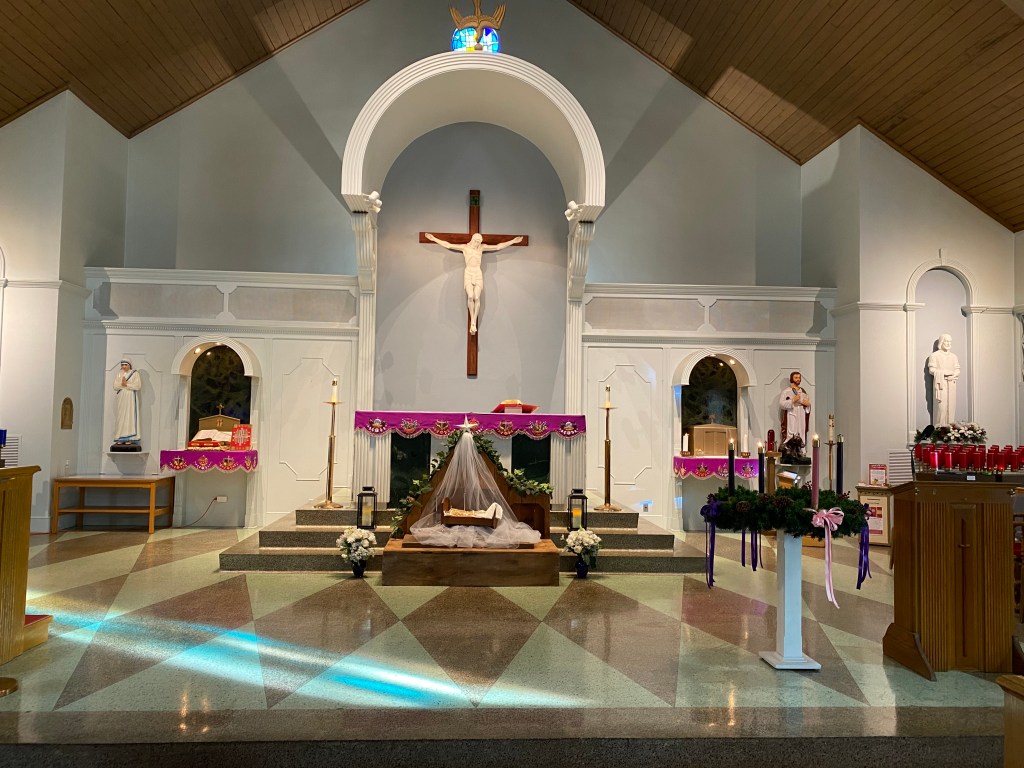
Photo: Attending Mass at St. Luke Catholic Church, Ellington, CT over Christmas break. Nice to experience Mass in different parishes each day while away!

Link for the Mass readings for Tuesday, February 27, 2024

Let us reflect the love of Christ with our thoughts and our words.

Jesus calls us to be holy, each and every one of us. Our life is to be lived with the end goal being our ascent to heaven, to be in union with our Loving God and Father for all eternity, and to assist others to do the same. Jesus provides for us a concrete example of the heights to which we are called to reach: “You have heard that it was said to your ancestors, You shall not kill; and whoever kills will be liable to judgment. But I say to you, whoever is angry with his brother will be liable to judgment, and whoever says to his brother, Raqa, will be answerable to the Sanhedrin, and whoever says, ‘You fool,’ will be liable to fiery Gehenna” (5:21-22). Jesus is building on the Torah, the Law or the Teachings, by helping us to realize that we can not only kill with weapons but also inflict dehumanizing damage with our words.

To resist this temptation of inflicting mortal wounds, we need to start participating in a deeper examination of conscience which gets to the roots of our own thoughts, words, and actions. If we are not able to discipline our thoughts, what will follow is undisciplined words, and then undisciplined actions, which can lead to entertaining and embracing the deadly sin of wrath. Wrath is unbridled anger that leads someone away from the capacity to think or behave in a rational manner, such that this individual would no longer acknowledge the dignity of the person they would inflict their wrath upon.

Jesus is helping us to see that we can be free of the temptation of wrath if we recognize the danger and destruction of unleashing words as weapons. He offers us the examples of calling someone, Raqa, meaning something along the lines of an air-head or an idiot, and calling someone a fool. These words directed at another have no other cause than to demean, degrade, and belittle. This language, and worse, has no business coming out of the mouths of a disciple of Christ if we are serious about being one of his followers.

I remember a moment in sixth or seventh grade unleashing a derogatory word or two directed at a classmate. Even though they were loosed in jest, I felt a sinking feeling in my gut after hearing myself say them. God gave me a graced moment to feel, contrition, actual sorrow for the negativity and poison I had unleashed with my words. I remember making a commitment to myself not to speak that way toward another person going forward.

We need to be aware that words have the power to wound or to heal. If we are serious about following Jesus, then a wonderful practice this Lent can be to commit to fasting from gossip and from words that belittle, divide, diminish, or dehumanize and replace them with words that empower, unite, uplift and acknowledge the dignity of others. Even when we disagree with another’s point of view, we can do so by still respecting the person and fostering a posture of dialogue.

May we also commit to resisting and not feeing negative or dehumanizing thoughts when they arise. Even when we have defensive musings, resulting from another’s disparaging tone, words, or actions, we need to resist entertaining them. Instead, we can ask for the strength from the Holy Spirit to develop a more mindful disposition that seeks to understand instead of react and to hold each other accountable with respect. We can also give ourselves time regularly to be still and enjoy time outside to let go and unwind. It is important to get enough rest as well. Ultimately we need to consciously choose to love: to will the good of each other as our first step in encountering one another as human beings, as beloved daughters and sons of God.

—————————————————————

Photo: The simple act of looking up can make a difference in our attitude and emotional state. Give it a try and see! Rosary walk, St. Vincent de Paul Regional Seminary, Boynton Beach, FL.
Link for the Mass readings for Friday, February 23, 2024

“Who do you say that I am?”

Jesus asked, “Who do people say that the Son of Man is” (Mt. 16:13)?

Peter answers Jesus by saying that Jesus is: “The Messiah, the Son of the Living God” (Mt: 16:16).

What does Peter’s response have to do with our lives? Does he really care about our everyday challenges, struggles, and tensions? Yes, he does because Jesus is the Christ the Son of the living God. Jesus is Emmanuel, God with us. Jesus is one with us. The infinite reality of God is present within each human being that exists because Jesus became one with us in our humanity so that we can be one with him in his divinity.

We have been created in God’s image and likeness and this is true from the moment of our conception through each stage of life until natural death. The unfortunate effects of Orignal sin are that our image has been distorted and our likeness to God has been lost. We have not been totally corrupted but we have been wounded and we need to be healed and restored.

Jesus experiences our suffering personally. Whatever we may be going through, whether it be a temporary or chronic illness, loss of job, conflict and tensions with family, friends, colleagues, and/or classmates, as well as experiencing feelings anxiety, confusion, and/or lack of direction, mourning and grieving over the death of those we hold close to our hearts: Jesus feels our pain and suffering.

The suffering of humanity is not something abstract for Jesus because Jesus knows each and every one of us intimately and uniquely. He knows us better than we know ourselves and is the one who cares about us and what we are experiencing. Also, he is no stranger to suffering.

Jesus not only cares, he loves us and will walk with us no matter what we may be facing right now. Jesus is inviting us this morning and this Lent to trust in him, to allow his light to shine in those places of darkness, those places where anxiety and fear have a hold, and those places where we need to let go because we give them more priority in our lives than we do God.

A good question to ponder and meditate on this morning is: Who is Jesus for us and are we willing to invite him into our situations and allow God to happen in our lives?

—————————————————————————–

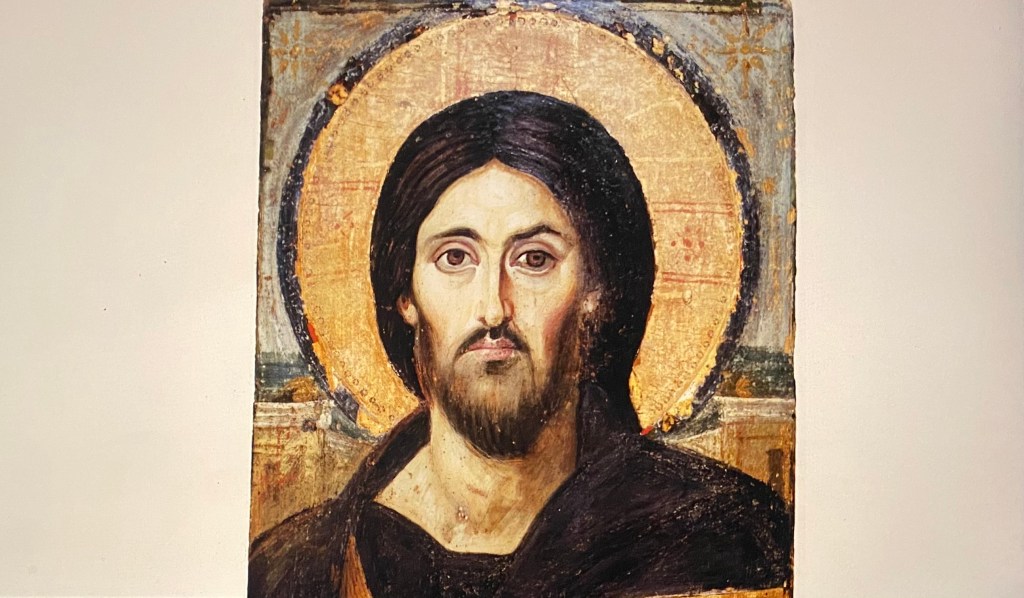
Photo: Closeup of a 6th century icon of Jesus from St Catherine’s Monastery.

Link for Mass readings for Monday, February 22, 2024

Allow the words of the Our Father to enkindle the fire of his love into your heart.

There is a creative power to God’s word. “In the beginning was the Word, and the Word was with God, and the Word was God” (John 1:1). God’s word is alive and present to all of us. And as Isaiah conveys in today’s first reading, God’s word “shall not return to me void, but shall do my will, achieving the end for which I sent it” (Isaiah 55:11).

This happened most profoundly in time when “the Word became flesh and dwelt among us” (John 1:14). God the Father through the overshadowing of the Holy Spirit and the ascent of Mary’s will, sent his Son to be human while remaining fully divine. Jesus lived, suffered, died, conquered death, rose again, and ascended into heaven bringing our humanity through his humanity back to the Father. God’s Word achieved the end for which he was sent, that salvation of the world!

God’s word, the Holy Spirit, and Jesus are still alive and active today. The gift of the Bible is that the story of salvation is there for us to experience. The Bible is not just a compilation of dead letters on a series of pages to be gathering dust. These words are most alive when they are proclaimed at Mass and read, prayed and meditated upon within our own time of prayer, and put into action in our daily lives.

God still speaks to us today through his living word when we make the time to listen and hear him speak in the silence of our hearts. In today’s Gospel, Jesus teaches us how to pray by sharing the words of the Our Father or the Lord’s Prayer. This is the same prayer that he taught his Apostles and has been prayed ever since then each and every day over the past two thousand years.

If you have been wanting to learn to pray and meditate with the Bible and haven’t been sure where to begin, the Our Father is a great place to start. Settle into a quiet place, take some deep breathes, and let the words come off the page and land on your lips. This can be silently or aloud. Read or recite slowly God’s word given to us by the Word, the Son of God, Jesus.

If you know these words well, resist the temptation to fly through them without a second thought. Say each word slowly, allow the mystery of God’s love to enfold you, allow Our Father to embrace you. The same Father who is in heaven, whose name is hallowed, holy. The God and creator of all that exists who is so far beyond our comprehension, while at the same time closer to us than we are to ourselves.

Contemplate on the wonderful truth that he wants us to be a part of his kingdom now and forever. God wants his will and our will to align as one so that we can be collaborators with him in creation so that we can put into practice what God guides us to on earth as it is in heaven. For heaven is the intimate communion with our loving God and Father that he seeks, and we have been created for.

We can then ask him for our daily bread, that which we need each day, most of all his Word among us made present again on Catholic altars throughout the world. Jesus, the Bread of Life, who we can consume and become transformed.

One of the most powerful transformations comes when we are forgiven by God who never tires of forgiving us. May we not only never tire of asking for forgiveness but also be willing to forgive as we have been forgiven. Sin, which causes separation and death from God and each other, is healed and we are redeemed by God’s forgiveness. As we are forgiven, we then are to forgive others and so God’s love is made manifest on earth as it is in heaven.

And as we prepare for each day, may we seek God’s guidance so that we may know his will and resist the temptations, distractions, and diversions of the enemy. God does not tempt us and he can help us to resist temptation when we follow his light. We will then not only avoid evil, but in the name of Jesus cast it out.

I invite you to pray with the Our Father in a similar way allowing Jesus to speak to you through your mind and heart as you meditate on each word. You may find that you want to stay with one particular word or phrase that calls to you and not even finish the prayer. Allow the Holy Spirit to guide you where he wills. May you feel his peace, love, and joy arise from within you as you do so, and enjoy!


Photo: The tree tops reflecting the rays of the setting sun. May we do the same as we receive and reflect the light of the Son from our experience of Jesus in prayer!

Link for the Mass readings for Tuesday, February 19, 2024

Let us not be corrupted by the leaven of the enemy but be nourished by the water of life.

Today’s account from the Gospel of Mark is a continuation of what we read yesterday when Jesus convicted the Pharisees for demanding a sign. He recognized their hardness of heart and hypocrisy and with the opportunity of being together in the boat, Jesus seized on this encounter as a teachable moment. He wanted to warn those of his inner circle to be aware not to follow the same path of corruption when he enjoined them: “Watch out, guard against the leaven of the Pharisees and the leaven of Herod” (Mk 8:15).

The disciples missed the point as they focused on the literal reality that they only had one loaf of bread among them. Jesus’ intent was to warn his followers about the danger of pride, seeking honor, power, and fame which had lead many of the Pharisees and Herod astray. To be his followers, striving to place themselves first would be not only the undoing of each of them but also this posture would undermine those they would be charged to care for.

Unfortunately, too many have not heeded this lesson that Jesus offered in today’s Gospel regarding being aware of the corrupting leaven of many of the Pharisees and Herod. Just as the effects of original sin has wounded humanity, so it has also affected those in the Church. Throughout the ages, clergy and laity alike have succumbed to the temptations of placing the focus first on our needs and on ourselves instead of God first and loving and serving others as he loves us.

Yet throughout the worst corruption and abuse throughout the generations, the Church is still here. God continues to work through many who are faithful to his invitation and follow his will in simple ways, living lives of quiet service. It is unfortunate that there are those who leave because they see hypocrisy, injustice, abuse, and corruption. For it is those of us with eyes to see and ears to hear that need to stay and continue to be true to the teachings of Jesus in our daily lives. Frustrations will arise for we are all imperfect and fall short of the glory of God, yet we must remain persistent as James mentioned in our first reading.

At the same time, we need to be aware of the sinful leaven that would seek to undo each of us. It is easy to point fingers outward. God does not tempt us, but in respecting our free will, he does allow us to be tempted. May we resist the temptations of the enemy, seek nourishment in the Eucharist, to live simple and holy lives, while seeking to be aware of the needs of others, and work to serve, protect, and empower the dignity of those in our midst each day. We need to remember to lean on Jesus to give us the strength and clarity on how best to help to heal his wounded Body.

——————————————————

Photo: Like a tree planted near fresh water, may our roots reach out to be nourished by Jesus, the water of life. Rosary walk, St. Vincent De Paul Regional Seminary, Boynton Beach, FL.

Link for the Mass readings for Tuesday, February 13, 20214

Sign or trust?

“Give me a sign!”

Often, when we ask for a sign, we have a preconceived notion of what we are seeking, and we want God’s stamp of approval on it. The impetus is coming from us, seeking to bend the will of God to our will. More often than not this approach will end in frustration. The Pharisees in today’s account are asking for a sign. Jesus has already been preaching with authority, healing, casting out unclean spirits and demons, encountering the unclean and restoring them to the community and right worship, and this is not enough?

We can understand how: He sighed from the depth of his spirit and said, “Why does this generation seek a sign? Amen, I say to you, no sign will be given to this generation”(Mk 8:12). The majority of the Pharisee’s minds were set. Jesus knew there was nothing he could say or do to prove to them he was who he said he was; the kingdom of God at hand. If they had not the eyes to see and the ears to hear there was no argument, point, or sign that would have changed their minds. Jesus sighed from the depths of his spirit because their hearts were hardened such that they closed themselves off from the gift of the grace he sought to share. He then got into the boat to go to the other shore, to share his message with others: “This is the time of fulfillment. The kingdom of heaven is at hand. Repent and believe in the gospel” (Mk 1:15).

The question for us today is, do we believe, do we really believe, that Jesus is who he says he is; do we believe that Jesus is “the way, the truth, and the life” (Jn 14:6)? Do we seek to bend God’s will to our own will or seek to align our will with his? The woman with the hemorrhage for twelve years, the woman whose daughter was possessed, the friends with the man with the withered hand, and the leper, did not ask for a sign, they asked for a healing. They trusted, believed, and risked getting closer to Jesus so as to encounter him despite the barriers in place to prevent them. In each of these cases, Jesus recognized their faith, and each received the healing they sought.

In our discernment, we need to be aware of our intent. There is a subtle distinction, but it is important. Are we seeking proof, a sign, or are we willing to surrender, believe, and seek to understand God’s will, as Mary did when she asked, “How can this be” (Lk 1:34)? Are we demanding proof, a three-point plan from God before we follow his lead, or do we trust his invitation, and seek to understand how he wants us to act, knowing that he will reveal what we need to do each step of the way? Often, if we knew the end result and full ramifications of his original request, our doubt would crush our spirit before we even started.

Let us embrace a posture of faith seeking understanding today, trust in Jesus, and seek to align our will with our loving God and Father. May we make time to be still and enter a place of prayer and to open our hearts and minds to the leading of the Holy Spirit. May we with confidence, say in the words of Mary, “May it be done to me according to your word” (Lk 1:38), then arise, grasp the hand of her Son, Jesus, and face head-on that which is before us, to accomplish what he calls us to do, knowing that with Jesus, we can overcome any obstacle that is placed before us.

————————————————————————————–

Photo: God sharing a sign is different than us demanding one! Evening Rosary walk back in September, St. Vincent de Paul Regional Seminary, Boynton Beach, FL.

Link for the Mass readings for Monday, February 12, 2024

Model of courage and faith

In today’s encounter between Jesus and the Syrophoenician woman, we can observe again the crossing of societal norms by both the woman and Jesus. She, very much like the woman who had been hemorrhaging for twelve years, was desperate and approached Jesus. She was willing to not only risk breaking the social taboo of speaking with Jesus, but she was also willing to do so by walking into the home where Jesus was staying and fall at his feet.

Jesus’ response to her begging sounded more like he was possessed himself rather than the healer she sought out: “Let the children be fed first. For it is not right to take the food of the children and throw it to the dogs” (Mk 7:27). This woman was not fazed by Jesus calling her a dog, she wasn’t leaving without receiving healing for her daughter, even if that meant she was putting her life in danger. Her retort, “Lord, even the dogs under the table eat the children’s scraps”, emphasized this point. It was also the key that opened the door for the disciples and us to witness a consistent pattern with Jesus.

We saw the same situation with the woman who was experiencing the hemorrhage (cf. Mk 5:25-34). Both women had the faith and courage to approach Jesus and both received the healings they sought and were affirmed by Jesus. The outcome of this encounter was also like the one Jesus had with another gentile, the Roman centurion, who said that he was not worthy for Jesus to enter under his roof (cf. Matthew 8:8). In both accounts, Jesus healed solely by his word from afar. What is important to Jesus is not whether they are male or female, Jew or Gentile. What matters if the person’s faith! Do they trust in him or not?

Do we have the courage, faith, and trust in Jesus as shown by the Syrophoenician woman in today’s Gospel? When we let nothing hinder us from drawing closer to Jesus, including relinquishing the reigns of being our own masters, acknowledging that God is God and we are not, believing that Jesus is truly the Son of God, that he is still present and active in our lives, and we have no reason to be anxious or afraid, miracles still do happen! Jesus said that if we have faith, even the size of the mustard seed, we can move mountains (cf. Mt 17:20).

We don’t need a lot of faith, a mustard seed is tiny. Just that little amount of trust in Jesus is enough for God to happen! Remember the feeding of the five thousand with just a loaf of bread and a few fish! When we believe with childlike trust that Jesus will provide, he will. It may not be as immediate as with the Syrophoenician woman or it may. What is important is that we can mature and grow in our faith such that we know Jesus, trust that he loves us, wants the best for us, and that he will always be there for us. It is also important to renounce any of the mind noise that may arise to counter these truths.

No matter what we might be dealing with today, let us be inspired by the Syrophoenician woman, and bring our petitions or intentions to him. Bring any anxieties, fears, trials, and/or tribulations to him, lay our burdens at his feet, and take his hand. With Jesus all things are possible. Jesus has not nor will he ever abandon us. He cares for and loves us. Jesus the Christ, the Son of the living God is our Savior and Redeemer, is present, is the kingdom of God at hand, and will see us through step by faithful step.


Photo: Icon of Syrophoenician Woman by Br. Robert Lentz, OFM

Link for the Mass reading for Thursday, February 8, 2024

We can choose to defile and demean or understand and empower each other.

“[W]hat comes out of the man, that is what defiles him” (Mk 7:20).

Jesus offers a list in today’s gospel of what can be unleashed from within and then directed out toward others. These are examples of what defiles because, at some level, we make the decision to think about, speak, and put into action those thoughts, words, and actions.

To resist the temptation to defile ourselves and others, we can follow the lead of the writer from the letter to the Hebrews who offered a wonderful verse, which I pray each morning in my recitation of the Office: “Encourage each other daily while it is still today” (Hebrews 3:13). There are many that we will encounter or hear about each day that will do the exact opposite.

Our goal each moment is to resist spending any time or energy in supporting any thoughts, words, or actions that demean, belittle, or dehumanize. We can call those out who do so, stand up for those impoverished from these attacks who do not have a voice, but we must not succumb, engage, or in any way be lowered to the negativity unleashed. Otherwise, we become an agent in perpetuating the same vileness and poison already unleashed.

Our thoughts, words, and actions matter because we are all interconnected. Even what we ponder can be projected on our faces and directed outward without saying one word. Thoughts entertained can lead to words and actions that wound. We need to approach each moment more thoughtfully, resist reacting, and instead take some slow breaths, think, and pray about our response before we choose what to say or do. The only time our silence can be harmful is when we refuse to stand up for others when they disregard the dignity of a person.

Let us choose this day to align our thoughts, words, and actions with those of Jesus. What we think, say, and do to our brothers and sisters, we say and do to Jesus (cf. Mt 25:35-45). We resist defiling ourselves by never letting evil talk pass our lips and instead thinking, speaking, and acting in ways that empower, convict, and build up others. Our effort is strengthened when we choose to forgive any negativity hurled at us and instead meet the darkness with the light of compassion and understanding. We are not alone in our efforts when we call upon the help and strength of Jesus as we strive to become ambassadors of his transforming love.

————————————————————————————————-

Photo: We can learn a lot about loving and caring for one another from the Holy Family. St. Vincent De Paul Regional Seminary, Boynton Beach, FL.

Link for the Mass readings for Wednesday, February 7, 2024

Discipline and love can lead to freedom.

Jesus reacted to the criticism of not observing ritual washing prior to eating that was leveled at him from the Pharisees and scribes by recalling the tradition of the Prophets through the words of Isaiah: “This people honors me with their lips, but their hearts are far from me” (Mk 7:6). For Jesus, following the law for the law’s sake is an empty act. What is important is encountering God, experiencing his love and forgiveness, developing a relationship with him, being transformed by him, and restoring what has been lost from being created in his image and likeness, so as to be able to glorify him by serving others and inviting others into communion with him. Jesus challenged the hyper scrupulosity and exactitude of the rules that had nothing to do with being humble servants of God.

Just laws and practices are those that are enacted to build up and empower people through discipline and clear boundaries. They help keep us from being enslaved to our passions and sins and instead lead us to freedom for excellence, for fulfillment, and to experience a heart on fire with an ever-growing love that yearns for a relationship with God and each other, like the deer that yearns for running streams.

As with any game we play, theatrical or musical performance, there are rules and regulations, there are referees, officials, directors, and conductors to keep order. When the rules enforced encroach on the flow of the game or performance, such that they inhibit the freedom of play, the communal interplay is stunted. When there is no enforcement, the opposite happens and all devolves into chaos. When the rules are consistent, they provide the structure and boundaries that limit abuse, allow for a freedom to flourish, and all those engaged to experience the freedom to actualize their potential, and as such, there is the experience of the true, the good, and the beautiful.

The first time I saw people skate, I was enraptured. I think I was seven. My father was working on a project at our local ice rink and even though we were not there to skate, I refused to leave until he took me on the ice. It didn’t matter that the only skates to rent that fit my feet were figure skates. It didn’t matter that my first attempt was a dismal failure. What mattered was that I made it to the ice and the joy of that experience carried me as I learned the rules of balance, how to stop and what a toe pick was and was not for. Soon I had the freedom not only to skate but to join a hockey team. The freedom and joy I felt any time I skated or played hockey, I still carry with me to this day.

The Church, when we are at our best, leads love and joy of what we believe and live in our everyday lives. We don’t lead with the rules and moralizing, but instead, we share our time, presence, and the joy of our faith. We empower and support one another as we enter into the play between our finite freedom and God’s infinite freedom. We are built for a relationship with God and one another and as our relationships mature, we start to learn and share the finer points of our life of faith. We experience the meaning of why we do what we do and why certain thought patterns and actions lead us either away from or closer to God. There is a unique balance between the rules and the freedom of play.

Loving someone does not mean we allow them to do whatever they want, but in willing their good, we offer practices of discipline, invitations, options, corrections, critiques, which establish boundaries that will provide opportunities for growth, maturity, and authentic freedom and we are open to receive the same. We are going to make mistakes, I have made many. Those we let into our lives will make mistakes. The key is recognizing that we are on a journey. As we walk together, when we are willing to be patient, understanding, forgiving, and kind, we will better support and learn from one another. In this way, the boundaries, disciplines, and rules we follow are meant to set a foundation for healthy relationships and actualizing who God invites us to be; joyful, human beings that fully love and are alive!

———————————————————————————

Photo: Back on the ice over Christmas break at Bushnell Park, Hartford, CT!

Link for the Mass readings for Tuesday, February 6, 2024