We can help to make visible the kingdom of heaven, relationship by relationship.

“As you go, make this proclamation: ‘The Kingdom of heaven is at hand” (Mt 10:7).

Empowered by Jesus, the Apostles were sent to proclaim that the Kingdom of heaven is at hand, that the God of all creation is present in our midst, and seeks to restore a relationship with his fallen creatures. This invitation is not new with Jesus. The Father has sought reconciliation and unity with his children since the fall. This is present also in our first reading through the words of Hosea, God shared how he sought to take care of his children, Israel. How he “drew them with human chords and bands of love”(Hosea 11:4).

God has reached out, generation after generation, not in some abstract way, but as he has done since he walked with Adam and Eve. He came among them, he drew close to offer reconciliation, forgiveness, and intimacy of relationship.

Salvation history is a record of God’s coming close to encounter and interact with individuals in every age. At the appointed time, he sent his Son to open the doors to a deeper communion with his Father. Jesus devoted himself to people, “accepting them, receiving them into fellowship with him and granting them forgiveness of sins. The power of his affirmation is to be found in his attention to the concrete individual, in particular to the despised, the abused, the sinner, but also involving himself with people in a very personal way… in giving himself away to them” (Gnilka 1997, 111).

We, as the Apostles were, are called to do the same. Empowered by Jesus, we are not to bring about some abstract utopian ideal, but we are sent to enter into the chaos of the lives of real individuals in our midst and on the margins in our own unique and personal way. The Gospel is not just for a select few but for everyone. This is just as true today in our polarized climate of 2024. We need to resist the temptation to be led by our prejudices and pride, of embracing an, us versus them mentality. For God, there is no us and them.

Just as the sun rises on the good and the bad alike (cf. Mt 5:45), we are to examine ways in which we have contributed to division and separation instead of invitation. May we get in touch with our sorrow for the hurt we have caused others, for our actions and omissions, and for failing to reach out in love. Jesus was sent by his Father to love us, he invites us to receive his love, abide in his love and to love him and others in his name. We do so by building relationships within as well as beyond our comfort zones. We do so when we are more present, accepting, understanding, kind, and forgiving and when we share person to person the light, love, mercy, and invitation of fellowship that we have received from Jesus. In doing so, we will help people to experience Jesus and his kingdom which is at hand.

——————————————

Photo: Blessed to be celebrating Mass with Dcn. Jude and a server from the Jesus Youth community in Delray Beach in June.

Gnilka, Joachim. Jesus of Nazareth: Message and History. Massachusetts: Hendrickson Publishers, 1997.

Link for the Mass readings for Thursday, July 11, 2024

Jesus will lead us to our fulfillment, if we are willing to listen and follow.

“At the sight of the crowds, his heart was moved with pity for them because they were troubled and abandoned, like sheep without a shepherd” (Mt 9:36).

There is much that pulls at us for our time and attention. Jesus witnessed the anxieties, struggles, pain, and feelings of being lost regarding those in his midst. Are we so different today? Jesus knows the Father, he knows the joy and fulfillment of what being in a full relationship with him entails. Jesus saw then and sees in us now how lost can become, how easily distracted and diverted can be, he knows how many things we put before our relationship with God, and he “is moved with pity.”

Jesus’ heart goes out to us, he yearns to be one with us, he loves us, but in that very act of love, he risks. He loves us so much, that he is willing to let us choose ourselves, others, or a myriad of other pursuits over him. Jesus invites us to the joyful experience of developing a relationship with him so we can come to know his Father, while at the same time he does not impose himself on us. We are given the whole world to choose from or we can choose him. Who do we put first? Is God a priority in our life? If we find that God is at best an after-thought, or at worst a no thought, instead of getting to know God better, what is it that we are choosing over him?

Jesus invites us, but too often we miss, ignore, or do not follow through on his invitation. Too often we choose other pleasures, distractions, diversions, temptations, and/or apparent goods. With time and experience, we may come to see the emptiness of the lure of these worldly promises, as well as begin to recognize that our attachments and disordered affections often lead to many of our troubles, trials, stresses, and anxieties. We are often led astray because we are seeking address our underlying experiences of unfulfillment, abandonment, and/or loneliness. There is only one source, one person, that will ultimately fulfill our innermost longing; God our Father.

I am not advocating for a rejection of the material world. All that God has created is good. We are human beings and a part of God’s glorious creation. Nor do I believe that we are souls trapped in this body waiting to be released upon our death. As human beings, we are a unique unity of body and soul. The key to our fulfillment, finding meaning and belonging is choosing to put God first. In establishing a firmer relationship with God, we can better discern that which we need to let go of, and/or how to reorder that which God wants to remain. Once we establish God as our firm foundation, even the challenges and trials that arise with not disturb our peace.

This might be the moment to be still and evaluate where we are in our lives and to ponder who we belong to. Jesus offers to lead us, just as he has led his disciples through the ages. Those of every age have experienced trials and tribulations and found the promises of this world fleeting. What made the difference for the saints was that they said yes to the call of the Shepherd and then followed him. Are we willing to slow down, to breathe, and listen to the Shepherd’s invitation today? Are we willing to follow his lead?


Photo: Rosary walk Sunday evening, Veteran’s Memorial Island Sanctuary, Vero Beach.

Link for the Mass readings for Tuesday, July 9, 2024

Let us harden not our hearts, instead let us trust in Jesus, and put on new wineskins.

“Rather, they pour new wine into fresh wineskins, and both are preserved” (Mt 9:17).

Mark, Matthew, and Luke all record Jesus’ reference of pouring new wine into fresh wineskins. What Matthew adds is, “and both are preserved.” Luke adds: “[And] no one who has been drinking old wine desires new, for he says, ‘The old is good.’”

The Gospel authors are reflecting on the tensions of those who would reject Jesus and those who would follow him and his new way. The new wine is to accept the Gospel, the Good News of the kingdom of God in their midst, and to do so means to change one’s mind and heart. “The tension, and often incompatibility, between the old and the new is part of every religious tradition and attends every change within that tradition. Matthew and Luke wrestled with it and adapted it to their community situation. Contemporary Christians have no less a challenge” (The Gospel of Mark, Donahue, SJ, p. 109). Matthew shared with his community that Jesus is the new Temple, for the old one had been destroyed in 70 AD. Following him in fact meant that both the old and new covenants would be preserved. Jesus did not come to abolish the law and prophets. Instead, he came to fulfill them and even raise the bar and challenge his followers even more.

We are invited to wrestle as well. The Church is called to change, to be transformed by the Living God. Many say the Church needs to change this and that, not realizing that we are the Church, the People of God, the Body of Christ. If the Church is to mature and grow each of us needs to embrace Jesus’ offer of the transforming love of God and be willing to be made anew through the guiding presence of the Holy Spirit. This invitation is a call to let go of those disordered affections, physical and emotional attachments, habits, lifestyles, behaviors, mindsets, and addictions that are weighing us down or worse holding us in bondage and slavery. To cling to that which is not of God keeps us separated from God. Much of the material and finite things we hold onto prevents us from receiving the new life God wants to pour into us.

Jesus has come to set us free from the old wine that will lead us astray. He is introducing some new wine. We are invited to sip and savor his teachings and actions as recorded in the Gospels. Even when they might be challenging, we do not have to be afraid of the change and transformation Jesus is calling us to experience. God wants the best for us, and he will give us the strength and discipline to move forward step by step, for as St. Irenaeus wrote: “The glory of God is man fully alive!” Jesus is inviting us to live our lives and live them to the full!

To become new wineskins, Jesus invites us to soften our hearts. Let us resist the temptation to harden them and dig in our heals because we are afraid that what God may be asking of us will be too hard or make us miserable. Jesus calls us to trust. As we take a breath or two, and trust him, we will begin to feel safe and be able to let go of those selfish and sinful inclinations that keep us constricted and rigid. We will also be able to step out beyond our comfort zones, ones that may have truly been good but were not intended to be the end goal. 

As we learn to trust, we will also learn to love as Jesus loves. We will then expand and open our minds and hearts more to receive the new wine Jesus wants to pour into us. We are called to go beyond the foundation of our identities that we have found safety and comfort in and become free to be people of integrity. Our identity gives us roots but our integrity gives us wings to fly.

It was hard for me to think of living my life without JoAnn after she died. It was hard to let go of teaching, first at Rosarian Academy and then at Cardinal Newman, and it was hard to leave, even after the intensity of the past two years of seminary, but Jesus was leading me to put on a new wineskin yet again. I am typing away, now as a priest, in my new office. I have been welcomed and blessed by the new wine poured out through the hospitality and kindness of Fr. Tom, the staff, clergy, and parishioners here at Holy Cross Catholic Church. 

Each time we have the courage to come to God in stillness, he will reveal to us that which distracts and diverts us from going deeper. As we trust Jesus and cut away the ties that bind us, as we are willing to be more and more conformed to Jesus, as we trust him and let go of our biases, prejudices, and fears, we expand and become more of our authentic and true selves and grow to be truly who Holy Spirit is leading us to be with his tender chords of love. 


Photo: Celebrating my first Mass of Thanksgiving at St. Peter Catholic Church.

Donahue, John R. S.J., and Daniel J. Harrington, S.J. The Gospel of Mark. Vol. 2 of Sacra Pagina, edited by Daniel J. Harrington, S.J. Collegeville, MN: Liturgical Press, 2002.

Parallel Scriptural accounts: See Mark 2:22, Matthew 9:16-17 and Luke 5:37-39

Link for the Mass readings for Saturday, July 6, 2024

“Love one another, as I love you.”

“This is my commandment: love one another as I love you” (Jn 15:12).

God created us to be loved, and to love. The love that Jesus is talking about is unconditional and not just relegated to those closest to us, although, hopefully, in our families and friendships is where we first experienced being loved and learned to love in return.

The love that Jesus commands of us as his followers, is a going out from, a giving of ourselves to one another. We are not to seek in return but are to empty and give ourselves away. The return we get is from experiencing the infinite wellspring and source of the Holy Spirit that rises up within us. The more we hold back, the less we receive, the more we give, the more we experience. We are to resist withdrawing our love and assuming a selfish posture that leads to us becoming more like a stagnant pool. Instead, we are to remain open so that we allow the living stream of God’s infinite love to flow through us.

The love Jesus commands is not selective. Love is accepting the interruption and choosing to be present. Love means stopping, setting aside our agendas, and accompanying another. Love is also not coercion and manipulation, it is accepting another as they are and where they are, inviting them to experience God’s love and healing. Love is sharing the journey of life together. St Thomas Aquinas has written it best: Love is to will the good of the other as other. This is more than mere emotion, feeling, or sentiment but seeking the best for someone else and to rejoice in their becoming fully alive. We are also not a doormat. We hold people accountable – for to love is also to be clear about respecting our and another’s dignity.

This practice of love is also not exclusive but universal. Yes, we are to love those in our family, community, place of worship, tribe, political party, and nation, while at the same time we must be willing to go out from our comfort zones and protected bubbles to risk opening ourselves up to those who we feel are different, those who do not see the world as we see it, and even those we consider our enemies. This does not mean we have to agree or even like someone else, but we are commanded to love, to respect the dignity of the person as our starting point.

A dialogue grounded in love means that we state clearly our beliefs, our thoughts, and dreams, but also allow others to do the same. In this way, though we may differ in our points of view, we can see how we are much more alike than we are different. When we talk at and over one another, demean, belittle, or are condescending, we dehumanize. In an open dialogue, we begin to encounter the person and the prejudicial caricature we carry begins to dissolve. Instead of keeping each other at arm’s length, we can instead learn to embrace and grow from one another. From a place of mutual, loving dialogue, we can recognize and remember again who we are, friends, brothers and sisters, children of God all on this journey we call life.

—————————————————————-

Photo: Jesus’ greatest act of love for each of us, his life that we might have life and have it to the full. Sanctuary of Our Lady of Florida Spiritual Center, North Palm Beach, FL.

Mass readings for Thursday, May 2, 2024

God’s commandments are invitations to grow in love.

Two points jump out of the Gospel of John today: commandments and love. How is each one of these related to living life as a disciple of Jesus? Often, many who hear the word commandments, often react, and are immediately put off. “There goes the Church again telling me what I can and cannot do.” Yet what Jesus is doing showing how the following of his commandments is a true expression of loving him.

Love is another word that evokes reactions. One reason is that, even though the English language has a plethora of words to utilize and choose from, there is only one word for love, and it is interpreted in many ways. In Ancient Greek, there are four words that are used to connote love. There is eros, which has to do with attraction. It is the beginning stage of love because we are drawn out of ourselves as we are attracted to another. The next word for love is philios, which has to do with friendship. This is the love between friends. If our love matures it moves from attraction or infatuation to friendship. The third word is storge or the deeper love shared with family members. The fourth word is agape, which is unconditional love.

When Jesus shares that we are to follow the commandments, he is not demanding that we do so as a tyrant. He is providing the boundaries and parameters for us to grow and mature as people who love, who, in the words of St Thomas Aquinas, will the good of the other as other. As humans, we are social beings. We want to belong, to be accepted, and to be a part of. We seek meaning, purpose, and fulfillment. This is best done through cooperation and collaboration with God and one another, striving for agape, to love unconditionally.

If we operate from a self-centered posture in which we are only turned in upon ourselves, and we only seek to manipulate and get from others, instead of working together and sharing a common vision with others, we will ultimately be empty with the exchange on any level, because we will be left wanting more. This is true because once the immediacy of the stimulation, whether material or sensual, ends, so does the experience of the feeling. Some happiness may linger from the effect, but we will never be filled or satisfied with anything finite. We will continue to seek more and more until the pursuit of instant and constant gratification ensnares us and we are entangled in a web of addiction.

The commandments, grounded in love, are meant to provide boundaries for us, training wheels, and to keep us free from enslavement to sin, while at the same time help us to be persons who move away from being self-centered to maturing as other-centered instead. Discipline in this way is meant to be a means of freedom for excellence such that we can become who God calls us to be and who we truly desire to be. Ultimately, we are to love God as he loves us and love our neighbor as ourselves in our own unique way. God is not in competition with us. He is our biggest fan. As St Irenaeus wrote, the glory of God is the human being fully alive!

Commandments and morality imposed, is a bludgeon. Love and mercy without accountability and justice can be enabling. Jesus provides the blueprint for a balanced both/and approach of invitation and shepherding. May we surrender to his loving guidance and correction, align ourselves with the Holy Spirit, who is the Love expressed and shared between the Father and the Son. May we seek ways to improve our lives, to be more honest with our weaknesses, so Jesus can be our strength, and to seek God when we are tempted to choose him so he can lead us away from the enticement to sin, and seek his forgiveness when we have fallen.

As we journey in this life, we do not do so alone. As we seek to follow Jesus’ lead, as we grow and mature, we do so while in the midst of encountering and forming relationships with others. Conformed by following the commandments, we are to reach out in love to each other as Jesus has done with us. As we form and deepen our relationships, new and old, may we encourage, support, and love one another while at the same time, challenge and hold each other accountable as we strive to be who Jesus invites us to be.
———————————————————–
Photo: The discipline of nightly Rosary walks over these past two years has been a blessing! St. Vincent de Paul Regional Seminary, Boynton Beach, FL.

Link for the Mass readings for Monday, April 29, 2024

We are to be “carriers of God’s love to everyone.”

When Philip asks Jesus to show him the Father, Jesus responds: “Have I been with you for so long a time and you still do not know me, Philip? Whoever has seen me has seen the Father” (Jn 14:9). Even though Philip had lived with Jesus, experienced the authority of his teachings, witnessed his works of healing and exorcism, witnessed to the inclusiveness of his ministry, he, as we, struggled with comprehending what Jesus was talking about regarding the unity between his Father and himself.

One of the reasons is that God is God, and we are not. God is not one being among many, he is not even the Supreme Being, nor is God even in the genus of being. God so transcends our reality and sphere of understanding that any words we say about him are going to be limited. God is Infinite Act, God simply is. We are finite. At the same time, this does not mean that God is an impersonal force. God transcends all of his creation, time, and space, is the source and foundation of all that exists, and yet he is closer to us than we are to ourselves, each and every one of us.

God came closer still when, in the Person of his Son, he came to dwell among us. This is what Jesus meant when he said to Philip that when he saw him, he saw God. Each person, God the Father and God the Son are distinct but because of their infinite essence they are also, as we say in the Nicene Creed each Sunday, consubstantial, they are of one and the same substance.

The Son became one with us while remaining fully divine and in full communion with his Father, so we can become one with him and experience the intimate relationship that they share. We participate in the life of Jesus because he became human, and as human beings, God created each of us as being interconnected with one another. So, what happens to one of us, happens to all of us.

Through our Baptism and participation in the sacraments, we participate and become conformed to the Body of Christ so to encounter Jesus in an ever deeper intimacy and share in the divine Communion between God the Father and God the Son, as well as the Love that is shared between them who is God the Holy Spirit.

The wonderful gift of participating in the relational communion with the Holy Trinity, is not just for us alone as some treasure to sit on, as some secret knowledge to be shared with only a chosen few. This is a universal message to be shared with all. As we grow in our relationship and participation with God, we are to make him known to others. We do so through our participation in the life of Jesus. As Jesus said to Philip, “[W]hoever believes in me will do the works that I do, and will do greater ones than these, because I am going to the Father” (Jn 14:12). Jesus seeks to work, love, and serve through us as the Father did through him.

Each of us is given a particular charism, a ministry of service to build up the kingdom of God. The key is to believe in Jesus and seek his guidance so that he can help us to discern how best we can serve him and build up his Body. Those we call saints were those who came to know that one thing that God called them to do. They then surrendered all to their vocation.

This is not just for clergy or religious, this is for each and every person on this planet. The only requirement is that we are willing to follow Jesus, say yes to the invitation to experience the love of the Holy Spirit he freely offers, and be willing to be sent to allow God to happen in our interactions with one another. As St. Mother Teresa said we are to “become the carriers of God’s love to everyone.”

Let us embrace today the reality that the God of all creation loves each and every one of us more than we can ever imagine. Embrace the unique relationship he calls us to participate in, which is a share in his Trinitarian Communion. Embrace this unique blessing so that we can open our hearts and minds to the service and ministry he calls us to through our participation in the life of Jesus the Christ, the Son of the Living God, through the Love of the Holy Spirit.

———————————————————-

Photo Credit: Photo I took of St Mother Teresa in Massachusetts in the early 90’s. No zoom either, that’s how close I was blessed to be!

Link for the Mass reading for Saturday, April 27, 2024

Walk not away from Jesus, ponder instead.

Even though Jesus had fed the five thousand and they were satisfied and there was plenty more where this gift of grace came from, even though they traveled by boat and followed him to Capernaum seeking a sign, the discourse regarding eating his Flesh and drinking his Blood was just too far of a stretch for the majority of the disciples to take. In fact: Many of the disciples of Jesus who were listening said, “This saying is hard; who can accept it” (Jn 6:60)?

All but the apostles walked away from Jesus at that point and returned to their former ways of life. They could not believe because they did not fully appreciate who Jesus was, the One from above, who was sent by the Father. They had not developed a deep enough relationship with him such that they could trust him and that what he had said was true, they could not believe that he was the One whom God had sent.

Jesus then said to the Twelve, “Do you also want to leave?” Simon Peter answered him, “Master, to whom shall we go? You have the words of eternal life. We have come to believe and are convinced that you are the Holy One of God” (Jn 6:67-69). Peter’s response is one of belief and trust. I am sure they reacted in the same way as the others gathered there, but they trusted Jesus enough that even though this teaching was hard, even inconceivable, he would make sense of it for them, just as he had done so many times before.

This is to be our response as well. When we find some of his teachings are hard to digest, we need to resist the temptation to walk away. Instead, may we follow Mary’s model of pondering, as she did when Gabriel shared that she would bear the Savior of the world. She did not fully comprehend what the message meant, but she trusted God and said yes. May we follow Peter, who may have also been dealing with mixed emotions and doubts, remained firm in his belief in Jesus because he trusted that Jesus was the “Holy One of God”. Peter had experienced that Jesus had known what he was saying and doing before, he would continue to trust him this time as well.

Jesus is a model to follow, yes, but he is so much more! Jesus does not give us more burdens to bear, but graces that build upon our nature that we are invited to receive. He did not want to die, but he was willing to say yes, to submit his human will to his Father because he trusted him and knew he would bring about a greater good. Jesus gave his life and in so doing he conquered death, transcending the time and space of our present dimension so to be present to us in the Sacrament of the Eucharist he gave us.

Jesus lives, he is the firstborn of the new creation, and he wants to not only lead us to eternal life, but impart his life in us today, in such an intimate way that we may consume him at each Mass, that we may be one with him in this life and for all eternity! May we with Peter come to believe and be convinced, that Jesus is the Holy One of God!

Amen. Amen.
I’m alive, I’m alive,
Because he lives.
Amen. Amen.
Let my song join the One that never ends.
Because he lives.
The verse from Matt Maher’s song, “Because He Lives (Amen)”.

—————————————————————

Photo: Taking some time to ponder and enjoying the company of a Blue Heron. St. Vincent de Paul Regional Seminary, Boynton Beach, FL.

Link for video: Because He Lives (Amen), Matt Maher, from cd: Saints and Sinners, 2015

Link for the Mass readings for Saturday, April 20, 2024

Jesus offers all as he gives his “Flesh for the life of the world.”

Those in the crowd who Jesus is speaking with are those who experienced his multiplication of the loaves and fish. Step by systematic and deliberate step, through chapter six of John and as read in this week’s Mass readings, Jesus is setting the stage for today’s insertion into his presentation.

Jesus begins slowly, but with each successive step, he is not willing to be tamed. He, as the One from above, the One who has seen and has been sent by the Father, is fully divine, as well as fully human. The Godman is speaking among those who have come to him. He has responded to the people’s request regarding how they were to “accomplish the works of God” and his response is that they are to believe in him, he who had been sent by God. They were to “work for food that endures for eternal life, which the Son of Man will give”. Jesus with the multiplication of the loaves and fish provided for those who were hungry in the moment. He is now describing how he will provide food that will endure for eternal life. Jesus shared that he is this food, the bread from heaven, that will give life to the world.

What Jesus has shared thus far and what he shares in today’s Gospel message has been given to him to say by his Father and is for everyone who is willing to accept his invitation: “I am the living bread that came down from heaven; whoever eats this bread will live forever; and the bread that I will give is my Flesh for the life of the world.”

We have an advantage, that those listening to Jesus, did not have. We just experienced Lent and we can certainly draw a line to how Jesus gave his very life, his Flesh, that was sacrificed and hung on the cross. Jesus died and experienced utter God forsakenness by giving his very life for the life the world.

But for those in the crowd who only the day before sought to unanimously make Jesus their Messiah by popular acclamation are growing a bit uncomfortable. This discourse is now starting to move into a more dramatic and concrete presentation with horrific implications. After an initial gasp or two, some murmuring of questions might have begun to arise:

“Did Jesus really just say he would give us his flesh?”

“Jesus is saying he is the bread from heaven, and the bread he is offering is his flesh?”

“Is Jesus saying what I think he is saying?”

Yes! The Son is saying exactly that because the Father has given all that he is, holding nothing back, emptying himself into the Son. The Son has received all that the Father is and returns himself, giving all that he is, holding nothing back, to the Father. This eternal giving and receiving, this eternal communion of Love shared between the Father and the Son is the Holy Spirit. Jesus is offering us a participation in this perichoresis, this divine dance of infinite communion, as he offers all that he is to his listeners then and to us, this day, to be consumed. He is holding nothing back in his offer. We are invited not only to receive all that Jesus is, we are also invited to give ourselves away in return. Stay tuned, more to come tomorrow…
—————————————-

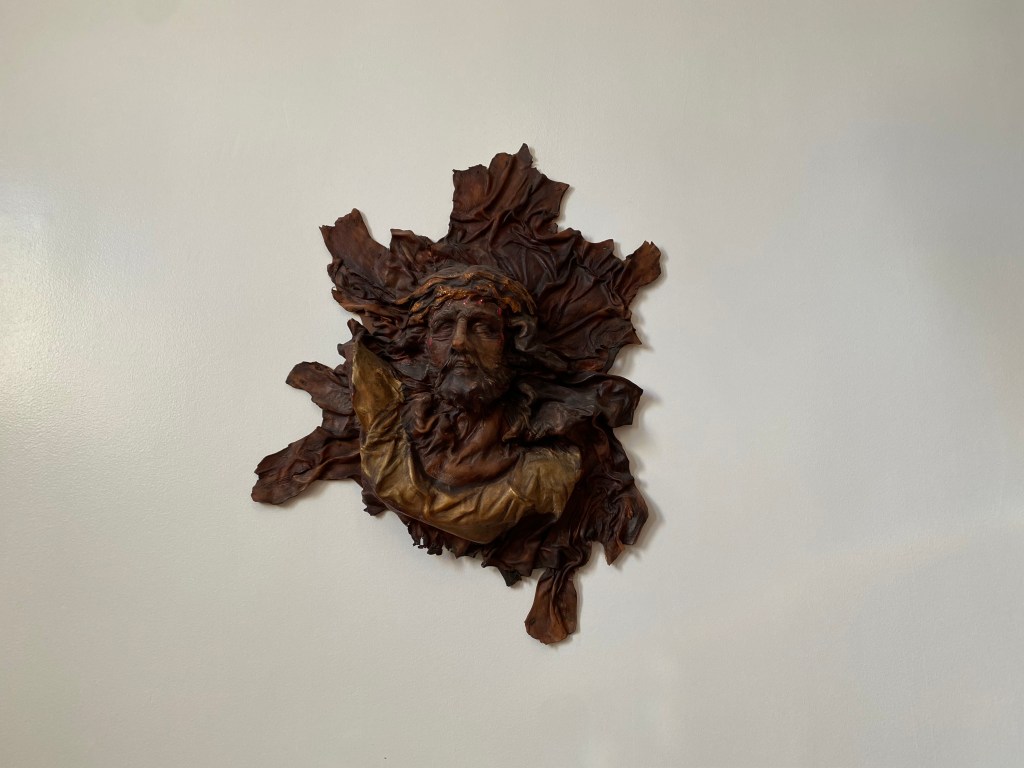
Photo: Closeup of the artistic rendition of the face of Jesus based on the Shroud of Turin.

Link for the Mass readings for Thursday, April 18, 2024

Jesus is with us, even when we fall.

“Everything that the Father gives me will come to me, and I will not reject anyone who comes to me, because I came down from heaven not to do my own will but the will of the one who sent me” (Jn 6:37-38). Jesus does not reject us, he accepts us as we are, first and foremost. Jesus has come to do his Father’s will which is to lead us all to salvation, to be redeemed and restored to the proper order of freedom from our enslavement to sin. This is why Jesus met Cleopas and the other disciple on the road to Emmaus. They were walking the wrong way! Jesus did not tell them that, he just opened the Scriptures for them, so that they could see that he was who he claimed to be and then revealed himself to them in the breaking of the bread. Once they had a deeper encounter with him, they determined on their own to turn back, and even though evening approached they went back to tell the Apostles the Good News of their experience.

It was through sharing a meal with them that they recognized him. How many meals had they shared together before his death? A close reading of Sacred Scripture shows how important table fellowship is for Jesus and his followers before his death and after his Resurrection. True, Jesus eating with his disciples after his Resurrection shows that he is no ghost, he is human, but also that he is reestablishing the cornerstone of his ministry, table fellowship.

Here the basic needs of sustenance are met, for the body, and in also in sharing his time and conversation with anyone willing to eat with him, no matter their level of ritual purity, touches the deepest hunger within each of us, which is to belong, to be accepted as we are, for who we are. The majority of the crowd that Jesus is speaking to has continued to come to him because he fed them with only a few loaves and some fish. In the miraculous multiplication, Jesus is providing for their bodily nourishment, but also preparing them for the deeper spiritual nourishment of the body and soul to come in the next verses as he goes deeper into his Bread of Life discourse.

Jesus loves us, he wills the best for us. Many resist this claim for different reasons. It could be the callouses, scars, growing cynicism resulting from wounds inflicted by others as well as from those within the Church. Each of us could have experienced the same and have also been let down by those we have looked up to and trusted. If we are involved in a relationship long enough, we will experience disappointment or worse. This is because sooner or later, when we allow ourselves to get close enough, the masks will come down and who we truly are, the fullness of our wounds and our gifts will come to the fore. Conflicts will arise because we are finite beings. We are still a work in progress. Conflict is not a bad thing. It is healthy when we are willing to work together to resolve the conflict together.

None of us are perfect. We are all on a journey. On our own, not only will we consistently fall short of our goal, we will often be headed in the wrong direction. That is why we need a savior. Jesus, fully divine as Son, came down from heaven and became human to meet us in our humanity. He is there for us when we fall down face-first into the mud. He is willing to be there with us, to look us in the eye, and smile.

Even if we are not able to look past the predicament, can we resist Jesus? His eyes looking at us and his smile that lets us know we can get through this together. His hand offered to us that we can grasp and feeling the strength of his grasp, then rise together and stand again. That is how Jesus shows his mercy and love for us. He enters our chaos and meets us in the muck and grime of our mistakes, brokenness, and sin. He loves us there, and when we are ready to accept his offer of love, he invites us to get up, and begin to walk again toward the fullness of who we are called by his Father to be.

As our relationship grows and deepens with Jesus and as our trust renews, we begin to believe that we belong. We begin to heal and realize that we are a part of something greater than ourselves and then, with wobbly steps, we begin to offer attempts of the same mercy, forgiveness, and unconditional love with others. This is the path of discipleship. This is the road we are on, together. This is not a hundred-yard dash but a long and winding road. Let us be willing to persist, to be led, to love, to be there for, and accompany one another each step of the way. And especially may we have the willingness to help each other when we fall.

———————————————————————————

Photo: Living Stations of the Cross in the streets of the Bronx, me, as Jesus, falling a third time – around 1991.

Link for the Mass readings for Wednesday, April 17, 2024

Let us believe in the one whom God sent.

One of the best ways to celebrate the Easter Season is to continue to conform our lives to the one who gave his life for us that we may experience and be engaged in our life to the full. We can accomplish this better by putting into practice what we read in the Gospels as well as being open to encountering God in our daily experiences and one another.

Today’s Gospel reading continues after Jesus not only fed the 5,000 but also after he had walked across the Sea of Galilee and guided his disciples safely to the shore. When the crowd caught up to, found, and gathered around Jesus, he continued to teach them, guiding them to “not work for food that perishes but for the food that endures for eternal life, which the Son of Man will give you.” The people asked him what they could, “do to accomplish the works of God?” Jesus answered and said to them, “This is the work of God, that you believe in the one he sent” (cf: Jn 6:27-29).

The people asked Jesus what they were to do to accomplish the work of God, and he said to believe in the one he sent. The response of Jesus may not appear to fit the request. But to believe is not passive. Belief is to be followed by action. If we say that we believe in Jesus, do we pray with him, do we worship him independently and in communion with fellow believers, do we sing songs praising him, do we serve him through the giving of ourselves to one another by practicing the corporal and spiritual works of mercy?

When we experience setbacks, interruptions, conflicts, or are weighed down by tribulations, do we turn to cursing and yelling or turn instead to Jesus for guidance and direction? By the way, yelling or expressing our anger at Jesus is turning to him in honest prayer instead of turning our back on him. We are honestly letting him know how we feel. The key is to vent, but then let it go, and not stay there.

Do we turn within ourselves or only surround ourselves with those of like mind, color, political and/or religious views, and make others into scapegoats, or do we embrace the richness, uniqueness, and diversity of God’s people, open ourselves to dialogue, and new possibilities? When life goes well, do we thank God for the wonderful things that happen? Where are we spending our time, talent, and treasure?

Answering these questions is a good way to assess what and in who we truly believe. If our diagnosis today is that we are not as faithful as we would like, we don’t believe as much as we thought we did, that is not an invitation to beat ourselves up. It is a gift to begin again, to take a spoonful of belief in Jesus, spend a few silent minutes with him, begin the journey from our head to our heart, and put into practice one small thing today in his name with great love.
——————————————————-
Photo: Jesus is the One whom God sent to die and conquer death that we might have life and have it to the full. Good Friday sunrise at Our Lady Of Florida Spiritual Center, North Palm Beach, FL.

Link for the Mass readings for Monday, April 15, 2024