We need not fear to invest our gift because Jesus is with us.

In today’s Gospel, we have available to us the parallel to The Parable of the Talents from Matthew 25:14-30, which is The Parable of the Ten Gold Coins from Luke 19:11-28. There are a few differences. A key opening point is that in Matthew’s account, we do not know why or where the master goes after he entrusted three of his servants with talents; five, two, and one respectively. In Luke’s account the man is a noble and he “went off to a distant country to obtain the kingship for himself and then to return” (Lk 19:12). He called ten servants to invest a gold coin he gave to each of them. The theme that is similar in both accounts is that when the man returns, two of the servants invested well and brought about a greater return on their investment, and one hid what he was given out of fear of his lord.

Another added feature in Luke’s account was the fellow citizens of the nobleman that did not want him to be king and openly opposed him. The nobleman after attaining his kingship and returning successfully, dealt harshly, to say the least, with those who opposed him, having them slain. Those listening to Jesus tell the parable would understand this predicted outcome, as it was not uncommon in the ancient Near East for a ruler to slay those who opposed his rise to power.

The most immediate parallel and contemporary example was the current tetrarch, Archelaus, who was placed into power in Judea and was reigning at the time of Jesus. He was a cruel tyrant. The Jewish historian, Josephus, who during the time of the Jewish Wars was captured and later became a Roman citizen wrote that there were “fifty ambassadors were sent from Judea to Rome to request that Archelaus not become king, because he had already killed three thousand Jews in quelling an uprising” (Gadenz, 320).

Just as the wicked tyrant is rejected, the innocent Messiah will also be rejected in Jerusalem, and will give his life. Jesus again appears to be presenting the contrast between the fallen nature of humanity with the coming of the new kingdom under his reign. His apostles are not to be like the corrupt leadership of the age, but they are to go out to all the nations to proclaim the good news of the kingdom.

The readings this week also continue to present eschatological talk, references to the second coming of Jesus, and final judgment because we are in the final two weeks of the liturgical year. Jesus’ reference to going away and coming back, could be a reference to his death, resurrection, ascension, and the waiting until his second coming in which there will be a judgment by God. Jesus makes clear that we are not the judge and jury, though many appropriate this role for themselves. We are only accountable for the talent or gold coin we have been entrusted with.

God has called us each uniquely by name and given us a gift that he wants us to put into action to help build up his kingdom. We need to resist burying this gift or hiding it away. The most important thing we can do each day is to pray, and deepen our relationship with God and each other. The enemy will tempt us with doubts, fears, and anxieties which we are to renounce and instead trust in Jesus, seek his strength, and guidance.

We are invited each day to begin with prayer. In the beginning, the length of time is not as important as consistently spending time with God intentionally. We show up, breathe, allow ourselves to be still, allow the restlessness of our mind to quiet, and we listen. This may take some time or days, but when we continue to return to these daily anchors and trust that God has a purpose for us, we will hear his guidance, and then we are to follow his lead.

The encouraging words of St. John Paul II are helpful: “Remember that you are never alone. Christ is with you on your journey every day of your lives!” – St. John Paul II

We are called by Jesus to be contemplatives in action. We are not to follow the lead of mediocrity and fear. With humility and patience, let us trust in the guidance of the Holy Spirit who will light our path to maturing and actualizing our unique call and as we serve God and one another we will bear good fruit.


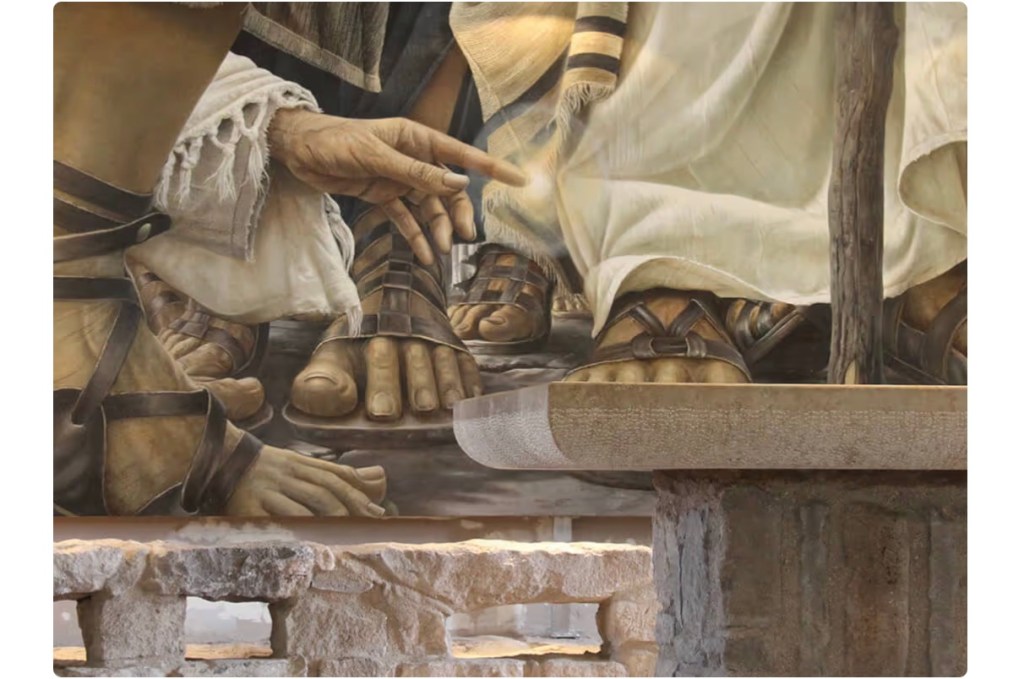
Painting: “The Lord of the Parables” by Jorge Cocco, Altus Fine Art

Gadenz, Pablo T. The Gospel of Luke. Grand Rapids, MI: Baker Academic, 2018.

Link for the Mass readings for Wednesday, November 19, 2025

When we pray, we are loved by God, and the love of God casts out our fear.

“Then the one who had received the one talent came forward and said, ‘Master, I knew you were a demanding person, harvesting where you did not plant and gathering where you did not scatter; so out of fear I went off and buried your talent in the ground. Here it is back'” (Mt 25: 24-25).

I used to struggle with this verse of Jesus’ Parable of the Talents, not because I didn’t relate to it, but because I did. The problem was that I sided with the servant who buried his talent in the ground. What the servant did made sense to me, he kept his master’s talent safe and returned what he had been given. Historically, burying was considered a safe and acceptable practice in ancient Palestine when protecting someone else’s money. Even in reading carefully back to the beginning of the parable, I could see no reference to investing the talents. Though in the Gospel of Luke, there is an explicit demand to “trade with these until I come” (Lk 19:13). What is Jesus saying?

Actually, Jesus in this parable offers a microcosm of salvation history, the thread of which has been woven through all of Sacred Scripture from Genesis to Revelation. God, through his sovereign will, has consistently called, calls today, and will continue to call into the future a people to himself. In each age, God has bestowed upon humanity the generous gift of his grace, inviting us to receive and share in his very life, which is what we have been created for. This is a free gift, to be freely accepted or rejected. Once received though – no matter how little we choose to receive, five, two or one talent, we are directed to share what we have been given. Through a life lived of accepting, receiving, giving back to God and to one another, we are given even “greater responsibilities”.

In receiving the gift of God, himself, and sharing what he has given, ultimately his love, for God is Love, we not only mirror on earth, albeit dimly, but share in the divine communion of the love between God the Father, God the Son, and God the Holy Spirit. To reject this gift outright, or to receive some of the benefits and not to share, we cut ourselves off from the very life force and source of our being.

The message of The Parable of the Talents is as clear as it is challenging. John P. Meier summarizes that “Jesus is insistent; along with sovereign grace, serious demand, and superabundant reward comes the possibility of being condemned for refusing the demand contained in the gift. Indeed, one might argue that no aspect of Jesus’ teaching is more pervasive in the many different streams of the Gospel tradition, and no aspect is more passed over in silence today” (Meier 2016, 309).

God has created us and all of creation from the abundant outpouring of his love. Will we reject the gift of his love and invitation of communion? Will we receive, yet not actualize who we are called to be for our self and others because we would rather merely just exist, willing to be lured and entrapped by the temptations of anxiety, fear, apparent goods, and half-truths? Will we give in to the fear, too afraid to risk, to go out from ourselves to serve others? Or, will we appreciate the gift of our life and say thank you for the breath that we breathe? Are we willing to expand the love we have received by being willing to share, to multiply our talents, to embrace who God calls us to be, to love in kind, to will the good of others in the unique way God calls us to serve, whoever they may be?

I have lived the life of the wicked servant who buried his talent out of fear. I have embraced the sin of sloth by overworking and thinking I was doing good, but was it really the good God wanted me to do? As I have recognized the importance of placing prayer front and center, so that I have grown in my relationship with God, my life has become more properly ordered. I do better when I reach out and seek the hand of Jesus and accept to be led by him. I have risked and fallen, made mistakes and duffed up time and again, but have learned and persevered.

When we learn who the enemy is, are able to identify his lies, renounce and turn away from them and back to God; when we slow down instead of run from what we are afraid of and invite the Lord into these areas we will be purified, we will heal; and when we realize that the most important thing that we can do each day is pray, then we will come to know in our core, that we are not human-doings, we are human beings. God loves us as we are. As we are loved, we will then act from being loved and share the love we have received.

We are not alone. What Jesus invites, gives, and yes, demands of us, he will at the same time provide the courage, guidance, support and strength we need to carry out the task given and to bring it to fulfillment. God has a talent or two to invest. We need not fear to invest what God has given. This morning, let us breathe deep and entrust ourselves to the words of Jesus and St John Paul II who echoed them as he began his pontificate:

“Be not afraid” (Mt 14:27).

———————————————————————————-

Photo credit: dpa Picture-Alliance via AFP accessed from Aleteia

Meier, John P. A Marginal Jew: Probing the Authenticity of the Parables. Vol. 5. New Haven: Yale University Press, 2016.

Link for the Mass readings for Saturday, August 28, 2021

Will we choose to remain in the darkness or follow Jesus into the light?

“He brought in the head on a platter and gave it to the girl. The girl in turn gave it to her mother” (Mark 6:28).

The momentum that led to the death of John the Baptist could have slow and the direction could have taken a different course. It did not even slow but only escalated. Once Herod Antipas offered to the girl “even half of his kingdom”, she went in haste to her mother. Without hesitation her mother asked for John the Baptist. There was a slight hesitation on Herod’s part when he received the request, but no one spoke about the atrocity or horror of this request. Herod, as would Pontius Pilate, gave in to the pressure of not saving a life, for even there no one spoke out against what was coming, but in taking the life of an innocent man, which the executioner executed efficiently.

John’s crime, what he was arrested for, was calling Herod and Herodias to repent, to turn away from the sin of adultery they were committing and to turn back to God. John sought to help this couple to see that their actions not only were leading to their own demise, but that they were leading many of their subjects with them. Each person chose to play their part in John’s death, they chose their own ego-drama over and above the principal actor before them playing out God’s theo-drama.

This horrific account, if it was not bad enough on its own, was a foreshadowing of another – John’s cousin. Jesus would also be tried, condemned, and crucified for choosing to speak God’s word of repentance, to invite others within ear shot to turn away from that which was keeping them from God. Many were not only closed to the idea of repentance, they not only ignored his message, but also called out for his death, “Crucify him” (Mark 15:13)!

John and Jesus were faithful to hearing and following the will of God. They exhibited true courage in their willingness to give their lives, and because they have done so, they have opened up for us the path to eternal life. Where do we find ourselves in the account of the beheading of John the Baptist and the crucifixion of Jesus? Are we on the side of the indifferent that will watch them die without a word, are we on the side of rejecting the light of God and choosing the darkness of our own sin? If our conscience is pricked, do we resist following the temptation of the Holy Spirit and listen to the lies of the enemy and follow him instead?

Is there another option than those witnessed in the Gospel accounts? Yes, those of Mary and the Apostles. They, despite the cultural, political, familial, internal, and even religious pressures of the time, chose to trust in Jesus and follow him, even when they didn’t understand. This is revealed powerfully when Jesus asked the Apostles at the end of the Bread of Life discourse, “Do you also want to leave?” Simon Peter answered him, “Master, to whom shall we go? You have the words of everlasting life” (John 6:67-68).

With each thought, word, and decision we make, we need to take the time to pause and discern what voices we are listening to. If they don’t align with the will of God, we need to follow the lead of John and Jesus and renounce them. Otherwise, we can get caught up in a momentum of thoughts that can lead to actions that can lead to some dark places we don’t want to go. The Holy Spirit can help us to change course, even when we have walked away… If we are willing to stop, take a breath, and listen. It is never too late to repent. It is never too late to turn away from sin, return to God, and get back on the path that leads to eternal life.


Photo: There is much distraction, diversion, and temptation that the enemy will place in our way. If we remain in and follow the light of Jesus he will “rescue our feet from the snare” (cf. Psalm 25:15).

Link for the Mass readings for Friday, August 29, 2025

“Courage daughter! Your faith has saved you.”

“If only I can touch his cloak, I shall be cured.” Jesus turned around and saw her, and said, “Courage, daughter! Your faith has saved you.” And from that hour the woman was cured (Mt 9:21-22).

Just to touch his cloak may seem a small and insignificant act, but by doing so, this woman showed tremendous courage. Suffering from hemorrhaging for twelve years, broke from spending all her resources to be healed, she risked. She could have been severely punished, beaten, or stoned for this small act. Under the Levitical code, her condition deemed her unclean, in the same category as a leper, a pariah. Touching someone else in that condition would then make them unclean. Yet, in that small touch, that great act of courage, “power had gone forth from him” (Mk 5:30), and she was completely healed.

In the parallel account from Mark 5:21-43, he reveals more details than Matthew does in today’s reading. Not only did the woman exhibit the courage to touch Jesus, but she was then willing to admit that she had done so when Jesus questioned who had touched him. Many of the disciples looked at Jesus wondering how he could ask such a question because so many people had been around and touching him. She could have easily slinked away, but she didn’t. She admitted to touching him and would receive whatever the consequence for doing so.

So many around Jesus as his disciples pointed out, and yet why was she the only one healed? Pope Leo addressed this in his June 25, 2025 audience: “In his commentary on this point of the text, Saint Augustine says – in Jesus’ name – “The crowd jostles, faith touches” (Sermon 243, 2, 2). It is thus: every time we perform an act of faith addressed to Jesus, contact is established with Him, and immediately his grace comes out from Him. At times we are unaware of it, but in a secret and real way, grace reaches us and gradually transforms our life from within.”

Jesus recognized immediately that the power came out from him. He may indeed have known who received his grace and gave the woman the chance to be healed on a deeper level and to set aside her fears completely. When she did so, Jesus did not reprimand but affirmed her faith and courage. In this act of healing, Jesus restored her to the community from which she had been ostracized. Jesus restored her dignity.

Pope Francis in his general audience from August 31, 2016, stated: “Once again Jesus, with his merciful behavior, shows the church the path it must take to reach out to every person so that each one can be healed in body and spirit and recover his or her dignity as a child of God”. May we too establish contact with Jesus, and experiencing his grace, reach out, in-person and online, and encounter others offering the same dignity, love, mercy, and respect we have received.


Photo of painting from Magdala.org

Link for the Mass readings for Monday, July 7, 2025

“Lord, even the dogs under the table eat the children’s scraps.”

In today’s encounter between Jesus and the Syrophoenician woman, we can observe again the crossing of societal norms by both the woman and Jesus. The woman, very much like the woman who had been hemorrhaging for twelve years, was desperate, faithful, and bold as she approached Jesus. She was willing to risk breaking the social taboo of speaking with Jesus on one hand and entering into the place where he was staying uninvited on the other! She walked into the home where Jesus was staying for the sole purpose that her daughter would be healed.

Jesus meets her with the derogatory language of equating her with a dog, considered one of the most unclean of animals by Jews: “Let the children be fed first. For it is not right to take the food of the children and throw it to the dogs” (Mk 7:27). This woman would have none of Jesus’ rebuke, she wasn’t leaving without receiving a healing for her daughter, even if that meant she was putting her life in danger. Her retort, “Lord, even the dogs under the table eat the children’s scraps”, emphasized this point. It was also the key that opened the door for the disciples and us to witness a consistent pattern with Jesus.

Just as the woman who was experiencing the hemorrhage (cf. Mk 5:25-34), both women had the faith and courage to approach Jesus. The outcome of this encounter was also similar to the one that Jesus had with another Gentile, the Roman centurion, who said that he was not worthy for Jesus to enter under his roof. In both accounts, Jesus healed solely by his word from afar. What is important to Jesus is the person’s faith and belief that Jesus was who he said he was and still is today!

Jesus’ apparent rebuke to the woman was more a statement of fact. He did first come to proclaim the Good News to the “children” first, the chosen ones of God’s children, the people of Israel. And how sad was the day as we saw not too long ago when Jesus came to proclaim this message to those in his hometown and none had the faith of this woman before him, a Gentile. Her faith not only saved her daughter from the possession of a demon, but was the opening for the Gospel to also be proclaimed to the Gentiles as well as to the Jewish people.

Do we have the courage, faith, and belief in Jesus as shown by the Syrophoenician woman? Are we willing to take the risk of crossing our own societal norms to draw closer to Jesus? When we let nothing hinder our stride closer to Jesus, including relinquishing the reigns of being our own masters, acknowledging that God is God and we are not, believing that Jesus is truly the Son of God and that he is still present and active in our lives, miracles still do happen! Jesus said that if we have faith but the size of the mustard seed, we can move mountains (cf. Mt 17:20) and what we ask for in prayer, we will receive (as we shall see in Mark 11:24).

If you or someone close to you are dealing with some conflicts, challenges, trials, or tribulations, if something, someone, or your own fear or anxiety is keeping you from making a deeper commitment to surrendering your life to Jesus, if there are opposing forces that feel as big as mountains, be not afraid! Trust in Jesus! Bring any and all burdens and lay them at his feet, and then take his hand. With Jesus all things are possible. We just need the courage to believe that our Lord is present with us especially in the midst of our challenges. Jesus has not left us as orphans. We are not alone, but we do need, as did the Syrophoenician woman, have faith that Jesus is who he says he is. Jesus is the Christ, the Son of the living God, our Savior and Redeemer, and he is present, is the kingdom of God at hand, and will see us through step by faithful step.


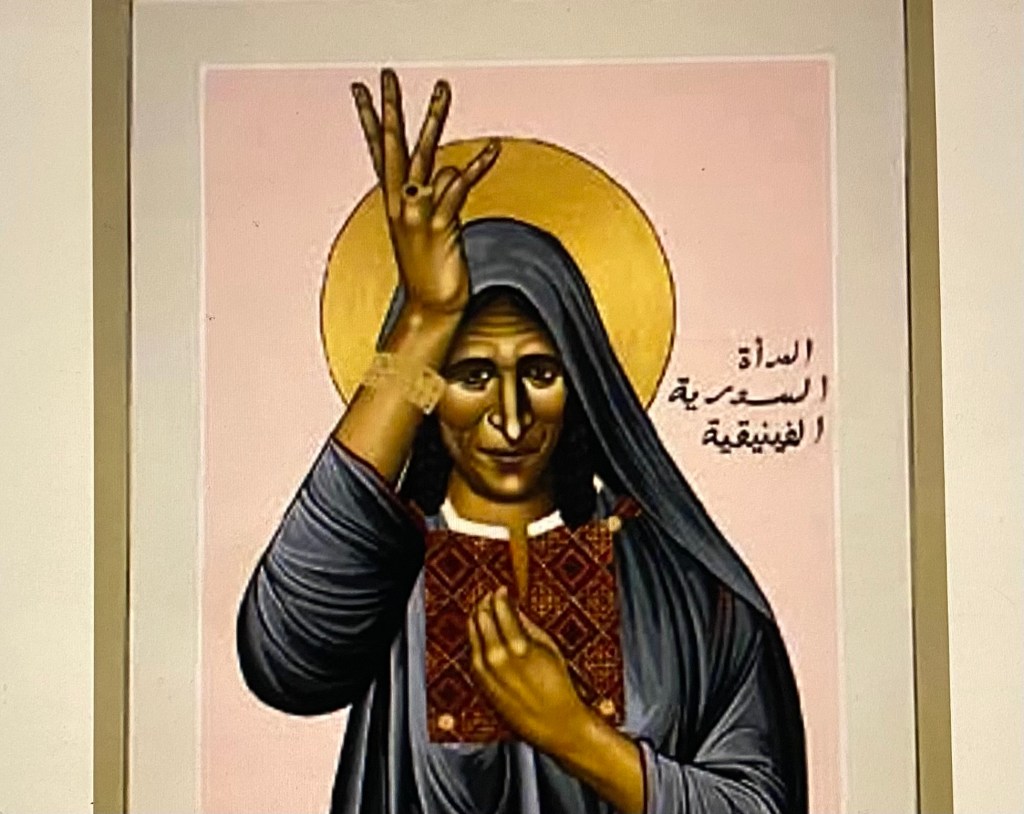
Photo: Syrophoenician Woman by Robert Lenz

Link for the Mass readings for Wednesday, February 13, 2025

Will we allow the Word of God, Jesus, to transform our hearts and minds?

The king was deeply distressed, but because of his oaths and the guests he did not wish to break his word to her (Mk 6:26).

The king referenced in today’s Gospel is the tetrarch, Herod Antipas, one of the sons of Herod the Great. He reveals the weakness of his character when he calls for the beheading of John the Baptist, much as a foreshadowing of Pilate before the crowd asking for Jesus’ death. Both condemned innocent men to die. They  each decided to take John and Jesus’ life. Herod chose to protect his foolish oath to Salome, instead of standing up and defending the dignity of the life of John the Baptist. Pilate caved into the pressure of the crowds who claimed he was no spokesman for Caesar. In both cases, innocent men were brutally murdered without any regard for their lives.

For the first part of his gospel, Mark has shown the opposite. He has shown what true leadership is as he has presented Jesus who instead of disregarding and degrading human beings has empowered them through his teaching a better way to be whole and in union with the God who has created his listeners. He has freed the possessed, healed those who had been on the outside bound by illness and/or sin. Instead of the evil disposition of Herodias, we recently saw the courage of the woman with the hemorrhage.

And while Mark provides us with this interlude and flashback of the death of John the Baptist, the apostles are on the march proclaiming the gospel, healing, and exorcising demons in Jesus’ name. They are putting into practice what they had learned. They are allowing their hearts and minds to be changed by the Word of God. Herod did not allow the same seeds of God’s word to find any root in his heart. Instead of hearing the words of John, repenting from his sin, and allowing his heart and mind to be transformed, the little inspiration that he received withered and died in the heat of his ego and passions.

Time and again, Jesus showed the moral courage to stand up for and empower those who were considered other, lesser, unclean, and social outcasts. He, like John, showed true courage by speaking the truth that God gave him to reveal. As John was willing to lose his head for being God’s spokesman and preparing the way for his Son, Jesus was willing to suffer, to be nailed to the Cross, to die and conquer death, that each one of us might have life, and have it to the full.

We have a choice to make each day and each moment. We can choose to follow the enemy or to follow Jesus. Herod and Pilate made their choices and the apostles made theirs. May we choose to follow Jesus and allow his words to find rich soil, that we may allow our hearts and mind to be transformed as apostles, and so also grow in virtue so that we too will have the moral courage to stand against the pressures of a culture of death and stand up for the dignity of each person at every stage of development from the womb to the tomb, and implore that our leaders do the same.


Photo: Nothing helps us to allow our hearts and minds to be transformed by God’s love than by making the time to be still, pray, and meditate on his word and listen.

Link for the Mass readings for Friday, February 7, 2025

“Do not be afraid, just have faith.”

“Jesus, aware at once that power had gone out from him, turned around in the crowd and asked, ‘Who has touched my clothes'” (Mk 5:30)? The woman could have slipped away, she could have stood still and said nothing, no one knew. His disciples were bewildered that Jesus asked such a question with so many pressing about him. But the woman approached with “fear and trembling” and told him the truth. Jesus did not admonish her for breaking a social taboo but publicly acknowledged her faith and so empowered her with a deeper healing than the merely physical that she sought.

All the while as this scene transpired, Jairus must have been in agony. He knew how close his daughter was to death, and every second counted. Jesus took that limited, precious time and engaged with this woman. Just as they were about to resume their journey, and he began to breathe again, the terrible news came that his daughter had passed away.

What might have flashed through his mind at that moment? The time Jesus took to talk with the woman, could that have made the difference? He was a synagogue official and would have known the taboos she crossed to reach out and touch Jesus in public, he knew that in doing so she would make Jesus unclean, she was a woman considered the lowest of low. She was frail and pallid from her condition, at death’s door herself, yet she had mustered such courage and faith to touch him. She took such a risk. While these or any other thoughts were passing through his mind, Jesus assured him, “Do not be afraid, just have faith” (Mk 5:36).

Jairus had just witnessed such faith with the woman healed from the hemorrhage, probably someone until this very moment for whom he might have shown disdain for. Maybe just maybe, if he could muster the same faith as her. Jesus could bring his daughter back to life just as Jesus had brought this woman, who was death’s door back to life and wholeness. A light shone in the darkness of his despair and the darkness did not overcome it. He would not be let down. Jesus indeed healed his daughter. He took her hand as he had done with Peter’s mother-in-law, and commanding her to rise and walk, she came back to life.

How many of us have ourselves or have ever known someone who has experienced such great needs as did Jairus, whose twelve-year old daughter died, or the woman who had been suffering for twelve years with hemorrhages, with no healing from doctors all this time? In both of these cases Jesus brought about miraculous healings. How many of us have experienced the opposite? No healing that we prayed for. We wondered where Jesus was or why he didn’t bother to help? The truth is Jesus is present, though he may or may not have brought about the outcome we may have sought.

February 2 marked five years and five months since JoAnn died. She was not healed from the pancreatic cancer that ate away at her body, as was the woman with the hemorrhage. Nor did Jesus come to raise JoAnn from the dead, as he did for Jaurus’ daughter, while I laid by her side and held her hand awaiting the funeral home to pick up her body. Does that mean Jesus does not heal anymore or that there is no relevance in the readings of the Gospel of Mark for us today?

No. Quite the opposite. Entering into the daily rhythm of reading, praying with, and meditating upon these accounts helps us to know him not as a historical figure but to encounter him as our Lord and Savior, brother and friend, who is present with us in this and each moment. As we enter into each passage, slowly and prayerfully, we are invited to enter into his memory, receive his direction and guidance. Over these five and a half years, I have healed, become aware of further areas in need of healing, attachments to let go of, and Jesus has helped me each step of the way. No step has been easy, but Jesus has given me the guidance and strength to make each one possible.

Read again prayerfully today’s account. May we pray for the courage and faith to approach Jesus and place all our trust in him for each situation as this woman did. When we struggle, when the ground feels a bit shaky underneath, let us take to heart and believe in the words that Jesus spoke to Jairus, “Do not be afraid, just have faith (Mk 5:36). When we place our trust and faith in Jesus, who is truly with us through it all, the good, the bad, and the ugly, we will experience his love, direction, and strength with each step we take along the way.


Photo: JoAnn received an even greater healing and I believe now that Jesus did come that day. He took JoAnn by the hand, and she like Jairus’ daughter arose to be with him for all eternity. 

Link for the Mass readings for Tuesday, February 4, 2025

May we also trust and have courage to reach out to Jesus in our need.

“If only I can touch his cloak, I shall be cured.” Jesus turned around and saw her, and said, “Courage, daughter! Your faith has saved you.” And from that hour the woman was cured (Mt 9:21-22).

Just to touch his cloak may seem a small and insignificant act, but by doing so, this woman showed tremendous courage. Suffering from hemorrhaging for twelve years, broke from spending all her resources to be healed, she risked. She could have been severely punished, beaten, or stoned for this small act. Under the Levitical code, her condition deemed her unclean, in the same category as a leper, a pariah. Touching someone else in that condition would then make them unclean. Yet, in that small touch, that great act of courage, “power had gone forth from him” (Mk 5:30), and she was completely healed. Not only did the woman exhibit the courage to touch Jesus, but to admit she had done so when Jesus questioned who had touched him.

In calling the woman who touched him out, Jesus was not condemning her, Jesus was acknowledging her faith and restoring her to the community from which she had been ostracized. Jesus restored her dignity. How many women today still feel and experience the pain of exclusion, not having access to the full and equal benefits of society and the Church? How many people are still considered outcasts and pariahs in our communities?

Pope Francis in his general audience from August 31, 2016, stated: “Once again Jesus, with his merciful behavior, shows the church the path it must take to reach out to every person so that each one can be healed in body and spirit and recover his or her dignity as a child of God”. We too then are to treat each person we encounter, in-person and online, with dignity, love, mercy, and respect.

The courage and persistence of the woman with a hemorrhage from today’s Gospel led her to reach out to touch Jesus even though she was crossing social norms. Jesus affirmed her move. May we also place our trust in Jesus, have the same courage to reach out to Jesus for our needs, when in our weakness, and to seek his guidance. While at the same time, may we be available and willing to allow Jesus to work through us to provide healing and support for those in our realm of influence who are in need.


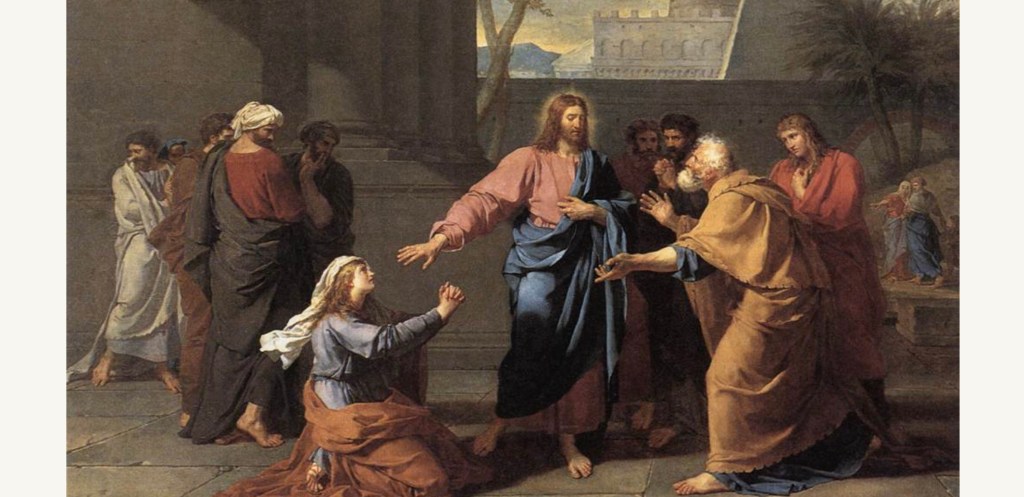
Painting: James J. Tissot, The Woman with the Issue of Blood (1886-94)

Link for the Mass readings for Monday, July 7, 2024

Model of courage and faith

In today’s encounter between Jesus and the Syrophoenician woman, we can observe again the crossing of societal norms by both the woman and Jesus. She, very much like the woman who had been hemorrhaging for twelve years, was desperate and approached Jesus. She was willing to not only risk breaking the social taboo of speaking with Jesus, but she was also willing to do so by walking into the home where Jesus was staying and fall at his feet.

Jesus’ response to her begging sounded more like he was possessed himself rather than the healer she sought out: “Let the children be fed first. For it is not right to take the food of the children and throw it to the dogs” (Mk 7:27). This woman was not fazed by Jesus calling her a dog, she wasn’t leaving without receiving healing for her daughter, even if that meant she was putting her life in danger. Her retort, “Lord, even the dogs under the table eat the children’s scraps”, emphasized this point. It was also the key that opened the door for the disciples and us to witness a consistent pattern with Jesus.

We saw the same situation with the woman who was experiencing the hemorrhage (cf. Mk 5:25-34). Both women had the faith and courage to approach Jesus and both received the healings they sought and were affirmed by Jesus. The outcome of this encounter was also like the one Jesus had with another gentile, the Roman centurion, who said that he was not worthy for Jesus to enter under his roof (cf. Matthew 8:8). In both accounts, Jesus healed solely by his word from afar. What is important to Jesus is not whether they are male or female, Jew or Gentile. What matters if the person’s faith! Do they trust in him or not?

Do we have the courage, faith, and trust in Jesus as shown by the Syrophoenician woman in today’s Gospel? When we let nothing hinder us from drawing closer to Jesus, including relinquishing the reigns of being our own masters, acknowledging that God is God and we are not, believing that Jesus is truly the Son of God, that he is still present and active in our lives, and we have no reason to be anxious or afraid, miracles still do happen! Jesus said that if we have faith, even the size of the mustard seed, we can move mountains (cf. Mt 17:20).

We don’t need a lot of faith, a mustard seed is tiny. Just that little amount of trust in Jesus is enough for God to happen! Remember the feeding of the five thousand with just a loaf of bread and a few fish! When we believe with childlike trust that Jesus will provide, he will. It may not be as immediate as with the Syrophoenician woman or it may. What is important is that we can mature and grow in our faith such that we know Jesus, trust that he loves us, wants the best for us, and that he will always be there for us. It is also important to renounce any of the mind noise that may arise to counter these truths.

No matter what we might be dealing with today, let us be inspired by the Syrophoenician woman, and bring our petitions or intentions to him. Bring any anxieties, fears, trials, and/or tribulations to him, lay our burdens at his feet, and take his hand. With Jesus all things are possible. Jesus has not nor will he ever abandon us. He cares for and loves us. Jesus the Christ, the Son of the living God is our Savior and Redeemer, is present, is the kingdom of God at hand, and will see us through step by faithful step.


Photo: Icon of Syrophoenician Woman by Br. Robert Lentz, OFM

Link for the Mass reading for Thursday, February 8, 2024

Have courage, have faith, trust in Jesus.

“Jesus, aware at once that power had gone out from him, turned around in the crowd and asked, ‘Who has touched my clothes'” (Mk 5:30)? The woman could have slipped away, she could have stood still and said nothing. Had anyone seen her touch his clothes. Jesus’ disciples were bewildered that Jesus even asked such a question with so many pressing about him. No matter, the woman approached with “fear and trembling” and told him the truth.

In coming forward and telling the truth, this woman was showing tremendous courage. She had just broken a serious, social taboo. She touched Jesus in public as a woman and having been hemorrhaging for twelve years, would have been considered ritually unclean. Her touch would have rendered Jesus unclean. The opposite happened. Both Jesus and the woman knew she was healed the moment she touched his garment. Jesus did not admonish her but publicly recognized her faith.

All the while as this scene transpired, Jairus must have been in agony, knowing how close his daughter was to death, and Jesus actually, stopped and took precious time to even engage with this woman. Finally, they were about to resume their journey when the terrible news came that his daughter had passed away. What might have flashed through his mind in that moment? The time Jesus took to talk with her, could that have made the difference?

Other details surely crossed his mind. As a synagogue official he would have known the taboos she crossed as a woman who was the lowest of low. She would have also been frail and pallid from her condition, at death’s door herself, yet she had mustered such courage and faith. As these and other thoughts raced through his mind, Jesus said to the man, “Do not be afraid, just have faith” (Mk 5:36).

Jairus had just experienced a powerful expression of just such faith with this woman, probably someone until this very moment who he would have shown disdain for. Maybe just maybe, if he could muster the same faith as her, Jesus could bring his daughter back to life. Could his and the woman’s eyes met at that moment? Could a light have then shone in the darkness of his despair? Jesus would heal his daughter, by taking her hand and commanding her to rise and walk.

How many of us have been or have known someone who has experienced the anguish Jairus, whose daughter was near death, was going through, or the woman who had been suffering for twelve years with hemorrhages and receiving no help and all but lost hope? How many of us know of such healings that still happen today? How many of us have though experienced the opposite? Where we experienced no healing, we wondered where Jesus was, and why did he allow this to happen, or did not step in to help?

The best we can do in times of trial and dire need is to summon the courage of the woman suffering from hemorrhages and trust in Jesus. He may or may not bring the outcome we seek. But I assure you that he is present with us through our pain and suffering, whether we feel his presence or not. Sometimes he allows the unthinkable to happen, of which we cannot even comprehend at the time, to bring about a greater good. Often, we are not able to see that until a later date when we are able to look back.

Remember also, that even death does not have the final say. Jesus does because he has conquered death. Jesus and we who participate in his life are victorious. Healings do still happen. Ultimately, faith is placing our trust in our God and Father who loves us, who is present with us no matter what, and carries us in our darkest hour. He sent his Son to walk with us and encourage us as he did with Jairus: “Do not be afraid, just have faith” (Mk 5:36). Let us place our hand in his, face what is before us, and be on our way together.


Photo: The light of Jesus shines even when the sun doesn’t. Rosary walk as storm clouds gathered a few weeks ago, St. Vincent De Paul Regional Seminary, Boynton Beach, FL.

Link for the Mass readings for Tuesday, January 30, 2024