We can become like Jesus.

Ordinary time in the Church calendar year is anything but ordinary. It is during this season, that the primary focus of the readings chosen from the Gospels are on Jesus’ life and teachings. By making time to read, pray, and meditate upon his word, and then putting what we have learned into practice we become his disciples.

We get the word disciple from the Greek, mathētḗs, and Latin, discipulus, which both mean pupil. A pupil is one who learns from the teacher. And as we heard in today’s Gospel, Jesus is teaching his disciples that:“No disciple is superior to the teacher; but when fully trained, every disciple will be like his teacher” (Luke 6:40).

Who wouldn’t want to be more like Jesus? There are many ways to answer that question. Some possibilities come down what people’s experience of Christians have been, what their concept of Jesus is, and what they think about and decide to do with his teachings.

When we spend any time reading his teachings, we will come across some that are challenging. Just as when those who heard that Jesus is the true bread from heaven and that those who followed him would eat his flesh and drink his blood walked away. They had enough. Multiplying five loaves and two fish were one thing, but eating his flesh and blood was quite another. But the twelve stayed, for when Jesus asked them if they would leave also, Peter said, “Where else are we to go, you have the words of eternal life.”

That is the answer of a disciple of Jesus. Even when we may not understand, disagree, or don’t feel we are capable of putting into practice some of Jesus’ teachings, we can trust that what he is saying is the truth. They are not unreasonable and not impossible. We may not understand or be able to do them because we are incapable of understanding without insight from the Holy Spirit and cannot put them into practice on our own power apart from Jesus. Jesus is the Word, he is our life and the source of our strength and with him all things are possible.

Jesus has challenged us in our most recent daily readings to love our enemies and those who hate us, outlined how we will be happy by living out the beatitudes even though they may seem counterintuitive, and as he has shared today, that we are not to judge others. If we do not agree, do not feel we can, then we bring our struggle to Jesus. We ask him to help us understand how we can love our enemy, how we can forgive, and not judge. And bring to him those specific persons we call to mind.

When we trust in Jesus, are honest with him, and share where we are struggling with his teachings, while trusting in him as Peter and the other Apostles did, we will come to understand, be transformed, and grow in our relationship with him. Seeking out guidance from those who are living those teachings is also helpful. Even when we feel like we can’t love or forgive someone, as long as we are willing to invite Jesus to help us to resist judging, to love and forgive, he will do so through us, and we will make progress. We will learn from our teacher, be empowered by him, and become like him.


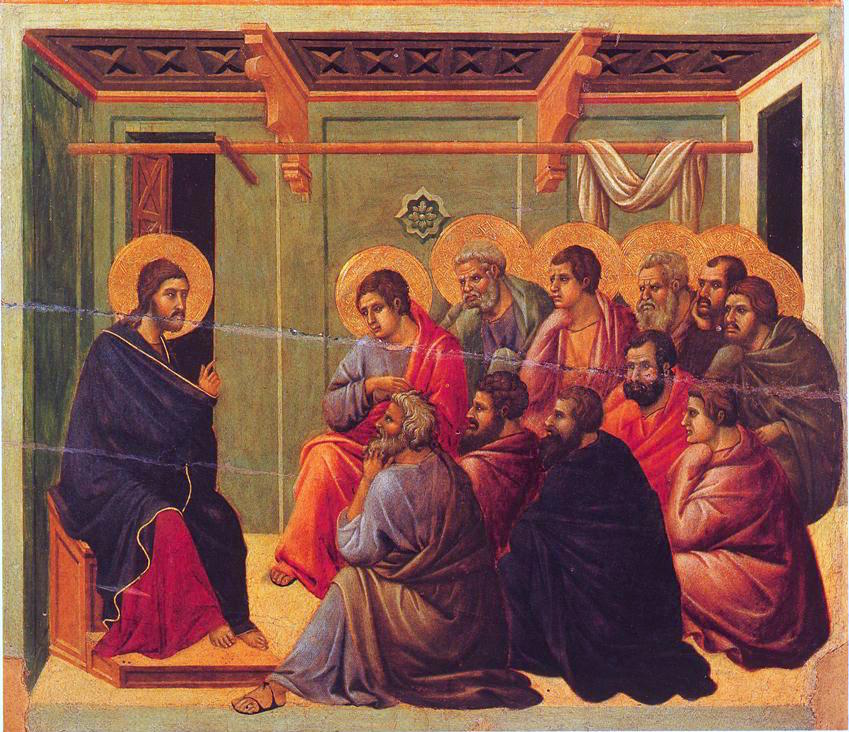
Painting: Christ Taking Leave of the Apostles by Duccio Buoninsegna

Link for the Mass readings for Friday, September 13, 2024

Jesus leads us from the darkness of our fears into the light of his love.

Jesus said to his Apostles: “No disciple is above his teacher, no slave above his master. It is enough for the disciple that he become like his teacher, for the slave that he become like his master (Mt 10:24-25).

Following the teachings and guidance of Jesus was hard for his apostles and disciples then and it is just as challenging today. To live as authentic disciples, we need to learn from and put his teachings into practice. That means more than reading some of his teachings: love God with your whole heart, mind, and soul and your neighbor as yourself, turn the other cheek, and what you do to the least of my brothers, you did it to me, and acknowledging, that, “That is some good stuff!” Then just moving on to the next thing on the to-do list.

Living as a disciple also happens in a public way, which means public scrutiny. One thing we all have in common as human beings is that we want to belong, to fit in, and to be a part of. We risk rejection and ridicule by following Jesus and living as his disciple because we run up against our own fallen nature and the fallen nature of others. Jesus said he would be sending us as sheep among wolves yesterday and in today’s reading, he announces that we are not to be afraid of those who kill the body. Not exactly the kind of encouragement many of us are looking for.

Yet, Jesus affirms consistently that we are not to be afraid. Jesus leads us to the most important relationship that we will ever develop and that is with his Father. God cares for us, just as Jesus said, as his Father cares for the sparrows, but even more. God knows us by name, and we are his, we belong to him. Our loving God and Father has known us not only before we were born, but before all creation began. Never have we been, are we now, nor will we ever be, alone. As we risk, grow in confidence, and begin to live our life in alignment, in relationship with Jesus and God through the love of the Holy Spirit, we will begin to become unified with him so to feel a joy and a fulfillment that is unmatched.

One of the keys to living the Christian life is understanding that it is more than a philosophy, a set of teachings, or a theology. Being a Christian means allowing ourselves to be known, loved, and to build our relationship with a person. Jesus is that person. Instead of hiding or running we are invited to trust and turn to him. By admitting and giving him our weaknesses and our fears, our anxieties and overthinking, our worries and our sins, we can begin to slowdown, to breathe, and begin to reset our brain’s wiring.

As Isaiah had his mouth purged by the ember placed in his mouth by a seraphim, as Peter recognized in the presence of Jesus that he was a sinful man, we too in the presence of God will see our weaknesses, our failures and our shortcomings. The light of Christ reveals to us our darkness not to condemn us, but to free us. To bring our sin into the light, so it can be purged, that we can be purified, and ultimately deified. Jesus became one with us in our humanity so that we can become one with him in his divinity. It is precisely in turning our weaknesses over to Jesus, and admitting our utter dependence on him, that we become strong.

Acknowledging Jesus is our teacher does not mean that we will gain all the answers to life, but it does mean we will be more aware of his presence during each step of our journey through this life. Take courage, be not afraid, and like Isaiah, the prophets, the Apostles, and Mary let us say, “Yes.” to the will of God and take our next step along the path to our freedom.
————————

Photo: Rosary walk last night in Riverside Park, Vero Beach, FL.

Link for the Mass readings for Saturday, July 13, 2024

Stop, breath, and listen.

“…the sheep follow him, because they recognize his voice” (Jn 10:4). This verse is one of the keys to growing in the spiritual life and becoming a disciple of Jesus. Amidst all the voices, distractions, diversions, and temptations clamoring for our attention, we want to develop an ear to hear and a mind to discern his voice. There are so many directions we can take and opportunities we can be enticed by, many that are detrimental, but more challenging are those that are good in and of themselves.

Jesus came to us so that we “might have life and have it more abundantly” (Jn 10:10). To live life to the fullest, to actualize our potential, we need to be able to discern the distinction between apparent goods and the true Good. An apparent good is appealing, attractive, and desirable, though once experienced, we conclude that it was indeed not good for us after all. We can see this in the promotion of processed foods, with additives and an excess incentive of enticing the taste buds with salts and sugars.

The experience of eating many of these products is that they taste good going down, especially if eaten quickly and not savored, such that we often eat them in excess. They not only have little, if any nutritional value, if this is the main source of our nutrition, over time, we will feel the ill effects of eating in this way. When I sit down to eat pizza, there are two clear voices. One voice encourages an eating of the whole pie in one sitting, while another urges a balanced two-slice approach or no slices at all.

There can also be choices between two actual goods. Discerning in each of these areas can be a challenge especially when we make the time to assess how we spend our time, talent, and treasure. We all have the same amount of time in the day. In what ways do we use our time, who is it that we are listening to? What are we investing our treasure in? How do we, or do we access and engage in our talent? Do we listen to the Father of Lies or the Good Shepherd?

A good practice to help develop our ears to hear the voice of the Good Shepherd is to resist making impulsive decisions, no matter how small. When a desire presents itself, instead of impulsively choosing, take a breath, reason it through, pray with Jesus, and seek his guidance. Too often, we skip the step of our reason and prayer, and dive right into the act of our will. Some helpful questions can make a difference: “Is what I am about to decide helping me to become a better disciple, leading me away from or closer to God, to be true to myself and who God is calling me to be?”

Putting this simple step into practice will help us over time and through various experiences come to better discern the voice of Jesus. Inviting a core group of people to talk with, to get their perspectives, to help keep us accountable, can also help us to learn to hear the words of Jesus through others.

May we have ears to hear the Good Shepherd’s voice today, and each day, and the courage and humility to follow his will!

————————————–

Photo: Have been blessed again with another wonderful evening to slow down, breathe, and pray; St. Vincent de Paul Regional Seminary, Boynton Beach, FL.

Link for the Mass readings for Monday, April 22, 2024

Growing in faith is a life-long journey.

Jesus not only tells his disciples that he has not come to abolish but to fulfill the law, he constantly teaches how this is true, models how to put his teachings into practice, and empowers his followers to do so. In his Sermon on the Mount and Sermon on the Plain alone, we can see the development of his teaching and building on the foundation of the Torah. With his Beatitudes, such as, “Blessed are the poor in spirit for theirs is the kingdom of heaven”, and his Six Antithesis including, “You have heard that it was said ‘an eye for an eye,’ but I say to you offer no resistance to one who is evil”, we can see the further development of Jewish teaching on full display.

If we seriously take the time to read through Jesus’ teachings, we will see quickly how challenging they are. Jesus is not lowering the bar of discipline for his followers, but in fact, raising it. Jesus does so not to place heavy burdens on us for burden’s sake, not just to give us busy working, but he seeks to make us holy. He himself lives what he preaches, but Jesus is no ordinary teacher or mentor. The principles that he teaches, forgiving seventy-seven times, loving our enemy, giving up all to follow him, these seemed impossible to his disciples then and to us today as well.

At face value, we may think that many of Jesus’ teachings are not possible to put into practice or very practical in our day and age. Attempting to do so with our own willpower alone may lead to coming up short each time, and feeling more frustrated. Jesus does not expect nor desire us to accomplish living as his followers on our own efforts. We are to yolk ourselves with him and be open to the transforming power and love of the Holy Spirit acting through us. This happens when we daily invite Jesus into our lives and are humble enough to follow his lead.

We become disciples of Jesus when we are willing to study his life, learn and put his teachings into practice, and surrender ourselves to his will through prayer, discipline, worship, service, and participation in the sacraments. We do so by first being willing to receive his guidance, open our hearts and minds to and allowing Jesus to live his life in and through us. In this way, we are transformed by his love and conformed to his life such that we can say with Paul, it is no longer I who live but Jesus who lives in me (cf. Galatians 2:20).

The path of faith is not a sprint or a one-time event, but an ongoing journey. Each one of us can be assured that Jesus is with us for the long haul, every step of the way and with each temptation that arises. Even when we fall, Jesus remains with us, to forgive and heal us. When we receive and rest in God’s love, we will experience his peace, and will better be able to make decisions free from fearful or reactive responses. By leaning on Jesus and each other, we will resist temptations, make healthier decisions, rise again after we fall, and make it through each day together, with more joy, love, and peace, no matter what arises.

————————————————————————–

Photo: On retreat last January, Marywood Retreat Center. Prayed morning and evening prayer on this dock each day at sunrise and sunset.

Link for the Mass readings for Wednesday, March 6, 2024