Called, loved, and sent.

The rejection of Jesus by those in his hometown did not slow down his mission. We can imagine that Jesus knew what he was going to do already, but en route wanted to stop by to see if any from his “native land” would like to participate in his public outreach. Apparently, no one, or only a very few, those who were healed by him, did. Jesus, as he does throughout the Gospel of Mark moves on without missing a beat, much like Mary going in haste to bring the good news to Elizabeth. Jesus went ahead and, “summoned the Twelve and began to send them out two by two and gave them authority over unclean spirits” (Mk 6:7).

Could the rejection of the people of Nazareth then also have been a preparation for the sending of the Twelve? They had experienced his exorcisms, teaching with authority and healing with miracles, and also saw the reaction of the crowds. Before he gives them some final instructions, maybe the most important of all was to be faithful to the message of repentance that they were sent to preach. They were to bring the light of Christ to those for him they were sent to reveal those sins they needed to turn away from those sins, attachments, and idols and instead turn to God and invite them to give their whole hearts and minds to them.

Jesus summons us and sends us out as well. We too have been accompanying Jesus and his disciples through each chapter. The word of God is living and alive and Jesus still reaches out and calls us as he called the Twelve.

At the end of each Mass, we are sent, just as the Apostles, to proclaim the Good News! All of us as the Body of Christ, believers in Jesus the Christ, those of us baptized into his death, are to live as his disciples and bear witness to how Jesus has transformed our lives. This is best done by repenting ourselves and placing God at the center of our lives. Jesus gives us each a unique call of evangelization with a particular charism and gift that the Holy Spirit imparts within us at our Confirmation.

Jesus is the one who calls, sends, and empowers us for mission. We are sanctified, made holy, and set apart when we say yes to his invitation, participate in his sacramental life, and follow the will of his Father. Jesus not only teaches with authority, but he also calls and sends us with that same authority. We are to rely on the divine providence of our Father. He prepares us and provides that which we need to accomplish the task he has given, and he will also send the Holy Spirit and others to provide help, aid, guidance, and support. We see this over and over again in the lives of the Apostles and each generation of saints thereafter.

At first sight, we may not agree with God’s choosing. Me, really? Those he sends to walk with us, are you sure! Yet, we only need to recall what he accomplished with the Apostles, remembering the imperfections of each apostle and their simple beginnings. Just as mustard seeds, that grew to mighty bushes, what wonders they accomplished in Jesus’ name. God does not see as we do, for we are often misled by appearances “or lofty stature” but God sees into the depths of the heart (cf 1 Samuel 16:7).

Ultimately it is not about us after all. It is about our willingness to be open to and led by God and to work arm in arm with those he has invited to walk with us. That makes all the difference. We are not to go forward alone. We are called to be in community as the Body of Christ. Jesus sent his disciples out two by two in the beginning, so that they could provide mutual support, guidance, encouragement, prayer, and accountability. We each begin best each day by making time to be still, to breathe, receive, rest, abide in God’s love, and listen to his word and guidance. Then we begin, step by faithful step, walking with our brothers and sisters to follow the light that Jesus shines before us.

—————————————————————————

Photo: Blessed to have begun my seminary journey with these my brothers in Christ!

Link for the Mass for Thursday, February 6, 2025

Will we follow Jesus as Levi did?

In both the first reading from Hebrews and verse from Psalm 19 we read about the power of God’s word. “The word of God is living and effective” (Hebrews 4:12) and the words of the “Lord, are spirit and life” (Psalm 19). Jesus gives face to the living word of God come down from heaven to transform his people as he continues to teach with authority and offer healing. In today’s account of Mark, Jesus calls his fifth disciple, Levi. The key difference with this call of Levi and the four fisherman is Levi’s occupational hazard.

Tax collectors were disliked, even despised by many in ancient Palestine because they were considered unclean, and categorized as with lepers and sinners. They were cast in this net because the tax collector had a responsibility to pay a fixed amount to the occupying power of Rome. This in itself was bad enough because their own countrymen were colluding with the enemy. What made matters worse was that too many kept as a commission anything he collected over and above that fixed amount. The majority of the population, already just getting by, paying a temple tax, and the Roman tax, then finding out their local tax collector was taking more than their fair share, did not make for feelings of endearment.

Jesus surprises all who had come to hear him teach when he not only invites Levi, also known as Matthew, to follow him but then they have dinner together. We are witnessing yet again another healing miracle. Jesus provides an opportunity of bridging divides by inviting someone to his inner circle, to turn away from one way of life to begin anew, to: “Repent and believe in the gospel” (cf. Mk 1:15). The Pharisees question his choice of table fellowship companions. It is not clear if the Pharisees are eating with them or are on the outside looking in. The other curious point is that the Pharisees are conversing with Jesus’ disciples. So both groups are together witnessing the communal exchange, from a distance. They choose not to engage in the fullness of the fellowship.

They could not have been at too great a distance though because Jesus could hear their concerns and responded to them: “Those who are well do not need a physician, but the sick do. I did not come to call the righteous but sinners” (Mk 2:17). The Pharisees, and possibly some of his disciples, were not a part of the intimacy of this communion because of their own unwillingness to accept those that Jesus invited to share a meal, to accept that they too were sinners also in need of healing.

All have sinned and fallen short of the glory of God. Jesus forgives and offers mercy to all who are willing to be aware of his invitation to fellowship. In surrendering our finite freedom over to his divine freedom, we receive healing and transformation, then are offered an opportunity to develop an intimate relationship and participate in communion with the one who is ushering in the kingdom of God. This is a foreshadowing of the last supper and the celebration of the Mass.

We too are invited as sinners to join the banquet, to be in fellowship with Jesus. As Levi received, we are given an opportunity to begin again, to leave behind anything that separates us from God and one another and follow Jesus, who came that we might be forgiven and healed.

As with many Gospel passages, today’s offers a wonderful opportunity to place ourselves in the scene. Mark presents Jesus teaching the people though he again does not tell us anything about what he shared. Knowing what follows, we might think about and ask ourselves, “What might Jesus have taught before going to Levi at the custom’s post?” Could he have been talking, as Matthew adds in his parallel account, about how Amos preached that God desires mercy and not sacrifice (Mt 9:12)?

Let us read this passage slowly a few times (Mark 2:13-17) and meditate upon these words of God that are “living and effective.” Then as Jesus moves to the custom post, follow him, and the others in your imagination. What is our honest reaction to Jesus calling the tax collector, Levi? Are there sins that others commit that we find easy to forgive, others that we find hard to forgive? As the scene shifts to the breaking of the bread, do we dive in with this motley crew, stay at a distance, or walk away?

The words of the “Lord, are spirit and life.” May we not only read them, but also meditate upon and pray with them so that we may be transformed by them. May we also encounter Jesus in this passage and be willing to listen to Jesus speak to us in the silence of our hearts. This is a wonderful spiritual practice that can bring us much joy, forgiveness, healing, and deeper communion with the Divine Physician and healer of our souls. No RSVP needed, just come, open up your Bible, and join the feast!

————————————————————————-

Painting: Caravaggio’s “The Call of St. Matthew”

Link for the Mass reading for Saturday, January 18, 2025

When we trust in the will of God and persevere, we will be saved.

“You will be hated by all because of my name, but whoever endures to the end will be saved” (Mt 10:22).

Why are we talking about being hated the day after Christmas? One reason could be that Jesus, this baby whose birth we just celebrated is “the light that shines in the darkness” (Jn 1:5). The very reality of Jesus is that he is the light that exposes darkness, he is the very embodiment of Love that exposes evil and hatred.

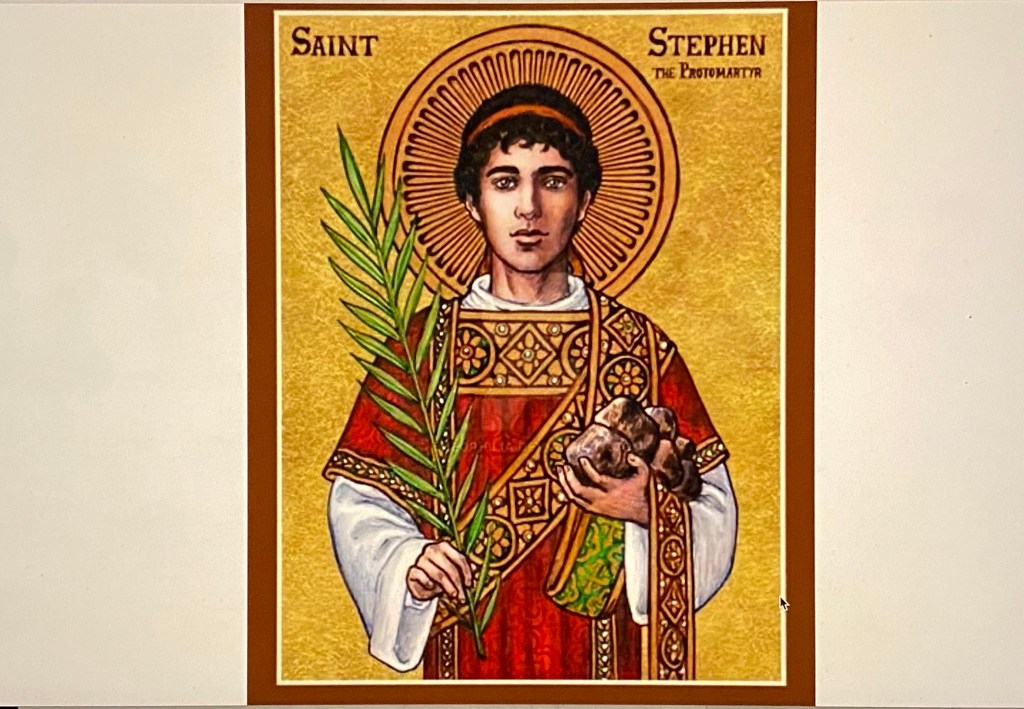
St. Stephen, whose feast we celebrate today, and whose death we read about in the first reading from Acts, experiences his words personally. For he is killed for the sole purpose of speaking the Gospel. While during his persecution he sees and communicates how even the heavens open for him. The reaction to those who hear his words are infuriation and they then throw him out of the city and “stone him” (cf. Acts 7:54-59).

Stephen radiated the light, love, and wisdom of Jesus and like Jesus he was put to death. His persecutors felt threatened by the light instead of welcomed to let go of the darkness that held them bound. Jesus exposes the truth of those dark places within our own hearts, minds, and the very depth of our being as well. What is our response? Will we also reject the light, not aware that it is an invitation to healing and to wholeness?

We may wince at the luminous brightness of Jesus’ light and resist the intimacy of the love he seeks to share. We may unconsciously do so, because we have so often faced so much of the opposite; hurt, pain, betrayal, and lack of understanding or acceptance, that we assume a defensive crouch is best to protect our false sense of self, when in fact that is just what we are invited to let go of. As time passes and we keep to the shadows, we risk becoming ingrained in our fear and pride and our posture of protecting our ego.

Yet, to be fully alive, we need to embrace the light, not hide from it. When we are open to the healing touch of Jesus and receive the gift of his light in our lives, we begin to die to our false self and the lies that we have believed. Allowing ourselves to breathe and rest in God’s loving presence helps us to heal, indentify, and allow Jesus to transform our vice to virtue. Once we allow ourselves to be loved by Jesus, we begin to recognize that we are turned in upon ourselves, and then we can adjust our posture and begin to open ourselves to him. We also begin to recognize that we are not the center of the universe.

As we follow the model of John the Baptist, St. Stephen, the other saints, we become less so that Jesus becomes more in our lives. We too will face the same rejection that Jesus faced. We will be labeled crazy, out of step, simple-minded, irrational, and worse. Yet we are to resist returning to a defensive posture, to refuse to react in kind, but instead, to be present, call upon and trust in the Holy Spirit to give us the words to speak, and allow God to happen. We are to remain open, accepting of the person where they are and as they are, and share the same transformative mercy, love, and forgiveness of Jesus that we have received from our attacker.

Change, maturation, and growth are not easy. As disciples, we are to be disciplined and persevere, while at the same time remember that our redemption does not come from our own doing or willing it to be so on our efforts alone. Our healing, restoration, and transformation come first and foremost from a willingness to accept the invitation to experience a deepening of our relationship with Jesus. When we accept his invitation to walk with him, and trust him, we will receive the healing salve of his love, mercy, and forgiveness. We will then heal from and let go of our biases, prejudices, hatred, and selfishness.

Transformation is not a one-time event. Christmas is not just a day, it is not just a season. Christmas is a time when we can recommit to allowing Jesus to enter into and to transform our lives each and every day, each and every moment, with each and every decision. When we are tempted in any way, let us call on the name of Jesus, trust in him, take a few deep breaths, and we will better be able to resist that which seeks to divert us.

In becoming human, Jesus lived showing us that this life was not all there is. The fullness of our lives are to be lived in and for God his Father. When we, like, Jesus, Stephen, and the saints, trust and obey God’s will, no matter where that will lead, we will be transformed, whole, and more alive than we can ever imagine, in this life and the next.

————————————————————————–

Photo: St Stephen the Protomartyr – icon by Theophili Saint Stephen, pray for us!

Link for today’s Mass readings for Thursday, December 26, 2024

When we turn to and trust in Jesus and Mary we will have the strength to follow God’s will.

Jesus compared “this generation” to children who could not be satisfied. For when the flute was played for them they did not dance, when the dirge was played they did not mourn. There was no pleasing them. Jesus drew the parallel to the present bystanders who acted as fickle as the children. They criticized John as being possessed for practicing fasting and asceticism. They then accused Jesus of being a glutton and a drunkard because his choice of companions for table fellowship.

In today’s Gospel account, Jesus could have been addressing his detractors as well as his disciples. He encouraged his followers to be wary of wallowing in the mud of fickleness. He also wanted them to be sure that they were authentic dispensers of his truth and the will of his Father no matter the reaction of the people, for “wisdom is vindicated by her works” (Mt 11:19). Just as Jesus taught that false prophets would be revealed over time by their fruits (cf. Mt 7:16), so those who were true to his teachings would be vindicated, if not fully in this life, certainly then in the next.

Pope Francis said that “The first thing for a disciple is to be with the Master, to listen to him and learn from him” (Francis 2014, 15). May we pray for open hearts and minds eager and willing to hear the word of Jesus our Master and the courage to act upon his leading in our everyday circumstances. To do so, it is important that we slow down our pace and quiet our minds so that we can even hear his word. We also need to discern the difference between his voice, our own, as well as the many other voices, the enemy, distractions, diversions, and temptations that we hear.

God himself speaks to us in so many ways; directly in the silence of our hearts, through others, spiritual direction, small groups, fellowship, through the Bible, as well as our culture, and influences, as well as through his creation.

More often than not, we may not definitively know if what we discern or hear is coming from God. Yet, remaining paralyzed and doing nothing out of indecision will not help us to move forward. We can find support and confirmation from Scripture and Tradition, others who are wise and practiced in following God, then we can reassess our guidance and then act. If we are wrong, we learn from our mistakes, make adjustments, and begin again. If we are on the mark, this helps us to build our confidence in recognizing God’s voice.

Another important step in discipleship is that we are not to seek to impress, but to express. Adulation and acclaim for ourselves are not what we are about. Our firm intent is to become less so that Christ becomes more. We are also to resist moralizing and condemning others and instead be willing to meet people where they are, convict as needed, as we accompany and break open the word in practical ways so they see the benefits of having God in their lives. The invitation and life of a disciple of Jesus is not an easy one. Will we follow?

We need not be afraid that we cannot fulfill the teachings of Jesus in the gospels because we can’t on our own strength. That is the point. We need Jesus to do so. Just as in learning to walk, our beginning attempts more often than not ended with a thud and us sitting on the floor or ground looking up. Yet, we got up, and with continued practice, we gained strength, balance, made corrections, and so began to gain confidence and the ability to move forward, upright, step by wobbly step. When we seek the support of Mary, and we turn to and trust in Jesus, he will give us the strength to walk on.

Dr. Martin Luther King, Jr. put it more eloquently when he spoke to students at Spelman College in April of 1960. “If you can’t fly then run, if you can’t run then walk, if you can’t walk then crawl, but whatever you do you have to keep moving forward.” So it is in anything we do, but especially in the spiritual life. If we are not moving ahead we are falling behind.

Jesus, please help us to trust in you and accept your invitation to know you and your voice so that we may better know your will. Grant us the courage to follow your will, your plan for our good, and lead us on the path you would like us to go. Inspire us each day to be aware of those you would like us to serve and love. Help us to move forward one more step each day closer to you and being who you call us to be.

—————————————————————————–

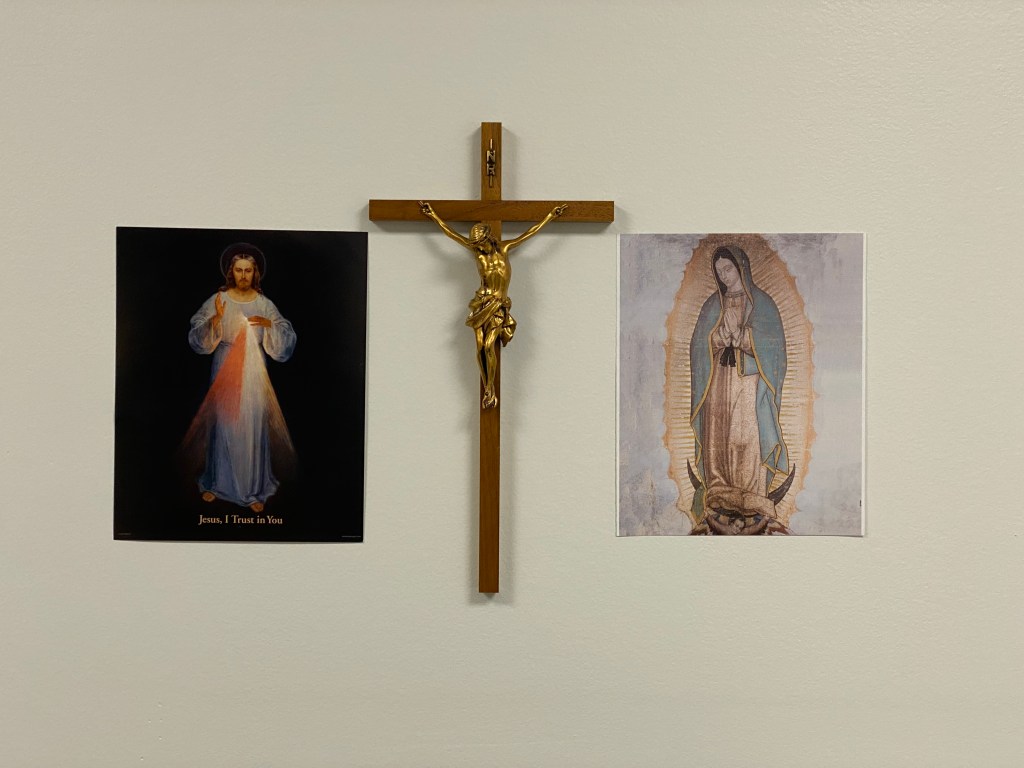
Photo: Let us take the hand of Jesus and Mary as we begin each day and walk on.

Francis, Pope. The Church of Mercy: A Vision for the Church. Chicago: Loyola Press, 2014.

Link for the Mass readings for Friday, December 13, 2024

When we know God and rest in his love, we can experience his peace even in times of conflict.

Jesus said to the crowd: “They will seize and persecute you, they will hand you over to the synagogues and to prisons, and they will have you led before kings and governors because of my name” (Lk 21:12).

Each of the predictions above; being seized, persecuted, handed over, and led before the rulers happened to Jesus’ disciples as was recorded by Luke in his second volume, the Acts of the Apostles. Jesus did not nor does he hide or paint a rosy picture of discipleship. He consistently shared and modeled in his own life how demanding it will be to follow his lead, the will of his Father, the demands of discipleship, as well as the reality of having to endure persecutions. This continues to be true today. In fact, the number of Christian martyrs in the twentieth century rose to a higher level than at any other time in history combined.

Since the first days of Jesus’ public ministry, there have been those who have said yes to the invitation to be his disciple and this has continued generation after generation up to an including today. Each of us has to make our own commitment to Christ. It is a personal invitation and a personal response. Though the demands, the sacrifices, and the expectations are high, Jesus is present with us through the journey. St. Paul equated discipleship with running a race: “Every athlete exercises discipline in every way. They do it to win a perishable crown, but we an imperishable one” (I Cor 9:25).

Any athlete, musician, artist, or person engaged in any serious endeavor, must discipline themselves to accomplish their goal of freedom for mastery, for excellence. A lack of concerted discipline will not lead to the fluency and the freedom for the sought after goal. The same is true with discipleship.

The discipline required that Jesus presents in today’s Gospel of Luke is to remain firm in authentically living out our faith even in the face of pushback, persecution, and hostility. This pressure may not just come from those who would seek us harm, but from family, friends, and/or peers. This is where the issue of putting God first comes to bear. We are not to be belligerent, get in someone’s face, or shut down dialogue about what we believe but meet others with love, mercy, and respect. Nor ought we back down from what we believe.

It is important to share, listen, respect and allow another the opportunity to do the same. From a place of mutual respect and honoring each other within and without of our own faith traditions, as well as those having none, we grow. People are free to decide as they wish. Sometimes people will react emotionally, rudely, crudely, or even violently. Yet that is not an excuse nor does it provide the green light for us to respond in kind. If we do, then we will often feed into and justify another person’s preconceived notions.

Archbishop Fulton Sheen said: “There are not one hundred people in the United States who hate the Catholic Church, but there are millions who hate what they wrongly perceive the Catholic Church to be.” As disciples of Jesus Christ, it is important that we know our faith, can explain what we believe, live it out authentically, clarify as needed through respectful dialogue, and above all to be icons of hope and love. We need not be afraid. The Holy Spirit will give us the words to speak as well as the ears to hear. The gift of respectful dialogue will result in the deepening of our relationship with the one who has made us for himself and one another. For where there is the truth, there is God who is Truth.


Photo: Making friends with silence, helps us to listen better to God and one another. We will also then know better when and what God wants us to speak.

Link for the Mass readings for Wednesday, November 27, 2024

We can become like Jesus.

Ordinary time in the Church calendar year is anything but ordinary. It is during this season, that the primary focus of the readings chosen from the Gospels are on Jesus’ life and teachings. By making time to read, pray, and meditate upon his word, and then putting what we have learned into practice we become his disciples.

We get the word disciple from the Greek, mathētḗs, and Latin, discipulus, which both mean pupil. A pupil is one who learns from the teacher. And as we heard in today’s Gospel, Jesus is teaching his disciples that:“No disciple is superior to the teacher; but when fully trained, every disciple will be like his teacher” (Luke 6:40).

Who wouldn’t want to be more like Jesus? There are many ways to answer that question. Some possibilities come down what people’s experience of Christians have been, what their concept of Jesus is, and what they think about and decide to do with his teachings.

When we spend any time reading his teachings, we will come across some that are challenging. Just as when those who heard that Jesus is the true bread from heaven and that those who followed him would eat his flesh and drink his blood walked away. They had enough. Multiplying five loaves and two fish were one thing, but eating his flesh and blood was quite another. But the twelve stayed, for when Jesus asked them if they would leave also, Peter said, “Where else are we to go, you have the words of eternal life.”

That is the answer of a disciple of Jesus. Even when we may not understand, disagree, or don’t feel we are capable of putting into practice some of Jesus’ teachings, we can trust that what he is saying is the truth. They are not unreasonable and not impossible. We may not understand or be able to do them because we are incapable of understanding without insight from the Holy Spirit and cannot put them into practice on our own power apart from Jesus. Jesus is the Word, he is our life and the source of our strength and with him all things are possible.

Jesus has challenged us in our most recent daily readings to love our enemies and those who hate us, outlined how we will be happy by living out the beatitudes even though they may seem counterintuitive, and as he has shared today, that we are not to judge others. If we do not agree, do not feel we can, then we bring our struggle to Jesus. We ask him to help us understand how we can love our enemy, how we can forgive, and not judge. And bring to him those specific persons we call to mind.

When we trust in Jesus, are honest with him, and share where we are struggling with his teachings, while trusting in him as Peter and the other Apostles did, we will come to understand, be transformed, and grow in our relationship with him. Seeking out guidance from those who are living those teachings is also helpful. Even when we feel like we can’t love or forgive someone, as long as we are willing to invite Jesus to help us to resist judging, to love and forgive, he will do so through us, and we will make progress. We will learn from our teacher, be empowered by him, and become like him.


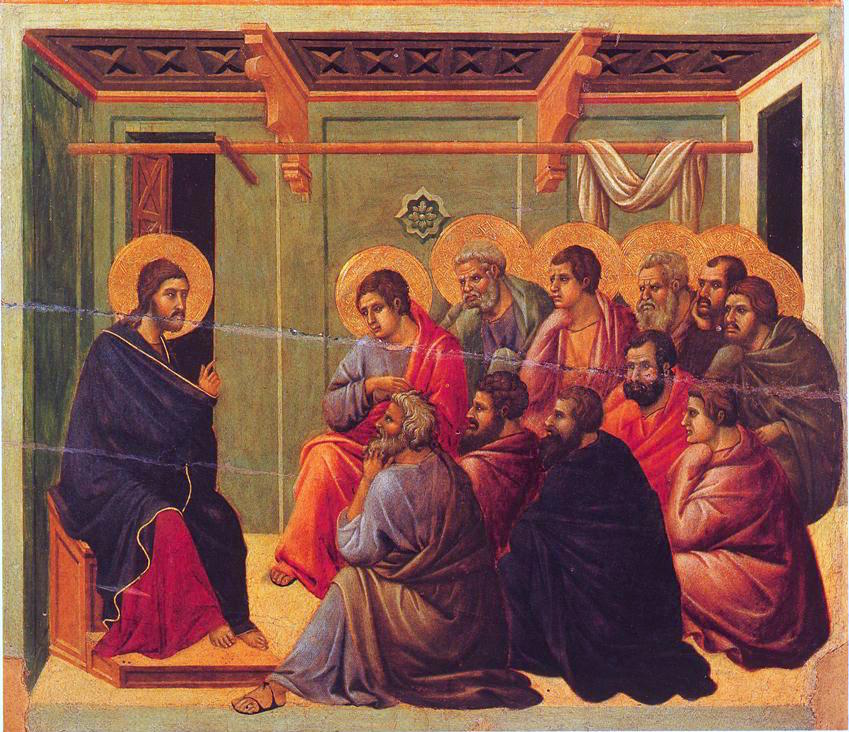
Painting: Christ Taking Leave of the Apostles by Duccio Buoninsegna

Link for the Mass readings for Friday, September 13, 2024

Jesus leads us from the darkness of our fears into the light of his love.

Jesus said to his Apostles: “No disciple is above his teacher, no slave above his master. It is enough for the disciple that he become like his teacher, for the slave that he become like his master (Mt 10:24-25).

Following the teachings and guidance of Jesus was hard for his apostles and disciples then and it is just as challenging today. To live as authentic disciples, we need to learn from and put his teachings into practice. That means more than reading some of his teachings: love God with your whole heart, mind, and soul and your neighbor as yourself, turn the other cheek, and what you do to the least of my brothers, you did it to me, and acknowledging, that, “That is some good stuff!” Then just moving on to the next thing on the to-do list.

Living as a disciple also happens in a public way, which means public scrutiny. One thing we all have in common as human beings is that we want to belong, to fit in, and to be a part of. We risk rejection and ridicule by following Jesus and living as his disciple because we run up against our own fallen nature and the fallen nature of others. Jesus said he would be sending us as sheep among wolves yesterday and in today’s reading, he announces that we are not to be afraid of those who kill the body. Not exactly the kind of encouragement many of us are looking for.

Yet, Jesus affirms consistently that we are not to be afraid. Jesus leads us to the most important relationship that we will ever develop and that is with his Father. God cares for us, just as Jesus said, as his Father cares for the sparrows, but even more. God knows us by name, and we are his, we belong to him. Our loving God and Father has known us not only before we were born, but before all creation began. Never have we been, are we now, nor will we ever be, alone. As we risk, grow in confidence, and begin to live our life in alignment, in relationship with Jesus and God through the love of the Holy Spirit, we will begin to become unified with him so to feel a joy and a fulfillment that is unmatched.

One of the keys to living the Christian life is understanding that it is more than a philosophy, a set of teachings, or a theology. Being a Christian means allowing ourselves to be known, loved, and to build our relationship with a person. Jesus is that person. Instead of hiding or running we are invited to trust and turn to him. By admitting and giving him our weaknesses and our fears, our anxieties and overthinking, our worries and our sins, we can begin to slowdown, to breathe, and begin to reset our brain’s wiring.

As Isaiah had his mouth purged by the ember placed in his mouth by a seraphim, as Peter recognized in the presence of Jesus that he was a sinful man, we too in the presence of God will see our weaknesses, our failures and our shortcomings. The light of Christ reveals to us our darkness not to condemn us, but to free us. To bring our sin into the light, so it can be purged, that we can be purified, and ultimately deified. Jesus became one with us in our humanity so that we can become one with him in his divinity. It is precisely in turning our weaknesses over to Jesus, and admitting our utter dependence on him, that we become strong.

Acknowledging Jesus is our teacher does not mean that we will gain all the answers to life, but it does mean we will be more aware of his presence during each step of our journey through this life. Take courage, be not afraid, and like Isaiah, the prophets, the Apostles, and Mary let us say, “Yes.” to the will of God and take our next step along the path to our freedom.
————————

Photo: Rosary walk last night in Riverside Park, Vero Beach, FL.

Link for the Mass readings for Saturday, July 13, 2024

Stop, breath, and listen.

“…the sheep follow him, because they recognize his voice” (Jn 10:4). This verse is one of the keys to growing in the spiritual life and becoming a disciple of Jesus. Amidst all the voices, distractions, diversions, and temptations clamoring for our attention, we want to develop an ear to hear and a mind to discern his voice. There are so many directions we can take and opportunities we can be enticed by, many that are detrimental, but more challenging are those that are good in and of themselves.

Jesus came to us so that we “might have life and have it more abundantly” (Jn 10:10). To live life to the fullest, to actualize our potential, we need to be able to discern the distinction between apparent goods and the true Good. An apparent good is appealing, attractive, and desirable, though once experienced, we conclude that it was indeed not good for us after all. We can see this in the promotion of processed foods, with additives and an excess incentive of enticing the taste buds with salts and sugars.

The experience of eating many of these products is that they taste good going down, especially if eaten quickly and not savored, such that we often eat them in excess. They not only have little, if any nutritional value, if this is the main source of our nutrition, over time, we will feel the ill effects of eating in this way. When I sit down to eat pizza, there are two clear voices. One voice encourages an eating of the whole pie in one sitting, while another urges a balanced two-slice approach or no slices at all.

There can also be choices between two actual goods. Discerning in each of these areas can be a challenge especially when we make the time to assess how we spend our time, talent, and treasure. We all have the same amount of time in the day. In what ways do we use our time, who is it that we are listening to? What are we investing our treasure in? How do we, or do we access and engage in our talent? Do we listen to the Father of Lies or the Good Shepherd?

A good practice to help develop our ears to hear the voice of the Good Shepherd is to resist making impulsive decisions, no matter how small. When a desire presents itself, instead of impulsively choosing, take a breath, reason it through, pray with Jesus, and seek his guidance. Too often, we skip the step of our reason and prayer, and dive right into the act of our will. Some helpful questions can make a difference: “Is what I am about to decide helping me to become a better disciple, leading me away from or closer to God, to be true to myself and who God is calling me to be?”

Putting this simple step into practice will help us over time and through various experiences come to better discern the voice of Jesus. Inviting a core group of people to talk with, to get their perspectives, to help keep us accountable, can also help us to learn to hear the words of Jesus through others.

May we have ears to hear the Good Shepherd’s voice today, and each day, and the courage and humility to follow his will!

————————————–

Photo: Have been blessed again with another wonderful evening to slow down, breathe, and pray; St. Vincent de Paul Regional Seminary, Boynton Beach, FL.

Link for the Mass readings for Monday, April 22, 2024

Growing in faith is a life-long journey.

Jesus not only tells his disciples that he has not come to abolish but to fulfill the law, he constantly teaches how this is true, models how to put his teachings into practice, and empowers his followers to do so. In his Sermon on the Mount and Sermon on the Plain alone, we can see the development of his teaching and building on the foundation of the Torah. With his Beatitudes, such as, “Blessed are the poor in spirit for theirs is the kingdom of heaven”, and his Six Antithesis including, “You have heard that it was said ‘an eye for an eye,’ but I say to you offer no resistance to one who is evil”, we can see the further development of Jewish teaching on full display.

If we seriously take the time to read through Jesus’ teachings, we will see quickly how challenging they are. Jesus is not lowering the bar of discipline for his followers, but in fact, raising it. Jesus does so not to place heavy burdens on us for burden’s sake, not just to give us busy working, but he seeks to make us holy. He himself lives what he preaches, but Jesus is no ordinary teacher or mentor. The principles that he teaches, forgiving seventy-seven times, loving our enemy, giving up all to follow him, these seemed impossible to his disciples then and to us today as well.

At face value, we may think that many of Jesus’ teachings are not possible to put into practice or very practical in our day and age. Attempting to do so with our own willpower alone may lead to coming up short each time, and feeling more frustrated. Jesus does not expect nor desire us to accomplish living as his followers on our own efforts. We are to yolk ourselves with him and be open to the transforming power and love of the Holy Spirit acting through us. This happens when we daily invite Jesus into our lives and are humble enough to follow his lead.

We become disciples of Jesus when we are willing to study his life, learn and put his teachings into practice, and surrender ourselves to his will through prayer, discipline, worship, service, and participation in the sacraments. We do so by first being willing to receive his guidance, open our hearts and minds to and allowing Jesus to live his life in and through us. In this way, we are transformed by his love and conformed to his life such that we can say with Paul, it is no longer I who live but Jesus who lives in me (cf. Galatians 2:20).

The path of faith is not a sprint or a one-time event, but an ongoing journey. Each one of us can be assured that Jesus is with us for the long haul, every step of the way and with each temptation that arises. Even when we fall, Jesus remains with us, to forgive and heal us. When we receive and rest in God’s love, we will experience his peace, and will better be able to make decisions free from fearful or reactive responses. By leaning on Jesus and each other, we will resist temptations, make healthier decisions, rise again after we fall, and make it through each day together, with more joy, love, and peace, no matter what arises.

————————————————————————–

Photo: On retreat last January, Marywood Retreat Center. Prayed morning and evening prayer on this dock each day at sunrise and sunset.

Link for the Mass readings for Wednesday, March 6, 2024